Showing posts with label Toyota. Show all posts

Toyota to Build $2.1B SUV Plant in India, Production Starts 2029

Toyota to Build $2.1B SUV Plant in India, Production Starts 2029

Toyota Motor Corporation has announced a ₹20,000 crore investment to build a new SUV manufacturing plant in Bidkin, Maharashtra, with a capacity of 100,000 vehicles annually. Production will begin in the first half of 2029, creating around 2,800 jobs and expanding Toyota’s total India capacity to nearly 450,000 units.

It is to be noted that the $2.1B valuation is not Toyota’s official disclosure but a state government estimate converted into USD. The $2.1B figure derived from Maharashtra’s confirmed investment figure of ₹20,000 crore for Toyota’s new SUV plant, converted using the latest May 2026 exchange rate of ~₹95.2 per USD, which equals about $2.1 billion.

The new Toyota plant will be positioned to steadily deliver vehicles not only to customers in India but also to customers in surrounding regions.

Plant Details

  • Location: Bidkin Industrial Area, Maharashtra
  • Capacity: 100,000 vehicles per year
  • Start of Operations: First half of 2029
  • Jobs Created: Approx. 2,800 direct positions
  • Production Focus: A new SUV model, targeting India’s SUV market and exports

Strategic Significance

  • India Expansion: Raises Toyota’s total India capacity to ~442,000 units
  • SUV Boom: SUVs account for over half of India’s passenger vehicle sales
  • Export Role: Facility to serve domestic and regional markets

Investment & Economic Impact

  • Estimated Investment: ₹20,000 crore
  • Local Benefits: Boost to Maharashtra’s automotive supply chain
  • Greenfield Project: Toyota’s first major greenfield investment in India in over a decade

Toyota’s India Portfolio

  • Current Models: Innova HyCross, Innova Crysta, Fortuner, Legender, Camry Hybrid, Urban Cruiser Hyryder, Hilux
  • Future Line-up: Compact SUV (possibly Land Cruiser FJ), affordable Innova variant, electric MPV, Corolla Cross SUV, next-gen Fortuner

Industry Context

  • Competitors Expanding: Suzuki plans >1 million unit expansion by 2030; Honda investing ₹1,200 crore in Rajasthan for EV rollout
  • Policy Alignment: India’s push for hybrid, EV, and ethanol-based vehicles aligns with Toyota’s global “Beyond Zero” sustainability vision

Quick Comparison: Toyota’s India Plants

Plant LocationStart YearCapacityKey Models Produced
Bidadi Plant 1 (Karnataka)1999132,000Innova HyCross, Innova Crysta, Fortuner, Legender
Bidadi Plant 2 (Karnataka)2010210,000Camry Hybrid, Urban Cruiser Hyryder, Hilux
Bidkin Plant (Maharashtra)2029 (planned)100,000New SUV (likely compact off-roader)


This expansion underscores Toyota’s long-term bet on India’s SUV-led growth story and positions Maharashtra as a major automotive hub.

Toyota Kirloskar Motor and Wipro 3D Partner to Launch Additive Manufacturing Training Hub in Karnataka

Toyota Kirloskar Motor and Wipro 3D Partner to Launch Additive Manufacturing Training Hub in Karnataka

Toyota Kirloskar Motor (TKM) and Wipro 3D have signed a Memorandum of Understanding (MoU) to establish an advanced manufacturing Centre of Excellence (CoE) at the Toyota Technical Training Institute (TTTI) in Bidadi, Karnataka. The hub will focus on additive manufacturing, skill development, and bridging the gap between academia and industry.

The initiative aims to create a future-ready workforce by equipping students and professionals with hands-on training in Industry 4.0 technologies, including additive manufacturing, design for AM, and advanced production techniques. It also supports India’s Skill India and Make in India missions.
Key Highlights of the Partnership
  • MoU Signed: April 10, 2026
  • Location: Toyota Technical Training Institute (TTTI), Bidadi, Karnataka
  • Focus Area: Additive manufacturing and advanced manufacturing technologies
  • Objective: Establish a Centre of Excellence (CoE) for training and skill development
  • Partners: Toyota Kirloskar Motor and Wipro 3D

Goals of the Training Hub

  • Skill Development: Hands-on training in additive manufacturing and advanced production
  • Industry-Academia Collaboration: Strengthening ties between vocational education and industrial practice
  • Future-Ready Workforce: Preparing talent for smart factories and sustainable manufacturing
  • Applied Learning: Exposure to real-world production environments

Strategic Importance -

  • For Toyota Kirloskar Motor: Aligns with Toyota’s global push toward digital transformation and sustainable manufacturing.
  • For Wipro 3D: Expands its footprint in industrial 3D printing and advanced manufacturing solutions.
  • For India: Supports the government’s Skill India and Make in India initiatives by nurturing a workforce trained in cutting-edge technologies. 

 Impact

Aspect Impact
Education Enhances vocational training with advanced manufacturing modules
Industry Builds a pipeline of skilled professionals for automotive and allied sectors
Technology Promotes adoption of additive manufacturing in mainstream production
Economy Strengthens India’s competitiveness in Industry 4.0 and global supply chains

The Toyota Kirloskar–Wipro 3D CoE marks a significant step in India’s journey toward advanced manufacturing and Industry 4.0 readiness. By combining Toyota’s automotive expertise with Wipro 3D’s additive manufacturing capabilities, the initiative is poised to create a future-ready workforce and strengthen India’s position in global manufacturing innovation.

Toyota, Maharashtra Govt Sign $2.7 Bn Electric & Hybrid Vehicle Manufacturing Deal

Toyota, Maharashtra Sign $2.7 Bn Electric & Hybrid Vehicle Manufacturing Deal

Toyota Kirloskar Motor has partnered with the Maharashtra government to establish a greenfield electric vehicle (EV) manufacturing hub in Chhatrapati Sambhajinagar.

This ₹20,000 crore (approximately $2.7 billion) initiative is set to revolutionize Maharashtra's automotive industry, focusing on electric and hybrid vehicles.

The project is expected to generate approximately 16,000 direct and indirect jobs and produce around 400,000 cars annually. The government has allocated 850 acres of land specifically for vehicle production.

Chief Minister Eknath Shinde hailed the project as a “revolutionary step” for the state’s motor manufacturing sector.

Notably, India’s electric vehicle (EV) market is poised for significant growth. EVs could account for over 40% of India’s automotive market by 2030, generating more than $100 billion in revenue. The market is projected to grow from $23.38 billion in 2024 to $117.78 billion by 2032, exhibiting a CAGR of 22.4%2.

The EV industry is projected to create around 50 million direct and indirect jobs by 2030.

India Launches World's 1st Prototype of the BS 6 Stage II Electrified Flex Fuel Vehicle (FFV)

India Launches World's 1st Prototype of the BS 6 Stage II Electrified Flex Fuel Vehicle (FFVs)

Today, India unveiled the world's first prototype of the BS 6 Stage II ‘Electrified Flex Fuel Vehicle’, developed by Toyota Kirloskar Motor.

A Flexible fuel vehicles (FFVs) have an internal combustion engine and are capable of operating on Petrol/Gasoline and any blend of petrol and ethanol (up to 83%). An Electrified Flex Fuel Vehicle has both a Flexi Fuel engine and an electric powertrain. This gives it ability to provide dual benefit of higher ethanol use and much higher fuel efficiency as is in case of a Strong Hybrid Electric Vehicle (SHEV), which can provide 30-50% higher Fuel Efficiency as it can run 40-60% in EV mode with engine shut off.

This initiative by Toyota is particularly important as it introduces the world’s first BS 6 (Stage II) Electrified Flex Fuel vehicle prototype, which has both the flex fuel engine as well as an electric powertrain, thereby offering higher use of ethanol combined with better fuel efficiencies.


This innovative vehicle is based on the Innova Hycross and is engineered to adhere to India’s stricter emission standards, marking it as the first-ever BS 6 ( Stage II) Electrified Flex Fuel Vehicle prototype globally. The forthcoming stages for this prototype encompasses meticulous refinement, homologation, and certification processes.

The Union Minister for Petroleum & Natural Gas, Mr Hardeep Singh Puri, speaking at the unveiling of the Prototype said that India has huge Ethanol potential, much beyond E20 mix. This excess potential can be utilised by the country by promoting Flex Fuel vehicle (FFVs) and Flex Fuel Strong Hybrid Electric Vehicle (FFV-SHEV) / Electrified Flex Fuel Vehicle.

With Industry and Government collaboration, we see India becoming a global hub for cleaner technologies and achieving self-reliance in energy soon”, Mr Puri added further.

The Minister informed that with the huge efforts made by the Government and the industry, in a short span of 8 years, the Ethanol blending in India has increased by over 8 times. It has increased from 1.53 % in 2014 to around 11.5 % (Mar ’23) leading to savings in the import bills and also lowering of carbon emissions.


Speaking on this launch, Union Minister for Road Transport and Highways Mr Nitin Gadkari, who launched the vehicle, said, "Ethanol being an indigenous, eco-friendly, and renewable fuel holds promising prospects for India."

Mr Gadkari said that the emphasis of the Modi Government on ethanol aligns with objectives of attaining energy self-sufficiency, doubling farmers' income, transitioning them to Urjadata while continuing to support them as Annadata, and positively impacting the environment. He said the day ethanol economy becomes of 2 lakh crores agricultural growth rate will reach 20% from the current 12%. Talking about innovations in biofuels Shri Gadkari spoke of refinery in Numaligarh in Asssam of Indian Oil Corporation where bamboo is being used for manufacturing bio ethanol.

Maruti to Launch Its 1st Hybrid Car in Partnership With Toyota

Maruti to Launch Its 1st Hybrid Car in Partnership With Toyota
Representational Image Via - Adrian Balasoiu on Unsplash

While almost all automobile manufacturers are switching from fossil fuels to Lithium-ion based electric vehicles, India's largest auto manufacturer, Maruti Suzuki India is instead betting on hybrid cars vehicles powered by hybrid technology, natural gas and biofuels.

Quoting Maruti Suzuki Chairman R.C. Bhargava, an Economic Times (ET) report says that the company is planning to launch its first hybrid car under a partnership between its parent Suzuki Motor Corp. and Toyota within 12 months.

To recall, in August of 2009, Maruti partnered with Toyota to develop all kinds of green technologies and electric cars as well as CNG and hybrid cars, in order to cut oil imports and reduce air pollution. 

Hybrid cars are also a better alternative than EVs given India lacks adequate charging infrastructure, according to the Maruti Chairman.

Mentioning that India generates about 75% of its electricity from dirty coal, Bhargava said that the company reckons that vehicles powered by hybrid technology, natural gas and biofuels present a better path toward a cleaner future than electric cars. A recently released whitepaper do highlight that India would continue to rely on coal power, at least in the near future. 

The report further said that Maruti will additionally move “aggressively” into cars that run on compressed natural gas (CNG) because they’re cleaner than petrol or diesel models and cheaper than EVs, making them a viable option for low-income consumers who want to upgrade from a two-wheeler, he said. Although compressed natural gas is a fossil fuel, it’s one of the cleanest burning in terms of emissions. 

The ET report further quote the Maruti Chairman, saying — "Talking about electric cars without looking at the greenness of the electricity generated in the country is an inadequate approach to this problem.

However, according to a previous report of October last year, Maruti Suzuki is expected to launch its first all-Electric Vehicle (EV) by fiscal 2025.

Notably, India’s shift to electric vehicles is also much slower than other major markets like China and the US. According to an estimates, by 2030, electric passenger cars will make up only about 5% of total EV sales. More progress on the two- and three-wheeler front will bring the automobile battery-powered total to about one-third. 

Charging electric vehicles with clean energy and reducing dependence on coal is difficult in India. The country was forced to import millions of tons of coal after electricity demand soared amid scorching summer temperatures and rising industrial activity after the pandemic.

Last month, Suzuki Motor Corporation, Japan (SMC), Maruti Suzuki India Limited (MSIL), and IIT Hyderabad (IITH) have teamed up to research India-specific vehicle usage scenarios based on futuristic V2X (Vehicle-to-Everything) communication technology.

Toyota Group Inks MoU With Karnataka Govt for Rs. 4800 Cr Investment to Make Deeper Cuts in CO2 Emissions

Toyota Group Inks MoU With Karnataka Govt for Rs. 4800 Cr Investment to Make Deeper Cuts in Co2 Emissions
  • Toyota Group of Companies (TKM & TKAP) & its related company TIEI* together invests INR 4,800 crores
  • Toyota’s large-scale investment to make deeper cuts in CO2 emissions
  • Aims to enhance electrification & shift towards greener technologies
  • Promote ‘Atma Nirbhar Bharat’ to manufacture for India and the world
  • Toyota’s additional investment coincides with 25 years of successful journey of Toyota Kirloskar Motor
  • The Investments are focused towards ‘Greener Technologies’ and ‘Make in India’ (Go Green. Make in India)
In its effort to contribute to the country’s vision of “Make in India” and to enable a faster reduction in carbon emissions, out of total investment of INR 4,800 crores, Toyota Group of Companies that constitutes of Toyota Kirloskar Motor and Toyota Kirloskar Auto Parts today announced their Memorandum of Understanding (MOU) with the Government of Karnataka to invest INR 4,100 crores. This announcement coincides with Toyota Kirloskar Motor’s 25 years of successful journey in India, by winning the hearts of millions of happy customers.

In-addition to boosting the local manufacturing eco-system, the new development will provide an impetus to employment generation and local community development. This investment will also spur the growth of local supplier base and hence result in higher investments and further job creation.

The MoU was exchanged between Hon’ble Chief Minister of Karnataka Shri Basavaraj Bommai and Mr. Vikram S. Kirloskar, Vice-Chairman, Toyota Kirloskar Motor, in the presence of Dr. Murugesh R. Nirani, Hon’ble Minister of Large & Medium Industries, Government of Karnataka, Mr. Ravi Kumar, IAS, Chief Secretary of Karnataka State, and among other dignitaries present at this momentous occasion of MoU Signing Ceremony.


As part of the MoU, Toyota Group of Companies will systematically invest towards making India a self-reliant manufacturing hub, thus contributing towards the Government’s Make in India and Atma Nirbhar Bharat mission. The investments are aimed at promoting greener technologies that will help lower dependence on fossil fuels and mitigate carbon emissions. This investment will also enable local production facilities to build electric powertrain parts and components, thereby cater to the electrified vehicle manufacturing in India. 

As a part of the Toyota Environmental Challenge 2050, Toyota will continue to focus on reducing carbon emissions in a holistic manner going beyond tailpipe emissions to address manufacturing and lifecycle CO2 emissions in order to realize its carbon neutrality goals by 2050, as announced earlier.

Speaking at the auspicious occasion, Hon’ble Chief Minister of Karnataka, Shri Basavaraj Bommai said, “Our aim is to build ‘New Karnataka for New India’ by creating new 21st century industrial townships and corridors. As a state committed to sustainable development and contributing to the nation’s progress, we want to make Karnataka a global supply-chain and manufacturing hub under our ‘Build for the World’ mission. This MoU with Toyota Group of Companies is a huge stride in this regard, and Karnataka Government is confident of Toyota’s commitment towards sustainable growth and local manufacturing quality for Karnataka’s growth and development. Karnataka being the hub of electric vehicles, welcomes this MoU which adds another feather to State’s cap as leader in this sector”.

Sharing his views on the MoU Signing, Hon’ble Minister for Large & Medium Industries, Government of Karnataka, Dr. Murugesh R. Nirani said, “Toyota Group investments will also enhance the local supplier growth in Karnataka, further leading to higher investments and more job creation. Besides boosting the local manufacturing sector, these investments will also support local community development.”

Since its inception, Toyota has been passionate and committed to build a stable, sustainable, and competitive local supply chain and has taken significant efforts in promoting localization of auto parts and components in line with Government’s ‘Make in India’ mission. The Group has invested in strengthening and increasing supplier base through consistently partnering with them to enhance their capacities and capabilities by sharing Toyota best practices, efficient processes and skilling of manpower, by imparting world-class training program to enhance the production excellence with high quality standards.

On upscaling the skill levels at suppliers, Toyota spent 40,000 man-hours every year to enhance processes through system, management, training, and hardware development. Further, another 8,500 man-hours are spent per year on suppliers’ people development.

Speaking on this occasion, Mr. Vikram S. Kirloskar, Vice-Chairman, Toyota Kirloskar Motor said, “Toyota is committed to enhance the pace of electrification strengthen domestic production with ‘Make in India’. Today’s MoU signing with the Government of Karnataka, in the gracious presence of Hon’ble Chief Minister Basavaraj Bommaiji and all dignitaries, is a very important milestone in terms of ushering in large-scale investment to make deeper cuts in carbon emissions, higher employment generation, creating local manufacturing hub not only for domestic needs but also for global markets, local community development and advancement in innovation. I believe that such investments are needed to provide technologically viable and economically competitive alternatives to fossil-fuel-intensive technologies in vehicle mobility space.

As a part of our philosophy, we always conduct deeper studies, analyse and explore multiple technological pathways that are best suited to optimally achieve the national goals on lowering dependence on fossil fuels, make India truly self-reliant, reducing carbon emissions and creating jobs. Toyota remains committed to serve our nation and the community where we operate.”

Toyota believes that the choice of technologies for achieving our national goals should be practical, sustainable, best suited for unique local conditions that helps to realise the transition in the fastest possible manner. Thus, while our long-term decisions are shaped by our Global environment challenge of achieving zero carbon emissions by 2050, our immediate technology decisions are influenced by our desire to achieve maximum immediate societal & environmental benefits, which in turn is largely determined by, the local energy mix of the country, infrastructure readiness as well as customer acceptance in line with our belief of ‘Leave No One Behind’.

These companies have so far invested Rs. 11,812 crores and employ more than 8,000 people. Over the years, the group has consciously adopted sustainable business practices and transforming from a carmaker to a mobility company.

Toyota believes in holistic approach and aims to strongly contribute to the State and country’s sustainable growth, as we are stepping into the greener future. Toyota is confident in creating an electrified manufacturing hub in India, thereby achieve our goal of delivering ‘Mass Happiness to All’.

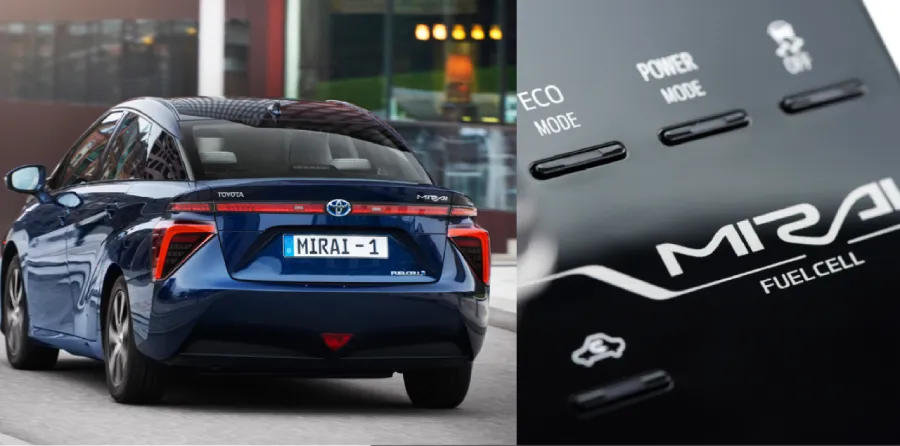
World’s Most Advanced Fuel-Cell EV Toyota Mirai To Run on Indian Roads

World’s Most Advanced Fuel-Cell EV Toyota Mirai To Run on Indian Roads

Soon, world’s most advanced Fuel Cell Electric Vehicle (FCEV) - 'Mirai', which is Japense automaker Toyota's premium zero emission, rear-wheel drive FCEV, will be running on Indian roads, at first on a pilot basis. 

Mirai, which sets the world record of traveling 1,360 Km with a full tank of 5.65 kg hydrogen, in August last year, is perhaps the greenest electric car to date.

In a first of its kind project in India aimed at spreading awareness about Hydrogen, FCEV technology and disseminating its benefits to support hydrogen-based society for the country, Union Minister of Road Transport & Highways Mr. Nitin Gadkari  would be inaugurating a pilot project and also demonstrating Toyota Mirai FCEV on 16th March in Delhi.

This Pilot project for Mirai FCEV is being conducted by Toyota Kirloskar Motor Pvt. Ltd. along with International Center for Automotive Technology (ICAT) to study and evaluate Toyota Mirai on Indian roads and climatic conditions. 

The name Mirai means “future” in Japanese.

The Toyota Mirai is expected to launch in India in January 2050, according to Cardekho.com. Mirai's expected prices will start from 6.88 Lakh. In November last year., Mirai was spotted testing in India wearing testing plates of Karnataka numbers. 

How It Works 

The Toyota Fuel Cell System used in Mirai produces electricity from a reaction between hydrogen and oxygen. Mirai users fill it up with hydrogen fuel, in the same way as buying petrol,/diesel/CNG at. The fuel (Hydrogen) is contained in high-pressure tanks and fed into a fuel cell stack, where the hydrogen and the oxygen found naturally in the air react with each other and generate electricity.

Moreover, in Mirai or any FCEV, energy is captured/stored in a battery every time the car brakes or slows down, which contributes to even better fuel efficiency.

Besides Toyota, Triton-EV, a subsidiary of Triton Solar, a leader in solar panel and battery engineering,  had a claim to produce a 100% electric- powered, full-service 18-wheeler semi-truck, which is a hybrid of hydrogen fuels that generate electricity stored in on-board batteries, has a 220,000-pound towing capacity

California-based FirstElement Fuel Inc., which was once a startup, became the world's largest hydrogen retailer, after it raised a $105 Million Series D funding round, in November last year.

Other Fuel-Cell Vehicles Brands in India

Tata Motors has collaborated with Indian Oil Corporation Limited (IOCL) for R&D projects and collectively study the potential of Fuel Cell technology for commercial vehicles. In June last year, Tata Motors won a tender of 15 hydrogen-based proton exchange membrane (PEM) fuel cell buses from the Indian Oil Corporation Limited (IOCL).

Last year in February, India's largest power company National Thermal Power Corporation Limited (NTPC) announced that it is planning to start a premium hydrogen fuel bus service on Delhi to Jaipur route. 

To recall, in year 2020, Department of Science & Technology under government of India had released a report on hydrogen and fuel cells research across the country.

Toyota Kirloskar Motor Signs Mou With Govt of Karnataka for the Implementation of Toyota Anganwadi Development Programme


Toyota Kirloskar Motor (TKM) today announced the signing of a Memorandum of Understanding (MoU) with the Women and Child Development Department, Ramanagara District, Government of Karnataka, to implement the Toyota Anganwadi Development Programme (TADP) in 30 shortlisted Anganwadi Centres (AWCs) across the district. These centres were selected in collaboration with the Women and Child Welfare Department to facilitate healthy growth and overall development among children.

TKM conceptualized the programme, which revolves around four main thematic pillars of infrastructure development, activity-based learning, teachers capacity development and health & hygiene to ensure quality care at these grassroots centres, as a collaborative project with the Government aimed to be accomplished by September 2023. To understand the actual facts on the ground, TKM partnered with an NGO, Support for Network and Extension Help Agency (SNEHA), to conduct a baseline survey that will act as direction setting to initiate this program in the selected AWCs. These 30 centres will be resource centres for the remaining AWCs in the district.

Talking about the collaboration, Mr. Ikram, IAS, CEO - Zilla Panchayat Ramanagara District, Government of Karnataka, said, "We are focussed on child development as a stepping stone to overall upliftment of the local communities through various initiatives. The aim is to facilitate healthy growth and development among children, thus creating better and healthy communities. The TADP initiative will not only help children’s growth but also equip teachers with innovative teaching skills that will have a significant positive impact on their ability to create a strong foundation for the future education of these children. We are happy that corporates like Toyota have been consistently working towards ensuring better public health and focusing on enabling a healthy lifestyle in rural Karnataka. We hope this initiative will go a long way in improving the overall health and development outcomes."

Sharing his thoughts Mr. Vikram Gulati, Senior Vice President, Corporate Affairs and Governance, TKM, said, “On this occasion, I would like to reiterate our appreciation and applaud the Government of Karnataka’s commitment to creating healthy and sustainable communities. Anganwadis are crucial in delivering both nutrition and education amongst toddlers. The primary objective of TADP is to focus on creating an environment for creative learning, boosting physical and cognitive development in children with child-centric infrastructure and quality education alongside improving health and hygiene standards. The programme will also focus on teacher’s capacity building by providing them with required training as per National Early Childhood Care & Education guidelines and standardize their skills by equipping them with activity-based learning material that are locally available. With this programme, we intend to aid capacity development of teachers and process improvements in 30 AWCs which will further facilitate healthy growth and development among children, thus preparing the grounds for lakhs of children."

TKM, through this programme, intends to provide scalable and sustainable solutions thereby aiding the development of children at the grassroots level. The programme will also promote new methods for imparting early education, implementing processes to maintain health and hygiene and stakeholder engagement for long term sustainability.

TOYOTA GAZOO Racing (TGR) announces Second Edition of GT Cup India 2021

Rev up to the national finals and the chance to compete on the world stage

Enhanced game formats amp up the excitement and offer more opportunities for e-racers to win

Bangalore, 2nd August 2021 - TOYOTA GAZOO Racing (TGR) e-Motorsport is back, and it is bigger and better than ever before. Toyota Kirloskar Motor (TKM) today announced India’s participation in the second edition of the fastest e-Motorsport race in Asia scheduled in August and September this year. Since its India debut in August 2020, the virtual race has enabled the brand to connect with motorsports enthusiasts by providing them with engaging and exciting avenues.

This year, based on last year‘s response, the thrill and joy will be stepped up through reaching out to a larger audience. For the first time, in addition to racing in the TOYOTA GAZOO Racing e-motorsports championship on Playstations 4, participants can also race in the “GR Excelerate Tournament” on PC platforms.


Winners of the contest on the PC platform stand a chance to win Playstations, which they can compete on in the national rounds of the TGR GT Cup.
  • Registration –2nd Aug – 15th Aug’21 (*Limited spots only)
  • Race – 18th Aug- 5th Sep, Prize announcement on 10th Sep’21

For the GT Cup tournament on PS4 platform

  • Registration – 2nd Aug – 21st Aug’21 (*Limited spots only)
  • Race – 27th Aug- 25th Sep, Prize announcement on 2nd Oct’21.
The top three national winners will stand to win a prize pool of 2 lakhs and also will get an opportunity to represent India at Asia Cup along with a prize pool of 7 Lakhs.

Commenting on the announcement, Mr. Wiseline Sigamani, Associate General Manager, Sales and Strategic Marketing, TKM said, “It gives us immense pleasure to bring the exciting TOYOTA GAZOO Racing (TGR) once again to fans particularly to the youth and motorsports fans in India. With the millennials spending more time at home, the craze for e-Motorsport has intensified and we are thrilled with the response received by TGR not just in India, but from across the world. The 2021 edition also promises to offer a unique and exhilarating experience to participants, offering the thrill and joy of racing from the safety and comfort of your homes.

“The e-motorsports element is one of the key pillars of TOYOTA GAZOO Racing and this competition intends to deliver Toyota’s commitment to making it possible to experience the adventure of racing Toyota GR cars on iconic racing circuits. We aim to bring in more elements of the TGR to the country via other events and activities,” he concluded.

TOYOTA GAZOO Racing (TGR) GT Cup ASIA 2021: Format of Play

Semi-Finals Race

The top three qualifiers from each national e-motorsports tournament like in India, Thailand, Singapore, Malaysia, Indonesia, Taiwan and Korea will compete in the Semi-Finals. These 21 qualifiers will kick off the TGR GT Cup ASIA 2021, by competing within their respective groups in the newly introduced GR Yaris on the Tokyo Expressway racing circuit.

The top five e-motorsport racers in each group will go straight into the Final Race.

The remaining 11 racers will then compete in the Consolation Race on the Fuji Speedway circuit, in the GR Supra’20 as their last bid for a place at the Final Race.

* For more details –
  1. Toyota Gazoo racing India page: https://www.toyotabharat.com/gazooracing/index.html
  2. GR excelerate e-motorsports championship India –https://www.toyotabharat.com/gazooracing/rr/index.html
  3. GT Cup India - https://www.toyotabharat.com/gazooracing/gtcup/index.html
**Eligibility – Registered candidates can participate using PlayStation 4 or PC platform.

Maruti bats for Green Tech, Developing Electric Cars with Toyota

The country's largest car maker Maruti Suzuki India (MSI) has said that usage of all kinds of green technologies, including CNG and hybrid cars, should be encouraged in order to cut oil imports and reduce air pollution.

Addressing shareholders in the company's annual report for 2018-19, MSI Chairman R C Bhargava said the company is fully committed to helping the government's programme for reducing the consumption of oil and achieving cleaner environmental standards.

"We had started in this direction many years ago with the introduction of factory-fitted CNG vehicles. The production of such cars increased by 40 per cent in 2018-19 and this year is targeted to increase by near 50 per cent," he said.

The government has also announced a large programme to increase CNG outlets and this should result in the steady increase in CNG vehicle sales, he noted.

On electric vehicles, he said MSI with the support of Toyota is working on developing such models.

"However, the challenges for electric vehicles in India, arising mainly from battery technology, and infrastructure limitations are likely to result in electric vehicle acceptance by customers being slow in the short term," Bhargava said.

Meanwhile, the objective of reducing oil consumption and pollution would be met by CNG vehicles, hybrid cars and the increasing use of biofuels, he added. Since India is a fast-growing market for cars, unlike most parts of the world, there is a need for using all these technologies, Bhargava said.

Echoing similar sentiments, MSI Managing Director and Chief Executive Officer Kenichi Ayukawa said India has a major challenge of oil imports and needs to pursue technologies to minimise the use of oil in automobiles.

"Different vehicle segments will have different solutions over different time perspectives. Electrification is being pursued with full effort. However, till the time charging infrastructure spreads sufficiently to give confidence to consumers and battery technology becomes competitive to liquid fuels, we will need some strong measures to reduce oil consumption and imports," he added.

CNG vehicles and hybrid electric vehicles can help reduce oil consumption significantly as compared to internal combustion engine-powered vehicles, Ayukawa said. Hybrid vehicles can run without charging infrastructure and so can prepone oil import reduction, he added.

"In this context, the business partnership between Suzuki Motor Corporation and Toyota Motor Corporation will help the company gain access to the technologies which are important to keep the company future ready," Ayukawa said. PTI MSS

World's Largest Automaker Toyota Led $30 Mn Funding in Gurgaon-based Droom

In its first India investment, world's largest automaker Toyota, through its subsidiary Toyota Tsusho Corp, has led a $30 million (~ Rs 203 crore) in Series D equity financing round of Droom, a Gurgaon-based online marketplace for used automobiles and auto services. The financing round was also co-led by Japanese incubator and venture capital investor Digital Garage, who is an existing investor in Droom.

Other investors who participated in the round include existing investors Ellison Investments along with several institutional investors and family offices from China, Hong Kong and South East Asia.

Notably, Droom has also signed a Memorandum of Understanding (MoU) with Toyota to expand its services overseas to markets such as Indonesia and Thailand.

Droom will utilize the freshly raised funds to boost its market share, which it claimed stands at 70%. It added that it tech-led platform will also invest heavily in further developing its artificial intelligence and machine learning capabilities.

Till date, Droom has raised about $95 million in equity financing and competes with the likes of Temasek and Warburg Pincus-backed CarTrade and Google Capital and Hillhouse Capital-backed CarDekho.

Founded in June 2014 by Sandeep Aggarwal, Droom claims to be India's first and mobile first marketplace to buy and sell used and new automobiles. Prior to this funding, the startup last raised $20 million in its Series C round led by Integrated Asset Management and Digital Garage.

“Droom has seen tremendous growth over the past three and half years in terms of adoption by buyers and sellers, number of categories and listings, geographical presence and GMV of transactions. This partnership (with Toyota) will play a major role for Droom as we realize our growth potential, both in India and internationally,” said Sandeep Aggarwal, Founder & CEO, Droom.

The company claims to generate about $700 million in gross revenue and $15 million in net revenue. The platform has about 250,000 auto dealers across over 500 cities in India.

"We were impressed that Droom has rapidly established its leadership position as the largest online marketplace to buy and sell automobiles in India. We believe that this partnership contributes to the establishment of highly transparent transaction of automotive and the wholesome development of auto market of any developing countries, by combining Droom’s technologically advanced platform and our various automotive business experience of all over the world," said a spokesperson for Toyota Tsusho Corporation.

The expansion will help Droom double its gross merchandise value to $1.4 billion by the end of 2018 and $3.5 billion by 2019. Droom is also targeting a public listing through an IPO by the end of 2019.

Source - ET Tech

World's Largest Automaker Toyota Led $30 Mn Funding in Gurgaon-based Droom

In its first India investment, world's largest automaker Toyota, through its subsidiary Toyota Tsusho Corp, has led a $30 million (~ Rs 203 crore) in Series D equity financing round of Droom, a Gurgaon-based online marketplace for used automobiles and auto services. The financing round was also co-led by Japanese incubator and venture capital investor Digital Garage, who is an existing investor in Droom.

Other investors who participated in the round include existing investors Ellison Investments along with several institutional investors and family offices from China, Hong Kong and South East Asia.

Notably, Droom has also signed a Memorandum of Understanding (MoU) with Toyota to expand its services overseas to markets such as Indonesia and Thailand.

Droom will utilize the freshly raised funds to boost its market share, which it claimed stands at 70%. It added that it tech-led platform will also invest heavily in further developing its artificial intelligence and machine learning capabilities.

Till date, Droom has raised about $95 million in equity financing and competes with the likes of Temasek and Warburg Pincus-backed CarTrade and Google Capital and Hillhouse Capital-backed CarDekho.

Founded in June 2014 by Sandeep Aggarwal, Droom claims to be India's first and mobile first marketplace to buy and sell used and new automobiles. Prior to this funding, the startup last raised $20 million in its Series C round led by Integrated Asset Management and Digital Garage.

“Droom has seen tremendous growth over the past three and half years in terms of adoption by buyers and sellers, number of categories and listings, geographical presence and GMV of transactions. This partnership (with Toyota) will play a major role for Droom as we realize our growth potential, both in India and internationally,” said Sandeep Aggarwal, Founder & CEO, Droom.

The company claims to generate about $700 million in gross revenue and $15 million in net revenue. The platform has about 250,000 auto dealers across over 500 cities in India.

"We were impressed that Droom has rapidly established its leadership position as the largest online marketplace to buy and sell automobiles in India. We believe that this partnership contributes to the establishment of highly transparent transaction of automotive and the wholesome development of auto market of any developing countries, by combining Droom’s technologically advanced platform and our various automotive business experience of all over the world," said a spokesperson for Toyota Tsusho Corporation.

The expansion will help Droom double its gross merchandise value to $1.4 billion by the end of 2018 and $3.5 billion by 2019. Droom is also targeting a public listing through an IPO by the end of 2019.

Source - ET Tech

Market Reports

Market Report & Surveys
IndianWeb2.com © all rights reserved