Showing posts with label FCEV. Show all posts

India Runs 1st Green Hydrogen Fuel Cell Bus, Made by Tata Motors for IOCL

India Runs 1st Green Hydrogen Fuel Cell Bus, Made by Tata Motors for IOCL

Union Minister of Petroleum & Natural Gas and Housing & Urban Affairs Mr. Hardeep Singh Puri, flagged-off first Green Hydrogen Fuel Cell Bus from Kartavya Path, New Delhi, on Monday.

The fuel cell utilizes Hydrogen and air to generate electricity to power the bus and the only by-product from the bus is water therefore making it possibly the most environmentally friendly mode of transportation.

These Hydrogen Fuel Cell powered (FCEV) buses are built at a dedicated lab in Tata Motors’ world class R&D centre at Pune. The FCEV buses are 12-metre long and designed for easy ingress and egress with a low-floor design, can seat 35 passengers and were delivered after successful strenuous road tests and validations.

India Runs 1st Green Hydrogen Fuel Cell Bus, Made by Tata Motors for IOCL

India Runs 1st Green Hydrogen Fuel Cell Bus, Made by Tata Motors for IOCL

In June 2021, Tata Motors had won a tender from Indian Oil Corporation Ltd. (IOCL) to provide 15 FCEV buses to evaluate the potential of hydrogen-based PEM fuel-cell technology in India. These buses are to be assessed as potential mass transport solution for inter and intra-city commute.

For FCEV buses, Tata Motors acquired the expertise from renowned industry partners and research institutions, for adapting the advanced hydrogen-based proton exchange membrane (PEM) fuel cell technology to Indian conditions, and has played a key role in developing the buses.

It was in August of last year when India’s first truly indigenously developed Hydrogen Fuel Cell Bus was unveiled however it wasn't ran on streets for passengers and was for trials only. Developed by CSIR and KPIT in Pune, the technology of FCEV buses were later transferred for commercialization to Tata Motors.

Speaking about the Government’s ambitious plans on clean and green energy, Union Minister Hardeep Singh Puri said that emerging fuels like hydrogen and bio-fuels shall account for 25% of global incremental energy demand growth over the next two decades.

“With one of the largest synchronous grids in the world, we have achieved ‘One Nation-One Grid-One Frequency’, and would soon be global champion in production and exports of Hydrogen and is set to emerge as the Hub for green hydrogen”, he added.

The Petroleum Minister further complimented Industry and Government’s collaboration in taking India on a global platform and ensuring that it becomes a global hub for cleaner technologies and achieving self-reliance in energy soon. He said, “We were privy to the launch of the world’s first BS 6 (Stage II) Electrified Flex Fuel vehicle prototype that encompasses both the flex fuel engine as well as an electric powertrain that offers higher use of ethanol combined with better fuel efficiencies. Now with flagging-off the first two hydrogen cell buses, we have set the ball rolling and expect another 15 such buses to ply on Delhi NCR roads by the end of this year”

Speaking about the successful deployment of first-of-its-kind FCEV bus, Mr. Girish Wagh, Executive Director, Tata Motors, said, “This is an outcome of the progressive policies of the Government, IOCL’s focus on future readiness and Tata Motors’ R&D prowess, all collaborating to fulfil the common vision of clean mobility in India. The delivery of the FCEV buses to IOCL marks a significant step forward in this journey and we are grateful for the trust and support of our partners. At Tata Motors, we always prioritise nation building and are leading the global megatrend of sustainable, connected, and safer mobility in the country. The delivery of these buses today heralds a new era in inter-city mass public transport and marks another step forward towards fulfilling the aspiration of sustainable mobility. With proactive actions to develop and adapt new age technologies, we are creating future-ready transport solutions for both cargo and people to address the mobility needs of tomorrow’s India, today.”

IOCL is extensively working towards incorporating hydrogen as next fuel for ditching fossil fuel based petrol & diesel. In in July 2021, Indian Oil Corporation Limited (IOC) announced that it is building India's first 'Green Hydrogen' plant at its Mathura refinery. Later, after a year IOCL signed a binding term sheet with Larsen & Toubro (L&T) and ReNew Power (ReNew) to set up a Joint Venture (JV) company that will develop the green hydrogen sector in India.

Besides Govt agencies like IOCL and Bharat Petroleum, private companies are also running for Hydrogen. Few months back, Mukesh Ambani led Reliance Industries announced its partnership with BharatBenz, a subsidiary of Mercedes-Benz’s sister company Daimler Truck AG to unveil India's first intercity luxury concept coach powered by Hydrogen Fuel Cell technology. It's currently in concept stage.



India Gets Its 1st Truly Indigenously Developed Hydrogen Fuel Cell Bus


Yesterday, Union Minister Dr Jitendra Singh launched India’s first truly indigenously developed Hydrogen Fuel Cell Bus. Developed by KPIT-CSIR in Pune, the fuel cell utilizes Hydrogen and Air to generate electricity to power the bus and the only effluent from the bus is water, thus making it possibly the most environmentally friendly mode of transportation.

For comparison, a single diesel bus plying on long distance routes typically emits 100 tons of CO2 annually and there are over a million such buses in India.

The uniqueness of the process developed by CSIR-NCL is a novel downstream process technology, which makes this indigenous technology competitive with global benchmarks. The process is ready for technology transfer and further co-development to commercial scale.

Earlier in March this year, Union Minister of Road Transport & Highways Mr. Nitin Gadkari  inaugurated and demonstrated a pilot project of Toyota Mirai FCEV, which is an electric sedan car based on Hydrogen Fuel-Cell technology.


Dr Jitendra Singh told the gathering that Prime Minister Modi's Hydrogen Vision is important for India to ensure Atma Nirbhar means of affordable and accessible clean energy, meeting climate change goals, and creating new entrepreneurs and jobs. He said, Green hydrogen is an excellent clean energy vector that enables deep decarbonization of difficult-to-abate emissions from the refining industry, fertiliser industry, steel industry, cement industry and also from the heavy commercial transportation sector.

To recall, Indian Railways too is exploring the feasibility of retrofitting the trains (that presently run o­n diesel) with hydrogen fuel and for same it invited bids for "hydrogen fuel cell-based technology" for retrofitting the existing Diesel units.

The high efficiency of fuel cell vehicles and the high energy density of hydrogen ensures that the operational costs in rupees per kilometre for fuel cell trucks and buses are lower than diesel powered vehicles and this can bring freight revolution in India. Moreover, Fuel Cell vehicles also give zero green-house gas emissions. The Minister lauded the joint development efforts of KPIT and CSIR-NCL and pointed out that the technology prowess of Indian scientists and engineers is no less than the best in the world and also at much lower costs.

Dr Jitendra Singh pointed out that about 12-14% CO2 emissions and particulate emissions come from diesel powered heavy commercial vehicles and these are decentralised emissions and hence difficult to capture. The Minister said, Hydrogen fuelled vehicles provide an excellent means to eliminate the on-road emissions from this sector. He said, India is also aiming to increase inland waterways for freight and passenger transport.

Dr Jitendra Singh concluded that by achieving these goals, India can pole-vault from being net importer of fossil energy to becoming net exporter of clean hydrogen energy and thus, providing global leadership to India in hydrogen space by becoming a large green hydrogen producer and supplier of equipment for green hydrogen.

World’s Most Advanced Fuel-Cell EV Toyota Mirai To Run on Indian Roads

World’s Most Advanced Fuel-Cell EV Toyota Mirai To Run on Indian Roads

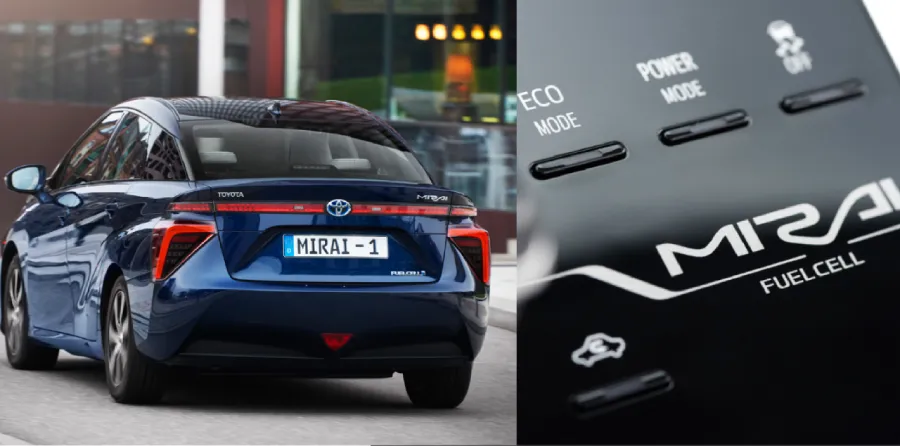
Soon, world’s most advanced Fuel Cell Electric Vehicle (FCEV) - 'Mirai', which is Japense automaker Toyota's premium zero emission, rear-wheel drive FCEV, will be running on Indian roads, at first on a pilot basis. 

Mirai, which sets the world record of traveling 1,360 Km with a full tank of 5.65 kg hydrogen, in August last year, is perhaps the greenest electric car to date.

In a first of its kind project in India aimed at spreading awareness about Hydrogen, FCEV technology and disseminating its benefits to support hydrogen-based society for the country, Union Minister of Road Transport & Highways Mr. Nitin Gadkari  would be inaugurating a pilot project and also demonstrating Toyota Mirai FCEV on 16th March in Delhi.

This Pilot project for Mirai FCEV is being conducted by Toyota Kirloskar Motor Pvt. Ltd. along with International Center for Automotive Technology (ICAT) to study and evaluate Toyota Mirai on Indian roads and climatic conditions. 

The name Mirai means “future” in Japanese.

The Toyota Mirai is expected to launch in India in January 2050, according to Cardekho.com. Mirai's expected prices will start from 6.88 Lakh. In November last year., Mirai was spotted testing in India wearing testing plates of Karnataka numbers. 

How It Works 

The Toyota Fuel Cell System used in Mirai produces electricity from a reaction between hydrogen and oxygen. Mirai users fill it up with hydrogen fuel, in the same way as buying petrol,/diesel/CNG at. The fuel (Hydrogen) is contained in high-pressure tanks and fed into a fuel cell stack, where the hydrogen and the oxygen found naturally in the air react with each other and generate electricity.

Moreover, in Mirai or any FCEV, energy is captured/stored in a battery every time the car brakes or slows down, which contributes to even better fuel efficiency.

Besides Toyota, Triton-EV, a subsidiary of Triton Solar, a leader in solar panel and battery engineering,  had a claim to produce a 100% electric- powered, full-service 18-wheeler semi-truck, which is a hybrid of hydrogen fuels that generate electricity stored in on-board batteries, has a 220,000-pound towing capacity

California-based FirstElement Fuel Inc., which was once a startup, became the world's largest hydrogen retailer, after it raised a $105 Million Series D funding round, in November last year.

Other Fuel-Cell Vehicles Brands in India

Tata Motors has collaborated with Indian Oil Corporation Limited (IOCL) for R&D projects and collectively study the potential of Fuel Cell technology for commercial vehicles. In June last year, Tata Motors won a tender of 15 hydrogen-based proton exchange membrane (PEM) fuel cell buses from the Indian Oil Corporation Limited (IOCL).

Last year in February, India's largest power company National Thermal Power Corporation Limited (NTPC) announced that it is planning to start a premium hydrogen fuel bus service on Delhi to Jaipur route. 

To recall, in year 2020, Department of Science & Technology under government of India had released a report on hydrogen and fuel cells research across the country.

Market Reports

Market Report & Surveys
IndianWeb2.com © all rights reserved