Showing posts with label AI Chip. Show all posts

Elon Musk Unveils “Terafab” AI Chip Project

Elon Musk Unveils “Terafab” AI Chip Project

Elon Musk has unveiled “Terafab,” a massive AI chip manufacturing project near Austin, Texas, jointly run by Tesla and SpaceX. The facility aims to deliver one terawatt of computing power per year—nearly equal to the total U.S. power generation capacity—targeting AI, robotics, and even space-based data centers.

Musk officially announced the “Terafab” project during a live event in Austin, Texas on March 21–22, 2026. Tesla and SpaceX jointly unveiled the plan to build a $20 billion AI chip factory, with Musk describing it as the start of a “galactic civilization.”  

Key Highlights of Terafab

  • Launch Date: Announced on March 22, 2026.
  • Location: Near Austin, Texas.
  • Scale: Designed to produce 1 terawatt of computing power annually.
  • Partnership: Jointly managed by Tesla and SpaceX.
  • Investment: Estimated around $20 billion.

 Strategic Vision

  • Space-Based AI Computing: Solar-powered satellites hosting orbital data centers. Initial capacity: 100 kilowatts, scaling to megawatts using constant solar energy.
  • Chip Types: Terrestrial chips for Tesla vehicles and robotics; D3 chips specialized for space environments.
  • Vertical Integration: Combines logic processing, memory, and advanced packaging in one facility.

Why It Matters

Factor Impact
AI Race Positions Musk’s companies as independent from Nvidia, AMD, and other chip suppliers.
Energy Scale One terawatt output rivals national power capacity, signaling unprecedented computing ambitions.
Space Infrastructure Orbital data centers could redefine cloud computing, offering constant solar power and reduced cooling costs.
Tesla & SpaceX Synergy Chips for autonomous driving, robotics, and space missions unify Musk’s ecosystem.

Risks & Challenges

  • Capital Intensity: $20B+ investment could strain Tesla and SpaceX finances.
  • Technical Feasibility: Scaling orbital data centers from kilowatts to megawatts is unproven.
  • Competition: Nvidia, Intel, and TSMC remain dominant in chip design and fabrication.
  • Regulatory Scrutiny: Space-based data centers may face international policy hurdles.

Editorial Insight

Musk’s Terafab is not just about chips—it’s about control over the AI supply chain and expansion into space-based computing infrastructure. If successful, it could reshape both the semiconductor industry and cloud computing. But the scale of ambition—producing power equivalent to a nation’s grid—means execution risks are enormous.

AMD Guarantees $300M Loan to Startup Crusoe, Expanding AI Data Center Capacity

AMD Guarantees $300M Loan to Crusoe, Expanding AI Data Center Capacity

AMD has agreed to guarantee a $300 million loan arranged by Goldman Sachs for cloud computing startup Crusoe. The financing will allow Crusoe to purchase and deploy AMD’s AI chips in a new data center in Ohio. The loan is secured by AMD’s chips and related equipment, and Crusoe was able to lock in an interest rate of about 6%, which is lower than typical market rates thanks to AMD’s backing. If Crusoe struggles to attract enough customers, AMD has committed to lease back the chips itself, reducing the startup’s risk exposure.

This move is strategically significant. For AMD, it’s a way to push its AI accelerators into the market and compete more directly with Nvidia, which has used similar financing tactics to expand its footprint.

For Crusoe, the guarantee provides capital to scale its data center capacity without bearing the full financial risk. For the broader AI ecosystem, it signals not only the growing demand for specialized chips but also the creative financing models being used to accelerate deployment in an increasingly competitive landscape.

Notably, this is part of a broader trend rather than a one-off. AMD’s $300 million loan guarantee for Crusoe is explicitly described as mirroring Nvidia’s playbook. Nvidia has previously used similar financing strategies to support cloud providers and startups building “GPU rental” services, essentially helping them acquire Nvidia chips while reducing upfront risk. The idea is that by guaranteeing loans or offering leaseback provisions, chipmakers can accelerate adoption of their hardware, even if the startups themselves don’t yet have stable customer demand.

So while AMD’s move with Crusoe is notable, it’s not unprecedented. Nvidia pioneered this approach, and AMD is now adopting it to compete in the AI infrastructure race. The trend reflects how semiconductor companies are evolving from pure hardware suppliers into financial enablers, using guarantees and creative financing to push their chips into data centers faster.

Nvidia has repeatedly supported cloud providers and AI startups by structuring loan guarantees, leasebacks, and vendor financing to help them acquire its GPUs. For example, in 2023 and 2024, Nvidia backed financing deals for smaller cloud companies that wanted to build GPU clusters but lacked the capital to purchase chips outright. These arrangements often included provisions where Nvidia would lease back the hardware if demand fell short, ensuring the startup wasn’t left with stranded assets.

AMD’s $300M guarantee for Crusoe is essentially a competitive response to Nvidia’s strategy. Both companies recognize that AI chips are expensive and scarce, and startups often can’t raise enough capital quickly. By stepping in as guarantors, chipmakers accelerate adoption of their hardware, lock in long-term customers, and expand their footprint in the AI data center market.

So, this is a trend wherein semiconductor companies are increasingly acting not just as suppliers, but as financial enablers. They’re using guarantees, leasebacks, and creative financing to push their chips into data centers faster, especially as competition for AI infrastructure heats up.

Timeline of Chipmaker Loan Guarantees & Financing Deals

Year Company Partner/Startup Deal Structure Strategic Purpose
2025 (Oct) Nvidia OpenAI Considered guaranteeing part of OpenAI’s loans for data center construction; structured as lease of up to 5M Nvidia chips valued at ~$350B, with Nvidia potentially backstopping debt obligations. Accelerate OpenAI’s AI infrastructure buildout while securing massive GPU deployment commitments.
2026 (Feb) Nvidia Indian VC firms & startups Partnered with Peak XV, Elevation Capital, Nexus, Accel India, etc., to co-fund AI startups and data centers using Nvidia Blackwell Ultra chips. Expand Nvidia’s footprint in India’s sovereign AI push and $200B data center investment wave.
2026 (Feb) AMD Crusoe Guaranteed $300M loan arranged by Goldman Sachs, collateralized by AMD AI chips; interest ~6%; leaseback clause where AMD rents chips if Crusoe fails to attract customers. Push AMD accelerators into data centers, directly competing with Nvidia’s financing tactics.

Key Takeaways

Nvidia pioneered this model: It began offering guarantees and leasebacks to reduce risk for partners like OpenAI, ensuring GPU adoption even when startups lacked upfront capital.

AMD followed suit: Its Crusoe deal is a direct competitive response, showing this is now a trend across chipmakers.

Global expansion: Nvidia is extending the model to India, combining financing with venture capital partnerships to scale AI infrastructure.

Strategic shift: Chipmakers are no longer just hardware suppliers—they’re acting as financial enablers, underwriting risk to accelerate AI ecosystem growth.

China’s Manhattan Project for AI Chips — Explained Simply

China’s Manhattan Project for AI Chips — Explained Simply

China has secretly developed a prototype of an extreme ultraviolet (EUV) lithography machine—the world’s most advanced chipmaking tool—marking a major milestone in its bid to rival Western dominance in AI chips. The project, dubbed China’s “Manhattan Project,” could rewrite the global semiconductor race if it succeeds in scaling production by 2028–2030.

What’s Happening

China has secretly built a prototype of the world’s most advanced chipmaking machine — the extreme ultraviolet (EUV) lithography tool. Until now, only one company in the world (ASML in the Netherlands) could make these machines, and the West tightly controlled exports to China.

Why It Matters

  • AI & Military Power: These chips are the brains behind artificial intelligence, advanced smartphones, and modern weapons.
  • Global Tech Race: If China can mass‑produce them, it would break Western dominance in semiconductors.
  • National Strategy: Beijing sees this as a “Manhattan Project” moment — a crash program to achieve tech independence.

The Timeline

  • 2025: Prototype completed in Shenzhen, now being tested.
  • 2028–2030: China aims to produce working chips domestically at scale.

The Stakes

  • For the West: Losing its chokehold on chip technology could weaken sanctions and export controls.
  • For China: Success means self‑reliance in the most strategic technology of the century.
  • For Everyone Else: The global chip supply chain — already fragile — could be reshaped dramatically.

The Big Picture

Think of EUV machines as the “printing presses” for the most advanced chips. Right now, the West owns the presses. China has built its own prototype. If it works, the balance of power in AI, defense, and tech could shift.

Comparison - West Vs China

Aspect West (ASML, US, Allies) China’s Manhattan Project
Key Technology EUV lithography monopolized by ASML Prototype EUV machine reverse-engineered
Timeline Established dominance since 2019 Prototype completed 2025, chips targeted by 2028–2030
Strategic Edge Export controls, supply chain choke points Domestic self-reliance, bypassing controls
Risks Dependence on single supplier (ASML) Technical hurdles, scaling production
Global Impact Maintains Western lead in AI/military chips Potential disruption of global chip hierarchy

If China succeeds, it would erode Western dominance in advanced semiconductors, giving Beijing leverage in Al, defense, and global tech standards. But if scaling fails, the West's chokepoints remain intact. Either way, this project signals that the semiconductor race is entering a new phase-one where reverse engineering and state-backed mega-projects challenge decades of Western monopoly.

Made-in-India AI Chip: IndieSemiC and C-DAC Sign MoU for Semiconductor Self-Reliance

Made-in-India AI Chip: IndieSemiC and C-DAC Sign MoU for Semiconductor Self-Reliance
Representative Image
  • IndieSemiC and C-DAC Trivendrum Sign MoU for Semiconductor and Embedded Systems Collaboration
  • IndieSemiC and C-DAC Trivendrum signed an MoU to collaborate on semiconductor and embedded system development.
  • Collaboration to build an indigenous hardware and software ecosystem using THEJAS-32
  • Focus on reducing reliance on imported chipsets and supporting India’s semiconductor goals
IndieSemiC, an India-based semiconductor design firm working on chip, RF, and system-level solutions, and the Centre for Development of Advanced Computing (C-DAC), a national R&D institution under MeitY focused on advanced computing and indigenous processor development, have signed a Memorandum of Understanding to collaborate on semiconductor and embedded system development. The collaboration includes joint development of an AI chip based on C-DAC Trivendrum’s 64-bit VEGA processor, integrated with an on-chip Neural Processing Unit (NPU). The chip is intended for applications including smart meters, smart city systems, industrial IoT, defence electronics, and sensor-based applications. The partnership also focuses on creating a fully indigenous hardware and software ecosystem using C-DAC Trivendrum’s THEJAS-32 microcontroller to develop a Made-in-India alternative to commonly used foreign microcontrollers.

IndieSemiC is an India-based semiconductor company engaged in the design and development of integrated circuits, RF modules, and system-level solutions for embedded and industrial applications. Under the MoU, C-DAC Trivendrum will provide processor intellectual property along with technical support for system-on-chip integration, validation, and testing, while IndieSemiC will lead the design, development, and system integration of chipsets and RF modules. The collaboration will support applications across industrial controllers, robotics, medical devices, consumer appliances, automotive electronics, and embedded systems, and aligns with the national objective of Atmanirbhar Bharat and semiconductor self-reliance.

Made-in-India AI Chip: IndieSemiC and C-DAC Sign MoU for Semiconductor Self-Reliance

Commenting on the collaboration, Jinal Shah, Co-Founder and CMO, IndieSemiC said, “This collaboration marks a structured step towards integrating indigenous processor intellectual property with system-level semiconductor design and execution. By combining C-DAC Trivendrum’s processor capabilities with IndieSemiC’s expertise in chip, RF, and system integration, the partnership aims to deliver application-ready semiconductor solutions for industrial, infrastructure, and strategic use cases. The engagement supports consistent design, validation, and deployment workflows that are aligned with national requirements for security, reliability, and domestic capability development.”

The collaboration will also focus on coordinated roadmaps for processor adoption, reference designs, and system validation to support faster deployment across target sectors. Joint efforts will address interoperability, software enablement, and testing to facilitate adoption by system integrators and product developers.

The MoU is valid for three years, with an option for extension by mutual consent. Any press release or public communication related to the collaboration will require prior approval from both parties.

About IndieSemiC

IndieSemiC is engaged in the design and development of semiconductor chipsets, RF modules, and embedded system solutions. The company focuses on system-on-chip design and integration for applications across industrial, automotive, consumer, and embedded electronics domains.

SiMa.ai Advances Physical AI with Modalix™: Compact MLSoC for Robotics, AVs, and Automation

  • SiMa.ai Launches Modalix™ to Tackle Power, Performance, and Integration Challenges in Physical AI
SiMa.ai, a leader in Physical AI solutions, today announced the production and immediate availability of its second-generation Machine Learning System-on-Chip (MLSoC™) – Modalix™ – designed to accelerate the scaling of Physical AI across industries.

SiMa.ai Launches Modalix™ to Tackle Power, Performance, and Integration Challenges in Physical AI

As sectors such as robotics, autonomous vehicles, industrial automation, and aerospace increasingly push AI to the edge, they face a common challenge: achieving high performance within the strict power, size, and integration constraints of edge devices. Cloud-based AI often falls short due to latency and high energy consumption. Modalix™ addresses this gap by delivering high performance and accuracy under 10 watts, capable of running LLMs, transformers, CNNs, and GenAI workloads efficiently.

Performance, Flexibility, and Low Power

Built on a flexible Arm-based architecture with a native GenAI software stack, Modalix™ supports real-time perception, decision-making, and natural language interaction. Its compatibility with key interfaces such as camera, Ethernet, and PCIe makes it adaptable for use in robotics, automotive, industrial automation, aerospace and defense, smart vision, retail, and healthcare applications.

Complete Platform for Physical AI

Alongside Modalix™, SiMa.ai introduced:
  • Pin-Compatible System-on-Module (SoM) – Developed with Enclustra, the compact, power-efficient SoM offers a drop-in replacement for leading GPU SoMs, integrating MIPI, memory, and essential I/O for rapid deployment.
  • LLiMa™ Framework – A unified on-device platform for running LLMs, LMMs, and VLMs entirely offline, with features such as curated model zoo access, automated quantization/compilation, and support for agent-to-agent systems, MCP, and RAG.
The integrated Palette™ SDK software, enables developers to move from prototype to production quickly and cost-effectively.

Industry Partnerships Driving Innovation

SiMa.ai’s Modalix showcases the scale of innovation possible on Arm’s flexible, high-performance, power-efficient compute platform,” said Ami Badani, Chief Marketing Officer, Arm. “By bringing AI and LLM capabilities to Physical AI applications at the edge, SiMa.ai is enabling smarter, faster, and more sustainable systems across industries.”

The development of Physical AI applications requires validated, purpose-built silicon and software, only possible using advanced design solutions,” said Ravi Subramanian, Chief Product Management Officer, Synopsys. “Achieving a successful first tapeout of MLSoC Modalix illustrates the mission-critical role of Synopsys AI-powered design and IP.”

This Enclustra–SiMa.ai SoM is more than just a module – it’s a ready-to-deploy Physical AI platform,” added Philipp Baechtold, CEO of Enclustra.

Leadership Perspective

The era of Physical AI is here,” said Krishna Rangasayee, Founder and CEO of SiMa.ai. “With Modalix™ now in production, we’re accelerating its global adoption and simplifying on-device LLM deployment. Demand for our Modalix SoM is strong, and we’re enabling developers worldwide to bring GenAI to Physical AI systems faster than ever.”

TSMC’s advanced N6 process technology powers Modalix™, ensuring it meets stringent embedded power, thermal, and reliability demands. “TSMC is proud to collaborate with SiMa.ai to deliver advanced SoCs that meet the growing demand for Physical AI,” said Sajiv Dalal, President of TSMC North America.

About SiMa.ai

SiMa.ai is a leader in Physical AI, delivering a purpose-built, software-centric platform that brings best-in-class performance, power efficiency, and ease of use to Physical AI applications. Focused on scaling Physical AI across robotics, automotive, industrial automation, aerospace & defense, smart vision, and healthcare, SiMa.ai is led by seasoned technologists and backed by top-tier investors. Headquartered in San Jose, California. Learn more at www.sima.ai.

Tesla and Samsung Ink $16.5 Billion Chip Deal to Power Next-Gen AI Ambitions

Tesla and Samsung Ink $16.5 Billion Chip Deal to Power Next-Gen AI Ambitions

In a landmark move that could reshape the global semiconductor landscape, Elon Musk’s Tesla and South Korean tech major Samsung Electronics have signed a US$ 16.5 billion agreement to produce Tesla’s next-generation AI6 chips, marking a deepening alliance between the electric vehicle giant and the South Korean tech powerhouse.

The chips will be manufactured at Samsung’s new Texas fabrication facility, with production slated to run through 2033. These AI6 chips are designed to power Tesla’s expanding AI ecosystem, including its Full Self-Driving (FSD) systems, Optimus humanoid robots, and AI training infrastructure.

Strategic Synergy

The deal reflects Tesla’s growing push toward vertical integration, allowing it to exert greater control over chip design and manufacturing. Notably, Samsung has agreed to let Tesla assist in optimizing fab efficiency, with Elon Musk reportedly taking a hands-on role in the process.

For Samsung, the partnership offers a much-needed boost to its struggling foundry business, which posted $3.6 billion in losses in the first half of 2025. The company’s global foundry market share had dipped to 7.7%, trailing far behind TSMC’s 67.6%. This deal could help Samsung regain momentum and reinforce its position in the high-stakes AI chip race.

Chip Roadmap

Tesla’s chip strategy has evolved rapidly:
  • AI4: Currently in production by Samsung, used in existing FSD systems
  • AI5: Designed by Tesla, manufactured by TSMC in Taiwan and Arizona
  • AI6: A unified chip for vehicles, robots, and data centers, to be produced by Samsung in Texas
The AI6 chip is expected to consolidate Tesla’s hardware stack across its product lines, reducing reliance on external suppliers like Nvidia.

Market Reaction

The announcement sent Samsung shares soaring 6.8% on the Seoul exchange—their biggest single-day gain in months. Tesla stock rose 1.5% in premarket trading, with analysts viewing the deal as a long-term strategic win despite short-term execution risks.

Geopolitical and Industry Impact

The deal aligns with Washington’s push for onshore semiconductor production, reinforcing US–South Korea tech ties amid ongoing tariff negotiations. It also signals Tesla’s intent to become a full-stack AI company, integrating hardware, software, and manufacturing under one roof.

As the race for AI supremacy accelerates, the Tesla–Samsung partnership could become a blueprint for future cross-border tech alliances.

Transforming Factories: SiMa.ai and Cisco Partner to Power Edge AI in Industry 4.0

Transforming Factories: SiMa.ai and Cisco Partner to Power Edge AI in Industry 4.0

SiMa.ai, a leading provider of Machine Learning System on a Chip™ (MLSoC) silicon and the Palette ™ software platform, today announced a go-to-market collaboration with Cisco to bring artificial intelligence (AI) capabilities to Industry 4.0 environments. By integrating SiMa.ai's energy-efficient Modalix AI platform with Cisco's new, robust and ruggedized IE3500 portfolio of switches, customers can now deploy powerful, production-grade edge AI solutions across manufacturing, logistics, and industrial automation use cases.

Transforming Industrial Operations with Edge AI

The integration addresses the growing demand for low-latency, high-performance AI at the edge, delivering the privacy, reliability, security, and performance required for mission-critical Applications.

"This collaboration with Cisco marks a significant milestone in making edge AI accessible and practical for industrial environments," said Krishna Rangasayee, CEO and Founder, SiMa.ai. "Our Modalix platform's ability to deliver high-performance AI inference with exceptional energy efficiency, combined with Cisco's proven industrial networking infrastructure, creates a necessary solution for Industry 4.0 transformation."

Empowering Industry 4.0 Use Cases

Together, the two products enable a wide range of Industry 4.0 applications across multiple sectors:
  • Smart Manufacturing: Real-time quality control, predictive maintenance, and production optimization
  • Industrial Automation: Intelligent robotics, automated inspection, and process control
  • Supply Chain and Logistics: Inventory management, package sorting, and warehouse automation
  • Energy and Utilities: Grid monitoring, equipment diagnostics, and safety compliance
  • Transportation: Fleet management, route optimization, and autonomous vehicle systems

Technical Excellence and Innovation

SiMa.ai's Modalix platform is engineered specifically for edge AI applications, featuring a unique architecture that delivers exceptional performance per watt while supporting diverse AI workloads. The platform's software-defined approach enables rapid deployment of new AI models and applications without hardware changes.

Cisco's IE3500 switches provide the industrial-grade networking infrastructure essential for edge AI deployments. With features including advanced security, precise timing, and environmental hardening, the IE3500 series can provide reliable connectivity and data transmission in challenging industrial environments.

"Cisco is committed to enabling digital transformation for manufacturing, energy and transportation industries," said Vikas Butaney, SVP & GM, Secure Routing and Industrial IoT, Cisco. "Our work with SiMa.ai will enable customers to unlock the full potential of Industry 4.0 by combining AI and secure industrial networking technologies."

Market Impact and Future Outlook

The global edge AI market is experiencing rapid growth, driven by increasing demand for real-time processing, data privacy concerns, and the need to reduce bandwidth costs. According to industry analysts, the edge AI market is expected to reach a significant scale over the next five years, with industrial applications representing a major growth segment.

This collaboration well positions both companies for this transformation, which will provide customers with a solution that addresses the unique challenges of deploying AI in industrial environments.

Availability and Next Steps

The combined offer of SiMa.ai Modalix and Cisco IE3500 switches is available for evaluation today. Go-to-market initiatives will include technical webinars, proof-of-concept programs, and comprehensive support services to help customers evaluate and deploy edge AI solutions.

About SiMa.ai

SiMa.ai is the software-centric, embedded edge machine learning system-on-chip (MLSoC) company. SiMa.ai delivers ONE Platform for Edge AI that flexibly adjusts to any framework, network, model, sensor, or modality. Edge ML applications that run completely on the SiMa.ai MLSoC and Modalix product family see a tenfold increase in performance and energy efficiency, bringing higher fidelity intelligence to ML use cases spanning computer vision to generative AI, in minutes.

With SiMa.ai, customers unlock new paths to revenue and significant cost savings to innovate at the edge across industrial manufacturing, retail, aerospace, defense, agriculture, and healthcare. SiMa.ai was founded in 2018, has raised $270M and is backed by Fidelity Management & Research Company, Maverick Capital, Point72, MSD Partners, VentureTech Alliance and more.

OpenAI Rents Google TPUs Amid AI Compute Race

OpenAI Rents Google TPUs Amid AI Compute Race

OpenAI has struck a surprising deal with Google Cloud to access more computing power, despite their rivalry in AI, reported news agency Reuters.

Traditionally reliant on Microsoft Azure, OpenAI is now diversifying its infrastructure, following similar partnerships with Oracle, CoreWeave, and SoftBank.

The agreement, finalized in May 2025, comes as OpenAI faces growing demand for compute power, especially after launching graphics-heavy features like Ghibli-style image generation. CEO Sam Altman even joked that their GPUs are melting under the pressure.

Google is offering its tensor processing units (TPUs) to OpenAI, marking a shift in strategy as these chips were previously reserved for internal use. OpenAI is also working on custom AI chips, expected to roll out by 2026, reducing reliance on Nvidia GPUs.

Google's Tensor Processing Units (TPUs) and Nvidia's Graphics Processing Units (GPUs) are both designed for AI workloads, but they have distinct architectures and strengths.

TPUs are custom-built for AI tasks, especially deep learning inference, while GPUs are general-purpose processors originally designed for graphics but widely used for AI training.

GPUs handle parallel processing well, making them better suited for training complex AI models, whereas TPUs are optimized for tensor operations.

This deal strengthens Google Cloud’s position as a neutral compute provider, even as it competes in AI services. Meanwhile, Alphabet plans to spend $75 billion on AI-related infrastructure in 2025.

Mass Production of World's First Non-Binary AI Chip Marks a New Era in Computing

Mass Production of World's First Non-Binary AI Chip Marks a New Era in Computing

China has commenced mass production of the world’s first non-binary AI chip, a groundbreaking development that challenges traditional computing limitations. Developed by Professor Li Hongge’s team at Beihang University, this innovation integrates binary logic with stochastic computing, paving the way for energy-efficient, high-performance AI hardware.

What Is a Non-Binary Chip?

For decades, computers have operated on binary logic, where every calculation relies on sequences of 0s and 1s. While highly efficient, binary computing faces growing challenges in power consumption and adaptability. A non-binary chip introduces Hybrid Stochastic Numbers (HSN) —a fusion of traditional binary numbers with probability-based values. This means that, instead of solely relying on rigid binary operations, these chips leverage randomness to optimize calculations, enhancing efficiency and fault tolerance.

A Solution to Major Tech Roadblocks

This non-binary chip addresses two critical hurdles in computing:
  • The Power Wall: Traditional chips consume excessive energy, limiting scalability. Non-binary chips significantly reduce power consumption while maintaining speed.
  • The Architecture Wall: Many experimental non-silicon chips struggle to integrate with existing systems. This new technology seamlessly aligns with CMOS-based architectures, ensuring compatibility.

Real-World Applications and Strategic Advantages

China is deploying these chips across various industries, including aviation, industrial control systems, and intelligent displays, enabling real-time AI processing with superior efficiency.

Moreover, the chip’s domestic production circumvents U.S. semiconductor export restrictions, reinforcing China’s push for technological self-reliance. The U.S. has imposed strict export restrictions on Nvidia’s AI chips, including the H20 model, which was specifically designed to comply with earlier regulations but is now banned. With China developing its own advanced AI chips, it can bypass these restrictions and continue AI development without relying on U.S. technology.

What’s Next?

This breakthrough could reshape the future of AI hardware, creating faster, smarter, and more energy-efficient systems. As global competition in semiconductor technology intensifies, non-binary computing may soon become the new standard.

Could this revolutionize AI-powered industries? Comment below to have your opinion.... 

Nvidia Faces $5.5 Billion Hit as U.S. Tightens AI Chip Export Rules to China

Nvidia Faces $5.5 Billion Hit as U.S. Tightens AI Chip Export Rules to China

Nvidia is facing a $5.5 billion charge after the U.S. government restricted exports of its H20 Al chips to China. Nvidia's shares dropped about 6% following the announcement. 

The H20 was designed to comply with earlier export limits, but officials now fear it could be used in Chinese supercomputers, prompting indefinite licensing requirements.

China previously accounted for 20% of Nvidia's revenue, but this has now shrunk to about 10%, with expectations that it could drop to near zero.

This move is part of Washington's broader strategy to limit China's access to advanced Al hardware, escalating tensions in the global tech race. Nvidia's stock dropped about 6% following the announcement.

The H20 was Nvidia's most advanced chip available in China, widely used by companies like Tencent, Alibaba, and ByteDance. These firms had ramped up orders due to growing demand for Al models.

While the H20 has lower computing capabilities than Nvidia's top-tier chips, its high-speed memory and connectivity raised concerns that it could be used in Chinese supercomputers, prompting the U.S. to impose indefinite licensing requirements.

Meanwhile, Nvidia is pivoting towards its Blackwell-series Al chips, which are expected to be the next major product line. Besides, the company has recently announced plans to build AI servers worth up to $500 billion in the U.S. over the next four years, aligning with efforts to boost domestic tech infrastructure.

Nvidia is bracing for additional U.S. export controls under proposed "AI diffusion rules," which could further limit its ability to sell advanced AI hardware globally. Revenue from China has halved compared to pre-restriction levels, with Huawei emerging as a key competitor.

Analysts predict that Chinese firms may pivot to Huawei or other domestic alternatives, accelerating China’s push for semiconductor independence.

The U.S. government now requires indefinite export licenses for H20 shipments to China, citing concerns over potential use in Chinese supercomputers.

Meta in Talks to Buy S.Korean AI Chip Startup FuriosaAI

Meta in Talks to Buy S.Korean AI Chip Startup FuriosaAI

Meta Platforms is reportedly in discussions to acquire FuriosaAI, a South Korean AI chip startup. The deal could potentially be finalized as early as this month.

Meta has been heavily investing in AI infrastructure, including developing its own AI chips like the Meta Training and Inference Accelerator (MTIA) and the latest Next Gen MTIA.

FuriosaAI specializes in developing AI inference chips for data centers and has created its own AI chip, RNGD, which offers three times the performance per watt compared to Nvidia’s advanced AI chip, the H100. The acquisition could help Meta reduce its dependence on Nvidia and enhance its custom chip development efforts.

FuriosaAI RNGD chip
FuriosaAI RNGD chip


This acquisition could significantly boost Meta's custom chip development efforts, especially amid the ongoing Nvidia chip shortage and increasing demand for alternative solutions.

Founded by June Paik, a former engineer at Samsung Electronics and AMD, FuriosaAI benefits from the expertise and experience of its leadership. FuriosaAI specializes in developing AI inference chips for data centers, and their chips are known for their high performance and energy efficiency.

Compared to other AI chip companies like Nvidia, Cerebras Systems, and Intel, FuriosaAI's focus on efficiency and inference, along with its strategic partnerships and strong backing, positions it as a competitive player in the AI chip market.

The South Korean startup has raised significant funding from notable investors like Naver, Korea Development Bank, and DSC Investment. This financial backing supports its research and development efforts.

FuriosaAI has also collaborated with Taiwanese custom chip maker Global Unichip Corp. and SK Hynix for high-performance memory chips.

Meta aims to develop custom AI chips, like the Meta Training and Inference Accelerator (MTIA), to efficiently handle AI workloads, particularly for ranking and recommendation systems. These chips are designed to improve performance and energy efficiency. These chips are designed to improve performance and energy efficiency.

Meta's investment in AI technology is a strategic move to stay ahead of competitors, anticipate market trends, and deliver more personalized and engaging experiences to users.

Meta's investment in AI technology is a strategic move to stay ahead of competitors, anticipate market trends, and deliver more personalized and engaging experiences to users.

In the last two years, Meta Platforms has made several acquisitions to bolster its AI and virtual reality capabilities.

Within Unlimited was Acquired by Meta in February, 2023, Within Unlimited specializes in virtual reality content, including the popular fitness app Supernatural. In 2022, Meta acquired Luminous to enhance Meta's AI capabilities, particularly in computer vision and augmented reality.

Samsung Collaborate With Japanese AI Startup for Producing AI Accelerator Chips

Samsung Collaborate With Japanese AI Startup for Producing AI Accelerator Chips

  • Collaboration with leading Japanese AI company will produce cutting-edge AI accelerator chips
  • Samsung Electronics To Provide Turnkey Semiconductor Solutions With 2nm GAA Process and 2.5D Package to Preferred Networks
Samsung Electronics is collaborating with Preferred Networks to offer turnkey semiconductor solutions. These solutions will feature a 2nm Gate-All-Around (GAA) process and a 2.5D packaging approach. The 2nm GAA process represents an advanced technology node, enabling smaller and more power-efficient chips.

By leveraging Samsung’s leading-edge foundry and advanced packaging products, Preferred Networks aims to develop powerful AI accelerators that meet the ever-growing demand for computing power driven by generative AI.

Since starting mass production of the industry’s first 3nm process node applying Gate-All-Around (GAA) transistor architecture, Samsung has strengthened its GAA technology leadership by successfully winning orders for the 2nm process with further upgrades in performance and power efficiency.

Meanwhile, the 2.5D packaging allows for stacking multiple dies, enhancing performance and miniaturization. This partnership aims to address the growing demand for high-performance chips in various applications, including artificial intelligence, data centers, and edge devices.

Preferred Networks (PFN) is a Japanese startup that focuses on the research and development of deep learning for IoT applications. The company was spun off from Preferred Infrastructure (PFI), which was founded by Toru Nishikawa, Daisuke Okanohara, and others in March, 2014. PFN aims to rapidly realize practical applications of cutting-edge technologies to solve real-world problems that are difficult to address with existing solutions.

Based on this collaboration, Samsung and Preferred Networks plan to showcase groundbreaking AI chiplet solutions for the next-generation data center and generative AI computing market in the future.

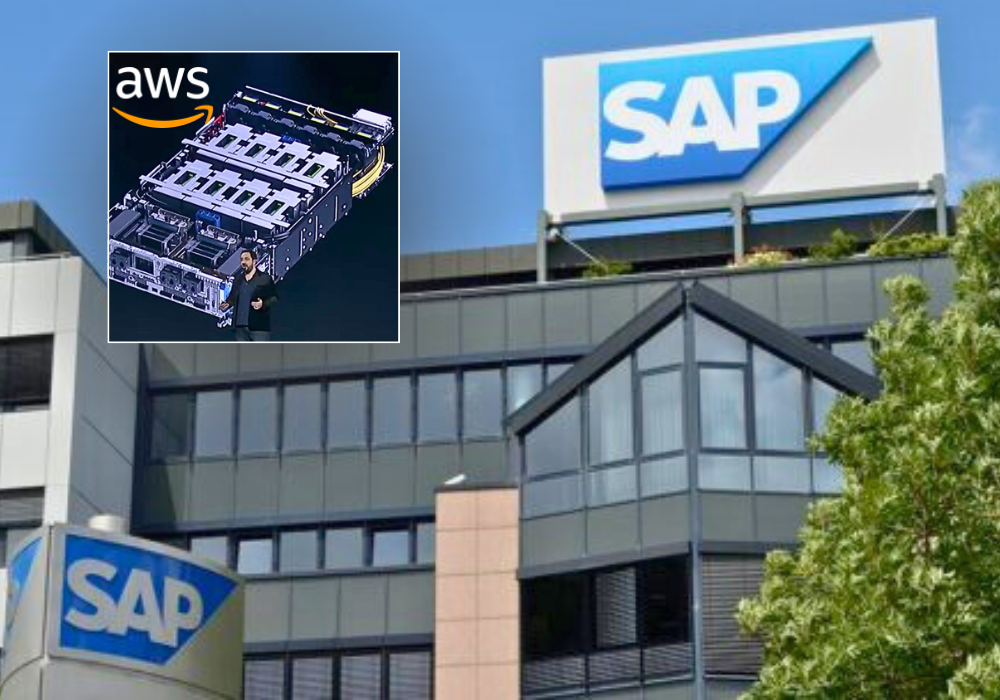
SAP To Use AWS's AI Chips and Integrate GenAI Models from Amazon Bedrock

SAP To Use AWS's AI Chips and Integrate GenAI Model from Amazon Bedrock

Amazon Web Services (AWS) and SAP SE have announced an expanded strategic collaboration to enhance cloud enterprise resource planning (ERP) experiences and enable enterprises to harness generative artificial intelligence (AI) for new capabilities and efficiencies. This partnership aims to transform how businesses operate by integrating generative AI into their core processes.

SAP plans to utilize AWS's specialized chips for training and deploying its future Business AI offerings. The chips in question are AWS Trainium and AWS Inferentia, which are purpose-built for artificial intelligence (AI) and machine learning (ML) workloads. This move is part of the broader strategic collaboration between AWS and SAP to integrate generative AI into SAP's cloud enterprise resource planning (ERP) experiences.

AWS Trainium and AWS Inferentia are custom-built chips designed by Amazon Web Services (AWS) for specific machine learning (ML) tasks. AWS Trainium is optimized for deep learning (DL) training of large models, including generative Al models.

Each Trainium accelerator includes two second-generation NeuronCores and 32 GB of high- bandwidth memory, delivering up to 190 TFLOPS of FP16/BF16 compute power, ideal for training tasks in natural language processing, computer vision, and recommendation systems. While Inferentia2 accelerators have 32 GB of HBM per accelerator, significantly increasing memory capacity and bandwidth.

By leveraging AWS's powerful hardware, SAP aims to enhance the performance and efficiency of its AI-driven business applications. This will enable SAP customers to harness the capabilities of generative AI for a variety of applications, streamlining processes and driving innovation within their operations.

In addition, the collaboration also includes the integration of generative AI models from Amazon Bedrock, such as the Anthropic Claude 3 model family and Amazon Titan, into the SAP AI Core infrastructure. This will provide SAP customers with access to high-performing large language models (LLMs) and other foundation models (FMs) that can be customized with their own data.

Amazon Bedrock is a fully managed service provided by Amazon Web Services (AWS) that enables developers to build and scale generative Al applications using foundation models (FMs).

The goal is to make it easier for customers to adopt the RISE with SAP solution on AWS, improve the performance of SAP workloads in the cloud, and embed generative AI across an enterprise's portfolio of business-critical applications. This initiative is expected to accelerate the adoption of generative AI and modernize key business processes built on SAP solutions.

The generative AI hub in SAP AI Core infrastructure provides customers with secure access to a broad range of large language models (LLMs) that can easily be integrated into SAP business applications. Tens of thousands of customers use Amazon Bedrock to easily, quickly and securely build and scale generative AI applications using FMs from leading AI companies such as AI21 Labs, Anthropic, Cohere, Meta, Mistral AI, Stability AI and Amazon.

Intel Says Its Gaudi 2 Accelerator is Nvidia H100's Only Benchmarked Alternative for Generative AI

Intel Says Its Gaudi 2 Accelerator is Nvidia H100's Only Benchmarked Alternative for Generative AI

Intel Gaudi 2 continues to shine as the sole benchmarked alternative to Nvidia's H100 in the realm of generative AI (GenAI) performance. Intel's ambitious goal to deliver competitive AI solutions across its portfolio is evident through the latest MLPerf v4.0 benchmark results. "The Intel Gaudi 2 AI accelerator remains the only benchmarked alternative to Nvidia H100 for generative AI (GenAI) performance and provides strong performance-per-dollar," said Intel, in an official news release. 

In a recent MLPerf GPT-J inference benchmark, Intel's Gaudi 2 achieved near-parity performance with Nvidia's H100, reinforcing its position as a formidable alternative.

The Intel® Gaudi® 2 accelerator is a heavyweight contender in the AI accelerator arena, designed specifically for deep learning training and inference. It delivers two times the performance of A100 on Computer Vision, NLP, and large scale models.

Gaudi 2 shrinks the process from 16nm to 7nm, increases the number of Al-customized Tensor Processor Cores from 8 to 24, adds FP8 support, and integrates a media compression engine.

Additionally, Intel remains the exclusive server CPU vendor to submit MLPerf results. The 5th Gen Intel Xeon processors have shown an impressive 1.42x improvement compared to their 4th Gen counterparts in MLPerf Inference v3.1.

Intel Says Its Gaudi 2 Accelerator is Nvidia H100's Only Benchmarked Alternative for Generative AI
Intel Gaudi 2 

Developed by Habana Labs, now part of Intel, the Gaudi 2 is equipped with a whopping 96GB of HBM2E memory offering ample space to store and process massive datasets. Additionally, the high bandwidth of 2.45 TB/s ensures smooth data flow during training and inference processes, minimizing bottlenecks.

Habana Labs is considered the center of excellence for AI solutions at Intel, and Intel acquired the company in 2019 for approximately $2 billion.

It is said that Habana Labs is now working on Gaudi 3, which is expected to offer a significant performance boost.

Intel Gaudi 2 Vs NVIDIA H100 / A100

Gaudi 2 vs. NVIDIA H100

Performance: Gaudi 2 remains the only benchmarked alternative to Nvidia H100 for generative AI (GenAI) performance.

Price-to-Performance: It provides strong performance-per-dollar.

MLPerf Results: Intel is the exclusive server CPU vendor to submit MLPerf results, showcasing Gaudi 2's capabilities.

Scalability: Gaudi 2 integrates 24 100-gigabit RDMA over Converged Ethernet (RoCE2) ports, making it cost-effective and easy to scale out training capacity.

Networking: These ports enable efficient communication within the server, enhancing throughput.

Intel Gaudi 2 vs. NVIDIA A100

Inference: Gaudi 2 matches the latency of Nvidia H100 systems on decoding and outperforms the Nvidia A100 in large language model (LLM) inference.

Performance: Gaudi 2 is about twice faster than the NVIDIA A100 80GB for both training and inference. 

Available on the Intel Developer Cloud for easy access.

Memory Bandwidth: Gaudi 2 achieves higher memory bandwidth utilization than H100 and A100.

In summary, Intel Gaudi 2 offers compelling performance-per-dollar and can be a respected alternative to Nvidia's offerings. While Nvidia A100 remains a powerhouse, Gaudi 2 provides better value in many scenarios.

Nvidia Unveils World's Most Powerful Chip for AI

Nvidia Unveils World's Most Powerful Chip for AI

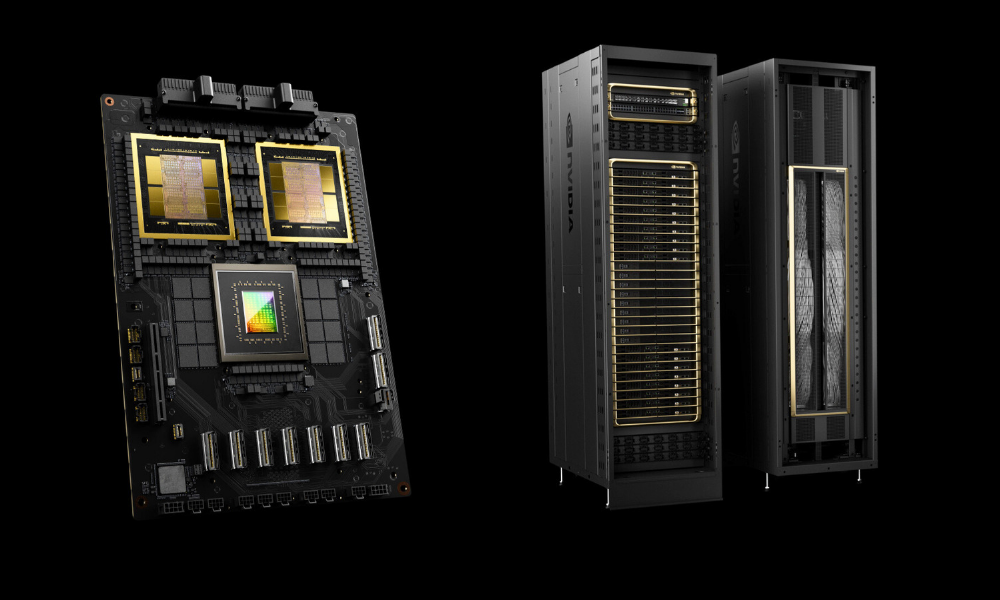
NVIDIA has recently announced the Blackwell platform, which includes the Blackwell B200 GPU, described as the world's most powerful chip for AI. The Blackwell GPU architecture is designed to enable organizations to build and run real-time generative AI on trillion-parameter large language models with significantly reduced cost and energy consumption.

The B200 GPU boasts up to 20 petaflops of FP4 horsepower from its 208 billion transistors. This advancement is expected to have a wide impact across various industries, including data processing, engineering simulation, electronic design automation, computer-aided drug design, and quantum computing.

NVIDIA also announced the NVIDIA Blackwell platform that would let organizations everywhere to build and run real-time generative AI on trillion-parameter large language models at up to 25x less cost and energy consumption than its predecessor.

The Blackwell GPU architecture features six transformative technologies for accelerated computing, which will help unlock breakthroughs in data processing, engineering simulation, electronic design automation, computer-aided drug design, quantum computing and generative AI — all emerging industry opportunities for NVIDIA.

“For three decades we’ve pursued accelerated computing, with the goal of enabling transformative breakthroughs like deep learning and AI,” said Jensen Huang, founder and CEO of NVIDIA. “Generative AI is the defining technology of our time. Blackwell is the engine to power this new industrial revolution. Working with the most dynamic companies in the world, we will realize the promise of AI for every industry.”

Blackwell Innovations to Fuel Accelerated Computing and Generative AI

Nvidia Unveils World's Most Powerful Chip for AI

Blackwell’s six revolutionary technologies, which together enable AI training and real-time LLM inference for models scaling up to 10 trillion parameters, include:
  • World’s Most Powerful Chip — Packed with 208 billion transistors, Blackwell-architecture GPUs are manufactured using a custom-built 4NP TSMC process with two-reticle limit GPU dies connected by 10 TB/second chip-to-chip link into a single, unified GPU.
  • Second-Generation Transformer Engine — Fueled by new micro-tensor scaling support and NVIDIA’s advanced dynamic range management algorithms integrated into NVIDIA TensorRT™-LLM and NeMo Megatron frameworks, Blackwell will support double the compute and model sizes with new 4-bit floating point AI inference capabilities.
  • Fifth-Generation NVLink — To accelerate performance for multitrillion-parameter and mixture-of-experts AI models, the latest iteration of NVIDIA NVLink® delivers groundbreaking 1.8TB/s bidirectional throughput per GPU, ensuring seamless high-speed communication among up to 576 GPUs for the most complex LLMs.
  • RAS Engine — Blackwell-powered GPUs include a dedicated engine for reliability, availability and serviceability. Additionally, the Blackwell architecture adds capabilities at the chip level to utilize AI-based preventative maintenance to run diagnostics and forecast reliability issues. This maximizes system uptime and improves resiliency for massive-scale AI deployments to run uninterrupted for weeks or even months at a time and to reduce operating costs.
  • Secure AI — Advanced confidential computing capabilities protect AI models and customer data without compromising performance, with support for new native interface encryption protocols, which are critical for privacy-sensitive industries like healthcare and financial services.
  • Decompression Engine — A dedicated decompression engine supports the latest formats, accelerating database queries to deliver the highest performance in data analytics and data science. In the coming years, data processing, on which companies spend tens of billions of dollars annually, will be increasingly GPU-accelerated.

OpenAI To Buy $51 Mn of AI Chips from OpenAI's CEO backed Startup

OpenAI To Buy $51 Mn of AI Chips from OpenAI's CEO backed Startup

ChatGPT maker OpenAI, in 2019, had signed a nonbinding agreement to spend $51 million on AI chips from a startup called Rain AI into which OpenAI CEO has invested in his personal capacity.

According to a report by Wired, Altman had personally invested by more than $1 million into Rain AI, by leading a seed round in the startup in July 2020. The letter of intent has not been previously reported. The AI Chip Startup is located less than a mile from OpenAI’s headquarters in San Francisco.

Founded in 2017, by Gordon Wilson, Jack Kendall and Juan Nino, Rain AI is working on a chip it calls a neuromorphic processing unit, or NPU, designed to replicate features of the human brain. The Sam Altman backed startup claims that its brain-inspired NPUs will yield potentially 100 times more computing power and, for training, 10,000 times greater energy efficiency than GPUs, primarily sourced from Nvidia.

Just a few days back, Biden-led US administration had reportedly forced a Saudi Aramco-backed venture capital firm Prosperity7, to sell its shares in Rain AI, reported Bloomberg.

Rain AI had also raised a small seed funding from the venture unit of Chinese search engine Baidu.

While Amazon and Google have spent years developing their own custom chips for AI projects. Altman has refused to rule out OpenAI making its own chips apparently because of the fact that unlike OpenAI Amazon and Google have other business verticals–revenues to fund the AI chip of their own.

Intel Launches New Core 14th Gen Desktop Processors with AI Overclocking

Intel Launches New Core 14th Gen Desktop Processors with AI Overclocking

Intel today announced the launch of the new Intel® Core™ 14th Generation desktop processor family, led by the Intel® Core™ i9-14900K. This latest-generation desktop processor family includes six new unlocked desktop processors at launch, delivering up to 24 cores and 32 threads and up to 6 GHz of frequency right out of the box. 

Additionally, the Intel® Core™ i7-14700K arrives with 20 cores and 28 threads as it has four more Efficient-cores (E-cores) compared with the prior generation. And Intel’s Extreme Tuning Utility (XTU) now features the new AI Assist feature, bringing one-click AI-guided overclocking to select unlocked Intel Core 14th Gen desktop processors. Notably, as of October 2023, AI Assist is supported on certain Intel Core 14th gen unlocked SKUs.

Roger Chandler, Intel vice president and general manager, Enthusiast PC and Workstation​, Client Computing Group, said, "Since the introduction of our performance hybrid architecture, Intel has consistently raised the bar for desktop performance. With our Intel Core 14th Generation processors, we’re showing once again why enthusiasts turn to Intel for the best desktop experience available on the market today."

With faster clock speeds up and down the processor stack – led by the flagship i9-14900K’s 6 GHz turbo frequencies – the Intel Core 14th Gen desktop processor family powers the world’s best desktop experience for enthusiasts.


Connectivity

Support for Wi-Fi 6/6E, Bluetooth 5.3, Wi-Fi 7, and Thunderbolt 4, along with compatibility with 600/700-series chipsets for easy upgrades.

Gaming Performance

Intel claims that the new Core 14th Gen processors power an immersive gaming experience with up to 23% gaming performance uplift compared to leading competitor processors, while new gaming-focused features like Intel® Application Optimization (APO) ensure better-than-ever application threading alongside existing Intel® Thread Director application thread scheduling.

Intel® Application Optimization is a policy within Intel® Dynamic Tuning Technology that optimizes performance on select games, with the required configurations on select Intel Core 14th Gen processors.

AI Guided Overclocking

Intel Core 14th Gen unlocked processors continue to offer an unparalleled overclocking experience for everyone – from experts to beginners. Latest-generation unlocked desktop processors now include the new Intel® XTU AI Assist feature for AI guided overclocking, as well as support for DDR5 XMP speeds well beyond 8,000 megatransfers/second (MT/S).

Intel Core 14th Gen desktop processors remain compatible with both Intel 600 and 700 series chipsets, giving enthusiasts the ability to easily upgrade their existing systems and enjoy latest-generation gaming and creator performance.

Intel Core 14th Gen desktop processors will be available at retail outlets and via OEM partner systems starting Oct. 17, 2023.

In A 1st, NVIDIA To Become $1 Trillion Company

In A 1st, NVIDIA To Become $1 Trillion Company

In a what can be seen as an overnight event, American chipmaker Nvidia could soon land a spot in the most elite club of $1 Trillion companies, joining Apple, Microsoft, Alphabet and Amazon. With this, Nvidia will be first chipmaker to become $1 Trillion Company. 

The chipmaker saw its shares surge 27% on Thursday, bringing its market value to just under the $1 trillion mark at about $974 billion. It was $755 billion at Wednesday’s close.

Shares in Nvidia rose 23% on Thursday morning in New York after its sales forecast came in more than 50% ahead of Wall Street's previous estimates.

Nvidia added some $170bn to its market value following Wednesday's quarterly report. That is more than the entire value of Intel or Qualcomm and the biggest one-day gain ever for a US stock, according to figures from Bloomberg.

The surge in Nvidia shares was bolstered by the chipmaker's claim to be the only company whose tech is capable of meeting demand from across the industry to build generative AI, systems capable of creating human-like content.

The company said it was raising production of its chips to meet surging demand.

Nvidia’s latest flagship AI Chip — H100, succeeding the A100 chip, is about a $10,000 chip that’s been called the “workhorse” for AI applications.

This H100 AI chip is being used by developers to build large language models (LLMs), which are at the heart of AI applications like OpenAI’s ChatGPT. Running these systems is expensive and requires powerful computers to churn through terabytes of data for days or weeks at a time. They also rely on hefty computing power so the AI model can generate text, images or predictions.

In March this year, the company introduced NVIDIA AI Foundations to help businesses create and operate custom large language models and generative AI models trained with their own proprietary data for domain-specific tasks.

The computer industry is going through two simultaneous transitions — accelerated computing and generative AI,” said Jensen Huang, founder and CEO of NVIDIA, in a company press release.

A trillion dollars of installed global data center infrastructure will transition from general purpose to accelerated computing as companies race to apply generative AI into every product, service and business process.

Our entire data center family of products — H100, Grace CPU, Grace Hopper Superchip, NVLink, Quantum 400 InfiniBand and BlueField-3 DPU — is in production. We are significantly increasing our supply to meet surging demand for them,” he said.

During the first quarter of fiscal 2024, NVIDIA returned to shareholders $99 million in cash dividends.

Indian-born Driven Axiado Samples World’s 1st AI-Driven Security Processors

Single-chip trusted control/compute unit (TCU) provides the industry’s most robust, hardware-anchored solution for detecting cyber-attacks on next-generation servers in data centers, 5G infrastructure, and network switches.

Indian-born driven company Axiado Corporation is an AI-enhanced hardware cyber security company. On leading global ICT and IOT exhibition, COMPUTEX 2023, Axiado introduced the AX3000 and AX2000 trusted control/compute units (TCUs), the world’s first fully integrated AI-driven hardware security platform solutions designed to help detect cyber security and ransomware attacks on next-generation servers and infrastructure elements in cloud datacenters, 5G networks, and network switches. Samples of AX3000/AX2000 TCUs are available now.

Axiado Picture
Axiado
Axiado’s TCU comes to market at a time when cybercrime and ransomware attacks are skyrocketing. According to Cyber security Ventures, it’s expected that cybercrime will cost the world economy around $10.5 trillion annually. Estimates suggest in 2022 a ransomware attack took place successfully every 40 seconds, with an attempt nearly every 11 seconds, according to DataProt.

Residing in the lowest layer of the hardware stack and integrating all security functions within a single SoC or module, the Axiado TCU effectively acts as a “last line of defense,” even when all other network functions have been compromised. The TCU detects and stops ongoing attacks and recovers the system from an attack by isolating it from the network.

The Axiado AX3000/AX2000 TCUs represent a new category of forensic-enabled cyber security processors. They combine silicon, AI and data collection, and software into a compact, power-efficient SoC with unique AI functionality explicitly designed for security. The single-chip solution is rooted in real-time and proactive AI with pre-emptive threat detection and comprehensive protection, provided by a dedicated coprocessor that allows manufacturers to build safe, secure, and resilient solutions by design and default. Additionally, we are enhancing existing Zero-Trust models with hardware-anchored, AI-driven security instead of replacing them.

The TCU platform has capabilities never available before, including the ability to detect ransomware attacks. Housed in a 23 x 23 BGA SoC and drawing under 5W, the TCU features a distributed hardware security manager with anti-tamper and anti-counterfeit hardware, and a control/management plane SmartNIC network interface controller that includes platform and tenant virtualization. It also offers protection from side-channel attacks, such as differential power analysis, voltage glitching and clock manipulation that are used to extract cryptographic keys.

The TCU relies extensively on AI-based real-time threat mitigation with forensic-enabled hardware fingerprints as well as platform monitoring and optimization (clocks/voltages/temp) using AI and machine learning. The SoC include Root of Trust (RoT), a baseboard management controller (BMC), a trusted platform module (TPM), a hardware security module, SmartNIC, firewall, and AI and machine learning.

This is a major step forward in our vision to provide comprehensive, AI-driven platform security in a single-chip SoC,” said Gopi Sirineni, President and CEO, Axiado.Our TCU is a game changer that delivers a lower cost of ownership than any other alternative in the market. We look forward to collaborating with ODMs/OEMs, cloud service providers, and the entire security ecosystem to help make the world’s digital infrastructure safer and more secure.”

There are multiple market pressure points we are grappling with when it comes to cloud computing,” said Patrick Moorhead, Founder, CEO, and Chief Analyst at Moor Insights & Strategy. "Finding ways to protect against the endemic ransomware trend, the move towards modular server systems as driven by OCP and the natural integration of functions in silicon SOCs sets us up for a new wave of innovation in silicon and systems. I believe, Axiado is well positioned to shine in the new world that takes zero trust security to the next level." “We are very pleased to have Axiado actively participate in the Open Compute Project (OCP) Community by taking the OCP approved Datacenter Secure Control Module Specification (DC-SCM) and build a product compliant with this specification,” said George Tchaparian, CEO, OCP. “Axiado’s innovative security platform is a perfect example of how OCP’s open specifications make hyperscale DC operator-led innovation available to all. Similarly, adopters from all corners of the market can now easily deploy OCP’s DC-SCM standard.”

DEMO AT COMPUTEX 2023

Axiado will demonstrate AX3000/AX2000 TCUs leveraging its AI-driven hardware security platform on a DC-SCM 2.0 server. This demonstration will be at Computex 2023 in Taipei, Taiwan from May 30-June 2, 2023.

AVAILABILITY

Axiado is currently sampling its AX3000/AX2000 TCUs to early-access partners in servers, wireless base stations, wired security appliances, centralized, and distributed infrastructure, and next-generation smart edge gateways. The AX2000 TCU provides a cost-effective advanced platform security option, while the AX3000 adds runtime protection and AI-based automation.

Axiado also offers AX3000/AX2000 TCUs in a Smart-SCM security module that is compliant with the Open Compute Project (OCP) datacenter-ready secure control module (DC-SCM) standard.

Samples of AX3000 and AX2000 are available now. Contact Axiado or register for a development kit today. 

Jas Tremblay, ​Vice president and ​General ​Manager​, ​Data Center Solutions Group, Broadcom, "We are pleased to see Axiado bring its new TCU security processors to market, where it's critical to provide data centers with the most advanced cybersecurity tools available​. Security and AI-intensive technology is important to the data center, where security threats are a great concern for companies. The Axiado TCU platform is the next step to delivering the cyber security tools the market needs.”

Michael Lee, SVP of Engineering, Accton Technology Corporation, “Networking applications are required to have stringent security requirements. A compact integrated platform security solution with open-source software is needed to enable next generation ToR switching for both enterprise and data center applications. Working with a disruptive technology such as the one from Axiado will make our end solution more compelling to our end customers.”

Richard Liu, General Manager of Enterprise Solutions BU, ASUSTek Computer Inc., "The prevalence of cloud and edge services has led to a rise in network attacks and fraud incidents. Our focus is on enhancing the server hardware security of our customers' data center infrastructure. We are confident that by teaming up with Axiado, we can accomplish this objective."

Magesh Ethirajan, Director General, Centre for Development of Advanced Computing (C-DAC), said, "Advanced research in high-performance computing (HPC) and building exascale computing infrastructure are imperative to solving large societal problems. We are a leading R&D institute involved in HPC, quantum computing, artificial intelligence, cyber security, and Digital India RISC-V (DIR-V) Microprocessor & Strategic Electronics, and actively engaging with premier institutions and leading innovators, such as Axiado, to find solutions for significant societal problems like ransomware and side-channel attacks in data centers.”

Mike Yang, SVP & GM, Quanta Computer, “As we design platforms for the workload of tomorrow, an integrated solution such as Axiado TCU is a welcome development that will improve system resilience and scalability."

Bou Lin, President, Senao Networks Inc., said “The wide networking application set where Senao plays is rapidly demanding a higher level of future proofing in all areas, including security. Working with Axiado’s hardware-anchored and AI-driven platform security establishes a solid basis for our portfolio to effectively compete and lead in the market.”

Joseph Byrne, Microprocessor Report, Editor-in-Chief, Tech Insights, “Securing and managing computing infrastructure is critical for cloud service providers, telcos, and others employing large server fleets to deliver services. At the same time, ransomware and other malware threatens these companies’ businesses. A single chip integrating server management, platform trust functions, and AI hardware to protect, monitor, and control systems delivers more capabilities in a smaller form factor than cobbling together legacy technologies.”

Danny Hsu, President, Tyan Computer Corporation, "We have collaborated with Axiado on their DC-SCM project for cloud service providers. DC-SCM 2.0 server is a product that very few manufacturers in the OCP community can develop and bring to the market. Tyan is excited to partner with Axiado for its TCU product design. Axiado’s Smart-SCM provides our DC-SCM 2.0 servers with the cutting-edge security that puts us at the forefront of next-generation multi-node servers."

Puneet Agarwal, Founder and CEO, VVDN Technologies, “Axiado and VVDN have been collaborating on multiple projects, where Axiado’s domain knowledge in SoC and security is a great complement to VVDN’s manufacturing and system capabilities. I look forward to continuing our partnership with a major milestone demonstrating our respective technologies at the OCP Global Summit in San Jose, California in the upcoming October.”

Steven Lu, Senior Vice President, Wiwynn Corporation, said “As an active contributor to OCP Server Design Project, we’re always evaluating innovative solutions such as the Axiado TCU. Our partnership with Axiado is a testament to our commitment to delivering the best server solutions to hyperscale datacenter customers.”

ABOUT AXIADO

Axiado is a cyber-security semiconductor company deploying a novel, AI-driven approach to platform security against ransomware, supply chain, side-channel and other cyber-attacks in the growing ecosystem of cloud data centers, 5G networks and other disaggregated compute networks. The company is developing new class of processors called the trusted control/compute unit (TCU) that redefines security from the ground-up: its hardware-anchored and AI-driven security technologies include Secure Vault root-of-trust/cryptography core and per-platform Secure AI pre-emptive threat detection engine. Axiado was founded in San Jose, Calif. in 2017 with a mission to protect the users of everyday technologies from digital threats. For more information, go to axiado.com or follow us on Linkedin.


Cloud-to-Edge AI Chip Kunlun Repositions Baidu in AI Market Globally

Search engine giant Baidu has recently unveiled China’s first cloud-to-edge artificial intelligence (AI) chip --Kunlun -- at Baidu Create 2018. The move repositions the company in not only the Chinese market but also globally, says leading data and analytics company GlobalData.

Launched this month, Kunlun is China’s first cloud-to-edge AI chip, built to accommodate high performance requirements of a wide variety of AI scenarios. With this, Baidu joined the ranks of Google, Nvidia, Intel, and many other tech companies making processors especially for AI.

Additionally, Baidu also joins select few companies that not only offer an AI platform to help enterprises deploy AI-infused solutions but also have their own hardware to maximize AI processing. Built to accommodate the high performance requirements of a wide variety of AI scenarios, Kunlun includes training chip ‘818-300’ and inference chip ‘818-100’. It can be used to provide AI capabilities such as speech and text analytics, natural language processing, and visual recognition.

Rena Bhattacharyya, Technology Analyst at GlobalData, says: “Well-established players such as IBM, Microsoft, Google and Amazon are fine-tuning their AI platforms to make it easier and faster for customers to incorporate a wide range of AI technologies. Although already an ambitious player in China, Baidu had not managed to establish itself as a major force in the AI space until now. The Kunlun chip has the potential to change that.”

Kunlun canbe deployed in the cloud or at the edge, such as in autonomous vehicles, an area in which Chinese companies are allocating sizeable research and development funds. But edge deployments of AI do not stop there. On-device AI is used in mobile phone cameras to improve picture quality, it can provide speech and voice recognition, and it may be used in security systems, drones or robots.

AI at the edge can increase efficiency since at least a portion of the analysis, if not all, can be performed without the need to transport data to and from the cloud. It also offers greater flexibility, because the device can utilize AI even when it is offline, and it can improve the user experience since the device can learn behavior patterns. Some users may prefer it since data stays on the device instead of being transmitted over a network to the cloud.

Bhattacharyya concludes: “Baidu does not market heavily to other regions and will have a tough time competing with the well-established players. Nonetheless, the release of the new chipset underscores the overall momentum behind AI in China, as well as the determination of Chinese players to establish themselves as global leaders in this emerging area.”

Kunlun leverages Baidu’s AI ecosystem, which includes AI scenarios like search ranking and deep learning frameworks like PaddlePaddle, which is a deep learning platform code-named after Parallel Distributed Deep Learning. Baidu made it open source in September 2016.

Additionally, in April 2017 the company also announced its open source autonomous driving project, Apollo, an open platform that provides open software stack, cloud infrastructure, and other services that are able to support major features and functions of an autonomous car. For this, Baidu has also joined hands with Microsoft to power the former's open source self-driving project outside China.

[Top Image - Twitter.com/Baidu_Inc]

Market Reports

Market Report & Surveys
IndianWeb2.com © all rights reserved