‏إظهار الرسائل ذات التسميات Spacetech. إظهار كافة الرسائل

StarBerrySense, A Raspberry-Pi based Low-Cost Space Instrument Made By IIAstrophysics Launched by ISRO On-Board PSLV C-55


For any space mission, it is crucial to know where the satellite is being pointed to, at any given time. While there are several ways to do this, a star sensor provides the most accurate information about a spacecraft’s orientation.

A new low-cost star sensor developed by Indian Institute of Astrophysics (IIAstrophysics) astronomers' group, from off-the-shelf components was recently launched by ISRO on board PSLV C-55.

StarBerrySense is capable of finding its pointing direction in space by identifying the stars in its field of view.

In its first-ever space test, StarBerrySense is mounted on the PSLV Orbital Experimental Module (POEM), and is performing well. The initial data has now validated its design as well as its function.

StarBerrySense, an indigenously developed small space Instrument can calculate where it is pointing to. The space instrument is a creation of Space Payloads Group at IIAstrophysics, Bengaluru. This group builds low cost space payloads for Astronomy and perform in-house design, integration, validation and calibration of space instruments.

StarBerrySense's hardware design is based on Raspberry Pi, a tiny, affordable and open-source credit-card sized computer initially used by hobbyists and now for various IoT and business applications. 

StarBerrySense

StarBerrySense not only withstood the harsh conditions in space and is functioning as expected, the initial data shows that it is able to calculate the pointing direction.

This payload is built around the well-known minicomputer RaspberryPi, and the electronics and software were designed in-house,” said Bharat Chandra, the technical lead of the project and a Ph.D. student at the Indian Institute of Astrophysics. “The advantage of this payload is that it is cost-effective, simple to build, and can be deployed on a wide variety of satellites,” he added.

StarBerrySense was mounted on ISRO's PSLV Orbital Experimental Module (POEM), which provides a stable platform for our payload to operate from. POEM is a unique initiative by ISRO that utilises the spent 4th stage of the PSLV as an orbital platform for carrying out scientific experiments. It is an excellent opportunity to conduct short-term scientific experiments in space,” said Rekhesh Mohan, the Principal Investigator of the StarBerrySense project.

POEM


The primary objective was to assess its survivability and performance in space. “The flight qualification tests were done at the MGK Menon Laboratory for Space Sciences, located in the CREST campus of the Indian Institute of Astrophysics at Hosakote. Sky imaging tests were conducted at our Vainu Bappu Observatory”, said Binukumar, former visiting scientist at IIA and a member of the StarBerrySense team. “During the days following the launch, we have verified that StarBerrySense is performing as expected in space,” said Shubham Ghatul, a Ph.D. student in the team.

The main function of StarBerrySense is to image the field of view, correctly identify the stars it sees, and calculate the pointing direction. Shubhangi Jain, a Ph.D. student in the team, said, “Analysis of the preliminary data has confirmed that the imaging equipment works as expected, and the onboard software is able to calculate the pointing direction."

Mahesh Babu, an electronics engineer with the team, added,"Using the images received from the payload, we are verifying its accuracy by comparing with data from international databases."

“Working with the PSLV team was a great learning experience for the whole team. Guidance and support from IN-SPACe was also invaluable in this successful venture,” added Rekhesh Mohan.

The team also consisted of Margarita Safonova (DST Woman-Scientist) and Jayant Murthy (Visiting Professor).The primary objective was to assess its survivability and performance in space. “The flight qualification tests were done at the MGK Menon Laboratory for Space Sciences, located in the CREST campus of the Indian Institute of Astrophysics at Hosakote. Sky imaging tests were conducted at our Vainu Bappu Observatory”, said Binukumar, former visiting scientist at IIA and a member of the StarBerrySense team. “During the days following the launch, we have verified that StarBerrySense is performing as expected in space,” said Shubham Ghatul, a Ph.D. student in the team.

The main function of StarBerrySense is to image the field of view, correctly identify the stars it sees, and calculate the pointing direction. Shubhangi Jain, a Ph.D. student in the team, said, “Analysis of the preliminary data has confirmed that the imaging equipment works as expected, and the onboard software is able to calculate the pointing direction.” “Using the images received from the payload, we are verifying its accuracy by comparing with data from international databases,” Mahesh Babu, an electronics engineer with the team, added.

“Working with the PSLV team was a great learning experience for the whole team. Guidance and support from IN-SPACe was also invaluable in this successful venture,” added Rekhesh Mohan. The team also consisted of Margarita Safonova (DST Woman-Scientist) and Jayant Murthy (Visiting Professor).

PSLV-C55 is a Dedicated Commercial PSLV mission of NewSpace India Limited (NSIL), for the international satellite customer from Singapore. In this mission, TeLEOS-2 a Synthetic Aperture Radar satellite will be the primary satellite and Lumelite-4 an Technology Demonstration nano-satellite will be co-passenger satellite. This is the 57th flight of PSLV and  16th mission using the PSLV Core Alone configuration (PSLV-CA). PSLV-C55 adopted “Integrate, Transfer and Launch (ITL)” concept using PSLV Integration Facility (PIF).
India Gets New Space Systems Design Lab to Help Space Startups Turn Ideas Into Implementable Module

India Gets New Space Systems Design Lab to Help Spece Startups Turn Ideas Into Implementable Module

The state-of-the-art Space Systems Design Lab is inaugurated by Sh. S. Somanath, Secretary, Department of Space (DOS), Govt. of India. The space systems design lab is situated at IN-SPACe HQ in Bopal, Ahmedabad.

Space-enthuse Start-ups are approaching IN-SPACe, an independent nodal agency under Department of Space, Government of India, with innovative ideas. As a key enabler, IN-SPACe has taken the lead to create a unique platform that provides a one stop solution to foster and transform their innovations into a full-fledged space product.

As a headstart for these start-ups, IN-SPACe has taken initiative to establish a Design Lab equipped with high-end simulation tools required from mission planning to RF, structural and thermal design and analysis of space systems.

Space Systems Design Lab at Technical Center

The space systems design lab is equipped with the software tools to design, analyze and perform mission simulations for space systems. The lab will enable space start-ups to transform their innovative ideas into on-board implementable module.

IN-SPACe as a key enabler and promoter of the space activities of NGE’s in the country, will augment these facilities with capability to perform real time hardware tests and evaluation.

Technical Center, Bopal, Ahmedabad

The lab has the computing resources comprising of 16 workstations and high-performance computing multi-core (up-to 400 cores).

The software resources include System Tool Kit, Advance Design Systems, Pathwave system design, high frequency structure simulation, 3D CAD Mach 3, Simcenter 3D space System (Thermal and cooling), Finite Element analysis structure (FEAST) and OpticStudio (Zemax) etc. which can contribute to mission planning to RF, structural and thermal design, and analysis of space systems.

To use these software packages, periodic training and workshops will be conducted at the space systems design lab to impart practical hands-on training to the NGEs.

To start using the space design lab, start ups and innovators can visit Digital Platform inspace.gov.in to book your slot. 

Elon Musk’s SpaceX Raises $750 Mn in Funding, at Valuation of $137 Bn

Elon Musk’s SpaceX Raises $750 Mn in Funding, at Valuation of $137 Bn

Elon Musk’s commercial rocket company SpaceX has raised $750 million in its latest funding round led by the venture capital firm Andreessen Horowitz, who also invested in Musk’s $44 billion buyout of Twitter, according to the report by CNBC.

However, there is no official confirmation from SpaceX or the investors.

The latest funding of SpaceX put the SpaceTech startup's valuation at $137 billion, an increase from the $127 billion that SpaceX was valued at in May 2022, when it raised around $1.7 billion.

The funding comes at time when Elon Musk comes under pressure from shareholders as Tesla’s stock price falls almost 70% in 2022.

The funds raised is expected to help push forward on development of the Starship program, which is expected be used to launch the first manned mission to Mars.

In November last year, SpaceX was in talks about an offering of mostly secondary shares that could value the company at up to $150 billion, representing a 20% increase in valuation.

In June, SpaceX raised about $1.68 billion through equity financing.

Last year, SpaceX carried out 61 launches of its Falcon reusable rockets while its satellite internet service crossed 1 million subscribers.

Last month, the U.S. Federal Communications Commission (FCC) granted approval to launch up to 7,500 of SpaceX's next-generation satellites in its Starlink internet network. 


SpaceTech Entrepreneurs, Pitch Your Ideas at India Space Congress 2022

India Space Congress 2022

India Space Congress 2022 – Springboard for SpaceTech Startups

The SpaceTech Entrepreneurs will have a defining moment at the SIA-India’s 'India Space Congress 2022' scheduled to be held between October 26-28, 2022 in New Delhi. At SIA-India’s India Space Congress 2022, 5 finalists of SpaceTech startups will be pitching their ideas to industry leaders and investors at the session ‘Pitch Right for Skyrocketing Start-ups’ on October 27, 2022. With the Government of India encouraging participation of private players and startups in the space sector, the private investment funds geared to pick the best 5 from space tech and the start-ups in the space ecosystem are geared up to claim their own slice of the USD 1.5 trillion pie.

The India Space Congress 2022, provides an opportunity for space entrepreneurs to showcase their business/business ideas on launch capabilities, Satellite systems that bring unique advantages, building communications or remote sensing satellite constellations, generating insights from space-based data, or even working on space sustainability. The start-ups have an opportunity to gain mentors to handhold them through the initial phase and offer their expertise to advise the mentors to help develop future leaders and galvanize personal and career development.

Dr. Subba Rao Pavuluri, President – SIA-India said, “The SpaceTech start-up ecosystem will play a pivotal role in scaling up India’s space program. At the India Space Congress 2022, start-ups will pitch their ideas to investors and mentors. The tenet of this pitch is to provide the SpaceTech entrepreneurs an opportunity to be mentored by some of the biggest names in the space and satellite communication industry. Ever since SIA-India’s formation, our endeavor has been to create an ecosystem where established industry members can mingle with the brightest SpaceTech entrepreneurs.”

Over 45 SpaceTech entrepreneurs have submitted their business ideas and more submissions are expected. The jury members include Vinod Kumar of IN-SPACe, Vivek Virmani, CEO-iDEX, Benjamin Zeituon of Starburst Ventures, Rahul Seth of Antler, and Raghu Das of E2MC.

The India Space Congress 2022 is supported by ISRO, IN-SPACE, NSIL, DoT, MoD, and the NITI Aayog apart from various domestic and international trade bodies.

Registeration & Tickets — https://www.indiaspacecongress.com

About SIA-India:

SIA India
SIA-India is a non-profit association created to represent the interests of the communication satellite ecosystem in India. As a vibrant body, SIA-India represents satellite operators, satellite systems, launch vehicles and ground and terminal equipment manufacturers and application solutions providers to the Government, Regulators, Policymakers, and domestic and international standards bodies. As the apex representative body for the satellite communications ecosystem, we aim to present the industry's interest to the highest Government levels for policy-making and regulatory and licensing matters.

A unified voice for Satellite Communication Industry in India
https://www.sia-india.com/

Indian Scientists with the Help of James Webb Telescope Formulate Model To Trace Elusive Exo-Moons

Indian Scientists With The Help of James Webb Telescope Formulate Model To Trace Elusive Exo-Moons

This may also help detect habitable exo-moons in the future and understand new worlds beyond our own.

NASA’s James Webb Space Telescope (JWST), which is touted as the most powerful telescope ever built, was successfully placed in outer space last year in December. And, with the help of this JWST, scientists at the Indian Institute of Astrophysics (IIA), Bangalore, have developed a model to trace the so far elusive exomoons – natural satellites that revolve around exoplanets (planets orbiting stars other than the Sun).

So far, five thousand exoplanets --- planets orbiting stars other than the Sun, have been discovered by using several ground-based and space telescopes such as Kepler, CoRoT, Spitzer, and Hubble space telescopes. However, the natural satellites or exomoon around any of these planets still remain untraced.

Scientists at the IIA, Bangalore, which is an autonomous institute of the Department of Science and Technology (DST), have demonstrated that the newly launched James Webb Space Telescope (JWST) is sufficiently powerful to detect the transit signal of exomoons in the photometric light curves of moon hosting exoplanets.

Schematic diagram of moon hosting exoplanet and its model photometric transit light curve


Professor Sujan Sengupta and his graduate student Suman Saha have developed an analytical model that uses the radius and orbital properties of the host planet and its moon as parameters to model the photometric transit light curve of moon-hosting exoplanets by incorporating various possible orientations of the moon-planet-star system. 

The co-alignment or non-coalignment of the orbits of the planet and the moon are used as parameters (using two angular parameters), and they can be used to model all the possible orbital alignments for a star-planet-moon system. Using these generic models and the analysis of photometric transit light curves of exoplanets that is being obtained by JWST, a large number of exomoons can be detected in near future. 

According to the researchers, an exo-moon around a gas giant planet like Jupiter in the habitable zone of the host star where temperature is appropriate for water to exist in liquid state may harbour life. Under favourable alignment of moon-planet-star, such exomoon may also be detected by JWST. The research has been accepted for publication in The Astrophysical Journal, which is published by the American Astronomical Society (AAS).

An International Centre for Space and Cosmology Launched at Ahmedabad University

Ahmedabad University announces the launch of a new International Centre for Space and Cosmology. The Centre will drive cutting edge research in the areas of Space, Astrophysics and Cosmology, train next generation of researchers, and advance the public understanding of this very exciting domain of Physics. The Centre seeks to reach out to young students to encourage them to consider a research career in Space and Cosmology and provide them with information regarding opportunities in these areas.
 
Sgr A* black hole at the centre of the Milky Way

The Centre will operate closely with other research clusters at Ahmedabad University. The International Centre for Space and Cosmology is also planning workshops and conferences, looking to host visitors for short and long durations, engage with students across the world who have an interest in Astrophysics, Space and Cosmology, and create academic programmes.

Anchored at Ahmedabad University's School of Arts and Sciences, the Centre will work in collaboration with colleagues nationally and internationally with related interests. The Director, Professor Pankaj Joshi, is a scientist acknowledged for his fundamental contributions in Black Hole Physics and Cosmology. One of his major topics of research is the possibility of gravitational collapse of massive stars into naked singularities rather than black holes. The other founding faculty members of the Centre are Professor Gaurav Goswami and Professor Raghavan Rangarajan, both of whom work on Cosmology and High Energy Physics, particularly in the context of early Universe physics and correlations with observations of the Universe today.

The launch of the new Centre coincides with recent observations by the Event Horizon Telescope (May 2022) of the highly compact and dense object at the centre of the Milky Way galaxy. Using an array of networked radio telescopes around the globe, an image has been obtained showing the ultracompact object at the centre of our galaxy. The JMN (Joshi-Malafarina-Narayan) naked singularity model proposed and published in 2011 by Professor Pankaj Joshi and colleagues contributed to the modelling that underlies this discovery.

About Ahmedabad University

Ahmedabad University is a leading private, non-profit research university offering students a liberal education focused on interdisciplinary learning and research thinking. The University, established in 2009, is rooted in the vision of one of India's finest educational foundations, the Ahmedabad Education Society, which was founded in 1935 by nationalist leaders. Programmes at the University range from bachelors to doctoral levels in humanities & social sciences, natural sciences, engineering and management through its ten Schools and Centres:

Amrut Mody School of Management | School of Arts and Sciences | School of Engineering and Applied Science | Centre for Heritage Management | VentureStudio | Centre for Learning Futures | Global Centre for Environment and Energy | Centre for Inter-Asian Research | Ahmedabad Design Lab | International Centre for Space and Cosmology.

An urban university, Ahmedabad promotes independent-mindedness and diversity across all dimensions of its activity and helps students mature into critical thinkers who are analytically equipped, practically oriented, and contextually-aware global citizens. The University provides a contemporary educational framework that brings liberal arts, sciences, and the professions to engage together in creating new knowledge for addressing complex challenges of the society and in offering majors that merge the boundaries of disciplines to prepare students for the new economy.

For more information, please visit: www.ahduni.edu.in. 

ISRO Looking for Space Tutors, Who Can Use Its Space-related Digital Content for Creating Scientific Temperament Among Kids

ISRO Looking for Space Tutors

Indian space agency ISRO is aiming to promote space education and create awareness of space activities & applications to the student community for creating scientific temperament and culture of innovative thinking amongst the students across India. And, for this ISRO has opened registration for NGOs / educational institutions that purely engaged in the STEM education and promotion, to work & engage with ISRO by using the space agency's digital content on Space & Science, but without any commercial advantage.

Educational institutes/ NGOs, once successfully registered with ISRO, shall get the study material from ISRO in digital form, which is subject to availability of the topic, and can use the content for promotion.

The successfully registered parties have to use content / images/ videos published in the ISRO’s official website as a part of their content or Teaching/Learning Materials.

Besides, ISRO may also collaborate with the registered institutes for any event which will be exclusively conducted by ISRO.

Interested NGOs/ institutions may fill the details as per the prescribed format and submit a proposal to CBPO, outlining their profile and proposed plan for engagement in the STEM activities.

ISRO shall evaluate the NGOs/ Institutions proposals and shortlist them based on the eligibility criteria. Shortlisted NGOs/ institutions will enter into an MoU with ISRO as registered space tutor.

More Information on Registration Form/Format can be found here.

Retired ISRO Scientist's Startup To Make SAR Radars that Can Be Attached to Drones

ISRO Scientist's Startup Sisir Radar To Make SAR Radars that Can Be Attached to Drones

Kolkata-based Sisir Radar Private Limited (Sisir) is a space technology startup co-founded by Tapan Misra, who is a retired Indian scientist and former director of Space Applications Centre- ISRO. Sisir Radar will make synthetic aperture radars (SAR) that can be fixed on drones for imaging smaller land areas. 

For uninitiated, Synthetic aperture radar (SAR) refers to a technique for producing fine-resolution images from a resolution-limited radar system. SAR is a form of radar that is used to create two-dimensional images or three-dimensional re-constructions of objects, such as landscapes. 

Sisir Radar, which has raised initial funds from angel investors, has got its name in memory of late Indian physicist Sisir K Mitra, who is known for his work in radio & wireless science and also a crater on the Moon is named after him.

Tapan Misra

Notably, Tapan Misra, who is co-founder & CTO of Sisir Radar, has even got a patent on his name. He has recently granted a patent, by the Patent Office of India, for developing a technology called the Spotlight Synthetic Aperture Radar  (SAR) system configuration. Misra has developed Spotlight SAR during his service tenure at ISRO. The patent office of India had awarded the patent certification to ISRO as the patentee and Misra as the inventor.

Sisir Radar Logo (credits - facebook.com/tapan.misra.9)

Unlike satellites-based SARs, Drone-based SARs by Sisir Radar will fly at low-altitude giving clearer images at lesser costing involved. This drone-based imaging SAR preposition from Tapan Misra's startup comes at time when the central government has recently announced incentives of Rs.120 crore, under the Production-Linked Incentive (PLI) scheme for drones and drone components manufacturer. 

Besides, in order to make drone technology affordable to the stakeholders of farming sector, the government recently started offering grants and subsidy for drone purchases within agriculture sector, making Sisir Radar more viable, cost effective and efficient for farming sector.

Apart from fitting SARs onto drones, Sisir Radar will also be launching a constellation of 32 SAR satellites based on new technology so that the cost of good satellite images come down drastically from $60 per sq km.

Sisir will use drone-based SAR to get clearer and accurate images of smaller land areas in a small landscape use cases such as to measure agricultural farms and crops, in order to assess crop damage and others. These  drone-fitted SARs can be used by state governments in the country.

It requires that the radar be moving in a straight line, either on an airplane or, as in the case of NISAR, orbiting in space.

In a statement to Indian Express, Tapan Misra, said - "Initially we are developing a drone-based SAR. It will be a very high-resolution SAR which can provide very clear pictures even from low altitudes. I do not think there is anyone who is offering a drone-based SAR, because in the low atmosphere there is a lot of disturbance that interferes with the quality of the image. Usually, SARs are mounted on moving platforms like a reconnaissance aircraft or on satellites."

Telangana To Use Metaverse for Launching Its SpaceTech Framework

Telangana To Use Metaverse for Launching Its SpaceTech Framework

Emerging Technologies Wing of Telangana state government's ITE&C Department has formulated a SpaceTech Framework, which will be launched in an event on April 18, and the sate government is planning to launch the SpaceTech Framework through a virtual event using Metaverse platform.

"We are planning to launch the SpaceTech Framework on April 18 using Metaverse. There will not be any physical event, it will all be virtual,” IT and Industries Secretary Jayesh Ranjan said in a media statement

Through the upcoming Metaverse event, representatives from the IT and Industries department, Space-Tech startup founders and other delegates will be shown in their virtual avatar. This include virtual avatars of Spacetech startups like Skyroot Aerospace and Dhruva, among others. Moreover, the government representatives would be elaborating on the framework through their virtual avatars too.

ISRO chairman and Telangana IT and Industries Minister K.T.Rama Rao are also among those invited to the programme.

Jayesh Ranjan, Principal Secretary (IT and Industries), said, "This will be the first time that an Indian State will be unveiling an emerging technology policy by using another niche technology. While Metaverse has many use cases, the State decided that we should also promote it in our own way. So, we thought of unveiling the Space-Tech framework through the Metaverse platform on April 18."

In an effort to achieve the above discussed objectives and position Telangana as the primary hub for all space-related activities, the state government has consulted various stakeholders from industry, academia, national agencies, startups and other domain experts to come up with the state’s strategies.

Under this upcoming framework, the SpaceTech startups shall also be considered part of the INR 1,300 Cr Startup Fund, setup under the sate's ICT Policy 2021-26 to support the startups.

The state government will also facilitate grants, suitable incentives and infrastructure support to promote research and development to boost space tech innovation.

A Space-Tech Fellowships will also be offered to students from India and abroad, to work on high end use cases in partnership with government departments, national and international research academic institutions. The fellowships shall focus on both the technical as well as business aspects in order to ignite the spirit of entrepreneurship.

Paras Defence and Space Technologies Limited’s IPO to Open on September 21, 2021

  • Price Band of ₹ 165 – ₹ 175 per equity share bearing face value of ₹ 10 each (“Equity Shares”).
  • Bid/Offer Opening Date – Tuesday, September 21, 2021 and Bid/Offer Closing Date – Thursday, September 23, 2021.
  • Minimum Bid Lot is 85 Equity Shares and in multiples of 85 Equity Shares thereafter.
  • The Floor Price is 16.50 times the face value of the Equity Share and the Cap Price is 17.50 times the face value of the Equity Share.
Chennai, September 16, 2021: Paras Defence and Space Technologies Limited (“Company”); one of the ‘Indigenously Designed Developed and Manufactured Company’ (“IDDM”) category private sector companies in India, primarily engaged in designing, developing, manufacturing and testing of a wide range of defence and space engineering products and solutions.

The Company is proposing to open its initial public offering of Equity Shares (the “Offer”) on Tuesday, September 21, 2021 and closes on Thursday, September 23, 2021. The price band for the Offer has been determined at ₹ 165 – ₹ 175 per Equity Share.

The Offer comprises of a fresh issuance of Equity Shares aggregating up to ₹ 1,406 million (“Fresh Issue”) and an offer for sale of up to 17,24,490 Equity Shares by Sharad Virji Shah, Munjal Sharad Shah (the “Promoter Selling Shareholders”) and Ami Munjal Shah, Shilpa Amit Mahajan and Amit Navin Mahajan (the “Individual Selling Shareholders”, and together with the Promoter Selling Shareholders, “Selling Shareholders”)

The Company intends to utilize the net proceeds from the Fresh Issue towards purchase of machinery and equipment, funding incremental working capital requirements, repayment or prepayment of all or certain borrowings and for general corporate purposes.

Mr. Munjal Shah

The Company and the Selling Shareholder have, in consultation with the book running lead manager to the Offer, considered participation by Anchor Investors in accordance with the SEBI ICDR Regulations, whose participation shall be one Working Day prior to the Bid/Offer Opening Date, i.e. Monday, September 20, 2021. 

The Offer is being made in terms of Rule 19(2)(b) of the Securities Contracts (Regulation) Rules, 1957, as amended, read with Regulation 31 of the SEBI ICDR Regulations. The Offer is being made through the Book Building Process, in compliance with Regulation 6(1) of the SEBI ICDR Regulations, wherein not more than 50% of the Offer shall be available for allocation to Qualified Institutional Buyers, not less than 15% of the Offer shall be available for allocation to Non-Institutional Investors and not less than 35% of the Offer shall be available for allocation to Retail Individual Investors.

As per the “Defence and Space Industry Report” prepared by Frost & Sullivan (“F&S Report”), the Company, is amongst India’s leading private sector Company catering to four major segments of Indian defence sector namely, defence optics, defence electronics, electro-magnetic pulse (“EMP”) protection solution, and heavy engineering for defence and niche technologies. The Company is the sole Indian supplier of critical imaging components such as large size optics and diffractive gratings for space applications in India. The Company manufactures high precision optics for the defence and space applications such as thermal imaging and space imaging systems. As per the F&S Report, it is the only Indian Company to have the design capability for space-optics and opto-mechanical assemblies.

The Company has contributed towards some of the most prestigious defence programmes; and under its defence electronics operations it has managed to provide a wide array of high performance computing and electronic systems for defence applications, including sub systems for border defence, missiles, tanks and naval applications. The Company has undertaken and delivered customized turnkey projects in the defence segment, especially in the defence electronics and EMP protection segments. Currently, the Company operates through two manufacturing facilities in Maharashtra, located at Nerul (Navi Mumbai) and Ambernath (in Thane).

At the domestic front, the Company’s customer base ranges from government organizations involved in defence and space research to various defence public sector undertakings like Bharat Electronics Limited (BEL), Electronic Corporation of India Limited (ECIL) and Hindustan Aeronautics Limited (HAL); and supply products and solutions to private entities including Tata Consultancy Services Limited, Solar Industries India Limited and Alpha Design Technologies Limited. The Company has also catered to various foreign customers.

Anand Rathi Advisors Limited is the book running lead manager to the Offer (“BRLM”).

All capitalized terms used herein and not specifically defined shall have the same meaning as ascribed to them in the red herring prospectus dated September 13, 2021 (“RHP”) filed with the Registrar of Companies, Maharashtra at Mumbai (“RoC”).

Bharti Global-Backed Spacetech Startup OneWeb To Begin Full Satellite Broadband Service In India


OneWeb, the Low Earth Orbit (LEO) satellite communications startup backed by Bharti Global, has launched 36 satellites today, 1 July, at 6:18 pm IST. With flight named Flight ST33, the launch took place from the Soyuz launch complex in Vostochny Cosmodrome, a Russian spaceport.

The launch took place just days after Bharti Global invested $500 million in OneWeb for a 38.6% stake in the company. With the launch of these 36 satellites, OneWeb completes its ‘Five to 50’ mission and has a total number of 254 satellites.


"The latest launch takes OneWeb’s in-orbit constellation to 254 satellites, or 40 percent of OneWeb’s planned fleet of 648 Low Earth Orbit satellites that will deliver high-speed, low-latency global connectivity,” said OneWeb.

“With this major milestone, the Company is ready to deliver connectivity across the United Kingdom, Canada, Alaska, Northern Europe, Greenland, and the Arctic Region. OneWeb intends to make global service available in 2022.”

The launch took place at Russian spaceport Vostochny Cosmodrome and was conducted by Arianespace, one of the major satellite launching companies in the world.

Earlier in last month, UK-based Network Access Associates (NAA), a OneWeb Group company, announced the acquisition of up to 74% stake in OneWeb India Communications as the latter gears up to run gateways and enter the bandwidth leasing business before launching fast satellite broadband services in India next year.

The $500 million investment by Indian billionaire Sunil Bharti Mittal run Bharti Global makes it the largest shareholder in the firm.

"Today’s momentous milestone demonstrates that OneWeb is now a leader in Low Earth Orbit broadband connectivity, serving a wide range of stakeholders across the Northern Hemisphere,” Mittal said in the statement.

"This fifth launch amid the unprecedented global pandemic is truly remarkable, and I congratulate the management team and fellow shareholders on the success. Bharti’s doubling of its investment earlier this week is a testament to the commitment to OneWeb’s mission."

"How long you can be killing each other [operators], we will not hesitate on raising tariffs, but cannot do it unilaterally."

The Most Powerful Telescope Ever Built and Worth $10 Bn To Launch in October

Image ~  James Webb Space Telescope

NASA’s James Webb Space Telescope (Webb), which is touted as the most powerful telescope ever built, remains on schedule for a launch readiness date no earlier than Oct. 31, 2021. However, Webb has no launch date constraints; hence, it can launch almost any day of this year, said NASA in a release.

A premier observatory of the next decade, the James Webb Space Telescope is fully booked by scientist around the world to peer at other planets and the origins of the universe. These include about 400 studies that are scheduled and could reveal secrets about the oldest galaxies, inhabitable planets and even the dawn of the universe, scientists said.

The Webb telescope, named for NASA’s second administrator, James E. Webb, is years behind schedule and billions of dollars over budget, with the cost approaching $10 billion.

Webb is an international collaboration among NASA, the European Space Agency (ESA), and the Canadian Space Agency (CSA). It as a 5-layer sunshield that protects the telescope from the infrared radiation of the Sun, Earth, and Moon; like having sun protection of SPF 1 million.

Webb will orbit the Sun 1.5 million kilometers from the Earth. (Hubble orbits 560 kilometers above the Earth)

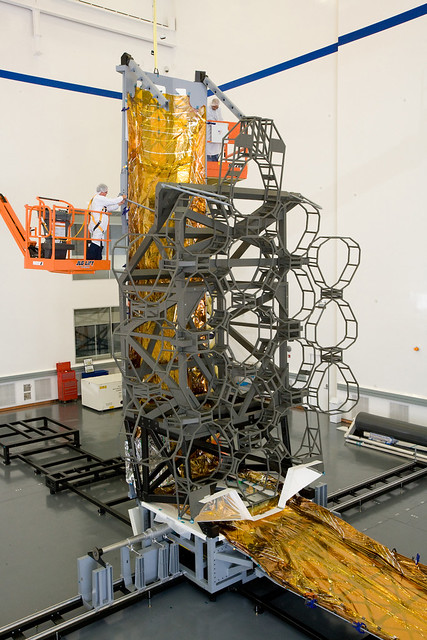
Webb’s Golden Mirror Wings Open One Last Time on Earth
[Image ~  James Webb Space Telescope]

Webb will be the largest telescope ever placed in space; 100 times more powerful than Hubble. So big it has to fold origami-style to fit in the rocket and will unfold like a "Transformer" in space. It will peer back in time over 13.5 billion years to see the first galaxies born after the Big Bang.

Once launched, Webb will be the largest, most powerful and complex space telescope ever built and launched into space. It will fundamentally alter humans' understanding of the universe. The powerful telescope will orbit the sun, a million miles away from Earth at the second Lagrange point. (L2 is four times further away than the moon!)

The Story of Webb

NASA aims to finally launch it Oct. 31 aboard a European Ariane 5 rocket made by France-based Arianespace from Europe’s Guiana Space Center in French Guiana, a region of France in South America. This is the European Space Agency’s contribution to the international project, which also involved the Canadian Space Agency.

The Webb observatory will be much larger the Hubble Space Telescope, which was launched in 1990. Webb’s main mirror, or light-gathering surface, is 21 feet across, compared to Hubble’s at 7.8 feet. Webb’s solar shield, which will keep its infrared instruments cold in space, is about the size of a tennis court. The telescope will orbit the sun, almost one million miles from Earth.

The longer wavelengths enable Webb to look much closer to the beginning of time and to hunt for the unobserved formation of the first galaxies, as well as to look inside dust clouds where stars and planetary systems are forming today.

Astronomer and physics professor at Arizona State University, Rogier Windhorst, said --
It’s going to be like Galileo first looking at the sky through a telescope. Our eyes are going to be reopened to the universe. …So, we’re going to see new and unexpected things that we’ve never dreamed of before.

Webb will ship to the launch site in August with little to no schedule margin; launch processing will take two months. The observatory has completed all the post-environmental testing deployments, and it is in its final integration and folding stages. Final stow, closeout, and pack and ship are imminent. 

NASA is working closely with the European Space Agency (ESA) and Arianespace on establishing the launch date. 

Webb will study every phase in the history of our universe, including the first luminous glows after the creation of the cosmos, the formation of solar systems capable of supporting life on planets like Earth, and the evolution of our own solar system.

AXA XL and Space Tech Startup SpaceAble Team Up To Support Safe and Responsible Activity in Low Earth Orbit


AXA XL Insurance announced it has established a global partnership with SpaceAble, a start-up specialising in Space Situational Awareness (SSA), to better support satellite operators and organisations operating in space.

Based in France and a leading European SSA service provider, SpaceAble’s mission is to enhance operational safety in Low Earth Orbit (LEO) through the collection and management of space-related data and modelling.

Through this partnership, AXA XL will have access to SpaceAble’s solutions, including ISSAN, a LEO data collection and secured web-based platform. These solutions, combined with AXA XL’s underwriting and risk management expertise, will allow AXA XL to further enhance its insurance solutions for satellite operators.

Chris Kunstadter, Global Head of Space at AXA XL, commented: “According to industry reports, commercial launch costs to LEO have been reduced by a factor of 20 over the last 20 years. This, combined with significant investment and development in smaller satellites, means that the LEO economy will continue to grow considerably over the next decade, making it a strategic area of focus for satellite operators and space insurers.”

Denis Bousquet, Global Chief Technical Officer, Space Insurance at AXA XL, added: “In space, just as on earth, sophisticated risk management begins with quality data. Partnering with a cutting-edge company such as SpaceAble, that shares our vision and has deep expertise, is a key milestone for our space insurance business.”

Julien Cantegreil, Chief Executive Officer of SpaceAble, commented: “We are proud to have partnered with AXA XL, a leading global provider of space insurance. This collaboration will allow us to refine our offering and to co-develop new solutions for insurers and satellite operators. Together, we will play a key role in increasing operational safety in LEO and, more broadly, in shaping the future of space environment."

ABOUT AXA XL

AXA XL1, the property & casualty and specialty risk division of AXA, provides insurance and risk management products and services for mid-sized companies through to large multinationals, and reinsurance solutions to insurance companies globally. We partner with those who move the world forward. To learn more, visit www.axaxl.com


Amazon Launches 'AWS Space Accelerator' for Startups


Amazon Web Services (AWS) has launched “Space Accelerator”, a four-week business support programme to help space startups grow.

The AWS Space Accelerator is a 4-week business support program that is open to space startups seeking to use AWS to help solve the biggest challenges in the space industry. Applications are open today and proposals are due by April 21, 2021.

The programme will provide technical, business, and mentoring resources to space startups around the globe.

AWS is offering this opportunity in collaboration with Seraphim, one of the world’s leading investment groups focused exclusively on the space industry, who will provide business development and investment guidance. 

AWS and Seraphim will select a cohort of space startups to participate in an intensive, four-week program with AWS Cloud and technical training to help them accelerate research, development, and growth using AWS. Seraphim, has helped dozens of emerging space companies around the world become investment ready through its own space accelerator program.

“Startups provide a catalyst for bold new experimentation in the space industry,” Clint Crosier, Director of Aerospace and Satellite at AWS, said in a statement.

“We are proud to announce the AWS Space Accelerator as part of our ongoing commitment to help startups succeed, and to shape the future of aerospace. We look forward to helping the first cohort of companies launch and grow through this new programme.”

AWS and Seraphim are accepting applications from innovative startups at all stages of maturity working with space technology or space-derived data who have a clearly defined and unique mission.

Qualifying missions can include, but are not limited to, earth observation, electronics and robotics, spacecraft launch and delivery, spacecraft hardware and software, launch manufacturing and launch operations, and more, AWS said.

Just Like in IT Sector, Indian talent to Attain Global Fame in Space Sector As Well - PM Modi

Just like Indian talent has been able to attain worldwide fame in the IT sector, it will be able to do so in the Space sector as well: PM

PM interacts with industries, startups and academia from Space sector
Reforms in the Space sector not limited to ensuring Ease of Doing Business; help being provided at each and every stage: PM

PM expresses hope that the country would soon become the manufacturing hub of space assets

Our endeavour is also to ensure the benefits of the space program reach out to the poorest: PM


Prime Minister Shri Narendra Modi today interacted with key industries, startups and academia from the Space sector via video conferencing to encourage their participation in space activities.

The Union Cabinet led by the Prime Minister took the historic decision in June 2020 to open up the Space sector and enable the participation of Indian private sector in the entire gamut of space activities. With the creation of Indian National Space Promotion and Authorization Centre (IN-SPACe), the reforms will provide a level playing field for private companies and start-ups. Subsequently, several ventures have submitted proposals with IN-SPACe under the Department of Space. The proposals pertain to a vast range of activities including satellite constellation, small satellite launch vehicles, ground station, geospatial services, propulsion systems and application products.

Unlocking India’s potential in Space sector


Prime Minister thanked the participants for providing feedback about their experience so far. He said that the decision to unlock India’s potential in the Space sector has heralded a new age of public-private partnership in this sector. He assured the participants of complete and wholehearted support of the government in this endeavour. He noted that the professionalism and transparency in policies as well as the decision-making process of the government will prove beneficial for the companies joining the Space sector.

Taking note of the plans of companies to make rockets and satellites, the Prime Minister remarked that this marks a big change that will further strengthen India’s foray into the Space sector. He said that private investment in the sector will lead to the creation of hi-tech jobs, which will provide a host of opportunities to the talent pool in IITs/NITs and other technical institutions. He said that it is his firm belief that just like Indian talent has been able to attain worldwide fame in the IT sector, it will be able to do so in the Space sector as well.

Going beyond Ease of Doing Business


Prime Minister underlined that the reforms in the Space sector are not limited to ensuring ease of doing business, but necessary mechanisms have also been put in place to ensure help for the participants at each stage, including making available testing facilities and launchpads. He said that through these reforms, the endeavour is not only to ensure that India becomes a competitive space market, but also to ensure the benefits of the space programme reach out to the poorest. He asked the participants to think boldly and work for the benefit of the society and the country.

Prime Minister underlined the significance of the Space sector in communication and navigation. He assured the participants that they will be co-passengers with ISRO in this age of space research and expressed hope that the country would soon become the manufacturing hub of space assets.

Active participants in the AatmaNirbhar Bharat Abhiyan


Dr K. Sivan, Secretary, Department of Space (DOS) and Chairman, ISRO, briefed the Prime Minister on various proposals received from industry for obtaining permission from IN-SPACe and support from the Department of Space. He informed that more than 25 industries have already approached DOS for undertaking their space activities.

During the interaction, the participants provided feedback on the reforms to the Prime Minister. Shri Sunil Bharti Mittal from Bharti Enterprises, Shri Jayant Patil from Larsen & Toubro Ltd, Shri Srinath Ravichandran from Agnikul Cosmos Pvt Ltd, Shri Pawan Kumar Chandana from Skyroot Aerospace Ltd, Colonel H S Shankar from Alpha Design Technologies Pvt. Ltd., Shri Rakesh Verma from MapmyIndia, Shri Awais Ahmed from PIXXEL India and Smt Srimathy Kesan from Space Kidz India expressed their views during the session. They thanked the Prime Minister for the move of opening up the sector for private participation, adding that this will help India move towards becoming a superpower in space technology. They expressed resolve to work as active participants in the AatmaNirbhar Bharat Abhiyan. They appreciated the help and guidance being provided by ISRO for their projects and said that the collaboration of private agencies with ISRO will not only result in more rocket launches per year but will also shape new technological advancements in the development of rocket engines. They also suggested opening up ISRO facilities for children to draw them further into this sector.


ISRO's 'Space 2.0' Program - Pvt Co.s Now be Allowed to Build Rockets; New Space Body IN-SPACe Formed


Last month, Indian space agency ISRO had announced that private companies including start-ups will be allowed to take part in India's space activities including planetary exploration, outer space travel among others and now, in a major announcement, ISRO Chairman Dr K.Sivan revealed the next phase a.k.a "Space 2.0" strategies including incorporation of new organization to implement the same. Dr Sivan, in a recent (separate) interaction with NDTV, said that private sector will now be allowed to build rockets too.


Even for ISRO's ongoing Gaganyaan mission, the agency has invited participation from private players for the new technologies that will have to be developed. ISRO is inviting private firms to participate in activities including building their own launchpads, launch vehicles, satellites and providing commercial services.

By allowing private firms to participate in all space activities at ISRO, the Indian space agency wants to focus on more advance technology development, indigenisation of technologies, and capacity building.

Beside, the Indian union cabinet, on Wednesday, has approved the formation of a new organisation called "Indian National Space Promotion and Authorisation Centre (IN-SPACe) ", which will provide private firms with equal opportunities in the space sector.


IN-SPACe will have members from the Space Commission as well as industry representatives on its board.

Dr Sivan, who is also Secretary of the Department of Space (DoS), while interacting with media personnels through video-conferencing, further said on IN-SPACe that a majority of start-ups have shown interest in space applications.


While many start-ups have already shown interest to participate in the space sector that has now been opened up for private players, big corporates are yet to come forward.said Dr. K. Sivan


The IN-SPACe will also hand-hold, promote and guide the private industries in space activities through encouraging policies and a friendly regulatory environment,” the government said in a statement. ‘New Space India Limited (NSIL)’ would endeavour to reorient space activities from a ‘supply driven’ model to a ‘demand driven’ one, thereby ensuring optimum utilisation of the nation’s space assets, it stated.


Market Reports

Market Report & Surveys
IndianWeb2.com © all rights reserved