‏إظهار الرسائل ذات التسميات Space tech. إظهار كافة الرسائل

Yusaku Maezawa Announces Eight Crew Members Flying Around the Moon Aboard Starship

https://ift.tt/MxoIp6T

Yusaku Maezawa (CEO, Start Today, Inc.) announced that 8 crew members and 2 backup crew members have been selected for "dearMoon", the first all-civilian project to fly around the Moon aboard Starship, a rocket being developed by Space Exploration Technologies Corp. (Headquartered in Hawthorne, California, Founder: Elon Musk, SpaceX, Inc.).

dearMoon Crew

In March 2021, Maezawa, wishing to "open up the opportunity of going to space to more and more diverse talents", put out a call on the official dearMoon website for crew members to join him on the moon, and received more than 1 million applications from 249 countries and regions.

The profiles and interview videos of the 8 crew members and 2 backup crew members who passed the selection, interviews, and medical check have now been released. The 8 crew members from diverse backgrounds will fly around the Moon for approximately 7 days with Maezawa and return to Earth.

Crew Profile: Alphabetical Order

Rhiannon Adam

April 19, 1985 (37)

Nationality: Ireland

Activity: Photographic artist who is currently living and working between London and the US.

Steve Aoki

November 30, 1977 (45) Nationality: United States Activity: A 2x-GRAMMY- nominated music producer, artist, fashion designer and entrepreneur.

Yemi A.D.

November 4,1981 (41) Nationality: Czech Republic Activity: Multi-disciplinary creative force, social innovator and choreographer who teaches creativity to people & organizations.

Tim Dodd

February 27, 1985 (37) Nationality: United States Activity: Content creator, photographer, videographer, and musician. Host of YouTube Channel "Everyday Astronaut".

Brendan Hall

May 1, 1994 (28)

Nationality: United States Activity: Documentary filmmaker telling stories in the natural world and beyond.

Karim Iliya

April 20,1990 (32)

Nationality: UK

Activity: Photographer and filmmaker based in Iceland and Hawaii.

TOP / Choi Seung Hyun

November 4, 1987 (35) Nationality: South Korea Activity: Musician, award- winning film actor, and avid art collector.

Dev D. Joshi

November 28, 2000 (22) Nationality: India

Activity: Professional actor with experience of more than 18 years and social media influencer.

Backup Crew Profile

Kaitlyn Farrington

December 18, 1989 (32) Nationality: United States Activity: An Olympic Gold Medal in snowboard halfpipe in the 2014 Sochi Olympic Games.

Miyu

December 3, 1997 (25) Nationality: Japan Activity: Dancer, choreographer, and movement practitioner.

"A Message From MZ (Maezawa) - dearMoon Crew Announcement"

Maezawa fulfilled his dream of going to space by staying on the International Space Station (ISS) in December 2021. His next challenge is this "first all-civilian trip around the Moon in the history of mankind". The crew members were chosen from among those who had been openly invited from all over the world to join them in this challenge to an unknown world. In this video, Maezawa explains why he chose these crew members and how the selection process was carried out.

Comments by Yusaku Maezawa (excerpts)

We received applications from about one million people from all around the world. Following a strict screening and selection process, today we will be announcing ten crew members.

I had deep conversations with each candidate, asking them about their childhood, why they are dreaming about going to space, what kind of challenges they would like to undertake. They are all fantastic people. They all have beautiful smiles.

There isnt a set task for each of them, but I hope each and every crewmember will recognize the responsibility that comes with leaving the Earth, traveling around the Moon and back within a week. They will gain a lot from this experience, and I hope they will use that to contribute to the planet, to humanity.

SpaceX Official Quote

"The entire SpaceX team is excited for these extraordinary people to join the dearMoon mission! As they share their experiences flying around the Moon, this crew will inspire everyone back home on planet Earth," said Jessica Jensen, SpaceX Vice President of Customer Operations & Integration. "In advance of their flight, the SpaceX team continues to make great progress in the development of Starship, a fully and rapidly reusable interplanetary transportation system. We look forward to flying this crew of artists, content creators, and athletes from all around the world who will travel within 200 km of the lunar surface as they complete a full journey around the Moon before safely returning to Earth."

Yusaku Maezawa

Born in Chiba prefecture, Japan in 1975 (age 47), he founded the company, Start Today Ltd. (currently, ZOZO, Inc.) in 1998 and launched the online fashion mall ZOZOTOWN in 2004. The company was listed on the TSE Mothers in December 2007 (3092) and on the TSE First Section in February 2012, and its market capitalization exceeded 1 trillion yen in August 2017. In September 2019, Maezawa stepped down as CEO at the same time as the company released its capital and business alliance with Yahoo Japan Corporation. Immediately after, he established Start Today Inc., and in 2021, he started thirteen of his own businesses, including his own companys business. In December 2021, he became the first Japanese civilian to visit the ISS, spending about 12 days on board.

Elon Musk

Elon Musk is the founder and Chief Engineer of SpaceX, where he oversees the development and manufacturing of the world's most advanced rockets and spacecraft for various space missions. As one of the worlds leading entrepreneurs and engineers, Musk is also the CEO and product architect of Tesla, Inc.; owner and CEO of Twitter, Inc., founder of The Boring Company; Co-founder of Neuralink; and a founding member of PayPal, an online money- transfer service.

dearMoon Project Official Website / SNS

Official Website: dearmoon.earth

Twitter: twitter.com/dearmoonproject

Instagram: www.instagram.com/dearmoonproject

YouTube Channel: www.youtube.com/@dearmoon2023


Agnikul Cosmos Tested Its Single Piece, Fully 3D Printed Engine at VSSC with IN-SPACe Support

  • Agnikul with the help of IN-SPACe and ISRO tested its fully 3d printed engine at Thumba Equatorial Rocket Launching Station (TERLS), VSSC, Thiruvananthapuram, on Nov 4, 2022
  • This marks a milestone in the development of its launch vehicle Agnibaan
Indian space-tech start-up Agnikul, has successfully test fired its single piece 3D printed engine - Agnilet at Vertical Test Facility, Thumba Equatorial Rocket Launching Station (TERLS), at Vikram Sarabhai Space Center (VSSC), Thiruvananthapuram. With the support of IN-SPACe and ISRO this test was conducted to validate the technological possibility that rocket engines can be made as a single piece of hardware. The startup had recently announced that the Government Of India has awarded them the patent for the design and manufacturing of their single-piece rocket engines.

Agnikul Cosmos Tested Its Single Piece, Fully 3D Printed Engine at VSSC with IN-SPACe Support
Agnilet

Agnilet, one such single piece engine, is the world's first single-piece 3D printed rocket engine fully designed and manufactured in India, it was successfully test-fired at IIT Madras in 2021. This new test at TERLS has validated the design and manufacturing methodology followed by the startup. Also, this is a major milestone for 3D printing technology in India.

Agnikul had recently announced the inauguration of its Rocket Factory- 1, India’s first-ever rocket facility dedicated to 3D print such rocket engines at scale situated at the IIT Madras Research Park. The new state-of-the-art production house houses world-class machinery, including a 400mm x 400mm x 400mm metal 3D-printer from EOS, and a host of other machines that will enable end-to-end manufacturing of a rocket engine under one roof.


Commenting on it, Srinath Ravichandran, Co-founder & CEO, Agnikul said, “This is a unforgettable moment for all of us here at Agnikul. Besides validating our in-house technology, this is also a huge step in understanding how to design, develop and fire rocket engines at a professional level. We are incredibly thankful to IN-SPACe and ISRO for making this happen. Also grateful to the Indian Government for having made such efforts possible by the creation of IN-SPACe.”

Moin SPM, Co-founder & COO, Agnikul said, “This is a major milestone for us and the Indian private space ecosystem. With the efforts of IN-SPACe, the private space ecosystem is growing in the right direction and also gets access to the state-of-art technologies to make and test world class products inside the country. Thus, directly contributing to the Make in India and Aatmanirbhar bharat initiatives.”

Founded in 2017 by Srinath Ravichandran, Moin SPM & Prof. SR Chakravarthy (from IIT Madras), Agnikul is on a mission to make space accessible and affordable and has its eyes set on supporting Honourable PM’s vision of enabling the building of Aatamanirbhar Bharat. The IIT Madras incubated startup became the first Indian company to sign an agreement with the Indian Space Research Organisation (ISRO) in December 2020. The agreement signed under the IN-SPACe initiative helps Agnikul access ISRO's expertise and facilities to test its systems.

Agnikul has raised total funding of INR 105 Crores ($15Mn) from Mayfield India, pi Ventures, Speciale Invest, and a host of others including prominent angels such as Anand Mahindra and Naval Ravikant since 2019.

For more information, https://www.isro.gov.in/ISRO_Agnilet_Engine.html

About Agnikul Cosmos:

Agnikul Cosmos Private Limited is a Chennai, India-based start-up incubated at the Indian Institute of Technology, Madras (IIT Madras). It is building India’s first private small satellite rocket, Agnibaan, that will be capable of carrying up to 100 to 300 kg of payload to low Earth orbits up to 700 km. The vehicle has the capability for a plug-and-play engine configuration that is configurable to precisely match the mission's needs.

For more information, visit https://agnikul.in

Homi Lab Celebrated International Day for the Preservation of the Ozone Layer

https://ift.tt/U9I1FpG

World Ozone Day is observed every year on September 16 to highlight and spread awareness about the significance of the Ozone layer for the protection of the Earth.

Photos from Space

Addressing the children from all across the world on the occasion of International Day for the Preservation of the Ozone Layer at a virtual program, the Hon'ble Minister of State for Environment, Forest and Climate Change, Consumer Affairs Food and Public Distribution, Govt. of India Shri Ashwini Kumar Choubey said, "This year also marks the 35th anniversary of the implementation of the Montreal Protocol which was designed to protect the ozone layer by phasing out the production of numerous substances responsible for ozone depletion. The Montreal Protocol serves as a powerful example of multilateralism in action." "The many problems facing the world - from deadly viruses to the climate change crisis - is a reminder that we can succeed in working together for the common good," he added.

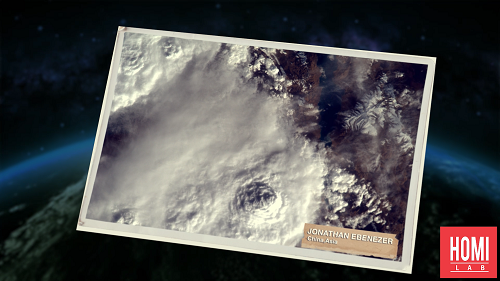
Homi Lab, the world's first future learning lab in association with NASA's Marshall Space Flight Center and Johnson Space Flight Center and Kalam Centre organized the International Space Station Camp where students were selected and trained to operate a digital camera on the International Space Station. Over 500 students from across the globe photographed various beautiful locations on Earth from a unique perspective in space. These students were also felicitated by the Hon'ble Minister.

The Hon'ble Minister of Environment, Forest and Climate Change, Shri Ashwini Kumar Choubey joined as the Distinguished Guest for the inauguration of the 'Photos from Space' Gallery. This gallery serves as an extraordinary resource to study not only science but also geography, art, and above all the environment.

Srijan Pal Singh, Founder and CEO, Homi Lab and Former Advisor to Dr. A.P.J. Abdul Kalam, said, "These photos highlight the concern our younger generation has towards protecting the sustainability of our planet. Also, this shows that young minds in our schools can be trained to use equipment in space and achieve extraordinary results. Homi Lab aspires to make future learning and big dreams part of our journey."


WhiteHat Jr and EnduroSat Partner to Enable Kids to "Code a Satellite"; Launched Ayana Satellite to Encourage Space Exploration

https://ift.tt/gLDQB6j

  • The Satellite, named Ayana, was part of the payload carried by the SpaceX Falcon 9 rideshare rocket, launched on May 25 at 18:35 GMT, from Cape Canaveral, Florida, USA

  • The initiative is part of 'Code a Satellite' programme from WhiteHat Jr through a partnership with EnduroSat, a leading space service organisation

  • It's a first-of-its-kind programme where thousands of kids can access the live satellite to explore the space and experience working like a space scientist

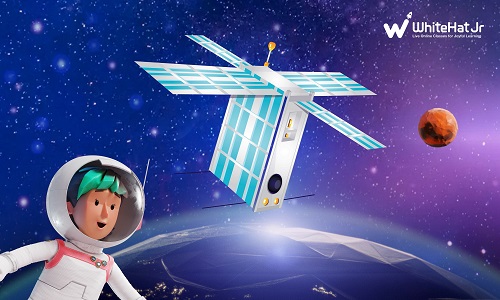
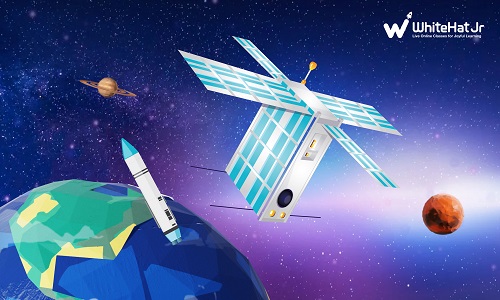
In its effort to introduce new learning experiences and innovation, WhiteHat Jr will be enabling its students to access a live satellite to encourage space exploration and give a first-hand experience in space science. The satellite, named Ayana, has been developed by leading space service organisation EnduroSat with inputs from and expertise of the WhiteHat Jr team. Ayana was part of the payload carried by the SpaceX Falcon 9 rideshare rocket, launched on May 25 at 18:35 GMT, from Cape Canaveral, Florida, USA. Ayana will create a one of a kind applied science opportunity for thousands of students who will be able to send commands to, and access data from a live satellite operating in space.

WhiteHat Jr and EnduroSat launched Ayana Satellite

Ayana is a result of the WhiteHat Jr's "Code A Satellite" programme, which is designed for WhiteHat Jr students to ideate, create, and explore space with the help of Ayana. Before accessing Ayana, students will be required to possess a basic understanding of coding to ensure that they are able to unlock the true potential of the program. Students will get a unique opportunity to:

  • Track and monitor Ayana's journey in real-time through an exclusive 90-degree camera

  • Observe Earth's landscapes and weather

  • Understand the correlation between power and sun sensor values

  • Simulate satellite behaviour by tinkering with the sensor values

WhiteHat Jr and EnduroSat launched Ayana Satellite

Speaking about the initiative, Ananya Tripathi, WhiteHat Jr CEO said, "We always believe in creativity, exploration and innovation-beyond the limits. Satellite and space technology are often considered out of reach and difficult to access by students. With the Code a Satellite programme, we will be able to democratise space technology and provide our students with an exceptional opportunity to interact with an orbiting satellite in real time. We are confident this will excite and encourage thousands of brilliant young minds across the globe and help them code like space scientists as they build their projects."

From analysing sensor data (there are 30+ sensors onboard the satellite, including infrared, temperature, solar, and gyroscopic) to controlling cameras and taking pictures, to relaying messages to and fro, the applied science opportunities that students can access are vast. More than 500 kids have already enrolled for the 'Code-a -Satellite' program to become space coders through this program. WhiteHat Jr is the first edtech company in India which is making live satellite accessible to children through this program.

About WhiteHat Jr

WhiteHat Jr was launched with the singular mission of empowering kids to become creators versus consumers of technology. The company has channelled students' natural creativity through an engaging curriculum and personalised, live teacher attention. WhiteHat Jr's 11,000+ strong teacher workforce conducts thousands of LIVE online classes every day on its proprietary platform. Cumulatively, the company has conducted more than 8.5 million classes to date. WhiteHat Jr was acquired by BYJUS, the worlds leading and Indias largest Edtech company, in 2020.


An International Centre for Space and Cosmology Launched at Ahmedabad University

Ahmedabad University announces the launch of a new International Centre for Space and Cosmology. The Centre will drive cutting edge research in the areas of Space, Astrophysics and Cosmology, train next generation of researchers, and advance the public understanding of this very exciting domain of Physics. The Centre seeks to reach out to young students to encourage them to consider a research career in Space and Cosmology and provide them with information regarding opportunities in these areas.
 
Sgr A* black hole at the centre of the Milky Way

The Centre will operate closely with other research clusters at Ahmedabad University. The International Centre for Space and Cosmology is also planning workshops and conferences, looking to host visitors for short and long durations, engage with students across the world who have an interest in Astrophysics, Space and Cosmology, and create academic programmes.

Anchored at Ahmedabad University's School of Arts and Sciences, the Centre will work in collaboration with colleagues nationally and internationally with related interests. The Director, Professor Pankaj Joshi, is a scientist acknowledged for his fundamental contributions in Black Hole Physics and Cosmology. One of his major topics of research is the possibility of gravitational collapse of massive stars into naked singularities rather than black holes. The other founding faculty members of the Centre are Professor Gaurav Goswami and Professor Raghavan Rangarajan, both of whom work on Cosmology and High Energy Physics, particularly in the context of early Universe physics and correlations with observations of the Universe today.

The launch of the new Centre coincides with recent observations by the Event Horizon Telescope (May 2022) of the highly compact and dense object at the centre of the Milky Way galaxy. Using an array of networked radio telescopes around the globe, an image has been obtained showing the ultracompact object at the centre of our galaxy. The JMN (Joshi-Malafarina-Narayan) naked singularity model proposed and published in 2011 by Professor Pankaj Joshi and colleagues contributed to the modelling that underlies this discovery.

About Ahmedabad University

Ahmedabad University is a leading private, non-profit research university offering students a liberal education focused on interdisciplinary learning and research thinking. The University, established in 2009, is rooted in the vision of one of India's finest educational foundations, the Ahmedabad Education Society, which was founded in 1935 by nationalist leaders. Programmes at the University range from bachelors to doctoral levels in humanities & social sciences, natural sciences, engineering and management through its ten Schools and Centres:

Amrut Mody School of Management | School of Arts and Sciences | School of Engineering and Applied Science | Centre for Heritage Management | VentureStudio | Centre for Learning Futures | Global Centre for Environment and Energy | Centre for Inter-Asian Research | Ahmedabad Design Lab | International Centre for Space and Cosmology.

An urban university, Ahmedabad promotes independent-mindedness and diversity across all dimensions of its activity and helps students mature into critical thinkers who are analytically equipped, practically oriented, and contextually-aware global citizens. The University provides a contemporary educational framework that brings liberal arts, sciences, and the professions to engage together in creating new knowledge for addressing complex challenges of the society and in offering majors that merge the boundaries of disciplines to prepare students for the new economy.

For more information, please visit: www.ahduni.edu.in. 

Telangana To Use Metaverse for Launching Its SpaceTech Framework

Telangana To Use Metaverse for Launching Its SpaceTech Framework

Emerging Technologies Wing of Telangana state government's ITE&C Department has formulated a SpaceTech Framework, which will be launched in an event on April 18, and the sate government is planning to launch the SpaceTech Framework through a virtual event using Metaverse platform.

"We are planning to launch the SpaceTech Framework on April 18 using Metaverse. There will not be any physical event, it will all be virtual,” IT and Industries Secretary Jayesh Ranjan said in a media statement

Through the upcoming Metaverse event, representatives from the IT and Industries department, Space-Tech startup founders and other delegates will be shown in their virtual avatar. This include virtual avatars of Spacetech startups like Skyroot Aerospace and Dhruva, among others. Moreover, the government representatives would be elaborating on the framework through their virtual avatars too.

ISRO chairman and Telangana IT and Industries Minister K.T.Rama Rao are also among those invited to the programme.

Jayesh Ranjan, Principal Secretary (IT and Industries), said, "This will be the first time that an Indian State will be unveiling an emerging technology policy by using another niche technology. While Metaverse has many use cases, the State decided that we should also promote it in our own way. So, we thought of unveiling the Space-Tech framework through the Metaverse platform on April 18."

In an effort to achieve the above discussed objectives and position Telangana as the primary hub for all space-related activities, the state government has consulted various stakeholders from industry, academia, national agencies, startups and other domain experts to come up with the state’s strategies.

Under this upcoming framework, the SpaceTech startups shall also be considered part of the INR 1,300 Cr Startup Fund, setup under the sate's ICT Policy 2021-26 to support the startups.

The state government will also facilitate grants, suitable incentives and infrastructure support to promote research and development to boost space tech innovation.

A Space-Tech Fellowships will also be offered to students from India and abroad, to work on high end use cases in partnership with government departments, national and international research academic institutions. The fellowships shall focus on both the technical as well as business aspects in order to ignite the spirit of entrepreneurship.

Pen or Pencil ? How Astronauts Write in Space ?

NASA astronaut Walter Cunningham writes with a Fisher Space Pen during the flight of Apollo 7, the first crewed Apollo flight and the Space Pen’s first trip to space. The pens have been used on every NASA human spaceflight mission since. [Credits: NASA]


How astronauts write aboard the space station ? Is it pencils or pens, or do they have special pens to write notes in micro-gravity of space. NASA recently revealed the detailed information bursting all the myths and speculations on how astronauts write in space, including speculations that NASA spent millions to invent a pen that can write in zero gravity, while cosmonauts simply used a pencil.

No, Astronauts DO NOT use Pencils because the pencil lead could easily break off and float away, making a harm to astronauts like going into their eyes, nose or ears and even hazardous to sensitive electronics on the spacecraft / ISS.

Is there A Pen Specially-made for Space ?

Yes and its called "Space Pen" made by Fisher Pen Company. The pens were introduced to space service on the Apollo7 mission and have been in regular NASA use since then.

The AG7 is the original Fisher Space Pen that was used on the Apollo 7 space mission in 1968 after 2 years of testing by NASA.

The AG7 model was the very first Fisher Space Pen.
Image Credits: Fisher Pen Company


Fisher's Space Pen was developed for use in gravity free environments. The cartridge, pressurized with nitrogen, seals out air preventing evaporation and oxidation of the ink. Internal pressures force ink outward toward the ball point. A thixotropic ink is used. 

According to NASA Technical Reports Server, the pen operates from -50 to +45 degrees Fahrenheit, and can withstand atmospheric extremes. It was used both on the Apollo missions and by Soviet Cosmonauts.

In 2021, the technology was recognized by the Space Foundation as an innovation developed for space that now improves life on Earth, joining around 80 other technologies in the organization’s Hall of Fame.

History of Inception of Space Pen

NASA reached out to Fisher Pen Company founder Paul Fisher looking for a pen that didn’t require gravity. Paul had already invented the 1st universal ink cartridge refill and was working on a sealed cartridge with pressurized nitrogen at the top pushing a tiny piston against the ink. But the pressure caused the pens to leak. 

Paul knew this pressurized ink cartridge could be just the thing -- if he could solve the leaks. With NASA’s interest spurring him on, he finally succeeded when he added resin to the ink to make it “thixotropic” – almost solid until friction with the ball at the point of the pen liquefied it. He called the result the AG7, for anti-gravity, and sent several to NASA.

Paul and his son, Cary Fisher, continued perfecting the technology and designing new models and now the Space Pen line comprises about 80 models. Fisher Pen Company has distributors in 52 countries but still makes all its pens in Boulder City, where more than 60 employees turn out over a million pens a year.

The Cost 

The cost of original AG7 Space Pen is $70 (~ ₹ 5,124 ), which is excluding delivery charges, directly via official Space Pen store. The Space Pen is also available on Amazon at $60 and on Amazon India at price tag of ₹9,662.

Over 400 Participants from 12 Countries Attended 2-day Conference by SIA-India

https://ift.tt/3lMoVbW

Mr. Prakasha Rao, Director, SIPO; ISRO HQ suggested that 'Sia-India' should create a portal for listing capabilities of Indian Industry in the field of design, development, manufacturing and investment community to facilitate interaction between Govt and young start-ups and SatCom industry.

SatCom Emerging trends - Speakers

'

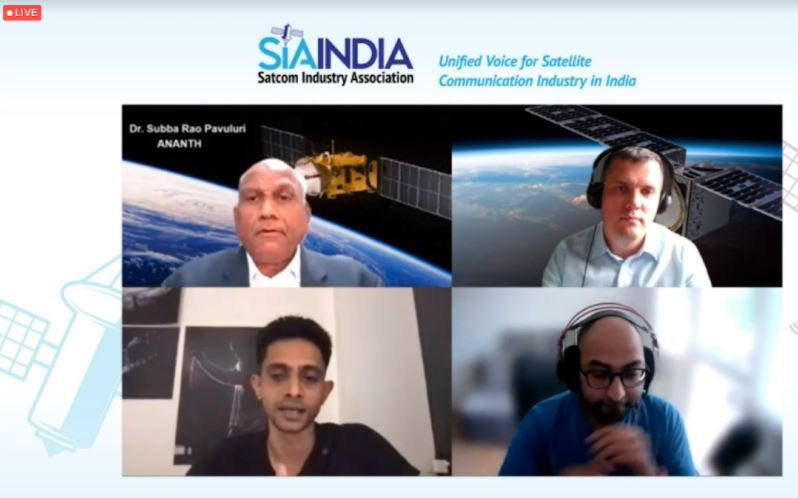
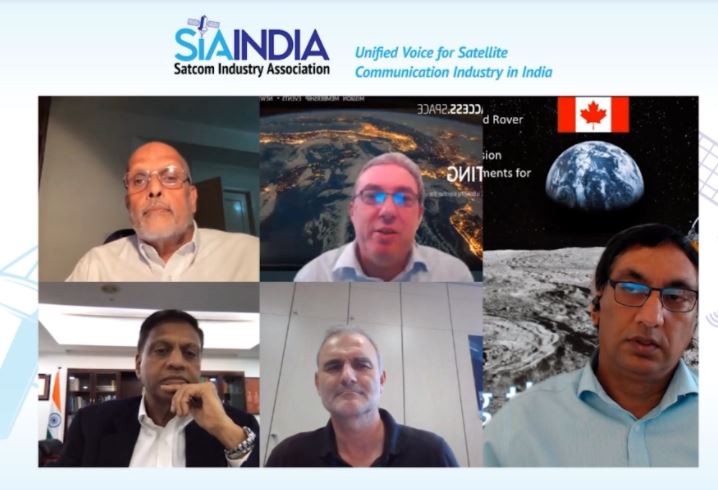
SatCom Emerging trends: Post reform era' a 2 day conference by SIA-India was attended by 48 speakers from over 12 countries with active participation of 400+ participants over 2 days.

SatCom Emerging trends - Speakers

The virtual event saw the leading luminaries and eminent speakers discussing the future role of Satellite industry especially in the context of India. Supported by ISRO the objective of this conference was to provide a platform to various stakeholders to come together and address the critical issues and challenges faced by the Satellite industry.

In his opening remark, Dr. Subba Rao Pavuluri, President-Sia-India & CMD - Ananth Technologies Ltd. outlined the importance and future prospect of space technology especially the Indian Satcom ecosystem. According to Dr. Rao, over 500 firms engaged in space technologies will benefit from these reforms. Mr. Thomas Choi, Founder CEO - Airspace IX and Founder CEO - Speedcast Limited mentioned, "India should focus more on developing systems which are not expensive." In his special address, Mr. R. Umamaheshwaran, Scientific Secretary, ISRO (Guest of Honour) talked about the fantastic growth of the SatCom industry in India in the last 40 years which has drastically affected the lives of the common people. He further said, "Space has the opportunity to play a complementary role for development and growth." Dr. AS Kiran Kumar, Former Chairman ISRO & Secretary, Department of Space emphasized on the larger participation of private and global players in this field to fulfil the need and demand for Satcom Industry overall growth in India.

"In a country with 57% rural India is unconnected, satellites will play a pivotal role in bridging the digital divide. SIA-Indias emphasis is to play an important role in facilitating a regulatory and policy framework to make this happen," Mr. Anil Prakash, Director General, Satcom Industry Association.

The day 2 of the event saw eminent speakers deliberate on the participation of the private sector in the SatCom industry. Space Startups connecting to International markets with emerging business Models was also a subject for the discussion.

This well timed conference is expected to help create a bridge between the government and the industry bodies to understand the importance of the space economy as the next big leap towards making India a global superpower.

About SIA-India

SIA-India is a non-profit association created to represent the interests of the communication satellite ecosystem in India. As a vibrant body, SIA-India represents satellite operators, satellite systems, launch vehicles and ground and terminal equipment manufacturers and application solutions providers to the Government, Regulators, Policymakers, and domestic and international standards bodies. As the apex representative body for the satellite communications ecosystem, we aim to present the industrys interest to the highest Government levels for policy-making and regulatory and licensing matters.

A unified voice for Satellite Communication Industry in India Website: www.sia-india.com.


Taking One Step Closer to Life on Mars, Interstellar Lab Unveils 'BioPod' Created with Dassault Systèmes’ 3DEXPERIENCE Platform

BioPod Top-View

Self-sustaining food production system advances Interstellar Lab’s mission to support human life sustainably on Earth, the Moon and Mars by generating and recycling food, water, air

Interstellar Lab used a virtual twin experience to simulate, test and optimize the performance of BioPod’s dome and biological systems

In the race to explore space, the “Reinvent the Sky” industry solution experience on the cloud accelerates concept to certification for disruptive companies

VELIZY-VILLACOUBLAY, France — June 24, 2021 — Dassault Systèmes (Euronext Paris: #13065, DSY.PA) today announced that Interstellar Lab, a research company creating closed-loop controlled environment habitats and biospheres generating and recycling food, water and air, used the 3DEXPERIENCE platform on the cloud to efficiently design and develop its first prototype, BioPod. This controlled environment food production system advances its mission to build space-ready stations containing the infrastructure and resources to support human life sustainably on Earth, the Moon and Mars.

Interstellar Lab used the “Reinvent the Sky” industry solution experience based on the 3DEXPERIENCE platform to seamlessly collaborate, and rapidly optimize and validate its designs. In one digital environment providing secure and instant access to the latest project data from anywhere at any time, team members in France and the U.S. combined their expertise and used a virtual twin to simulate and test the performance of BioPod’s structure in extreme climates, as well as that of its biological systems such as the optimal levels of oxygen, carbon dioxide and light levels for plants to grow.

Bio Pods on Earth

"Climate change is a real emergency for Earth and we only have a small window to bring about positive change. We are developing a new framework for sustainable living on Earth and a testbed for future space missions,” said Barbara Belvisi, Founder and CEO, Interstellar Lab. “The 3DEXPERIENCE platform enables us to have the most efficient working processes and avoid reworking designs from scratch. As we progress to the next stage, the platform’s program and project management capabilities will be invaluable to us for storing and retrieving design knowledge and managing the product lifecycle effectively."

BioPod is an inflatable dome measuring 6 meters (19.7 feet) wide, 10 meters (32.8 feet) long and 4.5 meters (14.8 feet) high that uses composites for the solid technical base and soft plastic membranes for the main and outer shell. It is designed to revolutionize food production by combining advanced crop cultivation technology with predictive monitoring to grow a diverse array of crops and plants that would not otherwise survive in a traditional indoor farming setup.

As BioPod evolves, Interstellar Lab will use the virtual twin to experience and monitor the dome’s operations and maintenance, and gather data around food production and the environment. The 3DEXPERIENCE platform will also facilitate communication with suppliers as the company designs future modules and scales up manufacturing and outsourcing, and enable Interstellar Lab to create photo-realistic renderings from BioPod’s 3D model, to communicate its vision.

"Innovators are shaking up traditional industry dynamics in the race to explore space with new concepts defining the future of aerospace systems,” said David Ziegler, Vice President, Aerospace & Defense Industry, Dassault Systèmes. “The 3DEXPERIENCE platform enables them to integrate technology into product development and accelerate the product lifecycle from concept to certification using the same tools that larger companies use, without the overhead. They can engage in virtual twin experiences to optimize their ideas, gain critical first-to-market advantage, and introduce more sustainable ways to live and explore."

Chandigarh University Launches North India's 1st Satellite Designing Program 'CUSAT'

- "India amongst the elite group of nations in the arena of Space Technology," says Moon Man of India, Dr. Mylswamy Annadurai

- Chandigarh University to design and launch its own multipurpose satellite in 10 months


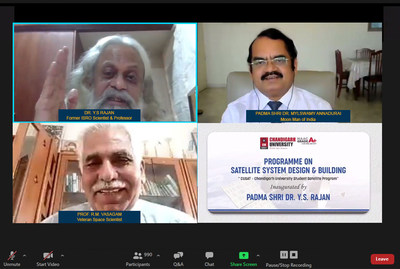
CHANDIGARH, India, May 14, 2021 /PRNewswire/ -- Chandigarh University has launched Student Satellite Designing and Training program 'CUSAT' and it has become North India's first University to launch the advanced training program for the students in the field of Aerospace Engineering. The virtual inauguration session of CUSAT was held today which was attended by distinguished Aerospace Engineering Scientists and Professionals which included Padma Shri Dr. YS Rajan, Scientist and Honorary Professor, ISRO; Padmashri Prof. R.M.Vasagam, Veteran Space Scientist and ISRO's former Director, Geostationary Satellite Apple's Project Director; Padma Shri Dr. Mylswamy Annadurai, Program Director of Chandrayaan-1 & Mangalyaan, also known as Moon Man of India.


While giving details about the newly launched satellite designing program for the students, Chancellor Chandigarh University, Satnam Singh Sandhu said, "The first-of-its-kind training program in Satellite Designing and Testing would have a duration of 4-months and it would be open for the students of Computer Science Engineering, Electronics and Communication Engineering, Mechatronics, Aerospace Engineering, Mechanical Engineering, Electrical Engineering, and Geo-Informatics." The training program would include study of Satellite Designing, Integration of Components, Testing and Simulation of launch process, collection & analysis of data from the satellite. "The students would undergo training under the guidance of former Indian and International Space Scientists including scientists from ISRO," added Sandhu. Chandigarh University has planned to design and launch a multipurpose Nano-satellite within a period of 10-12 months which will be launched in space by ISRO.

While giving his inaugural address Dr. YS Rajan said, "Scientists from North India like Kalpana Chawla, Dr. Satish Dhawan have made big time contribution in the field of Space Technology and Exploration and therefore it is important to educate the young & budding engineers from this part of India about the rich legacy that they have in this field." 

Dr. Rajan added, "It is not important that you design the whole satellite or mission. Designing and assembly of a small component plays an equal and important role in the success of a Space Mission. The first-of-its-kind training program introduced by Chandigarh University will play an important foundation in taking the interest of students of North India especially from Punjab towards the rewarding career in the field of Space Technology."

While giving the keynote address, Dr. Mylswamy Annadurai also known as Moon Man of India said, "Russia and USA have maintained a lead for the past many decades in space exploration and space research and although India entered into the field much later yet India has carved out a special identity for itself in the International space program". He further added, "The success of Chandrayan 1 and Mangalyaan missions have significantly positioned India amongst the top countries that have a great success rate in launching satellites and carried out experimental projects. The foundation of Indian space is so strong which can be verified by the fact that many missions of Russia and other nations took 5 or 6 attempts, but India has been successful in just one attempt in the Mangalyaan mission without any International help." 

The success of Indian Space Research Program and ISRO has also opened new economic opportunities that can significantly contribute in the GDP of the country, added Dr. Annadurai. India has already helped countries like U.A.E, Singapore, Thailand, France, Spain, and others countries to launch their satellite which will help them in communication, navigation, and in other programs also.

"The training of young students should focus on apprising them with the real time problems that can be solved with the help of space technology. Satellite to be designed by Chandigarh University should focus on providing and collecting data which can be useful to tackle problems like Floods, Landslides, Draught Situation, and Underground Water Conservation. Addressing such real time situation through scientific approach should be the main objective of the satellite designing and training program launched by Chandigarh University," said veteran space scientist, Prof. R.M.Vasagam.

"Chandigarh University has always focused on providing real-time industry exposure for its students where they can attain hands-on practical experience under the guidance of industry experts," said Satnam Singh Sandhu, Chancellor, Chandigarh University. He further said, "Chandigarh University would be spending Rs. 1 crore for designing of Nano-satellite for which the training of students has already began. The establishment of ground control station for the satellite project is already underway and we are sure to design and launch our own multipurpose satellite within a time frame of 10-12 months."

About Chandigarh University

Chandigarh University is a NAAC A+ Grade University and an autonomous educational institution approved by UGC and is located near Chandigarh in the state of Punjab. It is the youngest university in India and the only private university in Punjab to be honored with A+ Grade by NAAC (National Assessment and Accreditation Council). CU offers more than 109 UG and PG programs in the field of engineering, management, pharmacy, law, architecture, journalism, animation, hotel management, commerce and others. It has been awarded as The University with Best Placements by WCRC.

Website: https://cucet.cuchd.in/

Indian High School Students to Compete for a Chance to Run Coding Experiments on the Edge Computer in Space

https://ift.tt/2Vos9Uq

  • Hewlett Packard Enterprise (HPE) Collaborates with K-12 coding platform Codingal to Host HPE CodeWars 2021 India Edition

  • The winner of the all India competition will win a chance to run experiments on HPE's Spaceborne Computer-2 (SBC-2) located aboard the International Space Station (ISS)

Hewlett Packard Enterprise is all set to host its annual coding event for students, HPE CodeWars 2021 India Edition. The first-of-its-kind virtual competition will be hosted in partnership with the leading K-12 coding platform Codingal.

Winner of the competition will get a chance to run their coding experiments on HPE's Spaceborne Computer-2 (SBC-2) which has been launched in space to be used on the International Space Station (ISS).

HPE CodeWars 2021 India Edition will be hosted on April 10, 2021. The competition, currently open for participation from schools across the country, aims to engage high-school students from grade 9-12 in order to motivate them to pursue coding and to introduce them to STEM-based career paths.

More than 3,000 students from schools across India are expected to participate in HPE CodeWars 2021 India Edition. Participants stand a chance to win prizes worth Rs 2,00,000/- from HPE and certificates for recognition; in addition to interacting with the SBC-2 and mentorship with HPE India technology leads.

For the competition, the students are required to solve 25 coding-related problems in 3 hours using any of the programming languages among C, C++, Java, Python, and JavaScript. More details about the competition are available here - www.codingal.com/competitions/hpe-codewars-2021.

Students will also get free guides on how to prepare for the competition. There will be a practice session consisting of 30 coding problems to solve. This will prepare young school students for how virtual competitions and problem-solving works. They will also get an idea of what type of problem statements to expect in the main competition.

Vivek Prakash, Co-founder of Codingal said, "HPE's Spaceborne Computer-2 is a part of an ongoing mission to test advanced, reliable computing in space by using an affordable, high-performing, commercial off-the-shelf (COTS) computer system that organizations buy and use on Earth, which has never been done before. We are extremely excited to collaborate with HPE to host HPE CodeWars 2021 India Edition, with a common goal of making the students realize the unprecedented opportunities that lie ahead of them through coding."

"In today's technology-centric life, it is crucial for children to develop logical thinking and problem-solving skills and coding can allow them to enhance these skills. HPE is an innovation leader and we couldn't have found a better partner to give students a dream platform to code and interact with HPE Spaceborne Computer-2 on the International Space Station. We hope this creates excitement among the children and allows them to unleash their potential," adds Vivek.

Pallavi Mahajan, VP & Site Lead, HPE India R&D Center said "HPE CodeWars is a gateway to an aspirational career option in the field of technology. It is aimed at high school students from grades 9th to 12th. It is a matter of pride for HPE to be able to encourage young minds by being a force for good. We are excited that the top ranks get an opportunity to run their experiments on HPE's Spaceborne Computer-2, which for the first time, is bringing astronauts and researchers the most advanced computer to run projects right from space by using the HPE ProLiant server and HPE Edgeline Converged Edge system that organizations use here on Earth."

Hewlett Packard Enterprise is the global edge-to-cloud platform as-a-service company that helps organizations accelerate outcomes by unlocking value from all of their data, everywhere. Built on decades of reimagining the future and innovating to advance the way people live and work, HPE delivers unique, open and intelligent technology solutions, with a consistent experience across all clouds and edges, to help customers develop new business models, engage in new ways, and increase operational performance.

Codingal is the #1 coding platform for K-12, with a mission to inspire school students to fall in love with coding at a young age. Launched in September 2020, Codingal has already empowered 40,000+ students by motivating them to start learning coding via competitions and high-quality coding education. All classes are taught live 1:1 by vetted and trained teachers who are expert at programming and only from a Computer Science background. The coding curriculum is based on a standardized K-12 Computer Science Framework, which students find very fun & engaging.

Today, schools and traditional education systems are not equipped to provide the proper coding education to children. Codingal is here to change that and empower every student with the tools, content, competitions, and live coding classes to start learning to code and build anything they imagine. Codingal is also backed by top industry advisors and investors, including Rebright Partners and Y Combinator.


Space Technology Sector To Create Large Scale Employment Opportunities under PM's Vision - Minister

Image is representative only


Union Minister Dr. Jitendra Singh said today that the Prime Minister’s vision for space technology is to unlock India’s potential in space sector; to transform skill, capacity and creativity to make the country self-reliant and technologically advanced. In a written reply to a question in the Rajya Sabha, the Minister said, the vision seeks to create opportunities for large scale employment generation in the space sector. 

India as global space technology powerhouse will play a major catalytic role in the advancement of socio-economic use of space assets, while guiding & promoting private sector through enabling policy environment.

The vision will transform the approach in space sector from supply driven to demand driven model for optimum utilization of national resources while harnessing capacity & creative skills and focus shall be more on R&D, cutting-edge technology, newer frontiers in space, space exploration, human space flight with a view to attract & exploit the potential of the future generation.

The vision will also provide enhanced benefits to the common man, through further development of technology-delivered public services in a faster, cheaper and efficient manner.


SatSure - Bellatrix Aerospace Signed a Memorandum of Understanding for Establishing a High-Resolution Satellite Constellation

At the Bellatrix Aerospace office in Bangalore, from left to right, Rohan Muralidhar, CEO, and Yashas Karanam, COO of Bellatrix Aerospace with Prateep Basu, CEO, and Rashmit Singh Sukhmani, CTO of SatSure AG

BENGALURU, India, Feb. 3, 2021 /PRNewswire/ -- The global space industry has been growing rapidly since the last decade. India has contributed to it through its NewSpace companies and the recent formation of InSpace by the Indian Space Research Organization (ISRO).

SatSure, founded in 2016 with core business in enterprise AI-based software products and platforms, has seen a surge in demand post-COVID-19 for data insights and solutions based on high-resolution satellite imagery at affordable price points that helps in decision making across the aviation, banking, insurance, and transportation, sectors.

While Bellatrix Aerospace, an IP driven company founded in 2015 and working on advanced spacecraft propulsion systems, is currently expanding its business towards being a prime contractor for developing and operating unconventional satellite platforms for highly demanding mission requirements.

In this respect, on February 3rd, 2021, SatSure has signed a Memorandum of Understanding (MoU) with Bellatrix Aerospace to help place its payloads in the Low Earth Orbit (LEO). The satellites will host a novel on-board processor for in-orbit high-resolution data processing using SatSure's proprietary Deep Learning algorithms and ultra low-bandwidth data transmission on a microsatellite platform comprising of Bellatrix Aerospace's unique hybrid propulsion systems. The missions will be supported by Bellatrix Aerospace's agile satellite platform currently under development and powered by its unique hybrid propulsion technology. SatSure and Bellatrix Aerospace plan to have the first satellite of the proposed constellation launched by December 2022. A return for proposal (RFP) for payload design, integration and testing will be made available to the industry in the coming weeks.

Mr Prateep Basu, CEO & Co-Founder at SatSure AG, said, "We are very excited about this partnership with Bellatrix Aerospace. This investment from our side is a natural step to providing timely and unique insights from space to our clients globally. Many breakthrough technologies will be demonstrated in the first mission, be it the hardware, software, or hardware-software integration. It is a hazardous mission, but then no innovation has ever been done without trial and errors."

Speaking about this partnership, Mr Rohan Muralidhar, CEO of Bellatrix Aerospace, said, "We see great synergies with SatSure on this mission, which we believe will set new benchmarks for frugal innovation. With this constellation, SatSure's proven capabilities in satellite data processing and pipelines will be further augmented with the help of high-resolution real-time imagery. This is also a significant announcement for Bellatrix, as we will be working on more of such missions catering to very niche mission requirements."

Bellatrix Aerospace is a full-suite solution provider of spacecraft propulsion systems based in Bangalore, India offering both chemical and electric propulsion technologies. The company has various recognitions for its innovation, including two National Awards.

SatSure is a World Economic Forum Global Innovator, providing decision intelligence by leveraging advances in satellites, machine learning and Big Data analytics across multiple domains like banking, insurance, agriculture, forestry, public infrastructure, and oil & gas. The company is based in St. Gallen (Switzerland), Bangalore (India), Liverpool (U.K.), and Sydney (Australia).

Launching 143 Satellites in One-Go, SpaceX breaks ISRO’s Record


In February last year, Indian Space Research Organization (ISRO) set a world record by launching 104 satellites on board a Polar Satellite Launch Vehicle (PSLV) flight. Jump cut to 25th January, Elon Musk-promoted SpaceX broke this record by launching 143 small satellites.

SpaceX successfully launched its ambitious rideshare mission called Transporter-1, carrying 143 small satellites, and created a new record of launching many satellites from a single rocket. With this launch, SpaceX broke the record set by ISRO in February 2017 for deploying 104 satellites onboard PSLV in a single mission.

The 143 satellites included 133 commercial and government satellites and 10 Starlink satellites of SpaceX.

The launch was part of SpaceX’s SmallSat Rideshare Program mission and the firm’s social media handles shared pictures from the launch. Falcon 9 which has taken part in numerous SpaceX missions in the past flew from Florida to take the 143 satellites of different shapes and sizes to their orbits.

SpaceX is offering to transport packages to earth-orbit for just $1 million.

In a separate development, SpaceX CEO Elon Musk and Amazon founder Jeff Bezos, the two richest people in the world, are fighting over altitude of satellites of their own respective ambitious projects related to satellites constellation.

To Promote Space and STEM Education, ISRO To Adopt 100 Atal Tinkering Labs Across India

ISRO To Adopt 100 Atal Tinkering Labs Across India

In an exciting online event today, Atal Innovation Mission, NITI Aayog and Indian Space Research Organization (ISRO) announced that ISRO will be adopting 100 Atal Tinkering Labs across the country to promote education in the field of STEM, Space education and space technology related Innovations for school students.

Addressing the virtual event through a special message, NITI Aayog Vice Chairman Dr. Rajiv Kumar said, “I am extremely elated that different departments and ministries of the Government of India are working in synergy to create an ‘Aatmanirbhar Bharat’. The collaboration between NITI Aayog and Indian Space Research Organization is one of the prime examples of such effort.

This is a great opportunity for our young budding space researchers and astronauts to learn from the best minds of our country, and become living inspirations for their school, families and local communities.”

Gracing the occasion, ISRO Chairman Dr K. Sivan expressed hope that the step shall help promoting innovation and the spirit of experiential learning among the school kids compared to traditional learning. He also opined that this project based learning will improve the attitude towards research right from the school days. With today’s adoption of 100 ATLs, distributed geographically in line with ISRO’s presence across the country, the organization is taking a small step in engaging with the students, towards giving them direction in pursuing their space dreams as a part of ‘Atma Nirbhar Bharat’. Scientists and engineers from ISRO centers, in close coordination with Capacity Building Program Office, ISRO Headquarters, shall actively mentor the kids as well as interact with teachers in these ATLs for encouraging experiments, brainstorming ideas and spreading awareness in space activities. Dr. Sivan also announced invitation to the students associated with these Atal Tinkering Labs, to one of the launches as guests, to witness the launch from Sriharikota.

An Atal Tinkering Lab provides a makerspace where young minds can give shape to their ideas through hands on do-it-yourself mode; and learn innovation skills. To foster entrepreneurship and innovation, Atal Innovation Mission, NITI Aayog has established over 7000 ATLs across the country so far enabling over 3 Million+ students between Grade VI to Grade XII acquire a problem solving, tinkering and innovative mindset. Through this collaboration, ISRO will facilitate coaching and mentoring of students in advanced cutting-edge technologies of the 21st century including those related to space. The students will not only gain only theoretical but also practical and application-based knowledge of STEM and Space Education related concepts such as Electronics, Physics, Optics, Space Technology, Material sciences and many more.

“I am proud to share that NITI Aayog is collaborating with ISRO to make advancements in space technology via Atal Innovation Mission and its initiatives, such as ARISE, Atal Incubation Centers, Atal Community Innovation Centers, and Atal Tinkering Labs.

I am glad that to nurture our future space scientists, ISRO in collaboration with their regional research centers are adopting 100 Atal Tinkering Labs, where ISRO scientists and researchers will personally guide and mentor the young innovators in the field of STEM education and Space technology.”, added NITI Aayog CEO Shri Amitabh Kant.

“We currently are witnessing an extremely exciting time in Space Technology. ISRO has been a global pioneer and innovative leader in this area with many crucial landmark achievements for India in the recent past. Recently ISRO has also opened up to startups and private players pitching in, and the future of space industry is very promising. This collaboration with ISRO will add great impetus to the opportunities provided by ATLs to young school students to learn in space technologies and innovate for the country” said Mr. Ramanathan Ramanan, Mission Director, Atal Innovation Mission, adding “By providing access to the latest technologies, it not only aligns with the vision of the NEP 2020 but also paves the way for an Aatmanirbhar Bharat.”

Atal Innovation Mission had earlier collaborated with ISRO for the Aatmanirbhar Bharat ARISE-ANIC Initiative along with four other ministries to spur applied research and innovation in Indian MSMEs and startups.

ISRO's Arm IN-SPACe To Provide Level Playing Field To Startups and Discourage Brain-Drain of Talented Space Scientists and Experts - Minister

Satish Dhawan Space Centre (SDSC) SHAR, Sriharikota Range
[Image - isro.gov.in]


Union Minister of State (Independent Charge) Development of North Eastern Region (DoNER), MoS PMO, Personnel, Public Grievances, Pensions, Atomic Energy and Space, Dr. Jitendra Singh stated here today that ISRO (Indian Space Research Organization) in collaboration with private sector will boost “Atmanirbhar Bharat”.

In a brief about some recent achievements of ISRO and India’s space programme, Dr. Jitendra Singh gave full credit to Prime Minister Narendra Modi whose personal intervention had made it possible to arrive at the historic decision to open up India’s Space sector for participation by private players. 

He said, the decision to create Indian National Space Promotion and Authorisation Centre (IN-SPACe) will provide a level playing field for private companies as well as Start-Ups. The proposed range of space activities includes Small Satellite Launch Vehicle, Geospatial services, Satellite Constellation, Application products, etc, he added.


Dr. Jitendra Singh said, the move to open up the Space sector for private participation was a path-breaking step taken by Prime Minister Modi and has been widely welcomed by leading private players across the country. He quoted the Prime Minister's words that through these reforms, the endeavor is not only to ensure that India becomes a competitive Space market, but also to ensure that the benefits of the Space programme reach out to the poorest. This is in keeping with the Modi Government's principle of planning every reform with the aim to benefit the poorest of the poor and to make India self-reliant through consistent endeavour in the direction of Atmanirbhar Bharat, he said. 

Related ReadingISRO's 'Space 2.0' Program - Pvt Co.s Now be Allowed to Build Rockets; New Space Body IN-SPACe Formed

Besides enhancing the capacity and resources of the Space sector, said Dr. Jitendra Singh, increased participation of private players will also discourage the brain-drain of talented Space scientists and experts who were otherwise moving out of India in search of a break. 

He further informed that more than 25 industries have already approached the Department of Space for undertaking space activities as per the guidelines.

Under the Modi government, Dr. Jitendra Singh said, the applications of Space technology had, in the last six years, been extended to different areas of infrastructure development as well as to bring ease of living for the common citizen. The Space and satellite technology is today being extensively used in railways, road and bridge construction, agriculture sector, housing, tele-medicine, etc, besides disaster management and accurate weather forecast, he added.

ISRO's Commercial Arm NSIL to Launch "India’s 1st Private" Remote Sensing Satellite

Representative

Bengaluru-based space technology startup Pixxel has entered into an agreement with ISRO's newly established commercial arm, NewSpace India Ltd (NSIL), also a Government of India company under the Department of Space (DoS), to launch the startup’s first remote-sensing satellite and India's first private remote-sensing satellite on an ISRO PSLV rocket in early 2021.

DoS and Pixxel will collaborate to enhance utilization and maximize the benefits of space assets for India. 

Though IRS-1A was India's first of the series of indigenous state-of-art operating remote sensing satellites that were launched in 1988. Pixxel's satellite will be India's first private remote-sensing satellite to be launched by Indian space agency ISRO. The ISRO-Pixxel agreement comes after recently established IN-SPACe, the authorization and regulatory body under the Department of Space (DoS) for enabling private players including startups to undertake space activities in India.

K.Sivan, Secretary of DoS, said - 
With the establishment of IN-SPACe we will also be partnering with other private players, that can help India achieve more milestones in the future.

"This first-of-a-kind private earth-observation mission will help provide solutions to many pressing environmental and agricultural issues among others and help make the world a better and more sustainable place," Pixxel said in a media statement.

Pixxel is building a constellation of earth imaging small satellites that will provide global coverage every 24 hours once fully deployed. The satellites will collect high-throughput information-rich data that will be analyzed using Artificial Intelligence and Machine Learning models to help make organizations more efficient in a plethora of sectors ranging from agriculture to urban monitoring among others.

Awais Ahmed, CEO, Pixxel, said "We are elated with the fact that India’s first commercial private satellite will now launch on an Indian rocket. This is not only a proud moment for us as an organisation but also as citizens to work with our nation’s capabilities."

Earlier in November last year, Pixxel had also inked an agreement with Italian firm Leaf Space for launching the first of its 24 earth imagery satellites, which was scheduled in July this year. 

Started by BITS Pilani alumni, Awais Ahmed and Kshitij Khandelwal, in February 2019, Pixxel was Asia's only Space Startup to qualify for the 2019 Techstars Starburst Space Accelerator in Los Angeles.

Godrej & Boyce sees new opportunities as the Indian Space Sector opens up for private participation

Godrej Aerospace partners with ISRO on its first satellite launch since January '20


MUMBAI, India , Nov. 18, 2020 /PRNewswire/ -- Godrej Aerospace, the aerospace and defence business of Godrej & Boyce, today announced that it sees significant opportunities to capture emerging from the opening up of the Indian Space sector which permits increased private participation.

This follows ISRO's (Indian Space Research Organization) successful launch of its own earth observation satellite (EOS-01), as well as nine satellites from other countries, using Polar Satellite Launch Vehicle (PSLV-C49), from the Satish Dhawan Space Centre in Andhra Pradesh on November 7, 2020 .

Godrej Aerospace played a key role in the first satellite launch after the COVID-19 pandemic began, by manufacturing the Vikas engine which is used to propel the second stage of the rocket.

This was the 51st mission for ISRO's PSLV as this launch vehicle continues to cement its reputation globally as one of the best rockets in its category, and is known for its reliability.

Congratulating ISRO, Mr. S M Vaidya, EVP & Business Head, Godrej Aerospace, said, "The successful launch of ISRO's PSLV carrying 10 satellites was a special occasion as ISRO overcame many constraints during the pandemic to enable this launch ."

He added: "We believe that ISRO's future space missions and their call for more private sector participation in Space will ensure better opportunities for Godrej Aerospace to showcase its engineering and manufacturing excellence and thereby continue to drive self-reliance in this strategic area ."

Godrej Aerospace has been partnering with ISRO for over 30 years to manufacture complex systems such as the liquid propulsion engines for PSLV and GSLV rockets, thrusters for satellites, and antenna systems.

Godrej Aerospace has also played an integral part in the Chandrayaan and Mangalyaan missions to the Moon and Mars respectively and has been proudly committed to the cause of driving indigenous manufacturing for India's space programs which are key to propel India's technological prowess on the global stage.

About Godrej & Boyce Mfg. Co.

Godrej & Boyce ('G&B'), a Godrej Group company, was founded in 1897, and has contributed to India's journey of self-reliance through manufacturing. G&B patented the world's first springless lock and since then, has diversified into 14 businesses across various sectors from Security, Furniture, Aerospace to Infrastructure and Defence. Godrej is one of India's most trusted brands serving over 1.1bn customers worldwide daily.

Govt Completely Scraps 18% GST on Indian Satellite Making Startups to Use ISRO Rockets


Earlier this month, in a bid to encourage start-ups making satellites to use ISRO's domestic launching services, GST Council has decided to exempt 18% GST levied on satellite launch services offered by the space agency ISRO and its commercial arm Antrix Corporation Ltd as well as New Space India Limited (NSIL).

In a 42nd meeting held on 5th of this month, GST Council recommended that 18% GST will be completely scrapped, said a notification announcement on Friday.

Prior to this announcement, an Indian satellite-maker must pay 18%t GST to launch satellites on ISRO’s rockets, whereas a foreign customer can do the same without paying any GST.

In a notification dated 16 October, that seeks to amend Notification No. 12/2017- Central Tax (Rate) the 28th June, 2017 which pertains to Exemptions on supply of services under CGST Act, serial number 19C is added in order to exempt Satellite launch services supplied by Indian Space Research Organization, Antrix Corporation Limited or New Space India Limited.

The startups that are manufacturing satellites will be exempted from GST now when they choose Indian launch vehicle.

The announcement also proved to be an incentive to those Satellite making startups that were earlier forced to opt for foreign rockets for their initial satellite launch. Notably, earlier the launch services provided to foreign companies was ironically qualify as “export of service” which are exempt from the levy of GST. So it is cheaper for an Indian-origin company or Stat-up ventures to register their business in a foreign country and launch using ISRO rockets as a foreign customer.

In 2018, the Falcon 9 rocket of Elon Musk-promoted firm SpaceX took off its space flight and carried 70 satellites from 16 countries including one from India called 'ExceedSAT 1', which became the first ever private satellite from India.

IIT Roorkee commemorates World Space Week 2020 through week-long webinar series

Indian Institute of Technology (IIT) Roorkee commemorated World Space Week 2020 through a week-long series of webinars with eminent luminaries as speakers. The various sessions shared strategic insights on space technology and the working of the Indian Space Research Organization(ISRO). The objective of the event is to commemorate the contribution of science and technology to the betterment of human lives. Prof. Ajit K. Chaturvedi, Director, IIT Roorkee inaugurated the event.


"Space technology is playing a critical role in our country's growth, from helping education to disaster mitigation and management. ISRO is now a symbol of our national pride and attracts the attention of the youth of the country who wish to pursue science and technology as a career. I am happy that eminent engineers and scientists from ISRO helped IIT Roorkee celebrate the World Space Week. We would specially like to thank Dr. Bhanu Pant, Shri Kali Shanker, Dr. RajashreeVinodBothale and Dr. D. Ram Rajak of ISRO for giving very informative lectures during the week," said Prof. Ajit K. Chaturvedi, Director, IIT Roorkee.

The first webinar titled 'Space Materials' witnessed Dr. Bhanu Pant, Outstanding Scientist, Group Director, Materials & Metallurgy Group, ISRO, enlightening the audience on the rationale of using various materials and their role in the space programmes. Dr. Pant joined ISRO in 1982and is currently leading a unique Group on research and development activities encompassing metallic/ ceramic/ ceramic-composite materials and process developments for all ISRO programs.

The second webinar titled 'Interesting Facts on Indian Space Agency' presided by Shri Kali Shanker, an IIT Roorkee alumnus and a former scientist in Space Applications Centre(SAC), ISRO. It threw light on interesting facts and figures on India's apex space organization- ISRO. 

The two sessions on remote Sensing Application'had Dr. RajashreeVinodBothale, Group Director, Training, Education & Outreach Group, NRSC and Dr. D. Ram Rajak, Scientist/Engineer-SG, Cryosphere Sciences Division, GHCAG / EPSA, Space Applications Centre (SAC), Indian Space Research Organisation (ISRO) as speakers respectively. Dr. Rajashree had also served as an ITEC expert on Remote Sensing and GIS to the Government of Mauritius on government deputation. Dr. Rajak'sprimary area of research is cryospheric studies. He has participated in the 33rd Indian Expedition to Antarctica (2013-14), in Arctic Expedition (March-April 2019) and two Himalayan Expeditions to Khardung-la (2016) and Chipa (2019) glaciers. These sessions focused on the contribution of remote sensing technology across various segments. The closing session titled 'Satellite Launchers & Payloads' featured Shri Vijai Kumar, worked on satellite payload project progress monitoring as well as on development and realisation of mechanical subsystems for communication satellite payloads, as a group head, SAC, ISRO 


"India is among the elite nations in space research. As a responsible organization, ISRO is committing to fostering innovation and shaping the trajectory of economic development in India through its unique projects and collaborative approach Dr. Bhanu Pant, Outstanding Scientist, Group Director, Materials & Metallurgy Group, ISRO. 

Prof M. Parida. Deputy Director IIT Roorkee mentioned in his Concluding remarks, "On the concluding day ceremony of World Space Week Lecture series, I am very happy to share that IIT Roorkee has long been associated with ISRO through various projects and collaborations that have resulted in a long-term engagement with ISRO through the recently set up ISRO IIT R Space Technology Cell. The STC is now the single contact point for reaching out to ISRO for attracting more funds. Our in-house expertise in various areas of Space Technology will greatly augment the research output in the related areas. Celebration of World Space Week for the past three years including the challenging time in this year's pandemic certainly reflects the interest of IIT Roorkee to get more involved in space technology programs."


Announced by the United Nations General Assembly on December 6, 1999, World Space Week is an annual event celebrated between October 4 and 10. The choice of dates coincides with two significant milestones in space history: the launch of the first human-made Earth satellite, Sputnik 1, on October 4, 1957, and the signing of the Outer Space Treaty on October 10, 1967. World Space Week is the largest annual space event in the world.

Market Reports

Market Report & Surveys
IndianWeb2.com © all rights reserved