‏إظهار الرسائل ذات التسميات satellites. إظهار كافة الرسائل

Reliance Takes Aim at Space: Jio to Launch India’s Own Starlink Rival

Reliance Takes Aim at Space: Jio to Launch India’s Own Starlink Rival

Reliance Industries is preparing a multi‑billion‑dollar push into satellite communications via Jio Platforms, aiming to build India’s answer to Starlink with a constellation of low earth orbit (LEO) satellites. Mukesh Ambani is personally spearheading the project, which is already in advanced planning stages.

Key Highlights of Reliance’s Satellite Communications Entry

  • Investment Scale: Multi‑billion‑dollar commitment focused on LEO satellites.
  • Platform: The satellite arm will be housed under Jio Platforms (JPL).
  • Leadership: Mukesh Ambani is leading the initiative, supported by senior executives.
  • Project Teams: Six specialized teams are working on satellites, launches, payloads, user terminals, and regulatory filings.
  • Regulatory Moves: Reliance has begun discussions with India’s Department of Telecommunications (DoT) to file orbital slots with the International Telecommunication Union (ITU).
  • Timeline: Targeting rollout within 2–4 years, positioning Reliance against Starlink, Amazon Kuiper, and OneWeb.

Strategic Importance

  • Domestic Capability: India’s government is keen to reduce reliance on foreign satcom providers.
  • Global Competition: China has filed for 200,000 satellites across multiple LEO constellations.
  • Connectivity Impact: LEO satellites enable high‑speed, low‑latency internet, vital for rural and remote areas.

Comparison: Reliance vs Global Players

CompanyFocus AreaInvestment ScaleTarget MarketTimeline
Reliance (Jio Platforms)LEO satellitesMulti‑billion USDIndia + Global2–4 years
Starlink (SpaceX)LEO satellites$10B+GlobalOperational
Amazon KuiperLEO satellites$10BGlobal2026–27
OneWeb (Eutelsat)LEO satellites$3B+Global (gov & enterprise)Operational

Risks & Challenges

  • Regulatory hurdles: Spectrum allocation and orbital slot approvals.
  • Capital intensity: Multi‑billion‑dollar upfront investment with long payback cycles.
  • Global competition: Starlink already operational with thousands of satellites.
  • Technology partnerships: Reliance is in talks with satellite tech firms.

What This Means for India

  • Boost to Digital India: Potential to bridge the rural‑urban digital divide.
  • Strategic autonomy: Reduces dependence on foreign satellite networks.
  • Industrial synergy: Complements Reliance’s telecom dominance.

SatLeo Labs Secures $2.2M to Advance AI-Powered Thermal Satellite Constellation

SatLeo Labs Secures $2.2M to Advance AI-Powered Thermal Satellite Constellation

  • The funding will accelerate SatLeo’s flagship thermal satellite mission and fast-track its AI-powered platform for next-gen thermal intelligence.
SatLeo Labs, a leading space-tech startup focused on capturing high-resolution thermal & visible data from Low Earth Orbit (LEO) has raised $2.2Mn in a seed round led by Unicorn India Ventures. With this, SatLeo has raised $5.5M in total funding to date. The round also saw participation from existing investors Merak Ventures, Java Capital, IIMA-CIIE and Deep tech Investor Manish Gandhi. The funding will be deployed to advance SatLeo’s flagship thermal satellite mission and the development of its AI-powered platform for thermal intelligence applications.

Over the last 12 months, SatLeo has experienced significant growth across technology development, team expansion, funding, and commercial traction. The company has grown its team from 8 to 30 members, bringing together engineers and researchers with deep expertise in satellite missions, thermal sensing, and AI-driven geospatial analytics.

The company has achieved a major milestone by designing and delivering its first experimental thermal payload, TAPAS-1, for satellite integration within six months, reaching TRL-8 readiness and positioning the system for launch. In parallel, the company began translating its technology into real-world deployments through commercial pilot projects, including urban heat island and air-pollution monitoring initiatives with cities such as Ahmedabad and Tumakuru, impacting more than 400,000 citizens. Additionally, the company has built a strong commercial pipeline, with Letters of Intent (LOIs) growing from approximately $15Mn to over $42Mn within the year, reflecting strong market demand for SatLeo’s space-based thermal intelligence solutions.

Sustainability has become imperative amid accelerating climate change, rapid urbanization, and increasing global uncertainties driven by heat anomalies," said Shravan Bhati, Co-founder & CEO, SatLeo Labs. At SatLeo Labs, we are developing a state-of-the-art thermal imaging satellite constellation designed to deliver actionable thermal intelligence at scale. This fundraise represents a critical milestone as we transition into the execution phase of our next mission—advancing payload performance, accelerating constellation deployment, and scaling our global thermal data capabilities.”

Bhaskar Majumdar, Managing Partner, Unicorn India Ventures, said, “We strongly believe that space is an arena where the next technological innovations and solutions will emerge from. This is our third space tech investment. The value of SatLeo presents a compelling opportunity, as it has a strong technological edge with very clear commercial applications aligning with the market needs. The company’s differentiated product is combining thermal and visible satellites to generate high value real-time insights and is well positioned to drive long-term value to become a key player in the space-tech ecosystem.”

In the next 12 months, SatLeo plans to focus on advancing its space-based thermal intelligence capabilities through satellite launch readiness, commercial expansion, and technology scaling

About SatLeo Labs

SatLeo Labs is a spacetech company building an advanced multi-spectral satellite constellation combining thermal (IR) and visible imaging to deliver continuous, high-resolution Earth observation insights. Its platform enables applications across defence, agriculture, disaster response, and urban climate intelligence, helping governments and enterprises make data-driven, sovereign decisions and build climate-resilient systems at scale.

About Unicorn India Ventures

Started in 2016 by Bhaskar Majumdar and Anil Joshi, Unicorn India Ventures is a deep tech focused early-stage fund that invests in emerging and visionary startups. Unicorn India Ventures launched its first fund with a corpus of Rs 100 crore and invested in 17 companies like SmartCoin, Open Bank, Sequretek, Pharmarack, Genrobotics, Clootrack, FutureCure to mention some. The Fund has emerged as the best performing early-stage fund in India with the stellar exits provided by the fund to its LPs. Fund II is a Rs 300 Cr fund launched in 2020 that has invested in 20 companies so far like Gamerji, Probus, Daalchini, Windo, Finsall. Most of the portfolio is scaling up fast and has had several uprounds.

Unicorn India Ventures has closed its Rs 1200 Cr Fund III surpassing the target of Rs 1000 Crore. With this Fund, UIV aims to build a portfolio of 20 startups that are focused mostly in the deep tech sector that includes semiconductor, space tech, and medical diagnostics apart from AI infrastructure and India digital platforms. Companies like Netrasemi, Kluisz, OrbitAID, TakeMe2Space, Aurassure, EyeROV, QubeHealth to name a few.

Recently, IIT-Madras and Unicorn India Ventures launched Rs 1000 crore “IITM Unicorn Frontier Fund I”. UIV is a fund with engineering DNA and has been backing deeptech companies for over a decade. The Fund has investors across the globe represented by institutions, family offices and UHNIs. The Fund has a global viewpoint while sourcing companies throughout the country.

Space Rivalry Heats Up: Amazon Challenges Musk’s Mega Constellation, Faces FCC Scrutiny

Space Rivalry Heats Up: Amazon Challenges Musk’s Mega Constellation, Faces FCC Scrutiny

Amazon has urged the U.S. government to reject Elon Musk’s ambitious plan to launch 1 million satellites, calling it unrealistic and potentially hazardous, while the FCC chair has criticized Amazon itself for the slow pace of its own satellite rollout. This clash highlights the intensifying rivalry between SpaceX’s Starlink and Amazon’s Project Kuiper in the race to dominate global satellite internet.

The Core of the Dispute

  • Amazon’s Objection to Musk’s Plan
    • Amazon argues that deploying 1 million satellites would be impractical, even if the entire global launch capacity were dedicated to the project.
    • The company warns it could take centuries to complete, create massive space debris risks, and disrupt other operators.
    • Amazon’s filing with the FCC emphasizes the lack of technical, safety, and disposal details in SpaceX’s proposal.
  • FCC Chair’s Criticism of Amazon
    • While Amazon challenges Musk’s plan, the FCC chair has criticized Amazon for delays in its own Project Kuiper launches.
    • Amazon has been slower to deploy satellites compared to SpaceX, which already has over 3,200 Starlink satellites in orbit providing global service.
    • The FCC has signaled impatience, urging Amazon to accelerate its rollout to remain competitive and meet regulatory expectations.

Rivalry in Context

Company Project Current Status Key Criticism
SpaceX (Musk) Starlink + proposed 1M satellites ~3,200 satellites already operational Plan seen as unrealistic, risky for orbital safety
Amazon (Kuiper/Leo) Kuiper satellite internet Launches delayed, slower progress FCC chair says rollout too slow

Why This Matters

  • Global Internet Access: Both companies aim to provide high-speed internet worldwide, especially in underserved regions.
  • Regulatory Oversight: The FCC’s role is crucial in balancing innovation with safety, orbital sustainability, and fair competition.
  • Space Sustainability: A million satellites could overwhelm orbital pathways, raising risks of collisions and debris that threaten all operators.

Key Takeaways

  • Amazon is positioning itself as the responsible player, warning against Musk’s “orbital data center” plan.
  • The FCC is skeptical of both sides: Musk’s plan for being too ambitious, and Amazon’s for being too slow.
  • The rivalry underscores a broader debate: Should space be a frontier for limitless expansion, or carefully regulated to ensure sustainability?

From Disney Star to Space CEO: Bridgit Mendler Secures $100M for Satellite Antennas

From Disney Star to Space CEO: Bridgit Mendler Secures $100M for Satellite Antennas

Bridgit Mendler, former Disney Channel actress and singer, has raised $100 million for her space startup Northwood Space, which builds advanced ground infrastructure and phased array antennas to improve satellite connectivity. The Series B round was co-led by Washington Harbour Partners and Andreessen Horowitz.

Founded in 2023, by Bridgit Mendler, Shaurya Luthra, and Griffin Cleverly, Northwood Space is positioning itself as the “ground infrastructure backbone” for the new space economy, aiming to solve one of the least glamorous but most essential problems in satellite operations: how data gets back to Earth efficiently.

The California–based startup builds next‑generation ground infrastructure—specifically phased array antennas and mobile ground stations—to improve satellite‑to‑Earth connectivity. It has already raised more than $136 million in funding, including a $100 million Series B announced now hip?  

Key Highlights

  • CEO & Co-Founder: Bridgit Mendler, known for her Disney Channel career and music, now leads Northwood Space.
  • Funding Round: $100 million Series B, announced
    January 27, 2026.
  • Investors: Washington Harbour Partners and Andreessen Horowitz jointly led the round.
  • Company Focus:
    • Builds phased array antennas and mobile ground infrastructure.
    • Enhances satellite-to-Earth connectivity for telecom, defense, and climate monitoring.
    • Addresses the problem of aging and obsolete satellite ground systems.
  • Location: Based in
    Southern California.
  • Use of Funds: Expansion of manufacturing and production capacity to support time-sensitive space missions.

Why It Matters

  • Satellite Boom: Thousands of satellites are being launched for communications, defense, and Earth observation.
  • Bottleneck: While rockets and satellites are advancing,
    ground infrastructure lags behind, limiting data transfer efficiency.
  • Northwood’s Solution: Modern, mobile ground stations that can be deployed quickly to meet mission needs.
Northwood Space's first phased array ground station

From Disney Star to Space CEO: Bridgit Mendler Secures $100M for Satellite Antennas
Rendering of Northwood Antenna

Comparison: Traditional vs. Northwood Approach

Feature Traditional Ground Systems Northwood Space
Technology Fixed parabolic antennas Phased array antennas
Mobility Stationary, large facilities Mobile, deployable units
Scalability Slow to expand Rapid manufacturing & deployment
Connectivity Limited bandwidth Enhanced, flexible connectivity
Target Users Government-heavy Commercial + defense + climate

Risks & Challenges

  • Competition: Other startups and established aerospace firms are also modernizing ground systems.
  • Capital Intensity: Manufacturing antennas and infrastructure requires significant upfront investment.
  • Regulatory Hurdles: Satellite communications involve complex international regulations.
  • Execution Risk: Scaling production while maintaining reliability is critical.

Takeaway

Bridgit Mendler’s transition from entertainment to aerospace highlights a growing trend of cross-industry leadership in tech startups. With $100 million in fresh capital, Northwood Space is positioned to play a pivotal role in modernizing satellite ground infrastructure, a sector often overlooked compared to rocket launches but essential for the future of global connectivity.

India Marks Historic Manufacturing Milestone with First Private Satellite Plant in Gujarat

India Marks Historic Manufacturing Milestone with First Private Satellite Plant in Gujarat

India has just marked a major milestone in space technology: Gujarat has laid the foundation stone for the country’s first integrated private satellite plant in Sanand, developed by Azista Space. The facility, called the Palmnaro plant, will focus on indigenous satellite manufacturing and advanced electro-optical payloads, strengthening India’s private space sector.

The groundbreaking ceremony of Azista Space Company’s Electro-Optical Payload Factory was held at Khoraj near Ahmedabad. This facility will become India’s first private-sector satellite manufacturing plant, for which the company has signed MoUs worth over ₹500 crore with the Government of Gujarat.

Key Highlights of the Sanand Satellite Plant

  • Location: Khoraj Industrial Estate, Sanand, Gujarat
  • Developer: Azista Space
  • Facility Name: Palmnaro Electro-Optical Payload Factory
  • Foundation Ceremony Date: January 22, 2026
  • Chief Guest: Gujarat Science & Technology Minister Arjun Modhwadia

Strategic Importance

  • First-of-its-kind: India’s first integrated private satellite plant
  • Boost to Self-Reliance: Supports Atmanirbhar Bharat
  • Legacy of Vikram Sarabhai: Gujarat as a hub for space technology

Expected Impact

  • Manufacturing Capacity: Advanced electro-optical payloads
  • Private Sector Participation: Strengthens India’s private space ecosystem
  • Economic Growth: High-skilled job creation
  • Global Competitiveness: Positions India as a competitive player

Comparison: Public vs. Private Space Manufacturing in India

Aspect ISRO (Public Sector) Azista Space (Private Sector)
Focus Launch vehicles, national missions Satellite manufacturing, payloads
Funding Government budget Private investment, partnerships
Innovation Speed Moderate, policy-driven Faster, market-driven
Global Market Role Limited exports Potential for commercial contracts

Challenges & Considerations

  • Regulatory Framework: Licensing, security, and exports
  • Global Competition: Competing with SpaceX, Airbus
  • Supply Chain Dependence: Need for local sourcing

About Azista Space

Azista Space is one of India’s leading private satellite technology companies, headquartered in Hyderabad, focused on industrial-scale satellite manufacturing and advanced payload engineering. It represents a major step in India’s push toward private-sector participation in space.

🛰️ Company Overview

  • Name: Azista BST Aerospace (Azista Space)
  • Founded: 2019 by Tom Segert
  • Headquarters: Hyderabad, Telangana, India
  • Core Business: Manufacturing small satellites, subsystems, payloads, and testing services
  • Funding: Raised about $4.58M; valuation around ₹34.4 crore (2025)

🚀 Capabilities & Achievements

  • Satellite Missions: Contributed to 75+ missions
  • First Satellite: ABA First Runner (AFR), launched June 13, 2023
  • Manufacturing Scale: 100,000 sq. ft. facility, capacity for 50 microsatellites annually
  • Workforce: Around 100 engineers

Strategic Positioning

  • End-to-End Solutions: Constellation services, payload integration, automated testing
  • Global Competitiveness: Competes with Terran Orbital, Blue Canyon Tech, Reflex Aerospace
  • Reliability: Mission-proven engineering with emphasis on secure systems

📊 Quick Snapshot

Attribute Details
Founded 2019
Founder Tom Segert
HQ Hyderabad, India
Facility Size 100,000 sq. ft.
Annual Capacity 50 microsatellites
Funding Raised $4.58M
Key Satellite ABA First Runner (AFR), launched 2023
Competitors Terran Orbital, Blue Canyon Tech, Reflex Aerospace

Challenges Ahead

  • Scaling Production: Need to expand beyond microsatellites
  • Policy & Regulation: Navigating India’s evolving private space framework
  • Global Market Entry: Building contracts in defense and commercial markets

India’s LVM3 ‘Baahubali’ Marks ISRO’s Largest Commercial Mission With 6,100 kg Satellite

India’s LVM3 ‘Baahubali’ Marks ISRO’s Largest Commercial Mission With 6,100 kg Satellite

India’s “Baahubali” rocket (LVM3-M6) has successfully placed the heaviest-ever satellite launched by the country—a U.S. communications satellite weighing over 6,000 kg—into orbit, marking a historic milestone for ISRO and India’s commercial space ambitions.

Key Highlights of the Mission

  • Rocket: LVM3-M6, India’s most powerful launch vehicle, nicknamed Baahubali.
  • Payload: BlueBird Block-2 / BlueBird 6, a U.S. communications satellite.
  • Weight: ~6,100 kg — the heaviest satellite ever launched by India.
  • Orbit: Successfully placed into a ~520 km Low Earth Orbit (LEO).
  • Launch Site: Satish Dhawan Space Centre, Sriharikota.
  • Date: December 24, 2025.
  • Commercial Deal: Conducted under NewSpace India Ltd (NSIL) for AST SpaceMobile.

Why This Matters

  • Direct-to-Mobile Connectivity: BlueBird satellites beam 4G/5G broadband directly to smartphones.
  • Global Impact: Enables voice calls, video streaming, and data access anywhere.
  • Commercial Strength: Positions India as a competitor in the global launch market.
  • Reliability: Ninth consecutive successful launch of LVM3.

Quick Comparison: India’s LVM3 vs Global Heavy-Lift Rockets

Rocket (Nickname) Country Max Payload to LEO Notable Missions
LVM3 “Baahubali” India ~8,000 kg BlueBird Block-2 (2025), Chandrayaan-2
Falcon 9 USA (SpaceX) ~22,800 kg Starlink, Crew Dragon
Ariane 5 Europe (ESA/Arianespace) ~21,000 kg James Webb Space Telescope
Long March 5 China ~25,000 kg Chang’e lunar missions

Challenges & Opportunities

  • Challenge: India’s payload capacity (~8 tons) is lower than SpaceX or China’s heavy-lift rockets.
  • Opportunity: Cost-effective launches can dominate the mid-weight satellite market.
  • Strategic Edge: Direct-to-mobile services could revolutionize connectivity in rural India and Africa.
This launch is more than just a technical achievement—it’s a signal of India’s growing role in global space commerce. The “Baahubali” rocket has proven itself as a reliable workhorse, and with missions like this, India is carving out a niche in the satellite communications sector.

Eutelsat OneWeb Eyeing ISRO to Boost Worldwide Satellite Coverage

Eutelsat OneWeb Eyeing ISRO to Boost Worldwide Satellite Coverage

Eutelsat OneWeb is planning to use ISRO’s heavy-lift rockets (LVM3) for part of its second-generation (Gen-2) satellite constellation, aiming to deploy over 340 new low-earth orbit (LEO) satellites by 2027 to expand global coverage and resilience said a report by Business Today.

In October this year, Eutelsat Group issued a regulatory news release confirming successful launches and outlining future plans, including reliance on ISRO’s LVM3 for upcoming missions.

OneWeb began launches in 2019 and now operates ~640 satellites in orbit, forming a near-global broadband network. The original plan was for 648 satellites, manufactured by Airbus Defence and Space. The network is fully operational, but about 100 satellites from the initial fleet are due for replenishment in the coming years. Eutelsat OneWeb is preparing to deploy 340+ new satellites by 2027, creating a more advanced and flexible architecture.  

Key Highlights

  • Gen-2 Expansion: Eutelsat OneWeb already operates ~640 satellites in orbit (Gen-1). The Gen-2 rollout will add 340+ satellites, enhancing flexibility, capacity, and resilience.
  • ISRO Partnership: India’s LVM3 rocket, nicknamed Bahubali, is being considered for these launches. ISRO has proven reliability with commercial missions, including recent deals with AST SpaceMobile.
  • Strategic Goals: The Gen-2 fleet will strengthen business-to-business (B2B) and business-to-government (B2G) offerings, targeting enterprise connectivity, defense, and sovereign data needs.
  • Replenishment Needs: About 100 Gen-1 satellites are due for replacement, making ISRO’s role in upcoming launches even more critical.

Comparison: ISRO vs Other Launch Partners

Criteria ISRO (LVM3) SpaceX (Falcon 9) Arianespace (Ariane 6)
Reliability 100% success rate for LVM3 commercial launches High success rate, frequent launches New vehicle, still proving track record
Payload Capacity ~6.5 tons to LEO ~22 tons to LEO ~20 tons to LEO
Cost Efficiency Competitive pricing, attractive for bulk launches Higher costs but frequent cadence Traditionally higher costs
Geopolitical Advantage Strong India-Europe ties, diversification from US US-based, subject to export controls EU-based, aligned with Eutelsat HQ
Recent Deals AST SpaceMobile BlueBird satellite launch Starlink competitor, less likely to host OneWeb Preparing for commercial debut

Risks & Considerations

  • Launch Cadence: ISRO’s LVM3 has fewer annual launches compared to SpaceX, which could affect timelines.
  • Competition: SpaceX’s Starlink is a direct competitor, making reliance on Falcon 9 less strategic for OneWeb.
  • Technology Transition: Gen-2 satellites will use a more advanced architecture, requiring careful integration with ISRO’s launch systems.
  • Regulatory Factors: India’s satcom policies and spectrum allocation will influence how quickly OneWeb can expand services locally.

Strategic Impact

  • India’s Role: Partnering with ISRO positions India as a major player in global satcom, aligning with its ambitions in sovereign data and space commercialization.
  • Global Coverage: Gen-2 satellites will improve OneWeb’s reach in underserved regions, supporting enterprise, government, and defense connectivity.
  • Market Differentiation: By diversifying launch providers, OneWeb reduces dependency on SpaceX and strengthens resilience against geopolitical risks.

SpaceX's 1,900th Starlink Satellite Launch

SpaceX's 1,900th Starlink Satellite Launch

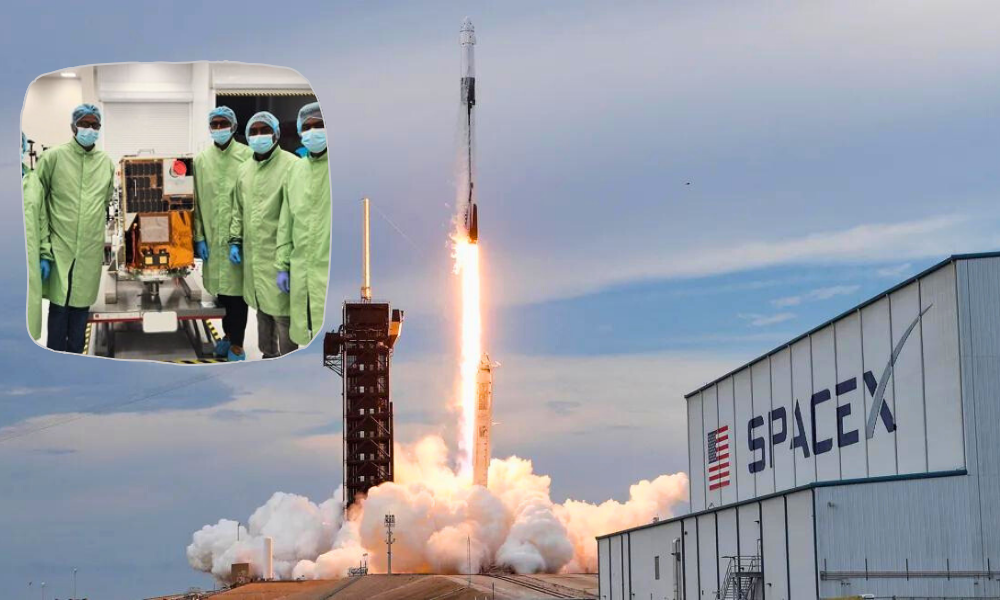
On Sunday, August 31, 2025, SpaceX is set to launch its 1,900th Starlink V2 Mini satellite aboard a Falcon 9 rocket from Cape Canaveral Space Force Station in Florida. This mission, designated Starlink 10-14, marks SpaceX’s 77th Starlink launch of the year, and its ninth Starlink mission in August alone.

Mission Highlights

  • Date: Sunday, August 31, 2025
  • Mission: Starlink 10-14
  • Launch Site: Cape Canaveral Space Force Station, Florida
  • Launch Time: 7:20 a.m. EDT (11:20 UTC)
    • Rocket: Falcon 9 Booster 1077 (23rd flight)
    • Trajectory: North-easterly path from Florida’s Space Coast
    • Landing Target: Drone ship Just Read the Instructions in the Atlantic Ocean

Network Expansion

  • Over 1,900 Starlink V2 Mini satellites launched in 2025 alone
  • Total active constellation exceeds 8,100 satellites
  • Global coverage spans 130+ countries, including rural India

Reusability Record

  • 489th Falcon 9 landing
  • 454th reflight milestone

Weather Outlook

  • 90% chance of favorable conditions
  • Minor risks from cumulus and anvil clouds
Summary: This launch marks SpaceX’s relentless cadence, operational efficiency, and its vision for global connectivity.

Starlink Launches by Year (2019–2025)

Year Launches Satellites Deployed Key Milestones
2019 6 ~360 First operational batch (v0.9) launched in May
2020 15 ~900 Regular cadence begins; v1.0 satellites dominate
2021 17 ~1,020 Laser interlinks introduced; global coverage expands
2022 25 ~1,500 v1.5 satellites deployed; polar orbit missions begin
2023 30+ ~2,000 v2 Mini satellites debut; constellation crosses 4,500
2024 40+ ~2,400 Direct-to-cell (DTC) satellites begin launching
2025 (Jan–Aug) 77 ~1,900+ Monthly launches peak; global user base hits 7M+

📊 Total Launches (2019–Aug 2025): ~210+
🛰️ Total Satellites Launched: ~9,580
🌐 Active Satellites in Orbit: ~8,280

🔍 Strategic Notes:
  • Reusability: Most launches used Falcon 9 Block 5 boosters, many flying 20+ times.
  • Coverage Expansion: Starlink now serves 150+ countries, including recent additions like Kazakhstan.
  • Tech Evolution: From basic v0.9 satellites to v2 Mini and DTC-enabled units, each year brought major upgrades.

Surya: NASA and IBM Release Largest Open-Source Heliophysics AI Model on Hugging Face


IBM and NASA have unveiled a groundbreaking open-source AI model called Surya, designed to predict solar weather and protect critical infrastructure from space-based disruptions. The powerful AI model is trained on 14 years of observations from NASA’s Solar Dynamics Observatory (SDO).

Here's a breakdown of what makes this initiative so impactful:

What Is Surya?

  • Name Origin: “Surya” is Sanskrit for “Sun,” reflecting its heliophysics focus.
  • Purpose: Predict solar flares, coronal mass ejections, and other solar phenomena that can disrupt satellites, GPS, power grids, and telecommunications.
  • Availability: Open-source and hosted on Hugging Face.

Technical Highlights

  • Foundation Model: Trained on 14 years of high-resolution solar data from NASA’s Solar Dynamics Observatory (SDO).
  • Data Types: Includes solar coronal EUV images, magnetic field maps, and solar surface velocity data.
  • Model Size: 366 million parameters—lightweight enough for broader deployment.

Capabilities & Performance

  • Forecasting Power:
    • Predicts solar flares up to 2 hours in advance.
    • Achieved 16% improvement in flare classification accuracy over previous models.
  • Use Cases:
    • Early warnings for satellite operators.
    • Infrastructure protection for energy grids and aviation.
    • Academic research in heliophysics and space weather.

Why It Matters

  • Economic Risk: A major solar storm could cost the global economy up to $2.4 trillion over five years.
  • Recent Events: Solar storms have already disrupted GPS, diverted flights, and damaged satellites.
  • Future-Proofing: As humanity ventures deeper into space, accurate solar forecasting becomes essential for safety and continuity.

Open Science Impact

  • SuryaBench Dataset: IBM and NASA also released the largest curated heliophysics dataset to support further research.
  • Community Collaboration: Encourages scientists and developers to build on Surya for new applications in space weather prediction.

Summary Table

Feature Details
Model Name Surya
Developed By IBM & NASA
Training Data 14 years of solar observations from NASA's SDO
Parameter Count 366 million
Forecast Window Up to 2 hours before solar flare events
Accuracy Improvement 16% over prior models
Hosted On Hugging Face

IN-SPACe Awards EO-PPP Contract to PixxelSpace-Led Consortium for Indigenous Satellite Constellation

IN-SPACe Awards EO-PPP Contract to PixxelSpace-Led Consortium for Indigenous Satellite Constellation

The Indian National Space Promotion and Authorisation Centre (IN-SPACe), under the Department of Space, Government of India, today announced the selection of a PixxelSpace India-led consortium, comprising of Piersight Space, Satsure Analytics India, and Dhruva Space, to design, build, and operate India’s first fully indigenous commercial Earth Observation (EO) satellite under the pioneering Public-Private Partnership (EO-PPP) model.

The selection follows a competitive bidding process. Three consortia were shortlisted after rigorous technical evaluation:
  1. Astra Microwave Products Limited, Hyderabad (with Bharat Electronics Ltd., Sisir Radar & Spectragaze Systems)
  2. GalaxEye Space, Bengaluru (with CoreEL)
  3. PixxelSpace India Pvt. Ltd., Bengaluru (with Piersight Space, Satsure Analytics India, and Dhruva Space)
Following the financial bid assessment, the PixxelSpace India-led consortium emerged as the successful bidder.

This initiative represents a pivotal point for India’s space sector. For the first time in the history of the Indian space sector, a private consortium would invest more than ₹1,200 crore over the next 5 years to launch a constellation of 12 state-of-the-art EO satellites equipped with panchromatic, multispectral, hyperspectral, and microwave SAR sensors. The constellation will deliver Analysis Ready Data (ARD) and Value-Added Services (VAS) for applications in climate change monitoring, disaster management, agriculture, infrastructure, marine surveillance, national security, and urban planning, while also catering to the global demand for high-quality geospatial intelligence.

By generating high-resolution, indigenous satellite data, the initiative will significantly reduce India’s reliance on foreign sources, ensure data sovereignty, and position the country among the global leader, in space-based data solutions.

Dr. Pawan Goenka, Chairman, IN-SPACe, said, “This initiative signals the coming of age of India’s private space industry in the space sector. It demonstrates the capability and confidence of Indian companies to lead large-scale, technologically advanced, and commercially viable space missions that serve both national and global markets. The EO-PPP model fosters an ecosystem where public and private capabilities reinforce each other to drive growth, innovation, and self-reliance.”

Under the PPP framework, the Government of India will provide strategic, technical, and policy support, while the PixxelSpace India-led consortium will own and operate the EO system, including satellite manufacturing, launches from Indian soil, ground infrastructure, and commercialization of data services.

Shri Rajeev Jyoti, Director, Technical Directorate, IN-SPACe, said: “All three shortlisted bidders submitted excellent technical and business plans, underscoring the growing maturity of India’s private space capabilities. This project is about building India’s own independent and future-ready geospatial infrastructure. It will lead to Atmanirbharta (self-reliance) in high-resolution optical and radar data for India, catalyse innovation, create thousands of high-skill jobs, and contribute directly to our goal of growing India’s space economy from $8.4 billion in 2022 to $44 billion by 2033.”

Awais Ahmed, CEO of Pixxel said: “Being the winning proposal to build India’s national EO constellation is a major milestone for Pixxel and our consortium members in India’s space story. We’re grateful to IN-SPACe and the Government of India for trusting our consortium with this historic mission. Together with our partners Satsure, Dhruva and PierSight, we look forward to building world-class space-tech capabilities that serve the whole planet from Indian soil. This is India’s moment to lead the world in space-powered solutions.”

The EO constellation will be deployed in a phased manner over the next four years to ensure continuous service upgrades and expanded coverage. Once operational, it will be among the most advanced EO systems in the world, designed, built, and operated entirely in India by Indian talent.

This initiative reaffirms the Government of India’s commitment to space sector reforms and to enabling Indian industry to emerge as a major global player in the space economy.

Eclipses on Demand: How ESA Is Casting Shadows in Space to Illuminate the Sun

Eclipses on Demand: How ESA Is Casting Shadows in Space to Illuminate the Sun

For centuries, astronomers have waited patiently for solar eclipses to glimpse the Sun’s ethereal halo. Now? They’re making their own.

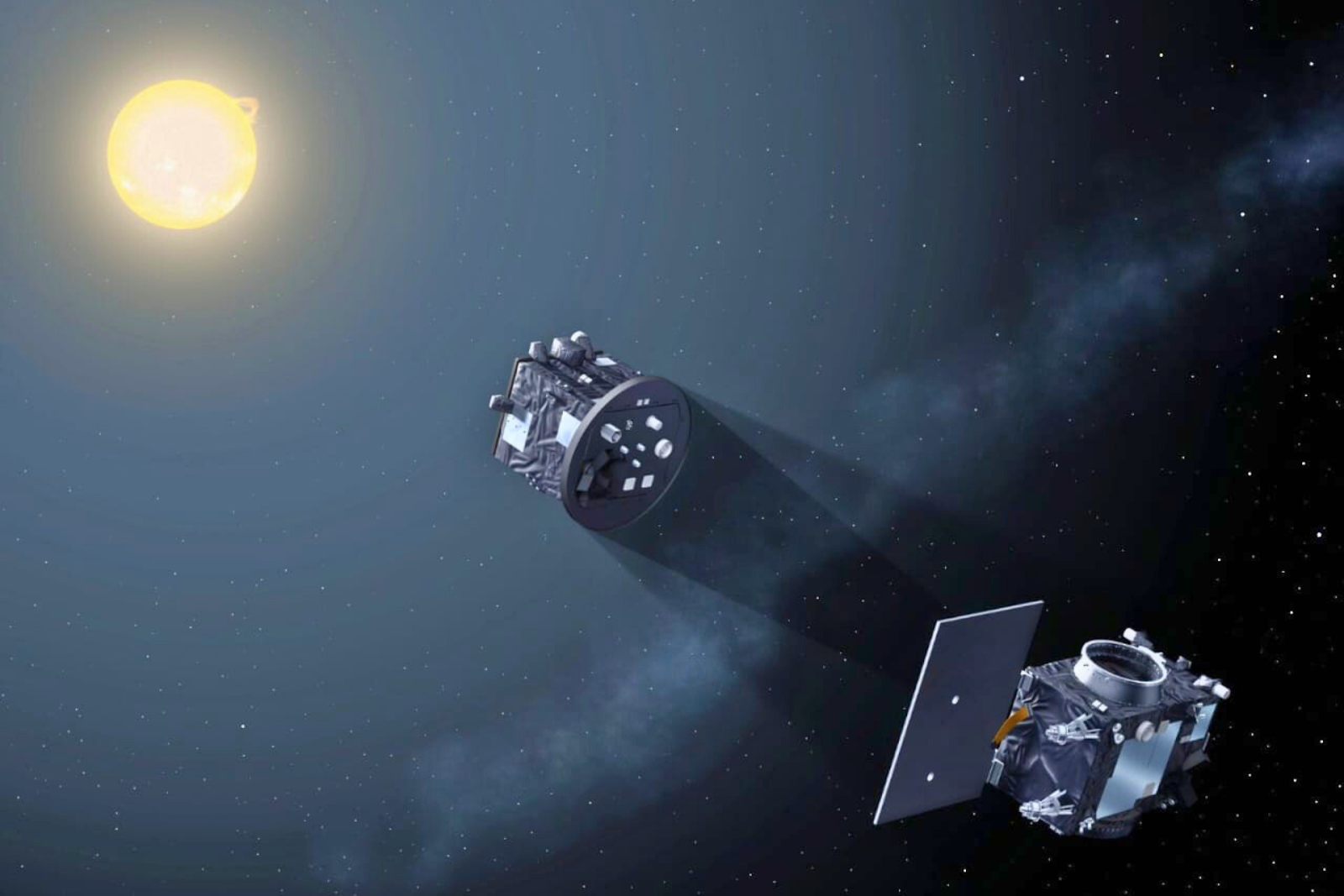
In a move straight from a science fiction script, the European Space Agency (ESA) has created a man-made solar eclipse in space—and it’s not just a one-time show. Using two satellites flying in tight formation, ESA’s Proba-3 mission is rewriting the rules of solar observation.

Scientists have figured out how to make a solar eclipse whenever they want, using two special satellites flying above Earth.

The European Space Agency launched a project called Proba-3. It has two satellites:
  • One blocks the sunlight (like putting your thumb over a torch).
  • The other takes pictures of the Sun’s outer layer, called the corona—a glowing, mysterious area that's hard to see normally.
These two satellites fly in perfect sync, 150 meters apart. That’s how they create a fake or artificial eclipse!

They can do this many times a week, and each eclipse lasts up to six hours—much longer than ones on Earth.

Notably, the Proba-3 mission satellites were launched by the Indian Space Research Organisation (ISRO) using their trusted PSLV-C59 rocket. The launch took place on December 5, 2024, from the Satish Dhawan Space Centre in Sriharikota, India. 

Why Is This a Big Deal?
  • Scientists can now study massive solar blasts that mess with mobile networks, GPS, and power.
  • They can examine the solar wind, which affects satellites and space weather.
  • They're also closer to solving a mystery: Why is the Sun’s outer layer hotter than its surface?
They’ve already taken stunning images—green loops, fire-like arcs, and hidden details of the Sun.

It’s like building a permanent space lab to study our star. Maybe one day, we’ll even see artificial eclipses on Mars!

Precision Shadowplay in Orbit

Eclipses on Demand: How ESA Is Casting Shadows in Space to Illuminate the Sun

At the heart of the mission are two spacecraft with poetic roles: the Occulter, which blocks sunlight using a 1.4-meter disk, and the Coronagraph, trailing behind at a razor-precise 150 meters, poised to observe the Sun’s corona—its wispy, superheated outer atmosphere.

The magic lies in their dance: millimeter-perfect alignment sustained autonomously in space, simulating a solar eclipse for up to six hours. No more relying on fleeting eclipses; now, solar scientists get multiple custom eclipses per week.

And nestled aboard the Coronagraph is ESA’s pride—ASPIICS (Association of Spacecraft for Polarimetric and Imaging Investigation of the Corona of the Sun). This instrument uses layered exposures to pierce the Sun’s glare and reveal its hidden anatomy.

At Least 10 Satellites Working Round-the-Clock to Ensure India's Safety & Security: ISRO Chairman

At Least 10 Satellites Working Round-the-Clock to Ensure India's Safety & Security: ISRO Chairman

ISRO Chairman V Narayanan recently stated that at least 10 satellites are working round-the-clock for strategic purposes to ensure India's safety and security. These satellites help monitor India’s 7,000 km coastline and the northern borders, playing a crucial role in surveillance and defense.

These satellites play a crucial role providing real-time imagery and video footage to track enemy movements and terrorist activities.

The comments from ISRO Chairman come amid escalating tensions between India and Pakistan, following the April 22 Pahalgam terror attack, which led to India launching Operation Sindoor against terror sites in Pakistan and Pakistan-occupied Kashmir. Pakistan responded with drone and missile strikes, which India intercepted. However, both nations have now agreed to halt all military actions on land, air, and sea.

Satellites like Cartosat provide sub-meter resolution images, enabling precise identification of military installations and terrorist hideouts.

Inter-Satellite Links (ISL) allow seamless data relay and coordination between satellites, improving intelligence-sharing. Synthetic Aperture Radar (SAR) used in RISAT satellites, capable of penetrating cloud cover and darkness to provide continuous surveillance.

Electronic Intelligence (ELINT) & Signal Monitoring helps intercept enemy communications and radar signals, aiding in counter-terrorism operations. Satellites work alongside military drones for target tracking and precision strikes.

Following the April 22 Pahalgam terror attack, India launched Operation Sindoor, targeting terrorist infrastructure in Pakistan and Pakistan-occupied Kashmir (PoK). ISRO's satellites provided critical intelligence, helping the Indianneutralize radar systems, disrupt drone strikes, and destroy 11 air bases inside Pakistan.

ISRO’s satellites also contribute to disaster management, telemedicine, agriculture, and environmental monitoring, reinforcing their broader role beyond defense.

India Conducting 'Dogfights' in Space with Satellites

India Conducting 'Dogfights' in Space

India is conducting "dogfights" in space—a sophisticated maneuver where two satellites, a chaser and a target, engage in close-range orbital tactics, much like fighter jets in aerial combat, reported several Indian media outlets including NDTV. This is part of ISRO’s SPADEX mission, which aims to advance satellite docking, proximity operations, and autonomous flight capabilities.

Dogfights in space refer to coordinated, close-range maneuvers between satellites, similar to aerial dogfights between fighter jets. In India's case, ISRO has successfully executed this maneuver using its SPADEX mission, where a chaser and target satellite engage in precision orbital tactics.

The satellites, orbiting 500 km above Earth at speeds of 28,800 km/h, have successfully demonstrated docking, undocking, and power transfer between them.

These advancements position India among the elite nations mastering space docking and orbital maneuvering.

This follows similar exercises by China’s defense satellites in 2024, prompting global interest in space-based maneuverability. Last month, it was reported that the U.S. Space Force observed five Chinese satellites executing synchronized movements, practicing tactics for on-orbit space operations conducted in Low Earth Orbit (LEO), last year.

India’s SPADEX mission relies on cutting-edge rendezvous and docking technology to execute these satellite maneuvers. The key technologies involved include:
  1. Laser Range Finder & Visual Cameras – Used for precise navigation during close-range docking.
  2. Retroreflectors & Real-Time Imaging – Help align satellites during final approach.
  3. Inter-Satellite Communication Link (ISL) – Enables autonomous coordination between spacecraft.
  4. Indigenous Docking Mechanism – Developed by ISRO as part of the Bharatiya Docking System.
  5. Power Transfer Technology – Allows one satellite to supply energy to another, crucial for future space stations.
  6. Autonomous Rendezvous Strategy – Ensures satellites can approach and dock without human intervention.
This breakthrough strengthens India’s position in space warfare and satellite autonomy, showcasing its ability to execute complex orbital maneuvers with precision. What aspect of this technology intrigues you the most?... Or... What do you think this means for India’s future in space defense? Do comment below...

Mumbai-based Deeptech Startup Delivered Its Green Propulsion System to DRDO

Mumbai-based Deeptech Startup Delivered Its Green Propulsion System to DRDO

Manastu Space Technologies, a Mumbai-based deep-tech startup, has delivered its iBooster Green Propulsion System to the Defence Research and Development Organisation (DRDO).


This system is designed for satellites weighing between 100 and 500 kg and will be used for critical operations such as orbit raising, station-keeping, and deorbiting.

Founded in 2017 by Tushar Jadhav and Ashtesh Kumar, Manastu Space Technologies specializes in developing green propulsion systems and satellite technology to address critical challenges in space safety and sustainability.

Key Features of iBooster Green Propulsion System:
  • Proprietary Hydrogen Peroxide-Based Fuel: Safer, more environmentally friendly, and cost-effective compared to conventional toxic fuels
  • Optimized Thruster Design: Ensures enhanced efficiency and precision.
  • High-Temperature Catalyst: Provides seamless ignition and long-term performance in space.
This achievement is the result of four years of intensive research and development, supported by DRDO's Technology Development Fund (TDF). Manastu Space is now preparing for a space test aboard an upcoming PSLV mission by ISRO, which will demonstrate the system's capabilities on a global stage.

iBooster Green Propulsion System
iBooster 

Last year in October, Manastu Space has successfully secured $3 million Pre-Series A round, led by IAN.

Apart from the iBooster Green Propulsion System, Manastu Space has developed several other innovative products and solutions such as Debris Collision Avoidance System, a system designed to prevent satellite collisions and reduce space debris by providing agile and efficient propulsion capabilities.

Vyom 1U Module, a compact propulsion module for small satellites (5U to 24U+), offering specific impulse and thrust capabilities suitable for various mission requirements.

India Plans Launching Quantum Satellite in 2-3 Years

India Plans Launching Quantum Satellite in 2-3 Years

India is gearing up to join the quantum satellite race with the goal of creating a hack-proof communication network. The National Quantum Mission (NQM) is at the forefront of this initiative, aiming to launch a quantum satellite within the next 2-3 years. This satellite will play a crucial role in establishing a secure quantum communications network across the country.

A quantum satellite is a satellite that uses quantum physics to communicate between space and Earth, and to secure information. Quantum satellites use quantum key distribution (QKD) to securely share a secret key between two parties, which can then be used to encrypt and decrypt messages. The security of QKD is based on quantum mechanics, making it resistant to hacking and eavesdropping.

Ajai Chowdhry, Co-founder of HCL and Chairman of the Mission Governing Board for the National Quantum Mission (NQM), told businessline, “Satellite-based communication will be required for securing country-wide or international communication. The Department of Space is planning to launch a quantum satellite in 2-3 years for quantum communications.”

The NQM has established four Section 8 companies, also known as not-for-profit entities, to focus on different verticals of quantum technologies. These Thematic Hubs (T-Hubs) are set up within premier academic institutions and national research and development labs. Below are the four verticals:
  1. Quantum Computing: Developing intermediate-scale quantum computers with 50-1000 physical qubits.
  2. Quantum Communication: Establishing satellite-based secure quantum communications and inter-city quantum key distribution.
  3. Quantum Sensing & Metrology: Creating high-sensitivity magnetometers and atomic clocks for precision timing.
  4. Quantum Materials & Devices: Designing and synthesizing quantum materials for fabrication of quantum devices.
These hubs aim to seed, nurture, and scale up scientific and industrial R&D in quantum technologies, making India a leader in this field.

Key Points of Quantum Satellite
  • Quantum Key Distribution (QKD): The satellite will use QKD technology to transfer encrypted information securely.
  • Complementary to Optical Fibers: While optical fibers are limited to 100-250 km, satellites can transfer quantum data over much larger distances.
  • Geographical Advantage: India's diverse geography, including locations like Hanle in Ladakh, offers unique advantages for setting up quantum communication ground stations.
  • Global Collaboration: India aims to develop satellite-based secure quantum communications between ground stations over a range of 2,000 km within the country and internationally.
This initiative positions India as a key player in the global quantum communications race, enhancing the security and reliability of communication networks.

PM Modi-Chaired CCS Approves 52 Spy Satellites equipped with Artificial Intelligence

PM Modi-Led CCS Approves 52 Spy Satellites equipped with Artificial Intelligence

The Cabinet Committee on Security (CCS), chaired by Prime Minister Narendra Modi, has approved the launch of 52 spy satellites under Phase III of the Space Based Surveillance (SBS-III) project. This project, estimated to cost around Rs 27,000 crore, aims to enhance India's surveillance capabilities, especially along its borders with Pakistan and China.

The satellites will be launched into low Earth and geostationary orbits and will be equipped with artificial intelligence (Al) to improve geo-intelligence and communication between satellites for better threat mitigation.

Additionally, the CCS has also approved the $3.9 billion purchase of 31 weaponized Predator drones from General Atomics, to complement the surveillance capabilities of the SBS-III mission. General Atomics (GA) is a California, US based company that specializes in defense and diversified technologies, including energy, defense, robotics, and unmanned aircraft.

The Space Based Surveillance (SBS-III) project is a significant initiative by the Indian government to enhance its surveillance capabilities through space-based technology.

In Phase-I (2001), 4 satellites were launched, under the aegis of the then prime minister Atal Bihari Vajpayee. In Phase-II, 6 satellites were launched in the year 2013. And, now in 2024, 52 surveillance satellites have been approved by the CCS, to launch. 

Indian Space Research Organisation (ISRO) is responsible for the development and launch of these satellites.

National Security Council Secretariat works alongside the Defence Space Agency under the integrated headquarters in the Defence Ministry to handle the project. Defence Space Agency plays a crucial role in the project, focusing on enhancing India's defense capabilities.

These organizations and entities are working together to enhance India's surveillance and defense infrastructure.

Development of the Spy Satellites

ISRO will follow a comprehensive process to develop these spy satellites. Here's an overview of the steps involved:

1. Design and Development: The satellites will be designed and developed at the U R Rao Satellite Centre (URSC). This involves creating detailed designs, selecting materials, and developing the technology.

2. Assembly and Testing: Once the design is finalized, the satellites will be assembled and rigorously tested to ensure they meet all specifications and can withstand the harsh conditions of space.

3. Launch Vehicle Preparation: The satellites will be launched using ISRO's launch vehicles, such as the Polar Satellite Launch Vehicle (PSLV) or Geosynchronous Satellite Launch Vehicle (GSLV), depending on the payload and orbit requirements.

4. Launch: The satellites will be launched from the Satish Dhawan Space Centre on Sriharikota Island, near Chennai.

5. Deployment and Operation: After launch, the satellites will be deployed into their designated orbits and will start their operational phase, providing surveillance data and enhancing India's national security.

ISRO's expertise in satellite technology and its successful track record in launching and operating satellites make it well-equipped to handle this ambitious project.

Scientists Detect Mysterious Plasma Bubble Over Egyptian Pyramids That Can Disrupt Satellite Communications

Scientists Detect Mysterious Plasma Bubble Over Egyptian Pyramids That Can Disrupt Satellite Communications

Chinese scientists have detected massive plasma bubbles over the Egyptian pyramids and Midway Islands using advanced radar technology developed by the Chinese Academy of Sciences.

These plasma bubbles, which can interfere with satellite communications and GPS, were observed on a large scale following a solar storm in November.

The formation of plasma bubbles is influenced by factors such as geomagnetic activity, atmospheric conditions, and the Earth’s magnetic field. Scientists study these bubbles to better understand and mitigate their impact on communication systems.

The detection was made using the Low Latitude Long Range Ionospheric Radar (LARID), which has an impressive detection range of 9,600 kilometers. This radar system allows scientists to track and observe the movement and formation of plasma bubbles in greater detail than ever before.

It's fascinating how advancements in radar technology are enabling such detailed observations of phenomena that can impact our communication systems.

Why Only Over Egyptian Pyramids?

The answer is No, the plasma bubbles detected over the Egyptian pyramids were not at all exclusive to that location. These bubbles can form in various regions around the equator and are influenced by solar activity and geomagnetic conditions. The detection over the pyramids was likely due to the specific timing and location of the solar storm that triggered the formation of these bubbles.

The word 'Mysterious' is tied to it because it is relatively new phenomena, detected only 83 years ago, and scientists are still understanding these bubbles.

The first irregularities in the ionosphere, now called as "Plasma Bubble", were observed as diffuse echoes in ionosonde observations. These observations were made by Booker and Wells in 1938. The phenomenon was initially referred to as equatorial spread-F.

The radar technology used by Chinese scientists has a wide detection range, allowing them to observe these phenomena over large areas, including the pyramids and other regions like the Midway Islands. The occurrence over the pyramids was coincidental and not unique to that location.

Effect on Satellite Communications

Plasma bubbles can significantly impact communication systems in several ways.

Plasma bubbles can cause rapid fluctuations in the ionosphere’s electron density, leading to signal fading and loss. This affects high-frequency (HF) radio communications, which rely on ionospheric reflection. The irregularities caused by plasma bubbles can distort GPS signals as they pass through the ionosphere. This can lead to errors in position calculations, affecting navigation systems used in aviation, maritime, and personal devices.

Satellites that communicate with ground stations via radio waves can experience signal degradation or loss when plasma bubbles are present. This can impact services like satellite TV, internet, and military communications.

The variability in the ionosphere can cause phase and amplitude scintillation, which disrupts the transmission of data over long distances. This can affect both civilian and military communication networks.

Understanding and predicting plasma bubbles is crucial for space weather forecasting. Accurate forecasts can help mitigate the impact on communication systems by allowing operators to take preventive measures.

Elon Musk, Jeff Bezos' Mega-Constellation of Satellites Threat to Ozone Layer

Elon Musk, Jeff Bezos' Mega-Constellation of Satellites Threat to Ozone Layer

The increasing number of satellites and mega-constellations poses a potential risk to Earth's ozone layer. Satellites, when they reach the end of their service life, burn up during reentry into Earth's atmosphere. This process generates aluminum oxides as a byproduct. These aluminum oxides are catalysts for chlorine activation, which leads to ozone depletion in the stratosphere. 

As of today, nearly 10,000 satellites are orbiting the Earth and 75% or two-thirds of these 10,000 belong to SpaceX’s broadband constellation, Starlink.

SpaceX has launched more than 6,000 Starlink satellites to orbit, and the company’s promoter Elon Musk is hoping to build a massive constellation of 42,000 satellites. Besides SpaceX, Jeff Bezos promoted Blue Origin’s Project Kuiper also plans to send 3,000 satellites to space, while Airbus-owned OneWeb wants to build a constellation of 648 satellites.

With knack of competition, China too is working to send out whopping number of about 13,000 satellites in space, that will encircle the Earth in the lower orbit (LEO).

A typical 250-kg satellite can produce around 30 kg of aluminum oxide nanoparticles during its demise. These particles may persist in the atmosphere for decades.

The entire population of satellites reentering the atmosphere in 2022 generated approximately 17 metric tons of aluminum oxide compounds. Mega-constellations could lead to over 360 metric tons of aluminum oxide compounds per year, significantly affecting ozone levels. Byproducts from reentering satellites may take up to 30 years to settle from the mesosphere into the stratospheric ozone layer.

At the end of their short lifespan, the satellites generate pollutants as they fall through the atmosphere. Satellite re-entry produces tiny particles of aluminum oxide, which trigger chemical reactions that destroy the stratospheric ozone, according to the recent study published in Geophysical Research Letters. The oxides don’t react chemically with the molecules of the ozone layer; instead they set off destructive reactions between ozone and chlorine that end up depleting the protective layer in Earth’s atmosphere.

Mitigating the risk of ozone depletion due to satellite reentry involves several strategies including designing satellites with deorbiting mechanisms to ensure controlled reentry at the end of their operational life. This minimizes the risk of uncontrolled disintegration and aluminum oxide release.

Plan for reentry trajectories also minimizes the altitude at which satellites disintegrate. Lower altitudes reduce the chances of aluminum oxide reaching the stratosphere.

In addition, exploring materials other than aluminum for satellite construction. Choosing materials that don't produce harmful byproducts during reentry can help mitigate ozone depletion.

Cabinet Approves 100% FDI in Space Sector, India Now Liberalised for FDI in Prescribed Space Sub-Sectors/Activities

Cabinet Approves 100% FDI in Space Sector, India Now Liberalised for FDI in Prescribed Space Sub-Sectors/Activities

The FDI policy reform will enhance Ease of Doing Business in the country, leading to greater FDI inflows and thereby contributing to growth of investment, income and employment

The Union Cabinet chaired by Prime Minister Shri Narendra Modi approved the amendment in Foreign Direct Investment (FDI) policy on space sector. Now, the satellites sub-sector has been divided into three different activities with defined limits for foreign investment in each such sector.

The Indian Space Policy 2023 was notified as an overarching, composite and dynamic framework to implement the vision for unlocking India’s potential in Space sector through enhanced private participation. The said policy aims to augment space capabilities; develop a flourishing commercial presence in space; use space as a driver of technology development and derived benefits in allied areas; pursue international relations and create an ecosystem for effective implementation of space applications among all stakeholders.

As per the existing FDI policy, FDI is permitted in establishment and operation of Satellites through the Government approval route only. In line with the vision and strategy under the Indian Space Policy 2023, the Union Cabinet has eased the FDI policy on Space sector by prescribing liberalized FDI thresholds for various sub-sectors/activities.

Department of Space consulted with internal stakeholders like IN-SPACe, ISRO and NSIL as well as several industrial stakeholders. NGEs have developed capabilities and expertise in the areas of satellites and launch vehicles. With increased investment, they would be able to achieve sophistication of products, global scale of operations and enhanced share of global space economy.

The proposed reforms seek to liberalize the FDI policy provisions in space sector by prescribing liberalized entry route and providing clarity for FDI in Satellites, Launch Vehicles and associated systems or subsystems, Creation of Spaceports for launching and receiving Spacecraft and manufacturing of space related components and systems.

Benefits:

Under the amended FDI policy, 100% FDI is allowed in space sector. The liberalized entry routes under the amended policy are aimed to attract potential investors to invest in Indian companies in space.

The entry route for the various activities under the amended policy are as follows:
  • Upto 74% under Automatic route: Satellites-Manufacturing & Operation, Satellite Data Products and Ground Segment & User Segment. Beyond 74% these activities are under government route.
  • Upto 49% under Automatic route: Launch Vehicles and associated systems or subsystems, Creation of Spaceports for launching and receiving Spacecraft. Beyond 49% these activities are under government route.
  • Upto 100% under Automatic route: Manufacturing of components and systems/ sub-systems for satellites, ground segment and user segment.
This increased private sector participation would help to generate employment, enable modern technology absorption and make the sector self-reliant. It is expected to integrate Indian companies into global value chains. With this, companies will be able to set up their manufacturing facilities within the country duly encouraging 'Make In India (MII)' and 'Atmanirbhar Bharat' initiatives of the Government.

SpaceX To Launch India’s 1st Private Spy Satellite Built by Tata Group's TASL, in April

SpaceX To Launch India’s 1st Private Spy Satellite Built by Tata Group's TASL

Elon Musk promoted SpaceX will soon be launching India's first private spy satellite — TSAT-1A, which has been built by Tata Group's Tata Advance Systems Limited (TASL). The launching is slated to happen in April.

TASL has built this military grade spy satellite and it has been shipped to Florida for assembling in the SpaceX rocket. With the help of TSAT-1A Indian defence forces will be able to get more accurate secret information and dependence on foreign vendors will be reduced.

TSAT-1A will have 0.5 meter spatial resolution and can provide sharp imagery. TASL can produce 25 such satellites annually and will develop multiple payloads as per requirements of armed forces.

To date, Indian armed forces have to rely on foreign vendors to obtain accurate co-ordinates and timings. But once the TSAT-1A satellite will be placed successfully in the orbit, the foreign reliance would nearly end. India will monitor this satellite and have full control of this spy satellite.

SpaceX To Launch India’s 1st Private Spy Satellite Built by Tata Group's TASL, in April

For monitoring the satellite, the ground control center is being built in Bengaluru and will be operational very soon. It will be used in the guidance and processing of satellite photographs. The Tata Company is building this center in association with the Latin-American company Satellogic (Satellogic). The imagery obtained from this satellite will also be shared with friendly countries. 

It is to be noted that, the Indian Space Research Organisation (ISRO) has its own satellites capable of capturing images, but their use is somewhat restricted.

TSAT-1A, which is a Low Earth Orbit (LEO) satellite, falls into the category of spy satellites because it has some sophisticated technologies. A spy satellite is essentially a camera in space, circling the Earth and taking detailed pictures of strategic places. These advanced satellites gather important information that’s useful for military and intelligence needs. They give key insights into things like troops’ movements what’s happening with infrastructure development near border areas, and any potential dangers.

Market Reports

Market Report & Surveys
IndianWeb2.com © all rights reserved