‏إظهار الرسائل ذات التسميات nanosatellite. إظهار كافة الرسائل

Assam to Launch Its Own Satellite System, with ISRO's Help

Assam to Launch Its Own Satellite System, with ISRO's Help

Assam is gearing up to launch its own satellite system, ASSAMSAT, with technical assistance from ISRO. The state government is set to sign a Memorandum of Understanding (MoU) with ISRO soon, and the initial groundwork for the satellite system is expected to be in place by the end of this year.

ASSAMSAT will consist of four to five low-earth orbiting satellites, each focusing on different regions of the state. The command and control center for these satellites will be located in Guwahati. The project aims to enhance disaster management, security (including monitoring illegal infiltration), wildlife tracking, agricultural land use analysis, and road network monitoring. Additionally, it is expected to encourage private sector participation in Assam’s space initiatives.

This is a huge step for Assam in terms of technological advancement and scientific research.

The ASSAMSAT satellites are being developed in collaboration with IN-SPACe (Indian National Space Promotion and Authorization Centre) and ISRO.

Additionally, the project aims to involve students from Assam, who will get hands-on experience in building experimental satellites with support from IN-SPACe and ISRO.

ISRO will also assist Assam in data acquisition and processing, ensuring that the satellite system is effectively utilized for disaster management, forest and agricultural monitoring, land administration, water resource management, and urban planning.

Additionally, ISRO is helping the Assam government develop policy guidelines for using space-based data in governance and environmental monitoring.

Beyond the technical aspects, ISRO is fostering scientific education by allowing 800 students from the Northeast, including 100 from Assam, to visit ISRO's research centers and projects 1 2. This initiative aims to inspire young minds and promote interest in space science and technology.

World's First Wooden Satellite with A Selfie Stick Launching This Year


The world’s first "wooden satellite" is preparing to launch before the end of this year. The satellite is designed and built in Finland and it will be launched to space during the fall of 2021 with a Rocket Lab Electron rocket from the Mahia Peninsula launch complex in New Zealand.

The mission of the satellite is to test the applicability of wooden materials, especially WISA-Birch plywood (a special plywood of Finalnd-based company) in spacecraft structures and expose it to extreme space conditions, such as heat, cold, vacuum and radiation, for an extended period of time.

Named "WISA Woodsat", the satellite is a 10x10x10 cm 'CubeSat' with surface panels made from plywood. Woodsat’s only non-wooden external parts are corner aluminium rails used for its deployment into space plus a metal selfie stick.

WISA Woodsat's selfi-stick camera

The wooden satellite uses a special type of coated plywood (called WISA) and has a pair of solar-powered onboard cameras, with one extended on a selfie stick to look back at the the wooden satellite and take pictures to see how it is behaving.

The wooden satellite will launch as part of a mission, designed by Arctic Astronautics, a Finnish company manufacturing cubesat kits for students.

The Special Wood

WISA plywood (Image - facebook.com/wisaplywood/)


Notably, as ordinary plywood is too humid for space uses, Arctic Astronautics is using a special plywood by placing the wood in a thermal vacuum chamber to dry it out and perform atomic layer deposition, adding a very thin aluminium oxide layer – typically used to encapsulate electronics. This, as per the company, minimize any unwanted vapours from the wood, known as ‘outgassing’ in the space field, while also protecting against the erosive effects of atomic oxygen.

According to Samuli Nymanm, co-founder of Arctic Astronautics and Woodsat chief engineer, Aluminum oxide, a chemical compound used as an electrical insulator, will help to prevent the wood from releasing any gas in the space environment. Also called as 'Alumina', Aluminum oxide is hard and wear-resistant, resists attacks by both acid and alkali substances, has high strength and stiffness. This will help the nanosatellite made with wood survive in outer space.

WISA Woodsat Stratospheric flight (12 June 2021)

WISA Woodsat got the first taste of space conditions on a stratospheric test flight on 12 June 2021 from the Heureka Science Center. The purpose of the flight was to use a functional model of the satellite to test the satellite's camera and communication equipment. The successful test flight lasted for 2:54 hours and reached an altitude of 31.2 km.


ISRO's Commercial Arm NSIL to Launch "India’s 1st Private" Remote Sensing Satellite

Representative

Bengaluru-based space technology startup Pixxel has entered into an agreement with ISRO's newly established commercial arm, NewSpace India Ltd (NSIL), also a Government of India company under the Department of Space (DoS), to launch the startup’s first remote-sensing satellite and India's first private remote-sensing satellite on an ISRO PSLV rocket in early 2021.

DoS and Pixxel will collaborate to enhance utilization and maximize the benefits of space assets for India. 

Though IRS-1A was India's first of the series of indigenous state-of-art operating remote sensing satellites that were launched in 1988. Pixxel's satellite will be India's first private remote-sensing satellite to be launched by Indian space agency ISRO. The ISRO-Pixxel agreement comes after recently established IN-SPACe, the authorization and regulatory body under the Department of Space (DoS) for enabling private players including startups to undertake space activities in India.

K.Sivan, Secretary of DoS, said - 
With the establishment of IN-SPACe we will also be partnering with other private players, that can help India achieve more milestones in the future.

"This first-of-a-kind private earth-observation mission will help provide solutions to many pressing environmental and agricultural issues among others and help make the world a better and more sustainable place," Pixxel said in a media statement.

Pixxel is building a constellation of earth imaging small satellites that will provide global coverage every 24 hours once fully deployed. The satellites will collect high-throughput information-rich data that will be analyzed using Artificial Intelligence and Machine Learning models to help make organizations more efficient in a plethora of sectors ranging from agriculture to urban monitoring among others.

Awais Ahmed, CEO, Pixxel, said "We are elated with the fact that India’s first commercial private satellite will now launch on an Indian rocket. This is not only a proud moment for us as an organisation but also as citizens to work with our nation’s capabilities."

Earlier in November last year, Pixxel had also inked an agreement with Italian firm Leaf Space for launching the first of its 24 earth imagery satellites, which was scheduled in July this year. 

Started by BITS Pilani alumni, Awais Ahmed and Kshitij Khandelwal, in February 2019, Pixxel was Asia's only Space Startup to qualify for the 2019 Techstars Starburst Space Accelerator in Los Angeles.

India's Bharti Global-led Consortium Wins Bid for OneWeb, A Satellite Firm Aiming Superfast Broadband Globally


The UK government has joined forces with India’s Bharti Global to buy the collapsed satellite operator OneWeb, which is building a network of hundreds of low Earth orbit satellites in order to accomplish its goal of providing internet services to "everyone, everywhere" delivering internet connections to rural and remote places as well as to a range of markets.


The consortium, along with the UK govt, is pledging $1 billion , to be jointly invested in OneWeb. Each of the two parties -- Bharti Group & UK government -- expected to invest US$500 million for a combined investment of US$1 billion.


Notably, OneWeb went bankrupt in March while trying to build a spacecraft network to deliver broadband internet globally. On 27 March 2020, OneWeb filed for bankruptcy, following a cash crunch amidst COVID-19 crisis and at the same time surrounded by difficulty raising capital to complete the build and deployment of the remaining 90% of the network.


Founded in 2012 under the name WorldVuIt, OneWeb commenced launches of the OneWeb satellite constellation in February 2019 with a network of more than 650 low Earth orbit satellites, and by March 2020, the company had launched only 74 of the planned 648 satellites in the initial constellation.


In June 2015, Bharti Group participated in $500 million round of funding in OneWeb.


Sunil Bharti Mittal, Chairman of Bharti Enterprises, said in a statement, "I am delighted that Bharti will be leading the effort to deliver the promise of universal broadband connectivity through OneWeb, with the active support and participation of the British Government. In addition to the strategic opportunities across a wide range of other applications and working with a broad range of international partners, this business has substantial commercial use cases across the telecoms, enterprise, aviation and maritime sectors."


“With strong operational execution, we will be able to generate an attractive return for investors, while ensuring that Britain plays a leading role in space and next-generation communications,” Mittal said.


If the deal materialize, the UK Government would acquire a 45% stake in OneWeb while Bharti Global of India who would hold 55%. The deal being subject to US Bankruptcy Court and regulatory approval.


Notably, the bankrupt global satellite operator also counts SoftBank Group Corp as one of its major big investors as the Japanese conglomerate has put in over $2 billion in OneWeb . In December 2016, SoftBank had invested US$1 billion in OneWeb. In March 2019, OneWeb raised fresh $1.25 billion in funding from SoftBank, Qualcomm, Mexico's Grupo Salinas as well as the Government of Rwanda.


In the World's Largest Satellite Constellation, US-based PredaSAR to Launch 48 Satellites for Govt., Commercial Applications


BOCA RATON, Florida, June 18, 2020 /PRNewswire/ -- PredaSAR Corporation announced today that it will launch a constellation of 48 commercial Synthetic Aperture Radar (SAR) satellites across multiple orbits. This groundbreaking constellation will be the world's largest and most advanced commercial SAR satellite constellation and provide PredaSAR's government and commercial clients with unprecedented image quality, unmatched global persistence, and rapid data delivery.

PredaSAR is led by a highly respected CEO, Major General Roger Teague, USAF (Ret), and a seasoned executive team with extensive national security space expertise and substantial access to capital. A U.S. owned and controlled company, PredaSAR is supported by a Board of Directors who bring over 100 years of national security experience, including General William Shelton, USAF (Ret), Lieutenant General Richard Newton, USAF (Ret), and Major General Douglas Raaberg, USAF (Ret).

"I am thrilled to announce the 48 satellite PredaSAR constellation. It delivers unparalleled capabilities that meet the most demanding national security needs addressable by a commercial constellation, demonstrating our commitment to our U.S. Government clients. Setting such a high bar also allows PredaSAR to deliver outstanding products and services for our commercial customers," said PredaSAR Executive Chairman and Co-Founder Marc Bell. "PredaSAR features a well-known and respected leadership team of trusted professionals with extraordinary depth and experience across both government and industry. With groundbreaking commercial technology, the PredaSAR constellation will deliver best-in-class, advanced SAR data products and services."

PredaSAR spacecraft employ an advanced, proprietary radar payload to create 2D Synthetic Aperture Radar images, 3D reconstructions of objects and the Earth's surface, and customer-tailored data products. SAR satellites provide high-resolution images at any time of day and in any weather condition, overcoming natural limitations of traditional optical satellites. PredaSAR spacecraft possess the latest in space-proven, high quality satellite systems to support scalable and fully capable operations in any orbit. Leveraging its advanced technologies, PredaSAR will deliver critical insights and data products to military and commercial decision makers at the speed of need.

"This is an exciting time to be in the commercial space industry. Today, more than ever, commercial space companies are delivering unprecedented value to the United States government, enabling military, intelligence, and commercial customers to maintain ever-critical U.S. leadership across their enterprises and markets," commented PredaSAR CEO Roger Teague. "PredaSAR looks forward to meeting the challenges of our customers to deliver compelling SAR products and services."

About PredaSAR

Founded in 2019, PredaSAR Corporation is building and will operate the world's largest and most advanced commercially operated Synthetic Aperture Radar (SAR) satellite constellation, providing end-to-end solutions to both government and commercial clients. PredaSAR is the clear choice for compelling SAR solutions, backed by a trusted and experienced, mission-savvy leadership team with strategic access to capital and cutting-edge satellite technology. For more information, please visit www.predasar.com

Pune-based VestaSpace building Small Satellite Platforms Raises $10 Mn Funding from Next Capital

Pune-based VestaSpace Technology on Wednesday said it has received USD 10 million (about Rs 75.8 crore) in funding from US-based investment and advisory firm Next Capital LLC.

Founded in 2018 by Arun Kumar Sureban, VestaSpace Technology specializes in making small satellite platforms for commercial and scientific applications.

The startup is developing an indigenous small satellite platform with a primary focus on assembly, integration, testing, and operation of satellite. The satellite platforms are for commercial and scientific applications enabling organizations levarage potential of small & Nanosatellites.

Spacecraft platforms developed by Vestaspace Technology Pvt ltd will cater to the needs of various Governments, Multi-National Companies, Universities and Research Institutions for applications such as technology demonstration, communications & earth observation missions.
"The massive financial support will enable VestaSpace Technology expand the reach of its innovative solutions across India and the world. The company estimates to achieve a 300 per cent growth rate post the funding," a statement to PTI said.

"Our association with Next Capital LLC began with my stay in the US for a project and has culminated into a promising financial deal that was cracked in April. This deal is going to be a great financial booster for VestaSpace Technology and will allow us to expand and scale up our operations and expand our footprint globally," Sureban said.

VestaSpace technology is aiming to acquire greater momentum by enabling businesses to leverage the potential of small and nanosatellites in India, he added.

"I strongly believe that India has tremendous intellectual capital for our innovative ventures to work," he said.

To recall, in November last year Bengaluru-based space technology startup Pixxel inked an agreement with Italian firm Leaf Space for launching the first of its 24 earth imagery satellites, which is supposed to scheduled July this year. Pixxel had raised pre-seed round of funding from growX Ventures and other prominent angels such as Raju Reddy, Dileep Nath, Pawan Sarda, and others.

Also in last year, an another space-tech startup based out of Bangalore, Bellatrix Aerospace, had raised $3 million in pre-Series A funding led by group of VCs that include IDFC-Parampara, StartupXseed, Karsemven Fund and Survam Partners. Notably, bollywood star Deepika Padukone, through KA Enterprises also contributed in that round of funding.

In 2018, the Falcon 9 rocket of Elon Musk-promoted firm SpaceX took off its space flight and carried 70 satellites from 16 countries including one from India called 'ExceedSAT 1', which became the first ever private satellite from India.

~ With major Inputs from PTI

Bengaluru's Space Tech Startup Pixxel ties with Italy's Leaf Space for its 1st Imagery Satellite

Bengaluru headquartered space technology startup Pixxel on Thursday said it has signed an agreement with Italian firm Leaf Space for launching the first of its 24 earth imagery satellites in July next year.

Through this agreement, Leaf Space will provide the support service up to one pass per orbit to the satellite in sun-synchronous orbit. The agreement also facilitates future mission support for Pixxel's planned constellation.

Pixxel's constellation of nano-satellites will be delivered into orbit as passengers on other rocket launch missions. The images gathered by these nano-satellites provide up-to-date information relevant to climate monitoring, crop yield prediction, urban planning, and disaster response.

"We are very excited to partner with Leaf Space for the ground segment support to our first satellite. This is an exciting step forward for our team as we ready for our first launch next year," Pixxel CEO Awais Ahmed said in a statement.

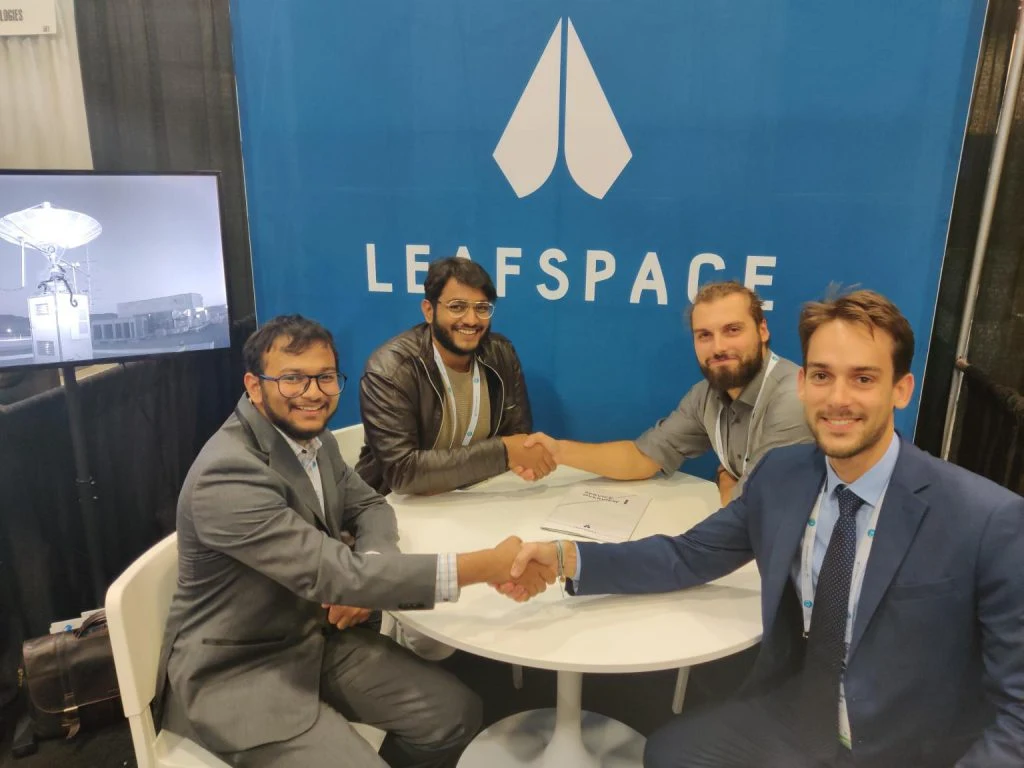
Pixxel and Leaf Space teams sigining service agreement for the ground segment support of the Pixxel's first mission

In a statement, Leaf Space CEO Jonata Puglia said,"It is very satisfying for us at Leaf Space to be the primary player for the ground segment of Pixxel's mission". Based out of Lomazzo in Italy, Leaf Space is creating satellite telecommunications as-a-service, in order to assist clients with their satellite operations by managing and procuring the entire ground segment system through a complete set of services, including time-shared access to ground, customize telecommunication solutions, ground station procurement, consultancy and backup services.

Uplink and downlink service for the mission will be provided using VHF, UHF and S-Band frequencies. The satellite is set to be launched on a Soyuz rocket in July 2020.

"Over the course of the next three years, we plan to deploy the first phase of our constellation consisting of 24 satellites to provide daily coverage. As we focus on development of the satellite constellation in the coming years, we will continue to partner with global ground station providers like Leaf Space to receive this data," Pixxel CTO Kshitij Khandelwal said.

The one of its kind space tech startup in India aims to create a one-stop solution for real-time, universally accessible, high-resolution information about any location on the globe.

Founded in 2018, Pixxel is aiming to build a constellation of 24 earth imaging small satellites that will provide global coverage every 24 hours.

Notably, Pixxel has signed a launch contract with GK Launch Services for its first tech demo mission to be launched in 2020 on GK-operated Soyuz-2 mission. The contract was arranged with the support of Precious Payload’s launch booking platform. Soyuz is a series of Russian spacecraft initiallu designed for the Soviet space program by the Korolev Design Bureau in the 1960s that remains in service today.

In July this year, Pixxel had raised pre-seed round of funding from growX Ventures and other prominent angels such as Raju Reddy, Dileep Nath, Pawan Sarda, and others.

Pixxel, which is an alumnus of the Techstars Starburst Space Accelerator, 2019, also aims to work for Indian agriculture sector, that accounts for 18% of India’s GDP, by using Artificial Intelligence (AI), with its universally accessible, high-resolution information received from its constellations of ultra-small, ultra-cheap, regularly updated nanosatellites.

Few weeks back, Maharashtra state government has unveiled its plans of modernizing and making exhaustive use of drone and satellite images, in order to alleviate agricultural hazards and provide farmers and policymakers, the authority the useful analyzed information to plan their moves accordingly. Maharashtra will be employing Artificial Intelligence (AI) along with the satellite images, based on mining data together from the Maharashtra Remote Sensing Application Centre (MRSAC) and the National Remote Sensing Centre (NRSC) in Hyderabad.

~ With Inputs from PTI

Satellite Imagery Startup Pixxel Raises Funding from growX Ventures, Others


Bangalore headquartered spacetech startup Pixxel, which is working towards creating India's first constellation of nano-satellites, has raised an undisclosed pre-seed round of funding from growX Ventures and other prominent angels such as Raju Reddy, Dileep Nath, Pawan Sarda, and others.

Pixxel makes satellite imagery useful by building a constellation of nanosatellites to provide global, real-time and affordable satellite imagery and the tools to analyse that data.

Pixxel is currently manufacturing the first of their satellites, which will be launch-ready by the end of the year and will be put in orbit early next year. The seed round of funding will be used to manufacture the prototype satellite.

“Our vision when we started was to build a world-beating company out of India that would operate at the cutting edge of space technology and contribute meaningfully towards space exploration,” the company said.

Founded in late 2018, by BITS Pilani alumni - Kshitij Khandelwal and Awais Ahmed, Pixxel is building a constellation of remote sensing satellites that will launch into space and beam down data that will be used to map minerals, water, and other resources on the moon, Mars, and even the asteroid belt.

The team behind Pixxel is serial creators, as the same team were the only Indian and one of the two Asian finalist teams at the SpaceX Hyperloop Pod Competition in 2017. The team were one of the 20 finalists out of the 2500 that had applied globally for the competition, and had presented a working Hyperloop pod prototype to Elon Musk at the SpaceX headquarters in LA.

Sheetal Bahl, Managing Partner at growX Ventures, said in a press statement, "Awais and Kshitij are the youngest, and among the most impressive founders we have invested in. They are envisioning the creation of a solution to capture high-resolution information of every location on the planet."

“This will enable them to monitor ever-changing situations that influence the environment, the economy, the security of nations, and help governments and organisations make smarter day-to-day operational decisions,” Sheetal said.

IISc-based Startup Bellatrix Aerospace Raises $3 Mn to build Re-Usable Space Launch Vehicles

Bangalore-based Bellatrix Aerospace, a new Space company specializing in In-space propulsion systems & orbital launch vehicles, has raised $3 million in pre-Series A round of funding led by group of venture capital investors that include IDFC-Parampara, StartupXseed, Karsemven Fund and Survam Partners.

GrowX Ventures and bollywood actress Deepika Padukone, through KA Enterprises also contributed in the round. Incubators -- CIIE of IIM Ahmedabad and IIT Bombay's SINE also participated.

Bellatrix will use the raised capital in increasing the team size, which currently consists of 14 people. The startup first raised funding from all Indian investors but now its reaching out globally for its next round.

Formed in 2015, by Yashas Karanam and Rohan M Ganapathy, Bellatrix is based out of Indian Institute of Science (IISc), Bangalore's Entrepreneurship center Society for Innovation and Development (SID), and is developing key technologies in electric propulsion, new generation propellants and launch vehicles. With its dedicated Launch Vehicles for Nano-Satellites and In-Space Propulsion Systems, the startup aims to offer affordable access to Space.

The young space tech startup is said to be developing two product lines with the aim of making space travel greener and more affordable. It has two launch rockets in the pipeline, with both models having re-usable features that can reduce the cost of space travel.

Building propulsion systems for all sizes of satellites, Bellatrix's first product is an electric propulsion system that runs on water

The startup is also making satellite propulsion systems, using a frontier technology that employs water as a propellant while heating it with microwave-induced plasma. One of its two-stage launch rocket, Chetak, is planned for 2023 launch.

Chetak is a two stage, all-carbon composite constructed vehicle that use liquid methane as fuel and the first stage is designed for reuse.

Notably, Bellatrix counts Dr. M.R. Srinivasan among its advisory, who is a recipient of Padma Vibhushan award for his immense contributions to nuclear science and technology. Dr Srinivasan retired as Chairman of Atomic Energy Commission and Secretary Department of Atomic Energy in 1990 as one of the towering personalities who ably guided Indian Nuclear Programme.

Market Reports

Market Report & Surveys
IndianWeb2.com © all rights reserved