‏إظهار الرسائل ذات التسميات Moon. إظهار كافة الرسائل

Blood Moon 2025: Science, Spectacle & Spiritual Shifts

Blood Moon 2025: Science, Spectacle & Spiritual Shifts

On the night of September 7–8, 2025, the skies over India and much of the Eastern Hemisphere were set ablaze by one of the most mesmerizing celestial events of the year—a Blood Moon, also known as a total lunar eclipse. For 82 minutes, the Moon bathed in a deep crimson glow, captivating skywatchers and stirring ancient myths and modern reflections alike.

The Science Behind the Scarlet Glow

Blood Moon 2025: Science, Spectacle & Spiritual Shifts
  • Earth aligns perfectly between the Sun and Moon, casting its shadow across the lunar surface.
  • Sunlight filters through Earth’s atmosphere, scattering shorter blue wavelengths and allowing longer red wavelengths to bend toward the Moon.
  • The result: a coppery-red Moon, visible to the naked eye and safe to observe without any special equipment.
This year’s eclipse was especially notable because:
  • It lasted 82 minutes, making it one of the longest total lunar eclipses since 2022.
  • It was visible across India, Asia, Africa, Europe, and Australia, reaching nearly 85% of the global population.
  • The Moon was near apogee (its farthest point from Earth), which slowed its transit and extended the eclipse duration.

Cultural Echoes & Ancient Lore

  • In Incan mythology, a jaguar was believed to devour the Moon.
  • In Hindu tradition, the demon Rahu swallows the Moon, causing eclipses.
  • Ancient Greeks saw the Moon goddess Selene veiled in darkness, prompting rituals to ward off ill omens.
Today, while science explains the phenomenon, the spiritual symbolism remains potent.

Astrological Insights: Pisces & Aquarius Energy Collide

This year’s Blood Moon occurred at 15° Pisces, opposing the Sun in Virgo—a cosmic tug-of-war between dreams and practicality. Astrologers interpret this eclipse as a powerful emotional reset, urging us to:
  • Release illusions and outdated beliefs.
  • Heal emotional wounds and embrace transformation.
  • Step into new chapters with clarity and courage.

Zodiac Highlights

Zodiac Sign Astrological Impact
Aries Let go of impulsiveness; embrace patience and long-term vision.
Leo Relationships mirror your ego—seek balance and humility.
Pisces Expect deep emotional revelations and spiritual growth.
Virgo Your routines may shift—prioritize health and inner harmony.

How to Experience It

  • No gear needed—just clear skies and curiosity.
  • Best viewed from rooftops, open fields, or hilltops.
  • Binoculars enhance the view, revealing lunar textures and color gradients.
Whether you're a scientist, a stargazer, or a seeker of cosmic meaning, the Blood Moon of 2025 offered more than just a visual treat, it was a moment to pause, reflect, and realign. As the Moon glowed red, it reminded us that even in shadow, there is beauty, mystery, and transformation.

Texas-based Firefly Aerospace Now the 2nd Pvt Company Ever to Achieve a Soft-Landing on the Moon

Texas-based Firefly Aerospace Now the 2nd Pvt Company Ever to Achieve a Soft-Landing on the Moon

Firefly Aerospace's Blue Ghost lunar lander successfully touched down on the moon, making it only the second private-sector company to achieve this feat.

The Blue Ghost lander, which carried 10 scientific payloads, landed near an ancient volcanic vent on Mare Crisium. This mission is part of NASA's Commercial Lunar Payload Services (CLPS) program, which aims to support lunar exploration and research.

The Blue Ghost mission is part of NASA's Commercial Lunar Payload Services (CLPS) program.

Firefly's success marks a significant milestone in the modern moon race, with private companies playing an increasingly important role in lunar missions. The lander will conduct various scientific experiments and capture high-definition imagery during its 14-day mission on the moon.

The first private company to achieve a soft lunar landing was Intuitive Machines. Their Odysseus lander successfully touched down on the moon in February 2024. However, the landing was not without its challenges, as the lander came down too fast and tipped over on impact, which affected its ability to generate enough solar power.

Texas-based Firefly Aerospace Now the 2nd Pvt Company Ever to Achieve a Soft-Landing on the Moon

Texas-based Firefly Aerospace Now the 2nd Pvt Company Ever to Achieve a Soft-Landing on the Moon
Blue Ghost Mission 1 - Lunar Lander Fully Assembled (Image - Firefly Aerospace/Flickr 

Firefly Aerospace's recent success with the Blue Ghost lander marks the second private-sector company to achieve this feat.

Blue Ghost will now begin its surface operations and support several NASA science and technology demonstrations over the next 14 days – equivalent to a full lunar day.

On March 14, Firefly expects to capture high-definition imagery of a total eclipse when the Earth blocks the sun above the Moon’s horizon.

On March 16, Blue Ghost will then capture the lunar sunset, providing data on how lunar dust levitates due to solar influences and creates a lunar horizon glow first documented by Eugene Cernan on Apollo 17. Following the sunset, Blue Ghost will operate several hours into the lunar night and continue to capture imagery that observes how levitating dust behavior changes after the sunset.

In its 45-day journey to the Moon, Blue Ghost traveled more than 2.8 million miles, downlinked more than 27 GB of data, and supported several payload science operations. This included signal tracking from the Global Navigation Satellite System at a record-breaking distance with the LuGRE payload, radiation tolerant computing through the Van Allen Belts with the RadPC payload, and measurements of magnetic field changes with the LMS payload.

Firefly will continue to provide regular updates on the Blue Ghost Mission 1 webpage through the completion of the mission. NASA’s Artemis blog will share additional details on payload operations. 

Headquartered in Cedar Park, Texas, Firefly is working on several upcoming missions, including additional lunar missions with the Blue Ghost lander and on-orbit missions with their Elytra vehicle.

Founded in March 2017 by Tom Markusic, Firefly focuses on developing small- and medium-lift launch vehicles for commercial space missions. The space technology company has secured multiple contracts with NASA and other organizations. For example, they were awarded a $179 million NASA contract for a moon delivery to the Gruithuisen Domes.

Firefly's main products include the Alpha (small-lift launch vehicle), MLV (medium-lift launch vehicle), Blue Ghost (lunar lander), and Elytra (space tug).

ISRO's Plan to Assemble Chandrayan–4 in Space and Bring Moondust Home

ISRO's Plan to Assemble Chandrayan–4 in Space and Bring Moondust Home

ISRO's Chandrayaan-4 mission is an ambitious and innovative project by the Indian space agency. Chandrayaan-4 is a planned lunar sample return mission, expected to launch around 2027. It will be the fourth mission in ISRO’s Chandrayaan series.

The mission will utilize two rockets to carry different modules into space. This includes the Ascender, Descender, Propulsion, Transfer, and Re-entry modules.

Unlike previous missions, Chandrayaan-4 will be assembled in space. The modules will be assembled in space, demonstrating advanced docking and robotic capabilities. After assembly, the spacecraft will proceed with its mission objectives, including traveling to the Moon, landing, collecting samples, and returning to Earth.

ISRO's Plan to Assemble Chandrayan–4 in Space and Bring Moondust Home
Stacks in Chandrayaan-4, which comprises the Ascender and Descender Modules

ISRO's Plan to Assemble Chandrayan–4 in Space and Bring Moondust Home
Stacks in Chandrayaan-4, which comprises the Transfer, Re-entry and Propulsion Modules


To achieve this, the process involves launching the mission in two parts and then performing a complex docking maneuver in Earth's orbit to integrate the modules into a single spacecraft.

Once the spacecraft reaches the Moon, the Descender module will perform a controlled soft landing. A robotic arm will then collect 2 to 3 kg of lunar soil a.k.a Moondust and subsurface material. The collected Moondust will be stored in the Ascender module, which will lift off from the Moon and dock with the Transfer and Re-entry modules for the journey back to Earth.

This mission not only aims to bring back lunar samples but also demonstrates advanced space technologies, setting a significant milestone for India's space exploration efforts.

Chandrayaan-4 aims to study the composition and mineralogy of the lunar surface, probe the subsurface for water ice and other volatiles, and analyze the returned samples for insights into the Moon’s geology and history.

This mission not only aims to enhance our understanding of the Moon but also showcases India’s growing capabilities in space exploration.

Several notable space missions have utilized in-space assembly techniques to achieve their objectives. International Space Station (ISS) is one of the most prominent examples of in-space assembly. It was constructed over multiple missions, with various modules and components launched separately and assembled in orbit by astronauts and robotic systems.

Besides, part of NASA’s Artemis program, the Lunar Gateway will be a space station orbiting the Moon. It will be assembled in space from multiple modules launched separately, providing a staging point for lunar exploration.

NASA’s In-Space Assembled Telescope (iSAT) project involves assembling a large aperture telescope in space, which will provide unprecedented spatial resolution and spectral coverage for astrophysics, planetary, and Earth science.

India’s Chandrayaan-4 mission, planned for lunar sample return from the Southern polar region is of utmost significance. This is more so after India’s systematic exploration of the Moon through orbiter, lander and rover. Lunar surface exploration missions followed by sample return will be the next major step in lunar exploration for India, and will result in important contributions in understanding the Earth-Moon system.

The total cost of the mission is estimated at 2104.06 Crore Indian Rupees, covering spacecraft development, two LVM3 launches, International network support, and various tests. Chandrayaan-4 will pave the way for India's future manned missions, lunar sample return, and scientific analysis.

India, Russia and China Plan to Develop Nuclear Power Plant on the Moon

India and Russia, and China, Plan to Develop Nuclear Power Plant on the Moon

India, Russia and China are planning to collaborate on developing a nuclear power plant on the Moon. This ambitious project is led by Russia's state nuclear corporation, Rosatom, and aims to establish a small nuclear reactor capable of generating up to half a megawatt of energy.

The nuclear power plant is intended to support future lunar base operations, providing a reliable energy source essential for sustaining long-term human presence and scientific research on the Moon.

This ground-breaking project, capable of generating half a megawatt of energy and expected to be operational by 2035, will see an initial step of installing a small reactor for essential power.

The plan positions the Global South at the forefront of lunar colonisation efforts. India's involvement aligns seamlessly with its ambitious plans for a manned lunar mission by 2040, potentially accelerating this timeline. The collaboration transcends terrestrial geopolitics, showcasing the Global South's growing influence in space technology and diplomacy.

Using nuclear power on the Moon offers several significant advantages. Unlike solar power, which is dependent on sunlight and affected by the lunar night (lasting about 14 Earth days), nuclear power can provide a continuous and stable energy supply.

Moreover, nuclear reactors have a high energy density, meaning they can produce a large amount of energy from a relatively small amount of fuel. This is crucial for supporting long-term missions and operations on the Moon.

Transporting a nuclear reactor to the Moon is a complex and multi-step process. Typically, the reactor will be designed to be compact and lightweight, ensuring it can be safely transported by a spacecraft. Once in lunar orbit, a specialized lunar lander will transport the reactor from the spacecraft to the Moon’s surface. This lander will need to be capable of safely landing the reactor in the designated area.

After landing, the reactor will be deployed and assembled on the lunar surface. This might involve robotic systems or astronauts, depending on the mission’s specifics.

India's involvement aligns with its plans for a manned lunar mission by 2040. This collaboration underscores the importance of International cooperation in space exploration and the development of sustainable energy solutions for extraterrestrial environments.

This collaboration between India, Russia, and China will likely leverage their combined expertise in space technology and nuclear engineering to achieve this ambitious goal.

Next-Gen Spacesuits to Allow Astronauts Communicate via Voice and Video

Next-Gen Spacesuits to Allow Astronauts Communicate via Voice and Video

Soon, Astronauts will be able to communicate more effectively with mission control and other crew members on the lunar surface. This real-time communication can improve safety, coordination, and decision-making during missions.

Artemis III, the first crewed NASA mission to set foot on the Moon in more than 50 years, will be a historic mission, returning astronauts to the Moon for the first time since Apollo 17 in 1972.

Axiom Space has partnered with Nokia to integrate advanced 4G/LTE communication capabilities into the next-generation spacesuits for the Artemis III lunar mission.

These spacesuits, known as the Axiom Extravehicular Mobility Unit (AxEMU), will support HD video, telemetry data, and voice transmission over multiple kilometers on the Moon. This advancement will allow Artemis III crewmembers to capture real-time video and communicate with mission controllers on Earth while exploring the lunar surface.

Next-Gen Spacesuits to Allow Astronauts Communicate via Voice and Video
Image credit: Axiom Space

Texas, US-headquartered privately funded space infrastructure developer, Axiom Space, has selected Nokia’s Lunar Surface Communications System (LSCS) for integration into its AxEMU spacesuits, which Artemis III astronauts will wear as they work on the lunar surface.

In its collaboration with Axiom Space on the Artemis III lunar spacesuit, Nokia intends to prove that the same cellular technologies that connect billions of devices on Earth can meet the critical communications needs of these seminal missions.

Together, Nokia and Axiom Space will incorporate high-speed cellular-network capabilities in AxEMU, supporting HD video, telemetry data and voice transmission over multiple kilometers on the Moon. This advancement will enable Artemis III crewmembers to capture real-time video and communicate with mission controllers on Earth while they explore the lunar surface.

The ability to transmit HD video and telemetry data over longer distances will facilitate scientific research, exploration, and documentation. Astronauts can share their experiences and findings with experts back on Earth.

Noki plans to deploy the first cellular network on the Moon as part of Intuitive Machines’ IM-2 mission, which is scheduled to be delivered to the launch site in this year only.

The Lunar Surface Communications System (LSCS)

Nokia’s Lunar Surface Communications System (LSCS), pioneered by Nokia Bell Labs’ research and innovation, will be deployed during IM-2 and will be further adapted for use in the AxEMU spacesuit.

While it is a 4G/LTE system at its heart, it is quite different to any cellular network on Earth.

4G/LTE Space Hardware


Nokia Bell Labs completely reconceptualized the hardware and software design of a 4G/LTE network, we experience on the Earth, to prepare the system for the unique operating parameters of a lunar mission and the harsh conditions of the Moon’s surface.

The LCS has been carefully engineered to withstand the extreme environmental conditions on the lunar surface, including radiation, extreme temperature variations and the Moon’s complete lack of atmosphere.

Finally, the equipment is designed to withstand the dynamic stresses of launch, spaceflight and lunar landing, as well as to meet Artemis III’s rigorous weight, size and power limitations.

Notably, the LSCS is the result of nearly two decades of research and innovation into automation, optimization, miniaturization and hardware and software integration. Nokia Bell Labs completely reconceptualized the hardware and software design of a terrestrial 4G/LTE network to prepare the system for the unique operating parameters of a lunar mission and the harsh conditions of the Moon’s surface.

The LSCS has two main components. First, a network-in-a-box combines the radio, base station, routing, security and core elements of a terrestrial network into a single highly resilient unit that will be integrated into the HLS. Second, device modules will be integrated into Axiom Space’s AxEMU spacesuits, providing mobile voice and broadband connectivity up to two kilometers away from the Artemis III human landing system (HLS).

The LSCS network system software is highly integrated and optimized, creating an extremely compact system that is fully autonomous and capable of self-deploying, self-configuring and self-healing.

As lunar missions become more frequent, this collaboration between Axiom Space and Nokia sets a precedent for developing lunar communication infrastructure. Future missions may build upon this technology or explore even more advanced communication systems.

China's Chang'e-6 Spacecraft Landed on Far Side of the Moon, Collects Samples

China's Chang'e-6 Spacecraft Landed on Far Side of the Moon

China has achieved a significant milestone in space exploration. The Chang'e 6 mission successfully landed on the far side of the moon on June 2, 2024. This historic mission is part of China's lunar exploration program and marks the second time China has landed a spacecraft on the moon's far side. The mission aims to collect rock and soil samples from the dark lunar hemisphere, which could provide valuable insights into the geological differences between the moon's far side and the more familiar near side.

The Chang'e 6 probe touched down inside the Apollo Crater, within the giant South Pole-Aitken basin. The mission is notable for being the first to attempt to return samples from the moon's far side to Earth. The successful landing elevates China's status as a major player in the global space race and brings it a step closer to its goal of sending humans to the moon.

This mission involves many engineering innovations and presents high risks and great difficulty due to the challenges of landing and communicating from the moon's far side. The far side of the moon always faces away from Earth, requiring special relay orbiters to maintain communication, which China had launched ahead of both Chang'e 4 and Chang'e 6 missions.

The Chang'e-6 mission, China's historic endeavor to collect samples from the far side of the moon, has several important scientific goals:

The mission aims to conduct on-site investigation and analysis of the landing area on the far side of the moon. By examining the geological setting and detailed context of the sampling site, scientists hope to gain insights into the unique features and composition of this previously unexplored lunar region.

Chang'e-6 will collect unique lunar samples from the far side. These samples include both surface regolith and subsurface material. The spacecraft will use a scoop to grab soil and rocks, as well as a drill to retrieve deeper samples. These samples are expected to provide crucial data about the moon's geological mysteries and its early history.

The far side of the moon differs significantly from its near side. Most ancient volcanic activity occurred on the near side, while the far side remained quieter under a thick, heavily cratered crust. By analyzing samples from the far side, scientists hope to unravel the reasons for this asymmetry and gain a deeper understanding of lunar geology and evolution.

Comprehensive laboratory analysis and characterization of the returned samples will help establish a relationship between in situ measurements (taken directly on the moon) and laboratory data. This ground truth information will enhance our understanding of lunar processes and the formation of the moon.

Overall, Chang'e-6's successful mission could provide a treasure trove of scientific insights and contribute to humanity's knowledge of our celestial neighbor.

Houses for Civilians on the Moon by 2040

Houses for Civilians on the Moon by 2040
NASA’s Moon to Mars Autonomous Construction Technologies project to advance space-based construction capabilities for long-duration exploration missions on the Moon or Mars. [Image– ICON] 

NASA is set to launch a new space mission to inhabitate the moon with humans and that include building houses on the lunar surface. These houses would not just for astronauts but also for civilians. By 2040, NASA aims to establish the first subdivision in space on the moon, with the potential for future habitation on Mars as well, according to a report in the New York Times that interviewed several NASA scientists about the work already underway.

To achieve its goal of building houses on the moon, NASA plans to utilize a 3-D printer that will create structures using lunar concrete, derived from the moon's surface material. While some in the scientific community find NASA's timeline ambitious, the agency remains committed to its benchmarks and partnerships with universities and private companies to make lunar habitation a reality.

In 2020, the US Air Force awarded contract to a Texas-based startup called ICON, for 3D printing of livable and workable structures. Prior to this, in last year, NASA, under its Small Business Innovation Research (SBIR) program, awarded contract worth $57.2 million to ICON, a space construction technology startup with specialisation in large-scale 3D printing. 

With this, NASA is supporting ICON in developing construction technology that could be used on the Moon and Mars for last 2 years.

The nearly $60 million contract builds upon previous NASA and the United States' Department of Defense funding for ICON’s Project Olympus to research and develop space-based construction systems to support planned exploration of the Moon and beyond.


ICON’s Olympus system is intended to be a multi-purpose construction system primarily using local Lunar and Martian resources as building materials to further the efforts of NASA as well as commercial organizations to establish a sustained lunar presence.

Moreover, ICON has even 3D printed a 1,700-square-foot simulated Martian habitat, called Mars Dune Alpha, that will be used during NASA’s Crew Health and Performance Analog, or CHAPEA, analog mission started this year only. 


Besides the houses, NASA is also working with universities and private companies on other household items, ranging from doors to tiles to furniture, that can sustain on lunar surface and the atmosphere. 


India Launching Chandrayaan-4 with Japan by 2026

India Launching Chandrayaan-4 with Japan by 2026

ISRO has just created history by becoming the first & only country to reach the South Pole of the Moon.

Now in a next lunar mission, ISRO in collaboration with Japenese space agency, Japanese Aerospace Exploration Agency (JAXA), is planning a Lunar Polar Exploration (LUPEX) mission, also known as Chandrayaan-4, slated for launch in the 2025/2026 timeframe. The aim of this mission is to obtain knowledge of lunar water resources and to explore the suitability of the lunar polar region for the establishment of a lunar base.

India would develop the lander while Japan will build the rover. LUPEX is likely to be launched by Japan’s H3 launch vehicle. 

In the past few years, satellites, telescopes and various cameras around the moon have provided positive indications of water. In 2008, the first of Chandrayaan Series, Chandrayaan-1 has many achievements and one of the discovery was "widespread presence of water molecules in lunar soil".

Lupex will put an end to this much-discussed speculation – "if there's water on Moon or not?". The trajectory of the lunar mission may change in the coming days. However, details about this operation are not known yet.

Lupex or 'Chandrayaan-4' is also expected to improve mutual relations between India and Japan. The campaign could be launched by 2026

Meanwhile, today an another lunar mission called "XRISM"— led by JAXA in collaboration with NASA and with contributions from ESA (European Space Agency) — is scheduled to launch on an H-IIA rocket from Japan’s Tanegashima Space Center at 8:26 p.m. EDT i.e on Sunday, Aug. 27 (9:26 a.m. on Monday, Aug. 28, in Japan).

ISRO and Austria-based Moon Village Association Collborate for the Outreach of the Chandrayaan-3 Mission

ISRO and Austria-based Moon Village Association Collborate for the Outreach of the Chandrayaan-3 Mission

India's space agency, Indian Space Research Organisation (ISRO), and Vienna, Austria based Moon Village Association (MVA), are announced that the two will host global outreach activities in connection with the proposed Chandrayaan-3 launch by Indian Space Research Organisation.

The Moon Village Association (MVA) is an international non-governmental organisation (NGO), founded in 2017. Its goal is the creation of a permanent global informal forum for stakeholders like governments, industry, academia and the general public interested in the development of the Moon Village.

The common goal of these activities is to increase the impact of the ISRO lunar programme on a global scale and foster further international cooperation. The two organisations are cooperating to focus on the global aspect of lunar exploration and identify, communicate, and encourage the youth to focus on the mutual benefits that the entire world gets at every lunar mission.

The topics proposed for possible cooperation are the following:

1. Global Video Competition:A global video competition wishing the Chandrayaan-3 mission a great ride and a successful landing on the Moon by discussing the importance of the Chandrayaan-3 Mission for India and the Global Moon Exploration and Settlement.
Apply herehttps://moonvillageassociation.org/chandrayaan-3-video-competition/

2. Webinars to brief the global audience about the mission; the challenges and the benefits.

Giuseppe Reibaldi, President of the Moon Village Association, stated that “This joint activity with ISRO is an important collaboration that demonstrates the relevance of MVA as a platform to multiply national lunar program outreach efforts. With MVA hoping to grow and support developing countries, established and emerging space countries, and many more, we look forward to working with ISRO on this outreach effort.”

Sudheer Kumar N, Director, Capacity Building and Public Outreach, ISRO Headquarters, stated that “The Chandrayaan-3 mission is going to be an important milestone in the Indian Space programme, which is aimed to demonstrate the critical technologies to land the spacecraft on the south pole of the moon. The mission encompasses critical technologies that should reach the global youth to encourage the scientific temperament on lunar missions.”

Giuseppe Reibaldi, President of the Moon Village Association, stated that “This joint activity with ISRO is an important collaboration that demonstrates the relevance of MVA as a platform to multiply national lunar program outreach efforts. With MVA hoping to grow and support developing countries, established and emerging space countries, and many more, we look forward to working with ISRO on this outreach effort.”

Sudheer Kumar N, Director, Capacity Building and Public Outreach, ISRO Headquarters, stated that “The Chandrayaan-3 mission is going to be an important milestone in the Indian Space programme, which is aimed to demonstrate the critical technologies to land the spacecraft on the south pole of the moon. The mission encompasses critical technologies that should reach the global youth to encourage the scientific temperament on lunar missions.”

The MVA fosters cooperation for existing or planned Moon exploration programs, whether public or private.


The MVA comprises more than 600 participants in MVA activities and 27 institutional members from more than 60 countries, representing a diverse array of technical, scientific, cultural, and interdisciplinary fields.

The MVA partners with non-space organisations to promote international discussions and formulation of plans to foster the development of the Moon Village, and is creating international, national and regional networks to engage civil society around the world. The Moon Village Association’s mission is unique, bridging together both spacefaring and non-spacefaring nations offering them the opportunity to play a role in its realisation. There is no other organisation on the international scene having such a mission.

India's 3rd Lunar Mission 'Chandrayaan-3' Scheduled for Launch in August This Year

Representational Image

India's third lunar exploration mission 'Chandrayaan-3' by its space agency, Indian Space Research Organisation (ISRO), is scheduled for launch in August this year.

This information was given by Dr Jitendra Singh, who is the Union Minister of State (Independent Charge) Science & Technology and also the minister of Atomic Energy and Space. 

He said that based on the learnings from Chandrayaan-2 and suggestions made by the national level experts, the realization of Chandrayaan-3 is in progress. Many related hardware and their special tests are successfully completed and the Launch is scheduled for August 2022.

Prior to this, Chandrayaan-2 was attempted by ISRO in July 2019, when a last-minute software glitch led to the failure of the India's second lunar mission. Chandrayaan-2's Vikram Lander crash-landed on the moon's surface after its guidance software malfunctioned, according to an internal report presented to the Space Commission.

The Minister also informed that the number of missions planned in this year  (Jan-Dec 2022) are 19, which consist -- 8 Launch Vehicle Missions, 7 Spacecraft Missions and 4 Technology Demonstrator Missions.

The lander for Chandrayaan-3 will have only four throttle-able engines unlike Vikram on Chandrayaan-2 which had five 800 Newtons engines with a fifth one being centrally mounted with a fixed thrust. 

Additionally, the Chandrayaan-3 lander will be equipped with a Laser Doppler Velocimeter

The LDV sensor was developed for Chandrayaan-2 too, however since it did not perform well in ground-tests, it was not included in that mission. 

LDV sensors will be useful as they will help directly measure the velocity from the height of about 20km, sources added and reports suggested that Bengaluru-based LEOS (Laboratory for Electro-Optics Systems) lab, a unit of ISRO, has developed the sensor. LEOS is situated at Peenya Industrial Estate, Bengaluru where first Indian satellite was fabricated in 1975.

The estimated cost of Chandrayaan-3 project is reportedly more than Rs.600 Crores.

India's next lunar mission will be the Lunar Polar Exploration Mission, which suggested to be launched in 2024 and for this India is collaborating with Japan however the mission details is not yet defined. 

According to Japan's space agency JAXA, it is working with ISRO to plan an international collaborative mission to obtain the data on the quantity and forms of the water resources present on the Moon.

In A First of Earth's Lifetime, A Space Junk May Collide with the Moon at 9,288 Km/Hour Speed

Representational Image (credits - Pixabay)

An old space junk, which is of Elon Musk promoted company SpaceX's rocket that was launched nearly 7-years ago, will now crash into the moon, predicts astronomers.

Launched in February 2015, SpaceX's Falcon 9 rocket ran out of fuel and now the 4.4-ton (4 metric tons) rocket has been moving around fast in the space, in a chaotic orbit. It was supposed to be the part of a mission to send a climate observation satellite 930,000 miles (1.5 million kilometers) from Earth.

On January 5, 2022, Falcon 9 rocket's debris made a close flyby of the moon.

This all was predicted by Bill Gray, a developer of software that tracks near-Earth objects. In a blog post, he stated, "The rocket's upper stage is now expected to hit the far side of the moon while traveling at a blistering speed of 5,771 mph (9,288 km/h) on March 4, 2022."

"There are still several bits of junk we're tracking that may eventually hit the earth or moon or be ejected into orbit around the sun.", Bill says in his blog post.

Further, the data from observers helped scientists pinpoint its orbit of Falcon 9 rocket, discovering it would hit the Hertzsprung crater on the moon’s far side on March 4 at approximately 12:25 UTC. 

The effects of the collision impact will be minimal, aside from a new, albeit small, crater on the moon.

Jonathan McDowell, an astrophysicist at Harvard University, also confirmed that Falcon 9 space debris will hit the Moon. In a tweet, he said, "yes, an old Falcon 9 second stage left in high orbit in 2015 is going to hit the moon on March 4. It's interesting, but not a big deal."

Though, SpaceX may not be held responsible for this collision as it's apparently unintentional. In the past there are few space probes which have been deliberately destroyed at their objects of study, like the moon or other planets, typically by hard landings or crash landings at the end of their respective missions and/or functionality.

For an instance, several rocket stages utilized during the Apollo space program were deliberately crashed on the Moon to aid seismic research, and four of the ascent stages of Apollo Lunar Modules were deliberately crashed onto the Moon after they had fulfilled their primary mission.  

The moon saw intentional crashing of space probes objects, into its surface, for more than 15 times. 

It is to be noted that sometimes, the components of space probes intentionally crashed in order to prevent the hazards of orbital space junk/debris and planetary contamination.

But, Falcon 9 is a first "space junk", wandering in the space with no control from the earth, will crash into the moon. In other words, this is the first known unintentional impact of space junk with the moon.

Besides the moon, the Mercury too has saw intentional crashing when MESSENGER, a NASA robotic space probe that orbited the planet Mercury between 2011 and 2015, for studying Mercury's chemical composition, geology, and magnetic field, intentionally crashed into Mercury on April 30, 2015, in order to end the mission.

Latest Scientific Study Says That The Moon Powerfully Influence Human Sleep


Sleep varied to a greater extent across the lunar cycle in men

Sleep disorder collectively refers to conditions that affect sleep quality, timing, or duration and impact a person's ability to properly function while they are awake. In an odd-thing scientifically, the Moon, including its cycles, have long been examined for the investigation of their effect on human sleep, although the outcomes of such analyses have been rather inconsistent.

Now in a latest. a new study which is among the largest of its kind, researchers have investigate the moon & its cycles (cycles from the Full Moon to the New Moon ) and their potential impact on human sleep. The research confirms that lunar cycles do have a significant and detectable influence on human sleep however not everybody is affected in the same way.

The researchers concluded that the lunar cycle may affect sleep in humans, with more pronounced sleep alterations in men than women.

In this research paper, a team of scientists monitored the sleep of over 850 people in Uppsala, Sweden's 4th largest city, using polysomnography measurements (a test used to diagnose sleep disorders) to ascertain their sleep onset, duration, and quality for a single night. These one-night measurements were recorded in individuals over several years (November 2001 to February 2004), across both men and women.

Image Credit ~ NASA


For each investigated study night date, data was retrieved on the moon's fullness for Uppsala location from www.timeanddate.com (May 2021). Researchers then assigned days of sleep recordings to two lunar phases: waxing phase, i.e., between the first day after new moon until the day of full moon (i.e., ~100% of the moon's face is illuminated by the sun); and waning phase, i.e., the first day after full moon until the day of new moon (i.e., moon is between earth and sun).

The thinking goes that the increasing brightness of the waxing Moon – reaching an optical crescendo on the night of the full Moon – should affect human sleep detrimentally overall, given people generally tend to sleep better with more darkness.

With this study, Researchers then found -
  • Moon's effects much more pronounced in men.
  • Women in the study slept on average almost 12 minutes less on nights during the waxing period, compared to waning nights.
  • Men slept over 20 minutes less on the waxing nights
  • Men have 3.4% lower sleep efficiency, more wakefulness, and larger disruptions to the lengths of sleep stages during waxing nights.
  • No correlation between age and lunar phase for any of the sleep parameters.
A waxing moon is a moon that gets more sunlight on it as the days go by. It is after we experience a new moon up to a full moon. A waning moon is after the full moon and will remain waning until we again experience a new moon.


Christian Benedict, a neuroscientist and first author of the study, from Uppsala University, said -
We used one-night at-home sleep recordings from 492 women and 360 men. We found that men whose sleep was recorded during nights in the waxing period of the lunar cycle exhibited lower sleep efficiency and increased time awake after sleep onset compared to men whose sleep was measured during nights in the waning period. In contrast, the sleep of women remained largely unaffected by the lunar cycle. Our results were robust to adjustment for chronic sleep problems and obstructive sleep apnea severity

Space Tourism: Jeff Bezos To Send Civilians To Space, Offering A Seat In Online Auction


Amazon Inc founder Jeff Bezos-founded aerospace manufacturing and sub-orbital spaceflight services company, Blue Origin LLC, has announced that it would start selling tickets for suborbital flights to the edge of space. 

The first flight of "New Shepard" rocket is scheduled for July 20, and Blue Origin is auctioning off one single ticket to the highest bidder. Named after astronaut Alan Shepard, the second man and first American to go to space, New Shepard is Blue Origin’s reusable suborbital rocket system designed to take astronauts and research payloads into space.

The rocket is designed to carry up to six tourists per flight.

The online auction will be held in three parts -- The first phase, from May 5 to May 19, allows people to bid any amount on the website. After May 19, the bids will be unsealed, and on June 12, Blue Origin will hold a live auction to determine the winner.


The winning bid amount will be donated to Blue Origin’s foundation, Club for the Future, to inspire future generations to pursue careers in STEM and help invent the future of life in space.

It is to be noted that whoever places the winning bid won’t be the first tourist in space as Dennis Tito, a wealthy American businessman, became history's first space tourist. He reportedly paid $20 million for a seat on a Russian Soyuz spacecraft to be the first tourist to visit the International Space Station (ISS).

Jeff Bezos Unveils "Blue Moon", A Lunar Spacecraft to Take Humans to the Moon's Surface by 2024

It was in September 2000, when Amazon Inc founder Jeff Bezos founded aerospace manufacturing and sub-orbital spaceflight services company Blue Origin LLC, with aims to develop a variety of technologies, with a focus on rocket-powered vertical takeoff and vertical landing (VTVL) vehicles for access to suborbital and orbital space.

In an event on 9th May, Bezos revealed the mock-up of spacecraft named "Blue Moon", which will land on lunar surface by 2024. Blue Origin, the company, has been working on Blue Moon spacecraft for the last three years, since well before US vice president Mike Pence announced the directive for NASA to send humans to the moon in 2024.

"It’s time to go back to the Moon, this time to stay," Bezos said at the end of the event. A new lunar lander is a necessary first step.


Designed for use on the Blue Moon mission by 2024, Blue Moon is essentially a robotic space cargo carrier that runs on Hydrogen and can make cargo deliveries to the Moon. Built to deliver science payloads, moon rovers and even astronauts to the lunar surface, the spacecraft can also deploy small satellites into lunar orbit as a "bonus mission" on the way.

Blue Moon is planned to be capable of delivering 4,500 kg (9,900 lb) to the surface of the Moon and can also be used as cargo vehicle to support NASA's outer space activities, or transport payloads of ice from Shackleton Crater, an impact crater that lies at the south pole of the Moon, to support space activities.


The first projected mission for Blue Moon would be a 2024 lunar south pole landing. It is proposed that a series of landings could be used to deliver the infrastructure for a Moon base.


In his speech in the event, Bezos also make a strong suggestion of mining water from lunar ice deposits, as well as potentially harvesting solar power to the moon.

"I think what he was able to do was to show that the lander has multiple capabilities, that it’s kind of a Swiss army knife,” says Eric Stallmer, president of the Commercial Spaceflight Federation. It will be able to carry rovers, ascent vehicles to launch off the surface of the moon, and maybe even mining equipment," he said.

Sources - Blue Origin, New Scientist, Space.com

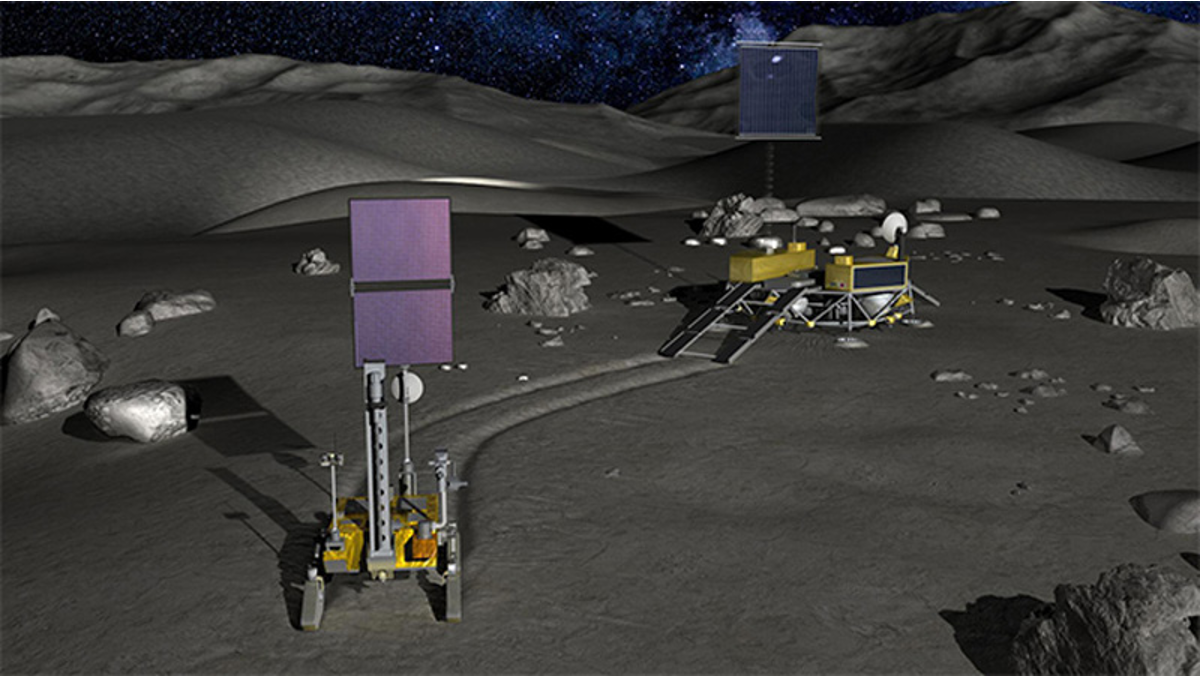
Japenese Startup To Partner With Indian Spacetech Startup To Land on Moon

Moon is once again an object of desire, courtesy tech giant Google, which under its aptly named Lunar XPRIZE competition is trying to inspire and challenge innovators, engineers, and entrepreneurs world to develop low-cost methods of robotic space exploration. The thing that makes the competition all the more lucrative is the $20 million prize amount that the winner will walk away with.

The latest contender which is almost very close to winning the Lunar XPRIZE is Team HAKUTO, a product of Japan-based startup ispace Inc. The startup has just obtained a launch vehicle to fulfil its plans to send to the Moon late next year.

Extending a helping hand to HAKUTO is India-based Team Indus, which already has a contract in its kitty for launching its own rover, aboard a rocket developed by the Indian Space Research Organization (ISRO), in December next year. The two, Team HAKUTO and Team Indus, have entered into a partnership for the same.

Industry experts claim that for Team HAKUTO, whose much famous rideshare with team Astrobiotic recently went kaput, this partnership with Team Indus came at just the right time to secure itself a launch vehicle so as to be able to stay in competition for the X-Prize which closes by the end of this year.

Also famous as "NASCAR on the Moon," Lunar X-Prize's first position will go to the first private company that is successfully able to make a landing on the Moon, do a 500 meters (1,640 feet) -dash, and then is able to send high-definition photos and video back to planet Earth. While the first position gets $20 million, the second position gets $5 million. In order to win either of the prizes, the teams must be able to prove that 90% of their mission costs were funded by private sources. In addition to this, there is a separate $5 million prize money to be given as a bonus. This will be available to teams that are successful in meeting several "bonus" challenges, which includes making a trip to the Apollo sites, and discovering water ice.

It is interesting to note that the news about Team Hakuto competing for the Lunar X-Prize comes just a few days after PT Scientists, a German team, announced that it has been successful in securing a ride to the Moon for next year. Other contenders in contention for one of the biggest competition on Earth includes American company Moon Express and Israeli nonprofit SpaceIL.

The door is soon closing for the rest of the 16 teams of the Lunar X-Prize to book themselves tickets to orbit. Let's wait and watch who all make the cut.

[Top Image: japantimes.co.jp]

Market Reports

Market Report & Surveys
IndianWeb2.com © all rights reserved