‏إظهار الرسائل ذات التسميات DPIIT. إظهار كافة الرسائل

Future of Mobility: MGDP 6.0 Opens Applications for Start-ups in AI, EV, and Sustainability

Future of Mobility: MGDP 6.0 Opens Applications for Start-ups in AI, EV, and Sustainability
  • Innovation in Automobile’ is the central theme of Season 6.0 of MG Developers Program & Grant
  • Applications open today; Entries close April 30, 2026
  • Demo Day is scheduled for June 1, 2026
  • MGDP has received over 1550 entries across its first five seasons
JSW MG Motor India today announced the launch of Season 6.0 of the MG Developer Program & Grant (MGDP) in collaboration with DPIIT, reaffirming its commitment to accelerating innovation and strengthening India’s start-up ecosystem. Building on the successes of the previous seasons, the sixth edition of MGDP is themed on ‘Innovation in Automotive’ and will focus on future-ready innovations.

Season 6.0 encourages start-ups to showcase their innovations under various categories, such as Innovation in Logistics and Supply Chain, AI in Automotive, V2X Intelligence, Sustainability & Circular Economy, Innovation in Vehicle Technology, Connected Services, Innovation in EV Charging Infrastructure, and Innovation in Manufacturing. An esteemed jury panel comprising senior leaders and distinguished experts from leading corporates, academic institutions and industry bodies will evaluate the entries based on their uniqueness and real-world applicability.

Speaking on the occasion, Anurag Mehrotra, Managing Director, JSW MG Motor India said, “Innovation remains the cornerstone of JSW MG Motor India’s vision for India, and we remain committed to nurturing this value through multiple initiatives. This new edition of MGDP aims to empower ambitious start-ups working across new energy, autonomous, and connected mobility technologies. Together, we hope to shape a future where technology meaningfully enhances every customer’s experience.

Sanjiv Singh, Joint Secretary, DPIIT, said, “Startup India, DPIIT is committed to supporting initiatives that foster collaboration, create opportunities for young talent and encourage India-specific innovation. We are delighted to partner with JSW MG Motor India for the new season of MGDP. This collaboration reflects our shared commitment to nurturing India’s future workforce and fostering a culture of practical problem-solving.

Selected participants will receive mentoring from JSW MG Motor India and its ecosystem partners, along with access to development support, opportunities for testing, and consideration for grant assistance at the jury’s discretion. Applications for the sixth season are live from today, with the final date for submission being April 30, 2026. Shortlisted teams will be mentored ahead of Demo Day on June 1, 2026.

Launched in 2019 in partnership with MG partner companies and tech giants, the MG Developer Program & Grant aims to nurture ground-breaking solutions within the Indian urban mobility space.

The program received over 1550 entries and saw 290+ teams being shortlisted in the first round across seasons 1 to 5. The teams were provided mentorship by 100+ experts, including JSW MG Motor India’s leadership and its technology ecosystem partners, making it the largest mentoring program in the automotive segment. A total of 51 start-ups have already been shortlisted by MG to date as part of MGDP and Grant, and they are working on various pilot projects.

Future of Mobility: MGDP 6.0 Opens Applications for Start-ups in AI, EV, and Sustainability

MGDP 6.0 website is live! https://www.mgmotor.co.in/world-of-mg/events/mg-developer-program-grant-6

Startup India Application Link: https://www.startupindia.gov.in/content/sih/en/ams-application/accelerator-program.html?applicationId=69ae994fe4b0b7e5b72b9dd4

About JSW MG Motor India

SAIC Motor, a global Fortune 500 company with a presence in over 100 countries and JSW Group (India's leading conglomerate with interests across B2B and B2C sectors) formed a joint venture - JSW MG Motor India Pvt. Ltd. in 2023. The joint venture aims to build a smart and sustainable automotive ecosystem while staying focused on developing a diverse portfolio of vehicles to give car buyers better access to advanced technologies and futuristic products with attractive value propositions. JSW MG Motor India Pvt. Ltd. is committed to introducing world-class technology, strengthening the manufacturing landscape, bringing the best of innovation across its business operations, and generating significant employment opportunities through extensive localisation.

About Morris Garages

Founded in the UK in 1924, Morris Garages vehicles were world-famous for their sports cars, roadsters, and cabriolet series. MG vehicles were much sought after by celebrities, including British Prime Ministers and even the British Royal Family, for their styling, elegance, and spirited performance. The MG Car Club, set up in 1930 at Abingdon in the UK, has thousands of loyal fans, making it one of the world’s largest clubs for a car brand. MG has evolved into a modern, futuristic, and innovative brand over the last 100 years. Its state-of-the-art manufacturing facility in Halol, Gujarat, has an annual production capacity of 1,00,000 plus vehicles and 6,000 direct and indirect employees. Driven by its vision of CASE (Connected, Autonomous, Shared, and Electric) mobility, the innovative automaker has augmented across-the-board ‘experiences’ within the automobile segment today. It has introduced several ‘firsts’ in India, including India’s first Internet SUV – MG Hector, India’s first Pure Electric Internet SUV – MG ZS EV, India’s first Autonomous (Level 1) Premium SUV – MG Gloster, the Astor- India’s first SUV with personal AI assistant and Autonomous (Level 2) technology, MG Comet – The Street-Smart Car, India’s first Intelligent CUV, MG Windsor, World’s Fastest MG – MG Cyberster and The Presidential Limousine – MG M9.

DPIIT, Blue Star Ink MoU to Drive HVAC and Boost Startup Innovation in Manufacturing

DPIIT, Blue Star Ink MoU to Drive HVAC and Boost Startup Innovation in Manufacturing

In a significant move to bolster India’s manufacturing and innovation ecosystem, the Department for Promotion of Industry and Internal Trade (DPIIT), under the Ministry of Commerce and Industry, has signed a Memorandum of Understanding (MoU) with Blue Star Limited, a leading air conditioning and refrigeration company.

The collaboration is designed to support startups, innovators, and entrepreneurs working in areas such as HVAC technologies, digital solutions, advanced manufacturing processes, and supply chain innovation. By fostering structured industry engagement, the initiative aims to help product startups develop scalable, industry-relevant solutions.

Under the agreement, startups will gain access to mentorship from industry experts, R&D laboratories, testing facilities, pilot opportunities, and market linkages. The partnership will also facilitate critical milestones such as product validation, Proof-of-Concept (PoC) development, and integration into industry value chains.

Speaking at the signing ceremony, Shri Sanjiv, Joint Secretary at DPIIT, emphasized that the collaboration represents an important step towards industry-driven innovation in the manufacturing sector. “Such partnerships enable startups to engage with real-world problem statements and scale solutions with tangible outcomes,” he noted.

As part of the initiative, DPIIT and Blue Star will explore innovation challenges under the Bharat Startup Grand Challenge, alongside targeted hackathons focused on HVAC, digital technologies, and manufacturing domains. Selected startups will have opportunities to participate in structured PoC programmes, with potential for pilot deployment and deeper industry engagement.

The MoU also ensures startups can access testing facilities, R&D infrastructure, and technical support, complemented by structured mentorship programmes and periodic engagement sessions to align innovations with industry requirements.

The agreement was signed by Shri T. L. K. Singh, Deputy Secretary, DPIIT, and Shri B Thiagarajan, Managing Director of Blue Star Limited, in the presence of senior officials from both sides.

India Approves BHAVYA: Plug-and-Play Industrial Parks to Attract Global Investors and Strengthen Atmanirbhar Bharat

India Approves BHAVYA: Plug-and-Play Industrial Parks to Attract Global Investors and Strengthen Atmanirbhar Bharat

India has taken a bold step toward accelerating regional industrialization and strengthening its manufacturing ecosystem with the approval of the BHAVYA scheme. This landmark initiative is designed to create new opportunities for millions of people while reinforcing the country’s vision of Atmanirbhar Bharat.

The BHAVYA scheme has been approved with a massive financial outlay of ₹33,660 crore (about $3.64 billion USD), aimed at developing 100 plug-and-play industrial parks across India. This investment is expected to generate around 15 lakh direct jobs and catalyze industrial growth nationwide.

Driving Industrial Growth and Inclusivity

The BHAVYA scheme is poised to benefit a wide spectrum of stakeholders:
  • Primary beneficiaries: Manufacturing units, MSMEs, startups, and global investors seeking ready-to-use industrial infrastructure.
  • Secondary beneficiaries: Workers, logistics providers, service sector enterprises, and local communities who will thrive in the ripple effects of industrial expansion.
By offering plug-and-play industrial parks, the scheme ensures industries can begin operations without delays related to land acquisition or infrastructure setup. This model not only boosts efficiency but also enhances India’s appeal as a global manufacturing hub.

A Step Toward Atmanirbhar Bharat

The approval of BHAVYA represents a transformational milestone in India’s industrial journey. It strengthens manufacturing capabilities, boosts exports, and lays the foundation for a resilient, inclusive, and globally competitive economy. The initiative aligns seamlessly with India’s broader goals of self-reliance, sustainability, and global leadership in production.

NICDC: Spearheading Smart Industrial Cities

At the heart of this transformation is the National Industrial Corridor Development Corporation Limited (NICDC), operating under the Department for Promotion of Industry and Internal Trade (DPIIT), Ministry of Commerce and Industry.

NICDC is currently implementing 20 projects across 13 states, building world-class greenfield industrial smart cities that enhance competitiveness, attract investments, and generate employment. These projects embody the concept of pre-developed ecosystems—where land, utilities, approvals, and infrastructure are ready, enabling industries to hit the ground running.

The Road Ahead

The BHAVYA scheme is more than an infrastructure project—it is a catalyst for economic transformation. By integrating manufacturing, logistics, and community development, it promises to:
  • Create millions of jobs across regions.
  • Empower MSMEs and startups with modern industrial infrastructure.
  • Attract global investors seeking efficiency and scale.
  • Strengthen India’s position in global supply chains.
This initiative signals India’s commitment to building a resilient, future-ready economy where industrial growth translates into inclusive prosperity.

Summary Table – BHAVYA Scheme 

Aspect Details
Budget Allocation ₹33,660 crore
Number of Parks 100
Park Size 100–1,000 acres
Lead Agency NICDC (under DPIIT)
Job Creation ~15 lakh direct jobs
Implementation Model Central + State + Private partnerships

About NICDC:

National Industrial Corridor Development Corporation Limited (NICDC), under the Department for Promotion of Industry and Internal Trade (DPIIT), Ministry of Commerce and Industry, is spearheading the development of world-class greenfield industrial smart cities to enhance manufacturing competitiveness, attract investments, and generate employment. NICDC is currently implementing 20 projects across 13 states.

NICDC-led initiatives are built on the concept of plug-and-play industrial parks—ready-to-use ecosystems where land, utilities, approvals, and infrastructure are pre-developed, enabling industries to start operations quickly without delays related to land acquisition or infrastructure setup.

Amazon India Collaborates with Govt Bodies to Support Artisans, Women-Led Enterprises, and Emerging Startups

Amazon India Collaborates with Govt Bodies to Support Artisans, Women-Led Enterprises, and Emerging Startups
  • Amazon aims to expand digital access and income opportunities for traditional artisan communities through the PM Vishwakarma Scheme
  • Endeavours to strengthen women-led businesses and early-stage startups through enhanced Saheli Accelerate and prioritised launch assistance to onboard on Amazon. 
  • Supports advance logistics research and multimodal transport innovation through a new collaboration with Gati Shakti Vishwavidyalaya
Amazon India today announced collaborations with multiple Government of India-run institutions to support traditional artisans, women-led enterprises, emerging startups, and research-driven innovation in India’s logistics ecosystem. These partnerships with the Ministry of Micro, Small and Medium Enterprises (MoMSME), the Department for Promotion of Industry and Internal Trade (DPIIT), and Gati Shakti Vishwavidyalaya (GSV) under the Ministry of Railways – aim to expand market access, build capability, and contribute meaningfully to India’s economic priorities.

Speaking on the partnerships, Samir Kumar, Country Manager, Amazon India said,
We are committed to working closely with these Government of India institutions to support artisans, entrepreneurs, and the evolving logistics ecosystem. These collaborations are opportunities to contribute to India’s long-term development goals while expanding access and opportunity for communities and businesses across the country.

Amazon is collaborating with Gati Shakti Vishwavidyalaya (GSV), India’s first university dedicated to transportation and logistics, to deepen research and sector capability. The partnership is being formalized through an MoU with the Office of the Vice Chancellor and will focus on railway freight corridors, multimodal transport, technology-led logistics efficiency, and sustainability initiatives. It will also include the publication of a report on warehousing opportunities and challenges in India. As part of the engagement, Amazon will support a dedicated research chair position at GSV to advance long-term work in areas of shared interest.

Prof. Manoj Choudhary, Vice Chancellor, Gati Shakti Vishwavidyalaya, said,
GSV is committed to shaping the future of India’s logistics sector through rigorous research and specialised talent development, being the only university for the sector in the country. Our collaboration with the logistics leader Amazon India brings valuable industry insights that will help informed planning, design, and innovation across logistics and transportation through coworking projects.

Amazon India has also partnered with MoMSME to support the PM Vishwakarma Scheme, which enables traditional artisans and craftspeople – including blacksmiths, goldsmiths, potters, carpenters, and sculptors – whose skills are passed down through generations. These artisans will be onboarded on amazon.in under Amazon’s Karigar program enabling them to showcase handmade products across categories such as apparel, home décor, footwear, and jewellery. Amazon’s Karigar program works with government bodies and artisan cooperatives to preserve traditional crafts and provide artisans with greater digital and market access.

Dr. Rajneesh, Additional Secretary and Development Commissioner, Ministry of Micro, Small and Medium Enterprises, said,
The PM Vishwakarma Scheme aims to strengthen India’s traditional artisans by improving access to tools, training, and markets. Our collaboration with Amazon India will support these artisans in participating more meaningfully in the digital economy and in building sustainable livelihoods, contributing towards our vision of a Viksit Bharat. 
Amazon has also expanded its collaboration with DPIIT to further support women-led businesses and early-stage startups. Under the strengthened partnership, the Saheli Accelerate program will scale from 18 to 50 women-led businesses – with a sharper focus on Tier-2 and Tier-3 cities and deeper mentorship support. Amazon will additionally offer prioritized onboarding and launch assistance to direct to customer startups joining the Amazon.in marketplace.

Shri Sanjiv, Joint Secretary, Department for Promotion of Industry and Internal Trade, said, “DPIIT continues to work toward strengthening India’s innovation landscape, especially among women-led businesses and young startups. Startup India’s collaboration with Amazon India helps extend these efforts by broadening access to mentorship, markets, and early-stage support.”

DPIIT Signs MoU with Ather Energy to Accelerate EV Manufacturing and Clean Mobility in India

DPIIT Signs MoU with Ather Energy to Accelerate EV Manufacturing and Clean Mobility in India

In a strategic move to bolster India’s electric vehicle (EV) sector, the Department for Promotion of Industry and Internal Trade (DPIIT) has announced the signing of a Memorandum of Understanding (MoU) with Bengaluru-based EV manufacturer Ather Energy. The partnership aims to strengthen the country’s clean mobility ecosystem and support deep-tech startups in the EV value chain.

A Push for Indigenous Innovation

The collaboration is part of the Build in Bharat initiative, led by the Startup Policy Forum (SPF)—a coalition of over 50 innovation-driven startups focused on hardware and manufacturing. The MoU outlines a multi-pronged strategy to:
  • Provide strategic mentorship for startups developing core EV and battery technologies. 
  • Offer infrastructure access and exposure to manufacturing processes. 
  • Launch joint innovation programs like the Bharat Startup Grand Challenge. 
  • Host skill development initiatives and national events such as Startup Mahakumbh

Voices from the Partnership

Joint Secretary of DPIIT, Sanjiv Singh, emphasized the transformative potential of the EV sector:
Through this partnership with Ather Energy, we aim to catalyse an enabling environment where startups can contribute meaningfully to EV manufacturing, battery innovation, and clean energy solutions.

Ather Energy’s Co-founder and CEO, Tarun Mehta, echoed the sentiment:

We are happy to collaborate with DPIIT to strengthen support systems for hardware and deep-tech startups. With policy support and stronger industry participation, this initiative can help founders tackle core technology challenges and scale high-quality products from India.

Strategic Impact

The MoU is expected to:
  • Bridge the gap between early-stage ventures and industrial-scale opportunities. 
  • Promote localisation of EV components and battery innovation
  • Expand India’s startup base in clean mobility and advanced manufacturing
President and CEO of the Startup Policy Forum, Shweta Rajpal Kohli, described the partnership as a milestone:

Unlocking the potential of India’s manufacturing sector through collaboration is key to building a globally competitive innovation ecosystem.

Context and Momentum

The DPIIT–Ather Energy pact comes amid growing momentum in India’s EV sector, driven by policy incentives, state-level EV programs, and rising consumer adoption. It follows DPIIT’s recent MoU with Maruti Suzuki India, signaling a broader push to integrate startups into the country’s industrial growth narrative.

Govt Collab with Bezos & Rockefeller Backed GEAPP To Accelerate Climate-Tech Entrepreneurship In India

Govt Collab with Bezos & Rockefeller Backed GEAPP To Accelerate Climate-Tech Entrepreneurship In India

The Department for Promotion of Industry and Internal Trade (DPIIT), a central government department under India's Ministry of Commerce and Industry, has signed a Memorandum of Understanding (MoU) with the Global Energy Alliance for People and Planet (GEAPP) to accelerate climate-tech entrepreneurship in India.

The GEAPP was founded through a collaboration of The Rockefeller Foundation, the IKEA Foundation, a Dutch charitable organization founded in 1982 by Ingvar Kamprad, the founder of IKEA, and the Bezos Earth Fund, a $10 billion philanthropic commitment by Jeff Bezos to combat climate change. GEAPP was launched at COP26 in 2021 to accelerate clean energy access and drive sustainable economic growth.

The two-year DPIIT-GEAPP partnership, with a provision for extension, will support early-stage climate-tech startups through funding access, mentorship, pilot opportunities, and market linkages. The initiative seeks to build a strong pipeline of scalable, investable ventures aligned with India’s net-zero ambitions.

Key Highlights of the Collaboration

  • ENTICE Challenge: A competitive platform offering up to USD 500,000 in rewards for startups developing impactful clean energy solutions.
  • Funding & Mentorship: Early-stage climate-tech startups will receive investment support through partners like Spectrum Impact and Avana Capital.
  • Integration with Startup India: DPIIT will connect the initiative to Startup India’s network, ensuring outreach through major government schemes.
  • Net-Zero Vision: The partnership aligns with India’s long-term climate goals, fostering scalable and investable ventures.
Sanjiv, Joint Secretary at DPIIT, emphasized that India’s climate leadership depends on a strong entrepreneurial base.

Saurabh Kumar, Vice President – India at GEAPP, described the MoU as a pivotal step toward systemic change through government-private sector collaboration.

DPIIT Inks MoU With Startup Policy Forum (SPF) To Boost Country’s Startup Ecosystem

The Department for Promotion of Industry and Internal Trade (DPIIT), under the Ministry of Commerce & Industry, has entered into a landmark partnership with the Startup Policy Forum (SPF), a premier industry organization representing India’s leading new-age companies. This strategic collaboration aims to establish India as a global hub for innovation and entrepreneurship.

DPIIT Inks MoU With Startup Policy Forum (SPF) To Boost Country’s Startup Ecosystem
Dr. Sumeet Kumar Jarangal, Director, Startup India and  Shweta Rajpal Kohli, President & CEO, Startup Policy Forum (L-R)

A highlight of this partnership is the upcoming SPF Startup Baithak, a flagship event scheduled to take place on January 15-16, 2025, at Bharat Mandapam as part of the National Startup Week celebrations. The event will serve as a dynamic platform for fostering meaningful collaborations between DPIIT and SPF members, showcasing groundbreaking innovations, and announcing new initiatives. Furthermore, SPF will join hands with DPIIT to curate specialized immersive programs, designed to connect global investors with India’s vibrant startup ecosystem.

Speaking on the occasion, Sh. Sanjiv, Joint Secretary, Startup India, shared, “This strategic collaboration with SPF underscores DPIIT’s unflinching commitment to create a congenial atmosphere where startups could thrive and contribute immensely to India’s mission of becoming a global innovation hub. The SPF members represent the essence of India’s entrepreneurial spirit and their participation in this mission will play a crucial role in achieving the goal of developed India by 2047.”

Shweta Rajpal Kohli, President & CEO, Startup Policy Forum, expressed her enthusiasm for the partnership by stating, “This alliance is a testament to the shared vision of DPIIT and SPF to cultivate a resilient and thriving startup ecosystem. By fostering impactful collaborations, we aim to position India prominently on the global innovation map and empower entrepreneurs to unlock their full potential.”

Elaborating on the perspective of this groundbreaking initiative, Dr. Sumeet Kumar Jarangal, Director, Startup India stated, “The collaboration aims to amplify innovation, drive technology adoption, and boost manufacturing capabilities in India. By forging partnerships amongst DPIIT and SPF members, the alliance seeks to promote the Indian startup ecosystem globally on the centre stage and facilitate relationship with international stakeholders and ecosystem enablers.”

About Startup Policy Forum:

Startup Policy Forum (SPF) is an industry alliance for India's new-age companies. SPF’s members include many of India’s most successful and valuable startups including Razorpay, CRED, Groww, Zerodha, Pine Labs, OYO, Acko, Swiggy, Dream11, Mobile Premier League (MPL), Livspace, Cars24, Cardekho, Mobikwik among others. SPF’s mission is to be a trusted partner to founders and policymakers. It engages in policy advocacy for new age companies, promotes the Indian startup ecosystem on a global stage and brings together a curated community of leading startups and founders. The Forum provides a platform for networking, community engagement, and consensus building, enabling startups across diverse sectors to scale both domestically and overseas.

Govt Enquires Quick Commerce Companies on Operating Model and Warehouse Ownership

Govt Enquires Quick Commerce Companies on Operating Model and Warehouse Ownership

Quick commerce companies like Blinkit, Swiggy Instamart, Zepto, and Bigbasket recently met with Indian government officials to discuss concerns related to Foreign Direct Investment (FDI) and their operating models.

The Department for Promotion of Industry and Internal Trade (DPIIT) chaired the meeting, which also included officials from the Department of Consumer Affairs and the Competition Commission of India (CCI).

The government is particularly interested in understanding how these companies operate their dark stores (mini warehouses within neighborhoods) and whether they comply with India's FDI norms for ecommerce, which prohibit online retailers with foreign investments from holding inventory.

Senior executives from Blinkit, Swiggy Instamart, Zepto, and Bigbasket met with officials from the Department for Promotion of Industry and Internal Trade (DPIIT), the Department of Consumer Affairs, and the Competition Commission of India (CCI).

Key Topics: The meeting focused on the ownership structure of dark stores (mini warehouses within neighborhoods), compliance with FDI norms, and the impact on traditional kirana stores.

Concerns Raised

FDI Compliance: Officials questioned whether quick commerce companies comply with India's FDI norms for ecommerce, which prohibit online retailers with foreign investments from holding inventory. Dark stores are a point of contention as they are used to store products for quick delivery.

Impact on Kirana Stores: There were concerns about how the growth of quick commerce affects traditional kirana stores, with some officials worried that it might lead to unfair competition and negatively impact small retailers.

Delivery Safety: Questions were raised about the burden on delivery partners to fulfill orders within 10 minutes and whether this creates road safety issues.

Company Responses

Supplementary Demand: Representatives from quick commerce companies argued that their services supplement demand rather than replace traditional retail.

Clarifications: They addressed concerns about delivery safety and clarified their compliance with regulatory norms.

Broader Context

Rapid Growth: Quick commerce is experiencing rapid growth, with companies raising significant capital and expanding their operations. 

Regulatory Scrutiny: The government is keen on ensuring that these companies adhere to regulatory frameworks to maintain fair competition and protect consumer interests.

The government plans to hold more such meetings to gather detailed information on the operations of quick commerce platforms. This ongoing dialogue aims to balance innovation with regulatory compliance and fair market practices.

Flipkart To Amazon, DPIIT Inks 6 MoUs in this Month Alone, To Boost Startup Ecosystem

Flipkart To Amazon, DPIIT Inks 6 MoUs in this Month Alone, To Boost Startup Ecosystem

Since October this year, the Department for Promotion of Industry and Internal Trade (DPIIT) has signed several Memorandums of Understanding (MoUs) to boost India's startup ecosystem. Here are six of them inked in this month alone:

1. HCLSoftware: DPIIT signed an MoU with HCLSoftware to support India's startup manufacturing ecosystem under the Startup India initiative. This collaboration aims to provide startups with global market exposure and help them showcase their products and services worldwide.

2. Flipkart: DPIIT partnered with Flipkart to invest in and mentor Indian startups. This MoU is part of Flipkart's USD 100 million venture fund initiative, which aims to support tech startups across India.

3. HDFC Bank: DPIIT signed an MoU with HDFC Bank to provide startups with world-class banking and financial services. This collaboration aims to address critical challenges like funding and financial management, creating a conducive environment for startups to innovate and grow.

4. Tally Solutions: DPIIT signed an MoU with Tally Solutions to mentor manufacturing startups. Tally will offer training, case studies, and expert-led sessions to help startups streamline operations, adopt scalable business practices, and address challenges in financial management, compliance, marketing, and digitization.

5. WinZO: DPIIT signed a two-year MoU with WinZO, India's largest social gaming and interactive entertainment platform. This partnership aims to accelerate the growth of India's interactive entertainment sector by fostering innovation, creating skilled talent, and scaling startups to compete globally.

6. Amazon: DPIIT signed an MoU with Amazon to propel India's manufacturing ambitions. Amazon has earmarked $120 million from its Smbhav Venture Fund to invest in startups that digitize consumer goods manufacturing in India and cater to domestic and global demand.

Beside these six MoUs, DPIIT signed an MoU with Hitachi, Merck Life Science and Shree Cements to boost innovation and technology development in India. This collaboration aims to enhance research and development capabilities, promote advanced manufacturing, and support startups in these fields.

DPIIT signed an MoU with Johnson Controls-Hitachi Air Conditioning India to establish a startup incubator in Gujarat. This incubator is designed to support manufacturing-focused startups by providing mentorship, guidance, and access to world-class R&D, prototyping, and testing processes. The goal is to foster technological advancements, sustainability, and energy efficiency.

The incubator will help startups with concept-to-prototype development, project viability assessment, and go-to-market strategies. It will also support them in managing potential funding needs and other necessary services such as legal and IP filing for commercialization of innovative products.

DPIIT signed an MoU with Merck Life Science India on November 26, 2024. This collaboration is part of the Startup India initiative and aims to empower emerging biotech startups by providing access to cutting-edge global technologies. The goal is to foster innovation, promote new product development, and strengthen India's biotech manufacturing ecosystem.

DPIIT signed an MoU with Shree Cement to empower and promote manufacturing incubation. This partnership aims to strengthen India's manufacturing ecosystem by encouraging product startups, innovators, and entrepreneurs. Through this collaboration, Shree Cement will offer infrastructure, mentorship, access to funding, and market connections to help startups from prototype development to potential international expansion.

The initiative will encourage and motivate biotech startups, innovators, and entrepreneurs by nurturing ideas and helping them overcome the "valley of death" – the critical phase where many startups struggle to survive.

These partnerships are part of DPIIT's broader efforts to foster innovation, entrepreneurship, and economic growth in India.

Amazon India Partners With Startup India, DPIIT to Empower Startups Through E-Commerce

Amazon India Partners With Startup India, DPIIT to Empower Startups Through E-Commerce

  • Amazon India will collaborate with Startup India to help startups scale their businesses across the nation through e-commerce.
  • Amazon India will partner with Startup India to support in increasing the reach of the Bharat Startup Knowledge Access Registry (BHASKAR) platform.
  • Through the Amazon Saheli x Startup India program, Amazon will work to accelerate the e-commerce journey of select women entrepreneurs by building capacity, providing upskilling opportunities, and fostering growth.

Amazon India has announced that it will be working with Startup India under the aegis of the Department for Promotion of Industry and Internal Trade (DPIIT), to drive multiple initiatives aimed towards empowering startups to build and grow their businesses through e-commerce. Amazon will collaborate with Startup India to enable eligible startups to tap into opportunities in ecommerce by registering on Amazon India’s marketplace through a dedicated page on the Startup India portal. Amazon will provide dedicated onboarding experience to the startups, which will help them gain access to the domestic market as well as mentorship from Amazon leaders, go-to-market support and logistics guidance.

Further, it will partner with Startup India to empower women entrepreneurs in e-commerce, through its Saheli program. The collaboration will drive a high-impact learning program designed to fuel the e-commerce journeys of eligible women led small and medium businesses in India. Amazon’s extensive suite of services including Amazon Pay, Amazon Incentives, Amazon Business, Amazon Transport, AWS, Amazon Advertising, and Mini TV will be available to the women startups, who will be part of the program. It will cover a broad gamut of relevant industries including Fashion, F&B, Textile & Apparel, Toys and Games, Automotive, Art & Photography, Pets & Animals, Agriculture and many more.


Additionally, Amazon will partner with Startup India to create awareness about the Bharat Startup Knowledge Access Registry (BHASKAR) initiative, under the Startup India program. BHASKAR is a platform designed to centralize, streamline, and enhance collaboration among key stakeholders within the entrepreneurial ecosystem, including startups, investors, mentors, service enablers, and government bodies.

Sharing his views on the occasion, Shri Sanjiv, Joint Secretary, Department for Promotion of Industry and Internal Trade (DPIIT), said “Our collaboration with Amazon is aimed at empowering startups to unleash their entrepreneurial potential and access new growth avenues. By combining Amazon's e-commerce expertise with Startup India's role as the Government of India’s flagship initiative for the development of the startup ecosystem, we will provide a robust platform for Indian startups and businesses to scale domestically. Further, the collaboration of Startup India with Amazon India is a testament to our commitment to the empowerment of Indian entrepreneurs across sectors and regions and driving economic development in the country through entrepreneurship and innovation.

Mr. Chetan Krishnaswamy, Vice President – Public Policy, Amazon India said, “Startups in India are an inspiration to everyone because of their sheer determination and willpower to build successful businesses across different industries. By leveraging the power of e-commerce, they are scaling new heights, and catering to customers across different parts of the country with their innovative products. We are honoured to join hands with Startup India, DPIIT, to pursue our common goal of empowering entrepreneurs and driving economic growth in India.Additionally, it underscores Amazon India's dedication to fostering a diverse and inclusive ecosystem, where women entrepreneurs are equipped with the tools and opportunities to realize their full potential.”

This comprehensive partnership between Startup India and Amazon India will create a powerful platform to drive the growth of startups in India, enabling SMBs to scale their businesses through e-commerce and reach a vast customer base across all serviceable pin codes where Amazon delivers, becoming national brands.

The Amazon.in marketplace is operated by Amazon Seller Services Private Ltd, an affiliate of Amazon.com, Inc. (NASDAQ: AMZN). Amazon.in seeks to build the most customer-centric online destination for customers to find and discover virtually anything they want to buy online by giving them more of what they want – vast selection, competitive prices, fast and reliable delivery, and a trusted and convenient experience; and provide sellers with a world-class e-commerce marketplace.

Govt Launching Groundbreaking Digital Platform BHASKAR for Indian Startup Ecosystem

Govt Launching Groundbreaking Digital Platform BHASKAR for Indian Startup Ecosystem

The Department for Promotion of Industry and Internal Trade (DPIIT), Ministry of Commerce and Industry, is set to launch a new digital platform called BHASKAR (Bharat Startup Knowledge Access Registry) to revolutionize India's startup ecosystem.

BHASKAR aims provide an all-encompassing, one-stop digital platform that addresses the challenges faced by entrepreneurs and investors alike.

The platform aims to centralize, streamline, and enhance collaboration among key stakeholders, including startups, investors, mentors, service providers, and government bodies.

By serving as a centralized registry, BHASKAR will enable seamless access to a wide array of resources, tools, and knowledge that will help fuel the entrepreneurial journey from ideation to execution.

Key features of BHASKAR include:
  • Networking and Collaboration: Bridging the gap between startups, investors, mentors, and other stakeholders for seamless interaction across sectors.
  • Centralized Access to Resources: Providing immediate access to critical tools and knowledge, enabling faster decision-making and efficient scaling.
  • Personalized Identification: Assigning unique BHASKAR IDs to each stakeholder for personalized interactions and tailored experiences.
  • Enhanced Discoverability: Powerful search features to easily locate relevant resources, collaborators, and opportunities.
This initiative aligns with the Government of India’s vision to transform India into a global leader in innovation and entrepreneurship.

The BHASKAR platform will offer a wide range of resources to support the startup ecosystem in India. Here are some key resources you can expect:

1. Funding Opportunities: Information on various funding options, including venture capital, angel investors, government grants, and loans.

2. Mentorship Programs: Access to experienced mentors across different industries to guide startups through their growth journey.

3. Networking Events: Details about upcoming events, workshops, and conferences to facilitate networking and collaboration.

4. Legal and Regulatory Support: Guidance on compliance, intellectual property rights, and other legal aspects crucial for startups.

5. Market Insights: Data and analytics on market trends, consumer behavior, and industry performance to help startups make informed decisions.

6. Training and Development: Courses and workshops on essential skills like business management, marketing, and technology.

7. Service Providers: Listings of service providers offering essential services such as accounting, marketing, and IT support.

8. Success Stories and Case Studies: Inspirational stories and case studies of successful startups to motivate and educate new entrepreneurs.

These resources aim to create a supportive environment for startups to thrive and scale efficiently.

With the launch of BHASKAR, the Government of India is reinforcing its commitment to making India a leader in global innovation, entrepreneurship, and economic growth.

Tesla Official in Talks With Indian Govt Officials Got Fired : DPIIT Secy on Tesla's Delays for India

Tesla Official in Talks With Indian Govt Officials Got Fired : DPIIT Secy on Tesla's Delays for India

Rajesh Kumar Singh, Secretary of the Department for Promotion of Industry and Internal Trade (DPIIT), recently addressed the delays surrounding Tesla's entry into the Indian market. In an interaction with CNBC-TV18, Singh stated, "We are the wrong person to be asked. Tesla representatives must answer this. The person talking to us got fired." While India remains open to all global companies interested in penetrating the Indian EV market, Tesla's entry remains uncertain.

DPIIT secretary admitted that the reasons behind Tesla’s delay remain unclear. "You really have to ask the Tesla representatives as to what they're waiting for. We really don't know; we don't have much of an update on that," Singh said.

The specific reason for the Tesla representative's dismissal remains undisclosed. The circumstances leading to this decision are not publicly available. Tesla's entry into the Indian market continues to be a topic of interest, and the company's internal dynamics may play a role in shaping their strategy.

Interestingly, Singh emphasized that India's EV policy framework aims to create a level playing field for all companies entering the market, drawing parallels with successful strategies in other sectors. Despite the absence of a Production Linked Incentive (PLI) scheme, Singh expressed confidence in attracting investment to India's EV sector through import policies and tariff measures. It seems the ball is now in Tesla's court to address internal and external factors influencing their plans.

Singh emphasized that India's EV policy aims to create a level playing field for all global companies interested in entering the market. The goal is to foster a competitive and inclusive environment for players in the EV sector.

Despite high expectations, Tesla's progress in India has stalled. Singh candidly stated that the reasons behind Tesla's delay remain unclear. He encouraged asking Tesla representatives directly for updates.

Drawing parallels with other sectors, Singh highlighted successful negotiations with global tire manufacturers. Relaxing restrictions led to significant foreign investment, even without a Production Linked Incentive (PLI) scheme.

While Tesla's entry remains uncertain, India's commitment to EV adoption and investment opportunities remains steadfast. 

DPIIT Requests FinMin to Remove Angel Tax on Startups

DPIIT Requests FinMin to Remove Angel Tax on Startups

The Department for Promotion of Industry and Internal Trade (DPIIT) has recommended the removal of the Angel Tax for startups. This tax, originally introduced in 2012 under Section 56 (2) (viib) of the Income Tax Act, aims to prevent abuse such as money laundering and round-tripping.

However, it has been a long-standing concern for startups and investors. When a closely held company (like a startup) issues shares at a valuation higher than the fair market value, tax authorities treat the excess amount received as income from other sources and levy a tax of about 30%. Investors argue that they invest at higher valuations considering a startup's future potential, and the tax notices hinder their "ease of doing business."

Venture capital investors also believe that repealing the Angel Tax will encourage Indian startups to relocate their domicile back to India and foster innovation in the world's third-largest startup economy. Let's hope for positive developments.

DPIIT's suggestion also comes after the Confederation of Indian Industry (CII) in its budget recommendations called for the removal of angel tax saying it “will greatly aid in capital formation”.

As of now, there isn't a specific timeline for the decision on repealing the Angel Tax. The recommendation to remove it has been made by the DPIIT, but the final decision rests with the Union Finance Ministry. We'll have to keep an eye out for update.

The potential benefits of repealing the Angel Tax for startups are manifold. Removal of the tax would create a more favorable environment for angel investors, encouraging them to invest in early-stage startups without the fear of tax scrutiny. As startups often rely on angel funding during their initial stages. Eliminating the tax burden would enhance their access to capital, fostering innovation and growth. A tax-free investment climate would attract foreign investors, leading to increased foreign direct investment (FDI) in the Indian startup ecosystem.

Moreover, vibrant startups contribute significantly to job creation. By easing investment, the country can witness more startups to scale up and hire talent.

In addition to these benefits, a tax-free regime would make Indian startups more competitive globally, encouraging them to stay and operate within the country. Simplifying tax regulations would improve the ease of doing business for startups, reducing administrative burdensm

These benefits depend on effective implementation and monitoring to prevent misuse. Let's hope for positive policy changes.

DPIIT, along with Villgro, Announce 25 Selected Incubators for the National Incubator Capacity Development Program

DPIIT, along with Villgro, announce 25 selected incubators for the National Incubator Capacity Development Program
  • Villgro will commence their 3-month-long National Incubator Capacity Development Program with 25 incubators.
  • Leading experts and industry stalwarts will provide intensive mentorship and advisory support to the incubators.
  • The program adopts a cohort-based hybrid approach which includes expert-led virtual and physical sessions, exposure to national and international best practices, and donor networking
  • The program aims to build sustainable incubators and create an enabling ecosystem for entrepreneurs to thrive.
The National Incubator Capacity Development Program, by the Department for Promotion of Industry and Internal Trade (DPIIT) has announced the selection of the Top-25 incubators that will go through an intensive 3-month mentorship, advisory, and capacity-building program. The initiative, in association with Villgro, is part of the Start-up India campaign. It is dedicated to nurturing social startups and entrepreneurs and propelling the rapid expansion of India's thriving startup ecosystem.

The program, over a period of 12 weeks, adopts a cohort-based hybrid approach to enhance the skills and abilities of the incubators. It includes a comprehensive set of self-learning modules, virtual and physical boot camps, exposure visits, and customized learning for incubator heads and sessions dedicated to efficiently managing the Startup India Seed Fund Scheme (SISFS). These sessions will be provided by a distinguished group of incubator business advisors, including PR Ganapathy, Chand Das, Rama Kannan, Sandeep Jain, etc.

Additionally, participants will gain access to VITALS (Villgro Information Tracking and Learning System), a technology-based information system designed to track enterprise incubation progress.

Speaking about the program, Srinivas Ramanujam, CEO of Villgro, said, "Incubators play a pivotal role in nurturing social enterprises and transforming India's vibrant startup ecosystem. Over the last 22 years, we have observed this first-hand and have been perfecting our incubation model. We aim to strengthen the capacity of the incubators by sharing our expertise and wide networks through intensive mentorship and advisory support. We hope to catalyze their growth and create a thriving ecosystem for social innovation.”

The National Incubator Capacity Building Program is launched to help build quality incubators across the country with an emphasis towards Tier-2 and Tier-3 cities and encourage cross-learning from larger cities and lighthouse incubators to address the needs of startups building for Bharat. The training program with industry veterans and experts will provide valuable insights and expertise that will be instrumental in shaping the dynamic cohort of 25 incubators, empowering them with the necessary support and mentorship to create an enabling ecosystem for entrepreneurs to flourish,” said Prashanth Prakash, Member of the National Startup Advisory Council and Partner at Accel.

Given the presence of over 99,000+ DPIIT-recognized startups nationwide, coupled with hundreds of incubators across the country, the imperative to establish and bolster new incubators has become paramount. However, there remains a limited level of training, sensitization, and knowledge building for new incubator managers and their teams, especially in emerging cities and beyond India's metros. The National Incubator Capacity Development Program seeks to bridge this gap by providing hands-on training and growth hacks for incubators to ensure their sustainability.

The Startup India Platform hosted a call for applications, inviting incubators from all over India to participate, that attracted 83 applications. After initial screening, the jury panel, comprising experts from various industries, conducted a rigorous evaluation of Top-35 applications. Out of these, 25 exceptional incubators were selected to be part of the program. The final incubator cohort support startups from diverse sectors, including Women Entrepreneurship, Education, Mobility, Agriculture, Rural Innnovations, and Climate Action among many others. The 25 incubators participating in the Incubating Incubator program are —
  1. Pilani Innovation and Entrepreneurship Development Society,
  2. AIC ADT Baramati Foundation,
  3. AIC - SKU Confederation,
  4. AIC BV Foundation,
  5. AIC Raise Foundation,
  6. BSC BioNEST Bio-Incubator,
  7. RCB Faridabad,
  8. Agri Business Incubation Foundation,
  9. IIT Kharagpur,
  10. IIMV Foundation for Incubation Entrepreneurial Learning and Development,
  11. AIC-JKLU (Atal Incubation Center-JK Lakshmipat University),
  12. Crescent Innovation and Incubation Council,
  13. MOTION CoE, AIC-RNTU Foundation,
  14. EdVenture Incubation Foundation,
  15. AIC BAMU Foundation,
  16. IIT Bhubaneswar Research And Entrepreneurship Park,
  17. AIC Banasthali Vidyapith Foundation,
  18. AICNIFTTEA Incubation Centre,
  19. PDEU Innovation and Incubation Centre,
  20. ANGRAU R Agri Business Incubator,
  21. FOUNDATION FOR CfHE,
  22. K L Technology Incubators Foundation,
  23. Centre for Incubation and Business Acceleration, 
  24. BioNEST-BHU InnoResTech Foundation,
  25. IIM Kashipur Foundation for Innovation & Entrepreneurship Development, STEP (Shakti-The Empathy Project).
The National Incubator Capacity Development Program represents a significant milestone in the development of India's startup ecosystem. NICDP will empower and equip a pathway to the incubators' sustainability. By empowering incubators with the necessary knowledge and resources, the program also aims to foster an environment conducive to innovation, job creation, and social impact. 

Govt Approves Rs 611 Crores for 165 Incubators Under Seed Fund Scheme of Startup India

Govt Approves Rs 611 Crores for 165 Incubators Under Seed Fund Scheme of Startup India

The government has allocated Rs 611 crore to the incubator under the scheme of seed fund that is to provide initial capital, which was started for the encouragement of startup in the country, out of this 611 crore fund Rs 61 crore, till date, have been given to start-ups.

A senior official reported on Tuesday that new startups found eligible through Incubator (an institution that initially supports new startups) are being given economic support through this fund.

Manmeet Nanda, Joint Secretary in the Department of Industry Promotion and Internal Trade ( DPIIT), told reporters here that within two years of the commencement of the scheme, it proved helpful in promoting innovation.

The government launched the ‘ Startup India Seed Fund Scheme ’ in April 2021 with an allocation of Rs 945 crore. This fund amount is to be allocated till FY 2024-2025.

Nanda said that so far 165 incubators have been selected under this scheme and the government has approved Rs 611 crore for them. He said, "so far more than 1,000 startups have benefited from the scheme."

He said that the department will be able to use the sum of Rs 945 crore under the scheme and a separate amount will also be demanded if needed.

Startup Related Events to Be Organized in Over 75 Places Across Country

Startup Related Events to Be Organized in Over 75 Places Across Country

DPIIT to organize Startup India Innovation Week from 10th January 2023 to 16th January 2023.

National Startup Awards 2022 Winners to be felicitated on National Startup Day on 16th January 2023

Department for Promotion of Industry and Internal Trade (DPIIT), Ministry of Commerce and Industry is organizing Startup India Innovation Week from 10th January 2023 to 16th January 2023 to celebrate the Indian Startup Ecosystem as well as National Startup Day (16th January 2023).

It was in January last year when Prime Minister Narendra Modi has declared to mark 16th January as 'National Start-up Day'.

Startup India Innovation Week 2023 will include Knowledge Sharing Sessions for entrepreneurs, aspiring entrepreneurs, and other enablers, involving relevant stakeholders from the startup ecosystem such as Government officials, incubators, corporates and investors.

Furthermore, as a part of Azadi Ka Amrit Mahotsav celebrations, various startup related events are being organized in more than 75 places across the country to foster a spirit of entrepreneurship and innovation by involving the startup community across length and breadth of the country. These events include dedicated workshops for women entrepreneurs, training of incubators, mentorship workshops, stakeholder round tables, conferences, capacity building workshops, startup pitching sessions, amongst others.

Furthermore, to commemorate National Startup Day on 16th January 2023, DPIIT is organizing the felicitation ceremony for the winners of National Startup Awards 2022, a flagship initiative under Startup India. The ceremony will recognize and reward the excellence exhibited by startups and ecosystem enablers across different sectors, sub-sectors, and categories.

Startup India Innovation Week 2023 aims to engage startup ecosystem stakeholders across the nation during 10th January-16th January 2023 and spur the spirit of entrepreneurship and innovation in India.

Startup India Launches MAARG Portal to Help New Startups

Startup India Launches MAARG Portal to Help New Startups
The Department for Promotion of Industry and Internal Trade (DPIIT), under the Ministry of Commerce Industry of the Central Government, has started MAARG Portal under the Ministry of Commerce Industry of the Central Government. The MAARG Portal will help new startups.

This portal will help ease the way people in the country create a successful startup.

The name 'MAARG' is decoded as — M means Mentorship, A means Advisory, another A means Assistance, R means Resilience and G means Growth. The route ( MAARG ~ in Hindi) is formed when connecting them all together. The government is preparing a path from starting startup to pushing it forward and later progressing.

The central government is doing everything possible to create a finest startup ecosystem . For which MAARG Portal is designed. The Department for Promotion of Industry and Internal Trade is the national mentorship platform of (DPIIT) under the Ministry of Commerce Industry of the Central Government. This is part of Startup India. The government has started registration on MAARG Portal and applications have been sought from startups across the country.

Once startups onboard at MAARG they will get a chance to make their idea a success by connecting with experts/mentors of their respective sectors. Startups and experts will be linked with the help of Artificial Intelligence algorithm. It is a known fact that new startups are constantly opening up everyday. There are over 82,000 recognized startups in India so far. Out of this, the number of unicorns has reached around 107.

With MAARG Portal, startups can connect with academics, industry experts, successful startup founders, investors. The startups may also get a chance to join world class advisors and experts.

The central government has completed the first phase of MAARG Portal. Under this, the government has added more than 400 experts related to different sectors on this portal who can answer queries on every problems startups face. Now the government is going to start its second phase, in which it is going to connect the startup across the country with this portal. This will be followed by interconnecting mentors and startups in the last step.

The mentorship offerings provided on MAARG are completely pro bono.

How MAARG Works

Each user can register on the platform as a Mentor or Startup. After publishing of the profile, the platform will matchmake mentors and Startups using artificial intelligence based on sector, stage, and functional skillset.

Either party can send a connection request to a desired mentor/Startup and once the request is accepted, the mentorship can be started.

Each mentorship connection will be tracked for evaluating progress and feedback. Following the sessions, the mentors and Startups will be prompted to update the session details in their respective dashboards namely duration of session, specific topic etc. In case the sessions are not updated, the users will not be able to proceed further for scheduling the next session.

It is to be noted that the mentorship session videos and chats may be recorded for quality purposes, says the MAARG Portal website.

Govt Asks Businesses and Citizens to Flag Issues Faced in Starting/ Running A Business

Govt Asks Businesses and Citizens to Flag Issues Faced in Starting/ Running A Business

Suggestion campaign to remain live on the Innovate platform of MyGov till 15th October 2022

Government of India in an official press release said that it is committed to improve Ease of Doing Business and Ease of Living across the country. Multitude of reforms have been implemented over the last few years to improve Government’s interface with businesses and citizens.

To further improve Ease of Doing Business and Ease of Living, Department for Promotion of Industry and Internal Trade (DPIIT), a central government department under the Ministry of Commerce and Industry, is inviting suggestions from businesses and citizens on issues in starting and running a business. 

Also, minor violations under which Provisions/Sections of the Acts/Rules are to be decriminalized. The aim is to make ‘New India’ a preferred investment destination across the globe and ensure hassle-free service delivery to the ultimate beneficiary. 

Campaign link: https://innovateindia.mygov.in/suggestion-box/
Last date : 15th October 2022

Following are some suggestive broad areas that can be seen to further improve Ease of Doing Business and Ease of Living:
  • Getting Permissions, Approvals
  • Renewal of Certificates, Licenses
  • Decriminalization of minor offences
  • Filings/Returns
  • Inspections/Audits
  • Online systems/process
  • Maintaining Registers & Records
  • Applying for Incentives
  • Payment of Incentives
  • Procedural/Guidelines related
  • Payment mechanism
  • Others
Suggestions are to be submitted in a clear and concise manner along with selection of correct Department of a Central Ministry or a State/ Union Territory. Participants need to fill separate forms for submitting different suggestions across different categories or Government Departments.

National Startup Report and States' Startup Ranking Results Declared

National Startup Report and States' Startup Ranking Results Declared

Results of Ranking of States’ Exercise 2021 on support to Start-up Ecosystems declared

Shri Goyal asks more start-ups to come on GeM platform; Says there is a great opportunity to democratize the start-up ecosystem

The results of the third edition of Ranking of States on Support to Startup Ecosystems were released by Minister of Commerce and Industry, Mr. Shri Piyush Goyal, on Monday at The Ashok Hotel, New Delhi. Gujarat and Karnataka emerged as the Best Performers in a category of States which included NCT of Delhi. Meghalaya won the top honour among UTs and North-eastern (NE) States.

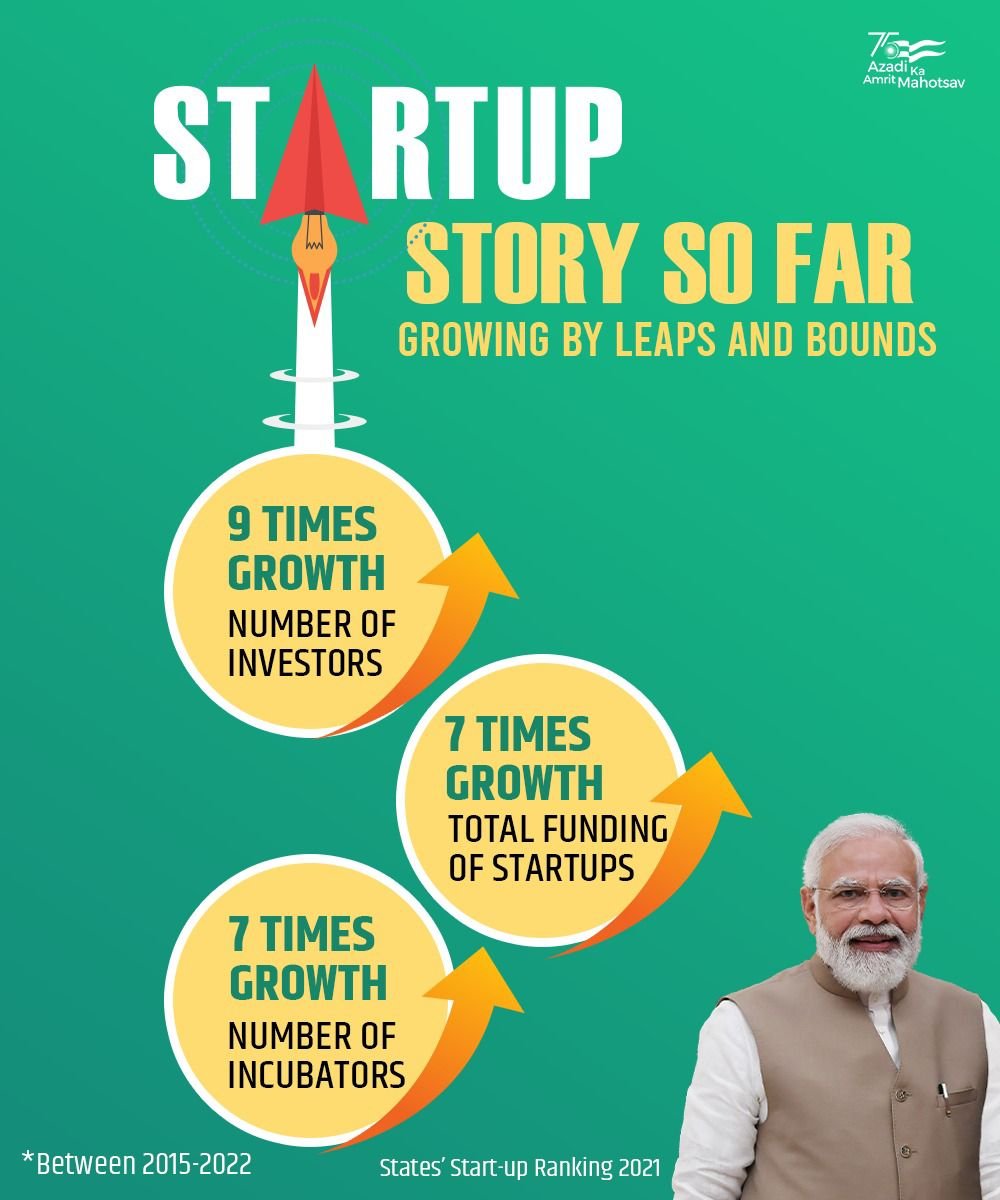
The States Startup Ranking 2021 highlighted the support being extended by over 30 states and union territories through startup policies to the ecosystem. There were only 4 states with startup policies prior to 2016. The state startup teams have been extending support across mentorship, incubation and funding. Moreover, feedback was gathered from more than 7,000 beneficiaries through surveys made in 13 different languages to grasp the real situation at the execution level.

While Kerala, Maharashtra, Orissa and Telangana got the Top Performers award among states, Jammu & Kashmir emerged as the Top Performer among UTs and NE states.


The call for mentors for MAARG portal was also announced during the event. The portal is developed with the idea to develop a tool for start-ups in India that can be accessed from every corner of the country to request and connect with a mentor.

For the purposes of the Ranking, States and Union Territories are classified into 5 Categories - 1. Best Performers; 2. Top Performers; 3. Leaders; 4. Aspiring Leaders; and 5. Emerging Start-up Ecosystems.

Gujarat and Karnataka emerged as the Best Performers in a category of States which included NCT of Delhi. Meghalaya won the top honour among UTs and North-eastern (NE) States. While Kerala, Maharashtra, Orissa and Telangana got the Top Performers award among states, Jammu & Kashmir emerged as the Top Performer among UTs and NE states.

States Startup Ranking Results 2021


CategoryState
Best PerformerGujarat
Karnataka
Top Performers Kerala
Maharashtra
Odisha
Telangana
Leaders Assam
Punjab
Tamil Nadu
Uttarakhand
Uttar Pradesh
Aspiring Leaders Chhattisgarh
Delhi
Madhya Pradesh
Rajasthan
Emerging Startup Ecosystems Andhra Pradesh
Bihar

Category B

All State with a population less than 1 crore.

Category State
Best Performer Meghalaya
Top Performer Jammu and Kashmir
Leader Andaman and Nicobar Islands
Arunachal Pradesh
Goa
Aspiring Leader Chandigarh
Dadra and Nagar Haveli & Daman and Diu
Himachal Pradesh
Manipur
Nagaland
Puducherry
Tripura
Emerging Startup Ecosystems Mizoram
Ladakh

Speaking after declaring the awards, Mr.Piyush Goyal said that ONDC (Open Network for Digital Commerce) had the power to spawn thousands of start-ups. "The huge success that UPI has been in India, which has democratized the payment system in India. In the next 5 year, we will have ONDC democratize the e-commerce across India. So much so that we will have a few thousand start-ups may be more and a few hundred unicorns. Rather than three companies being 100 billion or one trillion size, you will have a thousand companies each of a billion dollar. That is what ONDC has the power to do," the Minister said.

Emphasizing that Indian ecosystem could become the best in the work, the commerce minister suggested that States could align with neighbouring ones so as to learn from each other. He also asked the department to get more start-ups on the Government E-Marketplace (GeM), saying that now even the Services had been brought under GeM.

Shri Goyal suggested that there was a need to focus on developing start-up ecosystem in districts with help of all the start-up related schemes by the central and the state government. He emphasized upon the need to onboard and register more start-ups. He added that there was a great opportunity to democratize the start-up ecosystem in the same way as the Indian Premier League (IPL) democratized the cricket arena.

The minister appreciated the new mentorship program and said that it would help those with ideas to get support and help them fructify their ideas.

Shri Anurag Jain, Secretary, DPIIT said that a number of initiatives of the government including JAM (Jandhan, Aadhar, Mobile), Digital India, Gatishakti, Ease of Doing Business were driving the start-up ecosystem. “If the Start-up system has to grow further, the biggest role has to be played by States. We can play a facilitative role,” he added.

Shri Manoj Kohli, Member, National Start-up Advisory Council the new coaching/mentoring programme MAARG (Mentorship, Advisory, Assistance, Resilience and Growth) would focus on creating profitable start-ups, improving their corporate governance, scaling up their operations, addressing funding gaps and building their brand. This, he said would improve their success rate.

Smt. Shruti Singh, Joint Secretary, DPIIT said that the start-up ecosystem has come a long way with States playing a big role. “Today, States have vibrant ecosystem with 27 states having their portals in regional languages,” she added.

The felicitation ceremony was accompanied by the release of the National Report which highlights the vision, framework, evolution across the years, methodology and implementation, and the way ahead for the States` Startup Ranking. A State Specific Report for each of the 31 participating States and Union Territories has also been released, containing an extensive analysis of respective ecosystem, which highlights strengths and priority areas for future.

The National Report and Specific Reports for all participating States and Union Territories launched during the session can be downloaded from the Startup India Portal.

For the 1st Time in 11 Yrs, Domestic Patent Filing Surpasses Int'l Patent Filing in India

Domestic Patent Filing Surpasses Int'l Patent Filing in India

Filing of patents increases by more than 50% in the last 7 years

Nearly five-fold increase in grant of patents 2021-22 as compared to 2014-15

Shri Piyush Goyal appreciates consistent efforts made by DPIIT to strengthen the IPR regime in India

For the first time in the last 11 years, the number of domestic patent filing has surpassed the number of international patent filing at Indian patent office in the Quarter Jan-Mar 2022 i.e. of the total 19796 patent applications filed, 10706 were filed by Indian applicants against 9090 by non-Indian applicants, said the Ministry of Commerce & Industry, in a press release.

The Union Minister of Commerce and Industry,  Mr. Piyush Goyal appreciated the consistent efforts made by DPIIT on strengthening the IPR regime in India by fostering innovation, and reducing compliance burden. The coordinated effort by DPIIT and IP office has led to increased IP awareness among all strata of society. These efforts have on one hand led to increase in the number of IPR filings, on the other hand has reduced the pendency of patent application at IP offices. 

Domestic Patent Filing Surpasses International Patent Filing in India
Filing and Grant of patent applications over the years

He also mentioned that this will take India a step closer to the India’s ambitious target of being in the top 25 nations of Global Innovation Index.

Last year in February, government launched a campaign called KAPILA (Kalam Program for Intellectual Property Literacy and Awareness Campaign) for Intellectual Property Literacy and creating patent awareness among Indian innovators,

Some of the key initiatives taken by the Government over the years that has bolstered India's IP regime includes fee concessions like 10% rebate on online filing, 80% fee concession for Start-ups, Small Entities and educational institutions, and provisions on expedited examination for Startups and MSMEs along with other categories.

Last year in August, Mr. Goyal informed that CY 2020-21 saw 572% growth in patent grants, where in 28,391 patents were granted in 2020-21 as compared to mere 4,227 patent grants during 2013-14. In the following month, the ministry reduced the patent fees for Educational Institutions by 80%.

The cornerstone laid down by National IPR policy and the efforts made by the Government has transpired into the following achievements for India:
  • Filing of patents have increased from 42763 in 2014-15 to 66440 in 2021-22, more that 50% increase in a span of 7 years
  • Nearly five times increase in grant of patents in 2021-22 (30,074) as compared to 2014-15 (5978)
  • Reduction in Time of patent examination from 72 months in Dec 2016 to 5-23 months at present, for different technological areas
  • India’s ranking in Global Innovation Index has increased to 46th in 2021 (+35 ranks) as compared to from 81st in 2015-16

Market Reports

Market Report & Surveys
IndianWeb2.com © all rights reserved