Showing posts with label Nokia. Show all posts

World’s First AI-Driven 5G Network Slicing Demo by Nokia, AWS, du & Orange

World’s First AI-Driven 5G Network Slicing Demo by Nokia, AWS, du & Orange

Nokia and Amazon Web Services (AWS) have unveiled what they call the industry’s first agentic AI-powered 5G-Advanced network slicing solution, showcased at MWC26 in Barcelona with operators du and Orange.

This breakthrough innovation inferences and leverages open Internet data, including traffic, events, locations, maps and operator data for network slicing business.

du and Orange first to explore this innovative slicing solution that adapts automatically to support customer demand.

Key Highlights

  • Agentic AI integration: The system uses AI agents to continuously analyze real-world data such as traffic conditions, live events, weather, maps, and incidents.
  • Adaptive slicing: This allows telecom operators to dynamically adjust network slices in real time, ensuring premium services that respond intelligently to changing conditions.
  • Intent-based services: Enterprises can define service-level intents (like guaranteed latency or bandwidth), and the AI automatically tunes radio access network (RAN) policies to meet those requirements.
  • Live deployment: du and Orange are the first operators to test this in their live 5G networks, demonstrating practical use cases for enterprise campuses and industry-specific applications.
  • Business impact: The solution promises new revenue opportunities by enabling differentiated, premium connectivity services that adapt autonomously to customer demand.
This move positions Nokia and AWS at the forefront of AI-driven telecom innovation, competing with similar agentic AI initiatives from Ericsson and others.

India Hosts Nokia’s Biggest Fixed Broadband Research Facility in Chennai

India Hosts Nokia’s Biggest Fixed Broadband Research Facility in Chennai

Nokia has just inaugurated its largest fixed networks R&D facility globally in SIPCOT Siruseri, Chennai, Tamil Nadu. This marks a major expansion of the Finnish telecom giant’s footprint in India.
  • Location: Chennai, Tamil Nadu
  • Investment: ₹270 crore in the first phase, with plans to expand to ₹300 crore
  • Focus Areas:
    • Next-gen broadband technologies (10G, 25G, 50G, 100G PON)
    • Fixed wireless access
    • Wi-Fi and multi-dwelling unit (MDU) solutions
    • AI-driven automation and cloud-based network controllers
  • Jobs Created: Over 200 high-end positions in advanced telecom R&D
  • Government Partnership: Expansion follows an MoU signed with the Tamil Nadu government during CM M.K. Stalin’s U.S. visit in August 2024

Why This Matters

  • Strengthens India’s role as a global hub for telecom innovation
  • Reinforces Tamil Nadu’s leadership in high-tech manufacturing and R&D
  • Positions Nokia to drive advancements in ultra-fast broadband and AI-powered network solutions worldwide

National Telecom R&D and Skilling Hub Takes Shape in Jabalpur, MP As BSNL Ties With Ericsson, Qualcomm, Cisco & Nokia

National Telecom R&D and Skilling Hub Takes Shape in Jabalpur, MP As BSNL Ties With Ericsson, Qualcomm, Cisco & Nokia

BSNL has launched a major industry-led digital skilling initiative at its premier training institute, Bharat Ratna Bhim Rao Ambedkar Institute of Telecom Training (BRBRAITT), Jabalpur, in collaboration with Ericsson, Qualcomm, Cisco, and Nokia. Here's a breakdown of the initiative's scope, objectives, and impact:

This development is a step towards a broader plan by the Department of Telecommunications (DoT), Ministry of Communications, to establish a Telecom Innovation, Research and Training Centre (TIRTC) at BRBRAITT. Envisioned as an industry-led national hub, TIRTC will focus on developing telecom-specific R&D talent and a future-ready workforce — aligning with the Hon’ble Prime Minister’s vision of Skill India and Atmanirbhar Bharat.

TIRTC will also support product innovation, prototyping, and telecom entrepreneurship in the long term.

Initiative Overview

  • Partners: Ericsson India, Qualcomm Technologies, Cisco Systems, Nokia Solutions and Networks India
  • Location: Bharat Ratna Bhim Rao Ambedkar Institute of Telecom Training (BRBRAITT), Jabalpur
  • Focus Areas: 5G, AI/ML, Cybersecurity, Networking
  • Annual Training Goal: Over 2,000 students

Training Programs & Infrastructure

Partner Contribution Training Focus
Ericsson 5G Centre of Excellence + Ericsson Educate Program Hands-on 5G training, global curriculum
Qualcomm Qualcomm Institute + sponsored training for first 100 participants Advanced 5G & AI, internships
Cisco Cisco Networking Academy Program Networking, cybersecurity, IT skills
Nokia 5G Centre of Excellence + AI/ML Lab + joint certification with BRBRAITT 5G radio/core networks, AI/ML

Strategic Goals

  • Establish Telecom Innovation, Research and Training Centre (TIRTC) at BRBRAITT
  • Support national missions: Digital India, Skill India, Make in India, Startup India, Atmanirbhar Bharat
  • Build a digitally enabled, job-ready youth workforce. 
  • Position Jabalpur as a national hub for telecom R&D, innovation, and skilling

Launch & Leadership

  • MoUs signed in New Delhi
  • Attended by Union Minister Jyotiraditya M. Scindia, Telecom Secretary Neeraj Mittal, BSNL leadership, and partner company representatives

Jio Platforms, Nokia, AMD and Cisco to Build An Open AI Platform for Telecom

Jio Platforms, Nokia, AMD and Cisco to Build An Open AI Platform for Telecom
  • The planned platform is a solutions-oriented, multi-domain intelligence framework aimed at enhancing network security and efficiency, reducing total cost of ownership (TCO)
  • Jio Platforms Limited (JPL), along with AMD, Cisco, and Nokia, plans to build an Open Telecom AI Platform to redefine telecom operations with cutting-edge AI integration
  • Technology from these industry leaders is pioneering the use of AI across its different forms including Agentic AI, general and domain specific LLMs and SLMs, and other non-GenAI ML techniques to set new standards for the future of telecom
Jio Platforms Limited (JPL), in collaboration with AMD, Cisco, and Nokia, has announced the launch of an Open Telecom AI Platform. This initiative, unveiled at the Mobile World Congress 2025, aims to revolutionize the telecom industry by integrating AI and automation into every layer of network operations. This was announced by the companies at Mobile World Congress 2025 in Barcelona. 

The platform will be LLM agnostic and utilize open APIs to optimize its functionality and capabilities. It combines agentic AI with Large Language Models (LLMs), domain-specific Small Language Models (SLMs), and non-GenAI machine learning techniques to enable end-to-end intelligence for network management and operations.

Reliance Jio will be the first customer to deploy this platform, creating a replicable reference architecture for the global service provider industry. The platform is designed to enhance network efficiency, security, and operational intelligence while creating new revenue opportunities for service providers.
 
Jio Platforms, Nokia, AMD and Cisco to Build An Open AI Platform for Telecom

This collaboration aims to transform networks into self-optimizing, customer-aware ecosystems that adapt in real-time, enhance user experiences, and create new service and revenue opportunities across the digital ecosystem.

The platform will support multiple LLMs, ensuring flexibility and adaptability across various applications. Domain-specific SLMs will be utilized to provide targeted intelligence for specific network functions.

Traditional machine learning methods i.e. Non-GenAI Machine Learning Techniques will be integrated to enable end-to-end intelligence for network management and operations.

In this collaboration for open telcos AI platform, AMD will contribute high-performance CPUs and GPUs to enhance the platform's scalability, security, and efficiency. Cisco will provide integrated solutions to support the platform's overall functionality. Nokia will bring its expertise in the areas of RAN, Core, Fixed Broadband, and Transport Technologies to ensure comprehensive AI integration across the network.

Jio Platforms (JPL) plays a pivotal role in the development and deployment of the Open Telecom AI Platform. Jio will be the first customer to deploy the platform, creating a replicable reference architecture for the global service provider industry.

These technologies will work together to create a centralized intelligence layer for telecom and digital services, optimizing network performance, security, and operational efficiency.

Jio will be the first customer to deploy the platform, creating a replicable reference architecture for the global service provider industry.

The platform is designed to enhance network efficiency, security, and operational intelligence while creating new revenue opportunities for service providers. Jio's involvement ensures that the platform is adaptable and scalable, meeting the needs of modern telecom operators.

Indian Govt Investing ₹450 Cr in One of Nokia's Largest R&D Labs

Indian Govt Investing ₹450 Cr in One of Nokia's Largest R&D Labs

Nokia is set to establish the world's largest fixed network testbed in Chennai. This initiative involves an investment of about ₹450 crore by the central government of India, and will be one of Nokia's largest research and development (R&D) laboratories. The testbed will focus on developing next-generation networks, including 10G, 25G, 50G, and 100G passive optical networks.

The deal will be signed in San Francisco on Friday morning in the presence of Tamil Nadu Chief Minister (CM) M K Stalin, who is on a 17-day trip to the US to attract fresh investments.

This project is expected to create around 100 specialized jobs and will be located at the State Industries Promotion Corporation of Tamil Nadu in Siruseri.

The testbed will facilitate the development of next-generation network technologies, such as 10G, 25G, 50G, and 100G passive optical networks. This can lead to advancements in network speed, reliability, and efficiency.

With an investment of ₹450 crore by India's Central Government, the project is expected to create around 100 specialized jobs, boosting local employment and contributing to the economic development of the region.

This development underscores Chennai's growing importance as a hub for technological innovation.

Several companies are investing in significant R&D facilities, similar to Nokia’s initiative in Chennai.

Microsoft has established multiple R&D centers in India, focusing on areas like AI, cloud computing, and cybersecurity. Intel has a major R&D presence in India, particularly in Bengaluru, where they work on semiconductor technology, AI, and IoT solutions. IBM’s R&D centers in India are involved in cutting-edge research in AI, quantum computing, and blockchain technology.

These investments highlight the growing importance of India as a hub for technological innovation and development.

Next-Gen Spacesuits to Allow Astronauts Communicate via Voice and Video

Next-Gen Spacesuits to Allow Astronauts Communicate via Voice and Video

Soon, Astronauts will be able to communicate more effectively with mission control and other crew members on the lunar surface. This real-time communication can improve safety, coordination, and decision-making during missions.

Artemis III, the first crewed NASA mission to set foot on the Moon in more than 50 years, will be a historic mission, returning astronauts to the Moon for the first time since Apollo 17 in 1972.

Axiom Space has partnered with Nokia to integrate advanced 4G/LTE communication capabilities into the next-generation spacesuits for the Artemis III lunar mission.

These spacesuits, known as the Axiom Extravehicular Mobility Unit (AxEMU), will support HD video, telemetry data, and voice transmission over multiple kilometers on the Moon. This advancement will allow Artemis III crewmembers to capture real-time video and communicate with mission controllers on Earth while exploring the lunar surface.

Next-Gen Spacesuits to Allow Astronauts Communicate via Voice and Video
Image credit: Axiom Space

Texas, US-headquartered privately funded space infrastructure developer, Axiom Space, has selected Nokia’s Lunar Surface Communications System (LSCS) for integration into its AxEMU spacesuits, which Artemis III astronauts will wear as they work on the lunar surface.

In its collaboration with Axiom Space on the Artemis III lunar spacesuit, Nokia intends to prove that the same cellular technologies that connect billions of devices on Earth can meet the critical communications needs of these seminal missions.

Together, Nokia and Axiom Space will incorporate high-speed cellular-network capabilities in AxEMU, supporting HD video, telemetry data and voice transmission over multiple kilometers on the Moon. This advancement will enable Artemis III crewmembers to capture real-time video and communicate with mission controllers on Earth while they explore the lunar surface.

The ability to transmit HD video and telemetry data over longer distances will facilitate scientific research, exploration, and documentation. Astronauts can share their experiences and findings with experts back on Earth.

Noki plans to deploy the first cellular network on the Moon as part of Intuitive Machines’ IM-2 mission, which is scheduled to be delivered to the launch site in this year only.

The Lunar Surface Communications System (LSCS)

Nokia’s Lunar Surface Communications System (LSCS), pioneered by Nokia Bell Labs’ research and innovation, will be deployed during IM-2 and will be further adapted for use in the AxEMU spacesuit.

While it is a 4G/LTE system at its heart, it is quite different to any cellular network on Earth.

4G/LTE Space Hardware


Nokia Bell Labs completely reconceptualized the hardware and software design of a 4G/LTE network, we experience on the Earth, to prepare the system for the unique operating parameters of a lunar mission and the harsh conditions of the Moon’s surface.

The LCS has been carefully engineered to withstand the extreme environmental conditions on the lunar surface, including radiation, extreme temperature variations and the Moon’s complete lack of atmosphere.

Finally, the equipment is designed to withstand the dynamic stresses of launch, spaceflight and lunar landing, as well as to meet Artemis III’s rigorous weight, size and power limitations.

Notably, the LSCS is the result of nearly two decades of research and innovation into automation, optimization, miniaturization and hardware and software integration. Nokia Bell Labs completely reconceptualized the hardware and software design of a terrestrial 4G/LTE network to prepare the system for the unique operating parameters of a lunar mission and the harsh conditions of the Moon’s surface.

The LSCS has two main components. First, a network-in-a-box combines the radio, base station, routing, security and core elements of a terrestrial network into a single highly resilient unit that will be integrated into the HLS. Second, device modules will be integrated into Axiom Space’s AxEMU spacesuits, providing mobile voice and broadband connectivity up to two kilometers away from the Artemis III human landing system (HLS).

The LSCS network system software is highly integrated and optimized, creating an extremely compact system that is fully autonomous and capable of self-deploying, self-configuring and self-healing.

As lunar missions become more frequent, this collaboration between Axiom Space and Nokia sets a precedent for developing lunar communication infrastructure. Future missions may build upon this technology or explore even more advanced communication systems.

Vodafone Idea Allots 25 Cr Equity Shares to Nokia and 15 Cr to Ericsson, Totaling ₹650 Crore

Vodafone Idea Allots 25 Cr Equity Shares to Nokia and 15 Cr to Ericsson, Totaling ₹650 Crore

Vodafone Idea (Vi) has approved the first tranche of allotment of 41,52,02,701 equity shares to Nokia Solutions and Networks India Pvt Ltd (25,67,56,756 Equity Shares) and Ericsson India Pvt Ltd (15,84,45,945 Equity Shares) via a preferential issue.

The issue price is ₹14.80 per share, including a premium of ₹4.80 per equity share. This move clears a portion of their pending dues and strengthens Vi's capital base. Following this allotment, Vi's paid-up share capital stands at ₹684,540,864,730, comprising 68,454,086,473 equity shares with a face value of ₹10 each.

Specifically, Vi allotted 25 crore shares to Nokia and 15 crore shares to Ericsson, resulting in a total value of ₹650 crore. This move likely strengthens the partnerships between these companies in the telecommunications sector.

This is said to be the first tranche of allotment of shares to Nokia and Ericsson. In June, it was reported that Vi aims to raise Rs 2,458 crore through a share sale to these two companies. Nokia will acquire a 1.5% stake in Vi for Rs 1,520 crore and Ericsson will obtain a 0.9% stake for Rs 938 crore. The shares will be allocated on a preferential basis and come with a six-month lock-in period.

By allotting shares to Nokia and Ericsson, Vi strengthens its capital base. This capital infusion can enhance Vi's financial stability and operational capabilities. The funds raised through this issue can be used to repay debt or meet other financial obligations. Reducing debt improves Vi's financial health.

The share allotment reinforces Vi's partnerships with Nokia and Ericsson. These companies play crucial roles in Vi's network infrastructure and technology solutions.

Investors and stakeholders may view this move positively, signaling Vi's commitment to improving its financial position and operational efficiency.

Nokia to Acquire Infinera for $2.3 Billion

Nokia to Acquire Infinera for $2.3 Billion

Nokia has recently announced its plan to acquire Infinera, a global supplier of innovative open optical networking solutions and advanced optical semiconductors. The acquisition aims to create a highly scaled and truly global optical business with increased in-house technology capabilities and vertical integration.

The transaction values Infinera at $6.65 per share or an enterprise value of US$ 2.3 billion.

The acquisition has been unanimously approved by the boards of directors of both Nokia and Infinera. The deal is targeted to close during the first half of 2025, subject to regulatory approvals and customary closing conditions.

The acquisition strengthens Nokia's optical position, particularly in North America. It accelerates Nokia's customer diversification strategy, expanding its presence in the webscale market. Infinera has built a solid presence in the North America optical market, representing ~60% of its sales, which will improve Nokia’s optical scale in the region and complement Nokia’s strong positions in APAC, EMEA and Latin America.

Nokia expects the transaction to be accretive to its comparable operating profit and EPS in year, with over 10% comparable EPS accretion projected by 2027.

The combined business aims to accelerate the development of new optical products and solutions to benefit customers. Nokia believes this aligns well with its strategy, as webscale customers represent the fastest-growing segment of the market.

Overall, Nokia's acquisition of Infinera is a significant move to enhance its optical networking capabilities and expand its global reach.

In 2023, Nokia acquired Fenix Group by adding Fenix Group's innovative broadband tactical communications products to its existing solutions portfolio. Additionally, Nokia recently entered into an agreement with the French State to sell its leading submarine networks business, ASN.

Nokia and Google Cloud Collaborate to Help Developers Worldwide Create 5G Applications Faster with Telco APIs

Nokia and Google Cloud Collaborate to Help Developers Worldwide Create 5G Applications Faster with Telco APIs

Nokia has expanded its collaboration with Google Cloud to empower developers worldwide in creating innovative 5G enterprise and consumer applications more efficiently.

This move enhances the developer experience by leveraging Google Cloud data and generative AI solutions, including Vertex AI and Gemini 1.5 Pro.

Nokia's "Network as Code" platform, which brings together telco networks, systems integrators, and software developers, will now run on Google Cloud. This platform accelerates the development of software applications that can utilize 5G and 4G network capabilities.

By leveraging Google Cloud's Vertex AI and Gemini 1.5 Pro, developers can easily consume AI in their applications and improve productivity with coding assistance agents.

The collaboration aims to target industry-specific use cases, starting with healthcare. This will help telehealth companies provide better and safer customer experiences.

Google Cloud's expansive developer community will benefit from standardized 5G network capabilities worldwide, exposed through Nokia's Network as Code platform. This provides technical tools for creating new applications.

Overall, this collaboration enhances the developer experience and promotes faster 5G application development across various sectors.

Nokia’s Network as Code platform with developer portal provides developers with software development kits (SDKs); network API documentation, a “sandbox” to create software code for use case simulation and testing; and code “snippets” that can be included in building new applications. The platform is based on a revenue share model between developers, operators, and Nokia.

Since its launch in September 2023, Nokia has signed collaboration agreements with 13 network operators and ecosystem partners in Europe, North America, and South America.

Vodafone Idea to Raise Rs 2,458 Crore through Share Sale to Nokia and Ericsson

Vodafone Idea to Raise Rs 2,458 Crore through Share Sale to Nokia and Ericsson

Vodafone Idea is set to raise Rs 2,458 crore through a share sale to Nokia and Ericsson to clear its outstanding dues, a regulatory filing said on Thursday.

Nokia will acquire a 1.5% stake in Vodafone Idea for Rs 1,520 crore. Ericsson will obtain a 0.9% stake for Rs 938 crore. The shares will be allocated on a preferential basis and come with a six-month lock-in period. This move will allow Vodafone Idea to clear part of their outstanding dues to these vendors.

The board of Vodafone Idea Ltd (VIL) has cleared allotment of shares on preferential basis at about 35 per cent higher price compared to the follow-on offer price of the company, and comes with a lock-in of 6 months.

The transaction is subject to approval by Vodafone Idea's shareholders at the Extraordinary General Meeting (EGM) scheduled for July 10, 2024. This strategic step is significant for Vodafone Idea as it continues to strengthen its financial position and network capabilities.

To recall, in April ATC Telecom Infrastructure Pvt Ltd sold its entire stake in Vodafone Idea. ATC Telecom sold a total of 144 crore shares, representing a 2.87% stake in Vodafone Idea. The shares were disposed of at an average price of Rs 12.78 apiece, resulting in a deal size of Rs 1,840.32 crore.

The stake acquisition in Vodafone Idea by Nokia and Ericsson is a strategic move that could have several impacts. Both companies are investing a significant amount of money, with Nokia acquiring a 1.5% stake for Rs 1,520 crore and Ericsson a 0.9% stake for Rs 938 crore. This investment could potentially yield financial returns if Vodafone Idea's stock price appreciates.

"Nokia and Ericsson both have a long-term partnership with VIL, as key suppliers of network equipment, and this preferential allotment will enable VIL to clear part of their outstanding dues," the filing by Vodafone Idea said.

By acquiring stakes in Vodafone Idea, Nokia and Ericsson are deepening their presence in the Indian telecom market, which is one of the largest in the world. This could enhance their influence and bargaining power in the industry.

The deal indicates a strengthening of the long-term partnership between Vodafone Idea and the two equipment vendors. It could lead to more collaboration on future projects, especially in areas like 5G technology and network expansion.

The transaction allows Vodafone Idea to clear part of their outstanding dues to Nokia and Ericsson, which could improve the financial health of the telecom operator and ensure the continuity of services from these vendors.

For Nokia and Ericsson, this move could be seen as a vote of confidence in Vodafone Idea's future, potentially adding value to their shareholders if the telecom operator's performance improves. The stakes could lead to operational synergies, allowing Nokia and Ericsson to integrate their technologies more closely with Vodafone Idea's network, potentially leading to improved network performance and customer experience.

Overall, the impact of this stake acquisition will depend on various factors, including the future performance of Vodafone Idea, market conditions, and the companies' ability to leverage this partnership to create value. It's a multifaceted decision with potential benefits and risks for both Nokia and Ericsson. 

Nokia Invents Groundbreaking 'Immersive' Phone Call Technology for Future

Nokia Invents Groundbreaking 'Immersive' Phone Call Technology for Future

Nokia's CEO, Pekka Lundmark, has made what's being touted as the world's first 'immersive' phone call. This groundbreaking call utilized a new Nokia-invented technology that enhances the call quality with immersive audio and video, providing a three-dimensional sound experience that makes interactions feel more life-like.

The call was enabled by the new Immersive Voice and Audio Services (IVAS) codec technology which is part of the upcoming 5G Advanced standard. The IVAS codec allows consumers to hear sound spatially in real-time instead of today’s monophonic smartphone voice call experience. Lundmark demonstrated the distinctive acoustic dimensions that can be experienced with the new IVAS technology to Lindström while calling him from Nokia’s campus in Espoo.

The IVAS codec allows consumers to hear 3D spatial sound in real-time instead of today’s monophonic smartphone voice call experience. Nokia is a leading contributor to the IVAS codec which is part of the upcoming 5G Advanced standard.

Innovation in immersive spatial communications also paves the way towards enhanced extended reality and metaverse applications.

This future technology is seen as a significant step in the evolution of phone calls, offering a massive improvement in call quality even on regular smartphones with 5G connectivity. It's an exciting development that could change how we experience voice calls in the future.

The immersive phone call technology developed by Nokia is not yet available to the public. It's part of the upcoming 5G Advanced standard and Nokia intends to secure licensing opportunities to ensure wider availability. However, it is expected that this technology will take several years to become readily available to the general public. So, it seems we'll have to wait a bit longer to experience this innovative communication advancement.

For the 1st Time, The Incredible Amazon Rainforest Gets Fiber Broadband Network

For the 1st Time, the Incredible Amazon Rainforest Gets Fiber Broadband Network

Known as the 'Lungs of the Earth' and the world's largest rain forest — Amazon Rainforest — has been equipped with a fiber broadband network. This groundbreaking project was carried out by Nokia in partnership with Global Fiber Peru, and the network is deployed underwater. 

Since Amazon has the world's largest river system and the most biologically diverse place on Earth containing millions of species, most of them still undescribed, the fiber cables used for subaquatic deployment are specially designed to withstand the underwater environment, including pressure, temperature variations, and potential damage from wildlife or natural occurrences.

The deployment of this subaquatic optical, IP, and XGS-PON fiber broadband network is a significant step towards bridging the digital divide in the incredible Amazon region.

The network is set to connect over 400 communities and more than 500,000 users across the heart of the Amazon rainforest, particularly in the three-border region shared by Peru, Colombia, and Brazil. This includes the localities of Iquitos and Santa Rosa de Yaraví in Peru, Leticia in Colombia, and Tabatinga in Brazil, which now have access to ultra-fast, multi-gigabit broadband services.

Dubbed as "Amazon Fiber", the first mega project with a deployment that has more than 1,600 km of subfluvial fiber optics, this initiative is expected to have a profound impact on the social, economic, and educational development of the region, providing high-quality internet access to thousands of people for the first time.


For the 1st Time, Amazon Rainforest Gets Fiber Broadband Network


The deployment of the fiber network underwater in the Amazon Rainforest was a complex process that involved several steps and specialized equipment. Before laying the fiber cables, a detailed survey of the riverbed is conducted to determine the best route and identify any potential obstacles.

The fiber cable is laid on the riverbed using specialized ships or barges equipped with cable-laying gear. The process is carefully monitored to ensure the cable follows the planned route and is laid down smoothly. Once the cable is in place, it may be buried under the riverbed for additional protection or covered with protective materials to prevent damage.

After the cable is laid, it is connected to the network on land, and extensive testing is conducted to ensure the integrity and performance of the connection.

Nokia said that regular maintenance is required to ensure the network remains operational. This can include inspections and repairs if any part of the network is damaged or degraded. Underwater networks are more challenging to access for maintenance and repairs. Any issues that arise require specialized equipment and trained personnel to address them.

Technology Stack

In the case of Nokia's project with Global Fiber Peru, the companies deployed a complete solution that included their 1830 Photonic Service Switch (PSS), 7750 service routers, 7250 interconnect routers, 7210 services access systems (SAS), network service platform (NSP), FX 8 and FX 16 optical line terminals (OLT), fiber optical network terminals (ONTs), and Nokia Beacon 1 devices to ensure a premium Wi-Fi experience within customer premises.

The deployment was made in collaboration with FYCO, a local partner specialized in fiber telecom networks in Latin America. They also provided training, professional services, and maintenance services as part of the project.

This project is a significant achievement as it bridges a considerable digital gap in remote areas previously inaccessible by traditional means. It's a testament to the advancements in technology and the commitment to providing connectivity even in the most challenging environments.

Reliance Industries is Partnering Tech Mahindra and Nokia to Offer 4G and 5G Network Support in Ghana

Reliance Industries is Partnering Tech Mahindra and Nokia to Offer 4G and 5G Network Support in Ghana

Reliance Industries Limited (RIL), led by Mukesh Ambani, is expanding its telecom playbook beyond India. The company plans to offer 4G and 5G network support in Ghana, the second-most populous country in West Africa.

Reliance is partnering with Anand Mahindra's Tech Mahindra and Finnish multinational telecommunications company Nokia for this venture.

Ghana is poised to roll out 5G services within the next six months, bridging the digital divide and transforming lives and businesses through high-speed mobile data. The Minister of Communications and Digitalisation, Ursula Owusu-Ekuful, expressed inspiration from India's digital infrastructure and low-cost mobile data model. Ghana aims to replicate this success by rapidly expanding 5G services across the country.

Next-Gen Infrastructure Company (NGIC) , which has the Ghanaian government, Ascend Digital, and K-Net as stakeholders, will be involved in this initiative. NGIC is the first neutral 5G shared infrastructure provider in Africa. It has been awarded Ghana's first 5G license and aims to build and operate a nationwide 4G/5G network.

NGIC plans to invest around Rs 1661 crore over three years to scale up its 4G and 5G networks in Africa. This investment will help mobile operators optimize costs by sharing infrastructure resources.

NGIC'S CEO, Harkirit Singh, announced plans to launch its wholesale 4G/5G Network as a Service within the next six months. The company aims to deliver affordable mobile broadband services to all Ghanaians and eventually expand to other parts of Africa.

Radisys, a subsidiary of RIL, will offer NGIC its own 5G software stack. Jio Platforms Ltd’s 5G stack uses Open radio access network technology and gear for delivering 5G-based fixed wireless access (FWA) services in African markets, starting with Ghana.

Anand Mahindra promoted Tech Mahindra is tasked with developing a Cloud-Native Core Network, leveraging platforms from leading original equipment manufacturers (OEMS). This core network will be a critical component in delivering high-speed data access to Ghana people.

Nokia, a global leader in telecom technology, brings its expertise in mobile broadband technology to the table. Nokia will contribute to supporting the establishment of an open-access network model designed to spur innovation and create economic opportunities in Ghana.

Radisys, a global leader in open telecom solutions, was acquired by RIL, in June 2018, to bolster its offerings in the telecom sector, particularly in areas like 5G and the Internet of Things (IoT). The acquisition was at a price of US$1.72 per share in cash, which amounted to a total deal size of approximately $74 million.

Headquartered in Hillsboro, Oregon, with an engineering team based out of Bengaluru, India, Radisys has been instrumental in providing disruptive open-centric software, hardware, and service capabilities that enable the migration to next-generation network topologies.

This collaboration of RIL, through its subsidiary Radisys, with Tech Mahindra and Nokia aims to enhance telecom capabilities and digital experiences in Ghana and potentially other African countries.

Mukesh Ambani, Asia's richest man and the head of Reliance Industries Ltd., has set his sights on Africa with an ambitious telecom venture with the goal of winning mobile broadband customers in a high-growth market of Africa, and Radisys plays a crucial role in this.

Wipro Inks Multi-Million-Dollar Contract with Nokia to Revamp Its Digital Workplace Services with AI-powered Solutions

Wipro Inks Multi-Million-Dollar Contract with Nokia to Revamp Its Digital Workplace Services with AI-powered Solutions

Wipro has secured a significant contract to revamp Nokia's digital workplace services. This multi-million-dollar deal will see Wipro develop a custom AI-powered, cloud-based solution to enhance the digital workspace for Nokia's global workforce, which includes approximately 86,700 users across 130 countries.

The project, spearheaded by Designit, a Wipro company specializing in user experience strategy, aims to deliver personalized assistance to Nokia employees, ensuring support is available when needed. The initiative is expected to create an experience-driven, omni-channel, and always-on global service desk, providing flexible and secure services to facilitate an effective hybrid work environment.

This transformation is part of Nokia's broader efforts to elevate and secure user experiences with their IT services, focusing on a modernized remote support concept that leverages the latest technologies for seamless, secure, and efficient support. The collaboration between Wipro and Nokia is set to empower Nokia employees to self-service their issues, receive intelligent and contextual guidance, and connect with experts as needed.

It's a significant step for both companies, with Wipro applying its technological expertise and design-led approach to improve the overall employee experience at Nokia.

Generative AI is fast becoming a critical component of Digital Workplace services,” said Vinay Firake, Sr. Vice President & Managing Director Nordics, Wipro Limited. “We are proud to work with Nokia on building an IT support solution that will improve the employee experience. Our technology cloud-based expertise, combined with our design-led approach, will provide Nokia employees a highly personalized support, allowing them to better leverage technology and deliver better value to their customers.”

Marije van Donk, Vice President, Head of User Experience, Nokia, said “At Nokia, we are increasing our efforts to elevate and secure User Experiences with our IT Services. A key pillar is a modernized remote support concept that uses the latest technologies to provide seamless, secure, and efficient support, regardless of location, device, or network. Implementing this concept will empower our users to self-service their issues, give intelligent and contextual guidance, and connect users with experts. We have chosen Wipro as our partner in this transformation journey."

Nokia, Vodafone Conduct World’s 1st Trial of A New Tech That Greatly Enhances Internet Experiences

Nokia, Vodafone Conduct World’s 1st Trial of A New Tech That Enhances Internet Experiences

Nokia and Vodafone conduct world’s first trial of L4S technology over an end-to-end PON network

Nokia and Vodafone have announced, on Tuesday, that the two companies have conducted the world's first trial of L4S technology over an end-to-end Passive Optical Network (PON), demonstrating its potential to enhance the internet experience for activities like video conferencing and gaming.

L4S is ideal for latency-dependent applications such as cloud gaming, virtual/ augmented reality (VR/AR), and high-quality video conferencing. It helps in managing network congestion, reducing jitter, and preventing packet loss.

What is L4S?

L4S, which stands for "Low Latency, Low Loss, Scalable throughput," is a technology that aims to significantly improve internet traffic management. This new technology ix developed and pioneered by Nokia Bell Labs and is now an Internet Engineering Task Force (IETF) standard.

This technology represents a significant step forward in creating a smoother and more reliable online experience for users, especially as we move towards more real-time and interactive applications on the internet.

The Lab Test

Nokia’s research arm Nokia Bell Labs and Vodafone’s Fixed Access Center of Excellence (CoE) performed this world’s first demonstration of L4S running over PON in Vodafone’s lab in Newbury, U.K.

The demonstration was performed on an end-to-end fixed access network built with Nokia technology. It consisted of a broadband network gateway (BNG), a PON optical line terminal (OLT), multiple PON optical network terminals (ONTs) and WiFi access points. The tests showed extremely low and consistent end-to-end latencies when travelling across every element of the network.

L4S achieves almost zero packet queuing delay, which is a common cause of latency on the internet. This is particularly beneficial when the network is under heavy load.

In tests, L4S showed extremely low and consistent end-to-end latencies across various network elements, including fully congested access networks and WiFi links.

In the lab tests, Vodafone and Nokia Bell Labs measured consistent latencies of 1.05ms at local Ethernet ports running over a fully congested access network (BNG to ONT), and just 12.1ms when including a fully congested WiFi link as the final connection.

Latency can affect the quality and speed of online activities, such as browsing, streaming, gaming, or video calling. Low latency means less delay and a smoother internet experience. For example, low latency ensures that video calls are synced and that your connection has minimal delay. Online gamers typically covet low lag or latency because delays cause losses. Low latency also reduces buffering and allows for better video quality.

While the tests were conducted on PON networks, L4S can be implemented over any access technology, whether wireless or wireline.

Nokia is also working on an another research initiative called UNEXT. L4S is a prime example of the network-application symbiosis that is a key component of UNEXT.

UNEXT is a research initiative from Nokia Bell Labs that aims to redefine network software and systems by evolving the network into an operating system. UNEXT is self-regulating and interactive, and includes Natural-Language Networking, which allows for voice-based network capabilities. Nokia believes that UNEXT will pave the way for the 6G era and enable smooth support for users and applications.

Nokia Bell Labs Selected by NATO for its Defence Innovation Accelerator DIANA

Nokia Bell Labs Selected by NATO for its Defence Innovation Accelerator DIANA

Nokia Bell Labs in Budapest has been chosen to join NATO's Defense Innovation Accelerator for the North Atlantic (DIANA) as both an accelerator and test site. This selection is part of NATO's initiative to develop dual-use emerging and disruptive technologies. Nokia Bell Labs will provide access to its cutting-edge testing facilities and expertise to support companies working on solutions in key sectors identified by the Alliance.

The focus areas include advanced capabilities such as 6G, post-quantum security, knowledge management, reliable and cyber-resilient networking, and AI/ML-based digital twins of communication networks. Nokia Bell Labs' involvement in DIANA will support NATO's efforts to maintain technological leadership and address challenges affecting security and defense.

Currently, Nokia Bell Labs in Budapest is researching autonomous intent-based robust and resilient network management architectures for special cyber security, critical networks and defense use cases for 5G, 5G-Advanced and 6G, including the creation of blueprints for using 5G for defense and cyber-physical test ranges.

Prof. Deeph Chana, Managing Director of DIANA, said, “Part of DIANA’s strength is our unique transatlantic network of talent centres and innovation leaders working
toward a common purpose. The breadth and diversity of partners in DIANA’s network will accelerate the development and deployment of ground-breaking solutions for defence, security and peace
.”

Interestingly, Prof. Chana has been Senior Advisor at Indian conglomerate, Reliance Industries Limited, between 2017 and 2020.

Peter Vetter, President of Bell Labs Core Research at Nokia, said: “By becoming part of the DIANA network, Nokia Bell Labs in Hungary will be able to support NATO and help maintain the technological leadership of the Alliance and its members that protect its one billion citizens. This is yet another example of Nokia’s commitment to EU innovation, the Defense community and the development of dual-use technologies.”

NATO's DIANA has a network of over 200 affiliated accelerator sites and test centers.

Recently, NATO selected 44 companies for DIANA projects to address challenges related to undersea sensing and surveillance, secure information-sharing, and energy resilience. These companies are part of the first cohort and were chosen from over 1,300 applicants. They will work on developing technology solutions for the alliance's defense and security challenges.

The NATO DIANA program has seen several success stories since its inception. For instance, the German company Helsing and Estonian companies Defendec and Milrem have shared their achievements in the defense sector. These companies have made significant contributions to defense innovation, showcasing the potential of the DIANA initiative to foster technological advancements within the Alliance.

Moreover, the first cohort of 44 companies selected for DIANA projects is working on challenges related to undersea sensing and surveillance, secure information-sharing, and energy resilience. These companies were chosen from over 1,300 applicants and are now actively developing their technology solutions with the support of DIANA's resources and network. Each company has received funding and mentorship to aid in the development of their projects, marking a dynamic and promising start for the program.

Nokia Bell Labs

Nokia Bell Labs is an American industrial research and scientific development company owned by the Finnish company Nokia. It's headquartered in Murray Hill, New Jersey, and operates a global network of laboratories. Known for its significant contributions to information technology and telecommunications, Bell Labs researchers have been credited with the development of radio astronomy, the transistor, the laser, the photovoltaic cell, the charge-coupled device (CCD), information theory, the Unix operating system, and programming languages like B, C, C++, and others.

Throughout its history, Bell Labs has been associated with a number of groundbreaking discoveries and developments, earning its researchers no less than ten Nobel Prizes². Originally established as Bell Telephone Laboratories in 1925, it has undergone several changes in ownership and name, with Nokia acquiring it in 2016 as part of its purchase of Alcatel-Lucent.

Today, Nokia Bell Labs continues to focus on innovating technologies that aim to transform how we live, with a strong emphasis on collaboration and sustainable, impactful research. They are actively involved in the development of 6G technology and have recently been selected for the NATO DIANA accelerator to develop dual-use emerging and disruptive technologies.

In India, 5G Data Consumption 4-Times Faster than 4G – Nokia Report

In India, 5G Data Consumption 4-Times Faster than 4G – Nokia Report

Nokia report reveals 5G data consumption four times faster than 4G in India
  • 5G users on average consume up to 3.6x more data compared to 4G users.
  • With a CAGR of 26 percent in the last five years, mobile data traffic in India reached 17.4 Exa Bytes per month in 2023.
  • Nearly 17% of total active 4G devices in India are 5G capable.

Nokia has just published the findings of its annual Indian market focused Mobile Broadband Index (MBiT), which revealed that 5G users are using approximately 3.6 times as much mobile data traffic compared to 4G since October 2022. In 2023, users consumed 17.4 exabytes per month with a CAGR of 26 percent over the past five years. The launch of 5G has emerged as a significant catalyst for the growth in data usage, contributing to 15 percent of all data traffic in 2023.

The 11th edition of MBiT report highlights a paradigm shift in the Indian mobile data landscape driven by the growing adoption of 5G technology. 5G traffic has shown substantial growth across all telecom circles, with metro circles leading the charge and reaching a 20 percent share in the overall mobile data traffic. Enhanced 5G availability and performance, coupled with the availability of affordable devices, as well as the introduction of new data-intensive apps and services will accelerate future 5G growth. The average monthly data traffic per user also surged by 24 percent year-on-year in 2023, reaching 24.1 gigabytes per user per month.

The rise of 5G Fixed Wireless Access (FWA) will also serve as a key enabler for new services in both the home and business with FWA users expected to consume an estimated 2.5 times more data than average 5G users. The 5G device ecosystem in India is rapidly evolving, with approximately 17 percent of active 4G devices, totalling 134 million out of 796 million, now being 5G capable.

The Nokia MBiT 2024 report also highlights that the years leading up to 2030 will produce major shifts in technology, leading to new opportunities and a digitized and programmable world. The key technology themes shaping the world in 2030 will include the Metaverse, AI/ML, Cloud, and Web 3.0 among others.

Tarun Chhabra, Head of Mobile Networks Business, India at Nokia, said, “The report shows the incredible proliferation of 5G technology across India and the increasing demand for super-fast 5G data speeds. Nokia looks forward to continuing to work together with our operator partners to help them meet customer demand.”

*an Exabyte is equal to 1,000 petabytes; one Petabyte is equal to 1,000 Terabytes

Key highlights of MBiT Index 2024

  • Mobile data traffic in India reached 17.4 EB per month in 2023 with a CAGR of 26% over the last five years
  • Average mobile data per user grew to 24.1 GB per month with a y-o-y growth of 24%
  • Solid growth in mobile data traffic across all circles with 5G’s traffic share in metros reaching 20%
  • 5G users on average consume up to 3.6x more data compared to 4G users; 5G FWA users consume up to 2.5x more data compared to normal 5G users
  • 5G device ecosystem in India is evolving at a fast pace, with around 17% of the active 4G devices are 5G capable
  • Technologies associated with the Metaverse, AI/ML, Cloud and Web 3.0 will have some of the greatest impact towards 2030.
Mobile Broadband India Traffic Index Info graphic

Resources
Webpage: Nokia AirScale Cloud RAN
Webpage: Nokia anyRAN
Webpage: Nokia AirScale Baseband
Report: MBiT index 2024

About Nokia

At Nokia, we create technology that helps the world act together.

As a B2B technology innovation leader, we are pioneering networks that sense, think and act by leveraging our work across mobile, fixed and cloud networks. In addition, we create value with intellectual property and long-term research, led by the award-winning Nokia Bell Labs.

Service providers, enterprises and partners worldwide trust Nokia to deliver secure, reliable and sustainable networks today – and work with us to create the digital services and applications of the future.

Nokia Launches New 25G PON Fiber Modem for True 10Gbs Speeds and Beyond

Nokia Launches New 25G PON Fiber Modem for True 10Gbs Speeds and Beyond

  • New 25G PON fiber modem from Nokia helps operators unlock additional revenue streams through new premium residential, business, and mobile services.
  • 25G PON provides the easiest, most cost-effective, and power-efficient way to upgrade current GPON and 10G PON networks.
  • New 25G PON ONT delivers 20x more bandwidth than current gigabit solutions while keeping the same size and energy efficiency.
  • 25G PON allows operators to connect fiber to everything using the same fiber infrastructure to deliver enhanced services and grow revenue.
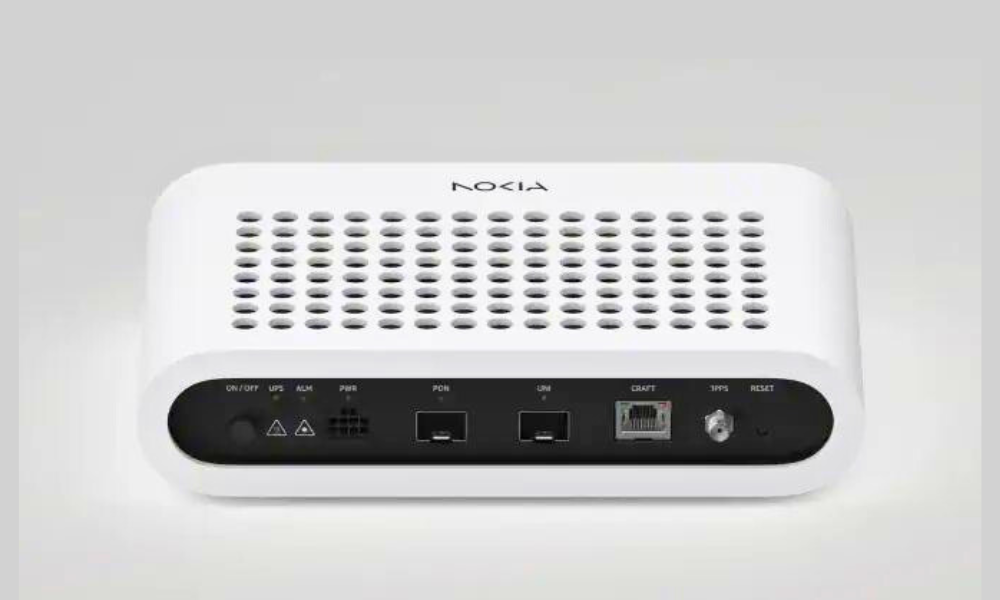
Nokia has just announced the launch of a new, symmetrical 25G PON fiber modem. Helping to further accelerate 25G PON deployments, the compact solution can easily be installed on a wall, inside a building, or in an outdoor enclosure to immediately deliver internet speeds that are 20x faster than current gigabit solutions. Once deployed, operators can leverage their existing fiber network to offer new premium residential, business, or anyhaul services that unlock additional revenue streams.

Demand for high-speed broadband access is accelerating with end-users increasingly seeking quality multi-gigabit services to power their homes and businesses. From the Metaverse and cloud gaming to cyber security, and Industry 4.0 applications, users want multi-gigabit services that can meet their evolving broadband needs.


Nokia’s new 25G PON fiber modem allows operators to establish a future-ready network that can immediately address the growing demand for more capacity and enhanced broadband services. The new 25G PON solution enables operators to quickly upgrade their existing GPON or XGS PON network to deliver true 10Gbs speeds and beyond with unprecedented ease. For enterprises, this can help significantly improve business productivity and enhance connectivity to the cloud or value-added applications located in data centers. For consumers and power users, the solution provides immediate access to additional capacity needed to support bandwidth-hungry applications such as AI, gaming, or security.

Geert Heyninck, General Manager of Broadband Networks at Nokia, said: “The 25G PON eco-system is growing and with it, the technology that continues to bring concrete business benefits to customers. The market for 25G PON is here and with the new fiber modem, we have a very efficient 25G solution that can support all types of services and applications in the fiber-for-everything era. 25G PON continues to be the easiest, most cost-effective and power-efficient way for services providers to upgrade and maximize the use of their existing fiber network to deliver ultra-fast broadband access.”

Jeff Heynen, Vice President, Broadband Access and Home Networking at Dell’Oro Group, said: “25G PON deployments and the 25GS-PON MSA (Multi-Source Agreement) Group has grown substantially over the past year. One of the driving factors for the growing interest in 25GS-PON is its ability to coexist with GPON and XGS-PON without having to deploy additional feeder fiber, splitters, or other ODN elements. This past year we’ve seen large operators like Google indicate plans to make 25G PON service available to its customers while the MSA continues to expand, encompassing a diverse range of service providers, equipment vendors, and component suppliers.”

The new 25G PON fiber modem complements Nokia’s growing 25G PON portfolio, which includes the Lightspan FX, DF and MF fiber access platforms (OLTs) and the industry’s first 25G PON sealed fiber access node designed for cable operators.

25 PON ONT product details:
  • Coexistence with GPON, XGS-PON and 50G PON on the same ODN
  • Hardened and compact design for various deployment practices and environments
  • Symmetrical 25 Gb/s throughput using pluggable optics
  • Frequency and time-of-day synchronization functions for mobile transport
  • Can be used to connect cell sites to transport mobile traffic over PON network in plug-and-play mode, delivering the required capacity, latency and synchronization required for 5G networks.
  • Supports demarcation point functions for enterprise and wholesale services.
Resources and additional information

Nokia, NTT, SKT and DOCOMO Team Up To Develop 6G AI-native Air Interface (AI-AI)

Nokia, NTT, SKT and DOCOMO Team Up To Develop 6G AI-native Air Interface (AI-AI)

  • AI is a critical 6G building block, with the potential to boost performance and minimize energy consumption in future 6G networks.
  • SKT joins the existing 6G collaboration between Nokia, NTT and DOCOMO, expanding the scope and scale of its work on the 6G native air interface (AI-AI).
  • At MWC 2024, an AI air interface (AI-AI) proof of concept video demonstration will be available at SKT’s booth.
Nokia, SK Telecom (“SKT”), NTT and DOCOMO, on Thursday last week, announced that they have joined forces to develop the 6G AI-native air interface (AI-AI), a critical next-generation technology that could greatly boost network performance while increasing energy efficiency. The four companies will show a video demonstration of an AI-AI proof of
concept at SKT’s booth at Mobile World Congress.

An AI-native air interface (AI-AI) is a dynamic interface that uses machine learning (ML) and AI (Artifical Intelligence) to define the air interface. It can adapt to different radio environments, data, applications, and Hardware.

This new 6G collaboration builds on an existing relationship between Nokia, NTT and DOCOMO targeted at 6G innovation. With the addition of SKT, the four companies will be able to expand the scope and scale of 6G AI-AI testing and validation as well as explore a broader range of business use cases for the technology.

Academics, leading research institutes, and key industry experts across the globe anticipate that a future 6G standard will use AI/ML for signal processing tasks, such as channel estimation, channel equalization, and demapping. This concept is understood as a neural receiver.

This collaboration is developing future proof-of-concept 6G AI-AI systems, which will then be put to the test using selected use cases and real environmental scenarios. These over-the-air validation tests will be conducted both in the lab and outdoors to best simulate real network results. SKT, NTT, DOCOMO and Nokia will cooperate on improving AI model performance by utilizing data generated from real networks or through simulation. This will be instrumental in developing AI training models for a best-in-industry AI-AI solution.

By working together Nokia, SKT, NTT and DOCOMO will be able to combine their research efforts and bring their core areas of expertise to the table. Nokia’s industrial research arm, Nokia Bell Labs, is a leader in 6G innovation, while SKT, NTT and DOCOMO are recognized worldwide for their successful adoption of every generation of networking and their ability to create new business value from advanced technologies.

Peter Vetter, President of Bell Labs Core Research at Nokia, said: “For Nokia to create a world-class 6G system, it’s critical we get input from the service providers that will one day deploy 6G. SKT, NTT and DOCOMO are among the most innovative service providers in the world, which gives us the perfect partners to design the networks of the future.”

Yu Takki, Vice President and Head of Infra Tech at SKT, said: “This milestone represents a significant step forward in collaborative efforts towards the development of 6G core technology involving technology leaders from Korea, Japan, Europe and the United States. SKT will maintain its momentum in its R&D efforts of applying AI technology to network infrastructure as we move forward to become a global AI company.”

Takaaki Sato, Executive Vice President and Chief Technology Officer at DOCOMO, said: “DOCOMO and NTT are delighted to advance this project with Nokia, a global vendor leading the world, and SKT, a mobile operator co-leading Asia. Through this collaboration, we will take the lead in innovative technology development and standardization of 6G, and focus on building a global ecosystem that includes future industries and technologies.”

Wipro and Nokia Launch Joint 5G Private Wireless Solution for Enterprises

Wipro and Nokia Launch Joint 5G Private Wireless Solution for Enterprises

Wipro Limited (NYSE: WIT, BSE: 507685, NSE: WIPRO), a leading technology services and consulting company, today announced a joint private wireless solution with Nokia (NYSE: NOK), to help enterprises scale their digital transformation.

This joint solution will provide enterprises with a more secure 5G private wireless network solution integrated with their operation infrastructure. The solution will bring greater reliability, mobility, connectivity speed, real-time access to business insights, and the ability to process high volumes of data with low latency. Through a dedicated wireless network, enterprises will be able to create an integrated private environment they can control to better manage their performance and mitigate security risks.

The greater speed, reliability, and security this technology brings will enable enterprises to improve operational efficiencies with advanced AI-driven automation. This joint solution will initially be made available to customers in the manufacturing, energy, utilities, transportation, and sports entertainment industries.

Nokia will provide the Nokia Digital Automation Cloud (DAC) and Modular Private Wireless (MPW) solutions inclusive of hardware and software. Wipro, with its state-of-the-art 5G Def-i with Industry DOT and OTNxt platforms, will offer strategic guidance and industry insights for effective integration into the enterprise environment.

Wipro will develop the architecture and design to best address clients’ unique business challenges, as well as implement and manage the end-to-end network to ensure business goals are met.

Jo Debecker, Global Head of Wipro FullStride Cloud, said, “In today’s digital world, data processing, accessibility and security are imperative. Traditional infrastructures are being stretched and performance is impacting business value and, in some cases, human lives through emerging areas such as remote-controlled robotic surgery. We are proud to partner with Nokia to address this pressing business need and to create a way for enterprises to leverage wireless private networks to digitize at speed and access real-time insights to realize their ambitions. By combining Nokia’s network expertise with Wipro’s strategic business, technology, and connectivity capabilities, we are enabling the promise of technology to drive impactful change and value.”

Stephan Litjens, Vice President of Enterprise Campus Edge Solutions, Nokia said, “Digital transformation is at the top of the enterprise agenda and enabling this is the driving force behind everything we do at Nokia. We are pleased to work with Wipro, a company that shares that vision, to provide a private secure 5G network solution that integrates seamlessly into enterprises' operation infrastructure and further scales their digital transformation. This partnership with Wipro will unlock new capabilities to help businesses in various sectors experience enhanced connectivity and AI-driven operational efficiencies, ushering them to the forefront of innovation.”

“This is a big step in Wipro Engineering Edge’s private 5G offering journey, which shows how Wipro continues to be at the forefront of innovation and connectivity with next-gen technology. The combined Wipro 5G Def-i, OTNxt and Industry DOT platforms will bond IT, OT and Nokia private network connectivity offering an end-to-end secure business operation solution to our customers. Working in collaboration with Nokia, we are excited to further fuel innovation for our customers in the market,” said Lourdes Charles, Vice President, 5G Connectivity Services, Wipro Engineering Edge.

Market Reports

Market Report & Surveys
IndianWeb2.com © all rights reserved