Showing posts with label Indian Navy. Show all posts

Cochin Shipyard Launches 7th Anti-submarine Warfare Shallow Water Craft for Indian Navy

Cochin Shipyard Launches 7th Anti-submarine Warfare Shallow Water Craft for Indian Navy

Cochin Shipyard Limited (CSL) today marked another significant milestone in its shipbuilding journey with the launch of the seventh Anti-Submarine Warfare vessel ‘Machilipatnam’, in a series of eight being constructed for the Indian Navy.

The ship was launched by Smt Goolrukh Anand and the ceremony was graced by Vice Admiral Atul Anand, PVSM, AVSM, VSM as the Chief Guest. Shri Jose VJ, Chairman and Managing Director, Cochin Shipyard Limited, Dr. Harikrishnan S, Dir (Ops) and Shri Rajesh Gopalakrishnan, Dir (Tech), CSL, Rear Admiral Deepak Singhal, VSM, CSO (Trg), HQSNC, Dr. C Pandi Selva Durai, IOFS, CVO, CSL, Senior officials of Southern Naval Command and IHQ MoD(N), Cmde Anup Menon, WPS (Kochi) and representatives of the Classification Society were present.

Cochin Shipyard Launches 7th Anti-submarine Warfare Shallow Water Craft for Indian Navy

The launch of the seventh vessel underscores the steady progress of the prestigious project and reflects the close collaboration between Cochin Shipyard Limited and the Indian Navy in strengthening the nation's maritime capabilities. The ship is being built with a strong focus on quality, safety, and timely execution, reaffirming CSL's commitment to supporting the Government of India's vision of self-reliance in defence manufacturing and enhancing indigenous naval shipbuilding capabilities.

The ASW SWC ships are designed to undertake anti-submarine operations in coastal waters, Low Intensity Maritime Operations (LIMO) and Mine Laying Operations including subsurface surveillance. The Yard BY 529 has been named after old port city ‘Machilipatnam’ along India’s east coast located in Krishna district of Andhra Pradesh.

The vessel is 78.0 m long, 11.36 m wide with a draught of about 2.7 m. The displacement is about 900 tons, with a maximum speed of 25 knots and endurance of 1800 nautical miles. The ships are designed to fit indigenously developed and built state-of-the-art Hull Mounted Sonar and Low Frequency Variable Depth Sonar for underwater surveillance in line with Government policy of ‘Atmanirbhar Bharat’

Tonbo Imaging Secures Indian Navy ADITI 3.0 Contract to Integrate High Power Microwave Systems for Next‑Gen Maritime Defence

Tonbo Imaging Secures Indian Navy ADITI 3.0 Contract to Integrate High Power Microwave Systems for Next‑Gen Maritime Defence
  • Indian Navy Awards ADITI 3.0 contract for High Power Microwave System to Tonbo Imaging, Among a Select Few Globally with HPM Capability
Defence technology company Tonbo Imaging has been awarded a contract by the Indian Navy under the ADITI 3.0 innovation framework to integrate and commission a High Power Microwave (HPM) system for naval platforms.

The programme is supported by iDEX and the Defence Innovation Organisation (DIO) under the Ministry of Defence, Government of India. Under the scope of the engagement, Tonbo Imaging will undertake system integration and commissioning activities, followed by the supply of multiple production units upon successful development, validation, and acceptance.

High Power Microwave systems represent a strategically significant directed-energy capability and are considered a strategic asset owned by only a limited number of countries today. Such systems provide a non-kinetic means of disabling or degrading adversary electronics, sensors, and unmanned systems, and are one of the few practical approaches to countering swarms of drones, making them increasingly relevant in modern maritime and asymmetric threat environments. The Indian Navy’s continued investment in this domain reflects a forward-looking approach to electromagnetic spectrum dominance and next-generation deterrence.

ADITI (Advanced Defence Technology Incubation) is a Government of India initiative designed to enable the maturation, integration, and validation of advanced defence technologies prior to induction. The selection of Tonbo Imaging under ADITI 3.0 reflects the emphasis on indigenously developing strategic capabilities aligned with the Navy’s evolving operational requirements and long-term force modernisation plans.

Commenting on the development, Arvind Lakshmikumar, Managing Director and Chief Executive Officer, Tonbo Imaging India Limited, stated “this programme represents a significant responsibility to execute complex capability integration with discipline, rigour, and clear alignment to end-user operational needs. Over the past several years, Tonbo Imaging has invested substantially in the indigenous development of core building blocks of High Power Microwave technology, including critical sub-systems and vacuum tube sources. We are among the very few private organisations to own core intellectual property in vacuum tube technologies that are fundamental to HPM systems, and this deep technology foundation has been a key factor in our selection for this naval programme.

For the class of effects required in High Power Microwave applications, vacuum tube–based sources remain the practical path forward, as they are capable of generating the extremely high peak power and energy levels necessary for effective target coupling. Solid-state RF sources, while well suited for many RF applications, cannot today achieve the required peak power and pulse energy levels within feasible size, weight, and efficiency envelopes for operational HPM systems.”

With this engagement, Tonbo Imaging’s role extends well beyond that of an imaging and electro-optics company, reinforcing its position as a defence technology company focused on the development and integration of advanced defence systems. The programme underscores the company’s growing involvement in complex system-level integration, advanced electronics, embedded software, and emerging directed-energy and mission systems, in addition to its established strengths in electro-optics. This evolution reflects Tonbo Imaging’s transition toward delivering integrated defence capabilities.

About Tonbo Imaging India Limited

Tonbo Imaging India Limited is a defence technology company focused on the design, development, and integration of advanced sensing, perception, and mission-critical systems for military and security applications. The company’s portfolio spans electro-optics, thermal imaging, situational awareness, advanced electronics, embedded software, and emerging directed-energy technologies, enabling the delivery of integrated defence solutions that support operational requirements across land, maritime, and air domains.

In recent years, Tonbo Imaging has continued to evolve as a defence technology and systems company, investing in the development of next-generation directed-energy systems as well as advanced defence solutions such as loitering munitions and counter-unmanned aerial systems (C-UAS), reflecting its strategic focus on addressing emerging operational threats through indigenous capability development.

L&T, Exail Forge Strategic Pact to Equip Indian Navy with Advanced Unmanned Mine Counter-Measure Suite

L&T, Exail Forge Strategic Pact to Equip Indian Navy with Advanced Unmanned Mine Counter-Measure Suite
Representative Image (Image - Exail.com)

L&T has entered a strategic collaboration with France-based Exail to deliver an advanced Unmanned Mine Counter-Measure (MCM) Suite for the Indian Navy’s Mine Counter Measure Vessels (MCMVs) programme.

L&T and Exail will together provide the Indian Navy with a state-of-the-art Unmanned MCM Suite, incorporating autonomous and remotely operated systems designed to detect, classify, identify and neutralise naval mines in a safe, stand-off manner.

L&T, as the prime contractor, will offer the Unmanned MCM Suite to all shipyards participating in Indian Navy’s upcoming programme for 12 Mine Counter Measure Vessels. Exail will serve as the technology partner.

The partnership will enable the delivery of Exail’s globally proven MCM technologies, already in operation with several navies worldwide and validated through extensive real-world deployments. The collaboration represents a major step towards strengthening India’s mine countermeasure capabilities, enhancing maritime security and reinforcing Indo-French defence cooperation, while building a robust and self-reliant naval defence manufacturing ecosystem in India.

Aligned with the Government of India’s Aatmanirbhar Bharat and Make in India initiatives, the programme will incorporate strong local industrial collaboration and capability development.

Commenting on the development, Arun Ramchandani, Senior VP & Head -Precision Engineering & Systems, L&T, said: “This partnership brings together L&T, with its extensive defence products legacy and maritime capabilities, and Exail, a global leader in unmanned maritime systems and mine warfare technologies. Exail contributes decades of proven operational expertise, while L&T leverages its strengths in defence engineering, indigenous manufacturing, complex system integration and lifecycle support”.

Jérôme Bendell, CEO – Maritime Systems Business Line, Exail, said: “We are proud to partner with L&T on this strategic programme for the Indian Navy. Beyond delivering a proven unmanned mine countermeasures capability, this collaboration also reflects a shared ambition to support the long-term development of sovereign unmanned maritime systems in India. By combining Exail’s operational expertise with L&T’s strong industrial and integration capabilities, we see significant potential to contribute to the local development and production of next-generation naval drones and autonomous mission systems”.

SAIL Supplies 4,000 Tonnes of Indigenous Steel for INS Taragiri, Strengthening India’s Defence Manufacturing

SAIL Supplies 4,000 Tonnes of Indigenous Steel for INS Taragiri, Strengthening India’s Defence Manufacturing

INS Taragiri, the fourth Nilgiri-class (Project 17A) stealth frigate, was commissioned into the Indian Navy on April 3, 2026, at Visakhapatnam. Built by Mazagon Dock Shipbuilders Limited (MDL) and powered by 4,000 tonnes of indigenous steel from Steel Authority of India Limited (SAIL), the warship marks a major milestone in India’s defence indigenisation and maritime self-reliance.

The Nilgiri-class (Project 17A) frigates are India’s latest generation of indigenous stealth warships, designed as versatile multi-mission platforms with advanced stealth, automation, and firepower. They represent a major leap in self-reliant naval shipbuilding under the Atmanirbhar Bharat initiative.  

SAIL Supplies 4,000 Tonnes of Indigenous Steel for INS Taragiri, Strengthening India’s Defence Manufacturing

Key Highlights of INS Taragiri Commissioning

  • Commissioning Date & Venue: April 3, 2026, Naval Dockyard, Visakhapatnam
  • Presiding Dignitary: Defence Minister Rajnath Singh led the ceremony
  • Shipbuilder: Mazagon Dock Shipbuilders Limited (MDL), Mumbai
  • Class & Project: Fourth vessel of the Nilgiri-class (Project 17A)
  • Displacement: Approx. 6,670 tonnes
  • Steel Supply: 4,000 tonnes of special-grade steel supplied by SAIL

Role of SAIL in Defence Indigenisation

SAIL has been a consistent contributor to the Indian Navy, supplying thousands of tonnes of indigenous, special‑grade steel for key warships like INS Taragiri (2026), INS Arnala (2025), and INS Androth (2025). These supplies have enabled India to reduce dependence on imports and strengthen defence self‑reliance.  
  • Supplied DMR 249A grade hot-rolled sheets and plates
  • Earlier contributions include INS Vikrant, INS Nilgiri, INS Himgiri, INS Udaygiri
  • Reinforces Atmanirbhar Bharat and Make in India

Project 17A – India’s Stealth Frigate Program

  • Total of seven frigates under construction at MDL and GRSE
  • Successor to Shivalik-class with enhanced stealth and automation
  • INS Taragiri named after the erstwhile Leander-class frigate (1980–2013)

Ships in the Class

  1. INS Nilgiri – Lead ship, launched 2019, commissioned 2025.
  2. INS Himgiri – Delivered July 2025 (GRSE). 
  3. INS Udaygiri – Commissioned 2025. 
  4. INS Taragiri – Commissioned April 3, 2026 (MDL). 
  5. INS Dunagiri – Delivered March 30, 2026 (GRSE). 
  6. INS Vindhyagiri – Launched August 2023.  
  7. INS Mahendragiri – Under construction.  

Strategic Significance

  • Strengthens India’s ability to safeguard its 11,000 km coastline
  • Demonstrates domestic capacity to design and build complex warships
  • Showcases collaboration between MDL and SAIL
Below is a comparison table between the Nilgiri-class (Project 17A) and its predecessor, the Shivalik-class (Project 17) frigates. This highlights the technological leap India has made in stealth warship design:

Nilgiri-class (Project 17A) Vs Shivalik-class (Project 17)

The Nilgiri-class (Project 17A) frigates represent India’s latest generation of indigenous stealth warships, building on the foundation of the Shivalik-class (Project 17).

Key Features of Nilgiri-class (Project 17A)

  • Advanced stealth shaping, infrared suppression, and acoustic quieting
  • Displacement of ~6,670 tonnes
  • High automation with reduced crew workload
  • 75% indigenous content including SAIL steel
  • Equipped with BrahMos missiles, Barak-8 SAM, and advanced CIWS

Comparison Table

FeatureShivalik-class (Project 17)Nilgiri-class (Project 17A)
Commissioning Period2010–20122025–2026 (ongoing)
Number of Ships3 (INS Shivalik, INS Satpura, INS Sahyadri)7 planned (INS Nilgiri, Himgiri, Udaygiri, Taragiri, Dunagiri, Vindhyagiri, Mahendragiri)
Displacement~6,200 tonnes~6,670 tonnes
Length~142 meters~149 meters
Beam~16.9 meters~17.8 meters
PropulsionCODOG (LM2500 gas turbines + Pielstick diesels)CODOG (LM2500 gas turbines + MAN diesels)
Speed~30 knots~32 knots
Range~5,000 nautical miles~2,500 nautical miles
Stealth FeaturesBasic radar signature reductionAdvanced stealth shaping, infrared suppression, acoustic quieting
WeaponsKlub missiles, Barak-1 SAM, AK-630 CIWSBrahMos missiles, Barak-8 SAM, advanced CIWS
AutomationModerate digital integrationHigh automation, reduced crew workload
Indigenous Content~60%~75% (including SAIL steel)
ShipbuildersMDL (Mumbai)MDL (Mumbai) & GRSE (Kolkata)

Key Takeaway

  • Shivalik-class was India’s first indigenous stealth frigate program
  • Nilgiri-class builds on that foundation with greater stealth, automation, and indigenous content
  • Represents one of the most capable frigate classes in Asia
The Nilgiri-class (Project 17A) frigates are central to India’s naval modernization, combining indigenous design, advanced weapons, and strategic self-reliance.

The commissioning of INS Taragiri is not just a naval milestone but a symbol of India’s growing industrial and defence ecosystem. With SAIL’s indigenous steel at its core, the frigate embodies the nation’s push toward Atmanirbhar Bharat, ensuring that India’s maritime strength is forged at home.

And, SAIL’s contributions — from 4,000 tonnes for INS Taragiri to entire steel requirements for INS Arnala and INS Androth — highlight its pivotal role in India’s naval modernization. By supplying indigenous, special‑grade steel, SAIL strengthens both the Indian Navy’s fleet and India’s strategic goal of defence self‑reliance.  

Marine Robotics Startup EyeROV Bags ₹47 Cr Order from Indian Navy to deliver Underwater Remotely operated Vehicles (UWROVs)

Marine Robotics Startup EyeROV Bags ₹47 Cr Order from Indian Navy to deliver Underwater Remotely operated Vehicles (UWROVs)

EyeROV, India’s pioneering underwater robotics startup, has announced the signing of a landmark ₹47 Cr contract with the Indian Navy for advanced Underwater Remotely Operated Vehicles (UWROVs). The deal strengthens India’s naval capability with field-tested, indigenously built technology.

EyeROV’s UWROVs have been tested in the most demanding environments, from the turbulent seas for deep water missions as deep as 400+ m for underwater volcanic studies to the coldest depths of the Antarctic Sea. These successful tests prove that the Navy receives systems designed for real-world challenges where precision, safety and reliability are paramount.

EyeROV TROUT, a 300m depth rated, is a military grade rugged ROV developed for dual applications of defence as well as commercial. It can deep dive equipped with advanced payloads to carry out multiple missions like underwater surveillance & reconnaissance to monitor naval environments and more.

Commenting on the development, Johns T. Mathai, Co-Founder & CEO, EyeROV, said, “This recognition is a true reward for our dedicated efforts over the past eight years. We sincerely thank the iDEX and Navy teams for their support in fostering advanced indigenous solutions. Our vision has always been to serve the nation by delivering technologies that are at par with global standards.”


EyeROV brings nearly a decade of field experience delivering underwater intelligence in mission-critical projects — from disaster & recovery to dam safety inspections to offshore energy operations and naval operations.

EyeROV’s indigenous technology stack is fully developed in India, reinforcing the nation’s push towards self-reliance in defence. Beyond cost efficiency, EyeROV’s systems deliver operational resilience, strategic autonomy, and global competitiveness — making the company a national asset in India’s defence deep-tech landscape.

Kannappa P., Co-Founder & CTO, EyeROV, added, “For eight years, EyeROV has engineered underwater systems tested in the harshest conditions. This partnership with the Navy is proof that Indian innovation can set benchmarks globally in defence deep-tech.”

Founded in 2017, EyeROV has completed more than 100 successful deployments across India, West Asia, APAC and Europe. The Company has more than 80 customers including some of the most prestigious names like DRDO, Indian Coast Guard, CSIR and NCPOR. Key product portfolio includes EyeROV TUNA (ROV), EyeROV TROUT (ROV), iBoat Alpha (USV) serving sectors like Defence & Security, Hydro & Marine Infrastructure, Disaster Management, Energy, Environmental Conservation. The Company also raised a Pre Series A round of $1.2 million from Unicorn India Ventures last year. EyeROV has been recognised among the top 5 def-tech startups in India and has won the National Startup Award in 2022.

About EyeROV

EyeROV is India’s pioneering deep-tech company specializing in underwater robotics and marine technology solutions. Founded in 2017 and headquartered in Kochi, EyeROV designs, develops, and deploys indigenously built Remotely Operated Vehicles (ROVs) and Unmanned Surface Vessels (USVs) that serve critical applications across Defence & Security, Hydro & Marine Infrastructure, Disaster Management, Energy, and Environmental Conservation. With over 100 successful deployments across India, West Asia, APAC, and Europe, EyeROV has earned the trust of 80+ customers including DRDO, Indian Coast Guard, CSIR, and NCPOR. Recognized among the Top 5 Defence Startups in India, EyeROV continues to drive innovation, delivering mission-critical systems that combine precision, resilience, and cost efficiency. EyeROV’s vision is to empower nations with strategic autonomy in underwater intelligence and contribute to global advancements in marine robotics.

Indian Navy Revives Ancient Shipbuilding: Hand-Stitched Vessel Set to Sail Historic Trade Routes

Indian Navy Revives Ancient Shipbuilding: Hand-Stitched Vessel Set to Sail Historic Trade Routes
The Indian Navy is set to induct the Ancient Stitched Ship, a remarkable recreation of a 5th-century CE vessel, inspired by a painting from the Ajanta Caves. This ship was constructed using traditional methods by artisans from Kerala, led by master shipwright Babu Sankaran, who meticulously executed thousands of hand-stitched joints.

The ancient stitching technique in shipbuilding, known as the Tankai method, involved sewing wooden planks together rather than using nails. This method provided flexibility and durability, making ships more resistant to damage from shoals and sandbars. The Hand-Stitched Joints were done by artisans using ropes or strings to sew planks together, sealing them with a mix of coconut fiber, resin, and fish oil.
 
Indian Navy Revives Ancient Shipbuilding: Hand-Stitched Vessel Set to Sail Historic Trade Routes

Indian Navy Revives Ancient Shipbuilding: Hand-Stitched Vessel Set to Sail Historic Trade Routes

Unlike modern vessels, this ship features square sails and steering oars, requiring a unique blend of archaeological interpretation, naval architecture, and hydrodynamic testing to ensure seaworthiness. The Indian Navy collaborated with IIT Madras to validate its hydrodynamic behavior at sea.

Following its induction, the Navy plans to sail the vessel along ancient maritime trade routes, with preparations already underway for its maiden voyage from Gujarat to Oman. This initiative not only revives India's rich shipbuilding legacy but also showcases the Navy’s commitment to preserving maritime heritage.

Indian Navy Revives Ancient Shipbuilding: Hand-Stitched Vessel Set to Sail Historic Trade Routes


L&T Launches INS Utkarsh, Its 2nd Multi-Purpose Vessel for Indian Navy

L&T Launches INS Utkarsh, Its 2nd Multi-Purpose Vessel for Indian Navy

Larsen & Toubro (L&T) on Monday launched the second Multi- Purpose Vessel (MPV) for the Indian Navy from its Kattupalli Shipyard near Chennai.

The vessel, christened INS Utkarsh, was launched by Dr Sushmita Misra Singh, the wife of Union Defence Secretary Mr Rajesh Kumar Singh. Mr Singh, Vice Admiral B Sivakumar (Controller of Warship Production & Acquisition), Rear Admiral Vishal Bishnoi (Assistant Controller of Warship Production & Acquisition) and senior leaders of L&T were present.

L&T Launches INS Utkarsh, Its 2nd Multi-Purpose Vessel for Indian Navy

L&T Launches INS Utkarsh, Its 2nd Multi-Purpose Vessel for Indian Navy

Following an accelerated production schedule, the launch of INS Utkarsh comes within three months of the launch of the first MPV INS Samarthak. The first vessel is now being readied for undergoing tests and trials prior to its delivery to the Indian Navy.

The MPVs are highly specialised, and play multiple roles, including serving as trial platforms, for the development of next generation weapons and sensors. They will perform maritime surveillance, humanitarian assistance, combat sea pollution, besides taking up launch and recovery of surface and aerial assets, etc.

The MPVs are 107m long, 18.6m wide with a displacement over 3,750 tonnes. In keeping with Government of India’s Aatmanirbhar Bharat mission and Make in India initiative, the design engineering of the MPVs has been undertaken at L&T’s in-house Warship Design Centre at Chennai and the construction is accomplished at L&T’s Katupalli Shipyard.

Commenting on the occasion, Mr A T Ramchandani, Senior Vice President & Head - L&T Precision Engineering & Systems, said:
The successful launch of the second MPV ahead of schedule underscores L&T’s unwavering commitment to bolster India’s national security. With our unmatched in-house design expertise and execution prowess, we are committed to providing cutting-edge defence platforms to support Indian Navy’s fleet expansion needs.

L&T’s Kattupalli Shipyard is one of the most advanced shipbuilding and ship repair facilities in India and is equipped with ship-lift, dry and wet berths to concurrently undertake new ship building and repairs.

Besides the two MPVs, L&T is also constructing three Cadet Training Ships and six other defence vessels for the Indian Navy on public-private-partnership model. This apart, the repair of the Indian naval ship INS Tir is also currently underway at the Kattupalli Shipyard.

Indian Navy and ISRO Conducted Welldeck Recovery Trials for Gaganyaan in Visakhapatnam

Indian Navy and ISRO Conducted Welldeck Recovery Trials for Gaganyaan in Visakhapatnam

The Indian Navy and ISRO recently conducted well deck recovery trials for the Gaganyaan mission on December 6, 2024. These trials took place at the Eastern Naval Command using a well deck ship off the coast of Visakhapatnam.

The well deck recovery process involves flooding the deck of the ship with water, allowing the Crew Module to be towed inside where the crew can exit comfortably. This method ensures quick and safe recovery of astronauts after splashdown.

The trials validated the sequence of operations, including attaching the recovery buoy, towing, entering the well deck, positioning the Crew Module, and draining the well deck.

These steps are crucial for finalizing the Standard Operating Procedures (SOPs) for both nominal and off-nominal recovery conditions.

The Gaganyaan mission aims to demonstrate India's human spaceflight capability by sending a crew of three members to orbit for a three-day mission and safely returning them to Earth.

Indian Navy and IIT Kanpur Sign MoU To Drive Innovation through Research Partnership

Indian Navy and IIT Kanpur Sign MoU To Drive Innovation through Research Partnership

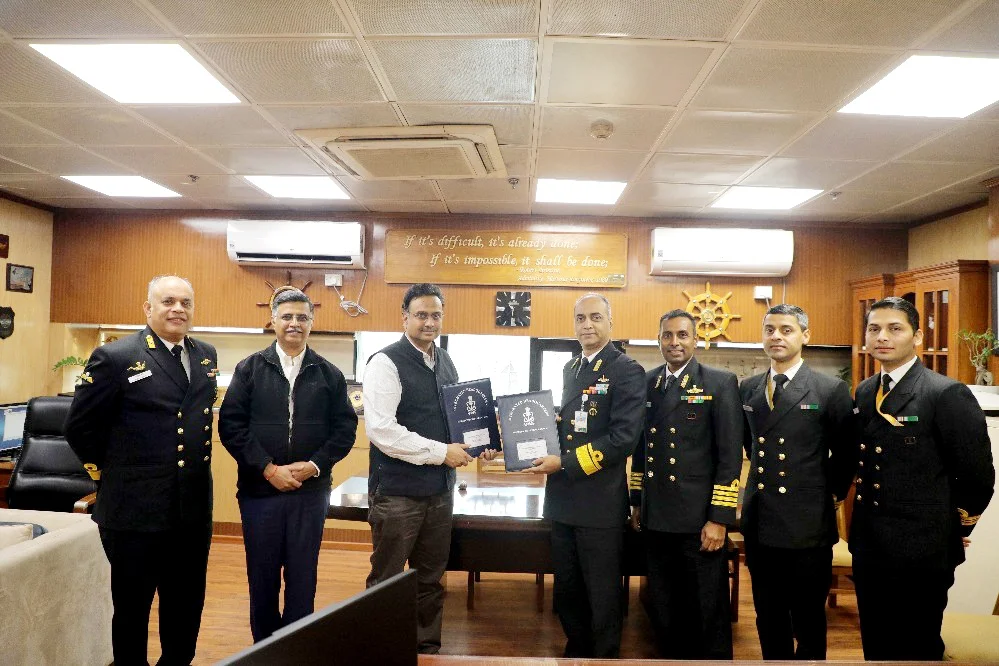
Indian Navy and Indian Institute of Technology Kanpur, signed a Memorandum of Understanding (MoU) today at Naval Headquarters, New Delhi, symbolising their commitment to promote technology development, innovative solutions and joint R&D. Rear Admiral K Srinivas, Asst Chief of Materiel (Dockyard & Refits) and Professor Subramaniam Ganesh, Officiating Director IIT Kanpur concluded this MoU.

Indian Navy and IIT Kanpur share common interest in academic exchange of scientific research activities in the field of Engineering related to defence technologies.

The MoU would serve as a broader framework and enable both sides to enhance capacity building, provide solutions to field level issues and enhance training effectiveness through exchange of faculty/ guest lectures. The structured collaboration focuses on joint Research and Development initiatives involving teams from Centre of Excellence (Marine Engg) at INS Shivaji, Lonavla and IIT Kanpur.

This Strategic alignment signifies a move towards a symbolic relationship between the academia and the armed forces, fostering a conducive environment for innovation and knowledge exchange.

Indian Navy and RRI To Jointly Develop Quantum Technologies for Secure Maritime Communications

Indian Navy and RRI To Jointly Develop Quantum Technologies for Secure Maritime Communications

Department of Science & Technology (DST) Institute to partner Indian Navy in developing secure maritime communications using Quantum Technology

In order to develop secure maritime communications, Quantum technologies will soon be used by Indian Navy, in a joint effort by the Raman Research Institute (RRI), an autonomous institute of the Department of Science and Technology (DST), and the Indian Navy, said a public press release by Ministry of Science & Technology.

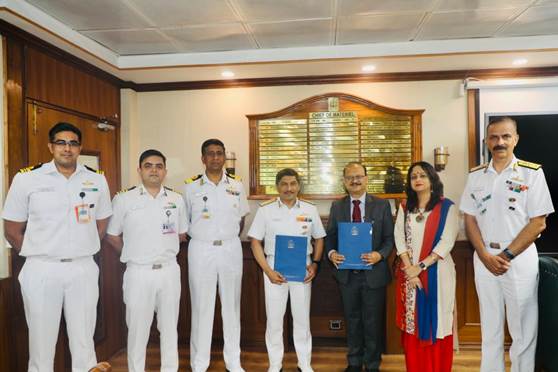
RRI has inked a Memorandum of Understanding (MoU) with the Indian Navy's R&D unit Weapons and Electronics Systems Engineering Establishment (WESEE), during a ceremony held in New Delhi recently. The MoU, which is for a period of 5 years, was signed between Professor Tarun Souradeep, Director, RRI, and Vice Admiral Sandeep Naithani, Chief of Materiel, Indian Navy.

Under this agreement, RRI’s Quantum Information and Computing (QuIC) lab will lead the research efforts towards developing quantum key distribution techniques that the Indian Navy could leverage in the nation's efforts towards securing free space communications.

The MoU was signed in New Delhi (Image Credit: Indian Navy) 

"I am absolutely delighted that Indian Science and Technology ecosystem has been opening borders in recent years that enable talented and world-class researchers in the academic research institutions to contribute to the growth of Science and Technology capabilities in strategic areas of national importance. Porosity of the perceived boundary between fundamental and applied sciences as well as Science and Technology, will bode well in the coming decades. RRI feels proud to partner with WESEE in cutting edge Science and Technology," said Prof. Souradeep.

Professor Urbasi Sinha, Group Head, QuIC lab, said, “This is a great opportunity to use indigenously developed science and technology knowledge to serve our nation. We are excited with the collaboration and believe that with our expertise in the domain of secure quantum communications, we will be able to help foster cutting-edge research towards identification of potential maritime use-cases for the Indian Navy.”

This lab has been leading the country’s research in the field of secure quantum communication. Some of its major achievements include the development of an end-to-end simulation toolkit named “qkdSim”, ensuring safety in communication platforms, establishing secure communication between two buildings, and, more recently, between a stationary source and a mobile receiver.

QuIC lab also happens to be India’s first laboratory to propose and implement a wide range of applications using single and entangled photons, particularly towards establishing secure communications in strategic areas like banking, defence, and cyber security.

Earlier this month, International Institute of Information Technology, Hyderabad (IIITH) partnered with Synergy Quantum India (SQ India) to establish Quantum Solution Lab with an aim of developing financially feasible quantum technologies and their applications in both military and civilian use cases.

In December 2020, India's DRDO unveiled "Quantum Key Distribution (QKD)" as a new technology developed by DRDO's Centre for Artificial Intelligence and Robotics (CAIR) and DRDO Young Scientist Laboratory (DYSL-CT).

Last year in August, it was reported that, QNu Labs, a Bengaluru-based Deep Tech Start-up, supported by the Defence Ministry's iDEX, did successful trials of QKD system and even equipping Indian Army with Quantum Communication technology.

IIT Hyderabad Joined Hands with Indian Navy/ WESEE for Establishing Co-developmental Technology Innovation Centre (CTIC)

Indian Institute of Technology Hyderabad (IITH) Joined hands with Indian Navy/ WESEE for establishing a Co-developmental Technology Innovation Centre (CTIC) at IITH Technology Research Park (IITH - TRP)

It will promote academic cooperation, enhance scientific understanding of technologies related to defence and undertake research and development activities in mutually beneficial areas.

Formulation of and participation in Joint Research Programs to leapfrog integration of Transformational Technology into products to be deployed on Indian Navy platforms.

IIT Hyderabad Joined Hands with Indian Navy/ WESEE for Establishing Co-developmental Technology Innovation Centre (CTIC)
Prof B S Murty, Director IITH (R) with Vice Admiral Sandeep Naithani (L)

Indian Institute of Technology Hyderabad (IITH), a public engineering and research institution, known for its academic strength, research, and publication and in proximity to IT & Industrial Hub has joined hands with Indian Navy’s Weapons and Electronics Systems Engineering Establishment. Weapons and Electronics Systems Engineering Establishment (WESEE); to make its research & academics focused more towards national safety & security. Prof B S Murty, Director, IITH has signed an MoU with Indian Navy, represented by Vice Admiral Sandeep Naithani, Chief of Materiel on Jan 09, 2023, to Work in tandem towards Aatma Nirbhar Bharat & Harness in-house Tech Prowess. On the occasion, Prof Sumohana S Channappayya, Faculty-in-Charge, Technology Research Park and Rear Admiral Ankur Sharma, DG WESEE from India Navy were also present.

The Project being steered by WESEE aims to collaborate with IITH on innovative & pioneering projects related to contemporary & emerging technologies in the maritime domain.

Team IITH with Team WESEE Indian Navy

Expressing delight at the opportunity to contribute to National Security, Prof B S Murty, Director, IITH, said, “As a civilian, it is a matter of pride to use our technological expertise and research acumen in the defense of our Nation. We are glad to host Indian Navy’s WESEE Innovation Centre on IITH Campus. I am confident that this CTIC at our TRP will nurture national building spirit on campus and lead to top-notch and futuristic innovations to serve humanity at large.

The MoU between WESEE, Indian Navy and IIT Hyderabad paves the way for long-term collaboration between the two organisations. The establishment of the Co-Developmental Technology Innovation Centre (CTIC) at IIT Hyderabad’s Technology Research Park (TRP) is the crucial first step for this engagement. The collaboration is aimed at solving real-world problems by leveraging the deep tactical and technical expertise of WESEE and IIT Hyderabad. The collaboration aligns with the goal of building an Atma Nirbhar Bharat”, added Prof Sumohana S Channappayya, Faculty-in-Charge, Technology Research Park.

About IIT Hyderabad

Indian Institute of Technology Hyderabad (IITH) is one of the eight new IITs established by the Government of India in 2008. In a short span of 14 years, the institute has become a top-ranker. It has 290+ full-time faculty, ~4,200 students, 18 Departments + Centre for Interdisciplinary Programs, nearly 200+ state-of-the-art laboratories, and five research and entrepreneurship centers. The institute has a strong research focus with approx. Rs ~700 crores of sanctioned research funding, with PhD scholars accounting for about 30% of total student strength. IITH has more than 8100+ research publications with 1,20,000+ Citations, 190+ Published Patents, 1,700+ sponsored/consultancy projects with 500+ running projects, and about 100+ startups.

To know more, please visit https://www.iith.ac.in/.

IDFC First Bank Signs Up With Indian Navy to Offer Honour First Banking Solutions

Commodore Neeraj Malhotra, Commodore – Pay and Allowances, Indian Navy and Colin D’Souza, Head – Corporate Salary, IDFC FIRST Bank after signing a memorandum of understanding (MoU) at the Naval Headquarters in New Delhi.


IDFC FIRST Bank announced the signing of a Memorandum of Understanding (MoU) with the Indian Navy to offer Honour FIRST, a premium banking solution, to serving personnel and veterans of the Indian Navy.

The Honour FIRST Defence Account is specially designed keeping in mind the needs of the Armed Forces and its veterans. Account holders of Honour FIRST are supported by a dedicated team of defence veterans.

The MoU for Honour FIRST was signed at the Naval Headquarters in New Delhi between Commodore Neeraj Malhotra, Commodore - Pay and Allowances, Indian Navy and senior officials of IDFC FIRST Bank.

Commodore Neeraj Malhotra, Commodore-Pay and Allowances of Indian Navy, said, “I welcome the initiative of IDFC FIRST Bank to offer customized banking solutions to suit the needs of the Indian Navy and its personnel.”

Speaking on the occasion, Amit Kumar, Head – Retail Liabilities, IDFC FIRST Bank, said, “This is indeed a proud moment for us. The association couldn’t have come at a better time as the Indian Navy commemorates the 50th anniversary of India’s historic victory in the 1971 war. We look forward to serving the banking needs of the prestigious Indian Navy as its safeguards the maritime frontiers of our country. This association is rooted in our nation-first approach to banking and reiterates our longstanding commitment to meeting the needs of our Armed Forces.”

The Honour FIRST Defence account comes with a range of privileges and features such as a zerobalance salary account that earns up to 5 per cent interest per annum and a netbanking and mobile App that offers superior user interface and experience.

Honour FIRST Account holders get a free enhanced Personal Accident Insurance Cover of Rs. 46 lakhs for both on-duty and off-duty incidents. This not only covers accidental death but also total and partial permanent disability. This Personal Accident Insurance Cover includes a Child Education Grant of Rs. 4 lakhs, and a marriage cover of Rs 2 lakh.

In addition, other best-in-class features include a top-of-the-line Visa Signature Debit Card with no annual charges, free Air Accidental Insurance cover of Rs. 1 crore and complimentary airport lounge access at domestic airports, twice a quarter.

Honour FIRST Defence Account also offers free lost card liability and fraud protection of up to Rs. 6 lakhs, purchase protection against burglary, theft and damage up to 90 days from date of purchase up to Rs. 1 lakh.

Account holders of Honour FIRST are eligible for a ‘Free for Life Credit Card’ with variable APR and 10X Reward Points, 1.5% forex markup, complimentary access to select spas and lounges at domestic and international airports, travel insurance and other benefits round the year. Privileges also include 10X reward points on spends greater than Rs. 20,000, 6X rewards on all online spends, complimentary for life & interest-free credit for purchases and cash withdrawals.

Other benefits comprise free unlimited ATM transactions across all domestic ATM’s, free online payment transactions, unlimited cheque books and anywhere banking across the Bank’s network of branches and ATMs.

The Bank is constantly investing in state-of-the-art technology to bring digital innovations to its customers, with a view to enhancing customer convenience and experience.


About IDFC FIRST Bank

Created in 2018 by the merger of renowned infrastructure financing institution IDFC Ltd. and leading technology NBFC, Capital First, IDFC FIRST Bank, with a balance sheet of over Rs. 1,68,000 crore, has provided over 30 million loans in its combined history and serves customers in over 60,000 villages cities and towns across the length and breadth of the country. IDFC FIRST Bank’s vision is to serve an aspiring India, backed by human values and technology and to be a force for social good. The Bank’s mission is to touch millions of Indians in a positive manner.

In a short time, the Bank has expanded to 601 branches, 161 asset service centres, 609 ATMs and 94 recyclers and 623 rural business correspondent centres across the country, a next-generation net and mobile banking platform and 24/7 Customer Care services, and is incrementally growing digitally. IDFC FIRST Bank is committed to bring high-quality banking at affordable rates to India. The Bank also offers technology-enabled corporate banking solutions.

Market Reports

Market Report & Surveys
IndianWeb2.com © all rights reserved