‏إظهار الرسائل ذات التسميات workspace. إظهار كافة الرسائل

1% Greener, 7% More Engaged: Landmark Study Quantifies ROI of Sustainable Workspaces in India

1% Greener, 7% More Engaged: Landmark Study Quantifies ROI of Sustainable Workspaces in India

The Confederation of Indian Industry (CII) – Indian Green Building Council (IGBC), in collaboration with the Confederation of Danish Industry (DI), today launched the landmark research report "SUSTAINABLE WORKSPACE – Catalyst for Productivity and Profitability in Indian Businesses" at the CII Green Business Centre, Hyderabad.

The unique one-of-its-kind research study in the world with academic support from the Indian Institute of Management Ahmedabad, reveals that sustainable workplaces are transformative for Indian businesses. The key findings of this research are that organizations that adopt Green Building Practices are more likely to have a thriving and engaged workforce, leading to increase in business performance for the organization. Moving far beyond environmental responsibility, the study demonstrates that green building strategies substantially enhance employee productivity, well-being, and organizational profitability.

The multi-year project presents the strongest evidence to date that adopting green solutions in India’s workplaces leads to marked improvements in employee thriving, engagement, and over all wellbeing outcomes. Through a rigorous, multi-phase approach involving inputs from 75 case study partners with over 1,100 occupant responses from 6 cities and analysis of more than 900 indoor environment quality data points, the study offers robust, data-driven proof that building sustainably delivers measurable value for both organizations and their people.

Key Findings

  • A 1% increase in Green Index (a composite of indoor environment quality and comfort) lifts employee thriving by 3% and engagement by 2%, respectively, and enhances physical well-being by 3%.
  • A 1% increase in Indoor Environment Quality leads to 7% increase in employee engagement and 2% increase in Thriving.
  • Improved Indoor Environmental Quality (IEQ)—covering temperature, lighting, noise, humidity, and CO₂—boosts both psychological vitality and learning at work, driving organizational performance, innovation, and staff retention.
  • The findings confirm that sustainable workspaces deliver far-reaching outcomes: higher employee satisfaction, well-being, and organizational profitability across varying climatic and cultural zones in India.
The report was unveiled by H.E. Rasmus Abildgaard Kristensen, Ambassador of the Royal Danish Embassy to India; Shri R V Karnan IAS, Commissioner GHMC Government of Telangana; Mr. M Goutham Reddy, Vice Chairman, CII Telangana State Council; and Mr. C Shekar Reddy, National Vice Chairman, IGBC; Ms Bente Toftkær, Director, Global Talent & International Services, Danish Industry; Ar. Srinivas Murthy, Chairman, IGBC Hyderabad Chapter; and Mr. K S Venkatagiri, Executive Director, CII GBC in the presence of other dignitaries and sustainable industry champions.

1% Greener, 7% More Engaged: Landmark Study Quantifies ROI of Sustainable Workspaces in India

1% Greener, 7% More Engaged: Landmark Study Quantifies ROI of Sustainable Workspaces in India

Speaking at the launch, H.E. Mr. Rasmus Abildgaard Kristensen, Ambassador of the Royal Danish Embassy to India, said "Denmark is delighted to partner with India in advancing the agenda of sustainable and people-centric development. Over the years, our collaboration has demonstrated how shared knowledge, technology, and innovation can deliver solutions that benefit both people and the planet. The launch of the DI and CII-IGBC report on Sustainable Workspaces is yet another milestone in this journey. It reinforces the importance of designing workplaces that reduce environmental impact while enhance well-being, creativity, and productivity. Together, Denmark and India can accelerate the green transition and create resilient urban futures that serve as a model for the world."

Shri R V Karnan IAS, Commissioner GHMC Government of Telangana, while addressing the gathering said, "Telangana is proud to lead the sustainable transformation of India’s built environment, with Hyderabad emerging as one of the country’s green building hubs. Our state has consistently championed IGBC-certified projects across residential, commercial, and institutional sectors, setting benchmarks in energy efficiency and eco-friendly urban development. Collaborating with national and international partners, we reaffirm our commitment to harnessing the power of green workspaces to enhance quality of life, drive innovation, and build resilient urban futures. This report provides compelling evidence that sustainable workplaces are not only vital for citizen well-being but also a strategic investment in Telangana’s economic growth and global competitiveness."

Mr. C Shekar Reddy, National Vice Chairman, IGBC, stated, "As IGBC celebrates 25 years of championing the green building movement in the country, the launch of the DI and CII-IGBC research report on Sustainable Workspaces – Catalysts for Productivity and Profitability in Indian Businesses marks an important milestone. This study reinforces the need to move beyond traditional metrics like energy and water savings to embrace workplaces that prioritize people’s well-being, creativity, and productivity while ensuring environmental stewardship. Together, we can transform our work environments into powerful catalysts for both sustainability and business growth, shaping a greener and healthier future for India."

The report provides actionable guidance for business leaders, Developers, policymakers, urban planners, architects, ESG investors and industry associations. It urges all stakeholders to:
  • Prioritize IEQ and comfort in both new and existing workplaces.
  • Integrate measurable green metrics in design and operations.
  • Assess workspaces with evidence-based tools to drive employee engagement and organizational success.

India’s Flex Space Penetration Stands at 6.5% as of Q1'23; Tech Companies Occupy 50% of Total Flex Space

India’s Flex Space Penetration Stands at 6.5% as of Q1'23; Tech Companies Occupy 50% of Total Flex Space
Tech Industry leads the way: Tech companies occupy 50% of total flex space in India

Flex space accounts for 10-12% of the occupiers’ portfolio

The latest Colliers’ report ‘Global Occupier Outlook 2023’, highlights key takeaways and insights on the evolving global workplace. The report reveals that APAC occupiers are grappling with the complexities of the hybrid work model, which remains inconsistent across markets and industries. The lack of clarity and macroeconomic uncertainty are posing challenges for businesses in projecting their space requirements.

For an uninitiated, A Flex Space is a form of commercial real estate with a warehouse, office, and retail space. It is a hybrid of office and industrial space. While industrial space is primarily made for manufacturing and distribution, flex space is adaptable and may be utilized for a variety of applications.

According to Colliers’ experts, companies are facing the dilemma of striking a balance between providing employees with desired flexibility and realigning their portfolios for the next evolution of the workplace. Consequently, many businesses are deferring decisions on office take up and investment.

Despite these challenges across the globe, occupiers in India have been quick to adopt flex spaces, attracted by the flexibility, agility, and cost-effectiveness. Flex spaces are becoming an integral part of occupiers’ portfolio, with its share in occupiers’ total portfolio rising to an estimated 10-12% in 2023, from 5-8% before the pandemic in 2019, as per interactions with industry experts.

Colliers’ leadership Sam Harvey-Jones, Chief Operating Officer, Asia Pacific and Mike Davis, Managing Director, Occupier Services, Asia Pacific in their recent visit to India note the positive market sentiments echoed by the Indian occupiers, particularly within the technology sector to adapt to the changing landscape with a focus on increasing flex space, using data to help in informed decision making and focus on the employee experience.

Harvey-Jones said, “The APAC region is undergoing a significant transformation in the way workspaces are perceived and utilized. While challenges persist, this period of change presents unprecedented opportunities to reimagine the role of space and explore new approaches that cater to evolving employee needs. The research finds APAC occupiers are shifting from an ‘inward’ business view of what’s important in an office or location, to an ‘external’ view of what locations gives their employees access to in terms of culture, lifestyle and wellness."

Davis added, “Adopting technology solutions such as digital tools and dashboards is critical for addressing the challenges posed by the hybrid workforce. These tools enable occupiers to optimize space utilization, implement safety measures, and make data-driven decisions.”

Colliers has developed tools that integrate various data sources to provide a comprehensive view and facilitate informed decision-making.

Key trends witnessed by Occupiers across the globe

The report features insights and resilient strategies being adopted by real estate decision makers to prepare for an uncertain future, adapt to emerging market trends and overcome unprecedented challenges. Focusing on three key aspects, Engage, Evolve and Accelerate, the findings uncover efforts being made by some of the leading global companies to strengthen processes, build resilience, and meet complex needs, with the aim to enrich the workplace experience.

Shining a spotlight on the ESG framework and the adoption of pioneering technology, the importance of a sustainable workplace is highlighted. Since over 65% of workers are seeking more in-person time with their teams, companies across the globe are investing in green design, tech-enabled features that promote higher health & safety, and wellbeing amenities, among others. Readers can also learn of other crucial factors occupiers are focused on including the right location, DEI initiatives, digital tools, and the precise portfolio mix. Further, as remote work gained momentum and proved to be effective, the big question of which work model augments productivity and business growth is addressed.

Across the APAC region, occupiers are keen on realigning their office portfolios to meet business needs while providing the flexibility employees’ desire. The right portfolio is key to keeping culture intact, attracting and retaining best talent, and controlling operational costs. India has always been a large and growing market when it comes to commercial real estate. Despite the lingering threat of the pandemic, the scare of a recession and geopolitical tensions, the investor sentiment both global and domestic, remains strong. A number of industries including tech, ecommerce, 3PL, consulting and manufacturing have witnessed rapid growth over the past few quarters and are the demand drivers for office assets across the country.

India occupiers quick to adopt flex space

Occupiers in India have been quick to adopt flex spaces, attracted by the flexibility, agility, and cost-effectiveness they offer. Flex spaces are becoming an integral part of occupiers’ portfolio, with its share in occupiers’ total portfolio rising to 10-12% in 2023, from 5-8% before the pandemic in 2019, as per interactions with industry experts. Going forward, flex spaces will continue to see strong growth, as they continue to support occupiers in realigning their portfolios and space considerations to suit a hybrid working style while leveraging technology & sustainability to improve efficiency and employee experience.

Peush Jain, Managing Director, Office Services, India, said, “Flex spaces have emerged as a core strategy for occupiers to adopt a decentralized workspace model, serving as a promising alternative to the traditional paradigm. As compared to shorter lease tenures of 1-2 years pre-pandemic, occupiers are now going for longer commitments of 3-5 years with flex space operators as they look to integrate flex space as a long-term solution. During 2022, leasing by flex space operators touched 7 mn sq ft across top 6 cities, highest in any year. This was a 46% YoY increase led by prominent IT hubs such as Bengaluru and Pune.”

As of Q1 2023, India’s flex space penetration stands at 6.5% and continues to expand, led by occupiers’ rapid adoption of hybrid & de-centralised work strategy in a bid to build new age workspaces at an optimal cost. Other markets in the APAC region have seen relatively slower growth in flex space, with flex space penetration hovering around 2-4%.

Flex spaces have also provided companies the agility required to scale operations up or down quickly, allowing businesses to respond effectively to evolving circumstances.

Trends in flex space leasing (Mn sq ft)


Notes:
  • Data pertains to Grade A buildings
  • Data pertains to top 6 cities- Bengaluru, Chennai, Delhi-NCR, Hyderabad, Mumbai and Pune
  • Gross absorption does not include pre-commitments and lease renewals

City wise flex space leasing Q1 2023 (mn sq ft)


Note:
Share of flex space in total leasing Pan India (Grade A) – 20%

Tech in Flex

We are seeing in India that technology occupiers have been one of the driving forces of rising flex space demand across the top cities. They currently occupy over 50% of the total flex space across Chennai, Delhi-NCR, Pune and Hyderabad as per industry experts. Other major sectors that are actively embracing hybrid working through flex include Engineering & Manufacturing and BFSI. In larger markets such as Mumbai and Bengaluru, demand by BFSI & Engineering occupiers for flex space is almost at par with Technology occupiers. Demand from Technology occupiers will continue to remain strong in next two years led by a strong recovery and robust hiring plans as businesses continue to focus on rationalizing costs.

Hybrid in Office

Across industries, occupiers are in the process of reassessing their current office footprint to assess, review & determine the most optimal mix for their employees. Several organizations are looking forward to pivoting to some form of a hybrid model for the foreseeable future – blending remote work and physical presence in offices. Despite the experience of working from home for more than two years, major occupiers believe that the physical presence of workers is critical at some regular interval. Hybrid working model has brought flex spaces to the centre stage and has helped occupiers in optimizing costs and ensuring employee flexibility.

The hybrid working pattern has reset expectations of the future workplace and has opened new possibilities for how much flexibility employees can have in choosing, ‘where to work.’ Companies are now opting distributed workspace strategy to ensure easy commute for their employees, over having one large central headquarter. This has spurred demand for flex spaces across peripheral locations and non-metro cities. Non metro cities such as Ahmedabad, Coimbatore, Indore, Jaipur, Kochi and Lucknow are witnessing heightened activity in flex spaces. This trend is prominent amongst Technology, Consulting and E-commerce companies who are establishing multiple satellite offices in these locations.

Technology and sustainability to drive future workplaces

Developers are increasingly taking cognizance of the evolving needs of occupiers and the need to integrate smart technology to attract tenants. Inclusion of digital infrastructure and smart facilities shall also contribute to achieving greater operational efficiency, reduce energy consumption and higher customer retention. Offices will continue to evolve as firms seek to re-invent their workspaces and incorporate touchless technology and next generation collaboration tools. We expect firms to integrate smart technologies such as Internet of Things (IoT) and predictive analytics for cost optimization and better space utilization.

While green buildings are not a new trend, they are garnering significant interest from occupiers as optimal energy usage and automated services remain key focus areas. During 2022, about 81% of the new office supply across top 6 cities was green certified. Going forward, demand for green certified buildings will continue to rise as occupiers continue to chase green certified buildings to ensure that the workplace meets environmental, energy, and health standards in its design, construction, and performance.

About Colliers

Colliers is a leading diversified professional services and investment management company. With operations in 66 countries, our 18,000 enterprising professionals work collaboratively to provide expert real estate and investment advice to clients. For more than 28 years, our experienced leadership with significant inside ownership has delivered compound annual investment returns of approximately 20% for shareholders. With annual revenues of $4.5 billion and $98 billion of assets under management, Colliers maximizes the potential of property and real assets to accelerate the success of our clients, our investors and our people. Learn more at corporate.colliers.com, Twitter @Colliers or LinkedIn.

WeWork India Forays into the National Capital with its Maiden Workspace - Eldeco Centre

WeWork India Forays into the National Capital with its Maiden Workspace - Eldeco Centre
Set to tentatively open in August 2023, this new property is spread across 54,000+ sq. ft with over 700 desks

In line with its strategic vision for long-term growth and expansion, leading flexible workspace provider - WeWork India announced its entry into Delhi commercial real estate market by leasing over 54,000 sq. feet of space at Eldeco Centre, New Delhi, a premium office building by Eldeco. The upcoming centre shows India's growing demand for flexible workspaces and WeWork’s robust growth.

The National Capital is a key area for business leading to a thriving demand for workspaces, thus making it an extremely coveted expansion for WeWork India. With a total of 9 locations across Noida and Gurgaon, the new lease agreement marks a strategic move to strengthen WeWork India’s presence in Delhi NCR region with yet another asset-light structure. Set to open around August 2023, the newly built Eldeco Centre is located in close proximity to Malviya Nagar metro station. This provides ease of access for commute and is one of the best locations in South Delhi offering state-of-the-art infrastructure and unmatched F&B experience. Keeping intact the rich essence of the Mughal culture, the property is an ode to the ‘Old Delhi’ charm.

Speaking about the expansion, Arnav S. Gusain, Head of Real Estate & Product, WeWork India, said “The office sector in India has seen a steady recovery post the pandemic and Delhi has been among the key cities that have dominated the flex space growth. With an escalating need for flexible workspaces that are customisable and delightful, WeWork India is all set to strengthen its presence in Delhi NCR and tap into a very key city with ELDECO Centre. We are confident that businesses across the board in the capital city will find deep value in our proposition and we will continue providing the finest and most innovative workplaces at prime locations in the country.”

Commenting on the alliance, Pankaj Bajaj, Chairman of Eldeco Group said, “Eldeco Centre is our new upmarket office building in the heart of South Delhi offering a perfect blend of world-class office spaces and eclectic F&B brands. Eldeco Centre has a unique design with three storeys high arrival atrium and sandstone façade inspired by Rai Pithoragarh Fort in the vicinity. The upper floors of the building have vast uninterrupted green views with a glimpse of Qutub Minar in the background. The Complex also features a great landscaped plaza which is truly difficult to find in the city centre location. Eldeco Centre is strategically located next to Malviya Nagar metro station, close to multiple shopping malls, hospitals, and F&B hubs. We are excited to have WeWork India at Eldeco Centre and are confident that they will achieve high occupancy levels within no time at their first Delhi office.”

WeWork India’s continued expansion across cities exemplifies its reliability as a brand and is a reflection of its strong relationships with all stakeholders, including landlords, IPCs and members. By driving innovation through customised product solutions, WeWork India will continue its growth trajectory in changing the landscape of flexible workspaces in the WeWork India’s continued expansion across cities exemplifies its reliability as a brand and is a reflection of its strong relationships with all stakeholders, including landlords, IPCs and members. By driving innovation through customised product solutions, WeWork India will continue its growth trajectory in changing the landscape of flexible workspaces in the country.

About WeWork India

WeWork is India’s largest office space provider, aimed at creating flexible workspace solutions for companies of all sizes. Since entering the Indian market in 2017, WeWork India has been spearheading the concept of flexible workspaces and driving the future of work with over 6.5 million sq. ft of assets signed across 45 locations in NCR, Mumbai, Bengaluru, Pune and Hyderabad.

About Eldeco Group

Established in 1985, Eldeco Group is a North India focused real estate developer with strong presence in Tier 2 cities. The Group operates in Lucknow through the listed entity Eldeco Housing & Industries Limited (EHIL) and in the rest of India through the privately held Eldeco Infrastructure & Properties Limited (EIPL). Eldeco Group has delivered 175 projects with approximately 30 million sq. of real estate development. Besides these, the Group has 30 projects with 35 million sq. in various stages of execution. Apart from Lucknow, Kanpur, Noida and Gurugram, Eldeco is a leading real estate developer in key cities of North India such as Panipat, Sonipat, Ludhiana, Bareilly, Panchkula, and Jalandhar.

Delhi-NCR Amongst the Fastest Growing Market in Office-Leasing by Startups

Delhi-NCR Amongst the Fastest-growing Market in Office-Leasing by Startups

From a real estate perspective, startups are becoming a force to reckon with. As startups continue to take up more space in commercial offices, commercial real estate will have to adapt to cater to the needs of startups. Managed spaces are also observing more traction from startups not only in metro cities, but in non-metro cities as well.

Leading diversified professional services and investment management company, Colliers along with CRE Matrix have jointly released a report , ‘Startups Scale Up’, that states that the startups’ footprint has quadrupled over the last 5  years, contributing 10% to office occupancy today vs 3% in 2016.

"Startups to lease 29 million sq ft of space during 2022-24; amongst the fastest growing occupier sectors," said the report.

Startups to account for 13% of occupied office stock by 2024

While global companies, followed by Indian conglomerates, remain the largest occupiers of commercial office space, startups are leasing space at a rapid pace. Startups have shown highest growth rate of 38% in the last 12 years in total occupied space as compared to other office occupiers. This is not only led by rapid expansion of existing startups, but also new enterprises.

About 49.7 million sq. ft. of space is occupied by startups as of 2021 across the top six cities - Bengaluru, Chennai, Delhi-NCR, Hyderabad, Mumbai and Pune, said the CRE Matrix-Colliers report.

Officespace leasing by Startups

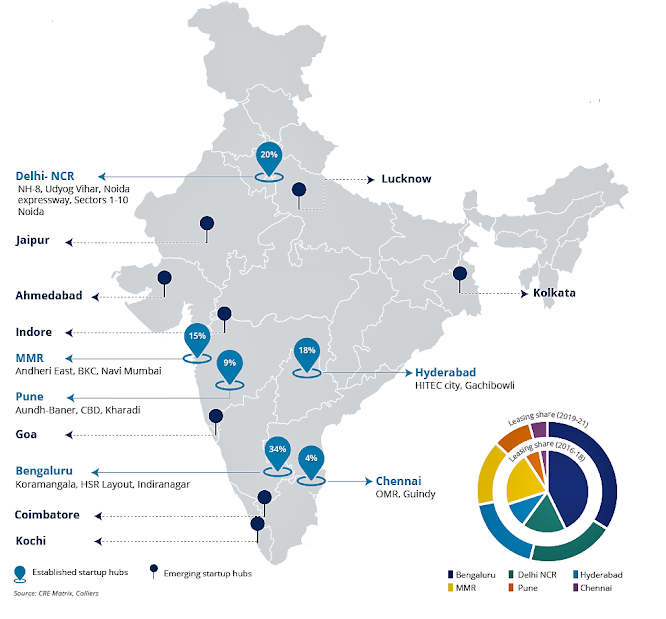
Delhi-NCR is amongst the fastest-growing market in terms of leasing by startups. Delhi-NCR witnessed a three-fold increase in leasing by startups during 2021 on a YoY basis. The region benefits from being a catchment for education institutions in the North and East India, and strong infrastructure.

Mumbai has seen certain pockets of startup activity over the years. However, relatively higher rentals, and high cost of living are often seen as deterrents by early-stage companies.

Bengaluru continues to lead the market with a 34% share in leasing by startups 2019-21. A well developed ecosystem, deep technology talent, and a culture of entrepreneurship are major factors attracting startups here.

Office space leasing by Startups

The workspace leasing demand will be led by fintech and logistics startups as they have gained momentum post-pandemic due to increased digital adoption and e-commerce boom, and hold a healthy pipeline in potential unicorns list. Additionally, increased digital adoption, availability of a deep talent pool, favourable government policies and funding options from venture capitalists are steering thegrowth of startups.

Future demand - startups workspace leasing

Startups' Choices of Leasing

Locations close to the CBDs and in proximity to established residential areas are preferred by startups. Locations close to other companies, research institutes/universities are ideal.

Plug & Play offices - High prices can be a challenge for startups since many are constrained by limited
cashflows or access to capital. Startups typically prefer plug and play flex space.

Collaborative culture - Informal spaces and interactive areas in the workspace.

Scalability - Startups are volatile in nature and may scale up and down quickly. Hence, they prefer spaces with expansion options

Standard deal size

  • Early-stage startups - 5,000-10,000 sq ft
  • Late-stage startups – 30,000 – 35,000 sq ft
The data for this report has been sourced from CRE Matrix for deals above 10,000 sq feet of traditional office space in top 6 cities. The deals include all registered office leases which have been executed since 2010, sized >10,000 sq. ft. in chargeable area, in all grades of office buildings. Cities covered by this report include -- MMR (Mumbai, Thane, Navi Mumbai), NCR (Delhi, Gurgaon, Noida), Bengaluru, Hyderabad, Chennai and Pune.

WeWork and Upflex Sign Strategic Partnership to Enable Access to Global Network of 5,500 Flex Workspaces


WeWork Inc., a leading flexible space provider, announced today a strategic and exclusive partnership with Upflex, a coworking aggregator and global flexible workplace startup. The exclusive partnership will establish a combined global network of over 5,500 locations and provide WeWork and Upflex’s clients with enhanced flexibility as they adopt hybrid work strategies. WeWork will also participate in Upflex’s Series A funding alongside additional investors.

Through the partnership, both WeWork and its members will gain access to Upflex’s fast-growing, aggregated portfolio of over 4,800 third-party spaces, provided by over 700 flexspace operators across 80 countries. WeWork will be the exclusive flex workspace operator to sell Upflex inventory to its members, allowing WeWork members to access Upflex’s vast network of third-party spaces while maintaining a streamlined experience through WeWork as their single workspace provider.

Additionally, this partnership will position WeWork to roll out enhanced WeWork Access membership options where members will have the ability to search, view and book space at select non-WeWork locations within the Upflex network. The expanded scale across non-core WeWork markets globally will allow members to choose from a wider array of tailored, flexible space solutions that best fit their specific real estate requirements.

Reciprocally, Upflex will be the exclusive coworking aggregator to access WeWork’s global inventory, allowing both Upflex’s customers and employees to book workspace at WeWork locations through the Upflex platform and marking the first time WeWork has allowed workspace bookings from a third-party platform. This partnership will also enable all coworking brands on the Upflex network to leverage WeWork's community of more than 28,000 member companies around the world.

Sandeep Mathrani, CEO of WeWork, said, “We are pleased to invest in and partner with the great team at Upflex, whose vast network of flexible office locations and offerings are a strong addition to WeWork’s portfolio. As we look to the future of work, this partnership will not only drive more value in our own product offerings for WeWork members, but also promote a more innovative and collaborative flex ecosystem that is continually thinking of new ways to better serve the workforce.”

Christophe Garnier, CEO of Upflex, said, “This partnership is a significant step forward for both our supply partners, who will see huge demand growth, and our customers, who will be able to embrace the largest and highest quality flex network in the world. WeWork and Upflex share the same goal: create a better workplace for everyone, and we are excited to take the industry to a new level by matching the largest players in supply and demand together.”

The deal marks a step forward in WeWork's continued shift into an asset-light growth strategy by exponentially increasing the physical network for members without added incremental capital investments. Additionally, by partnering with Upflex, WeWork is enhancing its tech-first approach to providing an exceptional member experience through Upflex’s online marketplace.

WeWork (NYSE: WE) was founded in 2010 with the vision to create environments where people and companies come together and do their best work. Since then, we’ve become one of the leading global flexible space providers committed to delivering technology-driven turnkey solutions, flexible spaces, and community experiences. For more information about WeWork, please visit us at wework.com.

About Upflex

Upflex is a virtual platform created around the idea that today's companies must provide on-demand workplace flexibility while embracing environmental sustainability. Through a global, best-in-class, comprehensive network of workspaces, Upflex offers companies flexibility and a workspace hybrid model for their employees. It provides instant access to the largest global network of workspaces across 5,500+ locations in 80 countries.

Forward-Looking Statements

Certain statements made in this press release may be deemed “forward-looking statements” within the meaning of the Private Securities Litigation Reform Act of 1995, as amended. These forward-looking statements include, but are not limited to, those regarding the partnership agreement with Upflex and the concurrent financing, and the transactions contemplated thereby, future strategic growth, efficiency, and enhanced customer experience, the anticipated benefits of the partnership and financing, future financial and operating results of WeWork or Upflex, and other statements about future expectations, plans and prospects. The words “believe,” “project,” “expect,” “anticipate,” “estimate,” “intend,” “strategy,” “future,” “opportunity,” “predict,” “plan,” “pipeline,” “potential,” “may,” “should,” “will,” “would,” “will be,” “will continue,” “will likely result,” and similar expressions are intended to identify forward-looking statements, although not all forward-looking statements contain these identifying words.

Forward-looking statements are predictions, projections and other statements about future events that are based on current expectations and assumptions and, as a result, are subject to risks and uncertainties. Although WeWork believes the expectations reflected in any forward-looking statement are based on reasonable assumptions, it can give no assurance that its expectations will be attained, and it is possible that actual results may differ materially from those indicated by these forward-looking statements due to a variety of risks, uncertainties and other factors. Such factors include, but are not limited to, WeWork’s ability to recognize the anticipated strategic, economic and other benefits of the partnership and the financing; the effect of the announcement of the partnership and the financing on WeWork’s business, operating results and relationships with customers, suppliers, competitors and others; risks that the partnership or financing may alter or change WeWork’s current plans and business operations; changes in general economic conditions, including as a result of the COVID-19 pandemic; delays in customers and prospective customers returning to the office and taking occupancy as a result of the COVID-19 pandemic, as well as the response of governments and business, and the emergence of variants leading to a parallel delay in receiving the corresponding revenue; the success of new product offerings; and WeWork’s inability to implement its business plan. Forward-looking statements speak only as of the date they are made. WeWork discusses these and other risks and uncertainties in its annual and quarterly periodic reports and other documents filed with the U.S. Securities and Exchange Commission. WeWork may update that discussion in its periodic reports, but otherwise takes no duty or obligation to update or revise these forward-looking statements, whether as a result of new information, future developments, or otherwise.


How Coworking Spaces Are Changing The Future Of Work?


The present corporate world is heavily dominated by the use and influence of advanced technology and innovative approaches. The methodology and concept of coworking is a product of this modern system which allows working professionals from different backgrounds to come together and work under a single roof.

The trend and culture of coworking spaces have therefore reached the very pinnacle as entrepreneurs, as well as startups, have realized the benefits of coworking spaces offer.

Coworking spaces have enhanced the aspect of convenience for working professionals allowing them to operate from different locations with an increase in the level of efficiency. The aspect of flexibility has also significantly improved as corporate officials work with more freedom and have a platform to express their creative ideas in a more effective manner.

Coworking spaces have broken the norm and culture of working within the confines of restricted office establishments which offers limited growth. Moreover, the solution of operating from coworking spaces has also helped business organizations to save a considerable amount of finances as well as time in the long run. The idea of coworking spaces has come as a boon for businesses as thousands of emerging budding businesses are gaining a lot of exposure from this modern work culture. This has resulted in startups and entrepreneurs opting for coworking spaces as per their requirements by doing thorough research like searching for a proper location. As the location is considered one of the major factors while choosing a workspace. Thus, they will do thorough research for a proper location, or another great way to make decisions while saving time and money is by using the platform which does a similar task for you by giving you all the information you need at your fingertips. Suppose you are looking for coworking spaces in Bangalore you can search for the location on the platform easily and find a suitable coworking space as per your requirement.

However, the trend of coworking spaces is here to stay and will definitely dominate the future of the corporate world.

How coworking spaces are changing the landscape of the corporate world?

1. The Opportunity to build connections

Coworking spaces have helped to bridge the communication gap which long existed in the business world. The level of exposure and overall reach has increased considerably with the introduction of the coworking culture.

Business professionals from diverse backgrounds can now come in contact and potentially collaborate more effectively while operating within the confines of a coworking space establishment. Therefore, working professionals can connect and build networks in a productive way. It helps them to learn about different market segments by directly making contact with other corporate agents.

2. Increase in the level of Productivity

The amenities offered to work professionals in the form of dedicated desks, private cabins, high-speed internet, power back-up, parking spaces, etc. help to create an enhanced work environment that keeps working professionals motivated at all times. Moreover, the overall ambiance of coworking spaces and the interiors are designed specifically to enhance and encourage working professionals to achieve their short as well as long-term goals.

Moreover, most of the coworking spaces also provide additional amenities in the form of lounge rooms, gym areas, cafeterias, etc. which helps freelancers and entrepreneurs alike to unwind and relax. The provision of these elite facilities significantly assists in improving the productivity and performance of working professionals. Moreover, if you surround yourself with dedicated and focused individuals, then it will influence you to work harder as well. This is precisely what you can expect from coworking spaces.

3. Creativity

Operating from a coworking space helps you to observe and learn from people that are in and around you. These individuals come from different industries and have unique stories and experiences to share. Therefore, the creative side of your business also gets a significant boost.

As a working professional, you will be able to brainstorm and come up with innovative ideas by gaining influence from these experts. The relaxed ambiance and corporate setup of these coworking spaces also allow working professionals to think out of the box and come up with new solutions to diverse problems.

4. Greater Flexibility

The norm of fixed working hours is successfully broken with the introduction of coworking spaces as flexibility is one of the keys to the growth of a business. Most of these shared business centers offer 24/7 services that corporate agents can use as per their convenience and need. Therefore, if you wish to extend your work hours then you need not worry about the office closing at a specific time period.

Accessing coworking spaces is easy. Moreover, booking your seat at a coworking space can be done on a daily basis with “Day Passes.” Such is the level of flexibility offered by coworking establishments. Additional forms of subscriptions can also be made on a weekly, monthly, or annual basis.

5. Unlock new levels of Success

Most businesses around the world fail to attain success due to the amount of investment that is required to be made in the initial stages during the business incorporation period. The price of real estate, especially in India, is certainly not cheap. Establishing an independent office space right from scratch can be expensive, to say the least. This is where most of the businesses fail to take off and attain long-term success.

However, with the introduction of coworking spaces, such expenses can be effectively mitigated. All the coworking establishments are completely equipped and come with necessary amenities that are essential for a business to blossom. Thus, the initial risk of investment is significantly lowered which increases the chances of a budding business to succeed in the long run.

6. Innovation and Collaboration

The coworking culture is certainly a product of the future and therefore, it always stays ahead of the curb and adopts the most effective form of innovative ideas from diverse communities and industries. Since it is an amalgamation of diverse work cultures, the ideas and approaches incorporated within the coworking culture are top-notch which is bound to scale businesses.

Likewise, collaborating with fellow colleagues can also be done with absolute ease and convenience as working professionals from unique fields come together and function under the same roof.

7. Increased employee satisfaction

The results obtained while operating from coworking spaces are impressive, to say the least. Employees get the opportunity to work from an enhanced and advanced work environment which helps them to express their ideas and creativity without any restriction. Therefore, work becomes more fun and interactive which results in greater employee satisfaction.

Final Overview

These were some of the foremost reasons which make the coworking culture a trend that will dominate the future of the corporate world. Therefore, if you are struggling to meet your long-term business goals then be sure to operate from coworking spaces. It will help you to cut down additional costs, increase the productivity of your business and you will be able to collaborate and connect with like-minded working professionals who are striving to attain success in the corporate world.

ABB India Unveils New AI-Enabled Corporate and Business Office Within Its Own Sustainable Manufacturing Campus

  • Campus aims to rely on 100 percent renewable energy by 2023
  • Corporate office building "Disha" is designed to meet the LEED Gold criteria
  • With ~ 5000 ABB products, the digitalized building is a live demonstration of ABB AbilityTM digital technology in building automation and energy efficiency solutions
  • ABB's intelligent building management solutions shall save up to 30 percent

BENGALURU, India, Nov. 1, 2021 /PRNewswire/ --

Energy Consumption

ABB India Corporate Office - Disha

ABB India today announced that it has moved its corporate and business office to an integrated, sustainable, and digitalized facility within its own Peenya campus in Bangalore. The facility, named Disha, will house the corporate office, along with the offices of Electrification and Motion businesses alongside Process Automation business in the same campus. Located in one of the prime industrial areas of Bengaluru, the campus minimizes carbon footprint by sourcing 90 percent electricity from renewable sources; it reduces 55 percent load on potable water with intelligent fixtures and with 98 percent of its waste recycled, almost reaches its target of zero waste to landfill. The 15 acres campus has a green cover of about 30 percent.

By upcycling and repurposing an existing building to convert it to Disha, the project has optimized resources and significantly reduced the environmental impact which a greenfield project of this scale would have generated. Showcasing ABB's expertise in digital energy management solutions, more than 5000 ABB products are being used in Disha. It is the first ABB facility to deploy ABB's Aspect IBMS (Integrated Building Management Solutions) technology. This is a unified platform to monitor and control from any location or city, the multiple points enabled with hundred sensors from lighting to HVAC solutions, room controls, safety, and security systems with special CO2 monitors for ambient air quality monitoring in the rooms. This is combined with a cloud-based SaaS solution - ABB Ability™ Building Ecosystem with Active Energy and Asset Manager. It is complemented by electricals from the ABB portfolio and an AI-enabled vehicle management and parking system. These nearly 500 connected products with embedded intelligence are designed to significantly reduce overall energy consumption and carbon footprint while saving energy costs by up to 30 percent.

"At ABB, we have always taken a sustainable and future-ready approach to business. Sustainability is a key part of our company's purpose and of the value that we create for our customers, employees, and all our stakeholders. The move to the existing Peenya campus brings our people together under the same roof enhancing collaboration and agility. It is also a step towards minimizing our carbon footprint, repurposing existing resources while offering a smarter workplace focused on employee wellbeing and improving productivity. ABB is developing all the companies' manufacturing campuses at Nashik, Baroda, Faridabad, and Bangalore & multiple office campuses to common ESG standards in India. The vision was to create a model, flexible industrial infrastructure project with an enabling eco-system by working with all our partners and stakeholders," said Sanjeev Sharma, Country Head and Managing Director, ABB India.

"In India, almost 30 percent of the energy is consumed by buildings and we believe Disha will create a legacy, a demonstration of what can be done to make buildings more efficient through the deployment of integrated digital building automation & electrical technology," he added.

This project also included the enhancement of local infrastructure through a 360-degree development of the associated road related infrastructure and laying of cable trenches for future expansion of IT infrastructure of the companies co-located in this area. As part of the sustainable infrastructure development theme, a special recycled plastic mix of 6,000 kgs, equivalent to 1,50,000 (1.5 lac) one-liter bottles is used for the footpath construction.

ABB India's Peenya campus has been in operation for more than 30 years and has been the bedrock of multiple milestones for the company. The campus hosts innovation centers of multiple products, global factories, precision product manufacturing with smart shopfloors, and remote monitoring centers for connected devices across Indian industries. The new building, Disha was built continuing the heritage of the location as well as retaining the existing green cover. Nearly 120 trees, some more than 60 years old, were preserved during the construction process.

ABB

(ABBN: SIX Swiss Ex) is a leading global technology company that energizes the transformation of society and industry to achieve a more productive, sustainable future. By connecting software to its electrification, robotics, automation and motion portfolio, ABB pushes the boundaries of technology to drive performance to new levels. With a history of excellence stretching back more than 130 years, ABB's success is driven by about 105,000 talented employees in over 100 countries. www.abb.com

Photo - https://mma.prnewswire.com/media/1674556/ABB_India_Corporate_Office___Disha.jpg 

WeWork Launches Virtual Offices for Easing Setting up Office At A Prime Location


In its continuous focus to cater to office space needs of businesses of all sizes, WeWork, the leading flexible workspace provider has launched WeWork Virtual Offices. Businesses across the country, as well as self-employed individuals, have a growing need to have a premium office set up for varied purposes that range from communication to registration necessities. WeWork has identified and met this demand with its unique offering of a Virtual office that will help them with a professional address at a central business district where its 35 workspaces are located.

Moreover, businesses in non metros now increasingly require office space in desired hubs of urban cities in order to facilitate wider networking opportunities, expansion of talent base, without incurring large expenditures. The offering which was running in its pilot phase has already received an enthusiastic response with over 100 companies setting up their virtual offices in a short span of time.

The product is officially live starting today across the 6 key cities of WeWork, with favourable packages starting from 6 months that goes upto 24 months priced at:
  • INR 4,500 PM for a 6 months membership
  • INR 4,000 PM for a 12 months membership
  • INR 3,000 PM for a 24 months membership

These memberships include monthly credits worth INR 2500 as an introductory offer. Additional benefits bundled into the offering include mail handling and storage facilities, ability to use credits to access meeting rooms or to use them as day passes across the entire WeWork network in India. These benefits can be availed by any employee in these companies as well. Prioritizing health and ease of usage for potential members, WeWork has ensured an end to end digital process for registration including NOC signing and agreement processing which can be done within a couple of minutes.

Excited about creating a virtual office, Vinayak Parameswaran, Head of Corporate Finance and Innovation at WeWork India said, “ At WeWork, we are constantly working towards anticipating and creating workspace solutions that suit varied business requirements. With the launch of WeWork Virtual Office, we are providing a distinctive option to businesses and individuals that need a prime office address along with a host of added benefits. Facilitating the same with an entirely online process is another step in enabling ease of work and introducing them to our member first culture with which we welcome them at WeWork”.

Based on the demand witnessed and the response so far, WeWork would also look into expansion of the service across Tier 2 cities. This is apart from a host of member-centric solutions such as WeWork On Demand which provides easy one day access to any of the WeWork spaces at an introductory price of INR 500 and WeWork Business Solutions which is a service platform that offers hassle-free, cost-effective, and specially curated solutions like Accounting and Finance services, Legal & Tax Advisory, Insurance, etc, for its members.

WeWork also offers its members WeWork All Access, a membership model that provides access to any WeWork location that is most convenient to them, reducing considerable commute time thereby enabling higher productivity levels.

WeWork is India’s largest office space provider, aimed at creating flexible workspace solutions for companies of all sizes. Since entering the Indian market in 2017, WeWork has been spearheading the concept of flexible workspaces and driving the future of work with over 5 million sq ft of space leased in 35 locations, across NCR, Mumbai, Bengaluru, Pune and Hyderabad as of Q1 2021.


Bengaluru-based Netrack Introduces Seismic Rack Cabinet to Protect IT Equipment from Earthquake

Image - netrackindia.com


When a company plans to set up an IT room, there is a considerable investment they consider for purchasing the right equipment as per their need, server rack cabinets being one among the most important. A single server rack can house a piece of equipment worth thousands of dollars. System administrators need to be sure that the purchased rack will be able to handle any hardship, sudden force, vibration, or a physical threat that the surrounding environment might bring to the equipment. For instance, an earthquake is an uncalled-for event that’s inevitable; and an earthquake-proof server rack is the right solution for the same.

No matter wherever a company may be located, it would want the server and other telecommunication equipment to be operational at all times. To reduce the risk involved and minimize equipment damage, an IT rack needs to have proper seismic protection


Earthquakes are a significant concern for the IT industry not only because they cause damage to the equipment but also because they eventually affect the overall operations. The aim of any IT setup is to provide compute power and uptime. Compute power can be achieved by purchasing the right hardware to an extent, but the certainty of uptime needs better infrastructure. 

The rating of a seismic rack is done based on the amount of protection it provides from the shocks in the event of an earthquake. Seismic rack standards are often specified in terms of the earthquake risk zones they are made to withstand. These zones vary from 0 to 5, with zero denoting no substantial risk, while three and above denoting medium to very high risk. A seismic rack is manufactured pertaining to the requirements for physical protection for each of these zones.

The benefits of a seismic rack include its physical properties and construction. It has an enhanced base and robust anchoring hardware to hold the rack in place and well protected, like the NRSs series from Netrack India. Made for high-density application in IT industry, and for IT rooms located in medium and high-risk seismic zones, this product offers four distinctive bracing option like High Tension Bracing Bolt, Anti vibration Mount Pads, Ultra Rigid Bracing frame & Top bracing to be able to mount the rack on True floor or the raised floor based on its type for the highest level of protection. Product also tackles the Airflow management issues with the accessories like Blanking Panel, Air Seal Kit & Brush module for efficiency to ensure effective airflow management within the cabinet specifically for the Data-Center industry.

Other features of the NRSs series that make it the best-in-class seismic rack to use:

  • UL certified
  • Conforms to DIN 41494 or equivalent ISO/EN/EIA standards 
  • Adjustable mounting depth 
  • Universal 25mm pitch holes for ETSI Standard racks 
  • Grounding and Bonding options 
  • 2 or 4 Fan module mount provision on Top cover 
Considered as one of the top-quality seismic server racks, they undergo workshop operations such as punching and forming, followed by intense quality testing to have them adhere to the best displacement distribution required for protection from earthquakes.

When it comes to investing in something that can save a business's purpose, it is crucial to have the product checked for quality and durability. A seismic server rack is the best solution for data centers in earthquake-prone regions.

About Netrack

Netrack Enclosures Pvt. Ltd. is one of the top manufacturers of network enclosures worldwide. The company offers active network components to meet the demands of the modern-day office spaces. Their product range includes Server & Networking Racks, Wall Mount Racks, Acoustic racks, Seismic Racks, Lab Racks & Furniture, and Customized racks.

To explore more about an ideal seismic rack and how it would suit your office IT equipment, log on to www.netrackindia.com.

Market Reports

Market Report & Surveys
IndianWeb2.com © all rights reserved