


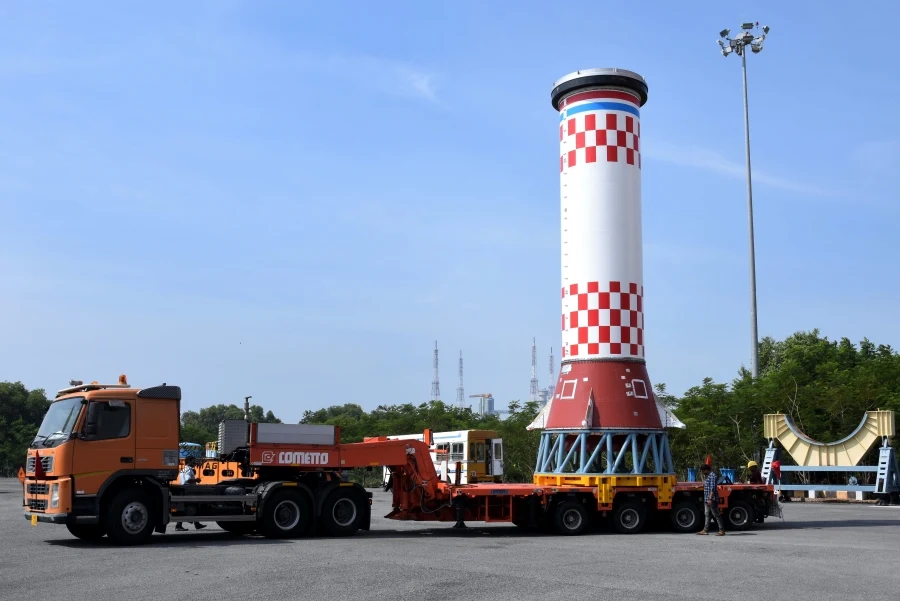
Tomorrow on Sunday morning, Indian space agency ISRO will launch SSLV, a small-lift launch vehicle, on its maiden flight at 09:18 am (IST) from the First Launch Pad of Satish Dhawan Space Centre, Sriharikota.
ISRO is inviting citizens to the Launch View Gallery at Satish Dhawan Space Centre to witness the launch. To witness the launch, click here for registration.
The ISRO-developed SSLV can launch upto 500 kg satellites to Low Earth Orbits on ‘launch-on-demand’ basis. SSLV's first mission called as "SSLV-D1" mission would launch EOS-02, a 135 kg Satellite, into low earth orbit of about 350 km to the equator, at an inclination of about 37 degrees.
This new launch-vehicle is developed with the aim of launching small satellites commercially at drastically reduced price and higher launch rate as compared to PSLV (Polar Satellite Launch Vehicle).
The ISRO-developed SSLV can launch upto 500 kg satellites to Low Earth Orbits on ‘launch-on-demand’ basis. SSLV's first mission called as "SSLV-D1" mission would launch EOS-02, a 135 kg Satellite, into low earth orbit of about 350 km to the equator, at an inclination of about 37 degrees.
SSLV is capable of launching Mini, Micro, or Nanosatellites (10 to 500 kg mass) to a 500 km planar orbit.
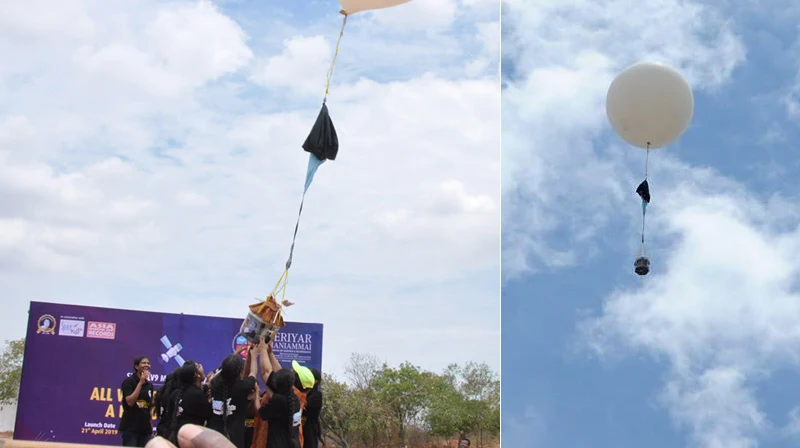
The mission also carries AzaadiSAT satellite, which is a 8U Cubesat weighing around 8 kg. It carries 75 different payloads each weighing around 50 grams and conducting femto-experiments. AzaadiSAT is a satellite mission with the ambitious vision to encourage Government school children (from economically weak backgrounds) with the basic understanding and knowledge of space and tutor them to build a small experiment and launch it to the edge of space through a “Balloon Satellite” or through an “Orbital Satellite".
Girl students from rural regions across the country were provided guidance to build these payloads. The payloads are integrated by the student team of Chennai-based Space Kidz India, which in 2019 mentored and trained Girl Students of Tanil Nadu's Periyar Maniammai Institute of Science Technology (PMIST), to launch Asia’s 1st satellite launch by girl students.
The payloads include a UHF-VHF Transponder working in ham radio frequency to enable voice and data transmission for amateur radio operators, a solid state PIN diode-based Radiation counter to measure the ionising radiation in its orbit, a long-range transponder and a selfie camera. The ground system developed by ‘Space Kidz India’ will be utilised for receiving the data from this satellite.
 |
| SSLV-D1/EOS-02 Mission | Image - ISRO |
The mission also carries AzaadiSAT satellite, which is a 8U Cubesat weighing around 8 kg. It carries 75 different payloads each weighing around 50 grams and conducting femto-experiments. AzaadiSAT is a satellite mission with the ambitious vision to encourage Government school children (from economically weak backgrounds) with the basic understanding and knowledge of space and tutor them to build a small experiment and launch it to the edge of space through a “Balloon Satellite” or through an “Orbital Satellite".
Girl students from rural regions across the country were provided guidance to build these payloads. The payloads are integrated by the student team of Chennai-based Space Kidz India, which in 2019 mentored and trained Girl Students of Tanil Nadu's Periyar Maniammai Institute of Science Technology (PMIST), to launch Asia’s 1st satellite launch by girl students.
The payloads include a UHF-VHF Transponder working in ham radio frequency to enable voice and data transmission for amateur radio operators, a solid state PIN diode-based Radiation counter to measure the ionising radiation in its orbit, a long-range transponder and a selfie camera. The ground system developed by ‘Space Kidz India’ will be utilised for receiving the data from this satellite.
SSLV vs PSLV
- PSLV launch involves 600 officials while SSLV launch operations can be managed by a small team of about 6 people.
- The launch readiness period of the SSLV is expected to be less than a week instead of months.
- SSLV can be assembled in 72 hours (3 days) to 15 Days – instead of the 60 days.
- SSLV can be assembled both vertically like the existing PSLV and Geosynchronous Satellite Launch Vehicle (GSLV) and horizontally like the decommissioned Satellite Launch Vehicle (SLV) and Augmented Satellite Launch Vehicle (ASLV).
- SSLV Specifications:
- Height: 34.0 meters
- Diameter: 2.0 meter
- Lift-Off Mass: 120 tonnes


 IndianWeb2.com is an independent digital media platform for business, entrepreneurship, science, technology, startups, gadgets and climate change news & reviews.
