‏إظهار الرسائل ذات التسميات Quantum Communication. إظهار كافة الرسائل

India Demonstrates 1,000-km Quantum Network in Record Time, Accelerating Secure Tech Frontier

India Demonstrates 1,000-km Quantum Network in Record Time, Accelerating Secure Tech Frontier

India has successfully demonstrated a 1,000-km quantum communication network under the National Quantum Mission, making it one of the longest such deployments globally and achieving the milestone in under three years—well ahead of its eight-year target. The breakthrough, powered by indigenous technology from QNu Labs, positions India at the forefront of secure quantum communications with strategic applications across defence, finance, and critical infrastructure.

Key Highlights of the Milestone

  • Network Length: 1,000 km quantum communication network, among the longest globally.
  • Timeline: Achieved in less than three years since the mission’s launch in October 2024.
  • Target: Mission aims for 2,000 km secure communication capability by 2032.
  • Technology: Developed by QNu Labs, a Bengaluru-based startup specializing in quantum-safe cybersecurity.
  • Applications: Defence communications, financial systems, critical infrastructure, and civilian networks across challenging terrains (underwater, underground).

Government Push and Startup Ecosystem

  • Expansion of Startups: The mission now supports 17 startups, up from 8, with 9 new ventures added recently.
  • Focus Areas: Quantum computing, communication, sensing, materials, biosensors, photon sensing, positioning systems, atomic memory, and precision electronics.
  • Examples of New Ventures: Sense-XT, ORVISSEMI, QuBeats, Quantum AI Global, bloq, GDQ Labs, Quantum Biosciences, Bumble Bee Instruments, SAS Qute Electronics.

Funding and Innovation Framework

  • Technology Development Board (TDB): Received over 100 R&D proposals within two months of its latest call.
  • Biotechnology Industry Research Assistance Council (BIRAC): Nearly 200 applications in cancer research, gene therapy, and bio-manufacturing.
  • Financial Instruments: Introduction of optionally convertible debt (OCD) to support startups without immediate equity dilution, encouraging private-public blended financing.

Strategic Significance

  • Global Positioning: India joins the ranks of countries like China and the US in demonstrating large-scale quantum communication networks.
  • Security Edge: Quantum Key Distribution (QKD) ensures unbreakable encryption, critical for national defence and secure digital ecosystems.
  • Policy Push: The mission is part of India’s broader deep-tech strategy, alongside initiatives in 6G, advanced manufacturing, space technologies, and biotechnology.


Dr. Jitendra Singh (Union Minister for Science & Technology): Praised the achievement as a landmark in indigenous innovation, stressing transparency and wider outreach for R&D funding.

Dr. Abhay Karandikar (DST Secretary): Called it “a landmark advancement in secure quantum communication,” noting progress ahead of envisaged timelines.

India’s 1,000-km quantum communication breakthrough marks a decisive leap in its National Quantum Mission, showcasing rapid progress, indigenous innovation, and strategic foresight. With expanded startup participation and blended financing models, India is positioning itself as a global leader in quantum technologies, reinforcing both its digital security and deep-tech ecosystem.

India Doubles R&D Spend for AI, Quantum & 6G Breakthroughs

India Doubles R&D Spend for AI, Quantum & 6G Breakthroughs

India is making a significant push in next-gen technology research, with plans to ramp up annual spending to ₹1,000 crore—more than doubling the ₹400 crore allocated for FY26. This funding will support advancements in 5G/6G, quantum communications, blockchain, and satellite communication, aligning with India's broader vision for technological leadership.

The Bharat 6G Mission is a key part of this strategy, aiming to position India as a global leader in 6G development by 2030. The government has also been actively fostering research in quantum communication, with recent conclaves focusing on standardization, industry collaboration, and innovation.

The Union Budget 2025-26 allocated ₹20,000 crore for research, development, and innovation, with a focus on deep-tech startups, geospatial infrastructure, and Al-driven advancements.

This increased investment underscores India's commitment to self-reliance in emerging technologies, ensuring that domestic research and development keep pace with global advancements. It also strengthens India's position in telecom, cybersecurity, and space-based communication, areas that are becoming increasingly critical.

India's increased investment in quantum communication, AI, and semiconductors is shaping a strategic shift in its technological landscape.

Quantum Communication & AI

The National Quantum Mission is driving advancements in quantum-secured communication, including satellite-based quantum networks and inter-city Quantum Key Distribution (QKD). This strengthens India's cybersecurity framework, making AI-driven systems more resilient against emerging threats.

Semiconductors & AI Integration

India's semiconductor push is gaining momentum with initiatives like the India Semiconductor Mission (ISM) and new Production Linked Incentive (PLI) schemes. Companies like Tata Electronics and Micron are setting up fabrication and packaging facilities, ensuring a robust supply chain for AI hardware.

Strategic Positioning

India is crafting a third path in AI and semiconductors, distinct from the U.S.-China rivalry. The IndiaAI Mission is fostering homegrown AI models, reducing reliance on foreign technologies while ensuring data sovereignty.

LTIMindtree Launches and Tests Quantum-Safe VPN Link in London

LTIMindtree Launches and Tests Quantum-Safe VPN Link in London

LTIMindtree Launches and Tests Quantum-Safe VPN Link in London in Collaboration with Quantum Xchange & Fortinet

A market-leading initiative to secure data transmission for the approaching quantum era

LTIMindtree [NSE: LTIM, BSE: 540005], a global technology consulting and digital solutions company, has launched a state-of-the-art Quantum-Safe Virtual Private Network (VPN) link at its London premises. This is an exciting move towards the era of quantum-secure communications, where data transmission is protected today from the looming “harvest now, decrypt later” threat. LTIMindtree’s Quantum-Safe VPN demonstrates the practical application of Post-Quantum Cryptography (PQC) within a live network, using quantum-based key generation and out-of-band key delivery, which is secured by Post-Quantum Cryptography algorithms that are on track for standardization by NIST, thereby bolstering the security and integrity of encrypted data.

LTIMindtree’s Quantum-Safe VPN platform is realized in close collaboration with its partners Quantum Xchange, a leader in quantum-safe communication solutions, and Fortinet, the global cybersecurity leader driving the convergence of networking and security. Quantum Xchange provides the quantum hardware and software that enable the generation, distribution, and management of quantum keys, while Fortinet’s FortiGate firewall provides the VPN functionality that integrates quantum-safe keys with standards-based VPN protocols. LTIMindtree leverages its integration and domain expertise to implement and operate the Quantum-Safe VPN link across its active network.

Aan Chauhan, Chief Technology Officer, LTIMindtree, said, “As a forward-looking partner, LTIMindtree is dedicated to anticipating and addressing the future challenges of quantum safe security. Our collaboration with Quantum Xchange and Fortinet underscores this commitment. We are committed to enhancing our expertise in quantum-safe security solutions, ensuring we offer the latest tools and approaches. This is integral to our mission of providing top-tier security for our customers in an evolving threat landscape.”

This platform offers several benefits and opportunities for its customers and stakeholders. LTIMindtree’s Quantum-Safe VPN setup, designed as a robust testbed, not only drives the development of industry-specific solutions, but also creates avenues for its customers to co-create industry aligned prototypes and pilots using this advanced infrastructure. LTIMindtree’s customers can benefit from the opportunity to experiment with quantum-safe technologies and explore their potential applications and use cases in various sectors and scenarios.

Eddy Zervigon, CEO of Quantum Xchange, said, “Joining forces with LTIMindtree for this innovative quantum-safe VPN project is the start of a forward-thinking partnership. Our quantum-based key generation and management solutions, combined with LTIMindtree’s integration expertise and Fortinet’s VPN devices, provide a robust and secure communication infrastructure that offers stronger data security today is ready for the quantum era. This collaboration underscores Quantum Xchange’s commitment to a quantum-secure future and our belief in the strength of collective innovation.

By adopting quantum-safe communication solutions, LTIMindtree can ensure a high level of data security for its own operations and for its clients, protecting their sensitive information from the quantum threats of today and tomorrow. LTIMindtree can also provide its customers with guidance and support in their quantum-safe journey, helping them to prepare for the quantum future.

Ben Wilson, VP of Product Management at Fortinet, said, “Working alongside LTIMindtree and Quantum Xchange, we are thrilled to be able to combine the mature and field-proven VPN capabilities of our FortiGate Next-Generation firewall with our long-term commitment to innovation. As we navigate the complexities of the digital age, it’s important that we stay ahead of potential threats. With this partnership, we are delighted to collaborate with like-minded companies to build quantum-safe solutions for the future.”

LTIMindtree’s Quantum-Safe VPN platform is a groundbreaking initiative that showcases the feasibility and benefits of quantum-safe communication solutions in a real-world setting. LTIMindtree, in collaboration with Quantum Xchange and Fortinet, has successfully encrypted data across its active network using quantum-based key generation and out-of-band key delivery, addressing the looming “harvest now, decrypt later” threat today. The Quantum-Safe VPN platform opens new possibilities for its customers to leverage this cutting-edge infrastructure and co-create quantum-safe solutions for their specific needs and challenges. LTIMindtree, along with its partners, is committed to preparing businesses for the quantum era and ensuring their data security and privacy, with more such efforts, in the long term.

For more on LTIMindtree’s Quantum-Safe VPN platform, please click here.

India Now Among 7 Elite Nations Using Quantum Technology

India Among 7 Elite Nations Using Quantum Technology

India is now among the seven elite countries in the world that are using Quantum Technology, said the Union Minister Dr. Jitendra Singh while addressing the Indian Military Heritage Festival in New Delhi, yesterday.

To recall, in December 2021 a quantum-powered secure communication trials were succesfully conducted between two physically distant DRDO labs. Later, in December of last year, Indian Army begun the process of procurement & Deployment of QKD (Quantum Key Distribution) systems 
developed by QNu Labs, a Bengaluru-based startup.

Bharat today is armed with state-of-the-art technology in the Defence sector, Dr Jitendra Singh said.

Unlike in the past, our Armed Forces are equipped with advanced weaponry including drones, heliborne operations and UAVs and are ready to adapt to new frontiers like Quantum Computing, Artificial Intelligence and Cyber Security, he said.

Dr. Singh, the Science & Technology Minister said, ‘i-Hub Quantum’, set up at IISER, Pune, is working in the area of Quantum Technologies and developing atom interferometry-based sensing and navigation devices; TIH at IIT Madras, namely, IITM Pravartak Technologies Foundation is working on developing a secure mobile phone for defence personnel. 

TIH at IIT Roorkee, namely, iHUB Divya Sampark supporting IDR Doot Mk-1, India’s first indigenous Nano drone for helping Indian Armed Forces during counter terrorist/counter insurgency and room intervention operations; i-Hub Quantum, set up at IISER, Pune working in the area of Quantum Technologies developing atom interferometry-based sensing and navigation devices; TIH at IIT Mandi, namely, Human Computer Interaction (HCI) Foundation developing the Naval Combat Management System (NCMS), TIH at IISc 
Bengaluru developing integrated robotic joint actuators for precise control of automation systems etc.

The three major defense applications of quantum technology are — quantum computing, quantum sensing, and quantum communication.

In April this year, Raman Research Institute (RRI), an autonomous institute of the Department of Science and Technology (DST), had signed a Memorandum of Understanding (MoU) with the Indian Navy's R&D unit Weapons and Electronics Systems Engineering Establishment (WESEE) for research in developing quantum key distribution techniques that the Indian Navy 
could leverage in the nation's efforts towards securing free space communications.

In the same month, International Institute of Information Technology, Hyderabad (IIITH) partnered with Synergy Quantum India (SQ India) to establish Quantum Solution Lab with an aim of developing financially feasible quantum technologies and their applications in both military and civilian use cases.


SAC, ISRO Inks MoU with Ahmedabad-based Nav Wireless Technologies for Satellite Communication in Space

SAC, ISRO Inks MoU with Ahmedabad-based Nav Wireless Technologies for Satellite Communication in Space
Hardik Soni, Co-founder & CTO, Navwireless Technologies signing MoU with Nilesh Desai, Director, Space Applications Centre (SAC), Ahmedabad

SAC, ISRO signs MoU with Nav Wireless Technologies for Optical Wireless Communication - LiFi | FSO & Quantum Key Technologies

The MoU envisages the use of the high speed secured communication technology for the upcoming space exploration programs of ISRO.

Pioneer in Light Fidelity (LiFi) technology, the Ahmedabad-based Nav Wireless Technologies Pvt Ltd (NavTech) has signed an MoU with Space Applications Centre, Indian Space Research Organization (ISRO). One of the major centers of ISRO, SAC has joined hands with Nav Wireless Technologies to use light-based high-speed communication for satellite communication in space.

Space agencies have already started using optical wireless technologies instead of Radio Frequency for space communication. SAC will use high speed secure quantum key communication using light from base station to satellite in space & terrestrial communication.

Through this technology, SAC will be able to do the quantum key distribution (QKD) & pointing acquisition and tracking (PAT) for satellite-to-satellite communications in the space. The technology is all set to be used in ISRO’s upcoming space exploration programs.

The MoU signed between SAC/ISRO and Nav Wireless Technologies, has a tenure of three years. Recommended by Department of Telecom (DoT), Nav Wireless Technologies is the first company in India to provide this technology to SAC, ISRO.

Commenting on this development, Hardik Soni, co-founder and CTO of Nav Wireless Technologies Pvt Ltd. said “It is a proud moment for Nav Wireless Technologies as it will contribute to the great projects of ISRO. Very few space agencies in the world are currently using LiFi technology for secured communication between base stations and for satellite communications around the globe.”

Li/Fi, also known as Light Fidelity, utilizes the transmission of data through a light beam spectrum in both indoor and outdoor environments. This technology enables ultra-fast data connections and proves especially valuable in urban areas with congested radio spectra, as well as in rural regions where fiber optic cables or networks are not available.

For over a year, Nav Wireless Technologies Pvt Ltd has been at the forefront of LiFi research and development in India. The company has positioned itself as the sole registered entity in the country dedicated to exploring the potential of LiFi technology. Through their groundbreaking work, Nav Wireless Technologies Pvt Ltd has showcased the most viable and practical solution for the nationwide launch of 5G services & BharatNet rural connectivity, utilizing Optical Wireless Communication (OWC).

Indian Navy and RRI To Jointly Develop Quantum Technologies for Secure Maritime Communications

Indian Navy and RRI To Jointly Develop Quantum Technologies for Secure Maritime Communications

Department of Science & Technology (DST) Institute to partner Indian Navy in developing secure maritime communications using Quantum Technology

In order to develop secure maritime communications, Quantum technologies will soon be used by Indian Navy, in a joint effort by the Raman Research Institute (RRI), an autonomous institute of the Department of Science and Technology (DST), and the Indian Navy, said a public press release by Ministry of Science & Technology.

RRI has inked a Memorandum of Understanding (MoU) with the Indian Navy's R&D unit Weapons and Electronics Systems Engineering Establishment (WESEE), during a ceremony held in New Delhi recently. The MoU, which is for a period of 5 years, was signed between Professor Tarun Souradeep, Director, RRI, and Vice Admiral Sandeep Naithani, Chief of Materiel, Indian Navy.

Under this agreement, RRI’s Quantum Information and Computing (QuIC) lab will lead the research efforts towards developing quantum key distribution techniques that the Indian Navy could leverage in the nation's efforts towards securing free space communications.

The MoU was signed in New Delhi (Image Credit: Indian Navy) 

"I am absolutely delighted that Indian Science and Technology ecosystem has been opening borders in recent years that enable talented and world-class researchers in the academic research institutions to contribute to the growth of Science and Technology capabilities in strategic areas of national importance. Porosity of the perceived boundary between fundamental and applied sciences as well as Science and Technology, will bode well in the coming decades. RRI feels proud to partner with WESEE in cutting edge Science and Technology," said Prof. Souradeep.

Professor Urbasi Sinha, Group Head, QuIC lab, said, “This is a great opportunity to use indigenously developed science and technology knowledge to serve our nation. We are excited with the collaboration and believe that with our expertise in the domain of secure quantum communications, we will be able to help foster cutting-edge research towards identification of potential maritime use-cases for the Indian Navy.”

This lab has been leading the country’s research in the field of secure quantum communication. Some of its major achievements include the development of an end-to-end simulation toolkit named “qkdSim”, ensuring safety in communication platforms, establishing secure communication between two buildings, and, more recently, between a stationary source and a mobile receiver.

QuIC lab also happens to be India’s first laboratory to propose and implement a wide range of applications using single and entangled photons, particularly towards establishing secure communications in strategic areas like banking, defence, and cyber security.

Earlier this month, International Institute of Information Technology, Hyderabad (IIITH) partnered with Synergy Quantum India (SQ India) to establish Quantum Solution Lab with an aim of developing financially feasible quantum technologies and their applications in both military and civilian use cases.

In December 2020, India's DRDO unveiled "Quantum Key Distribution (QKD)" as a new technology developed by DRDO's Centre for Artificial Intelligence and Robotics (CAIR) and DRDO Young Scientist Laboratory (DYSL-CT).

Last year in August, it was reported that, QNu Labs, a Bengaluru-based Deep Tech Start-up, supported by the Defence Ministry's iDEX, did successful trials of QKD system and even equipping Indian Army with Quantum Communication technology.

Defence Ministry's iDEX Supported Startup To Equip Indian Army with Quantum Communication Tech

Defence Ministry's iDEX Supported Startup QNu Labs To Equip Indian Army with Quantum Communication Tech

Back in year 2020, in the month of December, a quantum-powered secure communication trials were conducted between two physically distant DRDO labs and the milestone was achieved as a secure  quantum communication was successfully established in the presence of Defence minister of India.

The technology called "Quantum Key Distribution (QKD)" has been developed by DRDO's Centre for Artificial Intelligence and Robotics (CAIR) and DRDO Young Scientist Laboratory (DYSL-CT).

While CAIR is a premier laboratory of DRDO involved in the Research & Development of high quality Secure Communication, Command and Control, and Intelligent System, DYSL-CT with emphasis on Cognitive technologies, works in the area of design and development of Cognitive Radio and Cognitive Radar Systems, realising through Deep Neural Networks and Reinforcement learning algorithms.

DRDO developed this technology to enable startups and SMEs in the domain of Quantum information technologies, as one of the objectives. The quantum tech will also serve to define standards and crypto policies that can leverage QKD system in a unified Cipher Policy Committee (CPC) framework for more secure and pragmatic key management for current and future military cryptographic systems.

Now after two odd-years, QNu Labs, a Bengaluru-based Deep Tech Start-up, has broken distance barriers by innovating advanced secured communication through Quantum Key Distribution (QKD) systems. The project was curated by iDEX-DIO with Indian Army.

After the successful trials, now the Indian Army has initiated the process of procurement of QKD systems developed by QNu Labs by issuing commercial Request For Proposal (RFP) and its deployment.

QNu Labs is touted as the first India company to successfully develop commercial cybersecurity products using quantum physics. It also has a subsidiary in the United States called QNu Labs Inc, which was set up in Massachusetts, back in year-2019.

Quantum technology has a huge potential for military application and a disruptive impact on modern-day warfare. A QKD system allows creation of a quantum secure secret pair of symmetric keys between two end points, separated by certain distance (in this case, over 150 Kms) in terrestrial optical fiber infrastructure. The QKD helps create a non-hackable quantum channel for creating un-hackable encryption keys which are used to encrypt critical data/voice/video, across the end points.

Buoyed with the success of the start-up, Defence Secretary Dr Ajay Kumar termed the development of indigenously QKD technology as a milestone achievement in ‘Azadi Ka Amrit Kaal’ and a befitting success story of ‘Aatmanirbhar Bharat’. He appreciated the efforts of iDEX start-ups working in deep tech as they are equipping the Armed Forces with innovative solutions for modern and futuristic warfare.

The Defence Secretary also applauded the efforts of the Department of Defence Production, Ministry of Defence, iDEX-DIO, Army Design Bureau and the Indian Army Signals Directorate, which have contributed in development of high end Quantum Technology in the country for the first time. He added that iDEX revolutionises the defence innovation and helps foster creation of new tech solutions at a fraction of cost and time.

QNu Labs’ co-founder and CEO Shri Sunil Gupta stated that the vision of putting India on the forefront of deep technologies in the field of data security through the use of Quantum technology has finally borne fruits. He added that winning the Open Challenge-2 of iDEX has provided a launching pad to QNu Labs to achieve this stellar success.

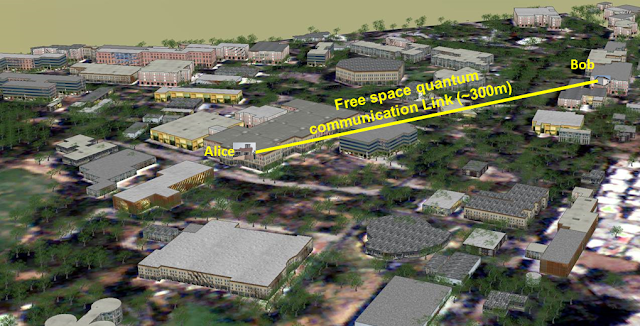
Earlier in February this year, in a major breakthrough for India, scientists from Space Applications Centre (SAC) and Physical Research Laboratory (PRL), both from the city of Ahmedabad, have jointly demonstrated quantum entanglement based real time Quantum Key Distribution (QKD) over 300m atmospheric channel along with quantum-secure text, image transmission and quantum-assisted two-way video calling. 

Breakthrough: India Conducts Demo of Free-Space Quantum Communication Over 300m for Future-Proof Data Security

Representational Image

In December 2020, DRDO developed Quantum Key Distribution (QKD) technology that undergone trials in Hyderabad between two DRDO labs (DRDL and RCI) to show secure communication using quantum-based technologies.

Now in a latest, on a day after this year's republic day, scientists from Space Applications Centre (SAC) and Physical Research Laboratory (PRL), both from the city of Ahmedabad, have jointly demonstrated quantum entanglement based real time Quantum Key Distribution (QKD) over 300m atmospheric channel along with quantum-secure text, image transmission and quantum-assisted two-way video calling. 

SAC and PRL are both the premier laboratories of Department of Space (DOS), Government of India.

The demonstration was conducted at SAC, Ahmedabad, between two buildings separated by a distance of 300 m. 

Department of Space demonstrates entanglement based quantum communication over 300m free space along with real time cryptographic applications (Image Credit - www.isro.gov.in)

With this, India has reached a milestone towards the development of the planned Satellite Based Quantum Communication (SBQC). This feat comes after the earlier breakthrough demonstration of quantum secure videoconferencing by SAC-ISRO using ‘prepare-and-measure’ quantum communication technology, in free space, over a distance of 300 m on 19 March 2021.

This experiment and demonstration were repeated over several nights to ensure the repeatability and robustness of indigenously developed QKD system capable of seamlessly generating and utilizing secure keys for various applications.  

Shri. S. Somanath, Chairman, ISRO & Secretary of DoS has witnessed this live breakthrough demonstration at SAC, Ahmedabad.  

Various images were encrypted using generated quantum key and transmitted over classical channel from one building to another building separated by 300m and decrypted at the receiving terminal in real time.

In order to achieve this technology feat, scientists developed various key technologies like robust & high brightness entangled photon source (EPS), BBM92 protocol implementation, NavIC -- the Indian version of Global Positioning System (GPS) -- enabled synchronization, polarization compensation technique etc. A cryptographic application software suite with integrated quantum security has also been developed and demonstrated for text, image, video encryption/decryption.

The BBM92 protocol based quantum communication link was demonstrated in the experiment. The secure-key-rate achieved was ~1.8 kbps, with Quantum Bit Error Rate (QBER) of less than 10%. Quantum entanglement was achieved with Bell’s parameter and quantum visibility greater than 2.2 and 80% respectively.

With these developments, ISRO, Department of Space is getting ready for satellite based demonstrations of fundamental quantum mechanics experiments as well as quantum communication for future-proof data security.

Prior to the demo in last year, Indian institutes & departments including DRDO, Department of Space (DoS) and ISRO, were developing a number of key indigenous technologies to accomplish this major feat, which included the use of indigenously developed NAVIC -- the Indian version of Global Positioning System (GPS) -- receiver for time synchronization between the transmitter and receiver modules, and gimbal mechanism systems instead of bulky large-aperture telescopes for optical alignment.

Market Reports

Market Report & Surveys
IndianWeb2.com © all rights reserved