‏إظهار الرسائل ذات التسميات Industrial Robots. إظهار كافة الرسائل

China’s UBTECH Lands $13.9M for Breakthrough Robot Development

China’s UBTECH Lands $13.9M for Breakthrough Robot Development

Chinese robotics firm UBTECH has raised $13.9 million in September 2026 to accelerate development of humanoid and quadruped robots. This complements its larger $139M round earlier this month, signaling a dual-track strategy to scale production while innovating new robot types.

Key Funding Details
  • Amount raised: $13.9M (September 2026)
  • Purpose:
    • Develop high-power-density integrated joint modules
    • Build industrial-operation humanoid robots
    • Create consumer-grade humanoid robots
    • Design heavy-load and explosion-proof quadruped robots
  • Cumulative financing: Several hundred million yuan to date
UBTECH Robotics, founded in 2012 by James Zhou (Zhou Jian) in Shenzhen, China, is a publicly listed humanoid and service robotics company that has raised approximately $1.34 billion across six funding rounds from investors including Tencent, Qiming Venture Partners, CDH Investments, and others. It is headquartered in Shenzhen, Guangdong, and became the first humanoid robotics company to list on a major stock exchange (HKEX: 9880) in December 2023. 

UBTECH’s Robotics Portfolio

China’s UBTECH Lands $13.9M for Breakthrough Robot Development
  • Walker series: Full-size humanoid robots for industrial automation, logistics, and inspection
  • Walker C1: Targeted at services, education, and research
  • U1 series: Consumer and companion robots
  • Quadruped robots: Heavy-load, explosion-proof designs for hazardous environments

Industry Context

China’s UBTECH Lands $13.9M for Breakthrough Robot Development
  • China’s humanoid robotics boom: VC investment hit $8.7B in 2026 YTD, double 2025’s record
  • UBTECH’s growth:
    • Revenue H1 2026: RMB 1.27B ($188M), more than double YoY
    • Sold 921 full-size humanoid robots in H1 2026
    • Revenue from humanoid robots rose 1,445% YoY

Challenges & Risks

  • Reliability: Robots must adapt beyond structured factory settings
  • Profitability: Despite revenue growth, UBTECH posted a net loss of RMB 339M in H1 2026
  • Scaling hurdles: Moving from pilot deployments to large-scale commercial use remains critical

Global & Local Impact

  • Industrial automation: Robots could accelerate manufacturing efficiency
  • Education robotics: May enter classrooms at lower cost
  • Hazardous environment quadrupeds: Could support mining, defence, and disaster response

Amazon Unveils Blue Jay and Project Eluna to Revolutionize Warehouse Robotics and AI

Amazon Unveils Blue Jay and Project Eluna to Revolutionize Warehouse Robotics and AI

Amazon has just unveiled two cutting-edge technologies—Blue Jay and Project Eluna—designed to transform its operations network by enhancing safety, efficiency, and decision-making for front-line employees.

Blue Jay: Multi-Arm Robotics System

Blue Jay
  • Functionality: Coordinates multiple robotic arms in a single station to perform picking, stowing, and consolidating tasks simultaneously.
  • Efficiency Boost: Replaces three separate robotic stations with one streamlined unit, handling ~75% of item types stored at Amazon sites.
  • Design: Ceiling-mounted system that moves packages at high speeds, already deployed in select fulfillment centers.

Project Eluna: Agentic AI for Smarter Decisions

Project Eluna
Project Eluna – An Agentic AI system
  • Project Eluna will be piloted at a fulfillment center in Tennessee to assist operators this holiday season, working initially on sortation optimization. Operators can ask questions like, “Where should we shift people to avoid a bottleneck?” and receive clear, data-backed recommendations. The goal: less putting out fires, more foresight.
  • Purpose: Supports front-line employees by simplifying complex decisions and optimizing workflows.
  • Agentic AI: Goes beyond traditional automation by acting as a collaborative decision-making partner, not just a tool.
  • Impact: Helps reduce repetitive tasks, improve safety, and open new career pathways for employees.
Project Eluna

Project Eluna
Blue Jay and Project Eluna join other new robotics and AI systems we launched this year, including Vulcan, Amazon’s first robot with a sense of touch designed to assist with ergonomically challenging tasks, and DeepFleet, an AI foundation model that coordinates large fleets of mobile robots across facilities.

Amazon Retiring Its Security Robot for SMBs Only After 7 Mths of Its Launch

Amazon Retiring Its Security Robot for SMBs Only After 7 Mths of Its Launch

Amazon has decided to discontinue its Astro for Business security robot after only seven months since its launch. The reason behind this decision is Amazon's focus on its home version of Astro. The home version, introduced in 2021, offers features like home security, pet detection, message delivery, and a cargo bin capable of carrying up to 4.4 pounds. Amazon aims to bring world-class consumer robotics solutions to households and is excited about the in-home experiences they're developing for Astro.

Starting from September 25, the Astro for Business robots will no longer function. Amazon recommends recycling these security robots through their recycling program, which covers the shipping cost.

The business version of Astro was priced at $2,350 and came with three subscription plans: "Astro Secure," Ring alarms and motion detectors, and human agent support and monitoring. Effective immediately, companies will no longer be charged the "Astro Secure" subscription fee, and affected customers will receive a $300 credit to support a replacement solution for their workplace.

It's interesting to note that Amazon initially launched Astro for the home, but now they're repurposing it as a security robot for small- and medium-sized businesses. The business version is designed for spaces up to 5,000 square feet and targets retailers, manufacturers, and other industries. If you were considering Astro for your business, it's essential to explore alternative solutions given this discontinuation.

Besides Amazon's Astro Robot, the Knightscope K5, is an another autonomous security robot for both outdoor and indoor use. There are other notable security robots in the MARKET. Sunflower Labs' Beehive is a robot similar to a drone and has the ability to fly for up to 20 minutes. It offers live video streaming features.

Despite competetion, Amazon Astro is one of the most well-known security robots in the tech market, it's often considered the real-life version of Alexa.

Amazon's Global Robotic Workforce of 750,000 Robots, Job Losses and How Amazon Addressing It

Amazon's Global Robotic Workforce of 7,50,000 Robots, Job Losses and How Amazon Addressing It

Amazon recently informed that it employs over 750,000 robots in its operations and, out of these number 400,000 robots were added in the last two years. These robots work collaboratively with employees, handling highly repetitive tasks to improve efficiency, safety, and delivery speed. Amazon's continued investment in robotics technology indicates a significant shift towards automated processes in the company's operations.

Amazon's robots perform a variety of tasks aimed at improving efficiency and safety within their operations which include moving and organizing products within Amazon's fulfillment centers, picking and packing items to fulfill customer orders, sorting packages for delivery, and to transport oversized and unwieldy items through the fulfillment center, navigating around obstacles and working alongside human associate.

Amazon has been at the forefront of incorporating robotics into its operations, and here's a brief overview of the latest advancements:

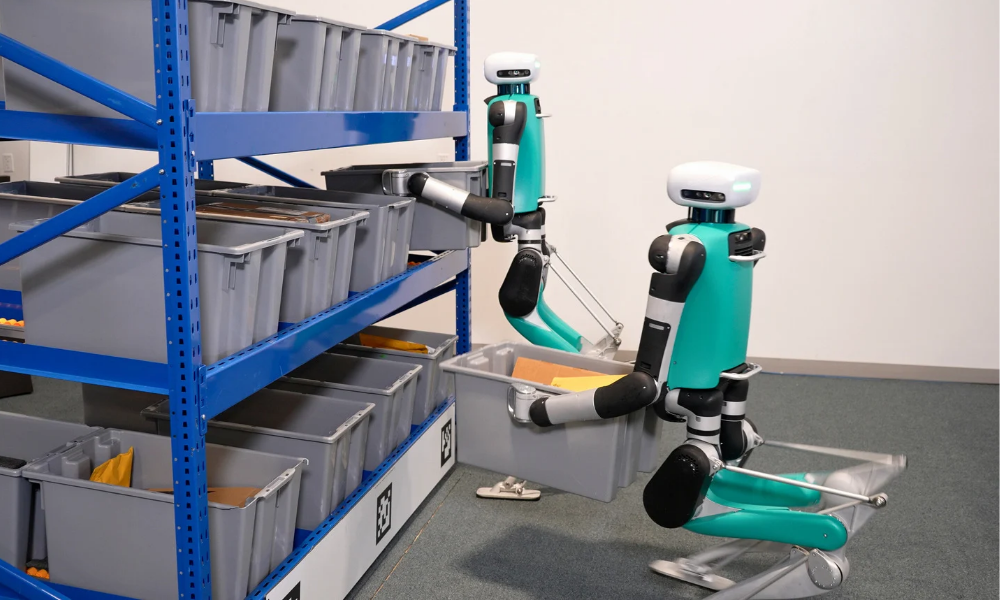
An image of the new robotic solution —Sequoia — that will support workplace safety and help Amazon deliver to customers faster

Sequoia and Digit: These are new robotic solutions introduced to assist employees and expedite deliveries. Sequoia is designed to improve inventory management, allowing Amazon to store and process inventory up to 75% faster.

Digit Robot
An image of the bi-pedal robot — Digit — working alongside an Amazon employee
Titan Robot
An image of Amazon's new Titan robot. It's blue, plate-like robot with black details, including a camera on the front, a name plate that says "T333333" and a large, circular plate on top.

Titan: A new mobile robot capable of lifting up to 2,500 pounds, Titan is used for moving heavy and bulky items within fulfillment centers, enhancing safety and operational efficiency.

Proteus: Amazon's first autonomous mobile robot, which can navigate through facilities using advanced safety, perception, and navigation technology.


These robots are part of Amazon's ongoing efforts to improve workplace safety and efficiency while also ensuring faster delivery for customers.

Job Displacement Due to Robots & Automation

Regarding job displacement, Amazon recently announced the elimination of over 18,000 jobs, which is the largest layoff in the company's history. These layoffs mostly affected administrative roles and are part of a broader trend of job cuts across the tech industry. While Amazon maintains that its investment in robotics and automation has not impacted its human workforce negatively, and claims to have increased both hourly pay and the number of people working for the company in addition to the robots, there are concerns about the long-term implications of automation on employment.

An analysis suggests that despite Amazon's growth and hiring numbers, the overall retail job losses that it helped cause will still result in a net decline of 24,000 jobs at Amazon and related retail companies. This reflects the complex relationship between automation, job creation, and job displacement, highlighting the need for strategies to manage the transition for workers whose jobs are at risk due to automation.

How Amazon is addressing the impact of automation on its workforce?

Amazon's "Hands off the Wheel" program aims to automate repetitive jobs and reassign employees to more creative roles where they can add more value. This approach helps retain workers and move them into new roles, allowing the company to be more nimble and find new ways to stay ahead of competitors.

Amazon has partnered with the Massachusetts Institute of Technology (MIT) to study the impact of automation on work. This partnership supports MIT's automation clinic and involves research to understand how employees and organizations are affected by emerging technologies like robots and Al.

In addition, Amazon is also teaming up with polling firm Ipsos to study public sentiment around the impact of robotics and Al in industrial settings. This research will inform both MIT and Amazon as they develop collaborative technologies that support employees.

Robotization Can Lead to Decline of Work Meaningfulness and Autonomy

Robotization Can Lead to Decline of Work Meaningfulness and Autonomy

The impact of robotization on work meaningfulness is a topic of current research and debate. A recent study has found that increasing robotization in the workplace correlates with a decrease in perceived work meaningfulness and autonomy.

Specifically, the study suggests that doubling robotization could lead to a 0.9% decrease in work meaningfulness and a 1% decrease in autonomy. If the robotization intensity of certain industries were to align with the leading industry's level, it could result in a 6.8% reduction in work meaningfulness and a 7.5% decrease in autonomy.

This reflects a significant concern, as meaningful work is closely linked to job satisfaction and worker well-being. The introduction of robots can affect various aspects of meaningful work, such as pursuing a purpose, social relationships, exercising skills and self-development, self-esteem and recognition, and autonomy. While there are potential negative impacts, it's also possible for robotization to enhance the meaningfulness of work by relieving workers from repetitive and physically demanding tasks, thereby allowing them to engage in more complex and fulfilling roles.

It's a complex issue with both challenges and opportunities, and the ethical implications of how robots are implemented in workplaces are crucial to consider.

The research paper released is the first to examine the impact of robotization on work meaningfulness, autonomy, competence, and relatedness, which are essential to motivation and well-being at work. Using surveys of workers and robotization data for 14 industries in 20 European countries spanning 2005–2021.

The statement that robotization can lead to a decline in work meaningfulness is a concern that has been raised in the context of increasing automation. The introduction of robots in the workplace can indeed change the nature of work, potentially reducing the opportunities for employees to engage in tasks that they find meaningful.

When robots take over routine, repetitive tasks, it can lead to a reduction in autonomy and a sense of accomplishment for workers, as they may have fewer opportunities to use their skills and creativity. This can affect their perception of the value and significance of their work, leading to a decline in work meaningfulness.

However, it's also important to consider that robotization can have positive effects on work meaningfulness when implemented thoughtfully. By automating mundane tasks, robots can free up human workers to focus on more complex, engaging, and fulfilling aspects of their jobs. This can enhance their sense of purpose and contribution, potentially increasing the meaningfulness of work.

The key is to find a balance where robotization supports human workers, allowing them to grow and find satisfaction in their roles, rather than replacing or diminishing the human aspect of work. It's a nuanced topic that requires careful consideration of the social, psychological, and economic impacts of automation on the workforce.

Amazon's $1 Bn Corporate VC Fund To Invest in in Startups that Combine AI with Robotics

Amazon's $1 Bn Corporate VC Fund To Invest in in Startups that Combine AI with Robotics

The Amazon Industrial Innovation Fund is a $1 billion corporate venture capital fund launched in 2022. The venture investment program by Amazon aims to supports emerging technology companies through direct investments.

This year, Amazon Industrial Innovation Fund wants to ramp up investments in companies that combine artificial intelligence (AI) and Robotics as the company is seeking to drive efficiencies across its logistics network.

In 2024, the Fund will expand to also invest in transportation, including autonomous vehicles and last-mile technologies.

"we are eager to support more promising startups as they scale to solve the most relevant industrial problems for Amazon and beyond.", said Franziska Bossart, Director, Industrial Innovation Fund at Amazon, who recently joined Amazon to lead the Industrial Innovation Fund and has over 20 years of experience working in corporate venture capital and digital transformation.

Franziska has recently told the Financial Times that "generative AI holds a lot of promise for robotics and automation" and is an area "we are going to focus on this year".

Last year, the Fund made its first investment in a generative AI company, the details of which have not been disclosed.

In an interaction with the Financial Times, Franziska said that innovation fund would expand its focus this year, including by seeking to invest in companies involved in the "last mile" of deliveries, when packages arrive with customers, as well as geographically and in later- stage companies.

Early this year, Franziska told TechCrunch that she sees potential in Europe and Asia and would like the portfolio, which is largely made up of early-stage companies, to shift “a little bit” more toward investments in later-stage startups.

The Amazon industrial innovation fund has made 12 investments in total, including in Mantis Robotics, which is developing a robotic arm that uses sensors to work alongside humans.

Accenture and Japan's Mujin Setup JV 'Accenture Alpha Automation' To Bring AI, Robotics to Manufacturing and Logistics

Accenture and Japan's Mujin Setup JV 'Accenture Alpha Automation' To Bring AI, Robotics to Manufacturing and Logistics

New joint venture will use AI and machine learning to connect operational and management data and accelerate data-driven management

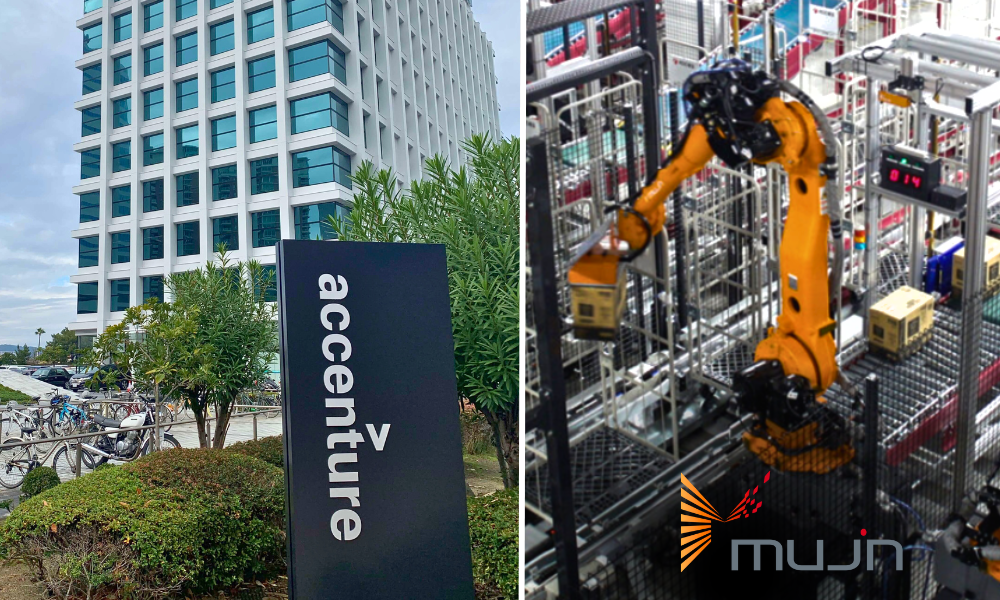
Accenture and Mujin, a Japan based company engaged in intelligent robotics for manufacturing, logistics and supply chain operations, have established Accenture Alpha Automation, a joint venture for the manufacturing and logistics industries. Accenture Alpha Automation will help companies automate their management infrastructure with data-driven solutions that seamlessly combine data from manufacturing and logistics operations with management data. The joint venture is owned 70% by Accenture and 30% by Mujin.

Mujin provides intelligent automation solutions for industrial sites. Its intelligent robotics platform enables companies to deploy industrial robotics systems without the typical complex advance settings and integration, including motion settings and peripheral equipment, often required for other robotics systems.

The joint venture will combine Mujin’s experience in industrial robotics and automation with expertise from Accenture’s digital engineering and manufacturing service, Industry X. Accenture Alpha Automation’s solutions will integrate previously disconnected operational data from manufacturing and logistics sites with business management data, such as the company-wide supply chain status, financial information and market information. Accenture and Mujin will bring these solutions to clients to help them make faster, better decisions and hyper-automate their manufacturing and logistics processes.

Atsushi Egawa, who leads Accenture’s business in Japan, said: “Manufacturing is the cornerstone of Japanese industry. Driving sophistication and efficiency in manufacturing and the logistics that support manufacturing is essential for Japan's further growth. By teaming with Mujin, a leader in robotics technology, Accenture will be able to help our clients take advantage of AI and robotics to connect data throughout the manufacturing and logistics value chain, further contributing to the data-driven transformation of Japan’s important manufacturing and logistics industries.”

Mujin Inc. CEO, Issei Takino adds: “Our mission is to make industrial robots intelligent and easy to use so they can improve productivity and quality and help create new value in an aging society. The new joint venture, which builds on our agreement with Accenture, will utilize our robot automation technology to drive a paradigm shift in the manufacturing and logistics industry and bring new value to customers first in Japan, then around the world.”

Accenture has also invested directly in Mujin through Accenture Ventures, marking its first Project Spotlight investment in Asia. Project Spotlight is an engagement and investment program focused on companies that create or apply disruptive enterprise technologies. The program offers extensive access to Accenture’s domain expertise and its enterprise clients, helping technology companies adapt their solutions to the enterprise market and scale faster and more effectively.

About the Joint Venture

Company name: Accenture Alpha Automation
Location:
Sumitomo Fudosan Azabu Juban Building, 1-4-1 Mita, Minato-ku, Tokyo
Operation starts: January 15, 2024
Scope of Operation:
  • Consult and develop automation concepts in the manufacturing and logistics industries
  • System integration in the manufacturing and logistics industries
  • All businesses incidental to the preceding items
Share: Accenture 70%, Mujin 30%


Accenture is a leading global professional services company that helps the world’s leading businesses, governments and other organizations build their digital core, optimize their operations, accelerate revenue growth and enhance citizen services—creating tangible value at speed and scale. We are a talent- and innovation-led company with approximately 743,000 people serving clients in more than 120 countries. Technology is at the core of change today, and we are one of the world’s leaders in helping drive that change, with strong ecosystem relationships. We combine our strength in technology and leadership in cloud, data and AI with unmatched industry experience, functional expertise and global delivery capability. We are uniquely able to deliver tangible outcomes because of our broad range of services, solutions and assets across Strategy & Consulting, Technology, Operations, Industry X and Song. These capabilities, together with our culture of shared success and commitment to creating 360° value, enable us to help our clients reinvent and build trusted, lasting relationships. We measure our success by the 360° value we create for our clients, each other, our shareholders, partners and communities.


Amazon’s New Mobile Robot Titan Can Lift Over 1,100 Kg


In 2013, Amazon launched SAT1 fulfillment center in San Antonio, Texas, to process larger, bulkier items. The facility is now deploying a new technology called 'Titan', a new robot to take on the extra-heavy lifting.

Built over a decade of innovations in mobile robotics at Amazon, Titan can lift up to two times more weight than Hercules, the most broadly deployed robot within operations of Amazon. With this strength, Titan’s task is to carry larger, bulkier items like small household appliances or pallets of pet food and gardening equipment.

Titan Robot
Titan robot 

Amazon’s New Mobile Robot Titan Can Lift Over 1,100 Kg

Titan can ferry up to two times more weight than Amazon’s widely deployed Hercules robot, which can lift up to 1,250 pounds (~ 567 Kilograms). Titan can lift up to 2,500 pounds (~1134 Kilograms), making it the perfect robot for the heavy-lifting.

Amazon manufactures Titan and other robots at its innovation hub in Massachusetts.

The mobile robot integrates several technologies from previous mobile robots, including the battery and charging management solution from Hercules, and the computer vision, obstacle detection, and user control systems from the Xanthus mobile robot.

Titan also uses hardware components from Proteus to manage its operating system as it plans, executes, and interfaces with other technologies within the facility.

Titan work collaboratively with other robotics systems to reduce repetitive motions, eliminates the need for employees to walk long distances or move heavy objects, and allows employees to focus on new tasks that require new skills.

Amazon has developed an entire suite of mobile robots with multiple components, like Pegasus which has a conveyor attached to the mobile robot allowing it to ferry individual packages from one part of a facility to another.

The company deployed over 750,000 robots across its fulfillment centers globally.

Autonomous Industrial EVs Maker Ati Motors Raises $10.85 Mn in Funding from True Ventures and Others

Autonomous Industrial EVs Maker Ati Motors Raises $10.85 Mn in Funding from True Ventures and Others

Bengaluru-based Ati Motors, which makes autonomous Industrial electric vehicles, has raised $10.85 million in Series A Round led by True Ventures. Existing investors Blume Ventures, Exfinity Ventures and MFV Partners also participated in this round.

Athera Ventures Partners joined as a new investor.

The freshly raised funds will help Ati Motors implement plans to expand into markets in the United States, South East Asia, Japan and Europe while exploring opportunities across the pharmaceuticals, chemicals, maritime, and injection moulding sectors.

Founded in 2017, by Saurabh Chandra, Vinay V and Saad Nasser, Ati Motors makes autonomous electric vehicles for material movement in industrial environments like factories or warehouses, for both indoor and outdoor usage.

In July 2021, Ati Motors had raised $3.5 million in a pre-series A funding round led by Blume Ventures, Exfinity Venture Partners, and MFV Partners. Prior to this, it had raised a seed fund from Village Global, a Bay Area based-early stage fund backed by prominent tech founders Bill Gates, Mark Zuckerberg, and Jeff Bezos, among others.

5 Cutting Edge Robotic Palletization System Providers in India

5 Cutting Edge Robotic Palletization System Providers in India

With e commerce growing at an exponential speed every day, the industries related to it need to keep pace with the changes. Warehousing industry is the one that is the backbone of e commerce, which enables fast delivery, the core advantage of e business. Automation of these warehouses ensures that the varied products that are in a warehouse can be managed as a data via customized software. However, another arena which needs focus is the movement of products and parcels. 

At times there are fragile items, at other there are huge and heavy parcels. It is humanly impossible to move them from one place to another, at each step, without any error. This is where the automation industry steps in. The robotic palletization has been a boon for this industry. Here are a few notable start- ups that have made a niche as the best in class robotic palletization system provider.

Atmos Systems

Atmos Systems is dedicated towards providing automation solutions, including robotic palletization system, to warehouses. Easing tasks such as picking up of boxes, cases, bags, cartons etc, it expedites and simplifies the task of unloading and loading objects in lesser time with minimal to no human intervention. In Palletizing, the objects are loaded onto a wooden or plastic pallet for transportation. In depalletizing the goods are unloaded at specific location. Any error at any stage can lead to a chain of mistakes, that will result in financial losses. Thus the automated process helps to cut out such mistakes and ensure accurate and error free deliveries to contact points at every stage.

Armstrong Ltd

They deliver with a promise to provide you products at a faster, as well as cheaper rate and smarter technology for all your robotic palletization needs. With the belief that automating the process, it brings about an increase in profitability, and minimizes errors. The unbeatable accuracy of the automated system is the key to success here. And warehouses jumping onto the bandwagon have definitely benefitted from it.

GreyOrange

Specializing in robotic solutions for warehouses, it makes use of AI cloud software to ensure that they provide the best of palletization solutions too. With a reach across Europe, US and Asia, one can expect them to deliver truly world-class products that adhere to international standards. This Gurugram based company is a force to reckon, in India and abroad because of the technology it uses.

Godrej Koerber

Offering world class services in manufacturing intra logistics and distribution intra logistics domain, their palletization solutions are hailed by the satisfied customers. Enabling a smooth, fast and effective handling of storage and packaging process, the products empower the end client to create a smooth process, that will yield better profits due to faster process, lesser manpower being used and zero scope for human error.

Rightbot

With an aim to truly revolutionize the warehouse industry it provides automated solutions to address the barriers in the warehousing industry. With a customized solution for every step, at lightning speed, all they want is to make the impossible, possible and give a higher throughput.

The bottom line here is that businesses related to warehousing industry can revolutionize the way they work by simply automating the warehouse, which is the need of the hour and increase profitability.

Cobots Lead the Future of the Global Industrial Robotics Market, Finds Frost & Sullivan

Asia-Pacific to remain the epicenter of growth opportunities for robot manufacturers, with market revenues estimated to top $25.08 billion by 2024


SANTA CLARA, Calif., April 21, 2021 /PRNewswire/ -- Frost & Sullivan's recent analysis finds that the global industrial robotics market will reach revenues of $38.3 billion in 2024 from $22.2 billion in 2020 at a CAGR of 12.2%. Although the industry was curtailed by the COVID-19 pandemic and uncertainty in the automotive business, rising demand from other high-growth sectors is expected to propel it over the next five years. Pharmaceuticals will be the fastest-growing segment, with a CAGR of 17.2% from 2019 to 2024, reaching $3.33 million by the end of the forecasted period, followed by food & beverage (F&B) and electrical and electronics, expanding at 15.8% and 15.1%, respectively.

Asia-Pacific continues to dominate the global industrial robotics market, and revenues are estimated to top $25.08 billion by 2024, with China, Japan and South Korea driving progress. The European region is the second most important, propelled by the automotive industry and Germany—the fifth-largest country globally for industrial robotics. North America's ongoing trend of production automation and keeping all manufacturing operations in-house puts it in the third position, with forecasted revenues of $6.19 billion by 2024.

For further information on this analysis, Cobots Transforming the Global Industrial Robotics Market—Opportunities Forecast, please visit: http://frost.ly/5m6

"The global battle against the COVID-19 pandemic has proven to be a strong use case for industrial robots, which helped assure business continuity," said Nandini Natarajan, Industry Analyst, Frost & Sullivan. "While 2020 witnessed reduced investments in robotics, the demand for industrial robots will rise sharply from 2021 on. The introduction of low-cost robots and innovative business models such as Robots-as-a-Service (RaaS) are expected to drive demand from small and medium enterprises (SMEs)."

Natarajan added: "Collaborative robots (cobots) are experiencing rapid market growth thanks to their utility, ease of installation, and consistently decreasing price, making them an affordable and viable solution for a wide range of applications. It will be the fastest-growing segment by 2024, recording a CAGR of 32.8% (2019-2024) and reaching $1.78 million in global revenues. Advances in 5G and edge computing will be instrumental in equipping cobots with improved flexibility and easier implementation."

For further opportunities, market participants should explore these strategic recommendations:
Embedded Vision and Machine Learning in Robotics: Embedded systems need to be lightweight, consume less energy, and be adaptable to be retrofitted/integrated with any robotic system. Manufacturers need to integrate advanced supportive technologies such as 3D perception and deep machine learning to enable new machine vision applications.
Smart Robot Grippers for Safe Collaboration with Human Workers: Robots have become more collaborative with human workforces instead of replacing them, as was the case before. Therefore, there is a need to design robot grippers that are more collaborative and safer. End-of-arm tooling (EOAT) providers will need to develop robot prototypes with advanced sensors that can detect human workers' presence and movement.
5G and Edge AI for Robotic Independence and Flexibility of Real-time Applications: While 5G will provide benefits such as low latency and on-the-go decision-making, edge-based AI will enable robots to carry out data processing on the machine without data traveling to and from the cloud. There will be a huge demand for secure local data processing closer to the robot.

Cobots Transforming the Global Industrial Robotics Market—Opportunities Forecast is part of Frost & Sullivan's global Industrial Automation https://ww2.frost.com/research/industry/information-communications-technologies/Growth Partnership Service program.

About Frost & Sullivan

For six decades, Frost & Sullivan has been world-renowned for its role in helping investors, corporate leaders, and governments navigate economic changes and identify disruptive technologies, Mega Trends, new business models, and companies to action, resulting in a continuous flow of growth opportunities to drive future success. Contact us: Start the discussion.

Cobots Transforming the Global Industrial Robotics Market—Opportunities Forecast

A Record of 2.7 Mn Industrial Robots Operating in Factories around the World


The new World Robotics 2020 Industrial Robots report presented by the International Federation of Robotics (IFR) shows a record of 2.7 million industrial robots operating in factories around the world – an increase of 12%. Sales of new robots remain on a high level with 373,000 units shipped globally in 2019. This is 12% less compared to 2018, but still the 3rd highest sales volume ever recorded.

"The stock of industrial robots operating in factories around the world today marks the highest level in history," says Milton Guerry, President of the International Federation of Robotics. "Driven by the success story of smart production and automation this is a worldwide increase of about 85% within five years (2014-2019). The recent slowdown in sales by 12% reflects the difficult times the two main customer industries, automotive and electrical/electronics, have experienced."


Asia, Europe and the Americas - overview

Asia remains the strongest market for industrial robots - operational stock for the region´s largest adopter China rose by 21% and reached about 783,000 units in 2019. Japan ranks second with about 355,000 units – plus 12 %. A runner-up is India with a new record of about 26,300 units – plus 15%. Within five years, India has doubled the number of industrial robots operating in the country´s factories.

Europe

Europe reached an operational stock of 580,000 units in 2019 – plus 7%. Germany remains the main user with an operational stock of about 221,500 units – this is about three times the stock of Italy (74,400 units), five times the stock of France (42,000 units) and about ten times the stock of the UK (21,700 units).

Americas

The USA is the largest industrial robot user in the Americas, reaching a new operational stock record of about 293.200 units – up 7%. Mexico comes second with 40,300 units, which is a plus of 11% followed by Canada with about 28,600 units – plus 2%.

Files for Download

The FULL PRESS RELEASE with IFR´s new statistics for the USA, China, Japan, UK, Germany and France + GRAPHICS + VIDEO is ready for download here: https://ifr.org/ifr-press-releases/news/record-2.7-million-robots-work-in-factories-around-the-globe

Market Reports

Market Report & Surveys
IndianWeb2.com © all rights reserved