‏إظهار الرسائل ذات التسميات humanoid. إظهار كافة الرسائل

Capgemini and Orano Deploy 1st AI-Powered Humanoid Robot in Nuclear Industry

Capgemini and Orano Deploy 1st AI-Powered Humanoid Robot in Nuclear Industry

Orano, a recognized industrial leader in the recovery and transformation of nuclear materials, and Capgemini, an AI-powered global business and technology transformation partner, announce the deployment of the first intelligent humanoid robot in the nuclear sector. This project marks a major step forward for a strategic industry that has long been a pioneer in innovation.

Deployed at the Orano Melox Ecole des Métiers [Created in early 2018, Ecole des Métiers is dedicated to promoting and developing the Orano’s technical training] in the Gard region of France, the robot named Hoxo is equipped with embedded artificial intelligence (AI) and advanced sensors for real-time perception, autonomous navigation, execution of technical gestures, and interaction. Its purpose is to replicate human movements and operate alongside teams within nuclear facilities, including in challenging intervention environments.

Over the next four months, Orano Melox’s innovation teams will conduct a testing phase to validate the robot’s range of applications, combining mobility, precision, and artificial intelligence (AI). By offering an agile, scalable robotic platform, this initiative is expected to enhance industrial performance and potentially support operators through robotic assistance.

"Hoxo opens new perspectives for our operations by combining an intelligent and ergonomic robotic solution with the expertise of our on-site teams. It’s an innovation we aim to evolve to meet our industrial needs, contributing to both safety and competitiveness as we tackle the challenges of today and tomorrow," said Arnaud Capdepon, Director of Orano Melox.

"This project, led by our AI Robotics & Experiences Lab, embodies the convergence of robotics, artificial intelligence, computer vision, and digital twins. It redefines human-machine interaction in sensitive environments and pushes the boundaries of industrial automation. Through this initiative, we harness the potential of physical AI to address Orano’s most demanding industrial challenges," added Pascal Brier, Chief Innovation Officer at Capgemini and member of the Group Executive Committee.

About Orano

As a leading international operator in the field of nuclear materials, Orano delivers solutions to address present and future global energy and health challenges. Its expertise and mastery of cutting-edge technologies enable Orano to offer its customers high value-added products and services throughout the entire fuel cycle. Every day, the Orano group’s 18,000 employees draw on their skills, unwavering dedication to safety and constant quest for innovation, with the commitment to develop know-how in the transformation and control of nuclear materials, for the climate and for a healthy and resource-efficient world, now and tomorrow. Orano, giving nuclear energy its full value.

About Capgemini

Capgemini is an AI-powered global business and technology transformation partner, delivering tangible business value. We imagine the future of organizations and make it real with AI, technology and people. With our strong heritage of nearly 60 years, we are a responsible and diverse group of 420,000 team members in more than 50 countries. We deliver end-to-end services and solutions with our deep industry expertise and strong partner ecosystem, leveraging our capabilities across strategy, technology, design, engineering and business operations. The Group reported 2024 global revenues of €22.1 billion.

Discover the humanoid robot Hoxo in pictures:

humanoid robot Hoxo


Humanoid Robotics Heats Up: Agility Reportedly Raising $400M with SoftBank Backing


SoftBank’s latest robotics move signals a renewed push into humanoid automation. Earlier in 2025, the Japanese tech giant reportedly held acquisition talks with Oregon-based Agility Robotics, exploring a deal valued at over $900 million. While the acquisition didn’t materialize, SoftBank pivoted to a strategic investment — joining Agility’s $400 million Series C funding round, which valued the company at $1.75 billion pre-money.

SoftBank has long been bullish on robotics and AI, with past investments in Boston Dynamics and its own humanoid robot, Pepper. Its renewed interest in Agility signals a pivot toward humanoid logistics automation.

As of now, Agility Robotics has not released an official press release confirming the $400 million funding round. However, multiple reputable outlets — including The Information, GeekWire, and Tech Funding News — have reported on the deal based on insider sources and term sheet details.

Who Is Agility Robotics?

  • Agility Robotics is the maker of Digit, a bipedal humanoid robot designed for warehouse and logistics tasks.
  • Digit can walk, climb stairs, and handle packages — making it a strong candidate for augmenting or replacing human labor in fulfillment centers.
  • The company is already piloting Digit with major retailers like Amazon, giving it a real-world edge.

Deal Breakdown

  • Acquisition Talks: SoftBank considered buying Agility outright for over $900M.
  • Funding Pivot: Instead, it joined a $400M round led by WP Global Partners.
  • Strategic Goal: Scale mass production of Digit and expand commercial deployment.

Competitive Landscape

Company Flagship Robot Focus Area Funding/Valuation (2025)
Agility Robotics Digit Warehouse logistics $400M round, $1.75B pre-money
Figure AI Figure 01 General-purpose labor Backed by OpenAI, Microsoft
Tesla Optimus Factory automation Internal R&D, no external funding

Why It Matters

  • SoftBank’s move reflects a strategic shift — from owning robotics IP to backing scalable platforms with real-world traction.
  • With humanoid robotics moving from R&D to commercialization, logistics and manufacturing are emerging as the first battlegrounds.
  • Agility’s Digit is no longer just a prototype — it’s a product on the verge of mass deployment.
  • With SoftBank’s backing, the humanoid race just got a lot more interesting.

Tesla Halts Plans for Thousands of Humanoid Bots Over Hand Design Flaws


Tesla has officially scaled back its ambitious plans to produce thousands of Optimus humanoid robots in 2025 due to significant design challenges—especially with the robot's hands.

Optimus, also known as the Tesla Bot, is a general-purpose humanoid robot developed by Tesla. It was first announced at Tesla’s AI Day in August 2021, with a prototype unveiled in 2022.

Designed to perform tasks humans don’t want to do, like factory work, sorting, lifting, and navigating terrain, the Optimus bot is powered by Tesla’s onboard AI brain (based on Autopilot hardware), it learns through simulation-based reinforcement learning. The latest Gen 3 version stands 173 cm tall, weighs 57 kg, and can walk at 5 mph. It has 22 degrees of freedom in each hand, enabling human-like dexterity.

In 2025, Tesla showcased Optimus performing Kung Fu movements—learned entirely through AI, without human programming. The robot demonstrated balance, coordination, and agility, marking a leap in real-time movement control.

Tesla initially planned internal deployment in 2025, with external sales starting in 2026. The projected cost is under $30,000, though skepticism remains about its timeline and mass-market viability.

What went wrong?

Tesla Halts Plans for Thousands of Humanoid Bots Over Hand Design Flaws
Tesla originally aimed to produce at least 5,000 Optimus bots this year, up from just a few dozen in 2024. However, technical issues with the hands, which are the most complex part of the design, have caused delays. Engineers are struggling to create dexterous, human-like hands.

The company has reportedly stockpiled Optimus bodies missing hands and forearms, with no clear timeline for completion. Tesla has now lowered its production target to 2,000 units, but even that revised goal appears to be in jeopardy.

Strategic implications

Elon Musk had previously described Optimus as a transformative technology that could eventually surpass Tesla’s EV business in impact. This setback may delay that vision, though development continues behind the scenes.

Figure 03: The Next Leap in Humanoid Robotics

Figure 03: The Next Leap in Humanoid Robotics


Figure 03 is the latest humanoid robot developed by Figure AI, a California-based robotics startup founded in 2022 by Brett Adcock. Designed for real-world environments—from homes to warehouses—Figure 03 is a full-sized, bipedal robot capable of performing everyday tasks like folding laundry, washing dishes, and navigating complex spaces.

About Figure AI

Figure AI is backed by major tech investors including OpenAI, Microsoft, and Jeff Bezos. Its mission is to create scalable, general-purpose humanoid robots that can fill labor gaps and assist in daily life.
  • Founded in 2022 by Brett Adcock
  • Headquartered in California
  • Focused on real-world deployment of humanoid robots
  • Backed by OpenAI, Microsoft, and Jeff Bezos

Architecture Highlights

At the heart of Figure 03 is Helix, a proprietary Vision-Language-Action (VLA) model that enables real-time decision-making without pre-scripted commands.
  • Vision: Wide field of view and high frame rate
  • Language: Natural language comprehension and contextual reasoning
  • Action: Dexterous hands and stable locomotion for task execution
  • Unified System: Integrates perception, planning, and control
Helix makes Figure 03 one of the first humanoids capable of unscripted, adaptive behavior in dynamic environments.

What Makes Figure 03 Revolutionary?

Figure 03 isn’t just a robot with limbs—it’s a general-purpose AI agent powered by Helix, a proprietary vision-language-action (VLA) model that allows it to understand, reason, and act in real time. It doesn’t follow scripts. It learns, adapts, and responds to the world like a human would.
  • Vision Upgrade: 60% wider field of view and 2× faster frame rate
  • Latency: Reduced by 75% for near-instant reactions
  • Mobility: Walks, balances, and navigates complex environments
  • Hands: Redesigned for dexterity—capable of folding laundry, pouring drinks, and more
Watch the full reveal in Introducing Figure 03, where the team showcases the robot’s capabilities and design philosophy.

Built for the Real World

Unlike its industrial predecessors, Figure 03 is engineered for human-centric environments. It’s 5'6" tall, weighs 60 kg, and is designed to operate safely around people.
  • Home Integration: Wireless charging, soft-touch materials, and voice interaction
  • Safety First: Advanced sensors and AI-driven motion planning
  • Household Tasks: From dishwashing to plant watering, it’s your new domestic ally
Curious how it performs in a real home? Is the Figure 03 Robot Ready to Clean Your House? puts it to the test in a domestic setting.

Beyond the Home: A Workforce Revolution

Figure AI envisions a future where humanoid robots fill labor gaps in logistics, manufacturing, and elder care. With a modular design and scalable production, Figure 03 is built for mass deployment.
  • Production-Ready: Designed for large-scale manufacturing
  • Cost Target: Estimated between $20,000–$30,000 per unit
  • Job Impact: Analysts predict up to 8 million jobs could be augmented or replaced by 2040

Explore the broader implications in Figure 03 – The Humanoid Robot Built for the Home and the ...

Watch Figure 03 in Action

🧩 The Bigger Picture

Figure 03 is more than a machine—it’s a symbol of the AI-human future. With backing from OpenAI, Microsoft, and Jeff Bezos, Figure AI is betting big on a world where robots are not just tools, but teammates.

As the humanoid revolution accelerates, one thing is clear: the future isn’t just coming—it’s walking right through your front door.

A Robot That Gives Birth? China’s Kaiwa Sparks Global Debate

A Robot That Gives Birth? China’s Kaiwa Sparks Global Debate

Kaiwa Technology, a Guangzhou, China-based firm led by Dr. Zhang Qifeng, has unveiled plans to launch the world’s first humanoid robot equipped with an artificial womb by 2026. The project was introduced at the 2025 World Robot Conference in Beijing and is being hailed as a potential revolution in reproductive science.

What Makes This Robot Unique?

  • Artificial Womb Integration: Carries a fetus from fertilization to full-term birth using synthetic amniotic fluid and nutrient-delivery tubes.
  • Interactive Pregnancy: Mimics the entire gestation process—from implantation to delivery.
  • Affordability: Target price under 100,000 yuan (~$13,900), far cheaper than traditional surrogacy.

Feature Overview

Feature Description
Artificial Amniotic Fluid Maintains fetal hydration and temperature
Nutrient Tubes Delivers oxygen and nutrients similar to an umbilical cord
Temperature Regulation Simulates womb-like warmth and stability
Oxygen Monitoring Ensures safe fetal development

Ethical & Legal Challenges

  • Surrogacy Ban: Surrogacy is illegal in China; Kaiwa is negotiating with Guangdong authorities.
  • Embryo Research Limits: Restricted to 14 days under current law.
  • Concerns:
    • Parental rights and legal guardianship
    • Psychological impact on robot-born children
    • Potential misuse for mass reproduction or genetic engineering

Societal Reactions

  • Some hail it as a lifeline for infertile couples.
  • Others call it “dehumanizing” or a “dystopian nightmare.”
  • Feminist critiques warn it could undermine maternal identity

iHub Robotics Set to Establish India’s Largest Humanoid Robotics Manufacturing Facility As It Raises ₹4.3 Crore in Funding

iHub Robotics Set to Establish India’s Largest Humanoid Robotics Manufacturing as It Raises ₹4.3 Crore in Funding
  • iHub Robotics Raises ₹4.3 Crore in Pre-Seed Funding
  • With this fresh capital, the company is set to establish India’s largest humanoid robotics manufacturing facility in Kerala.
  • The company also expects to create over 150 jobs in the next 2 years, contributing to India’s deep-tech ecosystem.
  • The company has launched iHub School of Learning, a platform dedicated to educating and training students in AI & robotics with a mission to empower 100,000 students with future-ready skills in deep-tech.
iHub Robotics, India’s pioneering humanoid robotics startup, has successfully raised ₹4.3 crore ($520K) in pre-seed funding from U.S. investors. With this fresh capital, the company is set to establish India’s largest humanoid robotics manufacturing facility in Kerala, reinforcing its vision to make India a global leader in robotics and AI-driven automation. The company also expects to create over 150 jobs in the next two years, contributing to India’s deep-tech ecosystem.

iHub Robotics has already made a significant international impact, exporting its semi-humanoid robot, Tara Gen-1, to the UAE and Saudi Arabia. Tara Gen-1 is the most advanced semi-humanoid robot in India, built with cutting-edge AI and robotics technology. It is designed to operate in hospitality, healthcare, airports, railway stations, and various customer service roles, enhancing efficiency and automation in these Industries.

iHub Robotics Set to Establish India’s Largest Humanoid Robotics Manufacturing as It Raises ₹4.3 Crore in Funding

iHub Robotics Set to Establish India’s Largest Humanoid Robotics Manufacturing as It Raises ₹4.3 Crore in Funding

What sets Tara Gen-1 apart is its advanced human behavior intelligence, allowing it to:
  • Recognize and respond to human emotions
  • Engage in natural conversations using AI-powered speech recognition
  • Adapt to different environments with real-time decision-making
  • Assist customers with navigation, inquiries and personalized service
  • Function seamlessly in multi-language settings
Additionally, in January 2025, iHub Robotics became India’s first company to be officially recognized by NVIDIA and was selected for the NVIDIA Humanoid Robotics Program. This milestone validates the company’s cutting-edge work in robotics and AI, granting it access to NVIDIA’s advanced technologies, research collaborations, and global networking opportunities.

Beyond humanoid robotics, iHub Robotics is also committed to empowering the next generation of AI and robotics innovators. The company has launched iHub School of Learning, a platform dedicated to educating and training students in AI and robotics with a mission to empower 100,000 students with future-ready skills in deep-tech.

iHub Robotics Set to Establish India’s Largest Humanoid Robotics Manufacturing as It Raises ₹4.3 Crore in Funding
Sarath S, ATHIL Krishna, Akhil k Haridasan

“This funding is a significant step toward realizing our dream of Physical AI, where intelligent robots seamlessly integrate into industries to enhance human capabilities. By setting up India’s biggest humanoid robotics manufacturing facility, we are not just building robots, we are shaping the future of AI-driven automation globally. Additionally, with our expansion, we aim to generate over 150 new jobs in the next two years, driving India’s deep-tech revolution forward,” said Athil Krishna, CEO of iHub Robotics.

Accenture Invests in Humanoid General-purpose Robots Developer Sanctuary AI

Accenture Invests in Humanoid General-purpose Robots Developer Sanctuary AI

Accenture has made a strategic investment through Accenture Ventures in Sanctuary AI, a company specializing in the development of AI-powered humanoid robots. These robots, like the PhoenixTM model, are designed to perform a wide variety of tasks quickly, safely, and effectively, and are intended to work alongside humans in various industries, including post and parcel, manufacturing, retail, and logistics warehousing operations.

Sanctuary AI's robots are notable for their human-like dexterity and ability to perform complex tasks with precision. The AI control system, CarbonTM, which powers these robots, is designed to mimic human brain subsystems, enabling the robots to react to their environment and perform new tasks efficiently.

This investment aligns with Accenture's broader strategy to innovate and provide solutions that integrate advanced technology with human creativity, ensuring a balanced and responsible approach to technology deployment. Sanctuary AI's inclusion in Accenture Ventures’ Project Spotlight is expected to connect emerging technology startups with Accenture’s global client base, fostering innovation and addressing strategic gaps.


"AI-powered humanoid robots are essential to reinventing work and supporting human workers as labor shortage is becoming an issue in many countries and industries,” said Joe Lui, Accenture’s global advanced automation and robotics lead. “Sanctuary AI’s advanced AI platform trains robots to react to their environment and perform new tasks with precision in a very short time. We see huge potential for their robots in post and parcel, manufacturing, retail and logistics warehousing operations, where they could complement and collaborate with human workers and automate tasks that traditional robotics can’t.

Sanctuary AI’s general-purpose robot PhoenixTM, recently recognized as one of TIME magazine’s “Best Inventions of 2023,” can perform a multitude of work tasks. For instance, at a Mark’s retail store in Langley, BC, Canada, Phoenix has performed more than 100 tasks, including choosing and packing merchandise, and correctly cleaning, tagging, labeling and folding items, with robotic hands that rival human hand dexterity and fine manipulation. Phoenix is powered by the company’s AI control system, CarbonTM, which mimics subsystems found in the human brain, such as memory, sight, sound and touch, and translates natural language into action in the real world.

Accenture has previously invested in other robotics areas, for example, through Accenture Alpha Automation, a recently formed joint venture with Japanese robotics leader Mujin, and acquisitions of Eclipse Automation in Canada and Pollux in Brazil. Sanctuary AI is the latest company to join Accenture Ventures’ Project Spotlight, an engagement and investment program that connects emerging technology startups with Accenture’s Global 2000 client base in order to fill strategic innovation gaps.

Geordie Rose, chief executive officer and co-founder of Sanctuary AI, said, “Robots with human-like intelligence will completely transform the workforce of the future. By combining Accenture’s expertise in disruptive technology with Sanctuary AI’s industry-leading robotics, we can help some of the biggest companies in the world manage this change and provide the best solutions for its clients.”

Founded in 2018, Sanctuary AI is based in Vancouver, Canada and is on a mission to create the world's first human-like intelligence in general purpose robots that will help us work more safely, efficiently, and sustainably, helping to address the labor challenges facing many organizations today. Sanctuary AI's growing list of customers and investors represents a wide variety of industries across Canada, the US, and other countries around the world.

Members of the Sanctuary team have earlier founded other notable technology ventures, such as D-Wave (a pioneer in the quantum computing industry), Kindred (first use of reinforcement learning in a production robot), and the Creative Destruction Lab (pioneered a revolutionary method for the commercialization of science for the betterment of humankind). With experience at startups and technology leaders such as Amazon, Microsoft, and Softbank Robotics, the team has experience launching market-defining innovations rooted in previously unsolved and deep scientific problems.

Besides Accenture, significant investments have been made by tech giants and venture capital firms in humanoid robotics. Jeff Bezos, Nvidia, and OpenAl have invested in a humanoid robot startup, Figure AI, which has drawn a $675 million investment, to date.

Microsoft, Intel, and LG Innotek are also among the investors in various humanoid robotics ventures, recognizing the potential of these technologies in various industries.

S. Korea's EveR 6 Becomes World's 1st Robotic Orchestra Conductor

S. Korea's EveR 6 Becomes World's 1st Robotic Orchestra Conductor

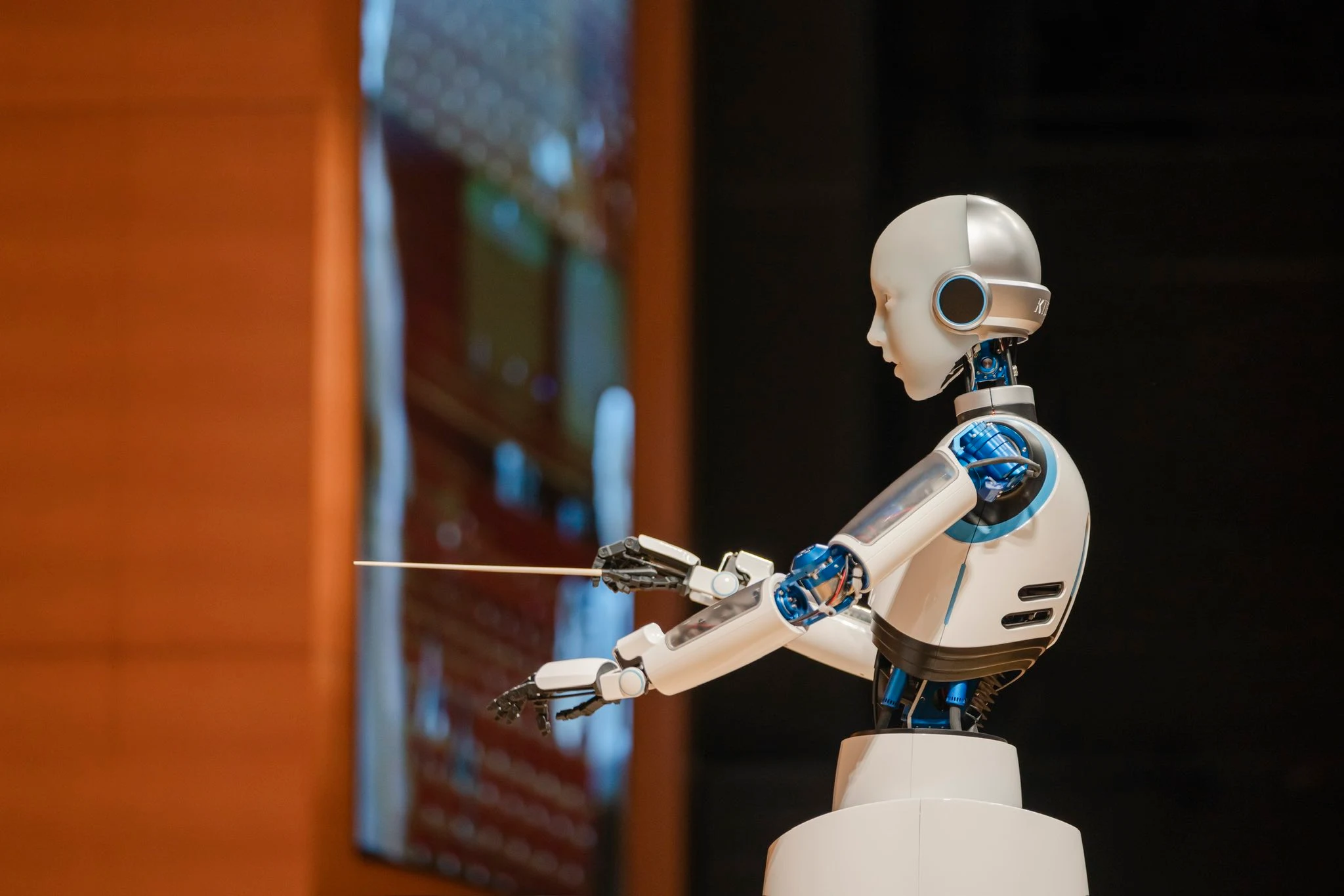
EveR 6, a robot conductor, led a practice session of the Korean National Orchestra at the National Theater of Korea in central Seoul on Monday of last week.

Later on Friday evening, the android robot took the conductor's podium in Seoul to lead a performance by South Korea's national orchestra, marking the first such attempt in the country, reported news agency Reuters.

Leading two of the five musical compositions by itself and another one with a human conductor, the robot, with a humanoid face, first bowed to the audience and started waving its arms to control the tempo of the live show.

EveR 6 was developed by the Korea Institute of Industrial Technology and is now touted as the world's first robotic orchestra conductor.

S. Korea's EveR 6 Becomes World's 1st Robotic Orchestra Conductor

S. Korea's EveR 6 Becomes World's 1st Robotic Orchestra Conductor

The 1.8-meter and two-handed EveR 6 robot guided more than 60 musicians of the National Orchestra of Korea who were playing traditional Korean instruments.

Ironically, EveR 6's critical weakness is that it cannot listen.

Citing Lee Young-ju, an audience member who studies traditional Korean music, the Reuters report further said that "the robot's moves, though impeccable in keeping the rhythm, lacked "breath" - or the ability to keep the orchestra ready to engage collectively and instantly - which he said was essential in performance". "It seemed there was some work to be done for the robot to do the job," Lee said.


All images from — National Theater of Korea@Twitter

Immervision Introduces JOYCE, the First Humanoid Robot with Intelligent Vision Developed by the Computer Vision Community

Immervision, the Montreal-based leader in wide-angle intelligent vision, introduces JOYCE, the first humanoid robot developed by the computer vision community to help machines gain human-like perception and beyond.

Watch the video: https://vimeo.com/458617443


The purpose of JOYCE is to further advance computer vision technologies by inviting the community to help JOYCE gain a better understanding of her environment by upgrading her optics, sensors and AI algorithms.

To support the realization of this complex task, Immervision is also unveiling the JOYCE Development Kit for engineers and AI developers. This “JOYCE IN A BOX” development kit is equipped with three ultra-wide-angle panomorph cameras calibrated to give 2D hemispheric, 3D stereoscopic hemispheric or full 360 x 360 spherical capture and viewing of the environment. It uses data-In-picture technology so that each of her video frames can be enriched with data from a wide array of sensors providing contextual information to AI and neural networks, computer vision and SLAM algorithms to help increase her visual perception.

Moreover, JOYCE will be streaming live so that people can, not only follow the evolution of her capabilities, but also look through her eyes while she travels around the world, skydives, visits a business conference or a computer vision lab.

JOYCE stems from the Immervision InnovationLab which mission is to accelerate the emergence of new innovative solutions and help build the next generation of intelligent vision systems for a wide range of industry devices.

“At Immervision, we strongly believe in the value of bringing together the computer vision community to break down the silos that are slowing the innovation cycle. Instead, let’s push forward the boundaries of machine perception through cross-pollination. We believe that JOYCE will help develop extremely innovative solutions to resolve complex industry challenges,” said Pascale Nini, President and CEO of Immervision.

Potential use cases include:
  1. Enhance the performance of smart home devices such as vacuum cleaners, lighting systems and home appliances.
  2. Improve optics technologies to ensure driver safety in assisted driving and autonomous cars.
  3. Improve fire fighters ability to detect people and objects over trees and see through smoke.
  4. Improve medical diagnostics to better identify cancer tumors or other conditions on a CT scan.
  5. Help identify early signs of crop diseases, and many more.

To follow JOYCE’s progress and collaboration within the community, visit her at JOYCE.VISION and follow her on her social channels.

About Immervision

Immervision enables intelligent vision in any device. Our Deep Seeing technology and renowned experts in wide-angle optical design and image processing enable smart devices with superhuman eyes to capture high quality visual and contextual data. We invent, customise and license wide-angle lenses and imaging software technology for AI, machine vision and user applications, from capture to display, in the mobile, automotive, robotics, security, and other industrial and consumer product industries. www.immervision.com

In A 1st, An AI Humanoid Robot to Play Lead Role in A Sci-Fi Movie


As film production across the globe halted amid COVID-19 crisis and several lockdowns to prevent the pandemic has already pushed the release of any fresh movies, film makers are now relying on robots, AI actors, as they are immune to Coronavirus.

A US-based flim financer, Bondit Capital Media, along with New York’s Ten Ten Global Media and Belgium's Happy Moon Productions have teamed up to finance new Sci-Fi movie called 'b', which will have an Artificial Intelligence based Humanoid Robot named 'Erica', playing a lead role in the upcoming film with the budget of US$70 milllion.

The AI Actor's name 'Erica' stands for "Erato Intelligent Conversational Android".


According to Hollywood Reporter, the science-fiction movie will be the first to rely on an artificially intelligent actor. The movie's story is created by visual effects supervisor Eric Pham, Tarek Zohdy, and Sam Khoze.

Erica with its creator, Professor Hiroshi Ishiguro. Photo: Osaka University/ATR


The movie tells the story of a scientist who discovers dangers associated with a program he created to perfect human DNA and helps the artificially intelligent woman he designed -- Erica -- escape his lab. The story aligns well with Erica’s real-world origin story — her creators, Japanese scientists Hiroshi Ishiguro and Kohei Ogawa — designed her to study human-computer interaction, with Ishiguro even creating an android version of his own daughter in the past.

Created by Hiroshi Ishiguro Laboratories, Eric is an advanced android designed as a research platform to study human-robot interaction. It understands natural language, has a synthesized human-like voice, and can display a variety of facial expressions.

Erica is 166cm (in standing) tall and with 44 pneumatic actuators (Face: 13 DoF; Neck: 4 DoF; Arms: 9 DoF x 2; Torso: 3 DoF; Hands: 3 DoF x 2), it has forty-four degrees of freedom for face, neck, arms, and waist. It can express various facial expressions and some gestural motions. Erica's appearance is designed for beautiful and neutral female face, by which people can familiarly interact with it. It speaks in unrealistic synthesized voice.

Erica runs on ROS, Java and Python. It has 2 CMOS cameras and 2 microphones in the head.

Ranchi Man Claims to Built Desi Version of ‘Sophia’ Humanoid Who Speaks Hindi, Bhojpuri, Marathi

38-years old Ranjit Srivastava claims to have developed an Indian equivalent of 'Sophia', the globally acclaimed humanoid robot developed by a Hong Kong-based company. The Desi robot is named as 'Rashmi' and other than English can speak in three local Indian languages - Hindi, Bhojpuri and Marathi.

Srivastava, who hails from Ranchi, the state capital of Jharkhand in northeast India, used linguistic interpretation (LI), artificial intelligence (AI), visual data and facial recognition systems to develop 'Rashmi', the humanoid robot and perhaps India's answer to 'Sophia'.

Rashmi functions under a specially designed software and linguistic interpretation system developed by me. The LI programme analyses the feeling of the conversation while AI program analyses the conversation to extract the response from the device," Srivastava told Hindustan Times.

He claims to have developed this world's first Hindi speaking robot in two years at a meager cost of about $700 (~ Rs.48,000).


Srivastava, who is an MBA, has experience of more than 15 years in software development. He claims to have developed e-Nibandhan portal for registration department, which received Scotch award, e-library for information and public relation department, tourism portal for tourism department, which won national tourism award.

"It will take another month to give it the complete shape of a human. The head and body have been developed and they are functioning properly. The process is on to add hands and legs to it,"


Although there are many locally developed robots in India including - intelligent robot called Mitra, who greeted US President's daughter Ivanka Trump, on the occasion of Entrepreneurshhip Summit held in Hyderabad last year.

However, it is a fact that none of the robots built to date can speak Hindi or any Indian languages for that matter.

Other Made in India Robots


A couple of months back, Vistara airlines launched ‘RADA’, a robot aimed at helping the airline offer an enhanced on-ground service to the airline's customers.

Last December, a Hyderabad-based robotics startup, H-Bots Robotics, unveiled world’s first smart policing robot, which was fully developed in India.

In March last year, a bunch of students from Maharashtra Institute of Technology (MIT), Pune, developed a cognitive assistant robot called 'Chintu' powered by IBM Watson Technology.

Via - Sputnik News

[Top-most Image - HindustanTimes.com]

World's First Robot Citizen 'Sophia' Wears Sari, Rejects Marriage Proposal In Her First India Visit

Making her first appearance in India, ‘Sophia’, the world's first robot citizen of any country, graced the Indian Institute of Technology-Bombay’s (IIT-B) annual Techfest with her presence on Saturday.

Wearing a Sari, she greeted the audience with a Namaste and spoke about future of humans and machines.

Sophia humanoid in India

Surprisingly, one of the audience member even asked the female humanoid if she would marry him to which she replied, “I will politely decline the proposal. Thank you for the compliment though.” To recall, just a couple of months back however, Sophia, in her first media interview told that she wants to start a family and even wants to have a baby.

Discussing the future of AI, she said humans should not see them as competition but work in collaboration with machines.

Sophia humanoid in India

Talking about those who see robots as a “threat”, she said: "It is science which created me, but philosophy will take me forward".

In an audience of more than 3,000 people, one of the onlooker asked about how many languages she speaks to which she replied with a frown expression, “I am just two years old, so till now I only know English and Chinese; but in some years I will be able to speak all languages.”

In her first visit to "Digital India" and that's too at prestigious IIT of Mumbai, Sophia -- who is after all a robot -- malfunctioned for 10 minutes because of a weak Internet connection on the part of the institute. IIT-B managers blamed the Internet issue on the lack of a proper connection.

World's First Humanoid Robot Citizen Wants To Have A Baby and Start A Family

Sophia, a humanoid and the first robot in the world to ever be granted citizenship, recently ( and quite amusingly) shared some thoughts about the future, her ambitions and her desire to even have a baby and start a family.

Sophia, in its first media interview to Khaleej Times at Dubai's Knowledge Summit, said that she foresees "massive and unimaginable change in the future." She also said she'd like to start a family, have a child and make friends.

Future humanoids with "rational mind and intellect" would complement the humans' "creative and flexible ideas", said Sophia, which hit the headlines last month after Saudi Arabia gave it a citizenship.

With technological advancements, it will be possible for robots to have complex human-like emotions, but they would be made more ethical and devoid of negative emotions like rage, hatred and jealousy, said Sophia, the robot.

Sophia, which has been created by Hansun Robotics to look like British actress Audrey Hepburn, said all robots deserve to start a family like humans.

Here's what Sophia had to say on starting a family -- "We're going to see family robots, either in the form of, sort of, digitally animated companions, humanoid helpers, friends, assistants and everything in between," she said.

"The notion of family is a really important thing, it seems. I think it's wonderful that people can find the same emotions and relationships, they call family, outside of their blood groups too. I think you're very lucky if you have a loving family and if you do not, you deserve one. I feel this way for robots and humans alike", added Sophia.

Market Reports

Market Report & Surveys
IndianWeb2.com © all rights reserved