Showing posts with label India Robots. Show all posts

Finvolve & IA Back Vikra Ocean Tech with $1M to Build India’s First Indigenous Ocean Robotics Stack

Finvolve & IA Back Vikra Ocean Tech with $1M to Build India’s First Indigenous Ocean Robotics Stack

Finvolve, a multi-stage venture capital fund, has announced a seed investment of $1 million in Vikra Ocean Tech, a Chennai-based deeptech startup developing India’s first fully indigenous ocean robotics stack for underwater and surface operations. The investment, led by Finvolve along with India Accelerator, will be utilized to scale product manufacturing, strengthen the company’s sales pipeline across defence and public sector undertakings (PSUs), and establish recurring revenue streams through service contracts and annual maintenance agreements.

Founded in 2019, Vikra Ocean Tech is developing an indigenous, modular ocean robotics ecosystem that includes deep-water ROVs, autonomous surface vessels, amphibious crawling robots, and AI-enabled imaging and communication systems. Built for interoperability through a unified control platform, its solutions address India’s dependence on imported underwater robotics by offering cost-effective, mission-ready systems tailored for defence, subsea inspection, hydrographic surveys, and disaster response. Its integrated hardware stack is supported by indigenous cameras, lighting, diver communication systems, and AI-based video enhancement tools for simplified and scalable operations.

VIKRA has gained strong early traction across both defence and commercial sectors, including securing two iDEX grants from the Indian Army and the Indian Coast Guard, along with several other prestigious innovation awards. The company has developed India’s first 2000-meter depth-rated deep-ocean camera and lighting systems. Its Autonomous Surface Vehicle (ASV) systems are also seeing wide adoption for offshore marine exploration applications.

The investment comes at a time when global and domestic tailwinds are accelerating the adoption of subsea robotics. With increasing maritime security concerns, rising climate-related disasters, and a strong policy push towards indigenous innovation, the demand for reliable, locally built ocean-tech solutions is growing rapidly. The global subsea robotics market is projected to expand significantly by 2030, while India’s domestic opportunity across inspection, monitoring, and blue economy applications continues to scale, creating a strong foundation for companies like Vikra to emerge as category leaders.

Commenting on the investment, Ashish Bhatia, Co-Founder of Finvolve and Founder & CEO of India Accelerator said –
Subsea robotics is fast becoming a strategic priority for India across defence, infrastructure, and disaster response. Vikra Ocean Tech is addressing this need with a fully indigenous, integrated robotics stack that combines deep-tech innovation with strong on-ground validation. Their ability to build and deploy scalable, high-performance systems positions them well to lead this space from India. 


Rajagurunathan, Co-Founder, Vikra Ocean Tech, added,
Our vision is to build a globally competitive ocean robotics ecosystem from India. This investment enables us to accelerate product development, scale deployments, and deepen our engagement with defence and industrial stakeholders. We aim to significantly reduce India’s dependence on imported systems while delivering robust, cost-effective solutions built for real-world conditions.

Rajeuv, Co-Founder, further added, “This investment will strengthen our R&D capabilities, scale manufacturing, and accelerate deployments across defence, offshore energy, research, and marine infrastructure sectors. We are committed to building reliable, world-class technologies that position India as a leader in ocean innovation.”

With a vertically integrated product stack, growing commercial traction, and strong alignment with India’s strategic priorities, Vikra Ocean Tech is well positioned to scale its operations and play a defining role in shaping the country’s subsea robotics and ocean-tech landscape.

About Finvolve

Finvolve is a multi-thesis growth and late-stage venture capital fund supporting startups across their growth journey from pre-seed to pre-IPO. The fund partners with founders to provide growth capital, strategic guidance, and long-term support, helping companies scale sustainably and build enduring businesses. With investments across high-growth sectors, Finvolve focuses on backing teams that combine strong execution with clear market opportunity.

About India Accelerator

India Accelerator (IA) is India’s leading seed-stage startup accelerator and the recipient of the “Best Accelerator of the Country” award from Startup India (2022). Alongside its accelerator programs, IA actively invests in early-stage startups through Finvolve, three AIFs, and a GIFT City Fund. IA provides founders with capital, mentorship, and market access, enabling scalable and sustainable growth.

CMC-Vellore and IIT-Madras Jointly Develop Portable, Affordable Robotic Device for Stroke Survivors

CMC-Vellore and IIT-Madras Jointly Develop Portable, Affordable Robotic Device for Stroke Survivors

Christian Medical College (CMC) Vellore and IIT Madras have developed a portable robotic device named PLUTO (Plug-and-Train Robot for Hand Neurorehabilitation) to aid stroke survivors in their recovery through hand movement therapy. This innovative device is designed to be affordable and user-friendly, making it accessible for use in various settings, including hospitals, small clinics, community centers, and even at home.

Pluto employs a single motor with multiple attachments to train different hand functions, inspired by the design of a mixer grinder⁴. It has already been used by over 1,000 patients across nine clinics in India, showing promising results. The technology has been licensed to Thryv Rehab Solutions for commercialization.

This development is a significant step forward in neurorehabilitation, potentially enhancing the quality of life for many stroke survivors.

This project was led by Prof. Sivakumar Balasubramanian from the Department of Bioengineering at CMC Vellore and Prof. Sujatha Srinivasan from the Department of Mechanical Engineering at IIT Madras.

Pluto was developed in collaboration with the Departments of Physical Medicine and Rehabilitation and Neurological Sciences at CMC Vellore. Initial funding came from the Department of Biotechnology, Government of India, with additional support from CSR grants provided by Tata Boeing Aerospace Limited ( TBAL) and Tata Elxsi Limited, which further enhanced PLUTO’s technological readiness.

The innovation has secured an Indian patent, with patents pending in the US and Canada.

Pluto, the physiotherapy robot, stands out in several ways compared to other rehabilitation devices:

1. Affordability: Pluto is designed to be cost-effective, making it accessible to a broader range of patients, including those in rural or low-income areas. Many advanced rehabilitation devices can be prohibitively expensive.

2. Portability: Unlike many bulky rehabilitation machines, Pluto is portable and can be used in various settings, including at home. This flexibility is crucial for continuous therapy, which i often needed for effective stroke recovery.

3. User-Friendly Design: Inspired by the simplicity of a mixer grinder, Pluto uses a single motor with multiple attachments to train different hand functions. This design makes it easy to use without extensive training.

4. Proven Effectiveness: Pluto has already been tested on over 1,000 patients across nine clinics in India, showing promising results. This real-world usage provides a strong foundation for its effectiveness.

5. Customization: The device can be tailored to individual patient needs, which is essential for personalized rehabilitation plans.

In comparison, other rehabilitation devices might offer more advanced features or higher precision but often at a higher cost and with less portability. Pluto's balance of affordability, portability, and effectiveness makes it a valuable tool for stroke rehabilitation.

Sparsh Hospital Introduces Robotic-Arm Assisted Surgery for Joint Replacement


Dr. Ashwath Narayan CN, Minister of Higher Education, IT & BT, Govt of Karnataka. unveils Mako Robotic-Arm Assisted Surgery for Joint Replacement

SPARSH introduces Mako Robotic-Arm Assisted Surgery for Joint Replacement along with many other tech and digital transformation initiatives. 

In the endeavour to redefine healthcare and offer the most advanced treatment options for patients, SPARSH Group of Hospitals has unveiled a series of initiatives as a part of its technology adoption and digital transformation journey. 

SPARSH Mako Robot
SPARSH Robot (L to R) Dr Sharan, Dr Ashwath (IT BT Minister) and Dr Gurava Reddy
SPARSH has introduced five key healthcare technologies that comprises the following
  • Mako: A Robotic Arm used for Joint Replacement Surgeries that enables surgeons to deliver more predictable surgical outcomes with increased accuracy.
  • 3D Printing Technology: The future of high accuracy surgery and customised implants is a game changer in surgical intervention.
  • O-arm and StealthStation S8: A high-precision surgical imaging and navigation system for brain surgeries: The O-arm System provides high-quality 2D and 3D images which are automatically synced to the StealthStation S8 Navigation system. Using these high-definition intraoperative scans, the StealthStation S8 navigation system allows surgeons to visualise the patient's anatomy in 3D and localise instruments and implants throughout the procedure. 
  • Kinevo 900 - 3D Microscope: The Kinevo 900 is a robotic visualisation system that offers a unique micro-inspection tool and surgeon-controlled robotics. 
  • SPARSH patient portal app: An integrated patient app to store all patient information, services, reports, and test results. Patients can also schedule virtual doctor consultations, download e-prescription and make payments through a wallet available within the app. 
SPARSH Mako Robot
SPARSH Mako Robot in the background (L to R) Dr Ashwath Narayan and Dr Sharan Shivaraj Patil

SPARSH Mako Robot

Commenting on the new initiatives, Dr. Sharan Shivaraj Patil, Chairman, SPARSH Hospital, said, “At SPARSH, we have been early adopters of cutting-edge technology that can offer precision, faster recovery, and better experience for our patients. We believe that technology-assisted procedures unquestionably offer more precision and accuracy as compared to conventional manual surgeries. The expertise and acumen of our clinicians, coupled with the finesse and meticulousness offered by smart tech tools will allow us to offer the highest quality of care to our patients. We will continue to introduce many more such initiatives that have the potential to reinvent healthcare” 

Over the last decade,technologies such as advanced imaging, robotics, and artificial intelligence have played a key role in enhancing the standard of care and making surgical science more precise.  The concept of technology-enabled hospitals is slowly becoming an essential part of improving patient experience and elevating the quality of care, resulting in faster recovery and better outcomes.  SPARSH has been an early adopter of many of these technologies that have helped redefine the quality of care and offer high-precision surgical procedures.

The newly introduced Mako Robotic-Arm Assisted Technology allows surgeons to reproduce precise bone cuts for patients, every single time, first on a virtual 3D model and then in the operation theatre. In case of a knee or hip surgery, Mako System’s software helps create a 3D model of the diseased joint based on the patient’s CT scan. The software then allows creating a personalized virtual surgical plan for each patient, based on their specific disease condition. This planning, done even before entering the operation theatre, helps in deciding the most accurate bone cuts and alignment of implants. The technology, with its insightful data analytics, allows the surgeon to modify the plan during the surgery if required. And once the plan is locked, the Mako System assists the surgeon in executing the bone cuts in the operation theatre.  Mako SmartRoboticsTM platform has shown, through published clinical studies, that patients experienced improved early function, lower pain, less postoperative pain, less need for analgesics, and fewer physiotherapy sessions compared to manual surgery for Total Knee surgery.

Dr. Ashwath Narayan CN, Minister of Higher Education, IT & BT, Govt of Karnataka, said, “As the IT capital of the country, Bengaluru has been a leader in introducing and implementing technology-driven solutions that have transformed people’s lives. In the field of healthcare, technology has the potential to improve care quality and create easier accessibility. I would like to congratulate Dr. Sharan and his team for implementing these solutions. We need more initiatives like this that can help Bengaluru become a sought-after destination for advanced medical procedures” 

H-Bots launches H-Labs, the first and biggest Robotics R&D Ecosystem

H-Bots launches H-Labs, the first and biggest Robotics R&D Ecosystem

Hyderabad is now known as the city for emerging technologies while Bangalore is known as IT city: Mr Shrikanth Sinha, CEO, Telangana Academy for Skills and Knowledge (TASK), Govt of Telangana

Dr. Shanta Thoutham, Chief Innovation Officer, TSIC, Govt of Telangana tells youth to be change makers

H-Bots Robotics unveils H-Labs, the first and the biggest Robotics R & D ecosystem in a brief function held at T-Hub at Gachibowli on Thursday evening.

Mr Shrikanth Sinha, CEO, Telangana Academy for Skills and Knowledge (TASK), Govt of Telangana and Dr. Shanta Thoutham, Chief Innovation Officer, TSIC, Govt of Telangana launched H-Labs

The launch was graced by representatives of various colleges, management, students and Robotics Researchers and Robotics enthusiasts.

Mr Shrikanth Sinha, Shanta Thoutham along with kishan seen at the launch of H-Labs

H-Labs is a Research lab owned and operated by H-Bots Group. 24 colleges across Telangana state have come forward to set up H-Labs. Nearly 40 to 50 lakh rupees will be invested in each lab. These H-Labs will become functional in the next couple of months. By next year each college or job is expected to come out with one product to begin with. Once this model clicks, we will soon go national, announced Mr PSV Kishan, Founder and CEO of H-Bots.

H-Labs research program is aimed to make people ready for the 4.0 generation Industrial Revolution, Kishan added.

At H-Labs, we incubate new concepts and apply the latest technologies to deliver breakthrough solutions for business and society, Kishan informed.

Addressing the 100 plus gathering immediately after unveiling the H-Lab, Mr Shrikanth Sinha, CEO, Telangana Academy for Skills and Knowledge (TASK), said that people have misconception that Robots replace people to do repetitive jobs. But in reality they support and do not replace people.

15% of the population is disabled. So you must make Robots that assist disabled to lead a normal life. Shrikanth Sinha asked H-Bots to focus on this area.

Mr Sinha expressed his happiness as Hyderabad has got national recognition as the city for emerging technologies. as the. Bangalore is the IT city, but we are one step ahead and we are known as the city for emerging technologies.

The 7.5 billion Population of the entire world is influenced by just 1000 people. Would be interested in being the follower or influencer Dr. Shanta Thoutham, Chief Innovation Officer, TSIC, Govt of Telangana asked the gathering. She told the youth to be change makers. We at Innovation cell are working to build innovation culture in the state. There should be an innovator from every house she said.

Speaking on the sidelines of the launch with the media Kishan said H-Bots is now getting fully involved in Robos and Robotics as a service. Post the pandemic many Robotics companies were exploring alternative players out of China to manufacture Robots. H-Bots rose to the occasion and started manufacturing robots in bulk for their clients in the UK and USA. They have manufactured 140 robots both Health and Education Robots In the next one year they are planning to Manufacture 2500 Robots for their clients.

H Bots is also manufacturing 500 Outdoor Delivery Robots for one of their clients. These robots can take delivery of the goods at the gate and deliver the same internally to individual homes in gated communities.

H-BOTS Research has been exploring Robotics, artificial intelligence, machine learning and 3D printing technologies and techniques for decades. It believes Robotics will transform the world in dramatic ways in the coming years. It is building Robots that can combine different forms of knowledge, unpack causal relationships, and learn new things on its own.

BLR Airport Introduces AI-driven Robots for an Enhanced Passenger Experience

BLR Airport Introduces Robots for an Enhanced Passenger Experience

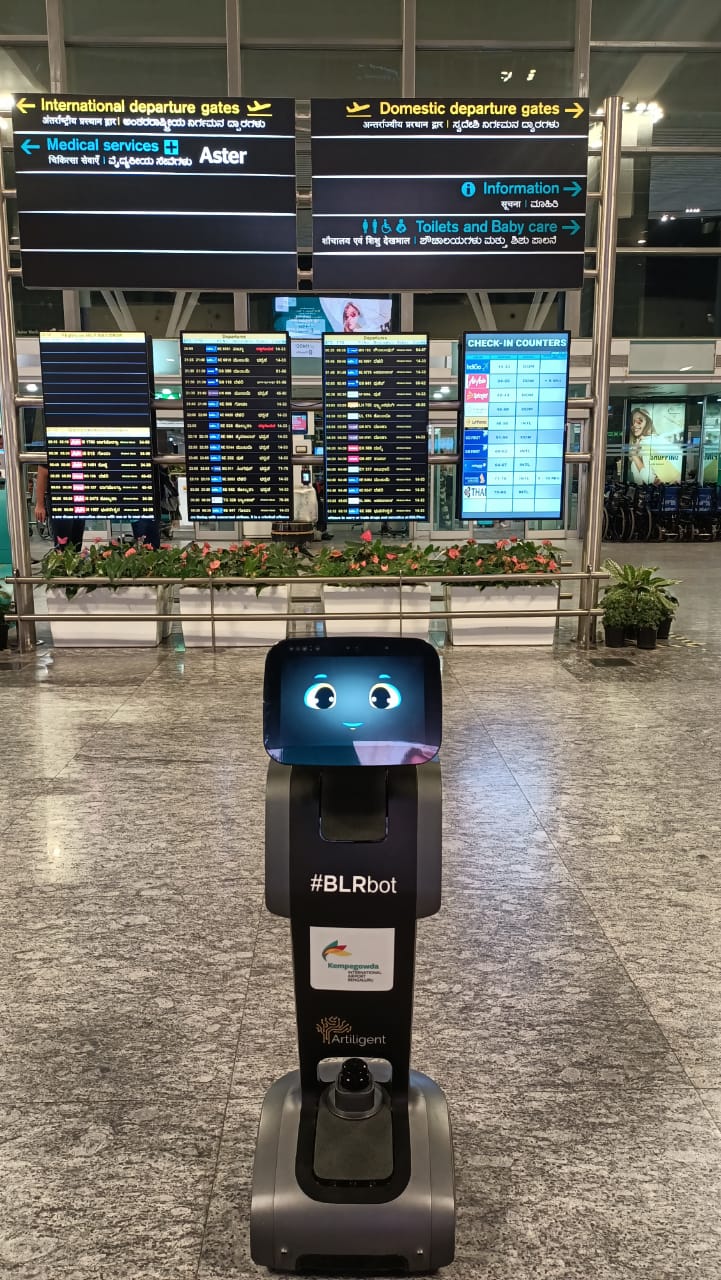
Innovation being the hallmark of its services, Kempegowda International Airport, Bengaluru (BLR Airport) has introduced the first-of-its-kind AI-driven, assistance robots to enhance passenger experience at BLR Airport.

Currently, at the trial stage, 10 robots have been deployed to help guide passengers through the airport and answer basic queries. The robot count will be increased in a calibrated manner and will be further developed over a period in terms of functionality and features, after gauging customer feedback.

BLR Airport Introduces Robots for an Enhanced Passenger Experience

BLR Airport Introduces Robots for an Enhanced Passenger Experience
#BLRbots
BLR Airport has partnered with Artiligent Solutions Pvt. Ltd. – specialists in AI and Robotics, to model the robots along with creating a customised passenger services software. The default language of communication will be English, with additional regional and international languages in the offing.

Jayaraj Shanmugam, Chief Operating Officer, BIAL, said that the airport prides itself on being a trendsetter when it comes to blending innovation and providing a seamless experience to passengers. “Pre-empting passenger requirements and complementing new-age technology with a focused customer-centric team approach has been our winning combination. These smart robots are the latest addition to our offering which shall further boost our concentrated endeavor to provide exceptional customer service.”

Rupesh Sawant, Chief Executive Officer, Artiligent said: “Innovative technology is revolutionising airtravel across the world. Artiligent ideated the AI_PORT concept to develop an enhanced airport experience for travellers. We are proud to associate with BLR Airport, the first airport in India to launch our solution and take a leap in their digital transformation journey.”

#BLRbots
The robots will provide a variety of services which include providing information on the flight status, passenger convenience services, directional assistance, Retail and F&B information. They shall navigate autonomously through the terminal and escort passengers to their desired locations. If due to any reason, the robot is unable to answer queries, passengers shall be immediately connected to the ‘Airport Help Desk’ via video call, on the robot screen itself.

'Robot Restaurant' comes to Bengaluru

Robot Restaurants' has announced the launch of the city's "first" restaurant where food service is done by robots. The restaurant claimed that its Bengaluru launch was after its "resounding success" in Chennai and Coimbatore.

"The restaurant will be located on Indira Nagar's high street 100 Feet Road and will be able to accommodate 50 diners. The menu will largely comprise Indo-Asian cuisine and will also have an exotic mocktail menu," it said in a release.


The restaurant will have a team of 6 robots (one usher and 5 bearers), it said, each table will be equipped with a tablet from which diners can place their order and summon the robots, and the food service is then done by the robots.

The robots are interactive and are programmed to sing birthday wishes and wishes for special occasions.

"Bengaluru already has a wide variety of culinary experiences and we are confident that the robots will be welcomed with open arms in Bengaluru," Robot Restaurant founder Venkatesh Rajendaran said.

[caption id="attachment_133164" align="aligncenter" width="540"] Picture: Metro.co.uk[/caption]

"Bengaluru has been a dream for us at Robot Restaurants and it's a happy and proud day for the team to see our dream come true," he added.

The robots have been programmed to work efficiently and the staff have also undergone training from the manufacturers to attend to any issues that may arise over the course of operations.

[caption id="attachment_133162" align="aligncenter" width="540"] The restaurant has a robot at the entry to usher people in and send them to their tables (Picture: Metro.co.uk)[/caption]

Indian Trains Now has 'USTAAD', An AI-Powered Robot to Ensure Safety

To check technical faults and ensure the safety of trains in India, a robot will now replace humans as Central Railways has developed an in-house robot named 'USTAAD' (abbreviation of 'Undergear Surveillance Through Artificial Intelligence Assisted Droid'), which will now check for safety in under gear parts of train coaches.

The new Artificial Intelligence (AI) powered robot will click photos and record videos of the train, under the gears and then transmits them over WiFi to engineers for maintenance and repair, thus reducing chances of human error while examining undergear equipment on Indian Railways trains.

Developed by Mechanical Branch of the Nagpur Division of Central Railways, the new robot USTAAD can watch and examine areas which cannot be seen and approached by humans usually, due to the narrow spaces between under-gear parts.

Some of the very proficient features and practical capabilities of USTAAD are as follows:

HD camera:

For the constructive and appropriate examination of train’s coaches or wagon’s parts, USTAAD has been facilitated with HD (high-definition) camera. This HD camera is able to move 320 degrees on X-axis and 130 degrees on Y axis so that the maximum portion of under gear gets covered. The camera captures video as well as still photographs of the under gear parts of the coaches in real time and then, can transfer them over Wi-Fi. The engineer can study these videos on the big screen and can record the same. The HD camera of USTAAD can be rotated in any direction as per commands given by the engineer. The camera can also zoom in or zoom out on the spot, during safety inspection.

[caption id="attachment_127897" align="aligncenter" width="660"]USTAAD Robot USTAAD, The AI-powered Robot (Image - Financialexpress.com)[/caption]

LED flood lights:

USTAAD is also equipped with LED (light-emitting diode) flood lights and is able to capture the videos in low light conditions as well as in dark mode. With the help of the robot’s technical power, the chances of any mistake overlooked by the human eye can be eliminated, which, in turn, reduces the chances of human error. With the help of USTAAD, engineers can easily analyse and examine areas which are difficult to see and impossible to approach manually. Cramped and narrow spaces, between or under the gear parts, can be easily captured by the robot.

Sound detection

The robot can also tap the sound of flat tyre, during placement of the rake on the Pit Line. This is particularly important for prior detection of flat tyre, in order to keep a check on the train’s swift journey.

Indian trains, which are second largest rail network of world, are known as the cheapest mode of transportation which millions of people prefer to travel in rather then other transport services. However, some times this busiest rail network comes to standstill due to accidents and mishaps.

By use of USTAAD robot, the chances of a mistake and any deficiency overlooked by the human eye can be eliminated.

It may also be recalled that in August this year, Indian Railways has also got its first 'SMART' coach including AI-enabled CCTV cameras. The 'SMART' coach, built by Modern Coach Factory, Raebareli, are equipped with black boxes and coach information and diagnostics systems.

Source - Financial Express

Smartworks Debuts 'Smart Mitri', An AI enabled She-Robot at its New Bangalore Center

L-R Balaji Viswananthan, CEO - Invento Robotics, Smart Mitri, Neetish Sarda, Founder - Smartworks, Harsh Binani, Co-founder -Smartworks

Smartworks, India’s largest agile workspaces player today launched its flagship facility in Bengaluru. Spread over 3 lakh sq. ft., with 6,000 seats, this is the firm’s largest centre located in Global Technology Park (GTP), Bellandur. 

One of the key highlights of the flagship centre is the introduction of ‘Smart Mitri’, which the company claims to be the world’s first female AI robot. Smart Mitri will be Smartworks’ in-house productivity mascot and will play an influential role in handling the overall office management for the facility, ranging from the visitor system to being a counsellor eventually. This is a first time in the world that a co-working firm is introducing robotic technology to the co-working management eco-system.

This is Smartworks second facility in Bengaluru, the first being in Cessna Business Park. GTP has received a tremendous response, with more than 60 percent of the space having been pre-booked by leading enterprises including Deluxe with 1200 seats, Altron with 220 seats and Playgames 24X7 with 450 seats.
Interior Of Smartworks, Bangalore

The Smartworks facility is a combination of modern aesthetics with the latest technology and a high emphasis on safety, wellness and productivity. Built across seven floors, it features smartly configured floor plans designed to promote employee productivity in a collaborative environment. It is designed to have plenty of natural light that has been proven to reduce stress, improve emotional health, increase productivity, and boost mood. It features fully glazed fire-rated lift lobby doors, marble-finished double height lobbies, green feature wall and fresh air filter for AHUs providing 0.25 Micron filtration.

Commenting on the launch, Neetish Sarda, Founder Smartworks said, “Smartworks is tapping the vast potential of India’s tech capital by building its futuristic office experience in Bengaluru on an unrivalled scale.” Speaking about the distinct edge that Smartworks provides, Neetish added, “Unlike other agile workplaces, Smartworks offers its clients a cost advantage of up to 30 – 40 % achieved through technology intervention that keep operating costs low. Our key focus remains on providing spaces that are modern, technology-rich, productive, collaborative, safe and promote wellbeing so that employees feel taken care of. Bengaluru has and will be a key market for us and we have plans to increase our presence here by ten-fold in the next few years."

With the launch of the Belladur facility, Smartworks now has a total portfolio of 2 million sq.ft. across India. The firm plans to expand their workspace portfolio to 10 million sq. ft. within the next 3-4 years.

The GTP facility marks the way forward for bigger and better technology innovations in the workplace for Smartworks. As the Silicon Valley of India, Bengaluru, has emerged as the Co-working capital of the world. Over the past few years, the city has witnessed massive adoption of the concept of co-working/agile office spaces, with companies and employees finding a co-working culture not just rhythmic to their working style, but also a key enhancer of productivity. As a tech park with state-of-art facilities such as crèche, meditation room, gym, angry man room, sleeping pods, connectivity, vending machines, employee engagement activities, multi cuisine food court and an enhanced user experience, GTP is a much sought after location for enterprises looking to establish or expand their footprint in the city.

Present at the launch of the Smartworks Bengaluru facility was Balaji Viswanathan, CEO of Invento Robotics, a Bengaluru based start-up and the brainchild behind Smart Mitri. Speaking at the event, he said, “It’s a great day for us today, to see our invention come to life! We would like to congratulate Smartworks on their vision to transform robot fantasy and fiction into robot reality with Smart Mitri as their visitor concierge. Smartworks is bringing this reality to life by expanding the possibilities for innovation."

To recall, in September last year we did a story on Invento Robotics in which discussed about how the startup had collaborated with manufacturing hubs in China to give birth to an intelligent robot called Mitra.

“Productivity and employee engagement are big focus areas for every employer today. In the knowledge era, the traditional approach to employee engagement and productivity needs to be turned on its head. Invento in partnership with Smartworks is finding new ways to enhance these interventions. The Mitra AI robots are a key element to making this a reality!” he added.

Smartworks has been on an expansion drive in Southern and Western India since the beginning of this year. The competition of Smartworks include WeWork, Cowrks, AWFIS among others. The firm is India’s preferred choice for top enterprises with these companies accounting for 90% of its seats. It is India’s only profitable co-working space player of its size.

With 20 locations across 9 cities, the firm caters to more than 500+ organizations across large enterprises, SMEs, start-ups. Select marquee clients that work out of its centres include Tata Communications, Microsoft, Arcelor Mittal, Amazon, Carrier, Otis, Daikin, Lenovo, Bacardi, and OLX.

Robotic Dogs to Replace Sniffer Dogs at Indian Airports

Soon airports in India will have robotics canines/dogs with advanced features such X-Ray vision eyes to scan the luggage of passengers. The Central Industrial Security Force (CISF) is reportedly planning to deploy robotic canines at airports across the country in an effort to boost security. CISF is paramilitary forces for India, which works for seaways, airways and some of the major installations in India including airports.

These robotic canines aka dogs will replace airport security dogs such as the German shepherds, Labradors or Belgian Malinois, which are used by the CISF in airport security.

The use of "robotic canines" came up in discussions at the Global Aviation Security Symposium 2018 held at Montreal, Canada, this week attended by CISF DG Rajesh Ranjan and additional DG M A Ganapathy, also in-charge of aviation security at airports across India.

With deployment of robotic canines, CISF aims to use the latest technologies to deal with increasing global threats to aviation, greater volumes of air travellers and new tactics used to smuggle illegal items through airports.

According an official statement to India Times, CISF has tie-up with Transport Security Administration (TSA) of the United States and also have a capacity building pact with the EU as well, which will help CISF explore a lot about new technologies and methods of securing airports across India.

Additionally, use of CT scan-based screening of hand-luggage and cabin baggage ws also discussed along with the use emerging technologies like Artificial Intelligence (AI), latest explosive detectors and biometric control access at the airports.

To recall, in May this year airline Vistara has launched India's first robot at Airport named ‘RADA that uses AI technology and can assist customers, address their queries and even entertain them.

Top featured image is for representative purpose only and taken from Publinews

Panasonic to Launch Assistive Robots and other Smart IoT Products in India

Since the start of 2018, Japanese electronics and technology giant Panasonic is continuously advancing in its robotics, automation and Internet of Things (IoT) strategies including both IoT-based products as well as services and solutions.

In a first in India, Panasonic is looking to launch two of its latest assisted robotic products in India by early next year. This includes a robot that can carry luggage and the other one is assisted-walking robot which the company wants to launch in hospitals before selling to the consumer market.

For its robotics products, Panasonic will initially target hospitals in India and then eventually take these for B2C (business to consumer) market sales in the country.

Panasonic first unveiled its autonomous delivery robots for hospitals called HOSPI, in 2015. A part of the company's hospital porter management system, HOSPI robot is able to deliver (up to 20kg) fragile and bulky medicine, medical specimens and patients' case notes 24/7, easing manpower constraints.

[caption id="attachment_127165" width="750" align="aligncenter"]HOSPI HOSPI - An Assistive Robot for Hospitals[/caption]

For its India strategy, Panasonic wants to create a complete IoT product ecosystem by launching a slew of new IoT-based products like location trackers and mobile handsets. The company is also developing new IoT products and solutions based on Artificial intelligence (AI). These IoT products will be developed at the company's Innovation Centre in Bengaluru, that it had opened in May last year.

For next 5 years, Panasonic is investing a total Rs 240 crores in its Bengaluru centre and a part of this investment will be utilized for solutions of its digital assistant Arbo. In August last year, Panasonic had launched its first AI-based smartphones India, that comes with Arbo, the virtual assistant .

The products made at Bengaluru centre will not only be for India but also for Asia, Middle East and Africa.

Panasonic is also aiming to work with developers and form tie-ups with technology companies to build AI-specific solutions and IoT products in India.

“We are looking out for partners. It would be extremely difficult for any organization not only Panasonic to look at these kinds of developments in isolation…it's an era where masters of trades are needed. However, the core technology has to come from your side," said Manish Sharma, President and CEO, Panasonic India, to Economic Times.

Additionally, the company is also on verge of launching a competitor product for Amazon Alexa and Google Home. This home automation product however will be based on Alexa platform.

Source - cnbctv18, Economic Times, Panasonic

Ranchi Man Claims to Built Desi Version of ‘Sophia’ Humanoid Who Speaks Hindi, Bhojpuri, Marathi

38-years old Ranjit Srivastava claims to have developed an Indian equivalent of 'Sophia', the globally acclaimed humanoid robot developed by a Hong Kong-based company. The Desi robot is named as 'Rashmi' and other than English can speak in three local Indian languages - Hindi, Bhojpuri and Marathi.

Srivastava, who hails from Ranchi, the state capital of Jharkhand in northeast India, used linguistic interpretation (LI), artificial intelligence (AI), visual data and facial recognition systems to develop 'Rashmi', the humanoid robot and perhaps India's answer to 'Sophia'.

Rashmi functions under a specially designed software and linguistic interpretation system developed by me. The LI programme analyses the feeling of the conversation while AI program analyses the conversation to extract the response from the device," Srivastava told Hindustan Times.

He claims to have developed this world's first Hindi speaking robot in two years at a meager cost of about $700 (~ Rs.48,000).


Srivastava, who is an MBA, has experience of more than 15 years in software development. He claims to have developed e-Nibandhan portal for registration department, which received Scotch award, e-library for information and public relation department, tourism portal for tourism department, which won national tourism award.

"It will take another month to give it the complete shape of a human. The head and body have been developed and they are functioning properly. The process is on to add hands and legs to it,"


Although there are many locally developed robots in India including - intelligent robot called Mitra, who greeted US President's daughter Ivanka Trump, on the occasion of Entrepreneurshhip Summit held in Hyderabad last year.

However, it is a fact that none of the robots built to date can speak Hindi or any Indian languages for that matter.

Other Made in India Robots


A couple of months back, Vistara airlines launched ‘RADA’, a robot aimed at helping the airline offer an enhanced on-ground service to the airline's customers.

Last December, a Hyderabad-based robotics startup, H-Bots Robotics, unveiled world’s first smart policing robot, which was fully developed in India.

In March last year, a bunch of students from Maharashtra Institute of Technology (MIT), Pune, developed a cognitive assistant robot called 'Chintu' powered by IBM Watson Technology.

Via - Sputnik News

[Top-most Image - HindustanTimes.com]

​Meet 'RADA' - India's First AI Robot To Assist Flyers, Scan Boarding Pass and Entertain

Tata Sons-Singapore Airlines joint venture airline Vistara has come up with a first-in-India robot using Artificial Intelligence (AI) technology that can assist customers, address their queries and entertain them.

Named ‘RADA’, the robot is aimed at helping the airline offer an enhanced on-ground service to its customers. During its initial stage, RADA will be placed at Vistara’s Signature Lounge at Delhi Airport’s Terminal 3 from July 5, 2018, to assist customers using the lounge before they board their flights.

At present, 'RADA' can scan boarding passes and further provide information on the terminal, departure gates, weather conditions of destination city, real-time flight status as well as information about Vistara’s products and services. It greets customers and interacts with them using basic hand movements, and is capable of moving around in the lounge on predefined pathways. Additionally, it can engage with kids and adults alike by playing games and other multimedia content such as songs and videos.

‘RADA’ will be further developed over a period of time in terms of functionality and features for future use cases, after gauging customer feedback.

[caption id="attachment_124536" align="aligncenter" width="700"] Vistara's new AI-powered robot RADA[/caption]

‘RADA’ has been envisioned and incubated under Vistara’s Innovation initiative. It is conceived, designed and engineered by its team of technology experts and apprentices from Tata Innovation Lab with support from students of reputed institutions. Vistara claims that it is one of India’s most economical robots which is completely made of indigenous components, thus making a compelling ‘Make in India’ story.

‘RADA’ is built on a chassis of four wheels, enabling it to rotate 360 degrees, and it has three in-built cameras for cognitive interaction.

Explaining what sparked the idea behind ‘RADA’, Vistara’s Chief Information and Innovation Officer, Ravinder Pal Singh said, “It was a realisation that the talented, young employees engaged in ground services, gain immense customer service experience on the job, but the limited scope of their routine work could challenge their true potential. Some of them spend decades within the walls of an airport, assisting customers. Therefore, we thought of inventing a robot that can help us enhance customer experience by gradually taking over the routine, mundane tasks."

He further adds "The basic premise of the thought was to develop a simple and extremely cost-effective practical robot that can engage in basic human interaction to begin with, and can further be developed to perform more complex tasks, as consumer habits continue to evolve in the technological age where humans and machines will complement and create an evolved harmonious evolution.”

Various Robots Launched in India


In December, H-Bots Robotics, a Hyderabad-based robotics startup, has unveiled world’s first smart policing robot. The robot is developed by the startup is fully 'Made in India', using all the components sourced from within the country.

Last September, Bengaluru-based robotics start-up Invento Robotics has launched an intelligent robot called Mitra, which the startup made in collaboration with manufacturing hubs in China.

In April 2017, a Chennai based startup had launched a a food serving robot and soon after a Mall robot was also launched by an another Indian startup.

Meanwhile, in last month a Mumbai-based robot making startup Emotix has raised $2 million in a funding round led by venture capital firms IDG Ventures India and YourNest. The startup has created India’s first personal companion robot, Miko, which has the capability of engaging, educating, and entertaining a child the Indian way.

​Meet 'RADA' - India's First AI Robot To Assist Flyers, Scan Boarding Pass and Entertain

Tata Sons-Singapore Airlines joint venture airline Vistara has come up with a first-in-India robot using Artificial Intelligence (AI) technology that can assist customers, address their queries and entertain them.

Named ‘RADA’, the robot is aimed at helping the airline offer an enhanced on-ground service to its customers. During its initial stage, RADA will be placed at Vistara’s Signature Lounge at Delhi Airport’s Terminal 3 from July 5, 2018, to assist customers using the lounge before they board their flights.

At present, 'RADA' can scan boarding passes and further provide information on the terminal, departure gates, weather conditions of destination city, real-time flight status as well as information about Vistara’s products and services. It greets customers and interacts with them using basic hand movements, and is capable of moving around in the lounge on predefined pathways. Additionally, it can engage with kids and adults alike by playing games and other multimedia content such as songs and videos.

‘RADA’ will be further developed over a period of time in terms of functionality and features for future use cases, after gauging customer feedback.

[caption id="attachment_124536" align="aligncenter" width="700"] Vistara's new AI-powered robot RADA[/caption]

‘RADA’ has been envisioned and incubated under Vistara’s Innovation initiative. It is conceived, designed and engineered by its team of technology experts and apprentices from Tata Innovation Lab with support from students of reputed institutions. Vistara claims that it is one of India’s most economical robots which is completely made of indigenous components, thus making a compelling ‘Make in India’ story.

‘RADA’ is built on a chassis of four wheels, enabling it to rotate 360 degrees, and it has three in-built cameras for cognitive interaction.

Explaining what sparked the idea behind ‘RADA’, Vistara’s Chief Information and Innovation Officer, Ravinder Pal Singh said, “It was a realisation that the talented, young employees engaged in ground services, gain immense customer service experience on the job, but the limited scope of their routine work could challenge their true potential. Some of them spend decades within the walls of an airport, assisting customers. Therefore, we thought of inventing a robot that can help us enhance customer experience by gradually taking over the routine, mundane tasks."

He further adds "The basic premise of the thought was to develop a simple and extremely cost-effective practical robot that can engage in basic human interaction to begin with, and can further be developed to perform more complex tasks, as consumer habits continue to evolve in the technological age where humans and machines will complement and create an evolved harmonious evolution.”

Various Robots Launched in India


In December, H-Bots Robotics, a Hyderabad-based robotics startup, has unveiled world’s first smart policing robot. The robot is developed by the startup is fully 'Made in India', using all the components sourced from within the country.

Last September, Bengaluru-based robotics start-up Invento Robotics has launched an intelligent robot called Mitra, which the startup made in collaboration with manufacturing hubs in China.

In April 2017, a Chennai based startup had launched a a food serving robot and soon after a Mall robot was also launched by an another Indian startup.

Meanwhile, in last month a Mumbai-based robot making startup Emotix has raised $2 million in a funding round led by venture capital firms IDG Ventures India and YourNest. The startup has created India’s first personal companion robot, Miko, which has the capability of engaging, educating, and entertaining a child the Indian way.

World's First Robot Citizen 'Sophia' Wears Sari, Rejects Marriage Proposal In Her First India Visit

Making her first appearance in India, ‘Sophia’, the world's first robot citizen of any country, graced the Indian Institute of Technology-Bombay’s (IIT-B) annual Techfest with her presence on Saturday.

Wearing a Sari, she greeted the audience with a Namaste and spoke about future of humans and machines.

Sophia humanoid in India

Surprisingly, one of the audience member even asked the female humanoid if she would marry him to which she replied, “I will politely decline the proposal. Thank you for the compliment though.” To recall, just a couple of months back however, Sophia, in her first media interview told that she wants to start a family and even wants to have a baby.

Discussing the future of AI, she said humans should not see them as competition but work in collaboration with machines.

Sophia humanoid in India

Talking about those who see robots as a “threat”, she said: "It is science which created me, but philosophy will take me forward".

In an audience of more than 3,000 people, one of the onlooker asked about how many languages she speaks to which she replied with a frown expression, “I am just two years old, so till now I only know English and Chinese; but in some years I will be able to speak all languages.”

In her first visit to "Digital India" and that's too at prestigious IIT of Mumbai, Sophia -- who is after all a robot -- malfunctioned for 10 minutes because of a weak Internet connection on the part of the institute. IIT-B managers blamed the Internet issue on the lack of a proper connection.

Hyderabad's Robotic Startup H-Bot Launches World’s 1st Smart Policing Robot

In July, we reported that H-Bots Robotics, a Hyderabad-based robotics startup, was in process of making a police robot. Today, the company has finally launched the world’s first smart policing robot.

The beta version robot developed by the company is fully 'Made in India', using all the components sourced from within the country.

The robot can move, recognise people, take complaints, detect bombs, identify suspects, interact with people and answer to queries.

To bring out the beta version of the robot, the company’s 16-member team spent 1,400 hours in the last six months. The company has spent about Rs 40 lakh on research and development of the robot. The company, which has already received 20 firm orders, aims to make 70 robots in the first year and 700 by 2020. The robot can be used by police, army and security agencies both in India and overseas, informed H-Bots Robotics founder PSV Kisshhan.

police robot by H-Bot

The robot will be available at a price of ₹5 lakh. By July 2018, the robot will be ready for commercial deployment.

The robot has been formally launched by Jayesh Ranjan, principal secretary, IT, Government of Telangana.

The startup in July this year launched Makers Leeway in Hyderabad, a lab facility that enables prototyping solutions in the space of robotics and hardware for startups and innovators.

The above news was reported first in Telangana Today.

Earlier this year, a Chennai based startup had launched a a food serving robot and soon after a Mall robot was also launched by an Indian startup, this year.

Meet Mitra - An AI Robot Designed By Bengaluru Startup and Built In China

In what could be considered as a perfect example of the greatness that can be achieved if both India and China come together and join hands more often, Bengaluru-based robotics start-up Invento Robotics has collaborated with manufacturing hubs in China to give birth to an intelligent robot called Mitra.

A 4.5 feet tall humanoid, Mitra has been designed by Invento to interact with humans through natural ways - voice and vision. It recognizes speech and then converts that into actionable information, which is then run through the startup’s algorithms to both respond to that query through past learning. This is then conveyed through speech output.

No, we’re not just talking about an idea in thin air. Mitra’s first prototype is actually currently functioning at Canara Bank’s headquarters in Bengaluru. Though at 30 kg, the robot is quite bulky, the robot is working quite efficiently as a receptionist at the bank and giving tours of the bank’s “experience zone” to customers.

When Invento Robotics started developing Mitra, they had an idea, they had the skills to design and come up with a working prototype, but what they lacked was the ability to manufacture it on a scale. That’s when they decided to jump on a flight and head to China’s manufacturing hubs of Shenzhen and Dongguan where they finally found suppliers who can fulfill what they were looking for.

Balaji Viswanathan, one of the founders of Invento Robotics, told Hindustan Times, “The computer-aided designing has been done in India, its plastic mould is being made in a factory in Dongguan and the printed circuit boards and motor controls are being manufactured in Shenzhen (both cities in south China).”

Talking about what made them choose China as their manufacturing hub, Viswanathan said, “The quality of assemblage is good and so is the speed of delivery (of products) in China.”

According to media reports, four Mitra prototypes, moulded in a Dongguan factory with circuit boards from Shenzhen, are currently on their way to India. If they prove to be successful, hundreds more robots could be headed our way.

Yesterday, the Dalian government signed a first of its kind MoU with Nasscom, the Indian National Association of Software and Services Companies, which entails Dalian government helping Indian IT companies setting up units there. The MoU aims to take forward the long-heralded coming together of Chinese hardware and Indian software that has been generally slow to crystallise.

Mitra is just one example of what’s more to come our way if India and China continue on this journey together.

Chennai Based Startup SP Robotics Creates Food Serving Robot Named 'BOB'

SP Robotics Works which provides robotic education to school and college students today announces the launch of the first food serving robot named Butler ‘O’ Bistro (BOB) in Bengaluru’s VR mall. The startup provides robotic education (practical experiments with Mechanical, Electronics, Programming and Algorithm framing) – a multi—disciplinary engineering platform with enough fun quotient to school students from age 12 to 17 in the brand name called Kidobotikz. Developed by Kidobotikz community members - Arjun (age 13), Anish (12), Srivatsan (13) and Varsha (20) the robot can be seen serving food once the order is placed.

Once you order food at the counter, there is no more a need to wait and walk all the way back to the counter to collect it! The food which is readied in the kitchen is placed on the robot. Once given a go ahead, BoB begins its journey along the predetermined route from the kitchen to the tables. Using wheels for traction, it follows a line embedded on the floor to move between locations. It also has ultrasonic sensors that gauge the distance between itself and passersby. Once it reaches the destination, the robot greets the guests with a smile and requests them to receive the food. After the food tray has been emptied, it greets them with a smile and begins to go back to its place in the kitchen.

VR Mall, promoted by VirtousRetail group, one of the largest real estate promoters in India is exploring to use this solution across its food-courts in the country and set a precedent in the food-serving techniques.

How it started?

The journey of the startup began in August, 2012 when two Anna University Electrical and Electronic Engineering Students, Pranavan and Sneha Priya, tried to decrease the usage of man-power for monotonous, hazardous and unstable works and rather use the brains for developing technologies for the future. Working together as a team for more than 7 years now, the pair has won accolades from all Major Universities in India and also representing India for their robotics expertise.

Kidobotikz is an e-learning startup which focuses on providing maker-centric education for ages 11+. With robotics as a theme, the company has a series of kits that concentrate on teaching Electronics, Mechanical and Programming (The core fields of any tech). The startup raised INR 2 Crore investments from The Indian Angel Network and The Chennai Angels in March 2016 to solve the problem of availability of technical education for ages 11+. Kidobotikz, today, has an AI (Artificial Intelligence) that teaches technologies with hands-on experiments and personalizes the learning experience by interacting with the learner. It also helps in finding the field of strength (Electronics, Mechanical or Programming) - what a person is really good at - and helps them to focus on it and become a master of it in the future !

Apart from the learning, Kidobotikz provides opportunity for their members to use their knowledge in developing robots in real-time and thereby develop professional skills too (that is what every industry requires today). The Chennai community has already done many such implements - like the Swachh Bot (For cleaning the beaches), Agri Bot (for weeding), and the company decided to provide such opportunities for the newly developed Bangalore community too.

Arjun (Programming), Anish (Mechanical and Electronics), Srivatsan (Electronics) and Varsha (Electronics) are part of the Kidobotikz community, whose strengths in these fields were analyzed by the AI and an opportunity to be part of a real-time project was provided to them ! Having grabbed the opportunity, it has taken 2 months for the team to complete the robot. Anish worked on the mechanical designing (the structure) and electronics design (sensor placements, face design, microcontroller wirings etc) and Arjun gave the brain to the robot by coding the logics to complete the task. Professional help was rendered by Kidobotikz engineers in implementing complex algorithms and Arjun’s father in making of the structure with wood (he loves carpentry and has a small workshop setup in his home). Such exposure on looking at the professional methods are sure to build the young mind to be future ready.

Market Reports

Market Report & Surveys
IndianWeb2.com © all rights reserved