‏إظهار الرسائل ذات التسميات IIT Kanpur. إظهار كافة الرسائل

IIT-Kanpur & IBM Deploy AI for Clean Air Across Uttar Pradesh

IIT-Kanpur & IBM Deploy AI for Clean Air Across Uttar Pradesh

India’s air quality crisis might soon find a formidable tech ally. The Airawat Research Foundation at IIT-Kanpur has signed a Memorandum of Understanding with IBM to roll out AI-driven air quality monitoring across Uttar Pradesh—a state long troubled by airborne pollutants, reported news agency PTI. 

What Sets This Collaboration Apart:
  • Sensor Supremacy: Airawat’s 1,365 low-cost sensors are already installed across administrative blocks, surpassing the government’s 110-node network and offering granular coverage.
  • AI-Powered Insights: A real-time dashboard powered by IBM’s AI stack will collect and interpret data on PM2.5, PM10, temperature, humidity, and various gaseous pollutants—starting with a pilot project in Lucknow.
  • Airshed Intelligence: The approach focuses on airsheds—tracking how pollutants drift across districts, not just urban boundaries—redefining how we see and combat air pollution.
  • Indigenous Innovation: The sensors are developed locally at IIT-Kanpur, making scalability more feasible and affordable.
  • Precision for Policy: With data granularity reaching 0.5 sq km, officials can target pollution hotspots with tailored interventions.
Why AI Is a Game-Changer for Air Monitoring:
  • Multisource Fusion: AI integrates satellite data, ground sensors, weather forecasts, and even mobile inputs to map pollution in real time.
  • Predictive Capabilities: Algorithms forecast pollution trends using historical data, while flagging anomalies like industrial spills or seasonal smog events.
  • Urban Planning Aid: By modeling pollutant drift patterns, AI supports zoning reforms and smarter traffic regulations.
  • Smart Buildings: AI-linked HVAC systems react dynamically to indoor pollutant levels, enhancing health and energy efficiency.
  • Public Engagement: Through alerts and transparent dashboards, AI empowers citizens to take protective actions and engage with policy shifts.
This initiative isn’t just about cleaner air—it’s about a new template for tech-enabled governance, one that blends academia, industry, and the state. The Airawat-IBM collaboration could become a model for other regions, aligning with India’s Viksit Bharat goals and global climate commitments.

Global Comparisons: How UP’s Model Stands Out

  • Delhi’s SAFAR System: Uses machine learning to forecast air quality 72 hours in advance, but focuses on urban zones.
  • Amsterdam’s Smart Grid: Integrates air and energy data to reduce peak demand by 25%, showcasing cross-sector AI synergy.
  • UNEP’s GEMS/Air Platform: Crowdsources PM2.5 data globally, reaching 300M users annually, but lacks localized policy integration.
  • Envira AQMS (Spain): Offers mobile and fixed air quality stations with legal backing, but relies on imported tech and centralized models.

IIT Study Finds Indian Ragas Sculpt Brain Activity, Boost Focus & Calm

IIT Study Finds Indian Ragas Sculpt Brain Activity, Boost Focus & Calm

In a landmark fusion of India’s rich musical heritage and cutting-edge neuroscience, a new and recent study led by Prof. Laxmidhar Behera, Director of IIT Mandi, has offered compelling scientific validation for a long-held cultural belief that music can transform the mind, exploring the dynamics of brain microtubules. Published in Frontiers in Human Neuroscience, the study reveals that listening to Indian Classical Ragas can significantly influence brain activity, enhancing attention, emotional regulation, and mental stability.

Conducted in collaboration with IIT Kanpur on 40 participants, the research employed advanced EEG microstate analysis, a real-time brain-mapping technique that captures momentary but meaningful patterns of neural activity. These “microstates,” often lasting just tens of milliseconds, represent the brain’s transient modes of operation such as attention, emotional engagement, or mind-wandering.

Prof. Laxmidhar Behera (far left), Dr. Ashish Gupta (Centre), and  Prof. Braj Bhushan (far right) during the EEG-based music and brain experiment.
Prof. Laxmidhar Behera (far left), Dr. Ashish Gupta (Centre), and  Prof. Braj Bhushan (far right) during the EEG-based music and brain experiment.

What makes this study exceptional is the measurable impact of specific Ragas on these brain states. Raga Darbari, known for its soothing and uplifting qualities, was found to increase attention-related microstates while reducing those associated with mind-wandering, indicating deeper focus and cognitive clarity.

In contrast, Raga Jogiya, a melancholic melody, not only enhanced attentional networks but also activated emotion-regulation microstates, enabling listeners to process emotions with calm and composure. “EEG microstates offer a window into how the brain operates moment by moment,” explained Prof. Behera. “It is remarkable to see how these ancient melodies consistently guide the brain into more stable and focused patterns.” Ashish Gupta, the first author of the study, emphasized that the shifts observed in neural activity were not random. “The data showed repeatable, consistent transitions after exposure to the Ragas, suggesting Indian Classical music can serve as a powerful tool for mental wellness,” he said.

With mental health challenges such as stress, burnout, and attention deficits on the rise, this research points to a culturally resonant, non-invasive alternative. The research team suggests that listening to Raga Darbari before exams or important meetings may improve focus, while Raga Jogiya could help manage emotional overwhelm or grief. The study doesn’t just underscore how people feel in response to music, it demonstrates how the brain structurally responds, offering new potential for music-based interventions in cognitive and emotional health. Professor Braj Bhushan of IIT Kanpur, co-author of the study, remarked, “This work reveals the remarkable capacity of Indian Classical music to engage cognitive and emotional systems. It opens a new path for developing personalized, music-based mental health support tools rooted in India’s cultural wisdom.”

In a further affirmation of the findings, the research team conducted a parallel study on Western participants, which confirmed similar effects of classical music on brain microstates. This cross-cultural consistency highlights the universal neurological power of classical music. Both studies, co-authored by Dr. Ashish Gupta, Mr. Chandan Kumar Srivastava, Prof. Braj Bhushan, and Prof. Laxmidhar Behera, have been published in Frontiers in Human Neuroscience.

In doing so, they contribute not only to the scientific understanding of music’s influence on the brain, but also to a growing movement that harmonizes ancient traditions with modern science reminding us that the future of mental well-being may well lie in the timeless strains of the past.

IIT Kanpur’s C3iHub Upgraded to a Technology Translational Research Park (TTRP)

IIT Kanpur’s C3iHub Upgraded to a Technology Translational Research Park (TTRP)

Indian Institute of Technology Kanpur’s C3iHub has been upgraded to a Technology Translational Research Park (TTRP) by the Department of Science and Technology (DST), Government of India. Among the selected institutions, C3iHub has been designated to host one of these prestigious TTRPs, with a dedicated focus on cybersecurity.

The TTRP at IIT Kanpur will specifically focus on advancing cybersecurity technologies and supporting deep-tech startups while promoting strong industry-academia partnerships. After a thorough examination of the proposal from IIT Kanpur, the Mission Governing Board of NM-ICPS has selected C3iHub for upgradation to TTRP under NM-ICPS in the focus area of “Cybersecurity”.

This announcement was made during a review meeting by the Union Minister of State for Science and Technology, Dr. Jitendra Singh. This development India’s commitment to advancing cutting-edge technological innovations for both societal and commercial applications.

The TTRP has been designed to enable the transformation of research into market-ready solutions. By upgrading existing Technology Innovation Hubs (TIHs), such as C3iHub, into TTRPs, the DST seeks to enhance collaboration between academia, industry, and startups.

This recognition reflects our ongoing commitment to pioneering research and innovation in cybersecurity. The enhanced support will further accelerate the translation of cutting-edge research into impactful, market-ready solutions and strengthen our role in advancing national cybersecurity capabilities. I congratulate the entire C3iHub team on this well-deserved achievement,” said Prof. Manindra Agrawal, Director, IIT Kanpur.

As a leading TIH under the National Mission on Interdisciplinary Cyber-Physical Systems (NM-ICPS), C3iHub will continue to work towards strengthening national by securing critical infrastructure, protecting data privacy and integrity, tracking evolving cybercrimes, and more.

With DST NM-ICPS support, C3iHub, as a Technology Innovation Hub (TIH) during mission tenure, i.e., 2020-2024, has successfully deployed more than 15 technology products, nurtured 49 start-ups, 3 spokes, and 50 spikes, with 60% start-ups commercializing one or more products and 25% of R&D delivering demonstrable technology solutions. More than ten thousand individuals have been skilled by C3iHub at various skill levels including master’s degree in cyber security, six month long certification programs, specialized hands-on training programs for organizations, and vocational training at scale to support and strengthen the startup and R&D ecosystem in cybersecurity.

With its elevation to a TTRP, C3iHub is set to lead in cybersecurity innovation, advancing research, empowering startups, and nurturing talent.

IIT Kanpur’s C3iHub Upgraded to a Technology Translational Research Park (TTRP)

SIIC, IIT Kanpur Incubated RF Nanocomposites Pvt Ltd Secures ₹6 Cr Funding at ₹30 Crore Valuation

  • RF Nanocomposites Pvt Ltd, a startup incubated at SIIC, IIT Kanpur, raised ₹6 crores in its latest funding round, achieving a valuation of ₹30 crores.
  • The funding round was led by prominent figures from Ahmedabad’s education and high-tech ecosystem, bringing expertise and strategic support to the company.
  • The company specializes in stealth and electromagnetic interference (EMI) shielding composite materials for India’s defense and advanced industrial sectors.
RF Nanocomposites Pvt Ltd, an innovative startup incubated at the SIIC, IIT Kanpur, has announced the successful completion of its latest funding round. The company has raised ₹6 crores, achieving a valuation of ₹30 crores. This milestone highlights investors' confidence in the company's groundbreaking technologies and growth potential.

Dr. Vishal Kumar Chakradhari, Founder & CEO of RF Nanocomposites
The investment round was led by prominent figures from Ahmedabad’s education and high-tech ecosystem, Mr. Raj and Mr. Divyaraj, who bring extensive expertise and strategic guidance to the venture. Their support marks a significant step forward for RF Nanocomposites in its mission to revolutionize the field of advanced materials.

RF Nanocomposites specializes in cutting-edge stealth and electromagnetic interference (EMI) shielding composite materials, addressing critical needs in India’s defense and advanced industrial sectors. The company’s innovative solutions set new benchmarks for high-performance materials, playing a crucial role in enhancing the nation’s strategic capabilities and technological self-reliance.

Speaking on the occasion, Dr. Vishal Kumar Chakradhari, Founder & CEO of RF Nanocomposites, stated,
This funding signifies the transformative potential of our technology. We are grateful to our investors for their trust and support, and we remain committed to driving innovation in high-performance materials to strengthen India’s defense and industrial sectors.
The fundraising process was facilitated by Tuskh Law & Associates, who served as legal advisors, ensuring a seamless and efficient transaction.

Mr. Anurag Singh, CEO of SIIC, IIT Kanpur, remarked,
RF Nanocomposites exemplifies the spirit of innovation and entrepreneurship that IIT Kanpur strives to foster. This milestone is a proud moment for the entire SIIC ecosystem, and we are confident that the company will continue to reach new heights.

IIT Kanpur continues to foster a culture of innovation and entrepreneurship through its incubation ecosystem. With a strong commitment to advancing technological frontiers, IIT Kanpur remains dedicated to nurturing visionary startups and contributing to India's journey towards self-reliance in science and technology.

India Gets Its First Hypervelocity Expansion Tunnel Test Facility 'Jigarthanda' at IIT Kanpur

India Gets Its First Hypervelocity Expansion Tunnel Test Facility 'Jigarthanda' at IIT Kanpur

The Indian Institute of Technology Kanpur (IITK) has successfully established and tested India’s first Hypervelocity Expansion Tunnel Test Facility, a major achievement that puts India amongst only a handful of countries with this advanced hypersonic testing capability. The facility, named S2, is capable of generating flight speeds between 3-10 km/s, simulating the hypersonic conditions encountered during atmospheric entry of vehicles, asteroid entry, scramjet flights, and ballistic missiles. This makes it a valuable test facility for ongoing missions of ISRO and DRDO including Gaganyaan, RLV, and hypersonic cruise missiles.

The S2, nicknamed 'Jigarthanda', is a 24-meter-long facility located at IIT Kanpur’s Hypersonic Experimental Aerodynamics Laboratory (HEAL) within the Department of Aerospace Engineering. The S2 was indigenously designed and developed over a period of three years with funding and support from the Aeronautical Research and Development Board (ARDB), the Department of Science and Technology (DST), and IIT Kanpur.

The development of the facility was supported by the Fund for Improvement in S&T Infrastructure (FIST) of the Department of Science & Technology (DST) with a sum of Rs 4.5 Crores in 2018.

The facility consists of 4 major sections —free piston driver, compression tube, shock/acceleration tube and test section with high vacuum system for generating and sustaining the hypersonic flow. The complete instrumentation of the facility; pressure sensors and associated equipment/instruments for acquiring and processing the data and the vacuum system with test section and associated instrumentation was acquired through the DST- FIST program.


Commenting on this, Prof. S. Ganesh, Director, IIT Kanpur, said, "The successful establishment of S2, India's first hypervelocity expansion tunnel test facility, marks a historic milestone for IIT Kanpur and for India's scientific capabilities. I congratulate Prof. Sugarno and his team for their exemplary work in designing and fabricating the hypersonic research infrastructure. S2 will empower India's space and defence organizations with domestic hypersonic testing capabilities for critical projects and missions."

Prof. Mohammed Ibrahim Sugarno, Associate Professor, Department of Aerospace Engineering and Centre for Lasers & Photonics at IIT Kanpur said, "Building S2 has been extremely challenging, requiring in-depth knowledge of physics and precision engineering. The most crucial and challenging aspect was perfecting the 'free piston driver' system, which requires firing a piston at high pressure between 20-35 atmospheres down a 6.5 m. compression tube at speeds of 150-200 m/s, and bringing it to a complete stop or 'soft landing' at the end."

"However, with our expertise, we were able to overcome this. Our team is proud to have designed, built, and tested this one-of-a-kind facility, cementing India's position in the elite global hypersonic research community," he added.

Prof. Tarun Gupta, Dean, Research and Development, IIT Kanpur, said, "S2 highlights IIT Kanpur's research excellence, positioning the institute at the forefront of innovative research and opening doors to groundbreaking advancements in aerospace technology. I am pleased to acknowledge the crucial support received from ARDB and DST."

Prof. G. M. Kamath, Head, Department of Aerospace Engineering, IIT Kanpur, said, "With S2, we advance our research horizons, inspiring a new generation of aerospace enthusiasts and fostering innovation and exploration in this exciting field. Being the first in India to develop such a facility enables us to set a new benchmark for hypervelocity research in India and beyond."

S2 represents a tremendous achievement for IIT Kanpur and a major capacity boost for India's space and defence sectors. With sophisticated hypervelocity testing capabilities now available domestically, India is better positioned to develop advanced hypersonic technologies and systems.

Hypersonic research activities are fast growing in India and the implementation of Hypersonic Test Facility in India will enable more aerospace engineers and researchers to pursue hypersonic research. The research activities and data generated in the facility will serve as an input for optimization of existing vehicles as well as futuristic defense and Space Missions.

Establishment of such facility will position India globally for advanced experimental hypersonic research. It is a major capacity boost for India's space and defense sectors and puts India in a better position to develop advanced hypersonic technologies and systems fast-forwarding the Hon’ble PM’s dream of a scientifically advanced nation. 

Indian Institute of Technology Kanpur was established in 1959 and declared to be an Institute of National Importance by the Government of India through an Act of Parliament. IIT Kanpur is best known for the highest standard of education in science and engineering and for seminal R&D contributions over the years. The institute has a sprawling lush green campus spread over 1055 acres with a large pool of academic and research resources spanning across 19 departments, 25 centres and 3 interdisciplinary programs in engineering, science, design, humanities, and management disciplines with more than 570 full-time faculty members and approximately 9000 students.

For more information, visit www.iitk.ac.in.

Indian Navy and IIT Kanpur Sign MoU To Drive Innovation through Research Partnership

Indian Navy and IIT Kanpur Sign MoU To Drive Innovation through Research Partnership

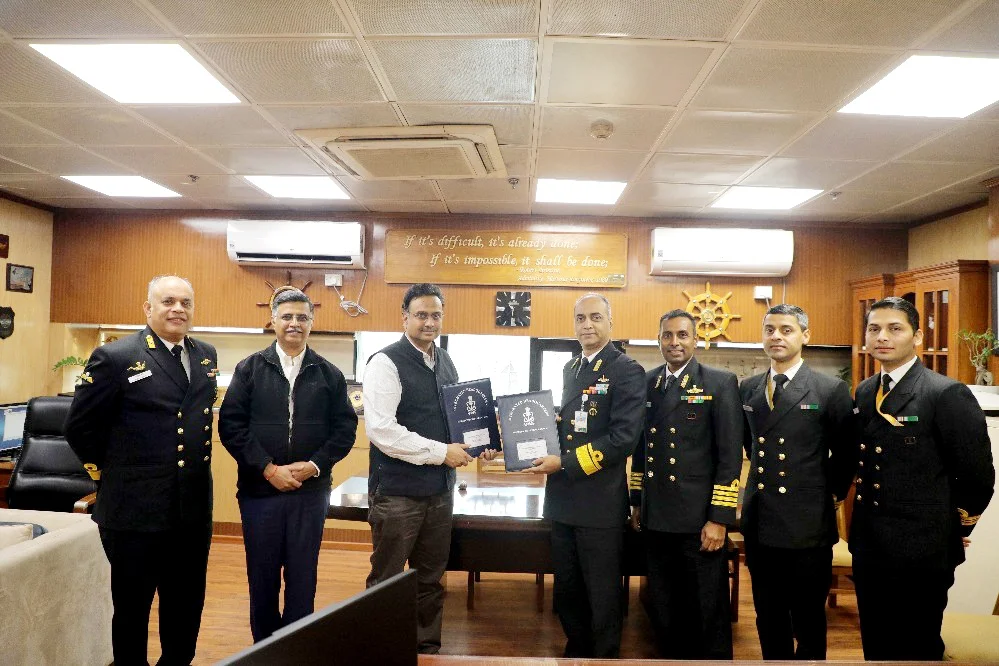
Indian Navy and Indian Institute of Technology Kanpur, signed a Memorandum of Understanding (MoU) today at Naval Headquarters, New Delhi, symbolising their commitment to promote technology development, innovative solutions and joint R&D. Rear Admiral K Srinivas, Asst Chief of Materiel (Dockyard & Refits) and Professor Subramaniam Ganesh, Officiating Director IIT Kanpur concluded this MoU.

Indian Navy and IIT Kanpur share common interest in academic exchange of scientific research activities in the field of Engineering related to defence technologies.

The MoU would serve as a broader framework and enable both sides to enhance capacity building, provide solutions to field level issues and enhance training effectiveness through exchange of faculty/ guest lectures. The structured collaboration focuses on joint Research and Development initiatives involving teams from Centre of Excellence (Marine Engg) at INS Shivaji, Lonavla and IIT Kanpur.

This Strategic alignment signifies a move towards a symbolic relationship between the academia and the armed forces, fostering a conducive environment for innovation and knowledge exchange.

IIT Kanpur Announces eMasters Degree in Renewable Energy & e-Mobility

IIT Kanpur Announces eMasters Degree in Renewable Energy & e-Mobility
  • The executive-friendly eMasters degree programmes do not require a GATE score to apply
  • It can be pursued without pausing professional careers
  • Offers flexibility of completion between 1-3 years
  • The participants are awarded formal Senate-approved degrees
The Indian Institute of Technology Kanpur (IITK) has launched a one-of-a-kind eMasters degree program in Renewable Energy and e-Mobility. The eMasters program, designed by the Department of Sustai6nable Energy Engineering, Chemical Engineering, Materials Science & Engineering, and Electrical Engineering, is intended to build a capable and highly skilled workforce that can work towards environmental responsibility. This executive-friendly eMasters degree program does not require a GATE score to apply. It can be pursued without pausing professional careers. The flexibility to complete the program within 1-3 years has been provided as a bonus.

The e-Masters program in Renewable Energy and e-Mobility helps harness the possibilities as the world accelerates its shift from fossil fuels, curbing carbon emissions, and combating climate change. The program presents a transformative journey towards innovative and eco-friendly solutions.

The program is tailored to expose the professionals to various technological aspects of this shift, including the generation side sources like photovoltaics, wind, batteries, hydrogen and the very fast-growing Electrical Vehicle domain. These twin forces of renewable Energy and e-mobility collectively drive innovation, reduce reliance on non-renewable resources, and foster a greener, more resilient world, addressing environmental and economic imperatives.

The global renewable energy market is expected to reach nearly US$2 trillion by 2030, requiring a highly skilled workforce to address challenges and seize opportunities.

The industry-relevant program offers a high-impact learning experience featuring live interactive weekend classes and self-paced learning. Distinguished faculty and accomplished researchers from IIT Kanpur lead the way. The program's 60-credit curriculum, tailored for the industry, allows for seamless credit transfers towards higher education opportunities like MTech and PhD programs at IIT Kanpur, with the potential for waiving up to 60 credits. Participants also enjoy exclusive access to IIT Kanpur's incubation cell and extensive alum network, enriching their career advancement and networking prospects. As part of the immersive learning journey, participants have the unique opportunity to visit the IIT Kanpur campus, where they can engage with renowned faculty members and network with seasoned professionals, ultimately earning the prestigious status of being an IIT Kanpur alumni.

This program empowers professionals with diverse expertise to address the challenges shaping our nation's future. The cutting-edge eMasters degree programs, set to launch in January 2024, have attracted over 600 professionals who are propelling their careers in pioneering domains. It's essential to note that, unlike many other diploma or professional courses, the eMasters degree program at IIT Kanpur confers formal Senate-approved degrees, which are awarded during convocation ceremonies. For more information about the program and the application process, please visit: Masters in Renewable Energy and E-Mobility | IIT Kanpur


Indian Institute of Technology (IIT) Kanpur was established on 2nd November 1959 by an Act of Parliament. The institute has a sprawling campus spread over 1055 acres with a large pool of academic and research resources spanning across 19 departments, 22 centres, and 3 Interdisciplinary programs in engineering, science, design, humanities, and management disciplines with more than 550 full-time faculty members and approximately 9000 students. In addition to formal undergraduate and postgraduate courses, the institute has been active in research and development in areas of value to industry and government.

IIT Kanpur Enters Into 6G Research Partnership with US-based InterDigital Inc

IIT Kanpur Enters Into 6G Research Partnership with US-based InterDigital Inc
  • 6G research partnership includes Extreme MIMO advancements for future wireless networks
  • These advancements are critical for enabling 6G networks to scale and meet increased bandwidth and coverage demands of advanced applications such as metaverse, holographic communications, and digital twins
  • InterDigital maintains a long heritage of technology innovation and collaboration and recognizes India’s leadership and significance in the global 6G wireless research and standards ecosystem
The Indian Institute of Technology, Kanpur (IITK) has announced a bilateral research partnership to develop 6G enabling technologies that impact future wireless standards with InterDigital, Inc. (Nasdaq: IDCC), a mobile and video technology research and development company. As part of the partnership, InterDigital will sponsor research and innovation at IIT-K in advancing Extreme MIMO (Multiple-Input, Multiple-Output) systems to achieve higher spectrum efficiency and larger network coverage required for 6G network deployments. These advancements are critical for enabling 6G networks to scale and meet increased bandwidth and coverage demands of advanced applications such as metaverse, holographic communications, and digital twins.

Prof. S Ganesh, Officiating Director, IIT Kanpur said, "The partnership comes at an opportune moment when India has released the Bharat 6G Vision Document and has laid the foundation to becoming a world leader in 6G technology and has launched the 6G R&D Test Bed. The academia has a major role to play both in terms of advanced research leading to 6G standardization as well as developing technology components of the 6G."

This partnership is aligned with the growing collaboration between India and the United States around 6G research and standardization and follows a joint statement between the two countries at the recently-concluded G20 summit. The statement highlights the importance of joint research and development in 6G technologies and also acknowledges IIT Kanpur as a key collaborator.

We are proud to formalize our partnership with IIT-K to explore and expand our expertise in the advanced technologies that will define our 6G future,” said Milind Kulkarni, VP and Head of Wireless Labs, InterDigital. “Collaboration adds fuel to our innovation and InterDigital’s commitment to collaborating with world-leading universities and institutions across India will positively impact our shared contributions to wireless standards bodies like 3GPP and TSDSI.”

InterDigital maintains a long heritage of technology innovation and collaboration and recognizes India’s leadership and significance in the global 6G wireless research and standards ecosystem. Most recently, India has displayed its influential contributions to global wireless evolution through the publication of the Bharat 6G Vision document, the launch of India’s 6G research and development test bed, and the visionary 6G standards being collaborated upon by Telecommunications Standards Development Society, India (TSDI) and other global standards organizations.

In addition to leading 6G road mapping efforts around the globe, InterDigital has a history of partnership in India spanning a decade, including collaborative research on cellular modem and IoT design centers. In 2021, InterDigital became a member of TSDSI to support the development of India’s wireless and video markets, the region’s upgrades to 5G and beyond, and migration to high-definition mobile video.

InterDigital® develops mobile and video technologies that are at the core of devices, networks, and services worldwide. We solve many of the industry’s most critical and complex technical challenges, inventing solutions for more efficient broadband networks, better video delivery, and richer multimedia experiences years ahead of market deployment. InterDigital has licenses and strategic relationships with many of the world’s leading technology companies. Founded in 1972, InterDigital is listed on Nasdaq.

InterDigital is a registered trademark of InterDigital, Inc

For more information, visit: www.interdigital.com.

Indian Institute of Technology (IIT) Kanpur was established on 2nd November 1959 by an Act of Parliament. The institute has a sprawling campus spread over 1055 acres with a large pool of academic and research resources spanning across 19 departments, 22 centres, and 3 Interdisciplinary programs in engineering, science, design, humanities, and management disciplines with more than 540 full-time faculty members and approximately 9000 students. In addition to formal undergraduate and postgraduate courses, the institute has been active in research and development in areas of value to both industry and government.

IIT Kanpur-Incubated Noccarc Gets ₹3.94 Cr in TDB-DST Funding for Commercialization of Digitally-enabled Advanced Universal ICU Ventilator

IIT Kanpur-Incubated Noccarc Robotics Gets ₹3.94 Cr in TDB-DST Funding for Commercialization of Digitally-enabled Advanced Universal ICU Ventilator

Technology Development Board (TDB), a statutory body established by Government of India, has entered into an agreement with Indian Institute of Technology (IIT) , Kanpur incubated startup — Noccarc — which is dedicated to the commercialization of Digitally Enabled Advanced Universal ICU Ventilators.

TBD has pledged support of ₹3.94 Crores out of the total project cost of ₹7.89 Crores to Pune-based Noccarc for its indigenously developed technology innovation.

Incubated at the Startup Incubation and Innovation Centre (SIIC) of the IIT-Kanpur, Noccarc has indigenously developed the entire technology, with several patents filed for each component, of the ventilator. The company's entry-level ventilator, V310, played a critical role during the COVID-19 pandemic, being deployed in diverse hospitals across India, where it became instrumental in saving lives.

Noccarc V730i
Noccarc V730i

Building on this success, Noccarc is now launching the Noccarc V730i, which is a smart ventilator. V730i allows seamless connectivity to the cloud via GSM, Wi-Fi, and LAN, allowing doctors and intensive care specialists to remotely monitor the patient data on Noccarc’s digital platform, and will also enable hospitals to digitize their ICU data and workflows.

This initiative is aligned with the Government's push towards creating a self-reliant India in the medical devices sector.

Founded in 2017, by IIT Kanpur graduates – Harshit Rathore and Nikhil Kurele, Noccarc (Formerly Nocca Robotics) is a medical device start-up company at the forefront of healthcare innovation. Its smart medical devices are just the beginning of our mission to transform the healthcare industry through technology.

In September 2019, Noccarc had raised INR 12.4 crore from IAN Fund and Indian Angel Network.

Speaking on this occasion, the Founders of Noccarc, Nikhil Kurele, and Harshit Rathore, expressed that the support and assistance from TDB would propel the company in its quest for technological indigenization across India's healthcare sector. They emphasized that Noccarc's endeavours would contribute significantly to the Atmanirbhar Bharat initiatives of the Government, setting a precedent for innovation and self-reliance in the field of medical technology.

Rajesh Kumar Pathak, Secretary, TDB said that, “Noccarc's innovations in advanced medical technology are a testament to India's capabilities in developing advanced solutions that cater to the needs of domestic healthcare facilities. M/s Noccarc focuses on commercializing Digitally Enabled Advanced Universal ICU Ventilators, which are expected to revolutionize the critical care industry. The company's manufacturing site in Pune is a symbol of the realization of digitally-enabled healthcare devices made in India, which have immense potential in export markets too.”

Notably, more than 85% of medical devices in India are imported, the push towards indigenously developed products is thus become more critical. The Government of India, under its "Make in India" initiative and a renewed focus on digitization across all sectors, including healthcare, is driving a robust ecosystem for homegrown Innovations like that of Noccarc. 

In A Communication Industry Breakthrough, IIT Kanpur Introduces ‘Planar Trefoil Knot Antennas' Compact in Size to Fit in PCBs

In A Communication Industry Breakthrough, IIT Kanpur Introduces ‘Planar Trefoil Knot Antennas' Compact in Size to Fit in PCBs
  • The novel technology, ‘Planar Trefoil Knot Antennas’ has been granted Indian Patent No. 431872 for having unique applications in the communication industry.
  • In comparison to the existing bulky 3D knot antennas available in the market, this tri-polarized antenna is a unique technology that is compact in size and can be easily fitted in PCBs, occupying less space.
  • This technology that can produce both omnidirectional and directional patterns can benefit telecommunication, healthcare, consumer electronics, aerospace and defense, and other markets.
The Indian Institute of Technology Kanpur (IITK) announces the development of 'Planar Trefoil Knot Antennas,' which can be a breakthrough for the communication industry. It has been developed with the collaborative efforts of Mr. Saurabh Shukla (Ph.D. Student) and Prof. Ayyangar Ranganath Harish from the Department of Electrical Engineering at IIT Kanpur. The novel invention has been granted Indian Patent No. 431872 for having unique applications in the communication industry.

The increasing utilization of wireless systems, wireless communications, and the rising adoption of antenna in consumer electronics such as smartphones, laptops, wearables, tablets and other devices are expected to drive the antenna market over the coming years. Moreover, a significant rise in the need for smart antennas as a result of technological advancements in this segment is expected to provide a boost to the market. IIT Kanpur’s invention can be a great addition to this growing segment.

Prof. Abhay Karandikar, Director of IIT Kanpur, said, “This is a significant development in technology and has far reaching implications for India’s communication and other industries. The technology showcases the ingenuity and expertise of our researchers at IIT Kanpur. Its capability to produce both omnidirectional and directional patterns gives it an edge over the market alternatives. We believe that this invention will revolutionize the way antennas are used in a wide range of applications, contributing to the advancement of wireless systems and meeting the growing demand for smart antennas.”

The 'Planar Trefoil Knot Antennas' marks an important advancement in the communication industry by offering unique applications. This innovative structure can produce both omnidirectional (which radiates and receives energy 360° in the horizontal plane around the antenna) as well as directional patterns (which radiates and receives wave power in a specific direction), providing exceptional versatility for various end-users. The market segments that stand to benefit from this technology include telecommunication, healthcare, consumer electronics, aerospace, defense, and more.

The growing utilization of wireless systems and communications, and RFID (radio-frequency identification) tags to serve security purposes and wireless computer networks, coupled with the rising adoption of antennas in various consumer electronics, is expected to drive the antenna market in the coming years. The advent of 5G technology and the focus on developing PCB (printed circuit boards), LCP (liquid crystalline polymers) and MPI (modified polyimide) solutions further contribute to the anticipated growth.

The 'Planar Trefoil Knot Antennas' technology presents an antenna that finds unique applications in WIFI, WLAN, RFID, indoor communication systems, radar systems, and more. Compared to existing bulky 3D knot antennas available in the market, this invention offers a compact and cost-effective solution that can be easily integrated into PCBs, occupying less space.

While the market potential is promising, there are certain challenges to overcome, including manufacturing costs and the bulky structure of traditional antennas. However, the 'Planar Trefoil Knot Antennas' address these limitations, providing a practical and efficient alternative.

With the successful development of the 'Planar Trefoil Knot Antennas' and the grant of the Indian Patent, IIT Kanpur reaffirms its commitment to pushing the boundaries of innovation and technology.

About IIT Kanpur:

Indian Institute of Technology (IIT) Kanpur was established on 2nd November 1959 by an Act of Parliament. The institute has a sprawling campus spread over 1055 acres with large pool of academic and research resources spanning across 19 departments, 22 centres, and 3 Interdisciplinary programs in engineering, science, design, humanities, and management disciplines with 540 full-time faculty members and approximately 9000 students. In addition to formal undergraduate and postgraduate courses, the institute has been active in research and development in areas of value to both industry and government. For more information, visit www.iitk.ac.in


C3iHub at IIT Kanpur Signs MoU with Tata Advanced Systems Ltd in the Field of Cybersecurity

C3iHub at IIT Kanpur Signs MoU with Tata Advanced Systems Ltd in the Field of Cybersecurity
  • The MoU was officially signed by the Chief Operating Officer (COO), C3iHub, Dr. Tanima Hajra and Head - Weapons, Sensors & Security of TASL, Shri Suresh Baroth
  • This collaboration will bring together the expertise and resources of both organizations to drive innovation and cutting-edge solutions in cybersecurity
C3iHub, a cybersecurity Technology Innovation hub at IIT Kanpur, supported by the Department of Science and Technology, Government of India under NM-ICPS Mission, has signed a Memorandum of Understanding (MoU) with the Tata Advanced Systems Limited (TASL), a wholly owned subsidiary of Tata Sons and the esteemed strategic Aerospace and Defense arm of the TATA Group.

This landmark partnership brings together two organizations to advance the realm of cybersecurity through collaborative research, innovation, and development. The MoU was officially signed by Dr. Tanima Hajra, Chief Operating Officer (COO), C3iHub; and Shri Suresh Baroth, Head, Weapons, Sensors & Security of Tata Advanced Systems Limited.

Prof. Manindra Agrawal, Project Director of C3iHub, highlighted the sign..,
Prof. Manindra Agrawal, Project Director of C3iHub

The TASL team visited the C3iHub facilities


The TASL team also included Dr. Jitendra Mohan Bhardwaj (CIO, CISO, and Head of Cyber Security division), Shri Yatan Mishra (Head of Engineering, Weapons & Sensors Division), and Shri Sanjay Rastogi (Head of Communications); and the C3iHub team included Prof. Manindra Agrawal (Project Director), Prof. Sandeep K Shukla (Project Director), and Shri Rohit Negi (Senior Vice-President).

By joining forces, C3iHub and TASL aim to leverage their expertise, knowledge, and resources to address the pressing challenges posed by ever-evolving cyber threats in the defense sector.

While welcoming the guests, Prof. Manindra Agrawal, Project Director of C3iHub informed that “C3iHub has gradually developed its expertise in the field of cybersecurity. With an aim to share our expertise, the MoU signing with the TASL is a major step in this direction. I look forward for a greater collaboration.”

Shri Suresh Baroth, Head, Weapons, Sensors & Security of TASL said, “TASL made various weapon systems for Indian Armed Forces and our main objective is to Cyberproof and Cybersecure these systems and no one is better than C3iHub to test these systems.”

The MoU signing between C3iHub and TASL marks the beginning of an exciting chapter, filled with opportunities to shape the future of cybersecurity. This collaboration brings together the expertise and resources of both organizations to drive innovation and create cutting-edge solutions in the realm of cybersecurity.

C3iHub at IIT Kanpur has taken the lead in cyber security by establishing a research center that addresses all aspects of critical infrastructure protection. It focuses on all aspects, including analysing security vulnerabilities and developing tools to address them at various levels of system architecture, to translating these tools into deployment-ready software, to nucleating start-ups developing such tools at scale, to partnering with industries within domain for co-development and technology transfer, and to training the next generation of cybersecurity researchers to build a cybersecurity ecosystem.

About C3iHub

C3iHub is a Technology Innovation Hub (TIH) established at Indian Institute of Technology Kanpur, funded by the Department of Science and Technology, Government of India, under the National Mission on Interdisciplinary Cyber-Physical Systems. C3iHub addresses cybersecurity of cyber-physical systems in its entirety. C3iHub detects security vulnerabilities in critical cyber-physical systems, develops security tools to address the vulnerabilities, nucleates start-ups and partners with industries to commercialize the security tools, and provides training to the next generation of cybersecurity researchers.

About Tata Advanced Systems Limited (TASL)

Tata Advanced Systems Limited (TASL) is a wholly owned subsidiary of Tata Sons and the strategic Aerospace and Defense arm of the TATA Group. TASL specializes in developing advanced technological solutions for the Aerospace and Defense sectors, leveraging its expertise, experience, and commitment to innovation. As a trusted partner, TASL strives to push the boundaries of excellence and contribute to the growth of the nation's defense capabilities.


IIT Kanpur Incubated Startup Gets Rs 3.29 Crores From Ministry to Develop Smart Water Management Technologies

IIT Kanpur Incubated Startup Gets Rs 3.29 Crores From Ministry to Develop Smart Water Management Technologies

Union Minister, Dr Jitendra Singh, announced financial support of Rs. 3.29 crores to Kritsnam Technologies, a Start-up Company, incubated at IIT Kanpur to develop smart water management technologies. The minister said the the technology, initially focused on commercial users, can be a game changer in effectively monitoring & controlling the ground water exploitation across country in future.

Kritsnam Technologies (Kritsnam) is a funded and incubated startup from IIT Kanpur working on data-driven water management solutions. The Ranchi, Jharkhand-based startup envision to use freshwater sustainably for industrial, agriculture and drinking purposes.

An MoU was signed in the presence of Dr Jitendra Singh between the Technology Development Board (TDB) under Department of Science and Technology (DST) and Kritsnam Technologies Pvt Ltd, for production & commercialization of Dhaara Smart Flow Meter.

The Minister was informed that the start-up is developing ‘Dhaara Smart Flowmeter’ - an integrated system for online monitoring using two beam ultrasonic flowmeters that is designed to track the water distribution in real-time for applications such as drinking water supply, ground water extraction, industrial water usage and precision irrigation. 

Dhaara Smart
Image - Kritsnam.com

The Dhaara is a new-age water meter that combines the power of IoT with the latest sensor technologies. The integrated telemetry and battery powered capabilities make it easy to manage your water consumption from anywhere and anytime (even when the power is down).

The device collects data through sensors, stores it in the device, and transmits to the online cloud servers and thereafter the data transmitted to servers is analysed and displayed in the dashboard. This unique solution is a combination of hardware & software for flow measurement and water management respectively.

Click to Enlarge [Image © - https://kritsnam.com/ ]


Dr Jitendra Singh said that Dhaara Smart Flow Meter will greatly benefit Prime Minister Modi’s Atal Bhujal Yojana (Atal Jal), a Rs.6,000 crore Central Sector Scheme, for sustainable management of ground water resources with community participation. The scheme is being implemented in 80 water stressed districts and 8,565 Gram Panchayats of seven States viz. Gujarat, Haryana, Karnataka, Madhya Pradesh, Maharashtra, Rajasthan and Uttar Pradesh from 01.04.2020 for a period of five years.

Dr. Jitendra Singh further said, Dhaara Smart Flow Meter can also help bulk water consumers to budget their water usage and empower them to understand their patterns, points of inefficiencies and help them to build strong strategies for reducing water wastage.

The Dhaara Smart Flow Meter is battery operated and does not require external power and the hardware architecture is based on the Internet of Things (IoT) communication circuits which is patented in India. In addition, it complies with ISO and Central Ground Water Authority standards. The water usage data is automatically recorded in an online logbook through telemetry via 4G/2G. 

The built-in telemetry and battery-operated capabilities make it easy for users to monitor their water consumption virtually anywhere (even when the power is out). 

The product being developed initially aims at commercial users like hotels, hospitals, malls, IT parks, schools, colleges and industrial users (food products, packaged drinking water, pharmaceuticals, paper & pulp etc.).

Kritsnam raised Pre Series-A funding of Rs 6 crore (~ $8,00,000) in February this year, which was led by an IIT Kanpur’s alumni of 1987 batch, along with participation from Ashish Gupta (Founder of Helion Ventures), Kunal Shah (Founder of Cred), Basab Pradhan (former Infosys Executive) and Sanjiv Verma (former Managing Director of Baxter India), among others. 

The startup was also among the three winners of Water Challenge organized by Smart City Living Lab at IIIT Hyderabad, in collaboration with the Government of Telangana and NIUM.

It may be recalled that the Central Groundwater Authority issued guidelines under which every commercial ground water user must install a smart water meter and pay yearly bills. All the project proponents/users drawing ground water and seeking/having NOC shall have to mandatorily install tamper-proof digital water flow meters with telemetry on all the ground water abstraction structures within their premises.

Ground Water levels in various parts of the country are declining because of continuous withdrawal due to reasons such as increased demand of fresh water for various uses, vagaries of rainfall, increase in population, industrialization and urbanization etc. As per the assessment of Dynamic Ground Water Resources (2017) carried out by the Central Ground Water Board (CGWB) in collaboration with States/UTs, out of the total 6,881 assessment units (Block/ Taluks/ Mandals/ watersheds/ Firkas) in the country, 1,186 units in 17 States/UTs have been categorized as ‘over-exploited’ where ‘Annual Ground Water Extraction’ is more than ‘Annual Extractable Ground Water Resource’.

Shri Rajesh Kumar Pathak, IP&TAFS, Secretary, TDB said, “Water is essential to all humankind & the ground water is dominant source of drinking water but the pace at which the ground water is depleting is alarming. Govt of India is taking urgent steps needed to replenish the ground water level through water harvesting technologies as well as planned & controlled ground water extraction. ‘Dhaara Smart Flow Meter’ from startup ‘Kritsnam’ would be a great addition to this endeavour. The smart meter has been designed in such a way that, it can perform ground water management with real time processing, even without electricity”.

IIT Kanpur To Set Up Centre To Tackle Climate Change Problems with Practical Solutions


Indian Institute of Technology, Kanpur (IITK) is establishing the Chandrakanta Kesavan Centre for Energy Policy and Climate Solutions to assist policy makers with practical solutions to the problems of climate change. India as a signatory to the Paris Climate Agreement will need to develop, adapt and implement technologies to reduce emissions and grow sustainably. The aim of the Centre will be to spearhead the development of technology and policy solutions to help India and the world combat climate change. Detailed description of the centre can be seen on https://iitk.ac.in/see/ckcepcs/.

An agreement to establish this center was signed on July 15th, 2021 between IIT Kanpur and Sudhakar Kesavan, an alumnus of the Class of 1976 from IIT Kanpur. The Centre is named in the memory of his mother Dr. Chandrakanta Kesavan who was a role model for Indian women in science. She received her PhD in Acoustical Physics from Allahabad University in 1942, was a Fulbright post-doctoral scholar at the Massachusetts Institute of Technology and worked as a pioneering acoustical engineer and administrator at All India Radio, India’s national broadcaster. Her biography is attached to this release. Sudhakar and Alka Kesavan have pledged USD 2.5 M for supporting various activities of the Centre.

After graduating with B.Tech. degree in Chemical Engineering, Sudhakar Kesavan went on to complete his PGDM from IIM Ahmedabad and an MS from the Technology and Policy Program at MIT. He served as Chairman and CEO of ICF International Inc. (www.icf.com) for over 20 years. With over 7000 employees, ICF is one of the world's largest specialty consulting firms specializing in four broad areas: energy and environment, health and social programs, disaster management, and digital transformation and technology services. He serves on the Boards of several non-profits and corporations in the United States.

The Centre will be an autonomous organization within IIT Kanpur. It will be anchored in, and work closely with, the Department of Sustainable Energy Engineering (www.iitk.ac.in/see). The Centre will focus on policy, communications, education and outreach efforts aimed at implementing technology and science-based solutions in the country at large, outside the academic world. The center will become a platform to bring eminent academics, technologists, researchers and policy makers from across the world together to discuss and address these issues.

At the launch of the center, Mr. Kesavan said I owe a large debt of gratitude to IIT Kanpur. The five years I spent at IIT Kanpur were an extraordinary experience in every way. The educational experience was enriching, the faculty was extraordinary and the bonds of friendship with my classmates are as strong today as they were then. I am honoured to be a part of the Institute's endeavours in creating impactful initiatives to tackle the climate change. I believe that the Chandrakanta Kesavan Centre for Energy Policy and Climate Solutions will add a fresh dimension in policy, communications, education and outreach efforts so that technology and science-based solutions can be effectively implemented in society. I believe that the Centre will be the preferred space for those seeking solutions and advice on matters related to energy technology, adoption strategies as well as policy and climate issues pertaining to decarbonization. I am also very pleased that Prof Ashish Garg, Head of the Department of Sustainable Energy Engineering has agreed to serve as the first Centre Coordinator.

Prof Abhay Karandikar, Director, IITK said In the light of growing importance of sustainable energy and climate change, this center will promote and develop appropriate technology and policy solutions to help India and the world combat address challenges in energy and climate change. To demonstrate IIT Kanpur's commitment to sustainable growth I have asked the Centre to develop a plan for IIT Kanpur to become carbon neutral within the next five years. The Centre’s broader aim is to develop low carbon solutions, provide the knowledge to build an appropriate policy framework, and engage with various stakeholders to help mitigate the challenges caused by the climate change, towards attaining a sustainable living. The Center will also act as the resource hub for policy makers and technologists.

The Centre also aims to conduct a Master’s programme with a specialization in ‘Energy Technology and Policy', e-Masters in Energy Technology, Economics and Policy for working professionals and communicate and engage with governments, businesses, and NGOs.

Source - iitk.ac.in

C3iHub, IIT Kanpur Launches 1st Cohort of Cyber Security Start-ups & R&D Investigators


The program aims to nurture the next generation of cyber security entrepreneurs and develop products and services to safeguard critical infrastructure

  • C3iHub, Indian Institute of Technology, Kanpur launched the first cohort of 13 start-ups and 25 R&D Principal Investigators for Incubation and Research programs
  • The cohort would be working across domains of Cyber Security Domains like UAV Security, Blockchain, Intrusion Detection and Cyber Physical System
  • This would go a long way in strengthening the Cyber Security ecosystem in India
23rd July 2021, Kanpur: C3iHub, the Technology Innovation Hub on Cyber Security at the Indian Institute of Technology, Kanpur today launched the first cohort of start-ups who will develop services and products across the critical cyber security domains of UAV Security, Blockchain, Intrusion Detection, and Cyber Physical System. 

The first cohort includes a select group of 13 start-ups and 25 R&D Principal Investigators for Incubation and Research programs respectively who were selected after a rigorous application process. The presence of cutting-edge technology in cyber security is accompanied by an increasing need to protect digital assets and deploy solutions for the common public as well as government and industry.

The event was graced by Prof. Ashutosh Sharma, Secretary, Department of Science and Technology, Government of India; Prof. Sandeep Verma, Secretary, SERB; Prof. AR Harish, Dean, Research and Development, IIT Kanpur; Prof. Manindra Agrawal, Project Director, C3iHub, IIT Kanpur; Prof. Sandeep Shukla, Co-Project Director, C3iHub, IIT Kanpur; and Dr Nikhil Agarwal, CEO, C3iHub, IIT Kanpur. The honorable panelists charted a way forward for the selected cohort aiming to redefine cyber security with a holistic approach in India. The dynamic nature of threats and ever evolving advancements necessitates the need for dedicated centres such as C3iHub supported by an evolving ecosystem such as IIT Kanpur.

Prof Ashutosh Sharma, Secretary, Department of Science and Technology, Government of India said “The Government is committed to bring India to a leadership position in Cyber Security. C3iHub IIT Kanpur’s focus on safeguarding cyberspace including critical infrastructure is vital in this regard. I urge innovators and researchers to take up challenges by solving problems through technology."

Prof. Abhay Karandikar, Director, IIT Kanpur shared, “We are excited to launch the first set of start-ups cohort in cyber security. Over the next few years, C3iHub is committed to create a vibrant eco system of cyber security start-ups fostering world class innovations”.

The event brought together industry veterans and experts in the Indian cyber security space to commemorate the launch of the start-up and R&D cohort. The start-ups, supported by C3iHub at IIT Kanpur, will innovate to disrupt the cyber security space, focusing on design and development of services and products to safeguard India’s critical infrastructure. The program’s interdisciplinary focus will nurture R&D in cyber security and cyber physical systems across India.

Prof Manindra Agarwal noted, “C3iHub aims to develop technologies for cyber security, work with industry and nucleate start-ups to deploy them, and train a new generation of cyber security experts. Our target is to become the leading source of cyber security related technologies in the country.”

Dr Nikhil Agarwal, congratulating the selected cohort at C3iHub, said, “We will be incubating around 25 start-ups with a generous funding support every year. The first cohort of researchers and start-ups is a demonstration of increasing interest in cyber security in India”

About C3iHub (https://c3ihub.org/)

C3iHub has been set up to address the issue of cyber security of cyber physical systems in its entirety. From analysing security vulnerabilities and developing tools to address them at various levels of system architecture, to translating these tools to deployment ready software, to nucleating start-ups developing these tools at scale, to partnering with industries in this domain and co-development and transfer of these technologies, to train the next generation of cyber security researchers and professionals.

SGPGI, Lucknow and IIT Kanpur Join Hands To Set Up the CoE in Telemedicine and Healthcare Robotics


SGPGI, Lucknow and IIT Kanpur sign an MoU to set up the Centre of Excellence in Telemedicine and Healthcare Robotics

The CoE will facilitate an interdisciplinary approach to public health and strengthening health systems.

Medical and engineering professionals will be able to pursue courses in digital health to nurture a nuanced skill set.

The initiative aims to make affordable healthcare accessible and blur borders in the pursuit of innovation in healthcare.

Sanjay Gandhi Postgraduate Institute of Medical Sciences, Lucknow and IIT Kanpur signed an MoU to advance innovation in accessible healthcare through indigenous solutions. Under the MoU, the institutes will set up a Centre of Excellence in Telemedicine and Healthcare robotics to nurture smart healthcare with an overarching objective of strengthening healthcare systems. areas.

The MoU signing ceremony, held on 29th June 2021 was graced by key members from both institutes, including Prof. R. K. Dhiman, Director, SGPGI and Prof. Abhay Karandikar, Director, IIT Kanpur.

Prof. Abhay Karandikar while addressing the gathering stated --
Through this initiative, two leading institutions of India will join hands to uphold their vision of a robust, indigenous healthcare system, focused on promoting interdisciplinary innovation. The MoU is a timely step in the right direction to enable an exchange of ideas across engineering and medicine, as professionals from IIT Kanpur will receive the opportunity to collaborate with specialized doctors at SGPGI, Lucknow.
Through this MoU, IIT Kanpur and SGPGI Lucknow have agreed to establish an R&D set up for promoting telemedicine aided by ICT and 5G, and point-of-care testing and diagnostics. An integrated network of mobile health vans in rural areas and smart kiosks in urban locales will ensure last-mile connectivity to ascertain availability of emergency healthcare services.

Commenting on the initiative’s vision, Prof. R. K. Dhiman said --
We will jointly launch courses in various fields of Digital Health which is not available in any engineering and medical educational institutions in the country at the moment. Current Corona pandemic has made telemedicine technology very popular and useful tool to bridge the gap between care providers and citizen so there is a need to develop indigenous technology platform and systems in large scale which can be affordable and made available widely. This will promote entrepreneurship and develop a rural health system which can be deployed far and wide to strengthen the health system. The future holds the key for hybrid healthcare system for which the bond between engineering and medical discipline needs to be strengthened. In that context the timing of handshake between the two major institutions is appropriate which is going to yield immense benefit to the society.

Role of IIT Kanpur


Any telemedicine system is about creating a network of expected beneficiaries and medical experts and integrating them together in a digital platform. A cost-effective platform consisting of hardware sensors and IOT controller devices needs to be developed for collecting patient health data. The system has to be integrated with cloud servers and mobile apps. In this regard, the role of IIT Kanpur will include:

Development of such portable IoT enabled health care systems along with point-of-care testing and diagnostics.

Designing customized mobile vans and kiosks equipped with AI-based diagnostics.

Integrating multi-lingual avatars with systems to give patients the feel of the presence of a doctor or a care giver. The avatars would especially be essential for patients with mental health disorders and elderly care.

Role of SGPGI, Lucknow

SGPGIMS, Lucknow has set up a School of Telemedicine & Biomedical Informatics in the year 2006 with the objective of teaching and training healthcare personnel and clinical engineers tools and strategies of ICT-enabled health care. It has received a major Grant-in-Aid from Ministry of Electronics & IT, Govt. of India in 2007 to elevate the school to a National Resource Centre in Telemedicine & Biomedical Informatics which was continued for five years.

Later from the year 2007 till date the facility and trained technical human power has been supported by Ministry of Health & Family Welfare, Govt. of India to develop and manage the National Medical College Network as the national resource centre.

With the collaboration with IIT Kanpur & the Centre of Excellence, the engineering aspects of clinical application of digital technologies can be addressed. Backed with two decades of experience in application-oriented telemedicine research, development, and deployment, SGPGI’s collaboration with IIT Kanpur will foster synergies to cultivate an ecosystem at the intersection of technology and healthcare through capacity development.

To Promote 250 AI Startups in 5 Yrs, IIT-Kanpur Setting Up CoE for Artificial Intelligence in its Noida Campus


Soon a centre of excellence (CoE) in Artificial Intelligence and Innovation-Driven Entrepreneurship (AIIDE) will come up at the Noida outreach campus of the Indian Institute of Technology, Kanpur (IITK).

Developed in collaboration with the Federation of Indian Chambers of Commerce and Industry (FICCI), the AIIDE CoE will provide financial assistance to start-ups under the Start-up Policy 2020. It is planned to incubate 250 startups in 5 years (50 start-ups each year) on the cohort model from which 20 start-ups will be given follow-up funding.

IIT-Kanpur will give the technological expertise and incubation support, while FICCI India will provide industry tie-ups and business connect.

The aim of the centre is to create successful enterprises by offering guidance and mentorship to start-ups in the field of artificial intelligence (AI).

Abhay Karandikar, Director of IIT Kanpur, said --
The center plans to foster entrepreneurship and facilitate usage of Technology. The main aim of the centre is to create successful enterprises by offering guidance and mentorship to startups in the field of Artificial Intelligence (AI).

Simplilearn Launches an Online Professional Certificate Program in Blockchain with IIT Kanpur

BENGALURU, India, March 17, 2021 /PRNewswire/ -- Blockchain technology has evolved greatly over the past few years, and today, innovators in various fields are looking at integrating the technology into their infrastructure. From finance to medicine, Blockchain technology has benefited businesses by providing greater transparency, enhanced trust, and easier traceability-making it one of the most marketable career paths today. In light of this, Simplilearn-a global digital skills training provider, today announced the launch of a Professional Certificate Program in Blockchain Technology in an exclusive partnership with IIT Kanpur.
 

With 70+ hours of applied learning and 50+ hours of self-paced learning modules, this four-month intensive program will offer learners a comprehensive curriculum co-created with IIT Kanpur, covering the most in-demand skills in the field of Blockchain. Learners will also get the opportunity to interact with expert faculty at IIT Kanpur through Master Classes. Best suited for individuals working as Software Developers, IT Professionals, Engineers, Analysts, and Technical Leads, the program will cover key topics including applications of blockchain technology, Bitcoin, platforms that use Blockchain, application building on Ethereum, Hyperledger, and other prospects of Blockchain. At the end of the program, learners will get to work on a Capstone project on industry use cases, an opportunity to solve real-world ledger challenges, and labs that provide hands-on experience.

Upon completion of the program, all learners will receive a Certification of Completion from IIT Kanpur. Program graduates from India will also be enrolled in Simplilearn's Job Assistance service and have access to the IIMJobs Pro-Membership for six months.

Speaking about the program, Anand Narayanan, Chief Product Officer, Simplilearn, said, "Given the enormous scope of blockchain, organizations across industries are now capitalizing on this technology. The increasing need for simplifying business processes and the need for applications integrated with blockchain technology will drive the overall blockchain market in the coming years. In fact, according to a leading industry report, the global blockchain market size is expected to grow from USD 3.0 billion in 2020 to USD 39.7 billion by 2025, at an impressive CAGR of 67.3% during the period. In light of this, we are happy to collaborate with IIT Kanpur to offer a comprehensive program on Blockchain technology. This in-depth program will provide extensive knowledge of Blockchain concepts and will enable learners to kick-start their career in this industry."

"With the application of blockchain growing beyond cryptocurrency, there is an upsurge in blockchain-related jobs. As the demand for talent rises, there is a need to further blockchain education in India and train the upcoming generation of blockchain developers. We are delighted to partner with Simplilearn to deliver the most updated industry-relevant curriculum to learners, featuring hands-on projects in developing smart ledgers and records," said Dr. Sandeep Kumar Shukla, Professor, Department of Computer Science and Engineering from IIT Kanpur.

Simplilearn conducts more than 1,500 live classes, with an average of 70,000 learners who together spend more than 500,000 hours each month on the platform. Programs offered by Simplilearn gives learners the opportunity to upskill and get certified in popular domains.

About Simplilearn

Simplilearn is one of the world's #1 online Bootcamp for digital skills training, focused on helping people acquire the skills they need to thrive in the digital economy. Simplilearn provides outcome-based online training across technologies and applications in Data Science, AI and Machine Learning, Cloud Computing, Cyber Security, Digital Marketing, DevOps, Project Management, and other critical digital disciplines. Through individual courses, comprehensive certification programs, and partnerships with world-renowned universities, Simplilearn provides millions of professionals and thousands of corporate training organizations with the work-ready skills they need to excel in their careers. Based in San Francisco, CA, and Bangalore, India, Simplilearn has helped more than 2,000,000 professionals and 2,000 companies across 150 countries to get trained, acquire certifications, and reach their business and career goals. With over 1,500 live classes each month, real-world projects, and more, professionals learn by doing at Simplilearn. Ongoing industry recognition for the company includes the 2020 Aegis Graham Bell Award for Innovation in EdTech, 2020 Stevie® Gold Award for Customer Service Success, a recognition by the prestigious Training Industry Inc. as one of the Top IT Training Companies for 2020 and 2021 Stevie Awards for Sales & Customer Service. For more information, please visit www.simplilearn.com

About IIT Kanpur

IIT Kanpur, one of the first Indian Institutes of Technology and a globally acclaimed Institute of National Importance was established in 1960 in Kanpur, Uttar Pradesh, India. Since its inception, it has remained at the forefront of teaching and research and has firmly established itself as an academic institute of high repute both nationally and internationally. The Institute has pioneered a paradigm of science-based engineering education that has been successfully adopted and implemented over time and emulated by many institutions across the country. Its alumni have received accolades for their outstanding contributions in academia, industry, research labs, and also in diverse arenas of public administration and civil society. IIT Kanpur is a vibrant creative hub, comprising the very best in terms of academic research and outreach practices with a potential to create a global impact, yet firmly connected to the national agenda of development.

IAN Fund Invests $1.4 Mn in IIT Kanpur backed Startup Phool.co

  • Phool.co is perhaps India’s first new-circular economy startup to raise a US$1.4 Million round
  • IAN fund invests US$1.4 Million in IIT Kanpur backed startup Phool.co, that has pioneered the flowercycling technology to upcycle cellulose waste and specializes in manufacturing charcoal-free luxury incense sticks from temple flowers
  • With Deep-tech research, the startup has successfully developed a commercially viable alternative to Animal leather called “Fleather” 

Phool.co, an IIT Kanpur backed biomaterial startup, today announced that it has raised US$1.4 Million in a pre-Series A funding round. The funding round was led by IAN Fund and San Francisco based, Draper Richards Kaplan Foundation.

Founded by engineering graduates, Ankit Agarwal & Prateek Kumar in July 2017, Phool.co is an innovative startup focused on the circular economy which converts the floral waste into Charcoal free Luxury incense products.


With deep-tech research, the startup has developed “Fleather” leveraging their flower cycling technology. Fleather is a viable alternative to Animal leather which was recently awarded PETA’s best innovation the Vegan World.

Phool.co has rapidly expanded its operations to Tirupati, Andhra Pradesh. During the lockdown, the company ensured its supply chain by sourcing flower waste directly from the distressed horticulture farmers, bringing them critical income in the toughest of times.


Phool.co vision is based on sustainable development goals focused on creating a circular economy, promoting sustainable consumption, and bringing dignified livelihoods.

Speaking on the latest development, Padmaja Ruparel, Founding Partner, IAN Fund said“Innovative solutions for the sustainable development of community is the need of the hour. Phool.co‘s circular economy model brings triple bottom benefits of environmental, social, and financial sustainability. Ankit and Prateek are passionate entrepreneurs with an innovative product for a sustainable world.” 


For its endeavors to make innovative and sustainable products, Phool.co has  received several international recognitions including the prestigious United Nations Young Leaders Award for Sustainable Development Goals , United Nations Momentum of Change Award at COP 2018, Asia Sustainability Award 2020, Hong Kong, Alquity Transforming Lives Awards, London and Breaking the Wall of Science , Berlin


IIT Kanpur has been Phool’s backbone for technical research Speaking on the latest development, Dr. Abhay Karandikar, Director IIT Kanpur said “Innovation in product development aside, I am a huge fan of Phool.co because it is deeply committed to upliftment of marginal women in our society. Phool.co has given a life of dignity to dozens of women and they did this despite having an option of automating the process. For a young entrepreneur, this is remarkable commitment towards nation building”


Ankit Agarwal, Founder Phool.co said, “Phool.co is a sustainable solution to the monumental temple-waste problem in India. Through our efforts, we aim to build natural alternatives to synthetic chemical-based products by using deep-tech & Research. We are perhaps India’s first natural incense brand taking a digital-first approach and have a first-mover advantage as bio-leathers are barely available in India. We are delighted to get IAN on board as an investor and the funds raised will be used to advance the research and scale the operations of the company."

Speaking on its efforts to create a new-circular economy, Manoj Kumar, Chairperson & Founder of Social Alpha & Senior Advisor at Tata Trusts said “I am extremely proud of what Ankit and team have achieved by pioneering new-circular economy solutions with temple-flowers. The resilience and courage with which Ankit has faced the challenges have been incredible as this sector has not witnessed entrepreneurial or investment risk taking in past.  Phool has set up a new benchmark and I hope this success story motivates more people from Tier 2 cities to pursue entrepreneurial missions with their market-creating innovations."

Earlier, Phool.co had raised Rs 3.38 crore in a seed round from Social Alpha (FISE) and DRK Foundation, and a few others such as IIT Kanpur and Balmer Lawrie. 


About IAN Fund: The IAN Fund, an INR 375 crores fund, is a uniquely differentiated seed/early stage Fund which aims to transform India’s entrepreneurial landscape. The fund invests in innovative companies in sectors including healthcare and medical devices, VR, AI, software as a service, marketplaces, fin-tech, big data, artificial intelligence, agritech and hardware. The Fund leverages and builds upon the strengths and success of IAN, the world’s largest angel investor group, to breed and grow innovative companies.

The fund has Institutional investors like SIDBI’s Fund of Funds for Startups, BIRAC’s ACE Fund, Kerala Startup Mission, IIFL, Wadhwani Foundation, Max Group, Hyundai along with marquee individuals like Kris Gopalakrishnan, Sunil Munjal, Rajan Anandan, Kanwal Rekhi, Vikram Gandhi, Jerry Rao amongst many others. This is the first in a series of Funds so that over the next 10 years, the IAN Platform would invest Rs 5000 Cr in ~500 companies, making it the single largest platform for early stage investing, enabling companies to raise from Rs 25 lakhs to Rs. 50 crores from a single platform, along with co investors, providing startups funding through the most challenging stages of their growth. The IAN fund plays a critical role, not just in plugging the gap in funding, but also in using its vast network to provide strategic mentorship and market access.

About IIT Kanpur & its ecosystem for Startups: IIT Kanpur’s TBI, Foundation for Innovation in Research, Science and Technology (FIRST), is one of the best academic TBIs in the country. It is primarily engaged in hardware-based product development, a rare trait amongst the incubators of India.


Genetically Encoded Intrabody Biosensors to Probe the Activation of Important Drug Targets - Research at IIT Kanpur

Cells in our body are surrounded by a lipid membrane structure, which works as the cell boundary. There are specific classes of protein molecules that are embedded in this membrane called receptors. These proteins act as messenger of information across the membrane. In other words, when cells encounter specific chemicals, for example, these receptors pass on the message to cell interior for appropriate response to take place. These receptors can be classified in different groups based on their overall shape and structure, and the largest group of receptors is known as G protein-coupled receptors (GPCRs).

About one third of the currently prescribed medicines target GPCRs by turning them on or off, and these include medicine for high blood pressure, heart failure, obesity and mental disorders. A common theme of how these receptors work in our body is that they bind to another class of proteins present inside the cell called beta-arrestins, when they are turned on. This crosstalk of the receptors and beta-arrestins is a hallmark of receptor activation and it regulates the cellular response and the fate of these receptors. In order to study when these receptors are turned on or off, scientists typically have to modify either the receptor or beta-arrestins, or both, which can change their functionality.

To overcome this hurdle, Prof Arun Shukla and his team have generated antibodies that can latch on to beta-arrestins, only when they are bound the GPCRs. This allows them to monitor the receptor activation without any modification. Typically, antibodies for such kind of studies are generated using the injection of target proteins in animals such as rats, mice, sheep and goats, with target proteins.


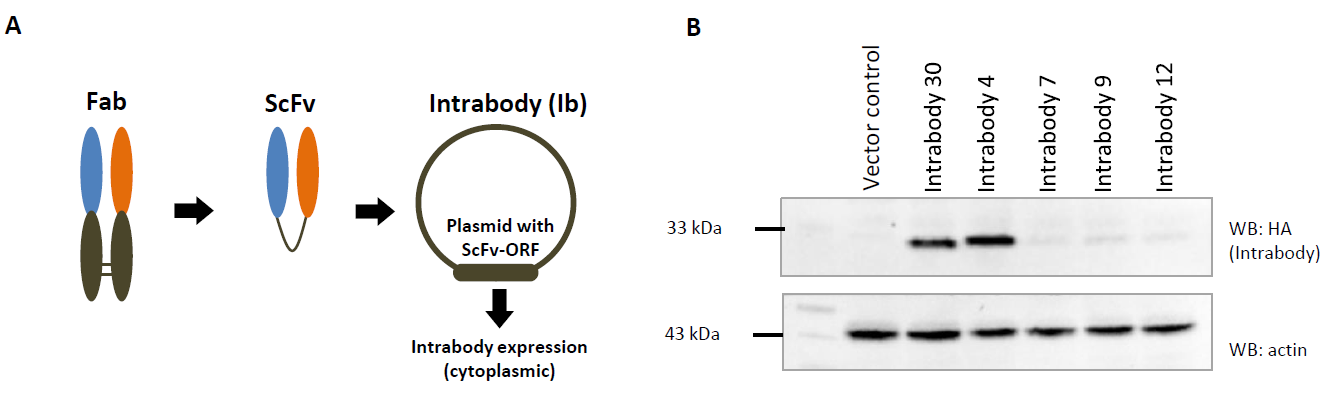
Conversion of FABs into intrabodies and their expression analysis.
A. Schematic representation of conversion of FABs into ScFv (Single Chain Variable Fragment) format for intracellular expression as intrabodies.
B. Expression profile of intrabodies in HEK-293 cells visualized by Western blotting. Lysate prepared from HEK-293 cells expressing the indicated intrabodies with carboxylterminus
HA tag were separated on SDS-PAGE followed by visualization using anti-HA antibody.
[/caption]

In this study however, they generated antibodies against beta-arrestins in the laboratory using protein-design approaches and produced them in bacteria without any animal immunization. Some of these antibodies selectively latch on to beta-arrestins, only when they are in contact with the receptors. They then attached fluorescence proteins to these antibodies and follow their localization in live cells using microscopy.

They observed that our antibodies act as powerful biosensors to report a receptor activation for a broad set of GPCRs, that is, when the receptor encounter their chemical ligands. These biosensors allow them to directly follow the movement of these receptors and beta-arrestins inside live cells. An important insight, which was somewhat unanticipated, that emerged from this study is that different receptors affect the overall shape of beta-arrestins differently when they interact with each other. This provides a possibility of selective targeting of different GPCRs, for example by clinically used medicines, to minimize their side effects.

Going forward, these biosensors can potentially be used in studying these receptors in their native context, that is, in the tissues of animals. More importantly, the platform to generate these antibodies without using animals can be applied to other proteins as well, and therefore, open new solutions to long standing challenge of generating high quality antibodies for life science research.

About IIT Kanpur

IIT Kanpur, an institute of national importance, was set up in 1959 and is currently celebrating its Diamond Jubilee. The Institute's 40,000+ alumni are experts and visionaries in various fields and many of them occupy leading positions all over the globe. The Institute has a strong focus on research and innovation as is set out in its vision statement "To create, disseminate and translate knowledge in science, engineering and allied disciplines that will best serve the society." The Institute's Startup Innovation & Incubation Center supports startups and encourages the spirit of innovation amongst the students of IIT Kanpur by providing guidance, access to infrastructure facilities and funding.

With over 20 departments and inter-disciplinary programs, IIT Kanpur has a long history of supporting promising research and encourages its faculty and students, to undertake meaningful research and contribute to society.

The faculty members at IIT Kanpur have been recipients of several national and international awards including Padma Shri, Fulkerson Prize, Goedel Prize, Member of US National Academy, Infosys Prize, Humboldt Research Award, Shanti Swarup Bhatnagar Award, TWAS Prize, National J.C. Bose Fellowship, Fellowships of National Academy of Sciences India (NASI),Indian National Science Academy (INSA), Indian Academy of Science (IASc), Indian National Academy of Engineering (INAE). For more information, visit https://www.iitk.ac.in .

~ Published via PTI with Headline changed

[Top Image ~ PDF Report at JBC.Org]

Market Reports

Market Report & Surveys
IndianWeb2.com © all rights reserved