‏إظهار الرسائل ذات التسميات IAMAI. إظهار كافة الرسائل

Union Minister Shri Rajeev Chandrasekhar to Deliver Keynote at India’s Largest Online Gaming Convention on December 5

Union Minister Shri Rajeev Chandrasekhar to Deliver Keynote at India’s Largest Online Gaming Convention on December 5

The Internet and Mobile Association of India (IAMAI), in collaboration with the Federation of Indian Fantasy Sports (FIFS) and the E-Gaming Federation (EGF) is all set to organise the first edition of the nation’s largest gaming conference, the Indian Gaming Convention (IGC), on December 5, 2023, at the Taj Palace, New Delhi. Shri Rajeev Chandrasekhar, Minister of State for Skill Development and Entrepreneurship, and Electronics and Information Technology, Government of India, will deliver the keynote address at the valedictory session.

Leading policymakers, regulators, gaming industry captains, marketers, game developers and service providers will converge on one platform to address the IGC, which is expected to draw more than 700 delegates, including senior professionals of the online gaming ecosystem of the country.

Indian Gaming Convention (IGC)

Among stalwarts of the gaming landscape who will share their insights at the IGC will be Dr. Trivikraman Thampy, Co-founder, Games24x7; Dilsher Singh Malhi, Founder & CEO, Zupee; Salone Sehgal, General Partner, Lumikai; Ishita Grover, Director (Marketing), Oneplus; Deepak Jacob, General Counsel, DreamSports, and Anuraag Saxena, CEO, EGF.

International speakers, addressing the IGC will include Jean Major, a former Canadian regulator currently on the Board of the Ontario Lottery and Gaming Commission, and Sarah Ramansaukas, a player safety expert from the UK, who co-founded The Game Safety Institute.

Elaborating on the context of the Convention Harsh Jain, Chairman, IAMAI and CEO and Co-founder Dream Sports, said, “2023 has been a defining year for India’s Online Gaming industry, marked by multiple positive developments like MeitY’s appointment as our nodal ministry, notification of the IT regulations and clarity on taxation. These developments will facilitate the industry’s sustainable and responsible growth over the long term. I look forward to insightful discussions at IGC, where the focus will be on exploring collaborative strategies between industry, Government, and the ecosystem to enable a safe, trusted, and accountable Indian online gaming industry that can emerge as the global hub for gaming.”

Bhavin Pandya, Chairman of the IAMAI Online Gaming Committee, and Co-founder & Co-CEO of Games24X7 said, “The Indian online gaming industry is going through a tectonic shift, with 2023 being a landmark year in its evolution. Key tax and policy frameworks have laid a robust foundation for the online gaming sector, but there is a long way to go from here. This underscores the need for platforms like the Indian Gaming Convention (IGC) where open and honest dialogues between industry and government, stakeholders and partners, and visionaries and innovators are earnestly facilitated. Such platforms are crucial for our industry to seize opportunities and face challenges collectively. I'm confident that the IGC will evolve into a central platform which will play an instrumental role in shaping the future of the online gaming industry in India.”

More than 35 of subject-experts will deliberate upon the opportunities and challenges before India’s online gaming industry 360 degrees in 10 of sessions, including keynotes, fireside chats, and panel discussions. Some of the key sessions of the IGC will be on “Future of Gaming: Fuelling Innovation to Make India a Global Gaming Hub”, “Empowering the Digital Landscape: Online Gaming's Role in Fueling Digital India”, ”Building a Robust National Regulatory Framework for Online Gaming”, “Investor Insights: How Can the Industry Build Through Regulatory Shifts”, “Gaming's Role in Promoting Culture, Education, and Sports”, and “Voices of the Game: Online Gaming in India, A User-Speaks Experience”.

Value Leaf is the Platinum Partner of the IGC, and it is being supported by the Government of Telangana.

For more information on India’s largest gaming convention please visit IAMAI Event | Indian Gaming Convention

About IAMAI:

Established in 2004, the Internet and Mobile Association of India (IAMAI) is a not-for-profit industry body and the country's only organization representing the digital services industry with over 550 Indian and multinational corporations as its members. IAMAI is dedicated to presenting a unified voice of the businesses it represents to the government, investors, consumers, and other stakeholders. IAMAI represents varied sectors such as digital payments, fintech, digital commerce, digital advertising, digital entertainment, traveltech, online gaming, edtech, healthtech, agritech, big data, ML, AI & IoT, AR/ VR, logistics-tech, D2C, EV, VC, gift cards, and so on.


IAMAI Members Flag Concerns Regarding Ex-Ante Regulations

IAMAI Members Flag Concerns Regarding Ex-Ante Regulations
In their written submission to the Committee on Digital Competition Law (CDCL), the Internet and Mobile Association of India (IAMAI) members voiced their opposition to ex-ante regulations for digital markets in India.

According to IAMAI, size or scale-based applicability of regulations under an ex-ante digital competition policy will impact larger players in the market in their growth trajectory, while also limiting the growth potential of start-ups.

Regulations that kick in as soon as certain financial/size-based thresholds are met, will disincentivise Indian tech companies from scaling so as to avoid additional regulations. It is pertinent to note that ex-ante regulations may affect Indian companies even before they can achieve scale to compete globally or achieve profitability. This in turn will reduce value creation and valuations.

India has already experimented with ex-ante regulations under the Monopolies and Restrictive Trade Practices (MRTP) Act, 1969. Size-based applicability of regulations under the MRTP Act limited the growth and scaling up of Indian companies. Notably, as part of various economic reform measures, India consciously moved away from an ex-ante regime under the MRTP Act. Taking competition policy for India’s digital sector back to the MRTP era will burden India’s most promising sector and inhibit its ability to scale, innovate and attract investments.

IAMAI members appreciate that antitrust enforcement has a vital role to play in keeping markets competitive. They are of the view that the extant rules and regulations sufficiently address competition concerns arising from the digital sector, while keeping the digital industry on a level playing field with other industries. The Competition Commission of India (CCI) has been promptly looking into various digital competition issues and has passed orders imposing penalties and requiring changes in the conduct of digital markets. Furthermore, the recent Competition (Amendment) Act, 2023 bolsters the existing regulatory framework for addressing competition issues in India.

About Internet and Mobile Association of India

Established in 2004, the Internet and Mobile Association of India (IAMAI) is a not-for-profit industry body and the country's only organization representing the digital services industry with over 500 Indian and multinational corporations as its members, which include established companies in diverse sectors of the digital ecosystem as well as start-ups. Its mandate is to expand and enhance the online and mobile value-added services sectors. It is dedicated to presenting a unified voice of the businesses it represents to the government, investors, consumers and other stakeholders. IAMAI represents varied sectors such as digital advertising, digital entertainment, traveltech, online gaming, digital payments, fintech, digital commerce, edtech, healthtech, agritech, big data, ML, AI & IoT, AR/ VR, logistics-tech and so on. 


Draft IT Rules on Online Gaming: Right on Intention, Poor on Scoping: IAMAI

Draft IT Rules on Online Gaming: Right on Intention, Poor on Scoping: IAMAI

The Internet and Mobile Association of India (IAMAI www.iamai.in) in a statement released today has said that the draft IT Rules on online gaming are right on intention, but poor on scoping.

The proposed Rules are a very positive development for the online gaming industry ecosystem for three reasons: a) they would create a legal framework for orderly and accelerated development of the industry. b) provide for very strong consumer safety measures and, most importantly, c) allow the industry to be self-regulated. These measures by bringing in recognition and regulatory certainty will allow for innovations and investments in the industry.

However, IAMAI members have also pointed out in a submission to the Union Ministry of Electronics and Information Technology (MeitY) that the scoping of the rules has been done poorly and the following aspects need a major re-look. A) Definition of gaming and what is sought to be regulated. Here the members of the association feel that the definition of online gaming is too broad and vague and would unnecessarily bring under regulation and expensive compliance a set of firms that do not need to be regulated or need to be very lightly regulated. B) Certain provisions of the draft also seem to imply that service providers or partners that advertise, publish or host online games will have to comply with the Rules by verifying each game with the self-regulatory body (SRB) on an ongoing basis making it impractical. Intermediaries must not be obligated to ascertain and verify the registration of online games. C) Most importantly, the scoping of the SRB is not strong enough: the industry has asked for a retired Judge since ultimately the role of the SRB would be adjudication and the industry has asked for common principles by which gaming SRBs are governed.

Established in 2004, the Internet & Mobile Association of India (IAMAI) is a not-for-profit industry body and the country's only organization representing the digital services industry with over 400 Indian and multinational corporations as its members, which include established companies in diverse sectors of the digital ecosystem as well as start-ups. Its mandate is to expand and enhance the online and mobile value-added services sectors. It is dedicated to presenting a unified voice of the businesses it represents to the government, investors, consumers and other stakeholders. IAMAI represents varied sectors such as online gaming, digital advertising, digital entertainment, TravelTech, digital payments, Fintech, digital commerce, Edutech, Healthtech, Agritech, blockchain, Big data, ML, AI & IoT, AR/ VR, LogisticsTech and so on

Digital Personal Data Protection Bill Industry-Friendly: IAMAI

Digital Personal Data Protection Bill Industry-Friendly: IAMAI

The Internet and Mobile Association of India (IAMAI, www.iamai.in) in a statement issued today has lauded the Digital Personal Data Protection Bill (DPDP) as industry-friendly. It has struck the right balance between protecting the interests of the data principals while leaving enough room for tech start-ups to innovate and grow.

According to the feedback received from the majority of IAMAI members, the reconceptualization of the data protection framework in the DPDP to balance innovation and economic growth with the interests of users will go a long way to assuage concerns of digital businesses and help make India a trillion-dollar digital economy by 2025. In particular, IAMAI appreciates the more liberalized framework for cross-border data flows and the exclusion of non-personal data from the ambit of the DPDP Bill. IAMAI also appreciates that the Bill imposes only financial penalties for non-compliance as opposed to both financial and criminal penalties.

Commenting on the Bill, Dr. Subho Ray, president, IAMAI stated, “By following a deep and wide process of consultation including that of a joint parliamentary committee, excluding non-essential provisions, by making a clear commitment that no Rules exceeding the provisions of the Act would be made, and yet protecting the interests of the state, citizens and the digital economy, this Bill has possibly set up new standards of law-making”.

On behalf of its members, the association has requested the government to provide clarifications regarding the DPDP so that once it is passed into an Act, there is better compliance by IAMAI members. In particular, there remain ambiguities surrounding the timelines for implementing the various provisions of the Bill and mechanisms for obtaining verifiable parental consent to process the personal data of children. As the inclusion of specific timelines will provide a roadmap for the industry to better comply with the Bill, IAMAI has requested the government to clearly indicate reasonable timelines by which the various provisions of the DPDP will be implemented and to adopt a graded approach to prescribing such timelines. IAMAI has also urged the government to consider a flexible approach to obtaining parental consent, as prescriptive mandates may have an adverse cascading impact on sectors that provide services to younger individuals.

IAMAI is confident that through consultation and collaboration, the final version of the law will help stakeholders who are invested in and committed to the digital ecosystem of India.

About Internet and Mobile Association of India

Established in 2004, Internet and Mobile Association of India (IAMAI) is a not-for-profit industry body and the country's only organization representing the digital services industry with over 400 Indian and multinational corporations as its members, which include established companies in diverse sectors of the digital ecosystem as well as start-ups. Its mandate is to expand and enhance the online and mobile value-added services sectors. It is dedicated to presenting a unified voice of the businesses it represents to the government, investors, consumers and other stakeholders. IAMAI represents varied sectors such as digital advertising, digital entertainment, traveltech, online gaming, digital payments, fintech, digital commerce, edtech, healthtech, agritech, big data, ML, AI & IoT, AR/ VR, logisticstech and so on

‘Willful Misinterpretation of How Digital Economy Works’: IAMAI on Ill-Conceived Recommendations on Draft Telecom Bill from A Section of The Industry

IAMAI on Ill-Conceived Recommendations on Draft Telecom Bill

The Internet and Mobile Association of India (IAMAI) in a statement on Friday said that it was appalled at the regression and denigration of the discussion around regulating the digital economy. Far from the government’s stated goal of creating a 1 trillion-dollar digital economy, part of the telecom infrastructure industry has sought to reignite discussions that threaten to erase the progress the Indian tech industry has achieved thus far.

Data released by the Union Ministry of Electronics and Information Technology (MeitY) shows that India’s digital economy has grown tremendously over the past decade, generating over 200 billion US dollars of economic value each year. Integral to this growth has been the compartmentalisation of legislations regulating carriage and content. By regulating carriage and content separately, India has enabled the growth of both OTT service providers as well as traditional telecommunication service providers. The rapid creation of India’s 100+ unicorns is a testament to this phenomenon. Despite this astronomical growth that has allowed India to leapfrog into becoming a global start-up hub, the recently concluded consultation on the Draft Telecom Bill betrays either a wilful misinterpretation or a fundamental lack of understanding of how the digital economy works.

An Industry body representing the telecom infrastructure sector has championed the creation of revenue -sharing mechanisms for ‘Over the Top’ (OTT) Layer within the ambit of the Draft Telecom Bill. The implications of this move would be as far-ranging as they would be devastating. Creating room for licensing provisions applicable to over-the-top service providers presents an existential threat to India’s start-up ecosystem by creating herculean barriers to entry. Not only would this mean that aspiring Indian start-ups which are still evolving and developing their business and monetisation models will risk massive compliance costs in their infancy, but also would mean that foreign investors bullish on Indian start-ups may experience a chilling effect owing to the drastic policy uncertainty.

Despite this, certain policy experts continue to propagate fantasies about equitable contributions from stakeholders within the OTT layer, which would only seem to strengthen the gatekeeping abilities of the owners of the infrastructural layer on which OTT services operate. These changes would only establish additional sources of revenues for well-established sectors while leaving the start-up ecosystem vulnerable to compliance costs even when they may be pre revenue.

IAMAI, in its letter to the DoT, expressed grave concern about the impact of these changes on India’s start-up ecosystem and the digital economy. IAMAI also sought to illustrate the success of the extant regulatory framework facilitated the creation of 100+ unicorns and 200+ billion dollars of growth, achievements which have enabled India to dream of a 1 trillion-dollar digital economy.

Considering this, IAMAI has recommended that the scope of telecommunication services be reviewed and be limited to only services which distribute spectrum in a utilisable form. The time-tested distinction between telecom spectrum-controlling entities and spectrum-using companies should be maintained as it has been the basis that has allowed innovation and deeper penetration of the internet in India.

About IAMAI

Established in 2004, the Internet & Mobile Association of India (IAMAI) is a not-for-profit industry body and the country's only organization representing the digital services industry with over 400 Indian and multinational corporations as its members, which include established companies in diverse sectors of the digital ecosystem as well as start-ups. Its mandate is to expand and enhance the online and mobile value-added services sectors. It is dedicated to presenting a unified voice of the businesses it represents to the government, investors, consumers and other stakeholders. IAMAI represents varied sectors such as digital advertising, digital entertainment, TravelTech, online gaming, digital payments, Fintech, digital commerce, Edutech, Healthtech, Agritech, blockchain, Big data, ML, AI & IoT, AR/ VR, LogisticsTech and so on.

For any query please contact: Nilanjan Hajra, Associate Vice President. E-mail ID: h.nilanjan@IAMAI.in Mobile Ph. No. 9163788318

Tech-led Surgeries: IAMAI Releases Self-Guiding Code of Conduct


IAMAI Releases Self-Guiding Code of Conduct For New Age Models in Surgical Care

The Internet And Mobile Association of India (IAMAI) released a Self-Guiding Code of Conduct (SGCC) for New Age Models in Surgical Care today in the presence of Dr. K Madan Gopal, Senior Consultant (Health), NITI Aayog. Being one of the largest sectors of the Indian economy, healthcare needs constant improvement including access to quality healthcare for everyone. Working to achieve that, the Code of Conduct for all the leading healthcare service provider companies, aims to guide all New Age Models to serve their communities and patients in the best possible manner.

The Code of Conduct will ensure complete transparency, offer access to cutting-edge technology for surgeries, postsurgical care, last-mile connectivity, and create a comprehensive patient-centric ecosystem.

Launch of IAMAI's Code of Conduct

Formally releasing the SGCC, Dr. K Madan Gopal said, “Establishing the Code of Conduct for leading healthcare companies will ensure that access to quality healthcare reaches every patient. The Code of Conduct is backed by strong tech support and I am hopeful that the new age models can transform clinical interventions to make India’s healthcare more inclusive.”

Speaking about the initiative, Dr Alexander Kuruvilla, Co-Chair, IAMAI HealthTech Committee, and Chief Healthcare Strategy Officer, Practo said, "As partners in the healthcare industry, we have a huge responsibility on our shoulders i.e. to serve, and it is imperative that we live up to this with utmost adherence. With that in mind, the IAMAI Self-Guiding Code of Conduct (SGCC) is a step in the right direction. It will ensure that digital healthcare companies set themselves to the highest professional standards thereby ensuring that quality of care is never compromised. Self-regulation is the first step towards creating a lasting impact and truly transforming healthcare in the country."

Dr Vaibhav Kapoor, Chair, IAMAI Sub Committee on New-Age Model in Surgical Care, and Co-Founder, Pristyn Care said, “The Self-Guiding Code of Conduct (SGCC) outlines a clear, progressive framework for New Age Models in Surgical Care to best engage with their patients, partner hospitals, healthcare professionals and insurers.” These voluntary guidelines are designed to build a truly patient-centric, universal healthcare ecosystem in India, wherein new-age care providers comply with the highest professional standards to deliver enhanced clinical outcomes at affordable cost, Dr Kapoor added.

The key components of the Code of Conduct include responsible communication, care coordinators for safe and effective care, relationship with healthcare professionals and Partner Hospitals, insurance & billings, and customer grievances. All members need to voluntarily commit to the above-mentioned elements.

The SGCC for New Age Models in Surgical Care may be downloaded from this link: https://eventsites.iamai.in/IAMAISelfRegulatoryCodeofConduct.pdf

About Internet and Mobile Association of India

Established in 2004, Internet and Mobile Association of India (IAMAI) is a not-for-profit industry body and the country's only organization representing the digital services industry with over 400 Indian and multinational corporations as its members, which include established companies in diverse sectors of the digital ecosystem as well as start-ups. Its mandate is to expand and enhance the online and mobile value-added services sectors. It is dedicated to presenting a unified voice of the businesses it represents to the government, investors, consumers and other stakeholders. IAMAI represents varied sectors such as digital advertising, digital entertainment, traveltech, online gaming, digital payments, fintech, digital commerce, edtech, healthtech, agritech, big data, ML, AI & IoT, AR/ VR, logisticstech and so on.

Rural India Takes Driving Seat in India’s Internet Usage Growth — IAMAI KANTAR Report

Rural India Takes Driving Seat in India’s Internet Usage Growth — IAMAI KANTAR Report

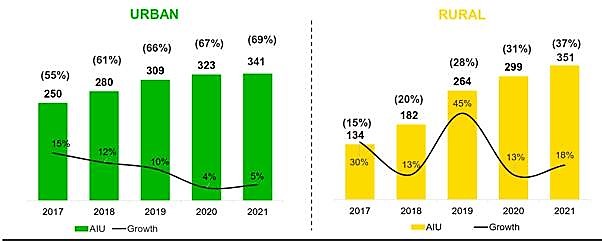
The recently released IAMAI KANTAR report titled ‘Internet in India’, based on ICUBE 2021 study, reflects a remarkable surge in internet users in rural India. According to the report, at present there are 692 million active internet users in India, and much of the growth continues to be driven by rural India (351 Mn users with 37% penetration), as urban India seems to have hit a plateau (341 Mn users with 69% penetration). The report also estimates that there will be 900 million internet users in India by 2025 led by rural growth. In terms of states, Goa has the maximum internet penetration while Bihar has the lowest.

Base: ICUBE 2021, All India Population 1454 Million, Urban India 496 Million, Rural India 958 Million, (Numbers in bracket indicate internet penetration)
Source: Internet in India 2021, IAMAI- KANTAR

More importantly for internet businesses in India, around 346 million Indians are engaged in actual online transactions such as e-commerce and digital payments, a number which is greater than the total US population estimated at 331 million. The global pandemic witnessed a record 51% increase in digital transactions in just two years from 230 Mn in 2019 in India.

In terms of gender break-up, there are more male internet users in India than female users, with almost similar gender ratios across both urban and rural users.

In terms of user cases, Entertainment, Communications and Social media are the top three activities engaged in by internet users across India. While Communications using text and e-mail is the most popular usage, the survey suggests that Voice and Indic languages usage will be the key drivers of growth in the future with two out of five rural internet users having done voice-based activities on their phones. The penetration of OTT services in rural India is at par with that in urban India, however, the penetration of other digital services such as online gaming, digital commerce and digital payments is still skewed in favour of urban users. This reflects a large head room for growth of such services among the rural population.

Base: ICUBE 2021, Non-Active Internet Users, All India 762 Million, Urban India 155 Million, Rural India 607 Million
Source: Internet in India 2021, IAMAI- KANTAR

At present around 762 Mn Indians have not adopted internet yet, out of which 63% are rural Indians. ‘Difficulty to understand the Internet’, continues to be primary deterrent along with lack of awareness, especially in rural India.

Base: ICUBE 2021, Active Internet Users, 692 Million, Urban India 341 Million, Rural India 351 Million (Number in bracket indicate penetration)
Source: Internet in India 2021, IAMAI- KANTAR

About ‘Internet in India’ report

‘Internet in India’ report based on the ICUBE 2021 study, covering over 77,000+ households across all states and Union Territories of India (barring Lakshadweep), is an annual report which is the oldest and most comprehensive survey of internet usage in the country. The report is jointly prepared by Internet and Mobile Association of India (IAMAI) and KANTAR, the world’s leading marketing data and analytics company.

About Internet and Mobile Association of India

Established in 2004, the Internet and Mobile Association of India (IAMAI) is a not-for-profit industry body and the country's only organization representing the digital services industry with over 400 Indian and multinational corporations as its members, which include established companies in diverse sectors of the digital ecosystem as well as start-ups. Its mandate is to expand and enhance the online and mobile value-added services sectors. It is dedicated to presenting a unified voice of the businesses it represents to the government, investors, consumers and other stakeholders. IAMAI represents varied sectors such as digital advertising, digital entertainment, TravelTech, online gaming, digital payments, Fintech, digital commerce, Edtech, Healthtech, Agritech, blockchain, Big data, ML, AI & IoT, AR/ VR, LogisticsTech and so on.

About Kantar

Kantar is the world’s leading marketing data and analytics company. We have a complete, unique and rounded understanding of how people think, feel and act; globally and locally in over 90 markets. By combining the deep expertise of our people, our data resources and benchmarks and our innovative analytics and technology, we help our clients understand people and inspire growth.

India’s Global Competitiveness Intricately Tied to Proficiency at Adopting AI: Shri Amitabh Kant, CEO, Niti Aayog

India’s Global Competitiveness Intricately Tied to Proficiency at Adopting Ai: Shri Amitabh Kant, CEO, Niti Aayog

“The long-term success of the Indian ecosystem and India’s global competitiveness will intricately be tied to our proficiency at adopting and leveraging AI at scale, especially in the larger enterprise context,” said Shri Amitabh Kant, CEO, Niti Aayog speaking at the 5th edition of the Digital Transformation Summit, organised by Internet and Mobile Association of India (IAMAI) today in Mumbai. 

Mr Kant also released a report, titled, ‘From Buzz to Reality: The Accelerating Pace of AI in India’, prepared by Bain & Company in collaboration with Microsoft and IAMAI. Shri Kant said, “Artificial Intelligence is now more important than ever, not only is its use becoming ubiquitous, its adoption is central for private sector companies to remain globally relevant.” Underlining the importance of using AI responsibly, he added, “The promise of AI presents a wealth of opportunities -- there are key privacy, data security and ethical considerations that have to be accounted for. Responsible management of AI in India is key to leveraging benefits of AI while minimising the risks.”

The Summit brought together various stakeholders covering new age technology developers, enterprise solution providers, adopters, policy makers, knowledge partners and think tanks on one platform to analyse and discuss the roadmap of Digital Transformation in the near future.

Over various sessions industry leaders discussed various issues related to AI, Web3, Metaverse. Among those who attended the conference were Mr. MVS Murthy, Head – Marketing, Digital, Corp Comm, Tata Mutual Fund; Mr. Milan Seth, EVP IMEA Region- Automation Anywhere, and Mr. Poorav Sheth, Chief Digital Officer, Godrej & Boyce.

Mr. Milan Sheth, Chair, Automation Committee, IAMAI & EVP IMEA Region, Automation Anywhere, said, "Digital transformation has gone from push to pull, with more organisations demanding integration of newer technologies."

Speaking at a session on data security solutions for digitalized enterprises, Mr. Brijesh Singh, Additional Director General of Police, Govt. of Maharashtra, said, “The regulatory environment is getting tightened in India when it comes to cyber security.”

“Web 2.0 based applications made start-ups much easier to grow and operate, similarly web 3 will make global applications easy to build and use,” said Sandeep Laxman, Head Fintech Business Development, Amazon Web, discussing the future business models with web 3 and metaverse.

Different sessions were held on digital transformation strategy, work management 5.0, future of connected vehicle experience, data security and data-driven decision making. Over 300 delegates, more than 250 companies and over 50 speakers took part in the Digital Transformation Summit.

About IAMAI

Established in 2004, the Internet & Mobile Association of India (IAMAI) is a not-for-profit industry body and the country's only organization representing the digital services industry with over 400 Indian and multinational corporations as its members, which include established companies in diverse sectors of the digital ecosystem as well as start-ups. Its mandate is to expand and enhance the online and mobile value-added services sectors. It is dedicated to presenting a unified voice of the businesses it represents to the government, investors, consumers and other stakeholders. IAMAI represents varied sectors such as digital advertising, digital entertainment, TravelTech, online gaming, digital payments, Fintech, digital commerce, Edutech, Healthtech, Agritech, blockchain, Big data, ML, AI & IoT, AR/ VR, LogisticsTech and so on.

Enabling and Futuristic Regulatory Framework Required to Harness the Full Potential of NFTs in India: IAMAI ESYA Centre Report


An enabling and future-proof regulatory and legal framework is required for Non-Fungible Tokens (NFT) to help the Indian economy derive full benefits of the technological innovation. A recent report by the Esya Centre, in association with the Internet and Mobile Association of India [IAMAI] titled “NFTs: A Technological and Legal Primer”, suggests that while several jurisdictions have introduced laws and regulations to govern cryptoassets, no country has yet proposed an overarching regulation for NFTs, given the emergent legal and regulatory concerns associated with their use. The report also identifies several regulatory and legal challenges presently being faced by NFT in India, which impedes their growth and adoption.

Non-Fungible Tokens are a form of code/software that help prove ownership of digital and physical goods in the virtual realm, something which was not feasible earlier. As a result, NFTs can be used for several different purposes, such as digital art, collectibles, fashion and finance.

The report sheds light on the growing involvement of Indians in all aspects of the NFT value chain. For instance, Polygon, a blockchain founded by three Indian developers, is increasingly preferred by leading marketplaces and artists to create and host their NFTs. Similarly, NFT marketplaces that cater specifically to the interests of the Indian public have also come up. For example, Rario creates NFTs based on highlights and notable events from cricket matches. Indian celebrities, such as Amitabh Bachchan, have also used NFTs to engage with their fans.

Commenting on the report, IAMAI president, Dr Subho Ray said: “The Primer is intended to raise awareness among policymakers about different types of NFTs and their future possibilities. Each possibly needs to be regulated and taxed differently and not with a single broad brush of ‘virtual assets’.”

The report highlights the legal and regulatory concerns that must be addressed to fuel the NFT ecosystem’s growth. Report co-author Mohit Chawdhry, Junior Fellow at Esya Centre, said that some of these concerns “stem from the potential use of NFTs for money laundering, tax evasion and infringement of intellectual property rights” and must be resolved. In addition, “greater clarity on the FDI caps on NFT marketplaces and their obligations under the Foreign Exchange Management Act will also help bolster the ecosystem,” he added.

The report lays out suggestions for policymakers, entrepreneurs, developers and creators to consider to help promote a healthy growth of the industry. The report also addresses the issues of copyright and IPR associated with NFT that both creators and dealers of NFT need to be aware of before engaging with NFT assets.

About IAMAI

The Internet and Mobile Association of India [IAMAI] is a young and vibrant association with ambitions of representing the entire gamut of digital businesses in India. It was established in 2004 by the leading online publishers, and in the last 16 years has come to effectively address the challenges facing the digital and online industry including mobile content and services, online publishing, mobile advertising, online advertising, digital entertainment, ecommerce and mobile & digital payments among others.

Sixteen years after its establishment, the association is still the only professional industry body representing the online industry in India. The association is registered under the Societies Act and is a recognized charity in Maharashtra. With a membership of nearly 300 Indian and overseas companies, and with offices in Delhi and Mumbai the association is well placed to work towards charting a growth path for the digital industry in India.

About Esya Centre

The Esya Centre is a New Delhi based think tank that aims at generating empirical research and informing thought leadership to catalyse new policy constructs for the future. It simultaneously builds institutional capacities for fostering ideas which enjoin the triad of people, innovation and value, consequently helping reimagine the public policy discourse in India. More information can be found on www.esyacentre.org

Union Budget Reflects the Govt’s Aim to Create a Robust and Inclusive Digital Economy: IAMAI


The Internet and Mobile Association of India [IAMAI] welcomes the Budget 2022 for its commitment to creating a robust and inclusive digital economy. “This year the Union Budget has an all-round focus on digital economy from creating an access infrastructure, to harnessing digital for social sectors such as agriculture, education and healthtech to promoting digital startups” said Dr Subho Ray, President, IAMAI.

From the digital payments and fintech sector, Mr. Vishwas Patel, PCI Chairman and Director Infibeam Avenues said, “The formal announcement on launch of India’s CBDC - the Digital Rupee, was a much awaited and positive move, and will trigger a wave of preparatory activity amongst retail payments providers and applications to offer payment mechanisms using the Digital Rupee. We are also very pleased to note that, 100% of 1.5 lakh post offices will come under core banking system, enabling financial inclusion which will be helpful for farmers and senior citizens in rural areas.”

The social sector representatives too reflected positively on the Union Budget. Mr. Mayank Kumar, Chair, India Edtech Consortium and Co-founder and Managing Director, upGrad remarked "… Changes like introducing digital universities, development of e-content in vernacular languages, expanding of 'one class one TV channel' programme from 12 channels to 200 channels under the PM e-Vidya scheme, and the overall increased financial allocation will not just accelerate digital learning but will improve the growth prospect for the ecosystem. Another critical aspect which has been covered is the skill gap situation - with the launch of the Digital DESH e-portal for skilling, upskilling, and reskilling for the youth, we are sure to witness a more dynamic sector with value additions like better employability and strengthened economy".

On a similar vein, Ms Divya Gokulnath, Co-Chair, India Edtech Consortium, co-founder and director of Byju's noted "The Budget announcement goes a long way in acknowledging Edtech's importance to education in India. The focus on setting up a digital university as well as government's promise to deliver high quality e-content in all spoken languages for delivery via internet, mobile phones, tv, radio and digital teachers will incentivize the Indian Edtech sector and further consolidate its position as world leader. The Budget also confirms that Edtech will play an integral role in bridging gaps in education caused by the pandemic."

“The budget announcements are mainstreaming India’s digital economy. It points to deepening role of tech across sectors – from agri to education to health to financial services – in making value chains efficient and resilient. The finance minister is also opting for innovative financing of capital investments. Sovereign green bonds, co-invested and thematic funds in deep-tech, digital and climate action to be managed by private asset managers are steps in right direction. The extension of tax incentives to startups will further boost the entrepreneurial momentum,” reflected Mr. Vikas Agnihotri, Chairman, IAMAI Venture Capital Committee and Operating Partner, SoftBank Investment Advisers.

Welcoming the AVGC Promotion Task force, Mr. Manish Agarwal, Chair, IAMAI Digital Gaming Committee and CEO, Nazara Technologies responded “India is now becoming a global talent hub for the gaming industry. With ‘AatmaNirbhar Bharat’, ‘Make in India’ and Animation, Visual Effects, Gaming and Comics (AVGC) taskforce, Indian game developers will create huge returns and help India position itself as a market leader. Skill Based Games played for real money + Competitive multiplayer + eSports will drive the overall gaming market going forward."

"We welcome the Hon’ble Finance Minister's announcement to set up an AVGC Promotion Task Force to provide a much-needed boost to the sector. The announcement highlights the need to build capacity to serve both domestic and global markets and is a strong indicator of the impetus that the government is willing to provide for its growth. It is also heartening to see the government's commitment to work with the industry, allowing for a balanced approach that accommodates the needs of all stakeholders and strengthens the ecosystem holistically. A progressive tax regime, predictable regulatory framework and supportive funding policies will allow the industry to compete on the world stage and fulfil the Hon’ble Prime Minister’s vision for the Indian digital gaming sector to be a global powerhouse." Mr. Sai Srinivas, Co-chair, IAMAI Digital Gaming committee and Co-Founder and CEO, Mobile Premier League (MPL) said in his reactions.

The budget provides clarity on taxation and shows the government’s intent to take a business-friendly approach while protecting the interest of consumers and the exchequer. We hope to work with the government to help bring crypto-asset taxation at par with other asset classes and participate in the central government’s vision to promote economic growth” responded Mr. Ashish Singhal, Co-chair Blockchain and Crypto Assets Council (BACC) and Founder and CEO, CoinSwitch.

Mr. Sumit Gupta, Co-Chair of Blockchain and Crypto Assets Council (BACC) and Co-founder and CEO, CoinDCX, said, “The budget is forward-looking and inspirational. It has touched key points that'll help us create modern, powerful, digital, and sustained growth”

About IAMAI

The Internet and Mobile Association of India [IAMAI] is a young and vibrant association with ambitions of representing the entire gamut of digital businesses in India. It was established in 2004 by the leading online publishers, and in the last 16 years has come to effectively address the challenges facing the digital and online industry including mobile content and services, online publishing, mobile advertising, online advertising, digital entertainment, ecommerce and mobile & digital payments among others.

Sixteen years after its establishment, the association is still the only professional industry body representing the online industry in India. The association is registered under the Societies Act and is a recognized charity in Maharashtra. With a membership of nearly 300 Indian and overseas companies, and with offices in Delhi and Mumbai the association is well placed to work towards charting a growth path for the digital industry in India.

Startups are the Agents of Change and Pillars for Making India Aatmanirbhar: Shri Piyush Goyal

Image - Flickr/World Economic Forum


Shri Piyush Goyal, Minister of Textiles, Minister of Commerce and Industry and Minister of Consumer Affairs, Food and Public Distribution, Government of India, has said, “Our startups are the agents of change as well as the pillars for making India aatmanirbhar. In barely three years, more than six lakh jobs were created by our startups.”

“Last year alone, two lakh jobs were created. Startups will help India transition from an assembly economy to a knowledge-based economy,” he said while addressing the valedictory session at the 16th edition of India Digital Summit 2022, organised by IAMAI.

He mentioned that 2021 has showcased to the world that India is rising as the world’s favourite startup destination, with 43 startups achieving the status of unicorns in one calendar year. Since the start of India Startup Mission, six years ago, we have already produced 82 unicorns, the world’s third-largest number of unicorns, and have over 60,000 startups registered at DPIIT and there’s a growing recognition of our skilled people, with investors queuing up from around the world to come and participate in this revolution.

He also highlighted that our potential has barely touched the tip of the ice berg and currently the focus is on ease of living, ease of service, and ease of skilling -- reskilling and upskilling and the government is acting as a facilitator. The government has taken a number of steps to strengthen the startup story like – 80% rebate on patent filing fees, 50% on trademark filing fees, relaxation of public procurement norms, seed fund schemes, income-tax exemptions, etc. All these steps have brought in simplification, facilitation and empowerment for our entrepreneurs, he added.

The two -day summit, which concluded yesterday, saw about 2,000 delegates participating at the event. The summit saw over 45 sessions, 150 speakers, 500 brands.

About IAMAI

Established in 2004, the Internet & Mobile Association of India (IAMAI) is a not-for-profit industry body and the country's only organization representing the digital services industry with over 350 Indian and multinational corporations as its members, which include established companies in diverse sectors of the digital ecosystem as well as start-ups. Its mandate is to expand and enhance the online and mobile value-added services sectors. It is dedicated to presenting a unified voice of the businesses it represents to the government, investors, consumers and other stakeholders. IAMAI represents varied sectors like Digital Advertising, Digital Entertainment, TravelTech, Online Gaming, Digital Payments, FinTech, Digital Commerce, Edutech, Healthtech, Agritech, Blockchain, Big-data, ML, AI & IoT, AR/ VR, LogisticsTech etc.


Banning Cryptocurrencies Can Leads to More Unlawful Usage: BACC


The Blockchain and Crypto Assets Council (BACC), of IAMAI, in a statement released to the media, said that a blanket ban on cryptocurrencies will encourage non-state players thereby leading to more unlawful usage of such currencies.

In his recent speech, the Honourable Prime Minister of India had said, "It is important that all democratic nations work together on this (cryptocurrency) and ensure it does not end up in the wrong hands, which can spoil our youth."

IAMAI fully concurs with this view and in its submission before the Supreme Court earlier listed several negative outcomes of a ban such as zero accountability and traceability of the origin and end usage of the cryptocurrencies; besides a complete evasion of taxes. A ban will also adversely impact retail investors.

The Council has always argued in favour of prohibiting the usage of private cryptocurrencies as a currency in India by law since usage as currency is likely to interfere with monetary policy and fiscal controls. On the other hand, the Council has advocated their use only as an asset. The Council believes that a smartly regulated crypto assets business will protect investors, help monitor Indian buyers and sellers, lead to better taxation of the industry, and limit illegal usage of cryptos.

Crypto exchanges based in India offer an effective instrument of monitoring and are dedicated to creating an ecosystem that guarantees investor protection besides bringing both the investors and exchanges under proper tax laws. The Council believes that the efforts of the exchanges should be supported by a law that should enable them to provide safer services to investors and fair taxes to the government.

About BACC

The Blockchain and Crypto Assets Council (BACC) representing crypto exchanges based in India, is mandated to create a transparently regulated crypto asset business in India.

About IAMAI

The Internet and Mobile Association of India [IAMAI] is a young and vibrant association with ambitions of representing the entire gamut of digital businesses in India. It was established in 2004 by the leading online publishers, and in the last 16 years has come to effectively address the challenges facing the digital and online industry including mobile content and services, online publishing, mobile advertising, online advertising, digital entertainment, ecommerce and mobile & digital payments among others. Sixteen years after its establishment, the association is still the only professional industry body representing the online industry in India. The association is registered under the Societies Act and is a recognized charity in Maharashtra. With a membership of nearly 350 Indian and overseas companies, and with offices in Delhi and Mumbai the association is well placed to work towards charting a growth path for the digital industry in India.

Ashish Singhal of CoinSwitch and Sumit Gupta of CoinDCX Appointed Co-Chairs of IAMAI’s Crypto Council

(L-R) Ashish Singhal of CoinSwitch & Sumit Gupta of CoinDCX 

The Blockchain and Crypto Assets Council (BACC), a part of IAMAI whose members are crypto exchanges operating in India and are signatories of a self-regulatory code of conduct that ensures they comply with basic KYC and other regulatory guidelines, has announced the appointment of Ashish Singhal, Founder and CEO, CoinSwitch and Sumit Gupta, Co-Founder and CEO, CoinDCX, as its Co-Chairs.

Singhal and Gupta will be primarily responsible for driving the adoption and growth of the crypto industry in India and ensuring to create a consumer safe environment. India has seen exponential rise in the adoption of cryptocurrency with more than 1.5 crore Indians currently holding crypto assets.

“As cryptocurrencies are getting further mainstreamed in India, the industry is working closely with regulators and policymakers to build a prosperous and secure crypto environment to put India on the global crypto map. We believe that a progressive regulatory framework will foster innovation in financial offerings and bring financial well-being to every Indian,” said Ashish Singhal, Founder and CEO, CoinSwitch Kuber.

Echoing similar views, Sumit Gupta, Co-Founder and CEO, CoinDCX, said: “India today ranks second, in percentage of cryptocurrency ownership across the world. The interest and confidence in the new age asset class will increase as more and more people understand its potential."

“The onus is now on the government and the players to create an inclusive ecosystem. The first step in this direction is to build trust around the product by removing misconceptions and providing user-focused education. Second, increase the availability of cryptocurrency transactions through a transparent, safe, and secure platform. And most importantly, the government should take up the steps and form crypto regulations in India to protect the best interests of crypto investors,” he added.

About BACC

The Blockchain and Crypto Assets Council (BACC) was formed with the vision of doing public advocacy for the crypto industry, to increase awareness about crypto and provide industry guidance. All major crypto exchanges are members of this industry body.

About IAMAI

The Internet and Mobile Association of India [IAMAI] is a young and vibrant association with ambitions of representing the entire gamut of digital businesses in India. It was established in 2004 by the leading online publishers, and in the last 16 years has come to effectively address the challenges facing the digital and online industry including mobile content and services, online publishing, mobile advertising, online advertising, digital entertainment, ecommerce and mobile & digital payments among others. Sixteen years after its establishment, the association is still the only professional industry body representing the online industry in India. 

The association is registered under the Societies Act and is a recognized charity in Maharashtra. With a membership of nearly 300 Indian and overseas companies, and with offices in Delhi and Mumbai the association is well placed to work towards charting a growth path for the digital industry in India.

Online Curated Content Industry Unveils "Universal Self-Regulation Code for OCCPs"


The Internet and Mobile Association of India (IAMAI) today unveiled the Universal Self-Regulation Code for OCCPs (“Code”). The Code has been adopted by 15 leading Online Curated Content Providers in India. The present set of signatories include Zee5, Viacom 18, Disney Hotstar, Amazon Prime Video, Netflix, MX Player, Jio Cinema, Eros Now, Alt Balaji, Arre, HoiChoi, Hungama, Shemaroo, Discovery Plus, Flickstree.

The goal of this industry-wide effort is to empower consumers with information and tools to assist them in making informed choice with regard to viewing decisions for them and their families, while at the same time, nurturing creativity and providing creators the freedom to tell the finest stories. By aiming to do what is best for both consumers and creators as guiding principles, the Code intends for India to be one of the most dynamic and fastest growing entertainment industries in the world.


To give consumers more choice and control, the Universal Self-Regulation Code includes a framework for age classification and content descriptions for titles as well as access control tools. The Code also introduces a clear, transparent and structured grievance redressal and escalation mechanism for reporting non-compliance with the prescribed guidelines. As a part of this mechanism, each OCCP will set-up a Consumer Complaints Department and/or an internal committee, as well as an advisory panel which will deal with complaints, appeals and escalations. The advisory panel will constitute a minimum of three members, including an independent external advisor and two senior executives of the respective OCCP. 


Tarun Katial, Chair, Digital Entertainment Committee, IAMAI said, “The Universal Self-Regulation Code for OCCPs is built around a shared belief that consumer empowerment and creative excellence are key to the long-term success of the Indian entertainment industry. With the Framework for Age Classification, Content Descriptions and parental controls in combination with a grievance redressal system, we’ve made it easier for consumers to make the right viewing decisions for themselves and their families.” 


“The combination of empowering consumers and enabling creative excellence will help Online Curated Content Providers be at the forefront of taking the best stories from India to the world and bringing the finest stories from around the world to Indian consumers. Most of the major streaming services have adopted the Code and we look forward to others joining.” he added.


The Code is effective from 15 August 2020 and allows OCCPs to comply with all the guidelines in a time bound manner. Each signatory to the code has agreed to appoint an external advisor as part of the grievance redressal mechanism within 60 days from today. 


About IAMAI


The Internet and Mobile Association of India [IAMAI] is a young and vibrant association with ambitions of representing the entire gamut of digital businesses in India. It was established in 2004 by the leading online publishers, and in the last 16 years has come to effectively address the challenges facing the digital and online industry including mobile content and services, online publishing, mobile advertising, online advertising, ecommerce and mobile & digital payments among others.


Sixteen years after its establishment, the association is still the only professional industry body representing the online industry in India. The association is registered under the Societies Act and is a recognized charity in Maharashtra. With a membership of nearly 300 Indian and overseas companies, and with offices in Delhi, Mumbai, Bengaluru and Kolkata, the association is well placed to work towards charting a growth path for the digital industry in India.


World's Largest Cryptocurrency Exchange Binance Now Member of India's IAMAI

Malta-headquartered Binance, the largest cryptocurrency exchanges in the world in terms of trading volume, has joined the crypto-asset exchange committee called "FinTech Convergence Council (FCC)" at the Internet and Mobile Association of India (IAMAI), the leading trade body of digital businesses in India.

FCC at IAMAI works closely with the Ministry & regulators like Reserve Bank of India (RBI), Ministry of Finance, Insurance Regulatory & Development Authority, Securities & Exchange Board of India & any similar government departments, bodies or Institution to grow the penetration of financial services.

With Binance joining the FCC, the IAMAI will put its efforts behind implementing industry best practices that are currently followed by international exchanges.


IAMAI plans to jointly work with the regulators and policy-makers on a sustainable policy framework for crypto assets in India to support innovation along with proper measures to ensure security and risk management.

Gaurav Chopra, Vice President of IAMAI, said “We warmly welcome Binance as a member of the Crypto Asset Committee of IAMAI. Given their hands-on experience of regulatory compliance in various countries, we are excited to work with Binance and other industry players in developing a constructive policy framework for crypto assets in India, helping other exchanges operate in India compliantly and developing a strong framework to foster innovation while managing potential risks.”

"Binance is honored and excited to join IAMAI and contribute our part in shaping the Indian blockchain industry for sustainable growth and development. Binance has been dedicated to and supportive of the Indian projects and entrepreneurs who are solving social or industrial problems through blockchain technology, including the launch of our ‘Blockchain for India Fund’ supporting the development of India’s blockchain ecosystem," said Changpeng Zhao (CZ), Binance CEO.

"We hope to further accelerate the progress of blockchain adoption in India and are committed to working with IAMAI on an innovation-led and progressive framework for digital assets and blockchain," Zhao said.

To recall, almost a year ago Binance had launched it's Singapore unit along with its online platform (binance.sg) that offers purchase and sale of cryptocurrencies with Singapore dollars (SGB).

IAMAI Launches Helpdesk to Assist Investors in Electronics Manufacturing

Industry body Internet and Mobile Association of India (IAMAI) on Wednesday said it has launched a helpdesk for mobile and its component manufacturers seeking to relocate their production bases in India.

Its reach-out programme will seek to amplify the policy packages to help create a buzz around India as the preferred destination for investment through Indian and international agencies such as Invest India and others.

The announcement comes on the heels of three major schemes being launched by the Indian government - Production-Linked Incentive Scheme (PLI), Scheme for Promotion of Manufacturing of Electronic Components and Semiconductors (SPECS) and Modified Electronics Manufacturing Clusters (EMC 2.0) Scheme - to boost the electronics manufacturing sector.

These policies echo the maxim 'vocal for local' as espoused by the Prime Minister for a stronger and more self-reliant Indian economy, IAMAI said in a statement.

Electronics import accounts for almost 11 per cent of total imports in India, and is valuated at Rs 4 trillion as on October 2019.

A vibrant domestic electronics manufacturing sector can not only help India reduce import dependency and become self-reliant, but has the potential of emerging as a major export revenue earner for the country, it said.

IAMAI extends its full co-operation to the government in this endeavour and the helpdesk is an effort to compliment the initiative, it said.

"The government agencies are not well-equipped to hand-hold individual firm, promote incentives overseas; and manufacturing investments are very difficult to relocate on account of time and effort.

"Therefore, considerable additional efforts are required to build trust and convince global manufacturing firms to actually take the call to invest in a new location," IAMAI said.

The IAMAI helpdesk seeks to address these issues via a two-pronged approach.

The industry body said it will leverage its international partners for the helpdesk to vigorously promote the enabling policies that the Government of India has announced in overseas markets such as East Asia, Europe, and the US with a view to establish India as a preferred destination of investment in electronics manufacturing.

IAMAI noted that some investors perceive India to be a difficult market for investments on account of variations in language, the two-tiered federal structure, compliance, and obligations under federal laws, taxation, and customs clearances.

The association understands that global firms will require a deeper level of handholding through various issues in the course of their relocation - from the initiation of the investment decision to the actual settlement at a location of their choice and convenience, it added.

"Investment in manufacturing is based on transparency and robustness of policies which the government has provided in case of electronics manufacturing. On the other hand, there is a need for on-ground support and hand-holding leading to trust-building with individual firms, which IAMAI seeks to enable via the helpdesk," IAMAI President Subho Ray said. PTI SR

Signzy wins IAMAI’s Most Innovative Fintech Data Solution Provider Award 2020 for VideoKYC

Leading RegTech startup, Signzy today announced that it won IAMAI’s (Internet and Mobile Association of India) ‘Most Innovative Fintech Data Solution Provider’ at the 10th India Digital Awards 2020. Signzy wins this award for the third time in a row, leaving behind prominent Government-backed institutions like the National Informatics Centre, MeitY & OnlinePSBLoans.

IAMAI’s India Digital Awards aims to recognize and reward entities and individuals who achieve successful business outcomes using digital as a medium. Signzy won this award for its product "Real Time Digital Onboarding for Current Account Customers". This is a Video KYC solution, which enables real-time Customer Onboarding, Verification and Fraud Detection for banking and financial institutions. Signzy, through its AI-based decision engines and back office automation solutions, enables account opening in real-time.

“As Signzy wins for the third consecutive year (2018-2020), we are humbled by the achievement and look towards contributing to the future of Digital Banking with more innovative and AI-enabled solutions. We dedicate this achievement to all our customers, who presented us with opportunities, our investors for their constant support and confidence and our employees, who have been a pillar of strength”, says Ankit Ratan, Co-founder at Signzy.

Founded in 2015, Signzy has offices in Mumbai, Bangalore, Dubai and New York. Today, it works with over 90 banks, NBFCs and FinTech companies globally, including Mastercard, SBI Bank, ICICI Bank, HDFC Bank and RBL Bank, among others. It has completed 5 million new customer onboarding transactions in the last two years.

Signzy’s technological innovations have been recognised by banking regulators in India (RBI) and Singapore (MAS), for making the financial industry’s digital regulatory processes simple, secure and compliant.

About Signzy


Signzy is a leading provider of AI-based digitalization and automation solutions to the BFSI industry and counts globally leading banks and NBFCs as its clients. As one of the leading Fintech RPA players, we are helping financial institutions make their digital transformation in a matter of weeks vs months and years.

Industry Body IAMAI Forms Committee for Augmented and Virtual Reality

After setting up a new blockchain committee earlier this month, industry body, Internet and Mobile Association of India (IAMAI), has formed an another new industry expert committee focused on Augmented and Virtual Reality (AR/VR).

Formed under IAMAI's Emerging Technology Council, the new AR/VR committee will help India’s AR/VR ecosystem by evangelizing AR/VR technology in partnership with government, industry and startups and thereby driving economic growth, job creation, and skill development in the country.

On the agenda of this, committee will be -- a) nurturing India’s AR/VR technology and talent ecosystem, in particular by driving Skill Development; b) engaging with business, industry and government to evangelize acceptance of the technology; c) Help drive training workshops, to familiarize potential users with technology and build use cases, in key sectors.

The committee is chaired by Namrita Mahindro, Senior General Manager od Digital Transformation, Mahindra Group and co-chaired by Satyajeet Singh, Head of Facebook's Strategic Product Partnership, India & South Asia.

The committee would also closely work to develop potential sectors like Healthcare, Tourism, Auto, Agriculture, Education and Skill Development.

“Immersive technologies like AR/VR and Mixed Reality will become the new engines of values creation in the experience economy. They will enable far more effective story telling for brands and businesses, drive greater efficiencies with product prototyping in manufacturing & beyond, facilitate training at scale, anytime, anywhere, to name just a few use cases," Namrita Mahindro, Chairperson of AR/VR Committee, IAMAI, said in a media statement.

“However, in order to be more effective and scale AR/VR to become main-stream needs industry, government and academia working in synergy,” she said.

The IAMAI AR / VR committee will focus on fostering collaboration between industry demand and supply side in the digital reality ecosystem to enhance awareness, enable dialogue, knowledge sharing and access, accelerate growth, promote research and innovation, help develop industry standards and nurture talent to benefit all stakeholders in the community.

Satyajeet Singh, Co-Chairperson, AR/VR Committee, IAMAI, said, "AR and VR technologies are making their mark across domains and Indian startups’ foray in the space of emerging tech is only the beginning. This expert committee formed under the aegis of IAMAI is a much needed initiative which will further provide an impetus for the growth and expansion of emerging technologies across the length and breadth of our country."

“As a part of this committee, we want to fuel homegrown emerging technologies ecosystem; enabling AR/VR ventures with the knowledge and help them navigate and harvest the growing opportunities in this new age emerging tech ecosystem,” he said.

Notably, last year in November, Facebook has expanded its scope of operations in India by announcing India Innovation Hub Accelerator programme, for which Facebook will pick up Virtual Reality based startups in India. This might be one of the reason that IAMAI has chosen Satyajeet Singh from Facebook to co-chair the AR/VR committee.

Besides, Marks Zuckerberg, the CEO of Facebook, in the annual F8 developer conference 2017 announced the social networking giant's ambitious plan of adapting and moving its wings to Virtual and Augmented Reality by launching a an augmented reality platform called Spaces.

Source - KNN India

India's Internet Services Sector Estimated to be $76.4 Bn Market by 2022

The Internet Services Sector in India is currently valued at US$ 33.8 billion and by the year 2022, it is expected to reach US$ 76.4 billion in conservative estimates, according to a report titled “Economic Impact of Internet Services in India”, published by the Internet and Mobile Association of India (IAMAI). However, the sector has the potential to reach a value of USD 124 billion by 2022 if certain recommendation made in the study fructify.

By the year 2022, India is expected to become a country of 1.4 billion people. With the proliferation of affordable internet connectivity, the number of internet users in the country is projected to increase 1.6x times from 481 million to reach 762 million in 2022. Along with increased availability of internet connectivity, the number of smartphone users in India too is estimated to grow at 1.75x times to reach 526 million in 2022. On the technology and business side of the Internet Services, internet will fundamentally change the way the needs, aspirations and demands of the consumers will be addressed. Pivoting on that, the Internet Services sector is expected to witness plethora of changes in the future.

[caption id="attachment_126908" align="aligncenter" width="606"] The Internet Services sector size for 2017 and 2022 are inclusive of e-tail, fin-tech, food-tech, digital classifieds, digital advertisements, e-travel and ticketing, Edu-tech and digital entertainment sub-sectors Figures for e-tail is of GMVs. The market size in 2022 has been estimated considering the growth of existing sub-sectors in Internet Services. However, the market size in 2022 has the potential to grow even bigger, owing to rapid innovations and new sub-sectors emerging. Digital payments are not included to avoid double counting.[/caption]

The report suggests that the sector can reach its potential US$124 billion if certain critical factors are realized; such as forward looking and supportive government policies, better infrastructure for widespread internet connectivity, developed distribution network enabling better reach and connectivity to customers in Tier II/III cities for e-commerce, adoption of digital and advanced technologies across the ecosystem and offline sectors etc.

The report covers some of the identifiable internet services that have gained critical mass in the Indian economy such as e-tail, OTAs, Online Classified, Digital Advertising, Edu-tech, Food-tech, health-tech, Digital Entertainment (including online gaming), Fintech and Digital payments. Digital payments as a sector has been mapped but not included in the total estimate given the challenge of double counting, as it serves as a facilitator for many of the other services.

IAMAI stated that the numbers projected in the report are conservative estimates as several sectors like Agritech have not been included in the study because these sectors are yet to gain any critical mass that could be used as benchmark for future projections. Similarly, new technologies like IoT, AI, M2M that are expected to shape the future of internet services too have been kept outside the ambit of this study because the real impact of these sectors are difficult to determine at present. The association stated the in the coming days the internet service sector may witness sea-changes that can well inflate the overall numbers substantially.

The report also attempts to map the socio-economic impact of digital services in terms of livelihood generation and positive linkages it generates. The study concludes that employment generation from the proliferation of Internet services will be at three levels; with the primary level referring to direct employment generation in fields of Product Design and Development, Sales and marketing teams, Seller and Customer Management, operations such as warehousing, vendor logistics management. Secondary employment generation will occur in the forms of self-employment generation for sellers, cab drivers, utility service providers, content creators etc who will be able to avail livelihood via the online platforms.

The third or tertiary level of employment generation will be by allied industries in the ecosystem providing on-ground field support to the internet service providers like third party warehouse and logistics handlers, delivery staff (first mile and last mile connectivity), affiliate marketers, bloggers social influencers, business associates for lead generation and order logging, packaging services, etc. The internet sector is estimated to employ around 10 lakh employees presently and is estimated to create 12 million net jobs by 2022.

IAMAI stated that in course of the study the association tried to recognize the digitization of conventional sectors being enabled by the internet services that can have long run positive consequences for the Indian economy. There are currently around 51 million SMEs in India, which contribute approximately 37% of the manufacturing output, 46% of exports and employ 117 million people. It has been observed that digitally enabled SMEs generate 2x revenues as compared to offline SMEs, attributed to the access to a wider base of customers, newer geographies/markets, additional sales channel etc. However, presently only 2% of these SMEs are digitally enabled.

There is a conscious effort by government agencies and internet businesses to digitize SMEs, and this trend is expected to generate immense benefits. With advances in digitizing existing offline businesses, promotion of industry 4.0, digital on boarding of micro-entrepreneurs, etc the impact of the internet services can potentially be greater with newer service categories emerging in the near future.

The Association hopes that the report will help both industry and policymakers understand the emerging internet service sector better.

Link to the Report: The Economic Impact of Internet Services in Indiahttps://we.tl/t-lH3r81Q7kB

India's Internet Services Sector Estimated to be $76.4 Bn Market by 2022

The Internet Services Sector in India is currently valued at US$ 33.8 billion and by the year 2022, it is expected to reach US$ 76.4 billion in conservative estimates, according to a report titled “Economic Impact of Internet Services in India”, published by the Internet and Mobile Association of India (IAMAI). However, the sector has the potential to reach a value of USD 124 billion by 2022 if certain recommendation made in the study fructify.

By the year 2022, India is expected to become a country of 1.4 billion people. With the proliferation of affordable internet connectivity, the number of internet users in the country is projected to increase 1.6x times from 481 million to reach 762 million in 2022. Along with increased availability of internet connectivity, the number of smartphone users in India too is estimated to grow at 1.75x times to reach 526 million in 2022. On the technology and business side of the Internet Services, internet will fundamentally change the way the needs, aspirations and demands of the consumers will be addressed. Pivoting on that, the Internet Services sector is expected to witness plethora of changes in the future.

[caption id="attachment_126908" align="aligncenter" width="606"] The Internet Services sector size for 2017 and 2022 are inclusive of e-tail, fin-tech, food-tech, digital classifieds, digital advertisements, e-travel and ticketing, Edu-tech and digital entertainment sub-sectors Figures for e-tail is of GMVs. The market size in 2022 has been estimated considering the growth of existing sub-sectors in Internet Services. However, the market size in 2022 has the potential to grow even bigger, owing to rapid innovations and new sub-sectors emerging. Digital payments are not included to avoid double counting.[/caption]

The report suggests that the sector can reach its potential US$124 billion if certain critical factors are realized; such as forward looking and supportive government policies, better infrastructure for widespread internet connectivity, developed distribution network enabling better reach and connectivity to customers in Tier II/III cities for e-commerce, adoption of digital and advanced technologies across the ecosystem and offline sectors etc.

The report covers some of the identifiable internet services that have gained critical mass in the Indian economy such as e-tail, OTAs, Online Classified, Digital Advertising, Edu-tech, Food-tech, health-tech, Digital Entertainment (including online gaming), Fintech and Digital payments. Digital payments as a sector has been mapped but not included in the total estimate given the challenge of double counting, as it serves as a facilitator for many of the other services.

IAMAI stated that the numbers projected in the report are conservative estimates as several sectors like Agritech have not been included in the study because these sectors are yet to gain any critical mass that could be used as benchmark for future projections. Similarly, new technologies like IoT, AI, M2M that are expected to shape the future of internet services too have been kept outside the ambit of this study because the real impact of these sectors are difficult to determine at present. The association stated the in the coming days the internet service sector may witness sea-changes that can well inflate the overall numbers substantially.

The report also attempts to map the socio-economic impact of digital services in terms of livelihood generation and positive linkages it generates. The study concludes that employment generation from the proliferation of Internet services will be at three levels; with the primary level referring to direct employment generation in fields of Product Design and Development, Sales and marketing teams, Seller and Customer Management, operations such as warehousing, vendor logistics management. Secondary employment generation will occur in the forms of self-employment generation for sellers, cab drivers, utility service providers, content creators etc who will be able to avail livelihood via the online platforms.

The third or tertiary level of employment generation will be by allied industries in the ecosystem providing on-ground field support to the internet service providers like third party warehouse and logistics handlers, delivery staff (first mile and last mile connectivity), affiliate marketers, bloggers social influencers, business associates for lead generation and order logging, packaging services, etc. The internet sector is estimated to employ around 10 lakh employees presently and is estimated to create 12 million net jobs by 2022.

IAMAI stated that in course of the study the association tried to recognize the digitization of conventional sectors being enabled by the internet services that can have long run positive consequences for the Indian economy. There are currently around 51 million SMEs in India, which contribute approximately 37% of the manufacturing output, 46% of exports and employ 117 million people. It has been observed that digitally enabled SMEs generate 2x revenues as compared to offline SMEs, attributed to the access to a wider base of customers, newer geographies/markets, additional sales channel etc. However, presently only 2% of these SMEs are digitally enabled.

There is a conscious effort by government agencies and internet businesses to digitize SMEs, and this trend is expected to generate immense benefits. With advances in digitizing existing offline businesses, promotion of industry 4.0, digital on boarding of micro-entrepreneurs, etc the impact of the internet services can potentially be greater with newer service categories emerging in the near future.

The Association hopes that the report will help both industry and policymakers understand the emerging internet service sector better.

Link to the Report: The Economic Impact of Internet Services in Indiahttps://we.tl/t-lH3r81Q7kB

Market Reports

Market Report & Surveys
IndianWeb2.com © all rights reserved