‏إظهار الرسائل ذات التسميات Energy Storage. إظهار كافة الرسائل

Midwest Energy Inaugurates Its Giga Watt Scale Manufacture Facility for Manufacturing Battery Energy Storage Systems

Midwest Energy Inaugurates Its Giga Watt Scale Manufacture Facility for Manufacturing Battery Energy Storage Systems
  • Integrated Cell-to-Container production strengthens India's advanced energy storage manufacturing capabilities
Midwest Energy, the technology and clean energy arm of the Midwest Business House, today announced the commencement of commercial production at its 1.2 GWh Battery Energy Storage System (BESS) manufacturing facility in Bengaluru.

The facility has been established with integrated Cell-to-Container manufacturing capabilities, enabling production of battery modules, trays, racks and fully integrated containerised Systems to serve commercial, industrial, renewable energy and utility-scale applications.

The commissioning of the facility marks an important milestone in Midwest Energy's journey in expansion of its capabilities at a time when battery storage is becoming an essential component of modern power infrastructure.

As renewable energy deployment accelerates and grid flexibility becomes increasingly important, Battery Energy Storage Systems are expected to play a significant role in supporting reliable power supply, renewable integration and energy resilience.

Facility Highlights

  • Annual manufacturing capacity of 1.2 GWh
  • Integrated Cell-to-Container manufacturing
  • Wide capacity range from 3 kWh to 6 MWh (48V–1500V)
  • Applications across commercial, industrial, renewable and utility sectors
  • Advanced quality assurance, traceability and end-of-line testing
  • Products aligned with UL 1973, UL 9540 and UL 9540A. 
  • Customised solutions
Soumya K, Chief Executive Officer, Midwest Energy Limited, said, "India is pursuing an accelerated transition towards a cleaner energy future driven by renewability, sustainability, decarbonisation and decentralisation. The increasing integration of renewable energy into the power grid is fundamental to achieving these objectives. While, it present challenges such as demand-supply mismatch, grid instability and supply uncertainties.

Battery Energy Storage Systems (BESS) provide a reliable, effective and fast deployable solution to address these challenges and enabling a resilient, stable and decarbonised energy ecosystem. Through this facility, we are building indigenous capabilities to design, manufacture and deploy advanced energy storage solutions that are proudly designed and made in India. Our vision is to become a trusted long-term partner in supporting the country's clean energy transition."

Midwest Energy will focus on supplying advanced Battery Energy Storage Systems across domestic and international markets while expanding its portfolio of customised energy storage solutions for diverse customer requirements.

The facility has been designed to support scalable manufacturing, high product reliability and globally benchmarked quality standards, in line with its stated objectives.

About Midwest Energy

Midwest Energy is the technology and clean energy arm of the Midwest Business House, a Hyderabad-headquartered industrial group established in 1981 with diversified operations spanning mineral exploration, mining, mineral processing, engineering and advanced materials.

The company is developing manufacturing capabilities across Battery Energy Storage Systems (BESS), rare earth permanent magnets and critical materials that support electric mobility, renewable energy, grid infrastructure and strategic industries.

Midwest Energy has commissioned an integrated 1.2 GWh Battery Energy Storage manufacturing facility in Bengaluru with end-to-end Cell-to-Container capabilities for manufacturing battery modules, battery trays, battery racks and fully integrated containerised Battery Energy Storage Systems.

The company is further building rare earth permanent magnet eco-system first time in India and has established a commercial scale magnet manufacturing unit with a capacity of 500 TPA and expanding the same to 5000 TPA in Hyderabad, Telangana.

Midwest Energy strives continuously to bring in improvements in the entire value system including but not limited to materials, process, products and production systems to support its core purpose i.e., cleaner air, water, food chain and public health.

FOUNDER’S MESSAGE

K Raghava Reddy, Founder Midwest Business House

This project is in sync with our stated objectives and purpose to contribute towards improving the quality of;
Air,
Water,
Food chain and consequently public health by contributing towards energy transition goals of renewability, sustainability, decarbonization & decentralization.

Indian Deep-Tech Startup Meine Electric's Fast-Charging Iron-Air Battery Clears Independent Validation, Paving the Way for 24/7 Renewable Energy Storage

Indian Deep-Tech Startup Meine Electric's Fast-Charging Iron-Air Battery Clears Independent Validation, Paving the Way for 24/7 Renewable Energy Storage
  • Independent validation by Customized Energy Solutions (CES), the parent company of the India Energy Storage Alliance (IESA), confirms the performance and cycle stability of Meine Electric’s breakthrough Fast-Charge Long-Discharge (FCLD) Iron-Air battery technology.
Indian deep-tech startup Meine Electric has developed the world's first fast-charging iron-air battery system, marking a significant technical advancement for long-duration energy storage (LDES). The technology, which features a proprietary Fast Charge Long Discharge (FCLD) capability allowing the battery to charge in 6 hours and discharge over 18 hours, has been independently validated by Customized Energy Solutions (CES), a US-headquartered global energy services and technology company and the parent organization of the India Energy Storage Alliance (IESA).

The independent testing was conducted by the CES Battery Laboratory through a structured testing protocol designed to assess electrochemical performance, capacity retention, and operational stability. Testing two iron-air electrochemical cells, the assessment validated the system's operational stability under an asymmetric duty cycle comprising a rapid 6 hours of charging followed by 18 hours of discharging per cycle.

Historically, iron-air battery chemistry has been limited by longer charge cycles, with existing approaches focused on multi-day storage applications. According to DataM Intelligence’s Iron Air Battery Market Size, Long-Duration Energy Storage Forecast 2035; 2026 Report, Iron-Air batteries are emerging as a promising solution for long-duration energy storage due to their ability to provide reliable and scalable storage using abundant materials such as iron. Global players, including Form Energy (US) and Ore Energy (Europe), have built Iron-Air systems focused on long-duration applications, with existing approaches demonstrating storage durations of up to 100 hours. However, these longer cycle times have restricted its suitability for daily renewable energy balancing.

Meine Electric has addressed this limitation through its proprietary Fast Charge Long Discharge (FCLD) technology, electrode development processes, and new system architecture. The technology enables a 6-hour charge and 18-hour discharge cycle, making it the world’s first fast-charging Iron-Air battery technology designed for daily-cycling renewable energy applications. The chemistry also offers fundamental advantages including inherent safety, reliance on abundant raw materials, and lower system costs compared to lithium-ion.

"Traditional iron-air systems are restricted to multi-day cycles, making them largely incompatible with the intermittent nature of renewable energy generation. Furthermore, solar-heavy grids don't need a 100-hour battery. Unlike regions that require seasonal storage, the renewable challenge across Asia and MEA is fundamentally a daily balancing problem. By engineering our system to capture a full charge within a tight 6-to-8-hour window, we are finally turning iron-air batteries from a sluggish backup chemistry into a foundational, daily-cycling asset," said Priyansh Mohan, Co-founder and CEO of Meine Electric.

This daily-cycling capability aligns precisely with the requirements of rapidly growing renewable energy markets like India, where the grid demands storage technologies that can consistently capture excess solar generation during the day and discharge it reliably overnight. For Meine Electric, it reinforces the company’s progress from laboratory-scale development towards real-world deployment of next-generation storage solutions.

Founded in 2023 by Priyansh Mohan and Stuti Kakkar, Meine Electric is the first company in APAC, and the third player globally, pioneering iron-air long-duration energy storage. As India races towards its 500 GW renewable energy target by 2030, Meine Electric is positioned to deliver key strategic advantages:
  • Market-Leading Costs: The proprietary technology operates at a levelised cost of storage (LCOS) of less than $0.05/kWh (~₹5/kWh).
  • Daily-Cycling Capability: Affordable, daily-cycling batteries that seamlessly complement lithium-ion to unlock true round-the-clock renewable power.
  • Grid Infrastructure: Systems capable of functioning as foundational assets to firm renewables and flexibilize thermal assets.
"The energy industry prioritizes lower costs and higher reliability, and iron-air technology is structurally positioned to deliver on both. We are betting on iron-air as a foundational infrastructure play to support the renewable grid," stated Stuti Kakkar, Co-founder and COO of Meine Electric.

The validation by CES adds critical third-party credibility to Meine Electric’s technology roadmap as the company moves towards larger-scale demonstrations, pilot deployments, and continues developing indigenous energy storage solutions to secure India’s transition to renewable energy.
About Meine Electric

Meine Electric is an Indian deep-tech startup pioneering the world’s first fast-charging Iron-Air battery for Long-Duration Energy Storage (LDES). By shrinking traditional charge times from 100 hours to just 6 hours, paired with an 18-hour discharge, the company utilizes a proprietary, low-cost "reversible rusting" chemistry to provide reliable & affordable 24/7 baseload power. Engineered specifically for the daily-cycling demands of modern power grids, Meine Electric's systems enable renewable firming and thermal asset flexibilization at a fraction of the cost of alternative storage technologies. As a first-mover in the high-growth APAC and MEA markets, the company is now working towards partnering with utilities and heavy industries to build the critical infrastructure required for a secure global energy transition. Backed by leading investors and institutional partners, Meine Electric is pioneering India-built, practical engineering to drive the shift to a future of limitless renewable energy. Meine Electric has won several industry awards, including The National Startup Award 2026, Nasscom Emerge 50 Award, besides others.

Vision: Limitless renewable energy.

Mission: Make iron-air batteries the backbone of long-duration storage and lead globally in this category.. 

Long-term goal: Enable $1B in revenue by 2032 through grid-scale Iron-Air Battery deployments.

Offgrid Energy Labs Launches UK’s Ist ZincGel® Facility, Showcasing India’s Deep‑Tech Battery Innovation

Offgrid Energy Labs Launches UK’s First ZincGel® Facility, Showcasing India’s Deep‑Tech Battery Innovation
  • Launch of the UK’s first Dedicated ZincGel® Long-Duration Battery Manufacturing Facility. 
  • Demonstrates global commercialisation of Indian deep-tech innovation in advanced energy storage. 
  • Supports growing global demand for long-duration storage amid accelerating renewable energy adoption. 
  • Anchors UK–India collaboration in advanced battery manufacturing and materials innovation. 
  • Establishes a foundation for scaling future giga-factory development and large-scale battery manufacturing

Offgrid Energy Labs, an IP-led battery innovation company founded in India, has announced the launch of its first ZincGel® pilot manufacturing facility — an initial 10 MWh demonstration line — in Hook, Hampshire, United Kingdom on 7 July 2026. The facility will serve as the company's first commercial pilot manufacturing line, marking the transition of the India-developed energy storage technology from laboratory innovation to international-scale production.

The launch comes at a pivotal moment for India's energy transition. Having already achieved 50% of installed electricity capacity from non-fossil sources ahead of schedule, India is now focused on building the storage infrastructure required to support its long-term target of 500 GW of non-fossil fuel capacity by 2030. The Central Electricity Authority estimates that the country's energy storage requirement will reach 411.4 GWh by 2031-32, including more than 236 GWh from battery energy storage systems, highlighting the growing need for scalable, safe and cost-effective storage technologies.

Originally conceptualised and developed within India's deep-science ecosystem, Offgrid's proprietary ZincGel® platform is built on zinc-bromine chemistry designed for manufacturability, scalability, and commercial viability from inception. Unlike lithium-ion systems, ZincGel® is non-flammable — eliminating the thermal-runaway failure mechanism behind lithium-ion battery fires — and is engineered to deliver 100% depth of discharge every day across a 6-to-16-hour discharge range and a 20-year operating life. It has been specifically designed for infrastructure-scale use cases such as renewable integration, peak-load management, microgrids, and industrial backup resilience.

Commenting on the launch, Rishi Srivastava, Co-founder, Offgrid Energy Labs, said, “The launch of our UK manufacturing facility represents an important milestone not only for Offgrid, but for the global commercialisation of Indian deep-tech innovation. We are launching at a pivotal moment for the India UK relationship as the CETA takes effect from the 15th of July. As the world scales renewable energy deployment and strengthens its focus on energy security and supply-chain resilience, there is an increasing need for next-generation storage technologies that are safe, scalable and built for long-duration applications. We believe ZincGel® can play a meaningful role in supporting both India's and the world's energy transition. By establishing our first manufacturing capability in the UK, we are creating a foundation to serve global markets while demonstrating how India-origin innovation can contribute to solving some of the world's most pressing energy challenges around energy sovereignty, industrial resilience and decarbonisation.”

Coming up in the backdrop of the India-UK CETA, which also makes it easier for the movement of professional talent between the countries, the facility also reflects the growing strategic importance of diversifying global battery supply chains beyond lithium. As countries seek to strengthen energy security and reduce dependence on concentrated critical mineral ecosystems, alternative battery technologies are gaining increased attention. For India, which is simultaneously expanding renewable energy deployment and building domestic advanced manufacturing capability, the development of non-lithium storage platforms represents an important opportunity to enhance technological self-reliance and strengthen long-term energy sovereignty.

The ZincGel® battery technology benefits from secure bromine supply relationships and industrial backing from Archean Chemical Industries, India's largest bromine exporter with established global supply capabilities. In parallel, Offgrid is supported by Ankur Capital, a science-led venture fund recognised for backing deep-technology sustainability ventures.

Tejas Kusurkar, Co-founder, Offgrid Energy Labs, added, “The energy transition requires a portfolio of battery chemistries designed for different applications. While existing technology has been instrumental in enabling mobility and short-duration storage, long-duration stationary applications demand technologies that prioritise safety, deep discharge capability, longevity, and supply-chain resilience. ZincGel® is built on zinc-bromine chemistry, using abundant and widely available materials to deliver safe, non-flammable, long-duration storage for grid-scale applications. As renewable energy penetration increases, alternative battery chemistries such as zinc-based systems will play an increasingly important role in delivering reliable, cost-effective and resilient energy storage.”

The establishment of UK manufacturing marks the first step in Offgrid's broader vision of creating globally competitive battery technologies originating from India. As countries accelerate renewable energy deployment and seek resilient storage solutions, the company aims to build a globally distributed manufacturing footprint anchored by Indian innovation, intellectual property and materials expertise. By combining India-origin deep-tech development with international manufacturing capability, Offgrid seeks to contribute to energy security, industrial resilience and the global transition toward low-carbon power systems.

About Offgrid Energy Labs

Offgrid Energy Labs leads in IP-driven battery innovation for a decarbonised future, developing ZincGel® — a patented zinc-bromine platform that offers safer, sustainable, scalable, and commercially viable energy storage for global markets, including India. The company is registered in India, UK, and USA and its technology is protected by more than 60 patents filed across the UK, EU, India and the United States. Offgrid uses common, non-toxic materials, robust zinc chemistry, and a flexible ZincGel® platform tailored for energy storage needs. Supported by investors like Shell Ventures, Ankur Capital, and Archean Chemical Industries, Offgrid is setting new standards in clean battery technology and paving the way for a renewable-first energy infrastructure.

GEON Powers India’s Grid: 2.88 GWh Battery Storage at Khavda Goes Live in Record 5 Months

GEON Powers India’s Grid: 2.88 GWh Battery Storage at Khavda Goes Live in Record 5 Months
Representative Image

GEON, the future technologies division of Kabra Extrusiontechnik Ltd, has successfully completed the integration and commissioning of a 2.88 GWh Battery Energy Storage System (BESS) at Khavda, Gujarat, within five months. This project is one of the largest utility-scale BESS deployments in India and is now fully commercially operational.

The installation is part of the growing renewable energy infrastructure at Khavda, which is emerging as one of India's key clean energy hubs. Geon's scope covered system integration, execution, testing, and commissioning — including the integration of Power Conditioning Systems (PCS), transformers, and advanced energy management systems (EMS).

Anand Kabra, Chairman and Managing Director at Geon – Green Energy ON, said – The Khavda project is a meaningful marker of how quickly energy storage infrastructure is scaling in India. Battery storage is no longer a supporting technology — it is fast becoming central to how we manage and deliver clean power at grid scale. We are proud to have delivered this project on time and look forward to building on this momentum.


Saurabh Jain, CEO – Energy Storage, Geon, added – GEON successfully delivered the 2.88 GWh BESS Khavda project as nodal agency, completing the entire scope within an impressive timeline of just five months. The achievement reflects strong planning, efficient execution, and seamless coordination between the engineering and on-site project teams. This milestone highlights GEON’s capability in executing large-scale energy storage projects with speed, precision, and high standards of quality. As India's renewable capacity grows, infrastructure like this will be critical to making that capacity reliable and dispatchable.

The project comes amid accelerating investments in battery storage across India, driven by the country's renewable energy targets and the growing need for grid balancing solutions. Geon's long-term strategy includes manufacturing BESS domestically, with plans underway for a gigafactory to support future demand and strengthen India's energy storage ecosystem.

About GEON:

Founded in 2018, GEON (Green Energy ON) is powering India’s clean energy transition with smart and sustainable solutions. The company works across e-mobility, energy storage, and electronics, offering lithium-ion battery packs for two-, three-, and four-wheelers as well as off-road vehicles. Its product portfolio also includes sophisticated storage systems like BESS, inverter batteries, telecom backup, and commercial and industrial solutions. Innovation, safety, and reliability are the strong pillars on which each product at GEON stands, while keeping sustainability and durability as core concerns. Responsible innovation coupled with customer-centric service helps GEON continue to deliver reliable energy systems that address India’s rising demand for future-ready technologies.
For further details, visit:

https://www.geon-energy.com

Elon Musk’s Tesla To Join Reliance, Adani in India’s Clean Energy Race

Elon Musk’s Tesla To Join Reliance, Adani in India’s Clean Energy Race

Tesla is officially preparing to enter India’s industrial energy storage market, as revealed by a job posting on its website. This marks a major expansion beyond electric cars, positioning Tesla against Reliance (Mukesh Ambani) and Adani (Gautam Adani) in the fast-growing clean energy sector.

Tesla’s energy storage business has rapidly evolved into a core growth driver, complementing its electric vehicle operations. At the heart of this expansion is the Megapack, a large-scale battery system designed for utilities and industries to stabilize grids and store renewable energy. By 2025, Tesla had deployed nearly 47 GWh of storage capacity across more than 65 countries, with projects ranging from California’s grid-scale installations to Australia’s Hornsdale Power Reserve. The segment now contributes roughly a quarter of Tesla’s gross profit, underscoring its importance in diversifying revenue streams and supporting the global clean energy transition.

Tesla’s Megapack
Tesla’s Megapack 

Tesla is aggressively expanding into new markets, including India’s industrial energy storage sector, where demand is surging due to ambitious renewable energy targets. This move positions Tesla against domestic giants like Reliance and Adani, who are building their own giga-factories and storage projects.

Globally, Tesla faces intensifying competition from firms such as Sungrow, BYD, and Fluence, yet its proven reliability, scale, and brand strength give it a strong foothold. With governments worldwide pushing for decarbonization, Tesla’s energy storage business is set to play a pivotal role in reshaping power infrastructure and ensuring renewable energy can be delivered reliably at scale.

Tesla’s India Energy Storage Push

  • Job Ad Confirmation: Tesla posted a recruitment ad signaling its intent to launch industrial-scale energy storage operations in India.
  • Megapack Technology: Tesla already operates its Megapack business in the U.S. and other global markets, offering large-scale battery systems for utilities and industries.
  • Strategic Expansion: This move extends Tesla’s India presence beyond EV sales (which began in August 2025) into the broader clean energy ecosystem.
India’s clean energy transition is driving demand for reliable storage solutions to balance renewable generation with grid stability.

Why India Matters for Tesla

  • Government Push: India’s ambitious renewable energy targets (500 GW by 2030) require advanced storage systems.
  • Market Potential: Industrial and utility-scale storage is critical for integrating solar and wind power into the grid.
  • Strategic Timing: Tesla’s entry aligns with India’s policy incentives for clean energy and global decarbonization goals.

India’s Energy Storage Market

India’s energy storage market is entering a breakout phase in 2026, with over 224 GWh of capacity tendered and projects now moving into execution. Installed capacity is projected to surge to 346 GWh by 2033, driven by government policy, renewable integration, and industrial demand.

Current Market Status (2026)

  • Tendered Capacity: As of Dec 2025, India had tendered 224 GWh of energy storage capacity:
    • 92 GWh battery energy storage systems (BESS)
    • 132 GWh pumped hydro storage (PHS)
  • Execution Phase: Projects awarded since mid-2023 are now entering commissioning, marking a shift from tendering to deployment.
  • Policy Support: The Ministry of Power and regulators are issuing guidelines and waiving requirements to accelerate adoption.

Growth Outlook

  • Installed Capacity Projection: India’s energy storage capacity is expected to reach 346 GWh by 2033, up from ~1 GWh today.
  • Drivers of Growth:
    • Integration of 500 GW renewable energy target by 2030
    • Rising demand for grid flexibility and reliability
    • Industrial-scale storage for manufacturing and data centers
    • Government tenders and tariff approvals lowering entry barriers

Competitive Landscape

Player Focus Position
Reliance Industries Battery giga-factories, renewables Building large-scale storage and clean energy hubs
Adani Group Grid infrastructure, renewables Expanding renewable + storage projects
NTPC & State Utilities Utility-scale tenders Issuing RfPs for BESS and PHS
Tesla (new entrant) Megapack battery systems Preparing entry via industrial storage job postings

Opportunities & Challenges

  • Opportunities:
    • Industrial demand for 24/7 clean power
    • Utility-scale storage to stabilize solar/wind integration
    • Policy incentives and tariff approvals improving viability
  • Challenges:
    • High upfront costs of battery systems
    • Regulatory complexity across states
    • Local competition from Reliance, Adani, and state-backed projects

Key Takeaway

India’s energy storage market is at an inflection point in 2026, moving from tendering to execution. With 346 GWh capacity projected by 2033, the sector will be central to India’s clean energy transition. Global entrants like Tesla will face stiff competition from Reliance, Adani, and NTPC, but the sheer scale of demand ensures room for multiple players.

Risks & Challenges in India 

  • Regulatory Hurdles: India’s energy sector is tightly regulated; Tesla must navigate policy frameworks and local partnerships.
  • Local Competition: Reliance and Adani already have deep infrastructure and political ties, giving them an edge.
  • Supply Chain & Costs: Import duties and localization requirements could affect Tesla’s pricing and competitiveness.

Tesla’s Energy Storage Footprint Worldwide 

Tesla’s energy storage business has become one of its fastest-growing segments globally, with its Megapack systems operating in over 65 countries and deployments reaching nearly 47 GWh worldwide by 2025. The company now generates almost a quarter of its gross profit from energy storage and solar, making it a critical pillar of Tesla’s future beyond electric vehicles.
  • Megapack Systems: Large-scale, utility-grade batteries designed to stabilize grids and store renewable energy.
  • Global Reach: Operating in 65+ countries, supporting multi-GWh projects worldwide.
  • Performance: Achieved 99.2% uptime across installations, proving reliability for industrial and utility use.
  • Deployment Growth: In 2025, Tesla deployed 46.7 GWh of storage products, a 48% increase year-on-year, making it the fastest-growing part of the company.

Key Markets & Projects

  • United States: California hosts several of the world’s largest Megapack installations, supporting grid stability during peak demand.
  • Europe: Projects in the UK and Germany focus on balancing renewable-heavy grids.
  • Australia: Home to the Hornsdale Power Reserve in South Australia, a benchmark for grid-scale battery storage.
  • Asia-Pacific: Expanding presence in Japan and China, and preparing entry into India’s industrial energy storage market.

Market Position

Metric Tesla Competitors
Global Market Share (2024) 15% Sungrow (14%), others trailing
Deployment (2025) 46.7 GWh Sungrow, BYD, Fluence growing rapidly
Profit Contribution ~25% of Tesla’s gross profit Competitors less diversified

Challenges in Global Markets

  • Competition: Chinese and European firms are narrowing Tesla’s lead in market share.
  • Policy & Regulation: Local energy rules and tariffs can slow deployment.
  • Supply Chain: Lithium and battery material costs remain volatile.
  • Diversification Pressure: Tesla’s reliance on storage to offset slowing EV sales makes this segment strategically critical.
Tesla’s energy storage business is no longer a side operation—it is now a core growth driver, with Megapack deployments expanding globally and profits increasingly tied to clean energy infrastructure. As Tesla enters India, it will leverage its proven success in the U.S., Europe, and Australia, but must contend with strong local players like Reliance and Adani.

Tesla’s move into India’s industrial energy storage market is strategically significant, expanding its footprint beyond EVs and directly challenging Reliance and Adani in a sector crucial to India’s clean energy future. The success of this venture will depend on local partnerships, regulatory navigation, and cost competitiveness.

Cygni Energy Opens 4.8 GWh BESS Gigafactory, To Double Output by 2027


  • Features fully-automated line for grid-scale energy storage solutions
  • Secures order pipeline of 1 GWh from BESS developers and automotive customers
  • Over ₹100 crores invested in Phase One, with ₹ 150 Crores earmarked for Phase Two
Hyderabad-headquartered Cygni Energy, India’s largest independent energy storage solutions company, announced today the commencement of its Phase-I, fully operational and automated Battery Energy Storage System (BESS) Gigafactory. Located in E-Mobility Valley, at the Electronics Manufacturing Clusters (EMC) Maheshwaram, Hyderabad, it is also India’s first “Leadership in Energy and Environmental Design” (LEED) qualified facility equipped with an Advanced Engineering Lab and Battery Management System (BMS) Lab.

Set up with an investment of over ₹100 crores, the 1,60,000 sq. ft Phase-I facility is located on a 5-acre campus and is designed with an initial capacity to produce 4.8 GWh of high-capacity battery packs for electric vehicles and energy storage systems. These advanced BESS systems will cater to large grid-scale stationary storage projects and Independent Power Producers (IPPs).

Cygni Energy Opens 4.8 GWh BESS Gigafactory, To Double Output by 2027
Shri. Jayesh Ranjan Inagurating cygni energy gigafactory at Maheswaram

Cygni Energy Opens 4.8 GWh BESS Gigafactory, To Double Output by 2027
Venkat Rajaraman- ​Founder & CEO​, Cygni Energy at the new Gigafactory

Cygni Energy Opens 4.8 GWh BESS Gigafactory, To Double Output by 2027
Mr. Venkat Rajaram, Cygni Energy, Founder & CEO, along with Vipin and Gautam

Shri. Jayesh Ranjan, Special Chief Secretary to Government of Telangana, and CEO Industry & Investment Cell in CMO, unveiled the first phase in the presence of Prof. Ashok Jhunjhunwala, Chairman, IIIT-Hyderabad, Mr. Srini Raju, Founder, iLabs Group, alongside many industrialists and the leadership team of Cygni on Wednesday.

In his address Shri. Jayesh Ranjan commended Cygni for completing its first milestone and setting up the BESS Gigafactory. “The inauguration of Cygni's battery manufacturing gigafactory in Telangana marks a transformative step toward sustainable energy, manufacturing excellence, and innovation. This facility not only strengthens India’s commitment to clean energy but also creates jobs, fosters local talent, and builds a robust ecosystem for the future of energy storage solutions”.

Venkat Rajaraman, Founder and CEO of Cygni said, “This Gigafactory positions us to lead in the energy storage sector, delivering high-quality, safe battery packs across multiple applications. Cygni's Automated BESS Assembly Line is engineered for advanced, high-quality BESS module manufacturing, leveraging globally recognized best practices such as Poka-Yoke-enabled stations and end-to-end traceability. We plan to grow exponentially in energy storage over the next few years in India and internationally”.

“In Phase II, we are scaling our Gigafactory’s capacity to 10.8 GWh in the existing facility itself. With a total investment of Rs. 250 Cr across 2 phases, this will result in direct and indirect job creation of over 1,000 jobs in the next 24 months. As part of this expansion, we will be adding three additional automated 2 GWh cell-to-pack manufacturing lines and container integration facilities to our existing lines, to meet the rising demand for stationary and e-mobility storage applications.” Rajaraman added.

Going forward, Cygni will provide advanced high-capacity energy storage solutions featuring modular, scalable designs and integrated with Machine Learning for predictive analysis, Digital Twin technology for real-time monitoring, high-performance energy management systems, seamless smart grid-code integration, and precision-engineered manufacturing. It also leverages research on futuristic technologies and battery chemistries through its long-term partnership with IIT-Madras, such as Cell-to-Pack (CTP) and Cell-to-Chassis (CTC) Design Architectures, sodium-ion batteries, and super-capacitors.

Cygni has manufactured and delivered 500 MWh of batteries for the power and energy segment. Currently, it has a pipeline of 1 GWh in orders for BESS projects and EV battery packs, backed by a nationwide service network and an experienced project commissioning team.

This production line is capable of manufacturing 105kWh liquid cooled base modules using advanced 314Ah cells, serving as the fundamental building blocks for nearly all energy storage containers worldwide. The Manufacturing Execution System (MES) Software in this BESS manufacturing line ensures seamless production monitoring, real-time data analytics, quality control, and enhanced traceability, driving operational efficiency and product reliability.

Ongoing R&D at the Gigafactory will include development of innovative energy storage solutions with Sodium-ion chemistry, thermal management strategies to improve safety, and advanced Energy Management System (EMS) algorithms to cater to evolving grid-code and design of India specific energy storage solutions.

About Cygni Energy

Cygni, headquartered in Hyderabad, India, is a New Age, chemistry agnostic, Energy Storage engineering and manufacturing company. Established in 2014, it has the distinction of becoming the first company recognized under the “Make in India” (Start-up India) initiative. Cygni’s Founder is also a Recognized Mentor under the Atal Innovation Mission (AIM).

Cygni is IATF 16949 certified (one of the highest levels of quality certification in the automotive sector). It also has ISO 9001:2015 and ISO 14001:2015 certifications and AIS 156 certifications for its automotive products.

The company boasts a robust portfolio of corporate and government customers. To know more about its offerings visit – https://cygni.com/

L&T Wins Order to Build 185MW Solar Combined with 254 MW Energy-Storage Plant in in Lakshisarai District, Bihar

L&T Wins Order to Build 185MW Solar Combined with 254 MW Energy-Storage Plant in in Lakshisarai District, Bihar

The Power Transmission & Distribution (PT&D) vertical of Larsen & Toubro (L&T) has won a domestic order to build a grid-connected 185MW Solar PV Plant along with a Battery Energy Storage System (BESS) having multitudes of MWh capacity.

The Solar PV plant at Kajra in Lakshisarai district will be a key element in Bihar’s plans to harness renewable energy for sustainable energy solutions towards combating climate change and meeting demand growth.

According to the company’s classification of projects, the value of the order is between 1,000 to 2,500 crore INR.

The BESS, with a capacity of 254MWh will enable storing solar energy during low-demand period and discharging when the demand peaks. In addition, the BESS will also help smoothening the fluctuations in generation, frequency regulation and voltage support. It comes with black start capability to the grid which will facilitate quick re-energisation after an outage.

Commenting on the order win, Mr A Ravindran, Sr Vice President & Head of Renewable Strategic Business Group, PT&D, said: “This is a welcome addition to our Renewable EPC portfolio of 18 GWp (Gigawatt Peak) cumulative capacity, comprising solar and wind generation projects already commissioned and in the making. On the Battery Energy Storage System front, we handle more than 1.5 GWh of storage capacity. This rich experience has made us the EPC partner of choice for developers globally”.

Mr T Madhava Das, Whole-time Director & Sr Executive Vice President (Utilities) - Larsen & Toubro, complemented saying: “Our expertise in providing renewable energy solutions encompasses a vast array of technologies involved in ground-mounted and floating solar generation, grid scale and distributed energy storage systems, efficient transmission and distribution networks and allied digital energy solutions. Our footprint in facilitating clean energy extends to multiple geographies including India, Middle East and the Far East, enabling our customers to develop GW-scale projects economically with safety, quality and timely delivery

IIT Roorkee and Power Firm THDC Collaborate for R&D in Energy, Green Hydrogen and Climate Change among Others

IIT Roorkee and Power Firm THDC Collaborate for R&D in Energy and Energy Storage
THDC India Limited and IIT Roorkee inks MoU for Collaborative Translational Research and Development

In a significant milestone, THDC India Limited (THDCIL), a renowned power generation company, and the prestigious Indian Institute of Technology (IIT), Roorkee have come together to embark on a collaborative journey in advancing research and development endeavors in the realms of Science, Engineering, and Technology.

The Memorandum of Understanding (MoU) signed on October 2023 outlines the commitment of both institutions to engage in a wide array of research activities, encompassing domains such as Energy Conservation, Alternatives to Li-Ion Storage Batteries, Nano Technology for Electric Vehicle Battery, Green Hydrogen, Geo-Thermal Technology, Climate Change, waste management and recycling, water management and conservation, Vortex induced vibrations, Tunnelling techniques, Bio Fuels, Grid Stability Improvements, and various other pertinent fields, aligned with the United Nations Sustainable Development Goals (SDGs).

Mr. R. K. Vishnoi, Chairman and Managing Director of THDCIL, expressed that this collaboration is geared towards both fundamental and translational research, with the overarching goal of bridging the gap between industry and academia, in alignment with the vision of 'Viksit Bharat' - a developed India.

Sh. Vishnoi added that this engagement is aimed at both basic and translational research solutions and bridging the gap between industry and academia to support the vision of ‘Viksit Bharat’.

Talking on the pivotal areas of collaboration envisioned in this MoU, Sh. R. K. Vishnoi, further stated, “This collaborative venture between THDC India Limited and IIT Roorkee represents a significant step forward in the fields of research, innovation, and technological advancement, with the potential to yield groundbreaking solutions for various industries and domains.”

Prof. K. K. Pant, Director, IIT Roorkee highlighted, “IIT Roorkee is proud to collaborate with THDC India Limited in a transformative partnership that signifies a major leap forward in research, innovation, and technological advancement. This MoU reflects our commitment to fostering groundbreaking solutions for various industries and domains. Through this collaboration, we aim to bridge the gap between academia and industry, facilitating both basic and translational research, and contributing to our shared vision of 'Viksit Bharat' – a developed India."

Prof. Akshay Dwivedi, Dean Sponsored Research and Industrial Consultancy, IIT Roorkee said, “Joining hands with THDC India Limited for collaborative research and development is a testament to IIT Roorkee's enduring commitment to advancing knowledge and innovation. This partnership will allow us to leverage our technical expertise and research facilities to drive progress in vital fields of study. We are excited to recognize and build on each other's strengths, facilitating pioneering solutions in research and development."

The MoU was signed by Sh. S. K. Chauhan, HoD(R&D) from THDCIL and Professor Akshay Dwivedi, Dean Sponsored Research & Industrial Consultancy, IIT, Roorkee.

THDCIL is one of the premier power generators in the country with installed capacity of 1587 MW with commissioning of Tehri Dam & HPP (1000MW), Koteshwar HEP (400MW) in Uttarakhand, Wind Power Projects of 50MW at Patan & 63MW at Dwarka in Gujarat, 24MW Dhukwan Small Hydro Project, Jhansi, Uttar Pradesh and 50 MW Solar Power Project at Kasaragod, Kerala to its credit. And IIT Roorkee, a leading institute in technological education and research, is renowned for its contributions to academia and industry alike. This collaboration reflects IIT Roorkee's commitment to advancing knowledge, fostering innovation, and bridging the gap between academia and industry to contribute to India's development vision of 'Viksit Bharat.'

During the event, Mr. Sunil Chandra, Mr. Bubai Ghosh, Mr. Shekhar Chauhan from THDC and Prof. Vivek Kumar Malik, Associate Dean (Innovation and Incubation), Prof. Pravindra Kumar, Head, Department of Biosciences and Bioengineering, Prof. Manish Shrikhande, Head, Department of Earthquake Engineering, Prof. Prakash Biswas, Head, Department of Chemical Engineering, Prof. Ramesh Chandra, Head, Institute Instrumentation Centre, Prof. Shailly Tomar, Prof. Ashwini Kumar Sharma, Prof. Prince Tiwari, Prof. Ashish Yadav, Prof. Hari Prakash Velluswamy, Prof. Sushil Kumar, Prof. N. Siva Mohanreddy, Prof. Deepak Ojha, Prof. Ashwini Kumar, Prof. Sohom Ray, Prof. Varun Kumar Singla and Mr. Vishal Tiwari were also present during the collaboration event.

IIT Roorkee is an institute of national importance imparting higher education in engineering, sciences, management, architecture and planning, and humanities and social sciences. Since its establishment in 1847, the Institute has played a vital role in providing technical human resources and know-how to the country.

Corporate Funding in Energy Storage Up Significantly with $12.9 Billion in Q1 2022

Corporate Funding in Energy Storage Up Significantly with $12.9 Billion in Q1 2022

Smart Grid companies raise $316 million; Energy Efficiency companies raise $109 million

Mercom Capital Group, llc, a global clean energy communications and consulting firm, released its report on funding and mergers & acquisitions (M&A) activity for the Battery Storage, Smart Grid, and Energy Efficiency sectors for the first quarter (Q1) of 2022.

To get a copy of the report, visit: https://mercomcapital.com/product/q1-2022-funding-and-ma-report-for-storage-grid-efficiency  

In Q1 2022, $1.6 billion was raised in VC funding by Battery Storage, Smart Grid, and Energy Efficiency companies, a 21% increase compared to the $1.3 billion raised in Q1 2021.

Corporate Funding in Energy Storage Up Significantly with $12.9 Billion in Q1 2022

Battery Storage

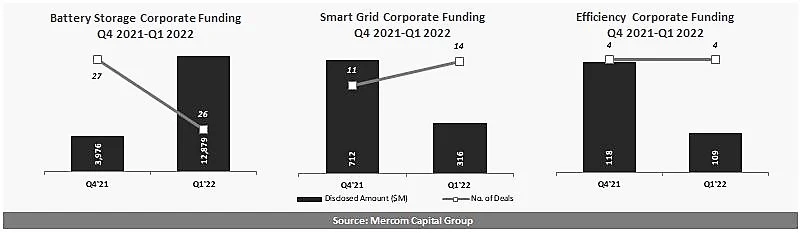
Total corporate funding (including VC, Debt, and Public Market Financing) in Battery Energy Storage came to $12.9 billion in 26 deals compared to $4 billion in 27 deals in Q4 2021. Funding was up significantly year-over-year (YoY) compared to $4.7 billion in 18 deals in Q1 2021.

Venture capital (VC) funding (including private equity and corporate venture capital) raised by Battery Storage companies in Q1 2022 came to $1.1 billion in 21 deals a 15% increase compared to $1 billion in 14 deals in Q1 2021. Quarter-over-quarter (QoQ) funding was 28% lower compared to $1.6 billion in 21 deals in Q4 2021.

The top-5 VC funded Battery Storage companies this quarter were:

  1. Hydrostor, which raised $250 million from Goldman Sachs Asset Management; 
  2. Sunfire raised $215 million from Copenhagen Infrastructure Energy Transition Fund I and Blue Earth Capital; 
  3. Factorial Energy raised $200 million from Mercedes-Benz (DAI) and Stellantis; 
  4. Viridi Parente raised $95 million from Thomas Golisano, Ashtead Group/Sunbelt Rentals, and National Grid Partners;
  5. Our Next Energy (ONE) raised $65 million from BMW i Ventures, Coatue Management, Breakthrough Energy Ventures, Assembly Ventures, Flex, and Volta Energy Technologies.
Seventy-six VC investors participated in Battery Storage funding this quarter.

In Q1 2022, announced debt and public market financing for Battery Storage technologies were higher, with $11.7 billion in five deals compared to $2.4 billion in six deals in Q4 2021 and $3.7 billion in four deals in Q1 2021.

There were five M&A transactions involving Battery Storage companies in Q1 2022. In Q4 2021, there were nine M&A transactions. YoY, there were four Battery Storage M&A transactions in Q1 2021.

There were 13 Battery Storage project M&A transactions in Q1 2022.
Top VC-Funded Deals in Energy Storage Q1-2022

Smart Grid

Total corporate funding in Smart Grid was 7% higher, with $316 million in 14 deals compared to $295 million in 11 deals in Q1 2021.

 VC funding for Smart Grid companies increased 9% in Q1 2022 with $312 million in 12 deals compared to $287 million in 10 deals in Q1 2021.

The top-5 VC funded Smart Grid companies included:

  1. Tibber, which secured $100 million from Summa Equity.
  2. SPAN raised $90 million from Fifth Wall Climate Tech, Wellington Management, Angeleno Group, FootPrintCoalition, Obsidian Investment Partners, A/O PropTech.
  3. Utilidata raised $27 million from Moore Strategic Ventures, Microsoft Climate Innovation Fund, NVIDIA, Keyframe Capital, Braemar Energy Ventures, MUUS Asset Management; 
  4. David Energy raised $21 million from Keyframe Capital, Union Square Ventures, Equal Ventures, Box Group, MCJ Collective, Toba Capital, Turntide, James Dice.
  5. JET Charge raised $18 million from RACV, Clean Energy Innovation Fund, Claremont Capital, Greg Roebuck, Simon Monk.
Thirty-nine investors participated in Smart Grid VC funding rounds this quarter.

Four million dollars was raised in two debt and public market financing deals in Q1 2022. There was one $484 million public market financing deal in Q4 2021. Year-over-year, $8 million was raised in one public market financing deal in Q1 2021.

In Q1 2022, there were three M&A transactions compared to two in Q4 2021 and six transactions in Q1 2021.

Energy Efficiency

Total corporate funding in Energy Efficiency came to $109 million in four deals compared to $118 million in the same number of deals in Q4 2021. In a YoY comparison, $5 million was raised in one deal in Q1 2021.

VC funding raised by Energy Efficiency companies in Q1 2022 came to $109 million in four deals compared to $118 million in four deals in Q4 2021. In a YoY comparison, $5 million was raised in one deal in Q1 2021.

Thirteen investors participated in VC funding this quarter.

There were no Efficiency M&A transactions in Q1 2022. There was one M&A transaction in Q4 2021. In Q1 2021, there was one M&A transaction for $300 million.

Indian Scientists Pave Way for Next-Gen High-Power High-Energy Storage Devices for Day to Day Use

ARCI and IIT-H Scientists develop high-performance hybrid supercapacitors with novel electrode material

The device could pave way for next generation high power-high energy storage devices for day to day use


Scientists have developed a low-cost supercapacitor device with excellent capacitive retention with a novel electrode material they have synthesized, which can pave the way for the next generation high power-high energy storage devices.

Supercapacitors have gained considerable attention due to their high power density, long cycle life, and excellent capacity retention compared to their battery counterparts. Supercapacitors with high capacitance and excellent capacitive retention developed from low-cost fabrication techniques are the need of the hour, considering their potential utility in the commercial market.

Scientists at the International Advanced Research Center for Powder Metallurgy and New Materials (ARCI), an autonomous body of the Department of Science and Technology (DST), Government of India in collaboration with IIT Hyderabad have developed a facile, scalable, and cost-effective electrochemical route to synthesize electrodes made of Nickel cobaltite (NiCo2O4) containing nanosheet structures with incorporated oxygen vacancies as an active material, for hybrid supercapacitors. These electrodes have been found to have excellent electrochemical performance.


Such hybrid supercapacitors combine the features of both conventional double layer supercapacitors and batteries and act as high power-high energy storage devices. However, it remains challenging to design pseudocapacitor devices with redox metal oxide (MO) materials with high porosity, which exhibit high capacitance and good cycle life. It is desirable to amend the intrinsic properties of the synthesized MO to enhance its conductivity, stability, and electrochemical activity.

Scientists at ARCI and IIT-H addressed these challenges and were successful in synthesizing NiCo2O4 nanostructured electrodes by a novel electrodeposition route. They also introduced an optimum number of oxygen vacancies by an environmentally benign chemical reduction process to make up for an active, positive electrode material for hybrid supercapacitor, as reported in their recent publication in the journal “Batteries &Supercaps". This could be an effective alternative to the existing carbon-based electrodes for supercapacitors to achieve high energy density.

An asymmetric supercapacitor device further fabricated by the research team, using porous carbon and NiCo2O4 electrodes exhibited excellent capacity retention and stability. The device could power an LED lamp and a DC fan, as shown in the figure.


Publication link: https://doi.org/10.1002/batt.202000121

India Energy Storage Week(IESW) 2020 to Pave Ways to Accelerate the Manufacturing, Adoption of Advanced Energy Storage and EV in India

Representative
India is on the path to become the largest market for advanced energy storage technologies within the next 5 years. It is undergoing exponential growth majorly driven by the existing demand for behind the meter stationary storage for inverter / UPS segment and rising demand for electric vehicles particularly 2 and 3W vehicles. Moreover, the recent schemes and initiatives by the central and state governments towards the adoption of EV have resulted in 20 percent jump in EV adoption in 2019-20 despite the slowdown witnessed due to COVID19.

With a vision to further accelerate the growth in the energy and e-mobility sector, India Energy Storage Alliance (IESA), India’s leading alliance on energy storage & e-mobility is all set to host its annual virtual conference and exhibition - India Energy Storage Week from 3rd - 6th November along with Pre – Conference Workshops on November 02, 2020.


With an intent to facilitate international trade, the eighth edition of IESA annual conference is expected to see global partnerships from 20+ countries, 50+ regulators & policymakers, 300+ industry leaders, 100+ partners & exhibitors, and 1000+ delegates. The conference is a dedicated effort towards bringing the key stakeholders together to make India a global hub for R&D and manufacturing. The vision is backed by eminent dignitaries from NITI Aayog, Department of Science & Technology (DST), The Ministry of Electronics and Information Technology (MeitY) and many more.


Prasad Dash, Executive Director, IESA
This year, IESA is all set to witness the mindshare from some of the most eminent speakers such as- Dr. Rahul Walawalkar (President, Customized Energy Solutions- India, Mr. Anant Nahata (MD, Exicom), Mr. Vijayanand Samudrala (MD, Amara Raja Batteries), Mr. Rakesh Malhotra (Founder, SAR Group and Livguard) , Mr. Vikram Gulati (Country Head, Toyota Kirloskar Motors Pvt. Ltd) , Dr. N. Kalaiselvi (Director, CSIR-Central Electrochemical Research Institute (CSIR-CECRI), Mr. Rohit Modi (President & Country Head, SB Energy (Softbank Group), Mr. Sanjay Kumar Banga (President – Transmission and Distribution, Tata Power) , Mr. Brieux Boisdequin (Vice President, Automotive and Materials, BASF South Asia) and many more.

The conference stands to bring global expertise under one roof through the virtual event. The 5-day-long event will feature thought-igniting sessions on ‘Make in India, Global EV manufacturing ecosystem, Regulatory and policy on electric mobility, Skill Development and capacity building and many more’. With the recent developments related to COVID19 and government announcement of energy storage manufacturing as a new Champion Sector, IESW 2020 garners more significance this year.

Two parallel energy storage workshop tracks will allow delegates to learn from hands-on experience of industry leaders and will provide an in-depth understanding of advanced technologies and solutions.

Debi Prasad Dash, Executive Director, IESA said, “The continually rising momentum of Electric Vehicles (EV), combined with the recent developments and strong future targets of the EV sector has fueled the demand for energy storage systems within the country, calling for rigorous policy measures to boost EV manufacturing. A proposal drafted by NITI Aayog said India could slash its oil import bills by as much as $40 billion by 2030 if electric vehicles were widely adopted. Though there has been a consistent focus on reducing oil dependence and cutting down on pollution, it can only be materialized when there are enough investments in manufacturing and infrastructure such as charging stations.”

“Through IESW, we aim to address the challenges and opportunities in the sector in order to robust the growth by bringing together global leaders and stakeholders to uncover the possibilities of making India a global hub of EV manufacturing in time to come.” he further added.

As part of the 5-day-long event, IESA will host Energy Storage Innovation workshop on 2nd Nov in association with the United Nations Industrial Development Organization (UNIDO) for startups in the energy storage, e-mobility, clean energy, and clean transportation sectors and a global startup outreach program during the Investor Summit on 6th November in association with TiE global, New Energy Nexus, Startup India, MeitY start-up hub, and VJTI- TBI. The ten global startups will be selected for start-up pitch at India Energy Storage & EV Investment summit; out of which top 3 selected startups will get 1-year complementary IESA membership and mentorship from IESA Leadership Council.

IESA is organizing a session on hydrogen economy and India/Nordic collaboration on 2nd Nov in association with Innovation Norway and Business Finland. Similarly, IESA also partnered with the Department for International Trade, British High Commission, Scotland development International, The New Energy, and Industrial Technology Development Organization (NEDO) for bilateral corporation business networking at IESW.

India Energy Storage Alliance recognizes women who are contributing significantly to the clean energy, mobility, and technology industry both in India and globally. In-line with the same, IESW will be hosting a dedicated session on Women in Energy Storage and EV Forum on 4th Nov.

IESW will also host the 4th IESA Industry Excellence Awards recognizing the best in Energy storage, Electric Vehicle and Microgrid industry in India. The 2020 IESA Industry Excellence Awards has expanded the market segments and award categories to include EV charging infrastructure, Microgrids, along with Energy storage and Electric vehicle markets. With this, IESA aims to acknowledge all the companies & Industry stalwarts, those have made their mark in the industry during the past year through technology innovation, market leadership, competitive strategy etc.

IESW is a flagship international conference & expo by India Energy Storage Alliance (IESA) incorporated in 2019, which was earlier Energy Storage India (ESI) since 2013. It is India’s premier B2B networking & business event focused on renewable energy, advanced batteries, alternate energy storage solutions, electric vehicles, charging infrastructure, and microgrids ecosystem. IESW is hosted by Customized Energy Solutions.


About India Energy Storage Alliance (IESA)


India Energy Storage Alliance (IESA) was launched in 2012 to assess the market potential of Energy Storage Technologies in India, through an active dialogue and subsequent analysis among the various stakeholders to make the Indian industry and power sector aware of the tremendous need for Energy Storage in the very near future. IESA aims to make India a Global Hub for research and manufacturing of advanced energy storage technologies by 2022. During the past 8 years IESA membership has grown from 5 to 100+ and covers verticals from Energy Storage & EV Manufacturers, Research institutes & universities, Renewable Energy companies and Power electronics companies.

Energy Storage leaders calls for policy measures for Atmanirbhar Bharat this World Energy Storage Day

  • The India Energy Storage Alliance (IESA) emphasized upon the importance of policy incentives, business leadership, skilled workforce, and inter-industry collaboration to make India Atmanirbhar in the energy storage space.
  • Urged policymakers and business leaders to take bold steps towards building the local capacity for energy storage.
  • The event featured 75+ global thought leaders and policymakers, who deliberated upon the policy, technology, and business landscape across the world
Marking the importance of energy storage as part of industrial progress and sustainable lives, the 4th World Energy Storage Day was celebrated today. On this occasion, India Energy Storage Alliance (IESA), India’s leading alliance on energy storage & e-mobility organized a unique virtual Global Conference & Expo with the aim to bring together industry leaders, policymakers, academia, researchers, and professionals and deliberate upon the need for nurturing a global ecosystem for energy storage. The participants engaged over insightful discussions on four critical aspects of the energy storage ecosystem, i.e., policy and government initiatives, stationary energy storage, e-mobility, and latest innovations and developments in the sector.


The significance of energy storage as an integral part of the electrical grid has been acknowledged by several stakeholders, including large consumers, renewable developers, utilities, grid system operators, and regulators. Moreover, the Government of India has set a target of installing 175 Gigawatt (GW) of renewable energy capacity by the year 2022 and 450 GW by 2030. A large proportion of this capacity will come from hybrid projects, where energy storage will play a very key role. IESA, thus emphasized upon the importance of building a robust energy storage ecosystem, supported by the policy incentives, business leadership, skilled workforce, and inter-industry collaboration to achieve this vision and make India Atmanirbhar in the energy storage sector.

Advanced energy storage technologies are also critical for the upcoming e-mobility manufacturing sector. With the advances in various battery chemistries and reducing prices, experts predict that this decade will belong to the electric vehicles. India is little late to invest in the R&D and manufacturing of these technologies, but with the government support and commitment from industry, we can still catch up within the next 3-5 years. It is estimated that India needs to set up at least 50 GWh of annual manufacturing capacity.

NITI Aayog has taken leadership in drafting the Advanced Chemistry Cell Battery Manufacturing Mission as part of the National Mission for Transformative Mobility and Battery Storage. As part of the already announced Phased Manufacturing Plan, the Government has charted out a roadmap for incentivizing the local players by imposing 10-12% import duties on cells. The Government will also provide up to US$ 30 per kWh as incentive for advanced chemistry cell manufacturing in the country. Therefore, the first movers in the country are certain to have an assured market opportunity.

At the conference, IESA also highlighted the huge employment opportunity presented by India’s energy storage space. However, to unlock this opportunity, there is a need for skill development, reskilling, and upskilling the existing workforce in the country to make them a strategic fit for the energy storage industry. As the energy storage sector evolves further, it will require interdisciplinary skill sets. To bring in the new skill sets and bridge the existing skill gap, there is a requirement for more intense industry-academic alliance. IESA, through its IESA Academy, is leading the crusade on this front.

Shri Narendra Modi, Prime Minister of India, in his letter to IESA said “I am pleased to learn that India Energy Storage Alliances and its partners are holding a digital World Energy Storage Day Conclave and Expo. Energy security and sufficiency are pivotal for self- reliant India. We are constantly striving to ensure that electricity reaches everyone, there is sufficient electricity for everyone, and that our environment remains clean. We are also making sure that our resolve towards clean and renewable energy is taken care of in every aspect of life. For, energy access and energy sustainability, we are focused towards building a robust storage capability in the country. Efforts like Global Conclave and Expo strengthen this vision. The presence of policymakers, technical experts, and other participants from various countries reflects mankind’s commitment to sustainable development.”


Summing up the key discussions and insights at the event, Dr Rahul Walawalkar, President, India Energy Storage Alliance says “The world is at the cusp of a 21st-century industrial revolution. Energy storage will be at the epicenter of this revolution. The discussions and insights here have set the tone for many strategic interventions across the world towards building a global ecosystem for energy storage in the power & transportation sector. The event emerged as catalyst towards highlighting the potential of energy storage for future businesses and sustainable living."

“There is a lot of innovation taking place in the energy storage ecosystem. India presents a significant opportunity of stationary energy storage technologies. In the next 5 years, we are entering into an unprecedented area, where thermal plants will have to pay down 30 percent which is not an ideal situation. At the same time, we do expect that the market for e-vehicles is set to pick up beyond 2022-24. We are coming up with a new report on e-mobility. Due to persistent efforts by various ministries in the last five years, energy storage has picked up rapidly and the technology advancements have also been accelerated. We must focus on building capacity for integrating existing projects and making India a global hub of innovation and R&D. We urge the Indian business leaders to take a lead in terms of investing in the future. As the event highlighted, there is also a need for the right policy and regulatory support, beyond announcements. These initiatives will boost the local ecosystem, make India a self-reliant economy for energy storage, and become the global benchmark. I am confident about the future.”


Mr. Amitabh Kant, CEO, NITI Aayog, said “NITI Aayog is working with the World Bank to pilot various energy storage points and projects across the power sector in India. Battery Storage is the undisputable leader in the overall Energy Storage Portfolio. The potential demand for advance battery storage applications till 2030 in India is expected to reach 230 GW on a Year to Year basis while on a cumulative basis, the domestic market demand of 1116 GWh has been estimated. With high priority accorded to Make in India, the government shall soon launch the incentive schemes to invite global companies through the transparent competitive process to set up Mega Manufacturing plant in advanced technologies areas such as Solar Photovoltaic Cell and Advanced Battery Storage in India. The Government stands by its renewable energy generation target as part of its Paris Agreement. The target is 200 GW by 2022 and 240 GW by 2050. Renewables can become dispatchable replacing fossil fuels.


Moreover, the next wave of job creation will come from energy storage in renewable energy. India has the potential for being the fastest-growing market for electric vehicles and the government is committed to the same with policy framework like FAME II for a smoother transition. The government is set to launch a tender to global companies for developing future solar. India is taking concrete steps to develop a favourable business environment for a greener economy. The coming age is the age of cutting-edge energy storage technology.”


H.E. Upendra Tripathy, Director General, International Solar Alliance (ISA) stated, “One of the most important aspects in energy storage is e-vehicles. In order to promote its adoption, Solar cost should be


affordable for the masses. Talking about storage economy, the aim is to solarize the storage to generate employment. ISA is closely working with member countries to understand the kind of storage requirements they have. In a first, the World Solar bank is aimed at infusing around $10 billion toward addressing solar projects in the member countries. Storage will play an important role in realizing the ambitious goal of “One World, One Sun, One Grid’ - a term coined by the Prime Minister of India.”


Shri Ghanshyam Prasad, Jt. Secretary, Ministry of Power added, “The day itself talks about the importance of energy storage. Any disruptions that takes place in the electricity sector is an opportunity to grow. The renewable energy was introduced in the electricity sector ten years back along with its drawbacks. The very first goal was to achieve 175 GW by 2022. In terms of advantages of batteries, as Ministry of Power, we look at it as grid element ensuring electricity to every household without any interruptions. There are variations as seasonality to renewable sources of power generation. To maintain reliability of power supply, there has to be some source to take care of the variability and storage is the answer to the same. The plan is to integrate energy storage at grid element level in the imminent future.


Prof. Stanley Whittingham, 2019 Nobel Laureate in Chemistry in a recorded message said, “Lithium battery are already changing the way we store our future energy. The future is bright for the storage and Li-ion batteries are raring to go. Clearly, battery is not only the medium, hydrogen, pumped hydro and supercapacitors will also be some active contenders for future energy storage requirements. Let’s make, 2020 the decade of energy storage!”


2019 Nobel Laureate in Chemistry, Dr Stanley Whittingham, who is currently working as a professor of Chemistry in Binghamton University, State University of New York, delivered the keynote at the event. He shared insights about advances in the technology and assured delegates that we are just at the cusp of the decade of energy storage. The event brought together 75+ global thought leaders and policy makers to share insights on latest developments and trends in the policy, technology, and business landscape. Delegates from over 60 countries keenly attended these sessions.


To celebrate the growing importance of energy storage, the Global Energy Storage Alliance started celebrating 22 September as World Energy Storage Day (WESD) in 2017. Over the past three years, the IESA and its partners celebrated WESD with various national-level events to spread the word within each region. This year, with COVID-19 limiting international travel, all the alliances had decided to opt for a virtual platform to jointly celebrate the WESD with this unique conference. For the first time a marathon online event dedicated to the energy storage and EV industry was organized on this scale.


WESD Global Conference was supported by over 30 partners including, International Solar Alliance and World Bank- ESMAP. Niti Aayog, Invest India and Department of Science and Technology were the India partners and Government of Australia was the partner country. The event received support from global alliances and organisations, such as the Alliance for Rural Electrification; The Associated Chambers of Commerce of India (Assocham), The Australian Energy Storage Alliance; BVES- the German Association of Energy Storage Systems; California Energy Storage Alliance; China Energy Storage Alliance; The US Clean Energy States Alliance; Dii Desert Energy; The US Energy Storage Association; European Alliance for Storage of Energy; European Battery Alliance (EBA250); Green Hydrogen Coalition; Indo German Energy Forum, Innovation Norway; Institute of Management Consultants of India; Irish Energy Storage Alliance, New Energy and Industrial Technology Development Organization, South Africa Energy Storage Association. Customized Energy Solutions was the presenting partner for the event and Amararaja, Exicom, Okaya, UL, BASF, Keysight Technologies, and Curtis have also joined as partners for this global event. For more details, please check (https://energystorageday.org/event/partners/)

Market Reports

Market Report & Surveys
IndianWeb2.com © all rights reserved