‏إظهار الرسائل ذات التسميات DOCOMO. إظهار كافة الرسائل

DOCOMO To Introduce 3D Printed Jet-Turbines for Irrigational Water-Powered Base Station of Mobile Communications N/w in Rural Areas

DOCOMO To Introduce 3D Printed Jet-Turbines for Irrigational Water-Powered Base Station of Mobile Communications N/w in Rural Areas

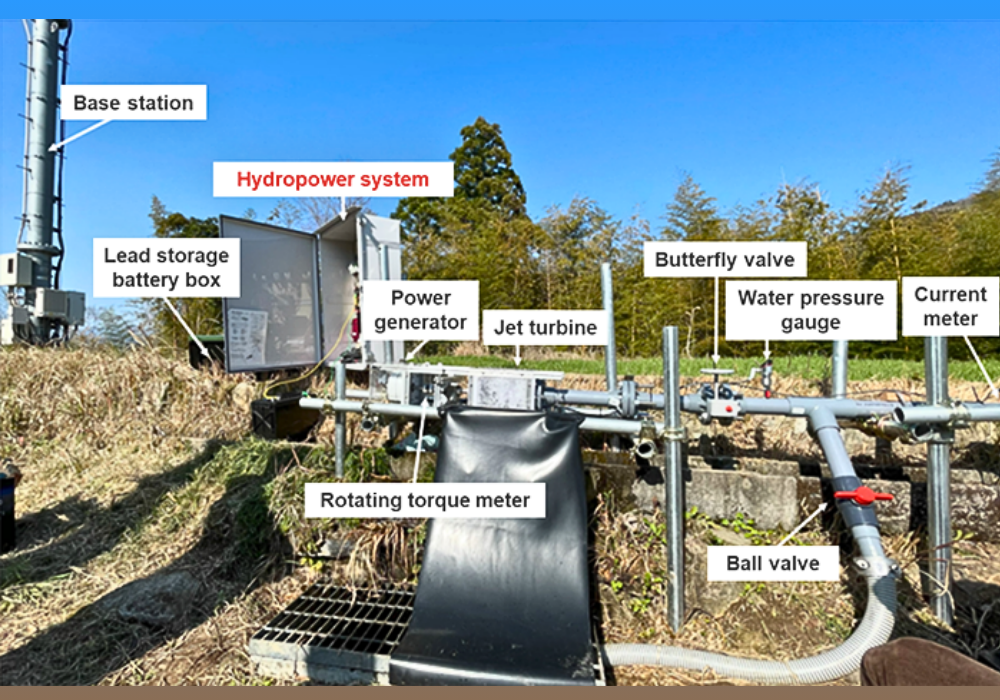
Base stations for mobile communications account for approximately 70% of the power consumed in Japan's NTT DOCOMO's operations in Japan. Hence, to use renewable energy such as hydropower in places where solar panels are not practical, NTT DOCOMO, INC. has launched Japan's first demonstration experiment of a self-powered hydropower cellular base station. The experiment began on May 30, 2024 and the company expect to start its implementation beginning in one year from now.

The experiment, which involves DOCOMO's hydroelectric power-generation system and a jet turbine developed by Professor Yukihiro Shimatani of the Prefectural University of Kumamoto, aims to prove the feasibility of a self-powered base station using water flowing in an irrigation canal, etc., as a sustainable, low-cost solution for mobile communication networks in rural areas.

The goal of this experiment is to demonstrate the feasibility of a self-powered base station using water flowing in an irrigation canal as a sustainable, low-cost solution for mobile communication networks, particularly in rural areas.

DOCOMO To Introduce 3D Printed Jet-Turbines for Irrigational Water-Powered Base Station of Mobile Communications N/w in Rural Areas


The jet turbine incorporates a nozzle that emits a stream of water, or "jet," to drive the turbine's rotation in the opposite direction and thereby generate electricity. While conventional hydroelectric systems use a separate nozzle and turbine, this device combines both components in a design so simple it can be manufactured with a 3D printer.

DOCOMO's Energy Management System (EMS) platform is being used to monitor and control the power driving the base station, as well as to visualize the amount of CO2 reduction achieved with this sustainable hydropower system. While DOCOMO's existing 286 green base stations mainly use solar power, this initiative aims to utilize renewable energy such as hydropower in locations where solar panels are not practical.

This experiment is a step towards DOCOMO's goal of achieving net-zero greenhouse gas emissions from its operations by 2030 and across its entire supply chain by 2040³. It's a significant move towards the adoption of renewable energy and the realization of a sustainable, carbon-neutral world.

There are similar initiatives in other countries that focus on integrating renewable energy sources into communication networks and other infrastructures. While the specific details of self-powered hydropower base stations like DOCOMO's experiment may not be widely reported, there are broader efforts to use sustainable energy solutions globally.

Notably, the International Renewable Energy Agency (IRENA) has discussed innovative operations of pumped hydropower storage (PHS) to provide greater flexibility to power sectors and integrate larger shares of variable renewable energy (VRE) into power systems. These initiatives often involve collaboration between technology developers, energy providers, and governments to create more resilient and sustainable energy infrastructures.

Additionally, telecom operators and technology companies worldwide are increasingly adopting green energy solutions, such as solar and wind power, to reduce their carbon footprint and ensure uninterrupted services in remote areas. These efforts are part of a global movement towards decarbonization and achieving net-zero emissions in various sectors, including mobile communications.

While the specific approach of using water from irrigation canals for powering base stations is unique to DOCOMO's experiment, the underlying principle of using renewable energy sources is a common thread in many international sustainability projects.

Nokia, NTT, SKT and DOCOMO Team Up To Develop 6G AI-native Air Interface (AI-AI)

Nokia, NTT, SKT and DOCOMO Team Up To Develop 6G AI-native Air Interface (AI-AI)

  • AI is a critical 6G building block, with the potential to boost performance and minimize energy consumption in future 6G networks.
  • SKT joins the existing 6G collaboration between Nokia, NTT and DOCOMO, expanding the scope and scale of its work on the 6G native air interface (AI-AI).
  • At MWC 2024, an AI air interface (AI-AI) proof of concept video demonstration will be available at SKT’s booth.
Nokia, SK Telecom (“SKT”), NTT and DOCOMO, on Thursday last week, announced that they have joined forces to develop the 6G AI-native air interface (AI-AI), a critical next-generation technology that could greatly boost network performance while increasing energy efficiency. The four companies will show a video demonstration of an AI-AI proof of
concept at SKT’s booth at Mobile World Congress.

An AI-native air interface (AI-AI) is a dynamic interface that uses machine learning (ML) and AI (Artifical Intelligence) to define the air interface. It can adapt to different radio environments, data, applications, and Hardware.

This new 6G collaboration builds on an existing relationship between Nokia, NTT and DOCOMO targeted at 6G innovation. With the addition of SKT, the four companies will be able to expand the scope and scale of 6G AI-AI testing and validation as well as explore a broader range of business use cases for the technology.

Academics, leading research institutes, and key industry experts across the globe anticipate that a future 6G standard will use AI/ML for signal processing tasks, such as channel estimation, channel equalization, and demapping. This concept is understood as a neural receiver.

This collaboration is developing future proof-of-concept 6G AI-AI systems, which will then be put to the test using selected use cases and real environmental scenarios. These over-the-air validation tests will be conducted both in the lab and outdoors to best simulate real network results. SKT, NTT, DOCOMO and Nokia will cooperate on improving AI model performance by utilizing data generated from real networks or through simulation. This will be instrumental in developing AI training models for a best-in-industry AI-AI solution.

By working together Nokia, SKT, NTT and DOCOMO will be able to combine their research efforts and bring their core areas of expertise to the table. Nokia’s industrial research arm, Nokia Bell Labs, is a leader in 6G innovation, while SKT, NTT and DOCOMO are recognized worldwide for their successful adoption of every generation of networking and their ability to create new business value from advanced technologies.

Peter Vetter, President of Bell Labs Core Research at Nokia, said: “For Nokia to create a world-class 6G system, it’s critical we get input from the service providers that will one day deploy 6G. SKT, NTT and DOCOMO are among the most innovative service providers in the world, which gives us the perfect partners to design the networks of the future.”

Yu Takki, Vice President and Head of Infra Tech at SKT, said: “This milestone represents a significant step forward in collaborative efforts towards the development of 6G core technology involving technology leaders from Korea, Japan, Europe and the United States. SKT will maintain its momentum in its R&D efforts of applying AI technology to network infrastructure as we move forward to become a global AI company.”

Takaaki Sato, Executive Vice President and Chief Technology Officer at DOCOMO, said: “DOCOMO and NTT are delighted to advance this project with Nokia, a global vendor leading the world, and SKT, a mobile operator co-leading Asia. Through this collaboration, we will take the lead in innovative technology development and standardization of 6G, and focus on building a global ecosystem that includes future industries and technologies.”

Trend Micro, DOCOMO to Launch Security for IoT Devices, Fully Protecting Business Users’ Connected Experience

Trend Micro Incorporated , a global leader in cybersecurity solutions, today announced NTT DOCOMO, INC., Japan's leading mobile operator and one of the world's foremost contributors to 3G, 4G and 5G mobile network technologies, will launch a solution to protect IoT devices running on DOCOMO’s mobile network utilizing Trend Micro’s security solution.

Enabling this first-of-its-kind protection is the new DOCOMO Cloud Platform Network Security Service, a solution that layers in security solutions from Trend Micro. The result is an easy-to-use security shield specifically for DOCOMO’s customers who are building infrastructure-as-a-service (IaaS) environments.

Until now, deploying a security solution on the DOCOMO Cloud Platform required customers to set up third-party products manually. This new service simplifies the deployment of security onto the DOCOMO Cloud Platform.

Telecom companies and service providers have long been planning for the impact of 5G. Now is the time to ensure the extra security risks posed by these smart endpoints at a network level are protected. Trend Micro is helping DOCOMO protect their customers’ data in cost-effective, easy-to-deploy ways.

Under the technical covers of this solution is Trend Micro’s Virtual Network Function Suite (VNFS), tested rigorously last year in the DOCOMO 5G Open Cloud.

In addition to verification in the 5G environment, verification has also been promoted in the 4G environment currently used by many customers. As a result of verification, DOCOMO concluded that this solution is effective in the environments with increased opportunity for IoT security threats. Therefore, they decided to provide this solution for 4G environments as part of DOCOMO Cloud Platform.

“The promise and potential of 5G has the world waiting but let me issue a warning for the need for extra protection. Smarter endpoints mean a greater cyber risk to manage,” said Akihiko Omikawa, executive vice president for Trend Micro. “We’re delighted and proud that our technology meets the needs of this global mobile phone leader. Together our joint solution delivers cloud infrastructure capabilities integrated with IoT-ready security customized for modern data centers.”

Trend Micro’s telecom solution, VNFS, offers service providers a range of security functionality including intrusion prevention, URL filtering and application control to mitigate threats across their networks without impacting performance.

As a software-based solution, this security service can be deployed in minutes versus the days required with on-site hardware, and is dynamically allocated, configured and scaled according to customer requirements.

Underlying threat intelligence is provided by Trend Micro, which analyzes 1.5 billion new threat samples and blocks 250 million threats every 24 hours.

Trend Micro Incorporated, a global leader in cybersecurity solutions, helps to make the world safe for exchanging digital information. Our innovative solutions for consumers, businesses, and governments provide layered security for data centers, cloud workloads, networks, and endpoints. All our products work together to seamlessly share threat intelligence and provide a connected threat defense with centralized visibility and investigation, enabling better, faster protection. With more than 6,000 employees in 50 countries and the world’s most advanced global threat research and intelligence, Trend Micro enables organizations to secure their connected world.

Market Reports

Market Report & Surveys
IndianWeb2.com © all rights reserved