‏إظهار الرسائل ذات التسميات Adani Ports. إظهار كافة الرسائل

Adani Ports’ New Subsidiary Aims to Build One of the World’s Largest Integrated Marine Platforms

Adani Ports’ New Subsidiary Aims to Build One of the World’s Largest Integrated Marine Platforms

Astro Offshore PTE, a step‑down subsidiary of Adani Ports & Special Economic Zone (APSEZ), has incorporated a wholly owned subsidiary (WOS), Astro Offshore MESA Company, on 31 August 2026.

APSEZ filed intimation under Regulation 30 of SEBI Listing Obligations on 1 September 2026, confirming Astro Offshore PTE Limited (step‑down subsidiary) incorporated Astro Offshore MESA Company in the Kingdom of Saudi Arabia.

The filing mentions that the strategic intent of this new subsidiary is to build one of the world’s largest integrated marine platforms, strengthen offshore operations in MESA region. And, the purpose is to conduct local offshore operations, diversify fleet globally, expand geographic reach. 
  • Corporate structuring: A WOS enables APSEZ to expand operations with full ownership and control.
  • Astro Offshore PTE: Specialized offshore services arm, now extending into MESA region.
  • MESA region: Middle East & South Asia is critical for offshore energy and marine logistics.
  • Adani Ports strategy: Aligns with APSEZ’s global expansion in LNG, ports, and transshipment hubs.

Implications 

AspectDetails
Regional FocusTargeting offshore oil, gas, and marine logistics in Middle East & South Asia.
Ownership100% WOS ensures APSEZ retains full control over operations and profits.
DiversificationExpands APSEZ’s footprint beyond India into global offshore services.
SynergyComplements APSEZ’s LNG, port automation, and transshipment hub projects.


This incorporation signals Adani Ports’ intent to deepen its offshore and marine services portfolio in high‑growth regions, strengthening its global positioning.

Adani Ports Quitely Deploying India’s First Fully Automated Container Cranes at Its Indian Ports

Adani Ports Quitely Deploying India’s First Fully Automated Container Cranes at Its Indian Ports

Adani Ports & Special Economic Zone (APSEZ) has begun deploying fully automated container cranes at Vizhinjam port, Kerala, operated remotely from climate‑controlled cabins, marking a major leap in India’s port automation and sustainability drive.

ABB is the technology partner behind Adani Ports’ automation at Vizhinjam, providing the control systems and automation solutions for quay and yard cranes, enabling India’s first fully automated container terminal. Their systems allow cranes to be operated remotely from climate‑controlled cabins, doubling productivity and enhancing safety.

The announcement about Adani Ports unveiling India’s first fully automated container cranes at Vizhinjam dates back roughly eight months. Even though the news is eight months old, it remains strategically relevant because Vizhinjam becoming India’s first fully automated container terminal is a milestone in South Asia.

ABB supplied the automation technology that allows cranes to be operated remotely from a centralized control room. Operators now work in climate‑controlled cabins using joysticks and screens, eliminating the need to sit in crane cabins 30–50 meters above ground.

Besides, APSEZ has expanded its partnership with Kaleris, a US-based supply chain execution software company best known for its Navis Terminal Operating System (TOS). Through this partnership APSEZ will deploy an AI-augmented, plug-and-play operating platform across a global network of 15 container terminals spanning 9 ports. The port is central to India’s transshipment strategy, reducing reliance on Colombo and Singapore.

Key Highlights of Vizhinjam Port Automation

  • Automated cranes: Quay cranes and yard gantry cranes are now remotely operated from air‑conditioned control rooms, eliminating the need for operators to sit in cabins 30–50 meters above ground.
  • Climate‑controlled cabins: Operators use joysticks and multiple screens in shared cabins, ensuring comfort, safety, and consistent productivity.
  • Community integration: Women from fishing and coastal communities have been trained to operate these advanced cranes, creating new employment opportunities.
  • ABB automation systems: ABB provided the technology for quay and yard crane automation, enabling India’s first fully automated container terminal.
  • Digital twin monitoring: IoT‑enabled systems collect real‑time operational data, displayed on large 3D video walls for proactive exception handling.

Benefits of Automation

FeatureImpact
Remote crane operationEliminates operator fatigue, improves safety
Climate‑controlled cabinsConsistent productivity, collaborative environment
AI & IoT integrationReal‑time monitoring, faster decision‑making
Automated gantry cranesNo human operator required, 24/7 efficiency
Community trainingEmployment for local women, social inclusion

Strategic Importance

  • India’s first deep‑sea trans-shipment hub: Vizhinjam is designed to handle Megamax containerships and reduce reliance on foreign hubs like Colombo and Singapore.
  • Capacity growth: Phase 1 capacity is 1 million TEUs, with expansion planned to 7.2 million TEUs.
  • Sustainability: APSEZ is embedding low‑carbon operations, afforestation, and renewable energy adoption into its port strategy.

Risks & Challenges

  • High capital costs: Automation requires significant upfront investment in AI, IoT, and digital twin systems.
  • Skill transition: Continuous training is needed to upskill local communities for advanced tech roles.
  • Cybersecurity risks: Increased reliance on digital systems makes ports vulnerable to cyber threats.
Adani Ports and Special Economic Zone (APSEZ) has expanded its partnership with US-based Kaleris, committing up to $100 million to deploy AI-powered automation across 15 container terminals at nine ports, as part of a broader $850 million investment in technology and decarbonisation by 2031.

Key Details of Adani’s AI Port Automation

  • Investment scale: Up to $100 million in two phases, part of a larger $850 million technology and decarbonisation plan.
  • Partnership with Kaleris: Deployment of the N4 Terminal Operating System (TOS) and AI-augmented optimisation solutions.
  • Coverage: Rollout across 15 container terminals spanning nine domestic and international ports.
  • Efficiency gains: Up to 20% improvement in RTG crane productivity and 14% improvement in terminal truck productivity.
  • Capacity expansion: Unlocking 91 million metric tonnes (MMT) of additional cargo handling capacity by 2030, supporting APSEZ’s goal of 1 billion tonnes per annum throughput.

Strategic Impact

Focus AreaDetails
AI-enabled automationDefines next frontier of competitiveness in ports and logistics
Unified digital backboneSeamless integration across yard, gate, and vessel workflows
DecarbonisationPart of $850M plan to modernise and reduce carbon footprint
Global footprintExpansion includes hubs in India, Australia, Israel, Tanzania, and Colombo
Customer experienceFaster turnaround, improved planning accuracy, superior service

Why It Matters

  • Global competitiveness: AI-driven automation positions APSEZ alongside leading global port operators.
  • Sustainability: Integration of AI, IoT, and optimisation aligns with decarbonisation goals.
  • Economic impact: Boosts India’s logistics efficiency, reducing costs and enhancing trade flows.
  • Technology leadership: Demonstrates India’s capability to deploy AI at scale in critical infrastructure.
The ambitious AI automation plan comes with significant hurdles. High upfront costs of $100 million demand strong returns on investment, while increased reliance on digital systems exposes ports to cybersecurity vulnerabilities. Workforce adaptation is another challenge, as employees must transition to AI-driven operations. Finally, scaling automation across diverse ports introduces execution complexity, requiring robust integration and continuous monitoring.

Global Port Automation Leaders 

The world’s leaders in port automation today are concentrated in Asia and Europe, with China’s Qingdao and Shanghai, Singapore, and Rotterdam consistently ranked at the top for fully automated container handling, AI-driven scheduling, and sustainability integration.

PortRegionKey Automation FeaturesGlobal Significance
Port of Qingdao, ChinaAsiaFully automated end-to-end terminal, electric AGVs, AI schedulingRanked #1 globally; benchmark for large-scale automation
Port of Shanghai, ChinaAsiaAutomated stacking cranes, digital twin systemsHandles world’s largest container throughput
Port of SingaporeAsiaAutonomous vehicles, AI-driven berth allocation, paperless customsGlobal hub for smart logistics and sustainability
Port of RotterdamEuropeAutomated cranes, IoT integration, hydrogen-powered equipmentEurope’s most advanced smart port
Port of Los Angeles, USANorth AmericaSemi-automated terminals, AI analyticsLeading US port despite labour constraints
Tanger Med, MoroccoAfricaAutomated stacking, smart cargo handlingAfrica’s largest and most advanced port
Port of Melbourne, AustraliaOceaniaAutomated yard cranes, smart energy systemsRegional leader in automation and sustainability

What Sets Them Apart

  • China’s dominance: Ports like Qingdao and Shanghai lead due to full-scale automation, electrified equipment, and AI-driven scheduling.
  • Singapore’s innovation: Known for autonomous vehicles, predictive analytics, and carbon-neutral goals.
  • Rotterdam’s sustainability: Europe’s leader in hydrogen-powered equipment and IoT integration.
  • North America’s lag: Despite advanced tech, governance and labour constraints slow full automation adoption.

Challenges

Global leaders face high capital costs, cybersecurity vulnerabilities, and workforce adaptation challenges. North American ports, in particular, struggle with labour union resistance, while Asian hubs must balance rapid scaling with sustainability goals.

Adani Ports Anchors Argentina’s First LNG Export to India

Adani Ports Anchors Argentina’s First LNG Export to India

Adani Ports and SEZ (APSEZ) has secured a landmark 10‑year marine services contract for Argentina’s first LNG export project to India, marking its entry into South America and reinforcing India‑Argentina energy trade ties. The Southern Energy FLNG project will begin operations in 2027, with Argentina expected to export up to 10 million tonnes of LNG annually to India.

The contract marks India's largest integrated transport utility’s entry into South America and strengthens its global marine services portfolio.

The Adani Group–Meridian consortium will deliver marine services for the Southern Energy FLNG project, supported by an estimated investment commitment of $70 million. The project strengthens APSEZ’s role in an emerging LNG export corridor while reinforcing growing energy linkages between India and Argentina.

Key Highlights of the Deal

  • APSEZ entry into South America: First major marine services contract in the region.
  • Consortium with Meridian Group: Joint venture (51:49) between Adani Harbour International FZCO and Argentina’s Meridian Transportes Marítimos S.A.
  • Southern Energy FLNG project: Developed by Southern Energy S.A., a JV of Golar LNG and Pan American Energy.
  • Investment commitment: Estimated at $70 million for marine assets and operations.
  • Marine services scope: Tugboat operations, offshore logistics, supply support, and crew transfer. Supported by 4 tugboats, 1 anchor handling tug supply vessel, and 1 crew boat.

Strategic Importance

  • Energy Corridor Creation: Argentina’s LNG exports will diversify India’s energy sources, reducing reliance on Middle Eastern suppliers.
  • Supply Resilience: APSEZ’s expertise in 12 countries ensures operational reliability in complex maritime environments.
  • Production Capacity: Phase 1 will produce 2.45 million tonnes annually (~28 cargoes), scaling up to 10 million tonnes per year for India from 2027.

India–Argentina Energy Linkages

  • Argentina’s LNG role: Emerging as a new global supplier, leveraging the General San Martin pipeline and FLNG vessel Hilli Episeyo.
  • India’s demand outlook: Rising LNG imports to support industrial growth, power generation, and clean energy transition.
  • Geopolitical impact: Strengthens Indo‑Latin American energy cooperation, diversifying India’s strategic energy partnerships.

APSEZ’s Global Marine Footprint

RegionKey ProjectsStrategic Value
Middle EastLNG terminal support, offshore logisticsEnergy hub connectivity
AfricaPort operations, oil & gas logisticsExpanding trade corridors
South America (Argentina)Southern Energy FLNG marine servicesFirst LNG export link to India
IndiaPorts, LNG terminals, refineriesDomestic energy resilience

Risks & Challenges

  • Operational Timeline: Commercial operations only from September 2027, requiring long‑term planning.
  • Global LNG Market Volatility: Prices and demand may fluctuate with geopolitical tensions.
  • Infrastructure Dependence: Success hinges on Argentina’s pipeline and FLNG vessel reliability.

Adani, NMDC & Vale Forge Global Iron Ore Hub at India’s Gangavaram Port

Adani, NMDC & Vale Forge Global Iron Ore Hub at India’s Gangavaram Port

Adani Ports and Special Economic Zone Ltd (APSEZ), through its subsidiary Adani Gangavaram Port Ltd, has signed a strategic Memorandum of Understanding (MoU) with NMDC Ltd and Vale SA to develop an integrated iron ore blending hub and Special Economic Zone (SEZ) at Gangavaram Port.

Key Highlights

  • Partnership: APSEZ (Adani), NMDC (India’s largest iron ore producer), and Vale SA (Brazilian mining giant).
  • Location: Gangavaram Port, Andhra Pradesh, India.
  • Objective: Establish a blending facility and SEZ ecosystem for iron ore value addition, commercialization, and exports.
  • Strategic Importance:
    • Enhances India’s East Coast iron ore export capacity.
    • Positions Gangavaram Port as a major hub capable of handling Valemax vessels (the world’s largest bulk carriers).
    • Strengthens India–Brazil trade ties, with the MoU signed during Brazilian President Luiz Inácio Lula da Silva’s visit to India.
  • Economic Impact: Expected to boost efficiency, global competitiveness, and create a robust supply chain for iron ore exports.
This move is significant because it integrates India’s domestic iron ore production (via NMDC) with Vale’s global supply, leveraging Adani’s port infrastructure to create a competitive export hub.

This Adani–NMDC–Vale MoU at Gangavaram Port could reshape India’s steel industry and global trade flows in significant ways. For India’s steelmakers, the partnership ensures a stable supply of high-grade ore by blending Vale’s premium output with NMDC’s domestic production. This consistency in quality is vital for efficient steelmaking, helping reduce impurities, lower energy consumption in blast furnaces, and ultimately cut production costs. The creation of a Special Economic Zone around the hub is also expected to attract pellet plants, beneficiation units, and downstream steel processing facilities, strengthening India’s steel value chain.

On the global stage, Gangavaram Port’s ability to handle Valemax vessels—among the largest bulk carriers in the world—positions India as a direct link to Brazil and other international markets. This deepens the India–Brazil trade corridor, diversifies India’s raw material sources beyond traditional suppliers like Australia, and enhances export competitiveness. By blending and re-exporting ore, India could emerge as a hub for global iron ore trade, serving East Asian markets such as China, Japan, and South Korea more efficiently.

Strategically, the move supports India’s ambition to become a global steel powerhouse in line with its National Steel Policy targets. It also expands Adani’s role in commodities logistics, moving beyond port operations into integrated resource management. Most importantly, it builds resilience into supply chains at a time when geopolitical uncertainties and commodity market fluctuations demand stronger, more reliable trade networks.

Adani Ports Unlocks New Export Corridor for Indian Rail Tech

Adani Ports Unlocks New Export Corridor for Indian Rail Tech

Mundra Port, the crown jewel of Adani Ports and SEZ Ltd, has just handled its first export shipment of hi-tech locomotives—a powerful symbol of India's industrial ascent and logistical prowess.

Key Highlights:
  • Shipment Details: Four state-of-the-art locomotives were shipped to Morebaya, Guinea aboard the vessel MV BBC WASHINGTON.
  • Manufacturer: These locomotives were built by Wabtec Locomotive Pvt Ltd at its plant in Marhowrah, Saran, Bihar, in collaboration with Indian Railways.
  • Export Plan: This is the first of a planned 150 locomotives to be exported, with 1–2 units expected monthly.
  • Gauge Conversion: Since India uses broad-gauge tracks and Guinea requires standard gauge (1.435 meters), a complex bogie conversion was executed at Mundra using hydraulic trailers and heavy-duty cranes.

Strategic Impact:

This initiative aligns with the Atmanirbhar Bharat vision—“Made in India for the World”—and showcases India’s growing capability in precision manufacturing and high-value industrial exports.

Why It Matters:

This isn’t just about locomotives—it’s about India stepping into the global spotlight as a trusted supplier of advanced rail technology. Mundra’s ability to handle such technically demanding cargo reinforces its role as a strategic export gateway.

Adani Unveils ₹600 Crore Smart Logistics Park in Kochi — A Game-Changer for Kerala’s Industrial Future

Adani Unveils ₹600 Crore Smart Logistics Park in Kochi — A Game-Changer for Kerala’s Industrial Future

In a bold move to reshape Kerala’s logistics landscape, Adani Ports and Special Economic Zone Ltd. (APSEZ) has launched a cutting-edge logistics park in Kalamassery, Kochi—an investment exceeding ₹600 crore that signals a new era of smart, sustainable supply chain infrastructure.

Unveiled by Chief Minister Pinarayi Vijayan under the “Invest in Kerala” initiative, the park spans 70+ acres and houses 1.3 million sq. ft. of integrated logistics space. But this isn’t just another industrial facility—it’s a strategic leap toward making Kerala a hub for next-gen logistics.

Built for the Future: Smart, Green, and Sector-Ready

From EV charging stations to zero-touch operations and digital integration, the park is engineered for speed, sustainability, and scale. It’s tailored to serve high-growth sectors like:
  • E-commerce
  • FMCG/FMCD
  • Pharmaceuticals
  • Automotive
  • Retail
This isn’t just infrastructure—it’s an ecosystem designed to empower businesses and energize Kerala’s industrial ambitions, –said an APSEZ spokesperson.

1,500+ Jobs and a Boost for Local SMEs

The facility is expected to create over 1,500 jobs, with a strong emphasis on local employment and SME empowerment. By offering plug-and-play logistics solutions, Adani aims to help small and medium enterprises scale faster and compete smarter.

Adani’s National Logistics Vision

The Kochi park is part of Adani’s aggressive push to expand its logistics footprint across India. From 3.1 million sq. ft. today to 20 million sq. ft., APSEZ plans to build 30 logistics parks nationwide, transforming from a port-centric player into a fully integrated transport and logistics powerhouse.

Why It Matters

  • For Kerala: A strategic boost to industrial growth, job creation, and SME competitiveness
  • For India: A step toward smarter, greener logistics infrastructure. 
  • For Adani: A bold pivot from ports to pan-India supply chain dominance

LIC Solely Subscribes Adani Ports’ ₹5,000 Cr Bond Issue in Exclusive Deal

LIC Solely Subscribes Adani Ports’ ₹5,000 Cr Bond Issue in Exclusive Deal

LIC has fully subscribed to Adani Ports and Special Economic Zone's ₹5,000 crore bond (approx $584.5 million USD) issue was a privately negotiated said a report by Business Standard.

This transaction, meaning LIC was the sole investor, and no other bids were received. The bonds have a 15-year tenure with a 7.75% coupon rate, making it Adani Ports' largest-ever rupee-denominated bond issuance.

This marks Adani Ports’ biggest-ever rupee-denominated bond issue and its first 15-year bond sale.

Notably, the 7.75% coupon rate was priced 126 basis points above comparable government securities, reflecting strong investor appetite.

The Business Standard report cited a source aware of the development, who said “There was only one bid from LIC and it was a pre-approved, privately negotiated transaction. No other bids were received, and since it wasn’t a market-based issuance, there was no green shoe option either.”

The source further added that it’s possible that the company was concerned about having to offer a higher coupon rate had it come to the broader market.

The funds raised will be used for refinancing existing debt and capital expenditure for port infrastructure development 12. This move aligns with Adani Ports' strategy to shift towards longer-term financing to reduce borrowing costs.

LIC’s exclusive participation signals strong institutional confidence in Adani Ports, reinforcing its role as a major player in India’s corporate debt market. LIC has been expanding its corporate bond investments with ₹80,000 crore invested in FY25, a 30% increase from last year.

By securing 15-year funding at 7.75%, Adani Ports reduces reliance on short-term, high-interest debt, improving financial stability. The company is actively working to extend debt maturity, lowering its net debt-to-EBITDA ratio, which stood at 1.78x as of March 31, 2025.

Adani Ports’ stock has been rising for six consecutive sessions, reflecting positive investor sentiment following the bond issuance.

Adani Ports Acquires North Queensland Export Terminal in $2.5B Stock Deal

Adani Ports Acquires North Queensland Export Terminal in $2.5B Stock Deal

Gautam Adani is transferring ownership of the North Queensland Export Terminal (NQXT) in Australia to Adani Ports & Special Economic Zone (APSEZ) in a non-cash stock deal valued at $2.4–$2.5 billion. 

Key Details: -

  • Transaction Structure: APSEZ will issue 143.8 million shares to acquire Abbot Point Port Holdings, which owns and operates NQXT. 
  • Strategic Expansion: This move aligns with Adani Ports' goal of handling 1 billion tonnes annually by 2030. 
  • Global Footprint: NQXT will be Adani’s fourth international port asset, following acquisitions in Israel, Sri Lanka, and Tanzanial. 
  • Future Prospects: The terminal has a 50 million tonne capacity, with potential for green hydrogen exports. This deal strengthens Adani’s global logistics presence, consolidating assets under APSEZ while increasing promoter shareholding.
Abbot Point Port Holdings (APPH) is currently owned by Carmichael Rail and Port Singapore Holdings (CRPSHPL), a related entity of Adani Group. APSEZ is acquiring 100% interest in APPH through a non-cash share swap.

APSEZ will issue 143.8 million new equity shares to CRPSHPL in exchange for APPH, effectively consolidating the terminal under Adani Ports.

APPH’s assets include the 50 MTPA deep-water export terminal, which plays a crucial role in Australia’s mining sector and could support green hydrogen exports in the future.

The transaction is valued at A$3.975 billion, with APSEZ assuming non-core assets and liabilities from APPH, though these will be realized within months with zero net impact on valuation.

This move strengthens Adani’s global logistics footprint, bringing NQXT back under APSEZ after previously being transferred to the Adani family in 2013.

Adani Close to Seal $332 Mn Debt Deal for Its Queensland Port

Adani Close to Seal $332 Mn Debt Deal for Its Queensland Port

Adani Group is reportedly close to securing a $332 million debt deal for its Abbot Point coal terminal in Queensland, a state in northeastern Australia. This deal is significant as it tests lenders' renewed interest in financing fossil fuel projects.

It's part of Adani's broader strategy to raise funds and continue its operations in Australia, despite facing challenges like the recent short-seller report.

The company is said to be in advanced talks with private lenders to provide new debt to settle the $332 million obligation its Abbot Point coal terminal must pay before June. There is no guarantee the talks will be successful.

This private credit loan is for Adani Group's North Queensland Export Terminal (NQXT), which operates the Abbot Point coal terminal in Queensland. The loan is reportedly being provided by Farallon Capital Management and King Street Capital Management.

North Queensland Export Terminal (NQXT) owns and operates a 50 million tonnes per annum coal export terminal under a long-term lease from the Queensland state government. The terminal is a key asset for Adani's coal export activities, particularly from the controversial Carmichael mine.

The North Queensland Export Terminal (NQXT) is controlled by the Adani family trust and plays a crucial role in Adani Group's operations in Queensland. The recent $332 million debt deal is directly related to NQXT, as the funds raised will be used to refinance existing debt and support the terminal's operations

This possible deal is part of Adani's strategy to refinance existing debt and continue its operations despite global banks becoming more reluctant to finance commodity-related companies due to ESG (Environmental, Social, and Governance) concerns.

The loan will be significant as it tests lenders' renewed interest in fossil fuel financing, especially after Adani Group faced a scathing short-seller report last year. Despite this, the group has announced plans to invest $100 billion in green energy over the next decade, aiming to become a net zero emitter by 2050.

Adani Group Plans to Invest $2 Bn in Acquiring Ports in Europe

Adani Group Plans to Invest $2 Bn in Acquiring Ports in Europe

The Adani Group has announced plans to invest $2 billion in acquiring ports in Europe, reported The Hindu. This move is part of their strategy to expand their international presence and boost their market share in global sea trade.

The company's flagship, Adani Ports & Special Economic Zones Ltd., is actively scouting for terminals in Europe, which accounts for 40% of global sea trade.

Key Points:
  • Target: Two or three terminals in Europe
  • Market Share: Currently holds a 27% market share in India, aiming to increase it to 40% by 2030.
  • Expansion: The company already has ports in Sri Lanka, Israel, Australia, Tanzania, and Greece.
Recently, in last month, Adani Group Chairman Gautam Adani hosted ambassadors from the European Union, Belgium, Denmark, and Germany at the company's office in Gujarat. The delegation toured the Adani Group's renewable energy park in Khavda and the port, logistics, and industrial hub in Mundra.

The Adani Group has several plans and projects in Europe, including wind and solar power station project in Morocco to produce green hydrogen for Europe. The Indian group also has a plan to scale up green hydrogen production to meet the European Union's Renewable Fuels of Non-Biological Origin (RFNBO) requirements.

This investment is expected to enhance Adani Group's capabilities and strengthen its position in the international maritime industry.

The Adani Group has several notable international ventures across various sectors. Adani aims to develop 10 GW of hydroelectric projects across Nepal, Bhutan, Kenya, Tanzania, the Philippines, and Vietnam.

The 1,600 MW Godda plant in Jharkhand, India, exports power exclusively to Dhaka, Bangladesh.

Besides, Adani Ports holds a 70% stake in Haifa Port, acquired for $1.2 billion in partnership with Israel's Gadot Group.

Adani Group on Acquisition Spree, Acquires Dubai's Astro and Tamil Nadu's Coastal Energen, FMCG Arm Seeks 3 Brands to Buy

Adani Group on Acquisition Spree, Acquires Dubai's Astro and Tamil Nadu's Coastal Energen, FMCG Arm Seeks 3 Brands to Buy

The Adani Group has been on an acquisition spree recently as the Group's three separate portfolio firms has acquired three different companies/projects located across the geographies.

Adani's logistics and port arm, Adani Ports and Special Economic Zone Ltd (APSEZ), has acquired Dubai-based Astro, while the power arm of Gautam Adani promoted group acquired Coastal Energen. The FMCG unit is on a $1 Billion plan for acquiring three brands of the market. In addition to these, Adani Energy Solutions Ltd has acquired the Khavda Phase-IV Part-A transmission project, aimed at evacuating 7 GW of renewable energy from Khavda Renewable Energy park in Gujarat.

Dubai's Astro

Adani Group has acquired Astro, a leading global OSV operator in the Middle East, India, Far East Asia and Africa, which is based out of Dubai. The acquisition will help Adani to expand its international footprint and diversify its business portfolio.

In the end of last week, Adani Ports and Special Economic Zone Ltd (APSEZ) announced that it is acquiring 80% stake in Astro, a global offshore service vehicle operator, in an all-cash deal for $185 million, implying an EV of $235 million and EV/FY25E EBITDA at 4.4x, as per the company press release.

Tamil Nadu's Coastal Energen

In Tamil Nadu, Adani has acquired Coastal Energen, a significant player in the energy sector. This acquisition is expected to bolster Adani's energy production capabilities.

Adani Power Ltd. Consortium, in which Adani Power holds 49% stake, has completed the acquisition of Tamil Nadu-based Coastal Energen Pvt. for Rs 3,330.88 crore. This acquisition was part of a resolution plan approved by the National Company Law Tribunal (NCLT). Coastal Energen owns and operates a 1,200 MW thermal power plant in Tuticorin, Tamil Nadu, which supplies 558 MW to the state distribution company, TANGEDCO, under a long-term power purchase agreement.

Khavda Renewable Energy Project

In a separate acquisition, which is of a project rather than a company, Adani Energy Solutions Ltd (AESL), formerly Adani Transmission, has been awarded the project to develop a 7 GW renewable energy evacuation transmission network in Khavda, Gujarat. This project is part of the Khavda Phase IV Part-A transmission initiative and aims to support the evacuation of renewable energy from the Khavda Renewable Energy Park, which is the world’s largest renewable energy park with a planned generation capacity of 30 GW.

The $1 Billion FMCG Buying Plan

Adani's FMCG Arm, Adani Wilmar, is actively seeking to acquire three brands to strengthen its market position and expand its product offerings.

Adani Wilmar is planning to invest up to $1 billion to acquire three FMCG brands. These acquisitions are part of their strategy to strengthen their presence in the packaged consumer goods market, particularly in the eastern and southern regions of India. The targeted brands specialize in spices, packaged foods, and ready-to-cook products.

These strategic acquisitions are part of Adani Group's broader plan to enhance its presence across various sectors, including energy, infrastructure, and consumer goods.

The acquisition of Coastal Energen and other energy assets has bolstered Adani’s market share in the energy sector, further solidifying its position as a leading energy producer.

Overall, these acquisitions have been seen as strategic moves to diversify and strengthen Adani’s business portfolio, which has generally been met with a positive response from the market.

Despite some controversies, such as the Hindenburg report, the Adani Group has managed to maintain investor confidence by emphasizing the robust health of its underlying assets. This has been reflected in the steady performance of its stocks.

Adani to Invest $1.2 Billion in Vizhinjam, Kerala Port to Attract Largest Ships

Adani to Invest $1.2 Billion in Vizhinjam, Kerala Port to Attract Largest Ships

Adani Ports and Special Economic Zone Ltd. is planning to invest Rs 10,000 crore (approximately $1.2 billion) in the Vizhinjam port in Kerala, India. This substantial investment aims to enhance the port's transshipment container facilities, positioning it as a key player in global trade routes.

The project, part of the second phase, is expected to be completed by 2028. Adani is actively wooing major container lines such as MSC Mediterranean Shipping Co, AP Moller - Maersk A/S, and Hapag-Lloyd to call at the port. This move reflects India's ambition to capture a larger share of international maritime trade, currently dominated by countries like China.

The port is set to welcome its first container vessel from Maersk on July 12 for a trial run at the 800-meter container berth.

The current capacity of Vizhinjam Port in its first phase is 1 million TEUs (twenty-foot equivalent units), making it India's deepest motherport with a water depth of 20 meters. In subsequent phases, an additional 6.2 million TEUs will be added. This strategic transshipment port is poised to handle larger container ships and play a crucial role in international maritime trade.

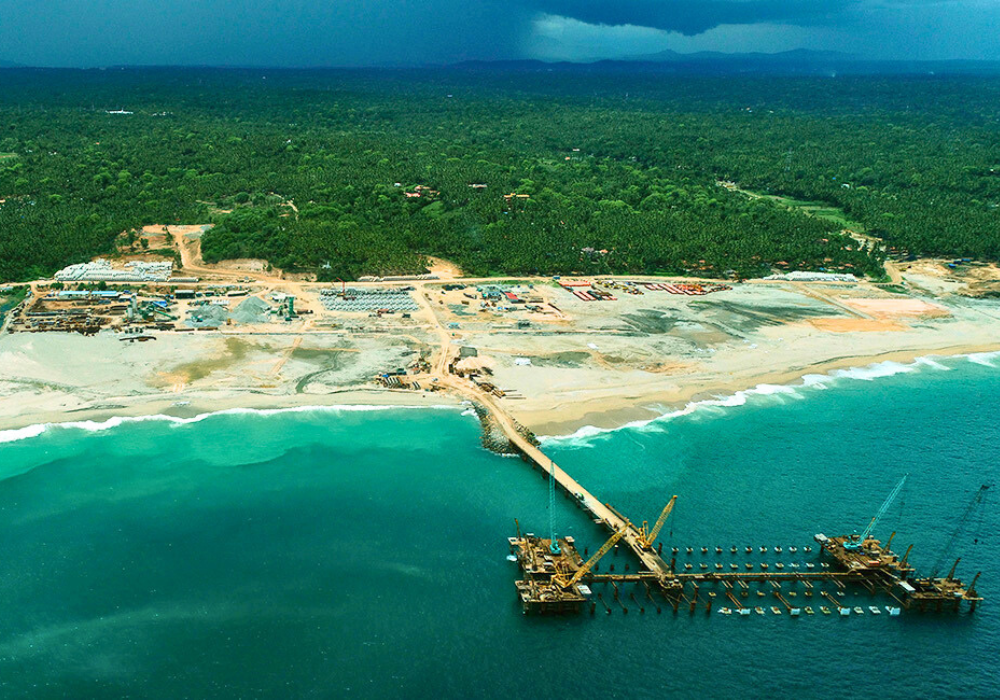
Vizhinjam Port, located near Thiruvananthapuram in Kerala, is India's first deepwater container transshipment port.

Vizhinjam is strategically positioned just 10 nautical miles from the busy international shipping route connecting Europe, the Persian Gulf, and the Far East. Its proximity to this East-West axis allows large vessels to access the port without deviation, making it an ideal global transshipment hub. The port boasts a natural draft of 18-20 meters, which means it can accommodate some of the largest container vessels in the world without capital dredging. Its curvilinear coast mitigates tsunami impact, and minimal erosion keeps maintenance costs low.

As the southern tip of India, Vizhinjam can consolidate and transfer Indian and regional origin cargo to mainline vessels at lower costs than routing them via Colombo. By being right on top of a core international shipping lane, Vizhinjam unlocks lasting maritime and economic advantages for India.

The Adani Group is the private partner responsible for developing Vizhinjam Port, and it aims to enhance India's blue economy and foster inclusive growth.

For the 1st Time Adani Group Company to be Included in Sensex; Wipro will be Excluded

For the 1st Time Adani Group Company to be Included in Sensex; Wipro will be Excluded

Adani Ports and Special Economic Zone (APSEZ) will be included in the Sensex starting from June 24, 2024, replacing IT major Wipro. This change is part of the semi-annual rebalancing exercise announced by the Bombay Stock Exchange (BSE).

This marks the first time a company from the Adani Group will be added to the 30-share Sensex index. The inclusion of Adani Ports is expected to attract significant inflows from passive funds that track the index. On the other hand, Wipro is anticipated to see an outflow as a result of its exclusion from the Sensex.

Notably, in the Nifty50 index, there are two Adani stocks - Adani Ports and Adani Enterprises.

The Sensex, officially known as the S&P BSE Sensex, is the benchmark index of the Bombay Stock Exchange (BSE) in India. It is composed of 30 of the largest and most actively traded stocks on the BSE, which are considered representative of various industrial sectors of the Indian economy.

Significance of Sensex

The Sensex, short for the S&P BSE Sensex Index, is the benchmark index of the Bombay Stock Exchange (BSE) in India. Below are major significance of this:

1. Economic Indicator: The Sensex reflects the health of the Indian economy. It comprises 30 of the largest and most actively traded stocks on the BSE, which are considered representative of various key sectors.

2. Investor Sentiment: Movements in the Sensex can indicate investor sentiment. A rising Sensex suggests optimism and confidence in the market, while a falling index may signal caution or pessimism.

3. Investment Decisions: The Sensex influences investment decisions and portfolio management. Investors and analysts use it to track the performance of the market and compare it with individual stock performance.

4. Market Trends: It provides insights into the development and decline of specific industries, helping investors to understand market trends.

5. Global Benchmark: The Sensex is also tracked internationally, making it a global benchmark for the Indian stock market.

In a brief, the Sensex is a vital tool for investors, analysts, and policymakers to gauge the overall economic sentiment and make informed decisions. It's a barometer of the Indian stock market's performance and a reflection of the country's economic trajectory.

Adani Group Gets Govt Nod for India's First TransShipment Port in Kerala

Adani Group Gets Govt Nod for India's First TransShipment Port in Kerala

Adani Group's Vizhinjam Port in Kerala has received approval to operate as India's first transshipment port. This port facilitates the transfer of cargo between ships and aims to tap into India's transshipment cargo, which is currently handled by foreign ports like Colombo.

The shipping ministry has given its nod for Vizhinjam Port to function as India's first transshipment port, reported Economic Times

The shipping ministry's approval allows customs to establish an office at Vizhinjam Port. The Central Board of Indirect Taxes and Customs (CBIC) is expected to provide the final nod within the next three months.

A transshipment port acts as a transit hub where cargo from one ship is transferred to another ship on its way to the final destination. Mostly transshipment happens to transfer smaller cargos on to bigger mother ships which saves shipment cost and time. Since all the ports in the world are not directly linked, transshipment ports are needed.

The project started in 2015 with the goal of completing the ₹7,700 crore deepwater seaport by 2019. However, it is now expected to start operations in the current financial year.

Vizhinjam Port boasts advanced infrastructure and can handle large vessels.

In its initial phase, the port's capacity is set at one million twenty-foot equivalent units (TEUs), with plans to expand further in subsequent phases. Large-scale automation ensures quick turnaround of vessels, and the port is equipped to handle Megamax containerships, which are currently the largest in operation globally.

Significances of Vizhinjam Port

Nearly 75% of India's transshipment cargo is currently handled by ports outside the country, including Colombo, Singapore, and Klang. By establishing Vizhinjam as a transshipment hub, India aims to retain a share of the more than a million containers transshipped annually through foreign Ports.

The vision for Vizhinjam Port is to be the preferred international transshipment gateway on the Indian subcontinent, known for operational excellence, industry leadership, and sustainability.

Leveraging cutting-edge infrastructure and technology, the port aims to boost India's blue economy and foster inclusive growth. With this development, Vizhinjam Port is set to become India's first full-fledged deepwater transshipment port.

The Port

Adani Group's Vizhinjam Port represents a significant milestone in India's maritime infrastructure, enhancing its capacity to handle transshipment cargo and reducing reliance on foreign ports.

Vizhinjam International Transhipment Deepwater Multipurpose Seaport, also known as the Adani Vizhinjam Port, is an ambitious project located near Kerala's capital, Thiruvananthapuram.

The Vizhinjam Port is designed primarily to cater to container transshipment along with multi- purpose and break bulk cargo. It operates under a landlord model with a Public Private Partnership (PPP) component, where the private partner is Adani Vizhinjam Port Private Limited.

Vizhinjam enjoys inherent locational advantages due to its proximity to the busy international shipping route connecting Europe, the Persian Gulf, and the Far East. It is strategically positioned on the East-West axis, which handles a substantial portion of global maritime trade.

The port's natural depth of 18 meters close to the shore requires no capital dredging, making it suitable for hosting ultra-large container ships with drafts of 20 meters or more. Its curvilinear coast helps mitigate tsunami impact, and minimal erosion reduces maintenance costs.

Adani Intends to Invest ₹1,689 Crore for Ship Leasing Firm in Gujarat's Gift City

Adani Intends to Invest ₹1,689 Crore for Ship Leasing Firm in Gujarat's Gift City

Adani Ports and Special Economic Zone Ltd (APSEZ) has reportedly proposed a significant investment of ₹1,689 crore for the establishment of Poseidon Leasing IFSC Ltd, a step-down subsidiary company, to operate within the GIFT SEZ in Gujarat. This strategic move marks their venture into ship leasing activities, encompassing both operating and financial leases of ships, ocean-going vessels, and related components.

Poseidon Leasing IFSC Ltd has been set up under the umbrella of another APSEZ subsidiary, Shanti Sagar International Dredging Ltd (SSIDL), which will hold full ownership of Poseidon. The newly formed entity will boast an authorized and paid-up capital of ₹2.5 crore, divided into ₹25,00,000 equity shares of ₹10 each. While the company is yet to formally respond to queries, sources familiar with the matter revealed that three director names have been proposed for the venture

This move by the Adani Group signifies their active expansion within the maritime sector, particularly in ports and terminals across India. Establishing a ship leasing entity within Gift City holds strategic significance as it enables Indian firms to conduct transactions in foreign currency, thus attracting companies that previously operated overseas due to regulatory and tax considerations. The decision to set up ship leasing operations at Gift City aligns with the broader trend of Indian entities seeking regulatory clarity and tax incentives domestically, rather than opting for offshore locations like Dubai or Singapore.

Gift City offers various tax breaks, including income tax waivers for up to 10 consecutive years within the first 15 years of operation, along with exemptions on input GST for services procured from Indian or non-resident vendors. Kolkata-based Ripley has already established Ripley Shipping India IFSC Pvt Ltd at Gift City in December 2022, pioneering ship leasing activities in the region.

Meanwhile, Reliance Industries has also ventured into the ship leasing domain at IFSC-Gift City with a substantial investment totaling ₹22,033 crore.

UAE based Transworld Group has also signed a ₹2,000 crore MoU for setting up a ship leasing and aircraft leasing activities in Gift IFSC, while StoneX Group will open a bullion trading desk in GIFT city

With an estimated $75 billion spent annually on seaborne freight to foreign shipping companies and a global charter hire market valued at $100 billion, the emergence of Gift City as a hub for ship leasing activities promises significant opportunities for Indian companies to capitalize on the growing maritime sector while benefiting from favorable regulatory and tax frameworks.


Market Reports

Market Report & Surveys
IndianWeb2.com © all rights reserved