‏إظهار الرسائل ذات التسميات ARIES. إظهار كافة الرسائل

Aditya-L1 Mission – DST Institutes IIA, ARIES, CREST and IUCAA Key Drivers in Designing Payloads To Automated Algo for Detecting CMEs

Aditya-L1 Mission – DST Institutes IIA, ARIES, CREST and IUCAA Key Drivers in Designing Payloads To Automated Algo for Detecting CMEs

Aditya-L1, India's first observatory to study Sun, seeded in IIA - ISRO discussions to observe solar corona closely
  • Visible Emission Line Coronagraph (VELC), the primary payload developed by IIA
  • IIA & ARIES designed the first automated algorithm to detect CMEs on board Aditya-L1 using the VELC instrument
  • Aditya-L1 support cell established at ARIES to act as community service centre for analyzing science data
India’s Aditya-L1, a space observatory with 7 payloads heading for a vantage point to study the Sun has started countdown for its journey. It had its beginnings in preliminary/initial discussions between the Indian Institute of Astrophysics (IIA) and Indian Space Research Organisation (ISRO) about possible observations of the solar corona using indigenous space based telescopes.
Aditya-L1

Visible Emission Line Coronagraph (VELC)

VELC Engineering Team
VELC Engineering Team Members in front of the truck which had the VELC all packed and ready to go to ISRO

IIA, an autonomous institute of the Department of Science and Technology (DST), had initially proposed a ‘suitable coronagraph’ payload to be mounted on a small satellite offered by ISRO. This ‘suitable coronagraph’ later graduated to the Visible Emission Line Coronagraph (VELC) and still prevails as the primary payload, even as India’s Solar study ambitions expanded, making it a national initiative with multi-institutional collaboration.

The VELC will image the Sun's atmosphere, the corona, closer to the Sun than ever before, at high resolution and time cadence. The payload has 40 different optical elements of high precision and will be kept at a temperature of 22 degrees celsius in space.

Led by IIA, the VELC was designed, assembled, characterised, tested and integrated at Centre for Research and Education in Science and Technology (CREST) campus in Hosakote and delivered in close collaboration with ISRO. A Clean Room of international standard (India's first large-scale “Class 10” Clean Room) was constructed for the purpose inside its MGK Menon Laboratory. ISRO made the mirrors and detectors and provided them to IIA, while IIA delivered the completed VELC to ISRO on 26 Jan 2023.

Faculty, students, postdocs in IIA who work on solar astrophysics


Since VELC observes the Sun closest to its surface, many other Aditya-L1 payloads also need its data about new coronal mass ejections and other eruptions. The VELC Payload Operations Centre (POC) set up in IIA campus, will receive raw data from ISRO Indian Space Science Data Centre (ISSDC) and process them further to make it suitable for scientific analysis.

The processed data will be sent back to ISSDC for dissemination. The scientific team at IIA will use the Aditya-L1 data from its many payloads in conjunction with field station observations on the ground to gain a deeper understanding of the Sun-Earth links and, more crucially, the space-weather impact.

Kodaikanal Solar Observatory and Gauribidanur Radio Observatory of IIA will play a key role in this.

Automated Algorithm To Detect Coronal Mass Ejections (CMEs)

IIA and Aryabhatta Research Institute of Observational Sciences (ARIES), an another institute of DST, designed an automated algorithm to detect CMEs (Coronal Mass Ejections) on board Aditya-L1 using the VELC instrument. This algorithm will be the first of its kind to track the huge bubbles of gas threaded with magnetic field lines that are ejected from the Sun, disrupting space weather and causing geomagnetic storms, satellite failures, and power outages.

Solar physics group at ARIES

This algorithm has been hard-coded by ISRO and will be used to detect CMEs automatically on board Aditya-L1, making it one of the first onboard intelligence algorithms for this purpose as no similar thing has been attempted in previous NASA or ESA missions studying the Sun.

Aditya-L1 Support Cell (AL1SC)

ISRO has also collaborated with ARIES to establish the Aditya-L1 Support Cell at ARIES. The Aditya-L1 Support Cell (AL1SC) acts as a community service centre for the guest observers in preparing science observing proposals and analyzing science data.

This support cell will provide additional tools and train users about solar physics and provide help to understand, download and analyse the data from ISSDC/ISRO. AL1SC is conducting workshops in different parts of the country to familiarise students with the basic processes happening on the Sun, current open problems, the Aditya-L1 mission and observational data analysis.
X-ray Spectrometers and In-Situ Instruments

Aditya-L1 carries an ultraviolet imager, two X-ray spectrometers, and four in-situ instruments to measure plasma parameters. These are made by various centres of ISRO and the Inter-University Centre for Astronomy and Astrophysics (IUCAA) with contributions from many other institutions.

India's 1st and Asia's Largest Liquid Mirror Telescope Formally Launched in Uttarakhand

India's 1st and Asia's Largest Liquid Mirror Telescope Formally Launched in Uttarakhand
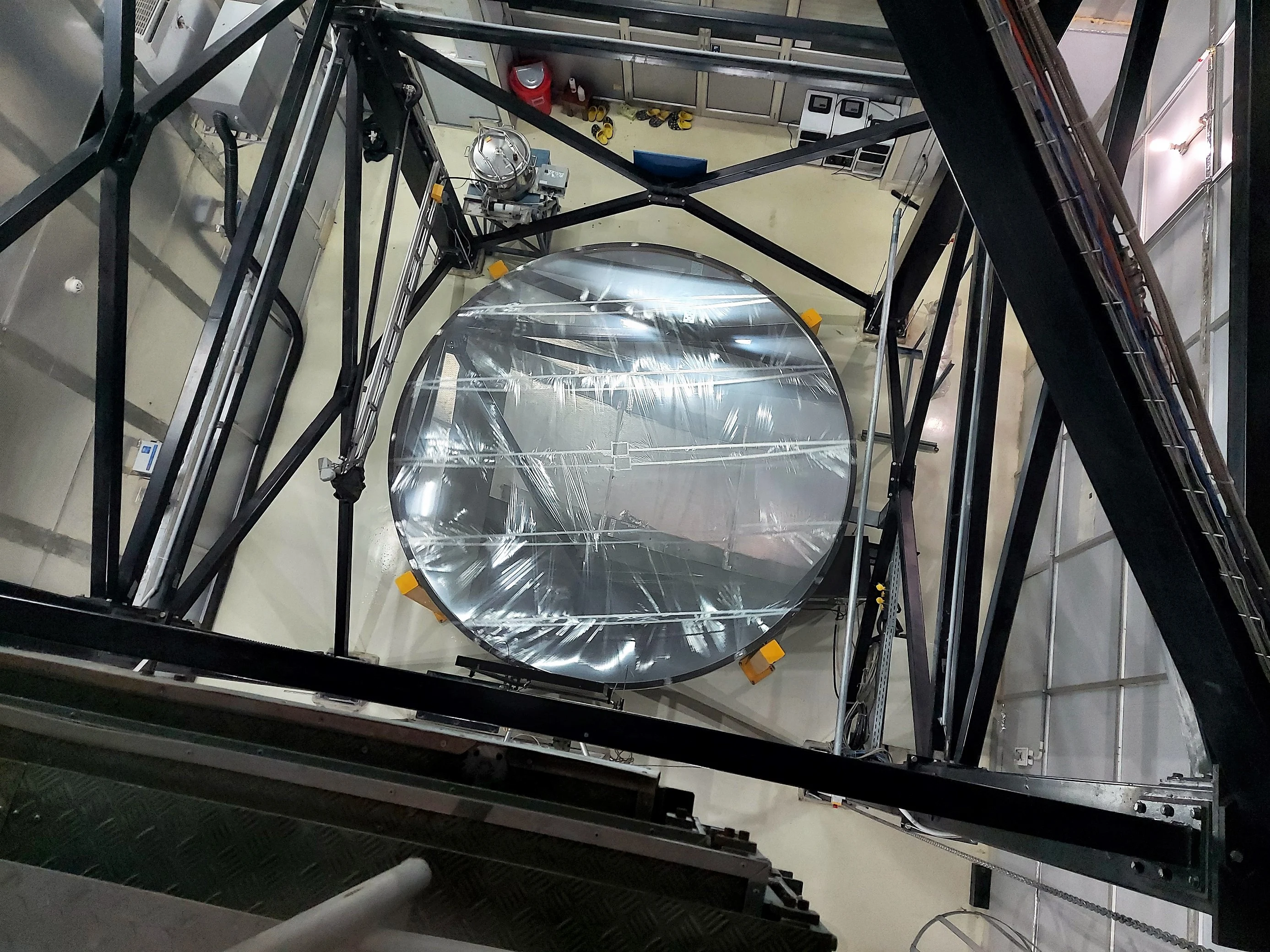
Top view of the ILMT showing the liquid mercury mirror covered by a thin mylar film.

A new telescope facility — International ​Liquid Mirror ​Telescope (ILMT) — has been formally launched in Uttarakhand at campus of Aryabhatta Research Institute of Observational Sciences (ARIES) to keep a watch on the overhead sky to identify transient or variable objects such as supernovae, gravitational lenses, space debris, and asteroids.

This new telescope is first liquid mirror telescope in India and the largest in Asia. It will help in surveying the sky making it possible to observe several galaxies and other astronomical sources just by staring at the strip of sky that passes overhead.

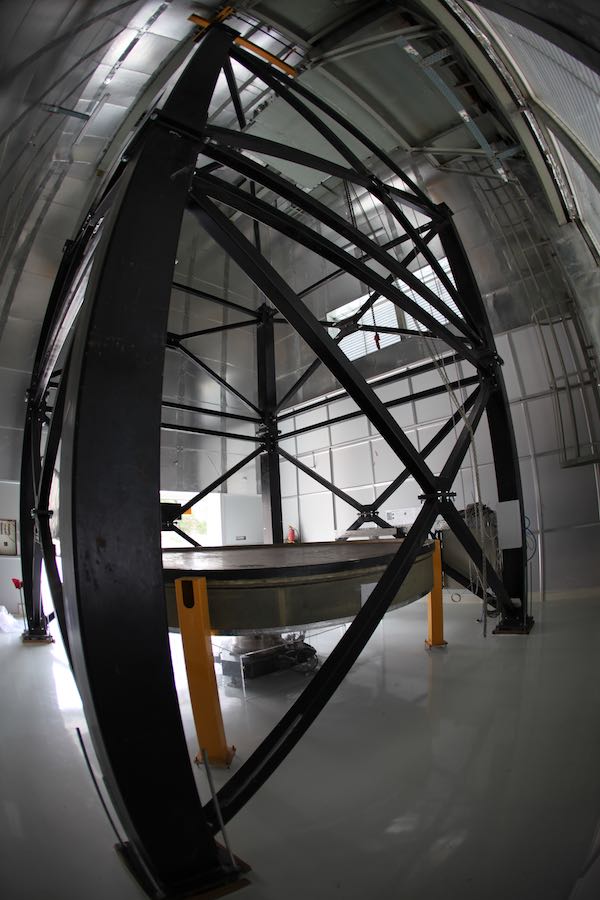
Built by astronomers from India, Belgium and Canada, the novel instrument employs a 4-meter-diameter rotating mirror made up of a thin film of liquid mercury to collect and focus light.

Prof. Dipankar Banerjee, Director, ARIES, said, "ILMT is the first liquid-mirror telescope designed exclusively for astronomical observations installed at the Devasthal Observatory of ARIES. The ILMT and the Devasthal Optical Telescope (DOT). Both are the largest aperture telescopes available in the country."

A ​4Kx4K ​CCD ​camera ​manufactured ​by ​'Spectral ​Instruments' ​and ​which ​can operate ​over ​the ​4000 ​to ​11000 ​Å ​spectral ​range ​(SDSS ​filters ​g', ​r', ​i' ​are ​available), ​will be ​positioned ​at ​the ​prime ​focus ​of ​the ​ILMT ​at ​about ​8m ​above ​the ​mirror. ​The ​mirror ​being parabolic ​in ​shape ​requires ​an ​optical ​corrector ​to ​get ​a ​flat ​focal ​surface ​of ​about ​27 ​arcminute in ​diameter. ​All ​these ​elements ​are ​mechanically ​coupled ​by ​an ​external ​structure ​and ​a ​spider.

India's 1st and Asia's Largest Liquid Mirror Telescope Formally Launched in Uttarakhand

Dr. Kuntal Misra, Project Investigator of ILMT at ARIES, said, "The wealth of data generated with the ILMT survey will be exemplary. In the future, several young researchers will be working on different science programs utilizing the ILMT data. When regular science operations begin later this year, the ILMT will produce about 10 GB of data every night, which will be quickly analyzed to reveal variable and transient stellar sources,” said Dr. Brajesh Kumar, ILMT Project Scientist at ARIES. The 3.6 metre DOT, with the availability of sophisticated back-end instruments, will allow rapid follow-up observations of the newly-detected transient sources with the adjacent ILMT."

The data collected from ILMT will be ideally suited to perform a deep photometric and astrometric variability survey over a period of typically 5 years,” notes Project Director Prof. Jean Surdej (University of Liège, Belgium and University of Poznan, Poland).

The ILMT achieved first light in the 2nd week of May 2022. Using the first light observations through the g, r and i Sloan filters, a colour composite image (shown below) of a small portion of the sky was prepared. 

To highlight the features of galaxies and other stellar objects, the green colour has been slightly enhanced in the image. NGC 4274 Galaxy can be seen in the top right corner.

Colour composite image obtained from first light observations of ILMT.

The ​4m ​International ​Liquid ​Mirror ​Telescope ​(ILMT) ​project ​results ​from ​a collaboration ​between ​Aryabhatta ​Research ​Institute ​of ​Observational ​Sciences ​(ARIES, ​India), the ​Institute ​of ​Astrophysics ​and ​Geophysics ​(Liege ​University), ​the ​Canadian ​Astronomical Institutes, ​University ​of ​Montreal, ​University ​of ​Toronto, ​York ​University, ​University ​of ​British Columbia ​and ​Victoria ​University.


Team of Indian and Int'l Scientists Derived Pluto's Accurate Atmospheric Pressure which is 80,000 Times < Earth

Pluto and its atmosphere seen by New Horizons (NASA)

A team of Indian and International scientists have derived the accurate value of Pluto’s atmospheric pressure at its surface. It is more than 80,000 times less than the atmospheric pressure at mean sea level on Earth.

After its discovery in 1930, Pluto was declared to be the ninth planet in our solar system. However later in 2006, it was given the status of dwarf-planet/ minor-planet in our solar system, by International Astronomical Union.

The pressure on the surface of Pluto was calculated from data obtained by observation of stellar occultation by Pluto on 6 June 2020 using 3.6-m Devasthal optical telescope (DOT) (India’s largest optical telescope) and 1.3-m Devasthal Fast Optical Telescope (DFOT) telescopes located at Devasthal, Nainital, said a press release from Ministry of Science & Technology, Government of India.

The work leading to these results has received funding from the European Research Council under the European Community's H2020 2014-2021 ERC Grant Agreement no. 669416  "Lucky Star." 

The "Lucky Star" project aims is to study the solar system beyond Neptune with stellar occultations. The project is led by Bruno Sicardy in collaboration with groups from Paris, Meudon, Granada and Rio.

In astronomy, an occultation happens when a celestial object gets hidden from the view of the observer due to another celestial object passing in between them. A compilation of twelve stellar occultations by Pluto observed between 1988 and 2016 showed a three-fold monotonic increase of atmospheric pressure during this period.

An international team of scientists, including members from Aryabhatta Research Institute of Observational Sciences (ARIES), used signal-to-noise ratio light curves obtained from the sophisticated instruments used in the observations to derive an accurate value of Pluto’s atmospheric pressure at its surface. It was found to be 12.23 μbar -- 80,000 times less than the atmospheric pressure at mean sea level on Earth. They also found that the pressure at the surface is close to the seasonal peak of Pluto.

The research published in ‘Astrophysical Journal Letters (ApJL)’ showed that since mid-2015, Pluto’s atmosphere is in a plateau phase close to peak and is in excellent agreement with the model values calculated earlier by the Pluto volatile transport model in 2019. The team explained further that this occultation was particularly timely as it can test the validity of the current models of Pluto’s atmosphere evolution.

The study also confirms earlier findings that Pluto suffers intense seasonal episodes because of large depression on Pluto, known as Sputnik Planitia. Pluto’s poles remain, for decades, in permanent sunlight or darkness over its 248-year long orbital period leading to strong effects on its Nitrogen (N2) atmosphere that is mainly controlled by vapour pressure equilibrium with the surface N2 ice. Moreover, as Pluto is now moving away from the Galactic plane as seen from Earth, stellar occultations by the dwarf planet are becoming increasingly rare, making this event a decisive one.

Publication link: https://iopscience.iop.org/article/10.3847/2041-8213/ac4249

For more details, Dr. Saurabh (ARIES) (saurabh[at]aries.res.in), Prof. N M Ashok (PRL) (ashoknagarhalli[at]gmail.com), Prof. Anandmayee Tej (IIST) (tej[at]iist.ac.in) can be contacted.

Scientists from India's ARIES Suggests New Formula to Help Estimate the Mass of Black Hole


A new study has suggested a formula that can help probe black holes. Black holes (BH) cannot be observed directly, but their presence can be detected by the huge amount of energy that is liberated through temporary accumulation of matter outside the BH, before it dives into the BH, a process called accretion.

Scientists have found the formula that can assess the spectrum emitted from the accretion discs around black holes. Spectra of accretion discs can help estimate the mass of the black hole.

Accretion flow around BH is composed of ionised plasma, which is a soup of bare electrons and protons. Since electrons are more prone to radiative losses than the protons, it is expected that around a BH, electrons and protons would settle down into two separate temperature distributions. Therefore, the two-temperature equations are generally solved to obtain the emitted spectrum from the electron temperature distribution. This is known as two-temperature modeling of accretion flows. 


Scientists from Aryabhatta Research Institute of Observational Sciences (ARIES), an autonomous institute under the Department of Science and Technology (DST), Govt. of India, investigated the nature of these two-temperature flows.

The research led by Shilpa Sarkar and Indranil Chattopadhyay from ARIES along with Philippe Laurent from IRFU / Service d’ Astrophysique and Laboratoire Astroparticule et Cosmologie, which has been recently accepted for publication in the journal Astronomy & Astrophysics (A&A), found that the number of unknown variables in the two-temperature regime exceeds the number of equations present. Hence, we get multiple solutions for the same set of constants of motion, like total energy or mass-inflow rate.

Looking for a unique solution, scientists have developed a new formula called the Sarkar & Chattopadhyay form of entropy formula that can only be applied near the horizon where gravity overpowers any other interactions like energy exchange terms between ions and electrons. This novel approach helped in selecting a unique solution out of the multiple solutions of accretion disc spectrum emission around a BH. Entropy is the measure of randomness in any system. In two temperature solutions, the formula for measure of entropy does not exist. This new formula allows to measure the entropy of the flow close to the black hole horizon. According to the second law of thermodynamics, nature selects or prefers those processes which maximize entropy. ARIES team showed that there exists one solution for which the entropy is maximum and thereby broke the multiplicity of solutions.

Using this formula, they found that with the increase of the mass supply to the central BH, the accretion disc becomes brighter and more high energy photons are emitted. With the increase of mass of the BH, luminosity increases, and the bandwidth of the emitted spectrum, both in the high energy and low energy range, increases, but the spectral shape does not change. In other words, matter around a massive BH will produce a lot of photons in the low energy and high energy band, but around a smaller BH, it will emit predominantly in the X-rays.

According to the ARIES team, this is the first time any approach of removing degeneracy from two-temperature theory has been proposed. It is necessary to obtain a correct solution, and hence a correct spectrum for any accretion flow around BH as any arbitrary choice of solution would give us a wrong picture of the system. The results could contribute in the understanding of physical processes around extreme objects like BHs.

A Cartoon Diagram of Accretion Disc


the Mach number, and temperature variation with the distance from the BH is plotted. Also, in panel Fig. 2c, the total spectrum and the contribution to the spectrum from various regions of accretion disc are shown.


For more details, contact: Shilpa Sarkar (shilpa@aries.res.in) and Indranil Chattopadhyay

(indra@aries.res.in). ]

Facebook Launches New Antenna-Technology Solutions To Provide Internet In Rural Areas


Facebook's Free Basics faced stern opposition from people in India, where instead of choosing the free goodies being offered by Facebook, people chose to go with net neutrality instead. But, Facebook, it seems, isn't ready to take no for answer. According to Facebook, its preliminary idea behind Free Basics was free basic internet for all. But, after it those plans went down the drain, Facebook has come up with new two brand new initiatives to spread Internet connectivity in rural areas of developing countries like India.

The two initiatives, the Antenna Radio Integration for Efficiency in Spectrum (ARIES) system and Terragraph were launched during Facebook's recently held two-day annual F8 conference in San Francisco, US.

Aimed at boosting efficiency, speed and quality of internet connectivity in remote areas in developing countries, ARIES is a base station with 96 antennas that is capable of supporting up to 24 devices or streams simultaneously over the same radio spectrum. This helps the ARIES cover more users across large, rural areas through the means of multiple transmitters and receivers.


Facebook ARIES - First version of our prototype antenna array with 96 transmit antennas providing 10x spectral and energy efficiency gains.

Further, the social networking giant boosts that ARIES will be able to showcase 10 times more spectral and energy efficiency gain over a typical 4G. According to Facebook, the company will extend a helping hand to telecom companies and make the process of improving mobile infrastructure cheaper by open sourcing ARIES' wireless hardware.

On the other hand, the 60GHz wireless Terragraph is missioned at bringing high-speed internet to dense urban areas around the world. The social networking giant is currently testing the Terragraph system at its Palo Alto headquarters and after that it will give it another run in San Jose city.
Urban deployment of Terragraph network

Terragraph four sector distribution node (left) and Terragraph prototype node (right)

While some of Facebook's initiatives launched in the past like the optical fibre is capable enough to provide hundreds of megabits up to several gigabits of capacity, the only problem is, that they are a little heavy on the pocket for many countries. But, Terragraph is a big reliever in that department. It can efficiently deliver gigabit speeds by placing small boxes called nodes around the urban area about 200-250 metres apart on objects such as light poles.

In February this year, Telecom Regulatory Authority of India (TRAI), the Indian telecom watchdog, had issued a ruling against Facebook’s Free Basics by backing net neutrality. According to TRAI, no service provider should be allowed to charge its customers discriminatory tariffs for data services on the basis of content.

Facebook Launches New Antenna-Technology Solutions To Provide Internet In Rural Areas


Facebook's Free Basics faced stern opposition from people in India, where instead of choosing the free goodies being offered by Facebook, people chose to go with net neutrality instead. But, Facebook, it seems, isn't ready to take no for answer. According to Facebook, its preliminary idea behind Free Basics was free basic internet for all. But, after it those plans went down the drain, Facebook has come up with new two brand new initiatives to spread Internet connectivity in rural areas of developing countries like India.

The two initiatives, the Antenna Radio Integration for Efficiency in Spectrum (ARIES) system and Terragraph were launched during Facebook's recently held two-day annual F8 conference in San Francisco, US.

Aimed at boosting efficiency, speed and quality of internet connectivity in remote areas in developing countries, ARIES is a base station with 96 antennas that is capable of supporting up to 24 devices or streams simultaneously over the same radio spectrum. This helps the ARIES cover more users across large, rural areas through the means of multiple transmitters and receivers.


Facebook ARIES - First version of our prototype antenna array with 96 transmit antennas providing 10x spectral and energy efficiency gains.

Further, the social networking giant boosts that ARIES will be able to showcase 10 times more spectral and energy efficiency gain over a typical 4G. According to Facebook, the company will extend a helping hand to telecom companies and make the process of improving mobile infrastructure cheaper by open sourcing ARIES' wireless hardware.

On the other hand, the 60GHz wireless Terragraph is missioned at bringing high-speed internet to dense urban areas around the world. The social networking giant is currently testing the Terragraph system at its Palo Alto headquarters and after that it will give it another run in San Jose city.
Urban deployment of Terragraph network

Terragraph four sector distribution node (left) and Terragraph prototype node (right)

While some of Facebook's initiatives launched in the past like the optical fibre is capable enough to provide hundreds of megabits up to several gigabits of capacity, the only problem is, that they are a little heavy on the pocket for many countries. But, Terragraph is a big reliever in that department. It can efficiently deliver gigabit speeds by placing small boxes called nodes around the urban area about 200-250 metres apart on objects such as light poles.

In February this year, Telecom Regulatory Authority of India (TRAI), the Indian telecom watchdog, had issued a ruling against Facebook’s Free Basics by backing net neutrality. According to TRAI, no service provider should be allowed to charge its customers discriminatory tariffs for data services on the basis of content.

Market Reports

Market Report & Surveys
IndianWeb2.com © all rights reserved