‏إظهار الرسائل ذات التسميات AI Robot. إظهار كافة الرسائل

Tesla Halts Plans for Thousands of Humanoid Bots Over Hand Design Flaws


Tesla has officially scaled back its ambitious plans to produce thousands of Optimus humanoid robots in 2025 due to significant design challenges—especially with the robot's hands.

Optimus, also known as the Tesla Bot, is a general-purpose humanoid robot developed by Tesla. It was first announced at Tesla’s AI Day in August 2021, with a prototype unveiled in 2022.

Designed to perform tasks humans don’t want to do, like factory work, sorting, lifting, and navigating terrain, the Optimus bot is powered by Tesla’s onboard AI brain (based on Autopilot hardware), it learns through simulation-based reinforcement learning. The latest Gen 3 version stands 173 cm tall, weighs 57 kg, and can walk at 5 mph. It has 22 degrees of freedom in each hand, enabling human-like dexterity.

In 2025, Tesla showcased Optimus performing Kung Fu movements—learned entirely through AI, without human programming. The robot demonstrated balance, coordination, and agility, marking a leap in real-time movement control.

Tesla initially planned internal deployment in 2025, with external sales starting in 2026. The projected cost is under $30,000, though skepticism remains about its timeline and mass-market viability.

What went wrong?

Tesla Halts Plans for Thousands of Humanoid Bots Over Hand Design Flaws
Tesla originally aimed to produce at least 5,000 Optimus bots this year, up from just a few dozen in 2024. However, technical issues with the hands, which are the most complex part of the design, have caused delays. Engineers are struggling to create dexterous, human-like hands.

The company has reportedly stockpiled Optimus bodies missing hands and forearms, with no clear timeline for completion. Tesla has now lowered its production target to 2,000 units, but even that revised goal appears to be in jeopardy.

Strategic implications

Elon Musk had previously described Optimus as a transformative technology that could eventually surpass Tesla’s EV business in impact. This setback may delay that vision, though development continues behind the scenes.

Figure 03: The Next Leap in Humanoid Robotics

Figure 03: The Next Leap in Humanoid Robotics


Figure 03 is the latest humanoid robot developed by Figure AI, a California-based robotics startup founded in 2022 by Brett Adcock. Designed for real-world environments—from homes to warehouses—Figure 03 is a full-sized, bipedal robot capable of performing everyday tasks like folding laundry, washing dishes, and navigating complex spaces.

About Figure AI

Figure AI is backed by major tech investors including OpenAI, Microsoft, and Jeff Bezos. Its mission is to create scalable, general-purpose humanoid robots that can fill labor gaps and assist in daily life.
  • Founded in 2022 by Brett Adcock
  • Headquartered in California
  • Focused on real-world deployment of humanoid robots
  • Backed by OpenAI, Microsoft, and Jeff Bezos

Architecture Highlights

At the heart of Figure 03 is Helix, a proprietary Vision-Language-Action (VLA) model that enables real-time decision-making without pre-scripted commands.
  • Vision: Wide field of view and high frame rate
  • Language: Natural language comprehension and contextual reasoning
  • Action: Dexterous hands and stable locomotion for task execution
  • Unified System: Integrates perception, planning, and control
Helix makes Figure 03 one of the first humanoids capable of unscripted, adaptive behavior in dynamic environments.

What Makes Figure 03 Revolutionary?

Figure 03 isn’t just a robot with limbs—it’s a general-purpose AI agent powered by Helix, a proprietary vision-language-action (VLA) model that allows it to understand, reason, and act in real time. It doesn’t follow scripts. It learns, adapts, and responds to the world like a human would.
  • Vision Upgrade: 60% wider field of view and 2× faster frame rate
  • Latency: Reduced by 75% for near-instant reactions
  • Mobility: Walks, balances, and navigates complex environments
  • Hands: Redesigned for dexterity—capable of folding laundry, pouring drinks, and more
Watch the full reveal in Introducing Figure 03, where the team showcases the robot’s capabilities and design philosophy.

Built for the Real World

Unlike its industrial predecessors, Figure 03 is engineered for human-centric environments. It’s 5'6" tall, weighs 60 kg, and is designed to operate safely around people.
  • Home Integration: Wireless charging, soft-touch materials, and voice interaction
  • Safety First: Advanced sensors and AI-driven motion planning
  • Household Tasks: From dishwashing to plant watering, it’s your new domestic ally
Curious how it performs in a real home? Is the Figure 03 Robot Ready to Clean Your House? puts it to the test in a domestic setting.

Beyond the Home: A Workforce Revolution

Figure AI envisions a future where humanoid robots fill labor gaps in logistics, manufacturing, and elder care. With a modular design and scalable production, Figure 03 is built for mass deployment.
  • Production-Ready: Designed for large-scale manufacturing
  • Cost Target: Estimated between $20,000–$30,000 per unit
  • Job Impact: Analysts predict up to 8 million jobs could be augmented or replaced by 2040

Explore the broader implications in Figure 03 – The Humanoid Robot Built for the Home and the ...

Watch Figure 03 in Action

🧩 The Bigger Picture

Figure 03 is more than a machine—it’s a symbol of the AI-human future. With backing from OpenAI, Microsoft, and Jeff Bezos, Figure AI is betting big on a world where robots are not just tools, but teammates.

As the humanoid revolution accelerates, one thing is clear: the future isn’t just coming—it’s walking right through your front door.

A Robot That Gives Birth? China’s Kaiwa Sparks Global Debate

A Robot That Gives Birth? China’s Kaiwa Sparks Global Debate

Kaiwa Technology, a Guangzhou, China-based firm led by Dr. Zhang Qifeng, has unveiled plans to launch the world’s first humanoid robot equipped with an artificial womb by 2026. The project was introduced at the 2025 World Robot Conference in Beijing and is being hailed as a potential revolution in reproductive science.

What Makes This Robot Unique?

  • Artificial Womb Integration: Carries a fetus from fertilization to full-term birth using synthetic amniotic fluid and nutrient-delivery tubes.
  • Interactive Pregnancy: Mimics the entire gestation process—from implantation to delivery.
  • Affordability: Target price under 100,000 yuan (~$13,900), far cheaper than traditional surrogacy.

Feature Overview

Feature Description
Artificial Amniotic Fluid Maintains fetal hydration and temperature
Nutrient Tubes Delivers oxygen and nutrients similar to an umbilical cord
Temperature Regulation Simulates womb-like warmth and stability
Oxygen Monitoring Ensures safe fetal development

Ethical & Legal Challenges

  • Surrogacy Ban: Surrogacy is illegal in China; Kaiwa is negotiating with Guangdong authorities.
  • Embryo Research Limits: Restricted to 14 days under current law.
  • Concerns:
    • Parental rights and legal guardianship
    • Psychological impact on robot-born children
    • Potential misuse for mass reproduction or genetic engineering

Societal Reactions

  • Some hail it as a lifeline for infertile couples.
  • Others call it “dehumanizing” or a “dystopian nightmare.”
  • Feminist critiques warn it could undermine maternal identity

Accenture Invests in Humanoid General-purpose Robots Developer Sanctuary AI

Accenture Invests in Humanoid General-purpose Robots Developer Sanctuary AI

Accenture has made a strategic investment through Accenture Ventures in Sanctuary AI, a company specializing in the development of AI-powered humanoid robots. These robots, like the PhoenixTM model, are designed to perform a wide variety of tasks quickly, safely, and effectively, and are intended to work alongside humans in various industries, including post and parcel, manufacturing, retail, and logistics warehousing operations.

Sanctuary AI's robots are notable for their human-like dexterity and ability to perform complex tasks with precision. The AI control system, CarbonTM, which powers these robots, is designed to mimic human brain subsystems, enabling the robots to react to their environment and perform new tasks efficiently.

This investment aligns with Accenture's broader strategy to innovate and provide solutions that integrate advanced technology with human creativity, ensuring a balanced and responsible approach to technology deployment. Sanctuary AI's inclusion in Accenture Ventures’ Project Spotlight is expected to connect emerging technology startups with Accenture’s global client base, fostering innovation and addressing strategic gaps.


"AI-powered humanoid robots are essential to reinventing work and supporting human workers as labor shortage is becoming an issue in many countries and industries,” said Joe Lui, Accenture’s global advanced automation and robotics lead. “Sanctuary AI’s advanced AI platform trains robots to react to their environment and perform new tasks with precision in a very short time. We see huge potential for their robots in post and parcel, manufacturing, retail and logistics warehousing operations, where they could complement and collaborate with human workers and automate tasks that traditional robotics can’t.

Sanctuary AI’s general-purpose robot PhoenixTM, recently recognized as one of TIME magazine’s “Best Inventions of 2023,” can perform a multitude of work tasks. For instance, at a Mark’s retail store in Langley, BC, Canada, Phoenix has performed more than 100 tasks, including choosing and packing merchandise, and correctly cleaning, tagging, labeling and folding items, with robotic hands that rival human hand dexterity and fine manipulation. Phoenix is powered by the company’s AI control system, CarbonTM, which mimics subsystems found in the human brain, such as memory, sight, sound and touch, and translates natural language into action in the real world.

Accenture has previously invested in other robotics areas, for example, through Accenture Alpha Automation, a recently formed joint venture with Japanese robotics leader Mujin, and acquisitions of Eclipse Automation in Canada and Pollux in Brazil. Sanctuary AI is the latest company to join Accenture Ventures’ Project Spotlight, an engagement and investment program that connects emerging technology startups with Accenture’s Global 2000 client base in order to fill strategic innovation gaps.

Geordie Rose, chief executive officer and co-founder of Sanctuary AI, said, “Robots with human-like intelligence will completely transform the workforce of the future. By combining Accenture’s expertise in disruptive technology with Sanctuary AI’s industry-leading robotics, we can help some of the biggest companies in the world manage this change and provide the best solutions for its clients.”

Founded in 2018, Sanctuary AI is based in Vancouver, Canada and is on a mission to create the world's first human-like intelligence in general purpose robots that will help us work more safely, efficiently, and sustainably, helping to address the labor challenges facing many organizations today. Sanctuary AI's growing list of customers and investors represents a wide variety of industries across Canada, the US, and other countries around the world.

Members of the Sanctuary team have earlier founded other notable technology ventures, such as D-Wave (a pioneer in the quantum computing industry), Kindred (first use of reinforcement learning in a production robot), and the Creative Destruction Lab (pioneered a revolutionary method for the commercialization of science for the betterment of humankind). With experience at startups and technology leaders such as Amazon, Microsoft, and Softbank Robotics, the team has experience launching market-defining innovations rooted in previously unsolved and deep scientific problems.

Besides Accenture, significant investments have been made by tech giants and venture capital firms in humanoid robotics. Jeff Bezos, Nvidia, and OpenAl have invested in a humanoid robot startup, Figure AI, which has drawn a $675 million investment, to date.

Microsoft, Intel, and LG Innotek are also among the investors in various humanoid robotics ventures, recognizing the potential of these technologies in various industries.

Samsung Unveils New Ballie, An AI Companion Robot for the Home

Samsung Introduces Ballie, An AI Companion Robot for the Home

A new, smart home companion is welcoming users home by taking care of household tasks, displaying the day’s events and sharing weather updates.

Samsung Electronics introduced a new version of its AI home companion robot Ballie at a press conference at the Mandalay Bay Hotel in Las Vegas on January 8 (local time) — ahead of the Consumer Electronics Show (CES) 2024. First introduced at CES 2020, Ballie has been revamped with new advanced features to help users intelligently navigate their lives.


Ballie acts as a personal home assistant, autonomously driving around the home to complete various tasks. By connecting to and managing home appliances, Ballie can provide a helping hand to users in many situations — continually learning from users’ patterns and habits to provide smarter, more personalized services. Ballie provides peace of mind by sending video updates of pets or loved ones to users’ devices when they’re away from home. What’s more, Ballie can set the mood for any home activity whether users are exercising, working or relaxing. From projecting workout videos on the wall or floor in an optimal size to playing music and answering phone calls, Ballie makes life at home more productive and enjoyable.

Learn more about Ballie’s unique AI functionalities in the video below.


BLR Airport Introduces AI-driven Robots for an Enhanced Passenger Experience

BLR Airport Introduces Robots for an Enhanced Passenger Experience

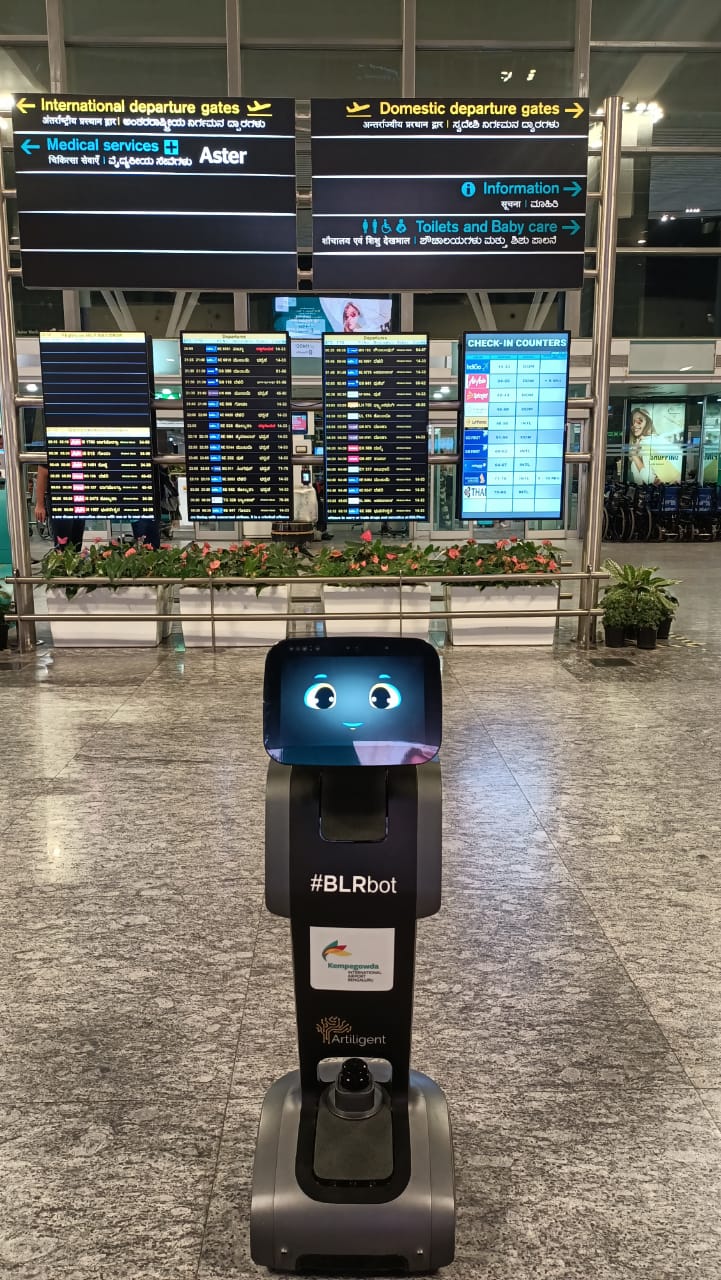
Innovation being the hallmark of its services, Kempegowda International Airport, Bengaluru (BLR Airport) has introduced the first-of-its-kind AI-driven, assistance robots to enhance passenger experience at BLR Airport.

Currently, at the trial stage, 10 robots have been deployed to help guide passengers through the airport and answer basic queries. The robot count will be increased in a calibrated manner and will be further developed over a period in terms of functionality and features, after gauging customer feedback.

BLR Airport Introduces Robots for an Enhanced Passenger Experience

BLR Airport Introduces Robots for an Enhanced Passenger Experience
#BLRbots
BLR Airport has partnered with Artiligent Solutions Pvt. Ltd. – specialists in AI and Robotics, to model the robots along with creating a customised passenger services software. The default language of communication will be English, with additional regional and international languages in the offing.

Jayaraj Shanmugam, Chief Operating Officer, BIAL, said that the airport prides itself on being a trendsetter when it comes to blending innovation and providing a seamless experience to passengers. “Pre-empting passenger requirements and complementing new-age technology with a focused customer-centric team approach has been our winning combination. These smart robots are the latest addition to our offering which shall further boost our concentrated endeavor to provide exceptional customer service.”

Rupesh Sawant, Chief Executive Officer, Artiligent said: “Innovative technology is revolutionising airtravel across the world. Artiligent ideated the AI_PORT concept to develop an enhanced airport experience for travellers. We are proud to associate with BLR Airport, the first airport in India to launch our solution and take a leap in their digital transformation journey.”

#BLRbots
The robots will provide a variety of services which include providing information on the flight status, passenger convenience services, directional assistance, Retail and F&B information. They shall navigate autonomously through the terminal and escort passengers to their desired locations. If due to any reason, the robot is unable to answer queries, passengers shall be immediately connected to the ‘Airport Help Desk’ via video call, on the robot screen itself.

Zendesk announces new self-service experiences with expanded AI-powered solutions

Zendesk, Inc. today announced the expansion of Answer Bot across all web and mobile channels, allowing companies to provide always-on support and faster responses for consumers with AI-powered self-service.

Supporting the growing demand for customer-centric solutions, Zendesk also announced new capabilities for its Guide Enterprise knowledge management product that helps customer experience teams leverage automation and AI to develop, maintain and manage more complex knowledge needs across multiple brands, products and services.

With Answer Bot and Guide Enterprise, companies can use AI and automation to power experiences that put customers at the center of the business.

Powerful automation with Answer Bot

This extension of Zendesk’s popular Answer Bot product enables real-time support, helping customers quickly access answers to common questions regardless of the channel they are reaching out on. Businesses can implement Answer Bot via API, Web Widget and Mobile SDKs, as well as email and web forms. As a result, companies will be able to reduce the volume of repetitive tickets, freeing up agent time to focus on more complex customer requests.

“Customers today demand fast responses in a context that suits them, and AI can be used to help companies be more timely and accurate when engaging with customers,” said Adrian McDermott, president of products, Zendesk. “With Answer Bot, we’re putting an end to laborious processes to resolve simple questions. We’re not just delivering self-service everywhere - we’re delivering AI-powered self-service everywhere, which will continue to make for a better customer experience."

Research from the Zendesk Benchmark report of 45,000 companies worldwide shows 85 percent of customers will shift to a different contact method if they don’t get a response from their initial request, with 44 percent waiting less than an hour before doing so.

“Answer Bot in the Web Widget has allowed our customers to self-serve their easy, quick-answer questions, allowing our agents to have bandwidth to serve more complex issues," said Aja Varney, Director, Global Customer Engagement at Spartan Race. “The time savings for our agents has allowed us to add an additional three hours of chat coverage per day."

Answer Bot also improves internal team productivity by surfacing recommendations as they speak to customers, contributing to a more efficient and accurate experience. Answer Bot for Slack and Answer Bot for Agents uses machine learning to automate support for internal teams to find answers as quickly as possible on behalf of their customers.

New Guide Enterprise powers smarter self-service

Nearly four billion knowledge base articles were viewed on Zendesk in 2018—up 13 times from five years ago. According to the Harvard Business Review, 81 percent of customers prefer to find answers themselves, which means companies should provide access to

Self-service options and regularly update help resources.

Newly added Guide Enterprise tools address this demand by empowering teams to maintain and manage more complex knowledge needs. Additional features including content lifecycle automation and enterprise-level customer self-service enhancements are detailed below:


  • Content Cues provide signals to content managers to maintain and improve their knowledge base. AI-powered cues help prioritize content based on support inquiry trends, allowing managers to optimize their knowledge base to better match customer questions. For example, they can be prompted to update the most viewed articles as a priority to make sure the most common queries are always addressed.

  • Article Events help companies better manage content throughout its lifecycle. Content managers can now use Article Verification to set automatic intervals to verify the relevance and accuracy of their articles, while prompting agents to create content on an ongoing basis. Scheduled Publishing* makes it easier for content managers to create and automatically manage content that has a limited life span, such as a short-term sale or promotion article.

  • Flexible Hierarchies, multiple theme templates and search enhancements, make it easy for companies to manage more complex knowledge needs internally, externally and across multiple brands or services. These new enhancements to the Guide Enterprise experience make it more user-friendly for advanced businesses to give customers the accurate self-service experiences they expect and are familiar with.


Zendesk unveiled these new solutions today at Showcase London, the company’s event that brings industry leaders together to have great conversations, the freshest Zendesk product updates, and stories from innovative brands who make the most of Zendesk.

Answer Bot for Web Widget and Answer Bot for Slack are now generally available for customers. Answer Bot API, scheduled publishing and Mobile SDKs are currently in early access and will be generally available soon. More details for Answer Bot are available here.

*Source: Zendesk Benchmark Report. Refers to customer results after one year with the service.

Indian Trains Now has 'USTAAD', An AI-Powered Robot to Ensure Safety

To check technical faults and ensure the safety of trains in India, a robot will now replace humans as Central Railways has developed an in-house robot named 'USTAAD' (abbreviation of 'Undergear Surveillance Through Artificial Intelligence Assisted Droid'), which will now check for safety in under gear parts of train coaches.

The new Artificial Intelligence (AI) powered robot will click photos and record videos of the train, under the gears and then transmits them over WiFi to engineers for maintenance and repair, thus reducing chances of human error while examining undergear equipment on Indian Railways trains.

Developed by Mechanical Branch of the Nagpur Division of Central Railways, the new robot USTAAD can watch and examine areas which cannot be seen and approached by humans usually, due to the narrow spaces between under-gear parts.

Some of the very proficient features and practical capabilities of USTAAD are as follows:

HD camera:

For the constructive and appropriate examination of train’s coaches or wagon’s parts, USTAAD has been facilitated with HD (high-definition) camera. This HD camera is able to move 320 degrees on X-axis and 130 degrees on Y axis so that the maximum portion of under gear gets covered. The camera captures video as well as still photographs of the under gear parts of the coaches in real time and then, can transfer them over Wi-Fi. The engineer can study these videos on the big screen and can record the same. The HD camera of USTAAD can be rotated in any direction as per commands given by the engineer. The camera can also zoom in or zoom out on the spot, during safety inspection.

[caption id="attachment_127897" align="aligncenter" width="660"]USTAAD Robot USTAAD, The AI-powered Robot (Image - Financialexpress.com)[/caption]

LED flood lights:

USTAAD is also equipped with LED (light-emitting diode) flood lights and is able to capture the videos in low light conditions as well as in dark mode. With the help of the robot’s technical power, the chances of any mistake overlooked by the human eye can be eliminated, which, in turn, reduces the chances of human error. With the help of USTAAD, engineers can easily analyse and examine areas which are difficult to see and impossible to approach manually. Cramped and narrow spaces, between or under the gear parts, can be easily captured by the robot.

Sound detection

The robot can also tap the sound of flat tyre, during placement of the rake on the Pit Line. This is particularly important for prior detection of flat tyre, in order to keep a check on the train’s swift journey.

Indian trains, which are second largest rail network of world, are known as the cheapest mode of transportation which millions of people prefer to travel in rather then other transport services. However, some times this busiest rail network comes to standstill due to accidents and mishaps.

By use of USTAAD robot, the chances of a mistake and any deficiency overlooked by the human eye can be eliminated.

It may also be recalled that in August this year, Indian Railways has also got its first 'SMART' coach including AI-enabled CCTV cameras. The 'SMART' coach, built by Modern Coach Factory, Raebareli, are equipped with black boxes and coach information and diagnostics systems.

Source - Financial Express

Meet Mitra - An AI Robot Designed By Bengaluru Startup and Built In China

In what could be considered as a perfect example of the greatness that can be achieved if both India and China come together and join hands more often, Bengaluru-based robotics start-up Invento Robotics has collaborated with manufacturing hubs in China to give birth to an intelligent robot called Mitra.

A 4.5 feet tall humanoid, Mitra has been designed by Invento to interact with humans through natural ways - voice and vision. It recognizes speech and then converts that into actionable information, which is then run through the startup’s algorithms to both respond to that query through past learning. This is then conveyed through speech output.

No, we’re not just talking about an idea in thin air. Mitra’s first prototype is actually currently functioning at Canara Bank’s headquarters in Bengaluru. Though at 30 kg, the robot is quite bulky, the robot is working quite efficiently as a receptionist at the bank and giving tours of the bank’s “experience zone” to customers.

When Invento Robotics started developing Mitra, they had an idea, they had the skills to design and come up with a working prototype, but what they lacked was the ability to manufacture it on a scale. That’s when they decided to jump on a flight and head to China’s manufacturing hubs of Shenzhen and Dongguan where they finally found suppliers who can fulfill what they were looking for.

Balaji Viswanathan, one of the founders of Invento Robotics, told Hindustan Times, “The computer-aided designing has been done in India, its plastic mould is being made in a factory in Dongguan and the printed circuit boards and motor controls are being manufactured in Shenzhen (both cities in south China).”

Talking about what made them choose China as their manufacturing hub, Viswanathan said, “The quality of assemblage is good and so is the speed of delivery (of products) in China.”

According to media reports, four Mitra prototypes, moulded in a Dongguan factory with circuit boards from Shenzhen, are currently on their way to India. If they prove to be successful, hundreds more robots could be headed our way.

Yesterday, the Dalian government signed a first of its kind MoU with Nasscom, the Indian National Association of Software and Services Companies, which entails Dalian government helping Indian IT companies setting up units there. The MoU aims to take forward the long-heralded coming together of Chinese hardware and Indian software that has been generally slow to crystallise.

Mitra is just one example of what’s more to come our way if India and China continue on this journey together.

Market Reports

Market Report & Surveys
IndianWeb2.com © all rights reserved