‏إظهار الرسائل ذات التسميات Graphene Seminconductor. إظهار كافة الرسائل

IISc Proposes ₹500 Crore Plan for World's Smallest Semiconductor Chip

IISc Proposes ₹500 Crore Plan for World's Smallest Semiconductor Chip

Angstrom-scale chips are ultra-small semiconductor chips that go beyond the current nanometer-scale technology. These chips are designed using 2D materials like graphene and transition metal dichalcogenides (TMDs), allowing for extremely compact and efficient electronics.

For context, the smallest chips currently in production measure 3 nanometers, but angstrom-scale chips aim to be one-tenth that size. This breakthrough could lead to faster computing, energy-efficient devices, and next-generation Al systems.

India's Indian Institute of Science (IISc) has proposed a ₹500 crore project to develop these ultra-small chips, positioning the country as a leader in next-gen semiconductor technology, said a report by news agency PTI.

According to the report, India’s Ministry of Electronics and IT (MeitY) confirmed that the proposal has been under discussion.

The report also cites an official privy to the development and quotes the official saying, "MeitY is positive about the project. The Principal Scientific Adviser and Secretary, MeitY, have held meetings on it. MeitY is exploring the electronics applications where such technology can be deployed. This is a collaborative effort that requires due diligence at every step."

This comes within few days after IISc researchers recently announced that they have engineered a bacteria-based technique to repair bricks used in space habitats.

Scientists from IISc have proposed developing angstrom-scale chips using 2D materials like graphene and transition metal dichalcogenides (TMDs). These chips would be far smaller than the smallest chips currently in production, potentially revolutionizing semiconductor technology. The proposal, submitted to the government, aims to position India as a leader in next-generation semiconductor research.

The project seeks ₹500 crore over five years to develop indigenous technology, contrasting with India's 91,000 crore semiconductor project led by Tata Electronics in partnership with Taiwan's PSMC.

Globally, Europe, South Korea, China, and Japan have already invested heavily in 2D material-based semiconductor research.

To recall, last year in January a team of researchers at Georgia Tech and Tianjin University has claimed to have created the world’s first functional semiconductor made from graphene.

Angstrom-scale chips could unlock groundbreaking advancements across multiple industries. With significantly higher transistor density, these chips could enable Al models to process vast amounts of data faster and more efficiently, revolutionizing fields like quantum computing and Al-driven automation.

India’s push toward 2D semiconductor materials like graphene and transition metal dichalcogenides (TMDs) could position it as a leader in this post-silicon era.

Besides, it may also be recalled that Digital University of Kerala (DUK), along with Centre for Materials for Electronics Technology (C-MET) in Thrissur, launched India's first Graphene Innovation Centre, in January 2022.
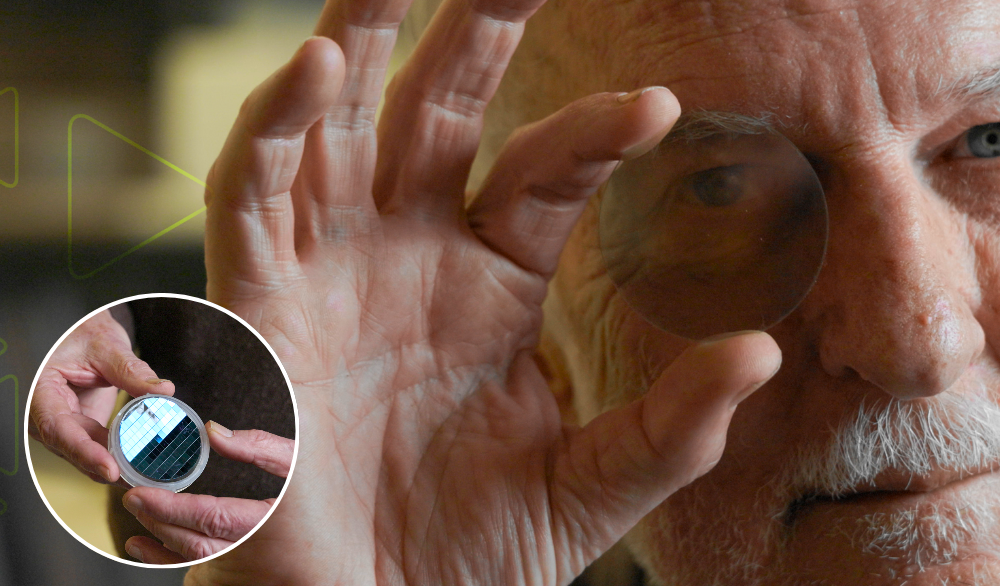
Researchers Develop World's 1st Functioning Graphene-Based Semiconductor

Researchers Develop World's 1st Functioning Graphene-Based Semiconductor

Researchers at Georgia Tech, in Atlanta, have claimed to developed the world’s first functioning graphene-based semiconductor

A team of researchers at Georgia Tech and Tianjin University has created the world’s first functional semiconductor made from graphene, a single sheet of carbon atoms held together by the strongest bonds known. Semiconductors are materials that conduct electricity under specific conditions and are foundational components of electronic devices.

Led by Walter de Heer, professor of physics at Georgia Tech, the research throws open the door to a new way of doing electronics. The breakthrough technology could allow for smaller and faster electronic devices and may have applications for quantum computing.

In a research, published on 3 January in Nature, focuses on leveraging epitaxial graphene, a crystal structure of carbon chemically bonded to silicon carbide (SiC). This novel semiconducting material, dubbed semiconducting epitaxial graphene (SEC) or — Epigraphene, which is graphene that spontaneously forms on silicon carbide crystals when silicon sublimates from the surface at high temperatures resulting in a carbon-rich surface that recrystallizes into graphene.

De Heer describes the method used as a modified version of an extremely simple technique that has been known for over 50 years. “When silicon carbide is heated to well over 1,000 °C, silicon evaporates from the surface, leaving a carbon-rich surface which then forms into graphene,” says de Heer.


Graphene, in a natural form, is neither a semiconductor nor a metal, but a sem-imetal. A band gap is a material that can be turned on and off when an electric field is applied to it, which is how all transistors and silicon electronics work. The major question in graphene electronics research was how to switch it on and off so it can work like silicon.

silicon and graphene models
Silicon and Graphene Models. 

semiconductor graphene wafer
Semiconductor Graphene Wafer 

The graphene revolution was originally driven by the search for electronic materials that could outperform silicon, Graphene, which is intrinsically a semi-metal (that is, a gapless semiconductor), was considered to be a probable candidate following predictions that, owing to quantum confinement, graphene nanoribbons can be semiconductors.

However, efforts to produce high-quality semiconducting ribbons were not successful". Therefore, research focused on altering the electronic structure of graphene chemically, but efforts failed to produce a viable semiconductor". After this, interest shifted away from graphene, towards other two-dimensional (20) materials that are intrinsically semiconducting".

The Georgia Tech researchers show that well-annealed epigraphene on a specific silicon carbide crystal face is a 20 semiconductor with very high mobility.

As a material, Epigraphene allows the quantum mechanical wave properties of electrons to be utilized, which is a requirement for quantum computing.

De Heer says that it will take time to develop this technology. “I compare this work to the Wright brothers’ first 100-meter flight. It will mainly depend on how much work is done to develop it.”

L&T Technology Services Acquires Karnataka VC Fund-backed Startup Graphene Semiconductor

L&T Technology Services Limited, a leading global pure-play engineering services company and subsidiary of Larsen & Toubro Limited, has acquired 100% stake in Bangalore-based Graphene Semiconductor Services Private Limited ('Graphene') by way of an all cash deal. The transaction is expected to be consummated by October 2018.

The financials of the acquisition deal was not disclosed.

Founded in April 2013, by Vilas Bhade, Vinay Hebballi, Nandagopal Ananda, and Pramod Sabnis, Graphene provide end-to-end support for the semiconductor industry including chip design, Embedded software design and product testing among others. Notably, it is also the first startup in semiconductor space to receive the backing of a governmental-backed VC fund when it received Rs 4.95 crore from Karnataka Semiconductor Venture Capital Fund. The SEBI-registered VC Fund chose Graphene for its differentiated focus in semiconductor technology and end-to-end product development.

Moreover, Graphene was also in the list of Karnataka's 100 Most Innovative Startups, released in 2017.

Graphene is one of the fastest growing companies in the Semiconductor Services domain with a presence in India, Singapore, Taiwan, and Malaysia. Counting 10 of the world’s top semiconductor fabrication and fabless companies as its customers, Graphene provides end-to-end solutions— right from chip design, embedded software, all the way through providing support to mass manufacturing, thereby being a one-stop service and solution provider. Graphene was awarded the title of "Best Startup 2016" by Mentor Graphics and Silicon India. Graphene had revenues of INR 663 million for the year ended March 31, 2018.

“Graphene’s strong offshore presence, coupled with expertise in complete VLSI Chip Design & Embedded Software will be a force multiplier for LTTS and will enhance our capabilities in the Semiconductor & Product OEM space,” said Dr Keshab Panda, CEO & Managing Director, L&T Technology Services Limited.

"Aligning with LTTS is the right decision to expand our global reach. We will now continue fulfilling our vision of enabling our customers realize products that attain market leadership positions in their respective markets," said Vilas Bhade, Co-founder Graphene Semiconductor Services Private Limited.

Larsen & Toubro, which had set up an Internet of Things Solutions Centre in Bangalore, in 2015, has L&T Technology Services Limited (LTTS) as its publicly listed subsidiary offering consultancy, design, development and testing services across the product and process development life cycle. Our customer base includes 52 Fortune 500 companies and 51 of the world’s top ER&D companies, across industrial products, medical devices, transportation, telecom & hi-tech, and the process industries. Headquartered in India, we have over 13,000 employees spread across 16 global design centers, 27 global sales offices and 42 innovation labs as of June 30, 2018.

L&T Technology Services Acquires Karnataka VC Fund-backed Startup Graphene Semiconductor

L&T Technology Services Limited, a leading global pure-play engineering services company and subsidiary of Larsen & Toubro Limited, has acquired 100% stake in Bangalore-based Graphene Semiconductor Services Private Limited ('Graphene') by way of an all cash deal. The transaction is expected to be consummated by October 2018.

The financials of the acquisition deal was not disclosed.


Founded in April 2013, by Vilas Bhade, Vinay Hebballi, Nandagopal Ananda, and Pramod Sabnis, Graphene provide end-to-end support for the semiconductor industry including chip design, Embedded software design and product testing among others. Notably, it is also the first startup in semiconductor space to receive the backing of a governmental-backed VC fund when it received Rs 4.95 crore from Karnataka Semiconductor Venture Capital Fund. The SEBI-registered VC Fund chose Graphene for its differentiated focus in semiconductor technology and end-to-end product development.

Moreover, Graphene was also in the list of Karnataka's 100 Most Innovative Startups, released in 2017.

Graphene is one of the fastest growing companies in the Semiconductor Services domain with a presence in India, Singapore, Taiwan, and Malaysia. Counting 10 of the world’s top semiconductor fabrication and fabless companies as its customers, Graphene provides end-to-end solutions— right from chip design, embedded software, all the way through providing support to mass manufacturing, thereby being a one-stop service and solution provider. Graphene was awarded the title of "Best Startup 2016" by Mentor Graphics and Silicon India. Graphene had revenues of INR 663 million for the year ended March 31, 2018.

“Graphene’s strong offshore presence, coupled with expertise in complete VLSI Chip Design & Embedded Software will be a force multiplier for LTTS and will enhance our capabilities in the Semiconductor & Product OEM space,” said Dr Keshab Panda, CEO & Managing Director, L&T Technology Services Limited.

"Aligning with LTTS is the right decision to expand our global reach. We will now continue fulfilling our vision of enabling our customers realize products that attain market leadership positions in their respective markets," said Vilas Bhade, Co-founder Graphene Semiconductor Services Private Limited.

Larsen & Toubro, which had set up an Internet of Things Solutions Centre in Bangalore, in 2015, has L&T Technology Services Limited (LTTS) as its publicly listed subsidiary offering consultancy, design, development and testing services across the product and process development life cycle. Our customer base includes 52 Fortune 500 companies and 51 of the world’s top ER&D companies, across industrial products, medical devices, transportation, telecom & hi-tech, and the process industries. Headquartered in India, we have over 13,000 employees spread across 16 global design centers, 27 global sales offices and 42 innovation labs as of June 30, 2018.

Market Reports

Market Report & Surveys
IndianWeb2.com © all rights reserved