‏إظهار الرسائل ذات التسميات Carbon Capturing Startups. إظهار كافة الرسائل

Startup Using Rail System To Capture CO² For Mitigating Climate Change

Startup Using Rail System To Clean Air of CO2 To Mitigate Climate Change

What if rail systems around the world could be harnessed to help mitigate climate change and clean our air of CO2? It is a question that the founders of a US-based startup, CO2Rail Company, have been pondering for several years. Direct Air Capture (“DAC”) technology for removing carbon dioxide from the air with special machines and compressing it for utilization or permanent geological sequestration, promises to reduce overall CO2 concentrations in the atmosphere and help mitigate global climate change.

The IPCC has reported that deep net-negative CO2 mitigation is almost certainly necessary to stay within 2°C of warming. However, despite its promise, the process of carbon removal straight from the air can be energy and land intensive and often very, very expensive.

CO2Rail and a world-renowned team hailing from University of Toronto, MIT, Princeton, University of Sheffield, business, and industry set their sights on designing DAC technology that used less energy, less land, and at a cost that the world could afford. Their plan was to operate DAC equipment within special rail cars placed with already running trains in regular service and take advantage of many synergies that integration within the global rail network would provide. Their effort is spotlighted on the cover and in a peer reviewed paper entitled “Rail-Based Direct Air Carbon Capture” published in the Future Energy section of the prestigious journal Joule released on July 20, 2022.#sdfootnote1sym1

These DAC rail cars work by using large intakes that extend up into the slipstream of the moving train to move ambient air into the large cylindrical CO2 collection chamber and eliminate the need for energy-intensive fan systems that are necessary with stationary DAC operations. The air then moves through a chemical process that separates the CO2 from the air and the carbon dioxide free air then travels out of the back or underside of the car and returns to the atmosphere. After a sufficient amount has been captured, the chamber is closed and the harvested CO2 is collected, concentrated, and stored in a liquid reservoir until it can be emptied from the train at crew change or fueling stops into normal CO2 rail tank cars for direct transportation into the circular carbon economy as value-added feedstock or to nearby geological sequestration sites. Notably, each of these processes are powered exclusively by on-board generated, sustainable energy sources that require no external energy input or off-duty charging cycles.

CO2Rail car in motion on a normal train in regular service, collecting mass quantities of CO2 from the atmosphere
CO2Rail car in motion on a normal train in regular service, collecting mass quantities of CO2 from the atmosphere. The system is powered by sustainable, train-generated regenerative braking energy and requires no off-duty charging cycles. (© 2022 CO2Rail Company) (US and International Patents Pending, All Rights Reserved)
 
When a train pumps the brakes, its energy braking system converts the entire train’s forward momentum into electrical energy in much the same way as an electric vehicle. Currently, this energy is dissipated on trains in the form of heat and discharged out of the top of the locomotive during every braking maneuver. The energy, suggests E. Bachman of CO2Rail, should be captured, stored, and used for productive purposes. “For many decades, this enormous amount of sustainable energy has been completely wasted,” says Bachman. “On average, each complete braking maneuver generates enough energy to power 20 average homes for an entire day so it is not a trivial amount of energy. Multiply this by every stop or deceleration for nearly every train in the world and you have about 105 times more energy than the Hoover Dam produces within that same period, and that was a hydro-electric construction project that took six years and cost $760 million in today’s dollars.”

 © 2022 CO2Rail Company - US and International Patents Pending, All Rights Reserved
 
Besides energy, there are also land issues that surround wide-spread DAC deployment. Stationary DAC operations at any meaningful scale will require large areas of land to build their equipment and even more to construct renewable sources of energy to power them. Moreover, even with efforts to save the world, obtaining the necessary permits, conducting surveys, meeting zoning requirements, and achieving community acceptance is necessary and takes both time and money. Obtaining the proper permits to build these industrial-looking operations can be difficult and many residents would be opposed to these large facilities being built near their towns and cities or on land that is important to them. 

“It’s a huge problem because most everybody wants to fix the climate crisis, but few are happy to have it done in their proverbial ‘backyard’. CO2Rail does not require special zoning, surveys, or building permits and would be transient and generally unseen by the public,” says Geoffrey Ozin, a nano and materials chemist and Albert Einstein World Award of Science medal recipient at The University of Toronto.

The authors argue that rail-based direct air capture becomes an even more attractive climate solution because much of the required infrastructure is already in place and the energy is there, just waiting to be utilized. “The infrastructure and energy already exist,” says Ozin. “That's the bottom line. All you need to do is take advantage of what is already available.” With rail being 3x – 5x more efficient than truck, increased rail utilization and greater CO2Rail deployments will have a positive impact beyond the carbon it removes from the atmosphere. “We could get a positive feedback loop where the increased utilization of rail not only reduces transportation emissions but also increases CO2 capture potential which then encourages even more utilization of rail,” says Bachman. 

"By increasing rail utilization, you increase the efficiency of the entire transportation system and, additionally, you increase CO2Rail’s ability to remove CO2 from the air because there are now more trains to which DAC cars can be attached.” The potential impact of this technology was also recently energized when European transport organizations announced earlier this month that they are committed to tripling high-speed rail use by 2050 to curb CO2-heavy air travel. “Imagine stepping onto a train each morning, seeing the CO2Rail cars attached, and knowing that your commute to work each day is actually helping to mitigate climate change," says Bachman. “It will work the same with freight, if there is a choice between rail and another mode of transportation, I think this technology will sway many shippers towards rail.”

The team says that each direct air capture car can harvest about 6,000 metric tons of carbon dioxide from the air per year and more as the technology develops. Moreover, since trains are capable of hosting multiple CO2Rail cars, each train will harvest a corresponding multiple of CO2 tonnage. With its sustainable power requirements exclusively supplied by train-generated sources that are without incremental cost, savings of 30 – 40% per tonne of harvested CO2 can be realized from energy inputs alone. “This, along with other significant savings such as land, brings projected cost at scale down to less than $50 per tonne and makes the technology not only commercially viable but commercially attractive”, Bachman says. “These kinds of numbers are unheard of in direct air capture,” continues Ozin. “At these price points and with its tremendous capabilities, CO2Rail is likely to soon become the first megaton-scale, first gigaton-scale, and overall largest provider of direct air capture deployments in the world.”

Even more, the team is also working on a similar system that can remove the CO2 emissions from the exhaust of diesel-powered locomotives as are universally common in North America and other parts of the world. With the growth of sustainably-sourced rail electrification systems, this point-source capability on diesel lines would make rail the world’s first carbon-neutral mode of large-scale transportation. “Carbon-neutral in regular transportation and then significantly carbon-negative with ambient air DAC operations. A win, win in every respect and a ‘save humanity’ technology,” says Ozin.

CO2Rail Company is a US-based start-up founded in 2020 that has developed rail-based, self-powered direct air capture (“DAC”) technology which removes excess carbon dioxide from the ambient air using the global rail network, purpose-built rail equipment, and sustainable, train-generated regenerative braking energy.

Website — www.co2rail.com


1 Bachman, E., Tavasoli, A., Hatton, T. A., Maravelias, C., Haites, E., Styring, P., . . . Ozin, G. (2022, July 20). Rail-Based Direct Air Carbon Capture. Joule. LINK
Carbon Capturing Startup Carbon Clean Raises $150 Mn in Record Funding Round

Carbon Capturing Firm Carbon Clean Raises $150 Mn in Record Funding Round
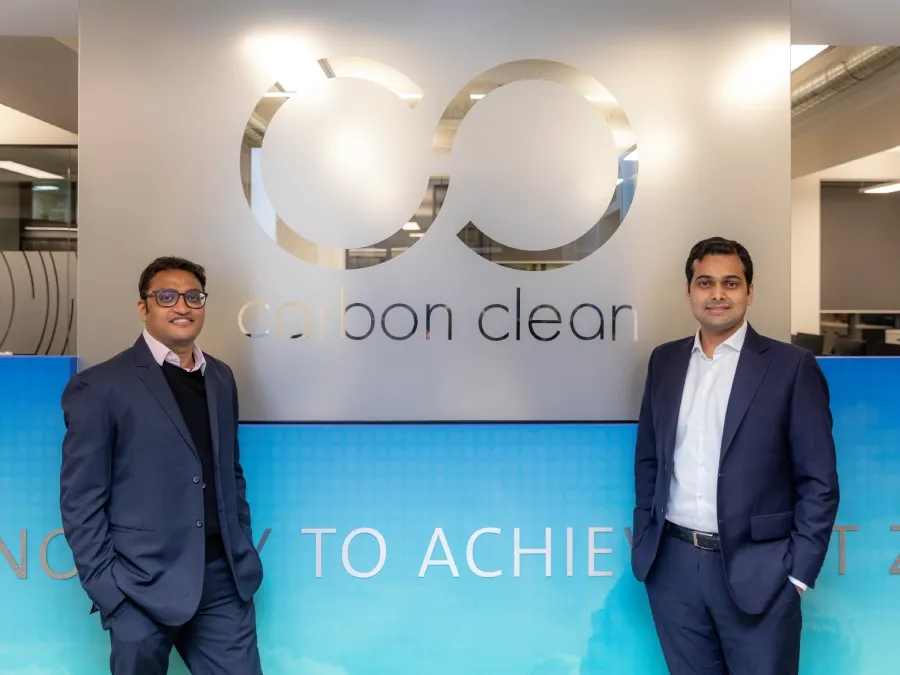
Anriuddha Sharma, Chair and CEO and Prateek Bumb, CTO - Carbon Clean co-founders
  • Largest ever funding round for a point source carbon capture company
  • Carbon Clean set to scale breakthrough technology to cement position as the leading provider of carbon capture solutions for heavy industry
  • Chevron leads Series C funding round, with participation from existing investors, CEMEX Ventures, Marubeni Corporation and WAVE Equity Partners, and new investors, AXA IM Alts, Samsung Ventures, Saudi Aramco Energy Ventures and TC Energy
Carbon Clean, a global leader in cost-effective carbon capture solutions, has closed the largest ever equity funding round for a point source carbon capture company, taking a major step towards its goal of delivering industrial decarbonisation on a gigatonne scale by the mid-2030s.

Carbon Clean has raised U.S. $150m from existing investor Chevron, who led the round, alongside CEMEX Ventures, Marubeni Corporation and WAVE Equity Partners and new investors, AXA IM Alts, Samsung Ventures, Saudi Aramco Energy Ventures and TC Energy. To date, Carbon Clean has raised $195m, having closed its $30m Series B investment round in August 2021.

The funding announced today will support Carbon Clean’s goal of becoming the world’s leading provider of carbon capture solutions for heavy industry, which accounts for around 30 per cent of global emissions.[1] To achieve this, Carbon Clean will work in collaboration with industrial partners and governments to manufacture and ship hundreds of standardised, fully modular carbon capture units to industrial facilities every year.

Aniruddha Sharma, Chair and CEO of Carbon Clean, said, "Carbon Clean’s vision is to deliver global industrial decarbonisation on a gigatonne scale, and we are now on track to do this by the mid-2030s. We are at the forefront of sector innovation, delivering products that can genuinely change the world. Today’s funding round is testament to the confidence of industry and global investors in our technology and its importance to reach net zero goals.

"Making carbon capture technology accessible for hard-to-abate sectors is a huge opportunity. We will use this new funding to scale production of our breakthrough fully modular technology which will overcome the biggest challenges facing widespread adoption of CCUS – cost and scale.”

In the past 12 months, Carbon Clean has achieved several significant milestones. The business reached the landmark of 1.5 million tonnes of carbon captured, launched CycloneCC – the world’s smallest industrial carbon capture technology, and signed partnerships with global industrial players like Veolia, CEMEX and Chevron, as well as with one of the most mature carbon capture and storage and hydrogen projects in the UK, the Acorn Project.

Now the focus is on delivering carbon capture on a gigatonne scale for heavy industry, achieving what solar did between 2010 and 2020: a +1,663% scale up in deployment.[2]

Carbon Clean’s latest technology, CycloneCC, launched in October 2021, can be a game changer for hard-to-abate sectors like steel, cement, energy from waste, refineries and upstream/midstream oil and gas. CycloneCC has a footprint ten times smaller than conventional carbon capture, making it easily deployable in less than eight weeks. The solution has the potential to reduce CapEx and OpEx by up to 50 per cent and drive down the cost of carbon capture to $30/tonne on average, which would make the economic case for CCUS undeniable.

As part of the new investment made during this round, Carbon Clean and Chevron are seeking to develop a technology demonstration pilot that will test CycloneCC at one of Chevron’s co-generation plants in San Joaquin Valley, California. ­

Chris Powers, Vice President, CCUS for Chevron New Energies said, "Chevron is proud to lead Carbon Clean’s record Series C funding round, and we look forward to partnering with Carbon Clean to help advance Chevron’s pursuit of lower carbon solutions. We have a long history of supporting the development and commercialisation of breakthrough technologies, and we’re especially excited about the potential for CycloneCC to revolutionise the industrial carbon capture sector."

About Carbon Clean

Carbon Clean is a global leader in carbon capture solutions for hard-to-abate industries such as cement, steel, refineries and energy from waste. The company’s patented technology significantly reduces the costs of carbon capture when compared to conventional solutions.

The company is leading innovation in the CCUS market and has developed a fully modular technology – CycloneCC – that is set to disrupt the sector. The company’s solutions will help deliver the necessary scaling up of carbon capture to achieve global net zero targets. The technology has been proven at scale in over 44 sites around the world, including plants in the UK, U.S., Japan, Germany, India, Norway and the Netherlands. It has delivered the world’s largest industrial-scale carbon capture and utilisation plant for Tuticorin Alkali Chemicals & Fertilizers Ltd, India.

The UK-based company has received funding and grant support from the British and U.S. governments and has established partnerships with industry leaders including CEMEX and Veolia. It is also an investor in the Swedish eMethanol shipping fuel company, Liquid Wind.

Carbon Clean is a 2022 BNEF Pioneer winner, has been a Global Cleantech 100 company three times, most recently in 2022, features in the inaugural PwC Net Zero Future50 and was chosen as one of CEMEX Ventures Top50 ConTech Startups. For further information: www.carbonclean.com

Kelp Blue, An Aquaculture Startup That Locks CO2, Raises $2 Mn From De Beers Group


De Beers Group Invests Us$2 Million in Kelp Blue, an Innovative Start-up Focused on Growing Underwater Kelp Forests to Lock Away Co2

The investment supports a pioneering nature-based solution for sequestering carbon and increasing biodiversity, while supporting job creation and sustainable economic development in Namibia

De Beers will have access to potential carbon credits generated by Kelp Blue to complement the company’s core carbon reduction and removal strategies as it strives to be carbon-neutral across its operations by 2030

De Beers Group today announced it is investing US$2 million in Kelp Blue, an innovative start-up focused on growing and managing large-scale giant kelp forests, initially off the Namibian coast. These underwater forests have the potential to safely and permanently lock away vast amounts of CO2 in the ocean. Research has shown that kelp forests have carbon sequestration properties exceeding those of terrestrial forests and that they help sustain healthy marine ecosystems, providing food and shelter for countless species.

In line with De Beers Group’s Building Forever sustainability goals, the investment supports a pioneering nature-based solution for sequestering carbon and enhancing biodiversity, while also delivering skills development and job creation in Namibia, where De Beers has recovered diamonds in joint venture partnership with the Namibian Government for almost three decades.

Giant Kelp underwater forests. [Photo credit - Kelp Blue]

Giant Kelp underwater forests. [Photo credit - Kelp Blue]

In 2021, Kelp Blue was awarded a license to cultivate Giant Kelp off the coast of Namibia and is now in the pilot phase. The business will contribute infrastructure development in and around the town of Lüderitz, benefitting the local community by creating employment and upskilling opportunities in kelp cultivation and processing. During the pilot phase, the business will generate a range of direct and indirect jobs in biotechnology, engineering, processing, support services and logistics in Namibia

The initiative will also support De Beers in its goal of being carbon neutral across its operations by 2030. While De Beers Group’s primary focus in achieving this goal will be on increasing efficiency and replacing fossil fuel and fossil-based energy from its operations with renewable alternatives, carbon credits resulting from the investment in Kelp Blue will support the company in removing any remaining emissions, alongside other nature-based initiatives.

Giant Kelp underwater forests. [Photo credit - Kelp Blue]

Neil Ventura, Executive Vice-President, Strategy and Innovation at De Beers Group, said: “We are committed to being carbon neutral across our operations by 2030, and to achieve this ambitious target we will need to recover a share of our emissions after we have removed and replaced the majority of the fossil fuel energy in our business. Instead of simply purchasing carbon credits on the market, we are looking to identify potential long-term, sustainable and innovative nature-based solutions for this – particularly those that can deliver additional carbon capture benefit beyond our own business. While there is still work to be done to understand more about the scale of opportunity, Kelp Blue is an innovative start-up with significant potential, and we are proud to invest in its future.

“Alongside protecting the natural world, another priority of our Building Forever sustainability framework is to partner with communities in our host countries on sustainable development opportunities. The potential benefits in Lüderitz and elsewhere in Namibia – in terms of employment and supporting ‘green’ solutions to wider challenges – highlight just how well Kelp Blue’s objectives align with our own sustainability approach.”

Daniel Hooft, Founder and CEO of Kelp Blue said: “We are very pleased to have De Beers alongside us, thinking about the future, today. De Beers has communicated its commitment to protecting the natural world through its 2030 Building Forever sustainability goals, with its focus on carbon neutrality, minimising its water footprint and delivering a net positive impact on biodiversity. These are one hundred per cent aligned to Kelp Blue’s core passion and purpose. De Beers’ early investment in our offshore pilot – a world first in terms of scale and ambition – specifically helps us accelerate the quantification and verification of the carbon sequestration pathways, which is essential for the whole seaweed industry in terms of scientifically establishing the potential of this novel nature-based solution.”

Startup Plans To Remove 1 Billion Tons of CO2 from Atmosphere by 2035, By Turning It To Stone


California, U.S. - based Heirloom Carbon Technologies is aiming to remove 1 billion tons of carbon dioxide by 2035, using natural processes to engineer the world's most cost-effective Direct Air Capture solution.

To help minerals absorb CO2 from the ambient air in days instead of years, Heirloom will use its own technology to enhance a natural process called Carbon Mineralization, wherein carbon dioxide in the air and water chemically bind to naturally occurring minerals and permanently turn to stone.

Seeing that climate change and its effects has arrived early, the startup says --
Deploying carbon dioxide removal at gigaton-scale is now a requirement if we want to keep global temperature rise below 1.5°C. Our solution is built on the foundations of high-quality carbon removal, with social, economic, environmental, and political impacts in mind.
Carbon mineralization is the process by which carbon dioxide (CO2) becomes a solid mineral/ rock, such as a carbonate. It is a chemical reaction that happens when certain naturally abundant minerals are exposed to carbon dioxide. The biggest advantage of carbon mineralization is that the carbon cannot escape back to the atmosphere.

Heirloom accelerates the natural properties of these minerals to permanently remove CO2 from the atmosphere and store it safely underground. By combining the best of nature and engineering, we can offer the most cost-effective, scalable direct air capture system in the world.

In this process, widely available and low-cost minerals are used to produce oxides that naturally bind to CO2 at ambient conditions. Then exposed to the air passively rather than relying on energy-intensive and high-cost air contactors.

Last month, Heirloom has raised an undisclosed amount of seed funding from major investors including Breakthrough Energy Ventures, Lowercarbon Capital, and Prelude Ventures. (Industry sources say it’s in the millions.)

In addition, the payment tech firm Stripe, will purchase nearly 250 tons of carbon removal from the company at $2,054 per ton.

Building with CO2 Technology Becomes possible

  • Up to 20 percent CO₂ instead of oil in rigid polyurethane foam
  • Innovative rigid foam for insulation boards
  • Materials show enhanced sustainability in initial tests

More sustainable, CO₂-based materials for the construction sector - in the future, this could become reality. Since 2016, Covestro has been working with research and development partners as part of the "DreamResource" joint project (FKZ 033RC002) funded by the German Federal Ministry of Education and Research (BMBF) to research new, more environmentally friendly polyols with the potential to be used, for example, in the form of rigid polyurethane foam in insulation for the construction sector. An initial prototype of an insulation board has now been developed together with the project partner puren gmbh, which contains the novel polyols based on conventional ethylene oxides and CO₂. This marks a decisive further development of Covestro's CO₂ technology for a particularly important part of the climate-relevant construction industry.

"Buildings are responsible for a large share of global energy consumption and greenhouse gas emissions. This makes it all the more important for us at Covestro to contribute to the Circular Economy and make insulation even more sustainable and efficient in the future. Our goal is to end the use of fossil fuels and make our production processes more sustainable," says Sucheta Govil, Chief Commercial Officer at Covestro.

Using innovative CO₂ technology, Covestro already produces the CO₂-based precursor cardyon®, which is utilized in the manufacture of mattresses, sports flooring, textile fibers and components for vehicle interiors.

New, promising approach thanks to CO₂ technology

Covestro has now succeeded in combining the petroleum derivative ethylene oxide with CO₂ in a chemical reaction to produce first polyols and finally rigid polyurethane foam. Up to 20 percent of petroleum-based raw materials are expected to be replaced by this process in the future. "With the development of these materials, we are endowing the greenhouse gas CO₂ with a new use with versatile applications," says Dr. Christoph Gürtler, Head of Catalysis and Technology at Covestro.

Together with Covestro's industrial partners puren gmbh, BYK-Chemie GmbH and PSS Polymer Standard Service GmbH, it proved possible not only to investigate a wide range of applications but also to develop new analytical methods for the CO₂-based materials. With RWTH Aachen University and the Technical University of Berlin, the ecological and economic potential of this expanded CO₂ technology was investigated along with the in-depth characterization of the novel materials. "The results of DreamResource very clearly demonstrate the diverse opportunities that arise from the use of CO₂ as a basic building block for polyols to produce a wide variety of polyurethane types. The interaction between industry and science plays an essential role in this innovative field," says Dennis Krämer, project manager for national and international research projects for CO₂ utilization at DECHEMA e.V.

Versatile and sustainable insulation

"This renewed expansion of the product range yields enormous leeway," continues Gürtler. Thanks to the promising combination of ethylene oxide and CO₂, surface-active substances can also be produced through this new route in addition to CO₂-based rigid polyurethane foam, which can be used in insulating boards for buildings, for example.

Lake Constance-based puren gmbh is one of the pioneers of rigid polyurethane foam technology and investigated the use of CO₂ polyols in the rigid foam segment in this research project.

Following more than three years of joint research in the collaborative project, over 400 kilogram of the CO₂-based polyol was successfully delivered to puren for further processing. "These initial rigid foam insulation boards made with a CO₂-based rigid foam polyol conform to standards and are already comparable with the market standard in terms of their key technical specifications. During further cooperation, we plan to manufacture additional prototypes and to enhance the properties with the aim of taking a giant step closer to the use of CO₂ as an alternative raw material in rigid foam insulation boards and ensuring rapid final development to market readiness," says puren Managing Director Dr. Andreas Huther. Thanks to this successful collaboration, CO₂ can now be used as an alternative raw material in the rigid foam sector. This will make building insulations even more sustainable and will further reduce the dependence on fossil raw materials.

This IIT Kharagpur Alumni Startup Is Using Carbon Dioxide To Make Valuable Chemicals

The saying, "one man's trash is another man's treasure" stands true for the company Tuticorin Alkali Chemicals (TAC). While Carbon dioxide is considered as a dangerous waste for planet Earth, it is an important element for TAC as it is a vital input in making soda ash. The company is completely dependent on a SPIC fertilizer plant for this gas, but in the near future with the changing technology it will have to drastically reduce the amount of carbon dioxide that it requires. In order to prepare itself for this future crunch, the company even attempted to produce the gas by making using of a lime kiln, but unfortunately they had to be abandoned this midway due to poor quality, high costs of lime and a number of other reasons. Hence, the company was in an urgent need of a fresh source of CO2 that could have the potential to take care of the growing soda dash demand that the company was facing. Here's where Carbon Clean Solutions, a startup by IIT Kharagpur amlumni, came to its rescue.

Started in the year 2009 by two undergraduate students, Mumbai-based Carbon Clean Solutions visions to become a world leader in carbon dioxide separation technology. While extracting carbon dioxide from flue gases in power plants and using it to make valuable chemicals is still considered a difficult task in technology and economic terms, but the startup claims that its method has the potential of achieving the results cheaply.

TAC already had boilers in a small thermal plant for producing flue gases. Carbon Clean Solutions has successfully set up its equipment to capture CO2, which also has the potential of capturing the soot and other pollutants from coal. The thermal plant is now able to function cleanly, and TAC is getting enough carbon dioxide supply for its present needs as well as for future.

Thermal plants are considered as an important carbon dioxide emissions source in the world. There is a strong belief present in the scientific world that capturing and sequestering thermal plant emissions is an important step so as to deescalate the alarming rate at which global warming is currently growing. This is mainly because currently humans have no choice but to keep using fossil fuels for a few more decades.

Research firm Markets and Markets predict that the global market for carbon capture and sequestration will stand at a whopping $8.05 billion by the year 2021. It is important to note that carbon capture technology is still in its nascent stage, and has the potential of becoming something quite big in the near future as billions of tonnes of carbon dioxide is emitted each year by coal plants. Seeing the graph of growth that one can have in this sector, there is a sudden urgency all around the world to develop solutions to capture and sequester carbon dioxide, or, if possible, even develop valuable products.

The startup, Carbon Clean Solutions, has been co-founded by Aniruddha Sharma and Prateek Bumb, who are currently serving as CEO and CTO of the company respectively. Both the co-founders are Alumni of the prestigious IIT Kharagpur and are involved in the day-to-day operations of the company so as to achieve the company's mission of delivering step changing products that can significantly reduce the cost of carbon dioxide capture.


The journey of Carbon Clean Solutions started seven years ago when its co-founders (who were still students back then) entered a business plan competition at IIT Bombay and came third. This was followed by them winning an award at the prestigious Pan-IIT conference. This is when a mentor, who is still unnamed, approached them and offered to give them some seed money. Since, back then, their Alma matter IIT Kharagpur did not have the labs where one could carry out this kind of research, they decided to started building things from scratch, outside from the purview of IIT Kharagpur. This led them to approaching Mumbai's Institute of Chemical Technology (ICT) in Mumbai, where they ended up setting a small pilot plant. At ICT, they both developed and tested a proprietary solvent that could successfully dissolve carbon dioxide using a proprietary catalyst. The solvent proved out to be extraordinary according to the existing industry standards back then and could remove 90% of the carbon dioxide from flue gases.

This success led Sharma and Bumb to venture out of the country for testing and expanding their business. During its seven year long journey, they have succeeded in getting angel investment from India and Europe, and a whopping $6 million from the UK Department of Energy and Climate Change for technology demonstration. In fact, the startup also received money from the US government, for demonstration in a pilot plant. In 2015, the startup raised another $5.7 from private equity firms. Its technology has also been tested at the Netherlands Organisation for Applied Scientific Research, called TNO in Europe, and according to TNO's principal scientist Earl Goetheer, the startup has made a breakthrough in energy consumption.

India is currently generating approximately 186 gigawatt of coal-based power, and these plants are emitting about 600-700 million tonnes of carbon dioxide gas every year. When compared globally, Indian thermal power plants are considered highly inefficient as they emit far more carbon dioxide than most of the plants in the world. In fact, even if the country has very efficient plants, it will still be emitting far more carbon dioxide than the country should, if it is serious about controlling the rapid climate change that planet is currently experiencing.

Although the number of coal-fired thermal plants are now declining in the developed world, they still continue to hold importance in the developing countries for a while. This is the reason that a number of public-funded labs and private companies are trying to develop innovative methods to capture and sequester carbon dioxide but at a cheap cost.

Market Reports

Market Report & Surveys
IndianWeb2.com © all rights reserved