Showing posts with label eVTOL. Show all posts

Air India Signs MoU to Revolutionize Healthcare Logistics With eVTOL

Representative image rendering of medical air
Air India has signed a landmark MoU with Japan’s SkyDrive and Suzuki Motor Corporation to study the use of electric vertical take-off and landing (eVTOL) aircraft for medical air logistics in India, said Air India in a press release. 

India’s urban centers grapple with relentless traffic congestion, posing serious obstacles to time‑critical medical logistics. By merging SkyDrive’s cutting‑edge eVTOL technology with Air India’s operational expertise and Suzuki’s deep understanding of the Indian market, the three companies aim to pioneer last‑mile emergency medical transport solutions—advancing the nation’s healthcare infrastructure and saving crucial minutes when lives are at stake.

To recall, late last month Apollo Hospitals and The ePlane Company also inked an MoU to deploy electric air ambulances and drones, bridging India’s golden hour trauma care gap. Prior to this, in the same month India's healthcare body ICMR’s i‑DRONE study shows that drones-enabled transport cut TB diagnosis time from 15 to 5 days and reduce patient costs by 99%, transforming rural healthcare access. All these developments in medical air logistics happen in couple of weeks' timeframe. 

Key Highlights of the Air India-SkyDrive-Suzuki MoU

  • Partnership Scope: Air India, SkyDrive, and Suzuki will jointly assess the feasibility of deploying eVTOL aircraft for time-sensitive medical logistics in India.
  • Focus Area: The study targets transportation of high-value, perishable medical supplies such as blood, organs, and emergency medicines, especially in congested metros.
  • Technology Contribution: SkyDrive brings its eVTOL aircraft expertise, Air India contributes operational and airport infrastructure knowledge, while Suzuki provides deep market insights into India.
  • Strategic Importance: The initiative strengthens India’s medical infrastructure by enabling last-mile emergency logistics, reducing delays where “every minute counts.”

Air India Signs MoU to Revolutionize Healthcare Logistics With eVTOL
Signing ceremony 

Image rendering of medical air logistics utilizing eVTOL aircraft in India
Representative image rendering of medical air logistics utilizing eVTOL aircraft in India (Image ~ airindia.com) 

Statements from Leaders

  • Ramesh Mamidala (Air India Cargo Head): Advanced air mobility is a “natural extension” of India’s transport ecosystem, and this collaboration reflects a shared ambition to solve real-world challenges.
  • Tomohiro Fukuzawa (SkyDrive CEO): Chronic congestion in India makes eVTOLs ideal for medical logistics, potentially saving lives by cutting transit times.
  • Masao Fujitani (Suzuki Executive): Highlighted Suzuki’s philosophy of “Sho-Sho-Kei-Tan-Bi” (Smaller, Fewer, Lighter, Shorter, Neater) as aligned with SkyDrive’s eVTOL design.

Comparison: Air India vs. IndiGo in Advanced Air Mobility

Air IndiaIndiGo
Focus on medical logisticsFocus on urban passenger mobility
Partners: SkyDrive (Japan), Suzuki (Japan)Partners: Archer Aviation (US), Sarla Aviation (India)
Goal: Reduce transit times for critical healthcare suppliesGoal: Develop air taxi services in Indian cities
Tata Group backing, leveraging cargo & airport expertiseStrong domestic market presence, exploring futuristic passenger services

Risks & Challenges

  • Regulatory hurdles: India’s aviation authorities must establish safety and certification frameworks for eVTOL operations.
  • Infrastructure readiness: Airports and hospitals need integration points for eVTOL landing and dispatch.
  • Scalability: Initial feasibility studies may face challenges in scaling operations across diverse terrains.
  • Competition: Rival airlines like IndiGo are already exploring passenger-focused eVTOL services, intensifying the race.

The ePlane Company Completes Full‑Scale e200X eVTOL Assembly, Enters Ground Testing for Passenger, Cargo, and Air Ambulance Markets

The ePlane Company Completes Full‑Scale e200X eVTOL Assembly, Enters Ground Testing for Passenger, Cargo, and Air Ambulance Markets
  • The completed aircraft now enters ground and flight testing, the phase that leads to certification and first operations.
  • A single platform engineered for three markets, passenger air taxi, urban cargo and air ambulance, the e200X is backed by a board that includes Vishesh Rajaram (Speciale Invest), Eash Sundaram (JetBlue) and Aditya Ghosh (Homage, Akasa Air, formerly IndiGo)
The ePlane Company has completed assembly of its full-scale electric vertical takeoff and landing (eVTOL) aircraft, the e200X, integrating the aircraft’s core subsystems into a single structure. The completed prototype, designated PT-01, moves the e200X from design and simulation into the physical testing phase that precedes flight. The aircraft is designed as one airframe serving three markets: a passenger air taxi, an urban cargo carrier, and an air ambulance.

A completed full-scale airframe is a decisive stage in any aircraft programme, because it establishes what simulation cannot. It validates that the design can be manufactured at full size, that the tooling and supply chain to build it are in place and functioning, and that the subsystems integrate physically into a single structure. It is the stage that separates designing an aircraft from being able to test one.

The e200X will now enter ground testing, in which the structure and onboard systems are subjected to aerodynamic and mechanical loads on specialised equipment at ePlane’s facility, followed by flight testing and the pursuit of Type Certification. Developing a full-scale eVTOL is among the most demanding challenges in contemporary aerospace, and only a small number of programmes worldwide have carried a design through to a complete, full-scale aircraft. With the e200X, ePlane is among them.

The e200X has been designed and assembled at ePlane’s own facilities, with its major systems, the propellers, the airframe structure, the landing gear and the battery pack, developed in-house rather than imported as finished assemblies. In a category where many developers rely on a global supply chain, that vertical integration gives ePlane unusual control over performance, cost and iteration speed.

The company has reached this stage on roughly 21 million US dollars raised to date, a fraction of what many international eVTOL programmes have consumed. Capital-efficient engineering is central to ePlane’s strategy.

Independent analysts value the global eVTOL market at roughly 1.3 billion US dollars in 2023 and project it to reach the 20-to-30-billion-dollar range by 2030, with the broader urban air mobility market on a similar trajectory.

Prof. Satya Chakravarthy, Founder of The ePlane Company said –
We set out to build an electric aircraft to a world-class benchmark, engineered and manufactured in depth in India for the World. We deliberately designed the e200X to be compact, because an aircraft that asks a city to rebuild itself around it will not solve the problem it was built to solve. The same airframe can move people as an air taxi, carry goods as a cargo aircraft, and save lives as an air ambulance, and it can do all three using the infrastructure cities already have. That combination of real capability and capital efficiency is how we intend to compete, and win, in markets around the world.”

ePlane’s ambition is matched by the people behind it. Its board brings together leaders who have built and scaled some of aviation’s most successful businesses: Vishesh Rajaram, Founder and Managing Director of lead investor Speciale Invest, Eash Sundaram, former Executive Vice President and Chief Digital and Technology Officer at JetBlue and founder of JetBlue Technology Ventures; and Aditya Ghosh, who scaled IndiGo into India’s largest airline and went on to co-found Akasa Air; Founder Prof. Satya Chakravarthy and CFO Jayakrishnan R anchor the company’s deep-technology and engineering foundation.

The problems the e200X addresses are shared across the world’s major cities. The World Health Organization estimates that road traffic crashes kill about 1.19 million people globally each year, and survival from time-critical emergencies depends heavily on the golden hour, the window after a trauma or cardiac event in which intervention most determines the outcome.

India, one of the largest emerging markets for urban air mobility, illustrates the gap acutely, recording 172,890 road-accident deaths in 2023 and ambulance availability well below WHO norms. An aircraft that lifts a patient, a passenger or a payload above congestion addresses the single variable, time, that ground mobility cannot.

ePlane will unveil the completed e200X publicly in the coming weeks and then begin a ground testing campaign, followed by flight testing of the full-scale aircraft, building on the subscale prototypes it has already flown. It will pursue Type Certification with India’s DGCA, the first regulator to accept an eVTOL into its certification process, and then seek international validations to open export markets.

First operations will begin with early commercial applications and scale across the passenger, cargo and medical markets as certification milestones are met. The programme has already drawn international recognition: ePlane, incubated at IIT Madras, is among the Indian deep-technology ventures showcased at Bharat Innovates 2026, inaugurated in France in June 2026, and was recently featured in NVIDIA founder Jensen Huang’s GTC keynote in Taipei.

NVIDIA's AI Push is Reaching Aircraft, and an Indian eVTOL is Part of the Story

NVIDIA's AI Push is Reaching Aircraft, and an Indian eVTOL is Part of the Story

A central theme of Jensen Huang's COMPUTEX keynote this week was Physical AI — the convergence of AI, simulation, robotics and autonomous systems. While much of the AI boom has focused on software, NVIDIA's vision is increasingly centered on intelligent machines operating in the real world. From industrial robots and autonomous systems to digital twins and edge computing, the company is building the technology stack that will power the next generation of physical machines. Increasingly, that vision is extending beyond factories and robotics into sectors such as aerospace.

One of the companies living inside that vision is an Indian aerospace startup called The ePlane Company. Featured during Jensen Huang's keynote, ePlane represents an emerging class of companies using AI, simulation and digital-twin technologies not to build software, but to engineer systems that operate in the physical world.


With this recognition, ePlane becomes only the third eVTOL company in the world to be supported by NVIDIA, and the only one from Asia (for their certification journey).

What distinguishes this partnership from a typical technology endorsement is its depth. ePlane was the first eVTOL company globally to publicly commit to NVIDIA hardware within its onboard avionics architecture, and is now actively pursuing aircraft certification with that hardware integrated into the system. This is a foundational hardware-software co-development programme designed from the ground up to meet aviation-grade certification requirements.

"Being on Jensen's stage at GTC Taipei is not a moment we take lightly," said Prof. Satya Chakraavarthy, Founder and CEO, ePlane. "It is a signal to the world that India is not a follower in this technology cycle. We are co-developing safety-critical systems with the most consequential embedded infrastructure company on the planet, at the standards required for certified flight. That is a different conversation that speaks to the growing maturity and global relevance of India’s aerospace ecosystem.”

For ePlane, the Omniverse integration goes well beyond simulation as a tool. By building physics-accurate digital twin environments that model aircraft behaviour across a comprehensive range of flight conditions, failure modes, and edge cases, the company is able to generate simulation evidence that directly feeds into its DGCA certification pathway. The rigour matches what global aerospace leaders apply, and is now being built indigenously, in Chennai.

"Partnerships like this one do not happen by accident," said Vishnu Ramakrishnan, SVP Customer Strategy & Business Partnerships, ePlane. "They happen when a company's technology is genuinely credible at the global level. Being selected by NVIDIA as a reference for how their platform is applied in certified aviation tells our partners and investors something no pitch deck can: that the world's leading embedded infrastructure company has looked at what we are building and decided it belongs on their stage."

ePlane is currently in the Ground Test Vehicle phase of its first full-scale aircraft, with a Series C fundraise underway.

About ePlane

The ePlane Company (Ubifly Technologies Pvt. Ltd.) is an IIT Madras-incubated eVTOL company building electric air mobility solutions for India and global markets. The company is developing a compact, safety-certified electric aircraft for passenger, cargo, and emergency medical services applications. ePlane holds Design Organisation Approval from the DGCA, with its Type Certification application officially accepted. The company is backed by [key investors] and is currently in advanced stages of its Series C fundraise.

The ePlane Company Integrates German Avionics Giant, HENSOLDT to Power the Digital Brain of India’s 1st Electric Air Taxi

The ePlane Company Integrates German Avionics Giant, HENSOLDT to Power the Digital Brain of India’s 1st Electric Air Taxi

Highlights:

  • Strategic Alliance: The ePlane Company has entered into an agreement with Germany’s HENSOLDT Avionics to supply and integrate avionics systems for its flagship e200X eVTOL aircraft. The integration will form the core navigation and mission management architecture of the platform.
  • Safety & Situational Awareness: The collaboration centres on equipping the e200X with navigation, landing assistance and secure data connectivity systems to support safe and structured operations in urban environments.
  • Prototyping to Production: This move signifies ePlane's transition from prototyping to building certifiable commercial aircraft, with aviation-grade, secure systems.
  • Engineering Synergy: A technical alliance combining ePlane’s engineering expertise with HENSOLDT’s technology for the unique aerodynamic and operational profile of a compact eVTOL.

In a significant leap towards redefining urban mobility, Ubifly Technologies (The ePlane Company), India’s leading developer of electric Vertical Takeoff and Landing (eVTOL) aircraft, has announced a strategic partnership with HENSOLDT Avionics, a global leader from Germany in sensor solutions and mission management electronics.

This integration forms part of the e200X transition from subscale to full-scale prototype development. By integrating HENSOLDT’s advanced avionics suite, ePlane is equipping its flagship aircraft with a "digital nervous system" designed for uncompromising safety, situational awareness, and operational efficiency in dense urban environments.

Avionics Scope for e200X

  • EuroNav 7 Next Gen (Digital Moving Map): EuroNav 7 NG ensures the e200x navigates complex cityscapes with precision, providing advanced moving maps and mission management that deliver total situational awareness within the urban canyon.
  • CaviSight (Visual Landing Aid): Landing on a rooftop helipad in India requires more than skill; it requires enhanced vision. CaviSight offers video and enhanced vision capabilities that manage camera feeds, provides enhanced intelligence, giving pilots a clear, augmented view and assistance during the most critical phases of flight; takeoff and landing.
  • RF1 Smart Antenna (Collision Avoidance): Safety is non-negotiable. The integration of the RF1 Smart Antenna enables cooperative traffic awareness, actively warning the pilot of other aircraft in the vicinity; a crucial feature for the busy skies of tomorrow.
  • CaviConnect (Secure Connectivity): Beyond its physical flight capabilities, the e200x operates as a fully integrated, data-driven node within the urban airspace. The integration of CaviConnect ensures a secure, robust datalink between the aircraft and ground stations, enabling the real-time data exchange critical for fleet management and continuous health monitoring.

A Convergence of German Precision and Indian Innovation

The ePlane Company Integrates German Avionics Giant, HENSOLDT to Power the Digital Brain of India’s 1st Electric Air Taxi

This collaboration constitutes a deeply integrated technical alliance. ePlane’s engineers are working in tandem with HENSOLDT to seamlessly integrate these systems, ensuring they seamlessly match the unique flight profile and operational demands of the e200x. The integration of the EB1 Multipurpose Airborne Computer adds a layer of onboard processing power that allows the aircraft to run mission-critical applications smoothly, future-proofing the platform for autonomous capabilities.

This integration supports the e200X certification program under the Directorate General of Civil Aviation (DGCA), following the internal design freeze of the aircraft’s avionics architecture.

"Building a certifiable eVTOL requires the flawless integration of highly advanced subsystems into a single, harmonious platform. By partnering with HENSOLDT, we aren't just buying components; we are integrating a legacy of aviation safety into the DNA of the e200x. This avionics suite provides the comprehensive situational awareness required to operate safely in dense urban environments”, said Prof. Satya Chakravarthy, Founder & Technical Lead, The ePlane Company

We are proud to support ePlane in their mission to alleviate urban congestion. Our avionics are designed for the most demanding missions, and the operational profile of an eVTOL in India is the ultimate proving ground. Together, we are defining the standards for situational awareness in the Advanced Air Mobility sector”, said Michael Groeninger, Managing Director, HENSOLDT Avionics GmbH

About The ePlane Company:

Incubated at IIT Madras, The ePlane Company is India’s leading deep-tech aerospace company building the e200X, the nation’s first compact electric air taxi. The company holds the distinction of being the first private Indian entity to receive Design Organisation Approval (DOA) and Type Certification (TC) application acceptance from the DGCA, and is actively defining the country's physical testing and safety benchmarks through its Ground Test Vehicle (GTV) validation phase. Operating out of a state-of-the-art 60,000 sq. ft. engineering and prototyping facility at the IIT Madras Discovery Campus, ePlane combines indigenous manufacturing with a robust global partnership ecosystem—including collaborations with NVIDIA, AWS, Dassault, CADFEM-Ansys and Hensoldt to power its advanced simulation, cloud infrastructure, avionics, and edge computing capabilities. With a strategic initial deployment focused on life-saving utility, the company is launching air ambulances as its first commercial application to cut critical medical transport times across India by up to 7x.

About HENSOLDT Avionics:

HENSOLDT Avionics represents the avionics business of the HENSOLDT Group, a leading company in the European defence industry with a global reach. The company develops situational awareness solutions for civil and military rotorcraft, fixed-wing aircraft, and UAVs, focusing on flight management, mission computers, and connectivity.

Tata Elxsi and CSIR-National Aerospace Laboratories to Accelerate Innovation in UAVs, UAM, and eVTOLs for Global Markets

Tata Elxsi and CSIR-National Aerospace Laboratories to Accelerate Innovation in UAVs, UAM, and eVTOLs for Global Markets
  • Tata Elxsi and National Aerospace Laboratories Sign Strategic Partnership for Advanced Air Mobility
Tata Elxsi and the CSIR-National Aerospace Laboratories (CSIR-NAL) have signed a strategic partnership to drive innovation in Advanced Air Mobility (AAM).

National Aerospace Laboratories, a constituent of the Council of Scientific and Industrial Research (CSIR), India, established in the year 1959 is the only government aerospace R&D laboratory in the country’s civilian sector.

CSIR-NAL is a high-technology oriented institution focusing on advanced disciplines in aerospace.

This collaboration is focused on driving innovation in emerging areas such as Unmanned Aerial Vehicles (UAVs), Urban Air Mobility (UAM), and electric vertical take-off and landing (eVTOL) aircraft.

Tata Elxsi and CSIR-National Aerospace Laboratories to Accelerate Innovation in UAVs, UAM, and eVTOLs for Global Markets

Here are some key details about this collaboration:

Focus Areas:

  • Unmanned Aerial Vehicles (UAVs): Developing advanced UAV technologies for various applications.
  • Urban Air Mobility (UAM): Enhancing air mobility solutions for urban transportation.
  • Electric Vertical Take-Off and Landing (eVTOL) Aircraft: Innovating in the field of eVTOL aircraft for efficient and sustainable air travel.

Partnership Goals:

  • Accelerate Product Development: Leveraging CSIR-NAL's aeronautical expertise and Tata Elxsi's technological capabilities in electrification, AI/ML, sensor fusion, and certification processes.
  • Build a Robust Ecosystem: Creating an ecosystem that integrates precision manufacturing, component suppliers, and tool vendors.
  • Shape Industry Standards: Contributing to the development of industry regulations and standards for AAM.
Manoj Raghavan, MD & CEO at Tata Elxsi, emphasized the importance of this partnership in pushing the boundaries of innovation and accelerating the development of next-generation air mobility solutions.

Dr. Abhay A Pashilkar, Director at CSIR-NAL, highlighted the collaboration's potential to develop innovative, scalable, and sustainable solutions that will shape the future of urban transportation.

This partnership is a significant step towards advancing AAM technologies and fostering innovation in the aerospace sector.

IndiGo Parent and US-based Archer Aviation Plan Electric Air Taxis in India By Early 2026

IndiGo Parent and Archer Aviation Plan Electric Air Taxis in India By Early 2026

InterGlobe Enterprises, the parent company of IndiGo, has joined forces with Archer Aviation to bring an all-electric air taxi service to India. The two companies plan to launch this service by 2026, offering a quick and efficient travel option between cities.

For instance, the service will enable passengers to travel from Connaught Place in New Delhi to Gurugram in just 7 minutes, a journey that would typically take around 90 minutes by car.

The air taxis will be electric vertical takeoff and landing (eVTOL) aircraft, which are designed to operate similarly to helicopters but with less noise and enhanced safety.

The cost for a 7-minute flight is expected to be around ₹2,000 to ₹3,000.

Initially, the service will focus on Delhi, Mumbai, and Bengaluru, with plans to expand further. This innovative mode of transportation could significantly reduce travel time and contribute to sustainable aviation in India.

Archer Aviation's eVTOL aircraft are planned to transport people in and around cities in an air taxi service and are claimed to have a range of up to 100 miles (160 km) at speeds of up to 150 miles per hour (240 km/h).

IndiGo Parent and US-based Archer Aviation Plan Electric Air Taxis in India By Early 2026
Archer Midnight Hero

IndiGo Parent and US-based Archer Aviation Plan Electric Air Taxis in India By Early 2026
Archer Midnight interior

IndiGo Parent and US-based Archer Aviation Plan Electric Air Taxis in India By Early 2026
Midnight side profile 

Archer's Midnight, a pilot-plus-four-passenger eVTOL aircraft, is designed to be safe, sustainable, quiet and, with its expected payload of over 1,000 pounds, can carry four passengers plus a pilot. Midnight is optimized for back-to-back short distance trips of around 20-miles, with a charging time of approximately 10 minutes in-between.

IndiGo, through its parent company InterGlobe Enterprises, has placed an order for 200 electric vertical takeoff and landing (eVTOL) aircraft from Archer Aviation. These aircraft are part of their plan to introduce an all-electric air taxi service in India by 2026, aiming to offer a quick and efficient travel option between cities.

Archer's first demonstrator aircraft, called Maker, is a two-passenger fully electric aircraft with 12 electric propellers. It's designed for both forward and VTOL flight and can travel at up to 150 mph over 60 miles (97 km). Maker has received its airworthiness certificate from the FAA and completed its first flight in December 2021.

Archer's aerial ridesharing service, also referred to as Urban Air Mobility (UAM), is planned to begin operations in 2025 in Miami, Florida, and Los Angeles, California. The company is working with various stakeholders to build the necessary infrastructure and service routes to support this new mode of transportation.

Besides IndiGo, several other airlines across the globe are exploring similar initiatives involving electric vertical takeoff and landing (eVTOL) aircraft. Lufthansa Group has partnered with Lilium, an eVTOL aircraft manufacturer, to build a greener aviation network across Europe.
flynas, a leading low-cost airline in the Middle East, has signed a Memorandum of Understanding with Eve Air Mobility to explore the future of eVTOL aircraft operations in Saudi Arabia. The two are considering starting eVTOL operations in Riyadh and Jeddah by 2026.

United Airlines, which is Archer Aviation's first major corporate partner, along with its regional partner Mesa Airlines, has pre-ordered 200 of Archer Aviation's Maker electric air taxis. United paid Archer $10M of pre-delivery payments for 100 aircraft of the total 200.

Electric Vertical Take-off and Landing Vehicles (eVTOLs) Aircraft Market is Growing, Expected $41.00 Bn Revenue By 2032

Electric Vertical Take-off and Landing Vehicles (eVTOLs) Aircraft Market is Growing, Expected $41.00 Bn Revenue By 2032

Electric Vertical Take-off and Landing Vehicles (eVTOLs) are a new class of aircraft that promise to revolutionize the way we think about urban transportation. These aircraft are designed to take off and land vertically, eliminating the need for a runway or other infrastructure. Unlike traditional helicopters, eVTOLs are powered by electric motors, making them quieter, more efficient, and more environmentally friendly. 

eVTOLs have the potential to drastically reduce congestion on the ground and in the air, providing a faster and more direct way to move people and goods within urban environments. They also have the potential to increase access to transportation in areas that are currently underserved, such as rural or remote communities.

According to recent study by Polaris Market Research, the global electric vertical take-off and landing vehicles (eVTOLs) aircraft market was valued at USD 11.43 Billion by 2022 and is expected to reach USD 41.00 Billion By 2032, growing at a CAGR of 13.86 % in the forecast period.

Key Applications of eVTOLs:

  1. Urban Air Taxis: eVTOLs have the potential to revolutionize urban transportation by offering an efficient and convenient way for people to move around cities. They could be used as air taxis, providing a faster and more direct mode of transportation than ground-based options.
  2. Emergency Medical Services: eVTOLs could be used to transport patients in emergency medical situations, particularly in areas with poor ground-based transportation infrastructure or in scenarios where time is critical.
  3. Cargo Delivery: eVTOLs could be used for cargo delivery in urban areas, providing a faster and more efficient way to move goods than traditional ground-based transportation.
  4. Search and Rescue Operations: eVTOLs could be used for search and rescue operations in remote or difficult-to-access areas, such as mountain ranges or dense forests.
  5. Military and Defense: eVTOLs could be used by military and defense organizations for a range of applications, such as reconnaissance, troop transport, and logistics support.

Key Takeaways

  • The COVID-19 pandemic had an overall negative impact on the eVTOL aircraft market. The pandemic has slowed the development and commercialization of eVTOL aircraft due to disruptions in supply chains, restrictions on travel and in-person meetings, and a general economic slowdown. While in the short run, the pandemic has also highlighted the need for new transportation solutions that are more efficient, safe, and sustainable.
  • Multirotor eVTOL aircraft use multiple rotors (usually four or more) to provide lift and control and are often designed for shorter-range missions such as urban air mobility and package delivery. The Multirotor segment is anticipated to dominate the market in the forecast period. The demand for urban air mobility, delivery services, versatility, lower cost, and innovation is driving the growth of this segment.
  • The Hydrogen Electric segment is anticipated to witness the highest CAGR in the forecast period. This segment's growth is driven by its longer range, sustainability, increasing availability of hydrogen fuel, lower operating costs, and innovation.
  • The 100 – 1000 kg MTOW segment will witness a significant CAGR in the forecast period. The segment is well-suited for urban air mobility applications, where eVTOL aircraft can provide fast and efficient transportation within urban areas. It is also being developed for package delivery services, where eVTOL aircraft can provide quick and efficient delivery of packages within urban areas.
  • North America region is leading the market in terms of revenue share for the year 2022. The market's growth is driven by favorable regulatory support, technological innovations, high population density, advanced infrastructure, and environmental concerns. These factors will likely drive growth in the North American eVTOL aircraft market for the foreseeable future.
In this context, it is important to understand the opportunities and challenges associated with eVTOLs, as they have the potential to transform the way we move and live in cities. This article will provide an overview of eVTOLs, including their design, technology, and potential applications, as well as the challenges that must be addressed for this new form of transportation to become a reality.

These insights can be read on Electric Vertical Take-off and Landing Vehicles (eVTOLs) Aircraft Market by Polaris Market Research. 

DroneTech Startup TSAW Drones Launched its "Made In India" Drone Hybrid Fixed Wing VTOL (Adarna V2) at Aero India 2023

DroneTech Startup TSAW Drones Launched its "Made In India" Drone Hybrid Fixed Wing VTOL (Adarna V2) at Aero India 2023
Mr. Kishan Tiwari, Founder & CEO of TSAW Drones, at Adarna V2 Launch

Adarna V2 has the proficiency to fly up to the ceiling height of 3500m with up to 8kg weight

Delhi-NCR headquartered Drone tech startup TSAW Drones launched its Made-In-India drone – Hybrid Fixed Wing VTOL (Adarna V2) at Aero India 2023. The 14th edition of Aero India takes place between the 13th to the 17th of February at the Air Force Station in Yelahanka, Bengaluru. The biennial Airshow was inaugurated by Prime Minister Modi and attended by Defence Minister Rajnath Singh along with several Defence ministers from different countries.

The available Drones have many applications, but they are limited by their short travel times and confined lifting capacities. Adarna V2 is designed intelligently to address these shortcomings, with its ability to fly for 100 minutes and cover a distance of 120 kilometres in a single flight. Adarna V2 has the proficiency to fly up to a ceiling height of 3500m and carry a heavy weight of up to 8kg. Additionally, the drone has wind resistance grade 5 (8.5-10.5m/s), allowing it to fly even in high-wind conditions and fulfil the requirements of e-commerce platforms, armed forces, medical suppliers, farmers, and others.

On the launch of the new Drone, Kishan Tiwari, Founder & CEO, TSAW Drones affirmed, “After working diligently to design and build its technology from the scratch and securing the pertinent regulatory approvals, we are thrilled to unveil Hybrid Fixed Wing VTOL (Adarna V2) at Aero India 2023. We intend to demonstrate its uncanny prowess to traverse complex terrains in order to carry cargo and operations to locations where conventional commuting would take hours or even days. Adarna V2 is engineered to fulfil a slew of underlying challenges in a wide range of industries, including streamlining access to healthcare in remote rural areas, faster hyperlocal & e-commerce distribution, optimizing & monitoring crop growth, and, most importantly, delivering reconnaissance & surveillance solutions for security apparatus. With TSAW and our just-launched logistics arm DRONECO, we aspire to take the flight of drone innovation, technology & manufacturing to a horizon which can en route us on the map of becoming world’s top drone company and making India a global drone hub.”

TSAW follows level 5 automation for their drone operations. This overcomes human discrepancies in Beyond Visual Line of Sight (BVLOS) operations. Furthermore, the health of the drone is transmitted in real-time with the drone operator via TSAW’s in-house developed Un-piloted Aerial Vehicle Traffic Management system (UTM). The drone can be switched from autopilot to manual mode in an emergency. This adds an extra layer of safety to the operations TSAW undertakes.

About TSAW:


Founded in 2019, by Kishan and Rimanshu, TSAW (Technit Space and Aero Works) is a drone technology company with a vision to facilitate industries by the introduction of drone-based tech solutions. The brand is headquartered in IIT Delhi. All these drones are operated on lithium batteries with Zero Carbon Emission. DRONECO is one of the brands under TSAW’s umbrella which is focused on providing logistics services using drones. All the drones are powered by TSAW’s propriety Drone Cloud Intelligence System (DCIS), a cloud-based autopilot, which performs jobs like automatic path planning, drone traffic deconfliction and predictive health management & recovery, hence reducing the downtime to approximately Zero mins between flights and providing better operational efficiency.

To learn more about TSAW please visit https://tsaw.tech/


Google's Larry Page Cofounded Electric Air-Taxi Startup Raises $450 Mn from The Boeing Company


Wisk, a developer of the first all-electric, self-flying air-taxi in the U.S., has raised $450 million in funding from The Boeing Company. Founded in 2010, Wisk is a joint venture between Boeing and Kitty Hawk Corporation, which was co-founded by Sebastian Thrun and Google co-founder Larry Page.

With this fresh funding, Wisk becomes one of the most well-funded AAM (Advanced Air Mobility) companies in the world. Wisk has previously secured undisclosed funding rounds, which were also led by The Boeing Company.

"This investment will further advance the development of Wisk’s 6th generation eVTOL aircraft, a first-ever candidate for certification of an autonomous, all-electric, passenger-carrying aircraft in the U.S. ", said an announcement release by Wisk.


California-based Wisk is one of the dozens of electric vertical takeoff and landing (eVTOL) makers however it differs in focusing its efforts on autonomous flight. Wisk intends to operate one of the industry’s largest fleets of AAM eVTOL aircraft. The eVTOL startup aiming to close to 14M annual flights bringing time savings to over 40 million people across 20 cities in the U.S. 

Wisk's eVTOL aircraft will not require a runway and allows to land where its passenger need to be. The company uses self-flying software combined with human oversight, aiming to shape the future of accessible, everyday flight.

In 2017, Wisk claimed to became the first company in the U.S. to successfully fly an autonomous, eVTOL aircraft designed for passenger use. Then in May 2021, Wisk signed its first deal to operate air taxis in the US.

In September last year, space agency NASA began flight-testing with Joby Aviation, which is also an eVTOL startup backed by Uber. Wisk too has partnered with NASA for Urban Air Mobility solutions in the U.S. 

Last year in March, Germany-based Volocopter, also an electric eVTOL startup, raised €200 million in its Series D funding round.


Wisk is a leading Advanced Air Mobility (AAM) company and developer of the first all-electric, self-flying air taxi in the U.S. With more than 140 patents issued on its name, Wisk has designed, developed, and tested five generations of aircraft and is currently developing its 6th generation autonomous eVTOL aircraft.

Marc Allen, Chief Strategy Officer of Boeing said, "With this investment, we are reconfirming our belief in Wisk’s business and the importance of their work in pioneering all-electric, AI-driven, autonomous capability for the aerospace industry. Autonomy is the key to unlocking scale across all AAM applications, from passenger to cargo and beyond. That’s why straight-to-autonomy is a core first principle. Boeing and Wisk have been at the forefront of AAM innovation for more than a decade, and will continue to lead in the years ahead."

NASA and Uber-backed Joby Aviation Testing Electric Air-Taxi Flight

Joby’s all-electric vertical takeoff and landing (eVTOL) aircraft is pictured at the company's Electric Flight Base, located near Big Sur, California. NASA began flight testing with the aircraft as part of the agency’s Advanced Air Mobility (AAM) National Campaign, Monday. This test runs through Friday, Sept.10. Credits: Joby Aviation


US-based space agency NASA has began flight testing with cab aggregator Uber -funded electric aircraft company Joby Aviation (Joby). Tagged as a Unicorn company, Joby Aviation is an aerospace transportation company developing electric aircrafts. Uber Technologies, Inc has invested a total of $125 million in Joby.

NASA has began testing Joby’s all-electric vertical takeoff and landing (eVTOL) aircraft as part of the space agency’s Advanced Air Mobility (AAM) National Campaign, announced NASA.

Joby's aircraft has a maximum range of 150 miles on a single charge, can transport a pilot and four passengers at speeds of up to 200 mph.

This testing runs through Friday, Sept.10, at Joby’s Electric Flight Base located in California. This is the first time NASA will test an eVTOL aircraft as part of the campaign.

"In the future, eVTOL aircraft could serve as air taxis for those in cities and surrounding areas around the country, adding another mode of transportation for moving people and goods.", said NASA.


In this round of testing, NASA will collect data from Joby’s eVTOL aircraft, which is intended to serve as a commercial passenger service in the future. Analyzing that data readies the AAM National Campaign to execute the first set of campaign tests, known as NC-1, slated for 2022, with more complex flight scenarios and other industry vehicles.

As the Joby aircraft flies planned test scenarios, the NASA team will collect information about how the vehicle moves, how the vehicle sounds, and how the vehicle communicates with controllers.

The team will deploy the mobile acoustics facility and construct an array of more than 50 microphones to measure the acoustic profile of Joby’s aircraft in different phases of flight.

NASA has also partnered with an another U.S. startup called Elroy Airwhich is developing the world's first autonomous drone capable of delivering 300 to 500 pounds (227 Kg) of cargo over a 300-mile (483 Km) range, with no need for airport or electric charging station.

Coming back to Uber connection with Joby, Uber invested $75 million in Joby, in december last year, as part of a broader transaction involving the acquisition of Uber's the aerial ride-hailing division, Uber Elevate, by Joby Aviation and an expanded partnership between the two parent companies.

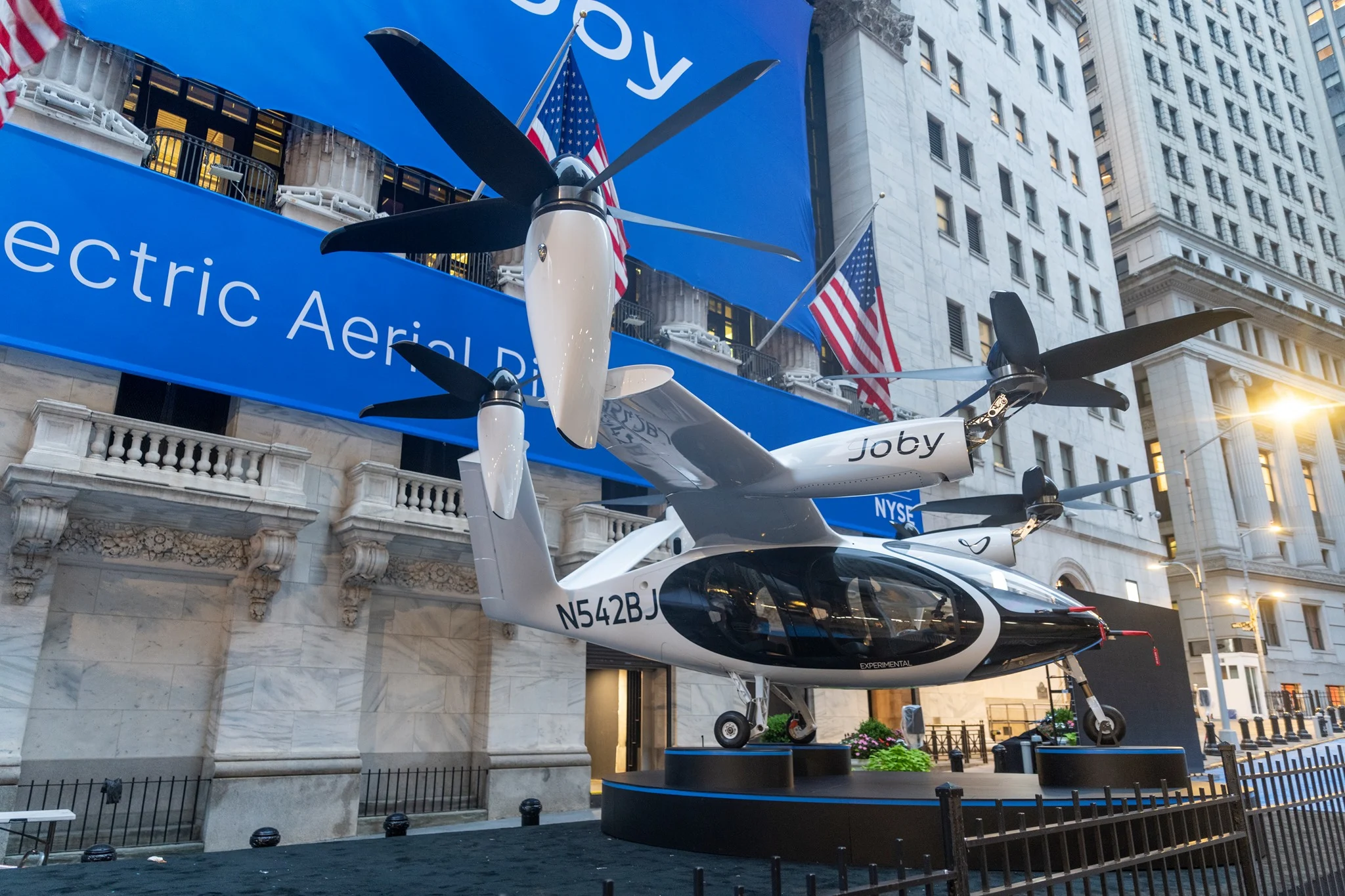
On August 11, Joby Aviation becomes first U.S.-based eVTOL company listed on public market to begin trading on NYSE.

NASA Partnered with Startup for World's 1st VTOL Aerial Cargo Systems with Same-Day Shipping Worldwide


A U.S. startup Elroy Air is developing the world's first autonomous drone capable of delivering 300 to 500 pounds (227 Kg) of cargo over a 300-mile (483 Km) range, with no need for even an airport or electric charging station.

Elroy Air is aiming to improve quality of life worldwide by expanding the reach of expedited logistics via air cargo.

Five-year-old Elroy Air is an aerospace + logistics startup developing the world’s first end-to-end automated vertical take-off and landing (VTOL) aerial cargo systems, and has even collaborating with the US space agency NASA to accelerate and improve the safe integration of advanced autonomous cargo aircraft into the United States airspace.

Together, NASA and Elroy Air intend to demonstrate key integrated operational Advanced Air Mobility (AAM) scenarios with flights of Chaparral, an Elroy Air's autonomous VTOL cargo aircraft. NASA will provide Elroy Air with simulation scenarios and software interface details to validate connection and data formats.

Chaparral is a hybrid-electric vertical takeoff and landing (VTOL) cargo aircraft being developed by the team at Elroy Air in San Francisco, California. The system will carry 136 kg (300lbs) of cargo over a 483 km range.


The Chaparral took a successful test flight that was conducted with a team of just 16 employees in August of 2019.

With ability for autonomous cargo loading and unloading, Chaparral  aircraft allows a single pilot to operate a fleet of 10-50 UAVs from a remote location. With these stunning features, the Elroy Air team believes drones have the power to improve quality of life worldwide by expanding the reach of express logistics.

Elroy Air will join two more companies - Wisk and Alaka'i Technologies, who signed information exchange agreements with NASA last year. Wisk is all-electric eVTOL air taxi and Alaka’i is eVTOL air taxi called Skai.

The three companies, along with other NASA industry partners, will prepare for the first National Campaign series, called NC-1, beginning in 2022 with intent to assess safety scenarios focused on automation and vehicle designs. These will focus on demonstrating integrated operations through flight activities with vehicles and third-party airspace service providers at various locations around the country.


Volocopter Raises €200 Million in Series D Funding Round

- €200 million (USD 240 million) raised in an oversubscribed Series D funding

- New investors include funds managed by BlackRock, Avala Capital, Atlantia S.p.A., Continental AG, NTT, and Tokyo Century amongst others, with all existing investors also joining the round

- Funding will be used to solidify Volocopter's market leadership


BRUCHSAL, Germany, March 3, 2021 /PRNewswire/ -- Volocopter, the pioneer of urban air mobility (UAM), announced the signing of their Series D funding round today, raising €200 million in additional capital. Cumulatively, Volocopter has raised €322 million. The funding will be used to solidify Volocopter's leading position in the UAM market by bringing the VoloCity, the battery-powered air taxi for cities, to certification and by accelerating the launch of its first commercial routes.
 
Volocopter is in the final stages of providing new, sustainable mobility options for cities around the world. Their future services range from electric autonomous air taxis flying passengers directly and safely to their destinations to transporting goods with the company's VoloDrone.

Having ten years of development experience, Volocopter is a leader in the urban air mobility space. As the first and only electric vertical take-off and landing (eVTOL) company to receive Design Organisation Approval (DOA) by the European Union Aviation Safety Agency (EASA), Volocopter expects its first commercial air taxi routes to be opened within the next two years.

"Volocopter is ahead of the curve in the UAM industry, and we have the achievements to prove it," says Florian Reuter, CEO of Volocopter. "No other electric air taxi company has publicly performed as many flights in cities around the world, with full regulatory approval, as Volocopter has. Our VoloCity is the fifth generation of Volocopter aircraft and has a strong path to being the first certified electric air taxi for cities. Volocopter already has the extensive partnerships necessary to set up the UAM ecosystem for launching both our company and the industry into commercial operations. We are called the pioneers of UAM for a reason, and we plan to keep that title."

Volocopter offers a holistic approach to the UAM market by developing a full ecosystem to connect all the vital parts to get the industry off the ground. This includes multipurpose aircraft (VoloCity and VoloDrone), physical and digital infrastructure (VoloPort and VoloIQ), as well as partnerships with global leaders in their respective fields.

"We are thrilled to welcome investors who share our belief that innovative technology like our Volocopter is one of the key enablers for a sustainable future," says Rene Griemens, CFO of Volocopter. "Our shareholder structure remains well balanced with a healthy mix of strategic and financial partners spread as globally as our business ambitions."

New investors in Volocopter include funds managed by BlackRock, global infrastructure company Atlantia S.p.A., Avala Capital, mobility technology giant Continental AG, global technology focused investment fund Jericho Capital, global technology and business solutions provider NTT via its venture capital arm, Tokyo Century, a leading Japanese leasing company, leading family offices, and others. All existing investors, including Geely, Daimler, DB Schenker, Intel Capital, btov Partners, Team Europe, and Klocke Holding amongst others also joined the round.

Volocopter has performed several milestone flights in Helsinki, Stuttgart, Dubai, and over Singapore's Marina Bay in recent years. While the first routes are yet to be announced, the company has committed to establishing air taxi services in Singapore and Paris with plans to expand many more routes in the US, Asia, and Europe.

About Volocopter


Volocopter is building the world's first sustainable and scalable urban air mobility business to bring affordable air taxi services to megacities worldwide. With the VoloCity, the company is developing the first fully electric "eVTOL" aircraft in certification to transport passengers safely and quietly within cities. Volocopter leads and cooperates with partners in infrastructure, operations, and air traffic management to build the ecosystem necessary to 'Bring Urban Air Mobility to Life'.: www.volocopter.com


Market Reports

Market Report & Surveys
IndianWeb2.com © all rights reserved