‏إظهار الرسائل ذات التسميات e-mobility. إظهار كافة الرسائل

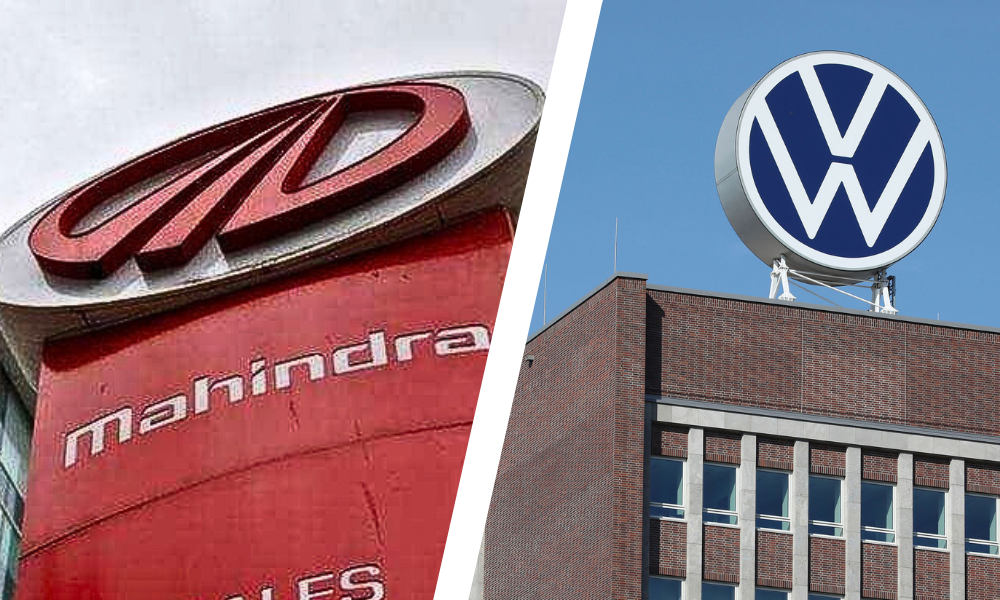
Mahindra to be the First External Partner to Use Volkswagen's Groundbreaking Unified Cell Concept

Mahindra to be the First External Partner to Use Volkswagen's Groundbreaking Unified Cell Concept

Mahindra Inks MoU with Volkswagen on e-Mobility Collaboration 
  • Mahindra will equip a certain range of its electric platform, INGLO with electric components from Volkswagen's MEB and unified cells
  • Both companies continue to explore further potential opportunities for collaboration in India in the field of e-mobility
Volkswagen Group and Mahindra & Mahindra Ltd. (M&M) have signed the first supply agreement on components of Volkswagen’s MEB for Mahindra’s purpose-built electric platform INGLO, taking a definitive step further on their joint vision for e-mobility collaboration. The deal covers the supply of certain electric components as well as unified cells. With the agreement, Volkswagen and Mahindra are further deepening their collaboration, which started with a partnering agreement and a term sheet in 2022. Both companies will continue to evaluate the potential expansion of the collaboration.

Mahindra will be the first external partner to use the groundbreaking unified cell concept, the core element of Volkswagen’s battery strategy. The supply agreement will run over several years and have total volume of about 50 GWh over its lifetime. Volkswagen Group and Mahindra aim to strengthen their e-mobility footprint in the Indian automotive market and accelerate electrification in the region.

The Unified Cell concept is Volkswagen Group-owned battery company PowerCo's new “modular” cell design for EV batteries, which is projected to be applicable for 80% of Volkswagen Group vehicles and drastically cut battery cost.

Mahindra plans to launch five all-electric SUVs in India based on its new, purpose-built electric platform, INGLO, starting in December 2024. With more than five million new vehicles per year in 2023, India is one of the largest automotive markets in the world. The electrification of the passenger car segment is expected to gain significant momentum in the coming years. Volkswagen’s MEB platform and its components are used by the Group brands Volkswagen, Audi, Škoda and SEAT/CUPRA as well as external partners like Ford and Mahindra. The partnership with Mahindra is led by Volkswagen Group Technology and its “Platform Business” unit in close cooperation with Škoda Auto Volkswagen India Pvt. Ltd.

About Mahindra

Founded in 1945, the Mahindra Group is one of the largest and most admired multinational federation of companies with 260000 employees in over 100 countries. It enjoys a leadership position in farm equipment, utility vehicles, information technology and financial services in India and is the world’s largest tractor company by volume. It has a strong presence in renewable energy, agriculture, logistics, hospitality and real estate. The Mahindra Group has a clear focus on leading ESG globally, enabling rural prosperity and enhancing urban living, with a goal to drive positive change in the lives of communities and stakeholders to enable them to Rise.

About the Volkswagen Group

The Volkswagen Group is one of the world's leading car makers, headquartered in Wolfsburg, Germany. It operates globally, with 115 production facilities in 19 European countries and 10 countries in the Americas, Asia and Africa. With around 676000 employees worldwide. The Group’s vehicles are sold in over 150 countries. With an unrivalled portfolio of strong global brands, leading technologies at scale, innovative ideas to tap into future profit pools and an entrepreneurial leadership team, the Volkswagen Group is committed to shaping the future of mobility through investments in electric and autonomous driving vehicles, digitalisation and sustainability. In 2022, the total number of vehicles delivered to customers by the Group globally was 8.3 Million (2021: 8.9 million). Group sales revenue in 2022 totaled EUR 279.2 Billion (2021: EUR 250.2 Billion). The operating result before special items in 2022 amounted to EUR 22.5 Billion (2021: EUR 20.0 Billion).

Intel Buys Israel's Urban Mobility Startup Moovit for $900 Mn

Intel Buys Israel's Urban Mobility Startup Moovit for $900 Mn

Intel said Monday that it has purchased Israeli urban mobility startup Moovit for USD 900 million.

The California-based chipmaker said the purchase buttresses its plan to become a “complete mobility provider." The acquisition deepens Intel's reach in Israel, where the company has spent billions buying other companies, and where it has a chip-making factory.


Founded in 2012 and based out of Tel Aviv, Israel, with approximately 200 employees, Moovit is a Mobility-as-a-Service (MaaS) platform company best known for its mobile application that provides public transit and navigation data to simplify urban mobility in 3,100 cities around the world. The app experience will not change and the company will continue to serve users, customers and partners with the exceptional level of service, professionalism and dedication they’ve come to expect.

Post acquisition, Moovit will join the Mobileye business while retaining its brand and existing partnerships.

Intel Corp. paid USD 15 billion in 2017 to acquire Mobileye, an Israeli company at the forefront of autonomous vehicle technology. Since then, Mobileye revenues have more than doubled on the increased adoption of ADAS (Advanced Driver Assistance Systems) technology and the mobility firm has been a growth engine for Intel as the company transforms for a world where the exponential growth of data fuels demand for technology solutions that can process, move and store more data faster. Intel is investing and expanding to serve new data-rich market opportunities, including the fast-growing market for ADAS, data and MaaS technologies, which together represent an opportunity totaling more than $230 billion by 2030.

Moovit is known for its urban mobility application that offers travelers around the world the best multimodal trip planning by combining public transportation, bicycle and scooter services, ride-hailing, and car-sharing. The addition of Moovit brings Intel’s Mobileye closer to achieving its plan to become a complete mobility provider, including robotaxi services, which is forecast to be an estimated $160 billion opportunity by 2030.

Nir Erez , CEO and co-founder of Moovit, will be joining Mobileye’s executive team as an executive vice president. (Credit: Moovit)

That purchase created another major player in self-driving technology and strengthened predictions that autonomous cars will someday come in large numbers and change the way people get around.

Moovit will join the Mobileye team, accelerating its "ability to truly revolutionize transportation,” Intel said.

Using information from users and bus and train schedules, Moovit's app provides urban transit solutions, combining public transport schedules and options with taxis, bicycles, electric scooters and more, to provide a comprehensive picture of how best to travel.

"Combining the daily mobility habits and needs of millions of Moovit users with the state-of-the-art, safe, affordable and eco-friendly transportation enabled by self-driving vehicles, we will be able to make cities better places to live in,” said Nir Erez, Moovit's chief executive.

Moovit has more than 800 million users and services in 3,100 cities across 102 countries, according to Intel.


~ With Inputs from PTI

After E-Mobility, India's Next Target is Cooking by Electricity - Power Minister

Power Minister R K Singh on Monday said India will eventually be an electricity-based economy, as the nation is embarking on power usage for running vehicles and cooking food.

"The entire power sector is going through change and this change will continue. We want to electrify our whole economy. The energy would be through electricity rather than through petroleum products or other forms of energy," Singh said at a function to mark 10 years of state-run Energy Efficiency Services Ltd (EESL) here.

The minister said, "Besides mobility, the next target would be cooking by electricity. So, we will electrify the economy and make electricity green (generation through renewable). Those are our long-term goals."

EESL, a joint venture of public sector undertakings under the power ministry, has completed 10 years of scaling up energy efficiency programmes in India and globally.

Established in 2009 to unlock the potential of energy efficiency, initiatives implemented by EESL have cumulatively led to energy savings of over 58 billion kWh (units) and a reduction of over 46 million tonnes of greenhouse gas emissions across the globe.

In its 10 years, EESL has had an exponential growth, with offices spread across India, the UK, Middle East, South Asia and Southeast Asia.

EESL's revenue has grown at a compound annual growth rate of 114.96 per cent from Rs 26 crore in 2013-14 to Rs 2,565 crore in 2018-19. With its rapid growth, EESL now aims to become a Rs 10,000-crore company in the next three years.

Lauding the business models provided by EESL to promote energy efficiency on the occasion, Singh said, "Business model, that is what works. You can have subsidy models. I have found through experience that the subsidy model does not work as well as a business model. That is what EESL brought in energy efficiency. The business model made it possible to replace agriculture (water) pumps with energy-efficient pumps."

The minister announced successful installation of 10 lakh smart meters across India, under the government's Smart Meter National Programme (SMNP). These smart meters, operational in Uttar Pradesh, Delhi, Haryana and Bihar, aim to bring efficiency in the distribution system leading to better service delivery.

He also announced commissioning of 100-megawatt (MW) cumulative capacity decentralised solar power plants connected to agriculture feeders.

The capacity of these solar power plants, in each substation, ranges from 0.5 MW to 10 MW. The decentralised solar plants cater to the requirements of farmers connected to the respective agriculture feeder daily, by means of reliable day-time electricity.

The minister also launched the dashboards of SMNP, National Electric Mobility Programme (NEMP) and solar initiatives to transparently monitor the real-time progress of the programmes and its impact.

He also launched an integrated mobile application, EK EESL, where all the dashboards of all the programmes being implemented by EESL will be accessible and anyone can monitor their real-time progress.

In the context of the NEMP, he highlighted that the electric vehicles deployed by EESL have completed 2 crore cumulative kilometers.

EESL and the Provincial Energy Authority, Ministry of Interior, Royal Thai Government, signed a pact during the event for long-term cooperation and collaboration to advance the implementation and deployment of energy efficiency measures at small and medium enterprises in Thailand.

Energy Efficiency Services Ltd spearheaded and implemented the zero-subsidy Unnat Jyoti by Affordable LEDs for All (UJALA) programme by distributing over 36.16 crore LED bulbs and Street Lighting National Programme (SLNP) by retrofitting over 1.06 crore street lights with LEDs.

Under the Buildings Energy Efficiency Programme, EESL has completed projects in 10,344 buildings, including railway stations and airports.

Implementing the Agriculture Demand-Side Management (AgDSM), EESL has installed over 73,800 pumps in Andhra Pradesh and Uttar Pradesh.

Under the NEMP, till date, 1,510 e-cars have been deployed or under registration. For charging e-cars, 300 AC and 170 DC captive chargers have also been commissioned and 68 public charging points are currently operational in Delhi-NCR.

Market Reports

Market Report & Surveys
IndianWeb2.com © all rights reserved