Showing posts with label digital healthcare. Show all posts

Samsung Partners FlexIt To Offer Online Health and Wellness Training on Samsung Daily+

Samsung Partners FlexIt To Offer Online Health and Wellness Training on Samsung Daily+

The partnership will allow users around the globe to access personal training services and more with the FlexIt app on the new Samsung Daily+ lifestyle hub

Samsung Electronics today announced a new partnership with FlexIt, a health and wellness solution that makes exercise more convenient and accessible. Starting this quarter,1 FlexIt will bring personal trainer-based fitness content to Samsung Smart TV users through the new lifestyle hub Samsung Daily+2 on Samsung Tizen OS.

“Wellness should be central to our routines, so building healthy habits through Samsung Daily+ makes it convenient to incorporate health and wellness into all different aspects of daily life,” said Demian Hyun, Vice President and Head of the Experience Planning Group of Visual Display Business at Samsung Electronics. “This new partnership underscores Samsung’s commitment as the leader in the global display industry to promoting thoughtful, interconnected health experiences aimed at bettering the lives of consumers.”

Samsung Partners FlexIt To Offer Online Health and Wellness Training on Samsung Daily+

Samsung Partners FlexIt To Offer Online Health and Wellness Training on Samsung Daily+

On the FlexIt app’s online portal, users can find, book and pay for exclusive one-on-one virtual fitness sessions directly on their TVs. With a camera connected — whether it be via a supported webcam3 or a smartphone — virtual health professionals4 provide real-time feedback, adjust workouts and offer form modifications to foster a supportive, safe and effective workout environment.

The FlexIt app helps users approach their health in a more holistic way; in addition to workout content, FlexIt offers nutrition training, low-impact wellness activities like meditation and yoga, and physical and occupational therapy. By working virtually with a trainer who understands their personal fitness journey and wellness goals, users craft an attainable routine that suits their needs and lifestyle, all from the comfort of their home or any other location with a connected device.

By housing services such as FlexIt, Samsung Daily+ is paving the way for the future of virtual health and wellness experiences through its convenience and accessibility to build productive and convenient daily routines. Samsung Daily+ serves as a new lifestyle hub for Smart TV users, allowing them to conveniently enjoy a wide range of premium lifestyle services and features — such as home fitness, telehealth services, video calls and more — using one single Interface.

“Through the innovative FlexIt app for Samsung, we’re furthering our commitment to making fitness more accessible than ever. By delivering personalized, one-on-one immersive training experiences directly to your living room, we’re extending our reach to a broader audience, empowering individuals to achieve their wellness goals with ease and convenience,” said Austin Cohen, FlexIt’s Founder and CEO.

During CES® 2024, Samsung gave consumers an early look at Samsung Daily+ and the FlexIt app on its 2024 Neo QLED 8K. Richard Friedman, FlexIt’s Senior Vice President of Technology, joined the Samsung team in Las Vegas to showcase how the FlexIt app integrates with Samsung TVs. Samsung Daily+ is also a 2024 CES Innovation Awards Honoree, having been recognized as a unique smart home service with an open ecosystem that integrates third-party services.

For more information on health offerings on Samsung’s TV lineup, visit Samsung.com.
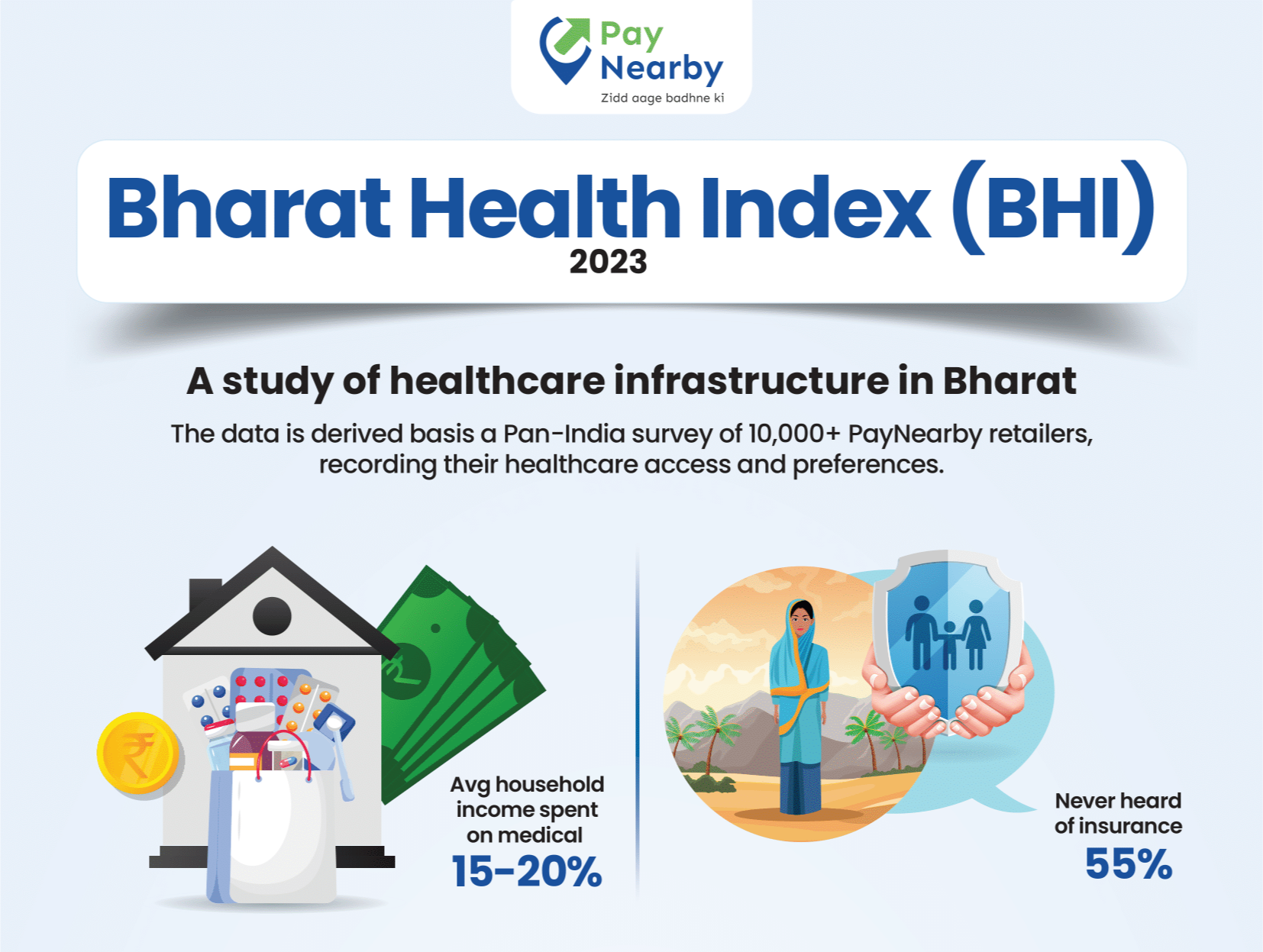

Bharat Health Index 2023: Bharat Spends An Average of 15-20% of Household Income on Medical Expenses; 32% Interested in Telemedicine Consultation

Bharat Health Index (BHI) 2023
On the occasion of India’s 76th Independence Day, PayNearby releases its first edition of ‘Bharat Health Index’ - a study of healthcare awareness in Bharat
  • 15-20% of yearly income spent on medical expenses in Bharat households
  • 55% of those surveyed have never heard of insurance
  • 70% did not have a health insurance cover
  • 23% relied on informal loans or borrowing to take care of hospital expenses
  • 45% travelled more than 10 kms to avail doctor services
  • 35% of respondents expressed interest in online medical purchases
  • 32% have shown interest on telemedicine consultation
Only 25% of the semi-rural and rural population in India have access to modern healthcare within their localities, highlighted a survey titled Bharat Health Index (BHI) 2023, released by PayNearby, India's largest branchless banking and digital network. The accessibility index saw a major dip as one moved from urban to rural India, with only 10% of the rural respondents citing that they had access to healthcare within a 10km radius.

These findings are based on survey responses of 10,000+ retailers across semi-rural and rural India over a month.

Lack of skilled healthcare providers at the last mile pose a significant challenge for accessibility. Only 15% of respondents confirmed having a doctor's clinic or healthcare facility within a 5 km radius. In terms of medical practitioners available, while 25% had access to general physicians in their area, 92% lacked specialised doctors, such as cardiologists, gynaecologists or paediatricians, impacting medical care.

Bharat Health Index (BHI) 2023

For specialised treatment such as cancer, neurological or blood disorders, 90% needed to travel to a different location for treatment. 5% reported loss of a loved one due to unavailability of specialist doctors at the local healthcare facility. The survey also evaluated the accessibility and convenience of medical stores at the last mile. A notable 52% of respondents had a pharmacy within 5 km radius of their residence, making essential medicines relatively accessible. However, 85% of the respondents had to travel more than 10 kms to obtain specialised medicines, indicating potential challenges for those with specific medical needs.

Interestingly, 47% of the respondents possessed a thermometer at home, while only 7% had instruments to check blood pressure and blood sugar, suggesting room for improved self- monitoring and prevention.

The survey also examined the funding mechanism for medical expenses and how affordability could be improved at the last mile. The report indicated that an average household in Bharat spent approximately 15-20% of their yearly income on medical expenses. 23% relied on informal loans or borrowing for hospital expenses, while 6% resorted to selling assets to pay off their medical bills. A significant 53% utilised some form of savings to cover these expenses.

Given the dependence on out-of-pocket expenses for medical costs, the survey emphasized the urgent need for setting up a financial funding mechanism to address the escalating medical expenses at the last mile. The penetration of financial products such as insurance emerged as crucial for enhancing healthcare affordability and accessibility. However, the report highlighted the abysmally low insurance awareness among Bharat’s last mile. A substantial 55% of the respondents had never heard of insurance. Among those aware of insurance, only 32% had opted for insurance at some point, with a mere 28% possessing health insurance for themselves or their families. Among those with insurance, 88% obtained it from government or state sponsored schemes, while less than 10% obtained it from private insurance providers.

For those without insurance, reasons varied. A substantial 38% cited affordability as a major hindrance, while others mentioned uncertainty about where to buy insurance (36%) or its benefits (24%). Respondents identified limited availability of health insurance providers and lack of information (32%) as the primary challenge. This was closely followed by high premiums (28%), complex documentation processes (15%), limited coverage for specific healthcare needs (18%), and language or literacy barriers (7%).

To improve overall accessibility of healthcare services, the survey also evaluated the affinity for online medicine purchase and teleconsultation among this population. 35% expressed interest in online medical purchases, 32% favoured telemedicine consultations, and 32% showed keenness for online awareness programs and diagnostics/lab tests- online appointments. The encouraging response towards digital adoption highlights the need for tech-led innovations and distribution models to broaden healthcare reach across the country.

Commenting on the findings, Mr. Anand Kumar Bajaj, Founder, MD & CEO, PayNearby said, “Over 70% of India resides in rural and semi-rural regions. This survey reinforces the urgent need to scale healthcare services for the masses. More than 80% of doctors, 75% of dispensaries, 60% of hospitals are concentrated in urban India, leaving out marginalised population in SURU to fend for themselves. While infrastructure scaling takes times, leveraging technology for distribution breakthroughs is crucial to cater to a wider audience. Reliable tele-consultation platforms and easy to use online pharmacy modules can greatly contribute. Our recently launched Health Correspondent program, is a step in that direction. Together with our retailers, the mission is to spread medical awareness and create local health hubs, ensuring the reach of critical primary health services through technology."

The survey also highlights the low penetration of insurance among our populace. To address this, more dialogue and action are needed to facilitate better insurance penetration in the country. This Independence Day, PayNearby has introduced Risk se Freedom Pao campaign, to not only build awareness but also eliminate roadblocks that keep people from availing insurance products. It’s critical that people perceive health insurance in the right light for a safer, better future for themselves and their families."

Commenting on the report findings, Jayatri Dasgupta, CMO, PayNearby, said, “As India celebrates its 76th Independence Day, an important yardstick to measure the health of the nation is to understand the state of health infrastructure and awareness among the country’s last mile. Affordable and accessible healthcare is pivotal for country’s progress. PayNearby’s Bharat Health Index (BHI) 2023 initiative addresses gaps in existing healthcare infrastructure and outlines ways to enhance it. The survey highlights the need for more trained medical professionals in rural areas, a better financial support system for medical expenses, accelerated insurance penetration, and the strategic use of technology for distribution breakthroughs.”

About PayNearby:

Incepted in April 2016, PayNearby is a DPIIT-certified company and India’s leading branchless banking and digital payments network. PayNearby operates on a B2B2C model, where it partners with neighbourhood retail stores and enables them with the tools to provide digital and financial services to local communities. PayNearby’s mission is to make financial services available to everyone, everywhere. The company aims to simplify high-end technology so that it can be easily assimilated at the last mile while transforming the lives of its retail partners and customers.

Today, PayNearby, through its tech-led DaaS (Distribution as a Service) network, serves 75% of India and is enabling services like cash withdrawal, remittance, Aadhaar Banking, bill payment and recharges, savings, travel, digital payments, insurance and more. Currently, PayNearby’s 50 lakh-plus micro-entrepreneurs across 20,000+ PIN codes assist 20+ crore customers across the country to the tune of more than ~7500 crores GTV per month.

To know more: www.paynearby.in

AI-enabled Pathology Software Maker Crosscope Ties with Mindpeak to Improve Cancer Diagnosis with Digital Pathology Image Analysis


Crosscope Inc. a leading provider of AI-enabled digital pathology software and Mindpeak Gmbh, known for building sophisticated AI tools for clinical diagnosis, today announced their partnership to integrate MIndpeak’s image analysis tools into the Crosscope’s Digital Pathology platform. This partnership will enable Crosscope to expand its portfolio of AI applications and deliver end-to-end digital pathology solutions.

Mindpeak has developed tools that analyze immunohistochemically stained tissue samples by immediately detecting, classifying, and quantifying breast cancer cells. Crosscope Dx, a workflow integrated vendor-agnostic digital pathology platform will use Mindpeak’s CE-marked BreastIHC and follow-on products each as a supplementary module within the workflow software which will enable pathologists with diagnostics support in the evaluation of histology images or image sections. With this strategic partnership, Crosscope will be the authorized partner of Mindpeak for India and Emerging Markets.

“This collaboration will be instrumental in leveraging the strengths of both the companies to provide end-to-end solutions for all kinds of Histopathology workflows thereby providing best-in-class AI tools seamlessly integrated into a single platform,” said Crosscope CEO - Dr. Jayendra Shinde. This partnership enables the integration of image analysis solutions for ER, PR, and Ki-67 IHC stainings into Crosscope that will immensely support pathologists to improve the efficiency of their pathology labs and provide a timely diagnosis for their patients ultimately impacting their treatment and outcomes.

“With our AI software BreastIHC now also available via the Crosscope platform in the USA, Europe, and e.g. India we are making a significant contribution to the AI-adoption of pathology”, explains Felix Faber, CEO of Mindpeak. Crosscope, as a leading AI software provider in digital pathology, wants to ensure that Mindpeak’s cutting-edge technology is available for the pathology community to enable digital transformation in the pathology laboratories in India & emerging markets, USA and Europe.

About Mindpeak GmbH

Mindpeak, founded by Felix Faber and Dr. Tobias Lang, has been developing image analysis software for pathologists based on artificial intelligence since 2018. Partnering with several international laboratories and leading pathology service providers, Mindpeak is continuously expanding its product range and developing it into an indispensable component of digitized pathology workflows with focus on aiding pathologists in primary diagnostics.

Contact | Dr. Anil Berger | Email: anil.berger@mindpeak.ai

For more information visit: https://www.mindpeak.ai/ or connect on Twitter and LinkedIn.

About Crosscope Inc.

Crosscope; abbreviated for “Computational Microscope” is a medical AI software company on a mission to radically transform patient care by unlocking the power of AI. The company’s Crosscope Dx software is a digital pathology platform to facilitate deploying scalable Artificial Intelligence and Computational Pathology tools to empower pathology laboratories with precision diagnostics. Crosscope’s team of engineers, data scientists, and pathologists are developing a unique platform and AI approach to deliver efficient pathology workflows for increased diagnostic accuracy and productivity.

Irish-based ROQU Group launches world-first 'Health Passport' Digital Platform to Support Increased Global COVID-19 Testing


  • World-first technology developed by ROQU Group to protect society, economy, and jobs
  • Irish trial commences with national partners in healthcare, agriculture, education, childcare, logistics, entertainment, and other sectors
  • Irish-engineered digital platform, in partnership with advanced diagnostics, delivers test results within 15 minutes, allowing businesses to operate in a safely controlled environment


The Irish-based ROQU Group has announced the pilot launch of Health Passport, a world-first digital platform designed to facilitate increased COVID-19 testing for businesses and the public.


Engineered in Ireland, the platform combines the latest digital technologies with highly accurate and validated COVID-19 testing solutions, delivering results in as little as 15 minutes. The platform will enable businesses and individuals to quickly minimise risks related to COVID-19 and ensure they can continue daily activities.


Health Passport is launching with a trial involving a select range of national participants representing a diverse range of industry sectors: healthcare (hospital, nursing home), logistics, agriculture, education, childcare, entertainment, and others.


Supporting businesses, protecting communities


The platform has been developed to help national economies by enabling businesses to remain open through continuous proactive testing of employees, identifying positive results at the earliest stage whilst simultaneously protecting communities by offering increased testing.


"Around the world, there is continued frustration and disappointment due to COVID-19 restrictions," said Robert Quirke, President and CEO of ROQU Group, at today's launch.


"Health Passport is designed to put a safety net in place where none currently exists, allowing economies to recover and thrive in a controlled environment," said Mr Quirke. "It is a world-first innovation, proudly engineered in Ireland to the highest standards, that will enable business and society to finally move forward. The game changer has finally arrived."


Works with all official COVID-19 tests


Health Passport has been developed specifically to work in harmony with all official COVID-19 tests, including laboratory swab and blood tests, and the very latest rapid testing solutions soon to be launched.


"Using our global visibility, we are helping local companies by making the best COVID-19 testing solutions readily available to all," said ROQU's Robert Quirke. "As testing and research continues to improve, we want to ensure that Irish society and economy can easily access testing solutions that offer the highest levels of clinical validation.


"The purpose of the pilot trial is to demonstrate how Health Passport works across a variety of real-life business and social scenarios," he added.


Amid calls for increased testing for the public, ROQU says that newly engineered rapid tests can provide the solution needed to stop the spread of the virus. Where no testing solution is already in place, Health Passport is providing the very latest rapid antibody blood tests and rapid antigen swab tests, which deliver a highly accurate diagnosis in less than 15 minutes. The testing solutions are engineered, manufactured, and clinically validated in Europe.


"Current situation not sustainable"


"We are all aware that the current situation regarding viral outbreaks in businesses and communities is simply not sustainable," said Robert Quirke. "There are too many gaps in the current testing system that are hindering our ability to get the economy and normal life back on track. It is time to immediately close those gaps.


"This platform provides the breakthrough we have been waiting for and can become the standard solution for business, travel, education, healthcare, events and all aspects of daily life," said Mr Quirke. "Every person on the Health Passport platform now represents one life and one job protected."


ROQU Group has announced that, in addition to Ireland, the Health Passport platform will be launched in the US, UK, Italy, Kenya and Germany, with other locations to follow. Health Passport has been developed as part of ROQU's international philanthropic and altruistic mission.


ABOUT ROQU GROUP


Founded and headquartered in Dublin, ROQU Group works with international Governments to fulfil projects of national importance, including economic development and strategic problem-solving.


www.healthpassportireland.ie | Instagram | Facebook | YouTube | LinkedIn


Venture Capital Funding in Digital Health Sector Reaches $8.9 Billion in 2019

Mercom Capital Group, llc, a global communications and research firm, released its annual report on funding and mergers and acquisitions (M&A) activity for the Digital Health / Healthcare Information Technology (IT) sector for 2019. Mercom’s comprehensive report covers deals of all sizes from around the world.

Global venture capital (VC) funding in digital health, including private equity and corporate venture capital (VC), declined in 2019 with $8.9 billion raised in 615 deals, a 6% drop compared to $9.5 billion in 698 deals in 2018. Total corporate funding for Digital Health companies - including VC, debt, and public market financing - reached $10.1 billion in 2019.

In 2019, debt and public market financing for Digital Health companies decreased by half from the previous year, with approximately $1.7 billion raised in 20 deals in 2019, compared to $3.5 billion in 21 deals in 2018.


Approximately 67% of Digital Health funding went to U.S. companies in 2019, with $5.9 billion in 2019 in 426 deals compared to $7 billion in 420 deals in 2018, a 16% decline in funding year-over-year (YoY). The United Kingdom was second with $853 million, followed by China with $663 million and France with $372 million.

Since 2010, Digital Health companies have received $44 billion in VC funding in over 4,500 deals and almost $14 billion in debt and public market financing (including IPOs), bringing the cumulative investments into the sector to $58 billion.

Large funding deals declined in 2019, with eight companies raising $100 million or more compared to 2018 when sixteen companies raised over $100 million each.

“After three consecutive years of growth, venture deals, and dollars for digital health companies declined in 2019. After a long dry spell, there were four U.S. IPOs, but their performance so far has been underwhelming. M&A activity also declined in 2019. The big winners were telemedicine companies, with a 55% percent increase in funding YoY while digital health products that were powered by AI, brought in over $2 billion,” said Raj Prabhu, CEO of Mercom Capital Group.


Consumer-centric companies brought in $5.3 billion in 354 deals in 2019, up just 2% from $5.2 billion raised in 447 deals in 2018. Practice-centric companies raised close to $3.6 billion in 261 deals in 2019, a 16% decrease compared to the $4.3 billion in 251 deals in 2018.

The top funded categories in 2019 included: Telemedicine with $1.8 billion, closely followed by Data Analytics with $1.6 billion, mHealth Apps with $1.2 billion, Clinical Decision Support with $748 million, Mobile Wireless Technology with $556 million, and Booking with $537 million.

Categories that witnessed significant YoY funding growth included Healthcare Service Booking, Telemedicine, Medical Imaging, Wellness, and Clinical Decision Support.


In 2019, Telemedicine companies received the highest amount of VC funding, followed by Data Analytics, mHealth Apps, Clinical Decision Support, Mobile Wireless, and Healthcare Booking companies.

There were 169 M&A transactions in 2019 compared to the 223 transactions in 2018, a 24% decline in deal activity. Nineteen companies participated in multiple transactions in 2019.

mHealth Apps were the most acquired category in 2019 with 27, followed by Practice Management Solutions with 17 transactions, and Telemedicine with 14 transactions.

There were 287 companies that made multiple acquisitions from 2010 to 2019, and about 50 companies have acquired five companies or more.

The top five disclosed M&A transactions in 2019 were: Dassault Systemes’s acquisition of Medidata for $5.8 billion, EQT VIII Fund (EQT) and Canada Pension Plan Investment Board (CPPIB), which acquired a majority stake in Waystar for $2.7 billion, Google’s acquisition of Fitbit for $2.1 billion, Golden Gate Capital’s acquisition of Ensemble Health Partners (51% stake) for $1.2 billion, Agfa-Gevaert Group’s acquisition of Dedalus Holding for $1.07 billion, and Baring Private Equity Asia’s acquisition of healthcare IT consulting company, CitiusTech, for $1 billion.


There were 580 companies and investors covered in this 136 page report, which contains 110 charts, graphs, and tables.

To learn more about the report, visit: https://mercomcapital.com/product/q4-annual-2019-digital-health-healthcare-it-funding-ma-report

UST Global Acquires Health Tech Consulting Firm Contineo Health

 UST Global, a leading digital transformation solutions company, today announced the acquisition of Contineo Health, a leading healthcare technology consulting firm specializing in Electronic Health Record (EHR) optimization and a partner to over thirty major hospital systems across the United States of America.

The healthcare ecosystem in the US continues to consolidate and shrink with payer-provider collaboration leading the charge toward ensuring improved quality, increased access to care, and lowered costs for consumers. UST Global’s acquisition of Contineo will allow the company to develop comprehensive, end-to-end business solutions that work seamlessly across the payer and provider domains.

“Our acquisition of Contineo Health will further enhance UST Global’s ability to serve our healthcare clients in their transformation journeys cutting across payer and provider footprints. We are committed to ensuring the success of our customers and, ultimately healthcare consumers, through a continued focus on building the right capabilities ahead of the curve through strategic acquisitions and partnerships,” said Jaffry Mohammed, Senior Vice President & Head of Healthcare, UST Global.

“Contineo is very excited to be a part of the UST Global family. With its scale and reach, UST Global provides us the right platform to enhance the value we deliver to healthcare systems and to expand our solutions that enable the value-based care journey of both providers and payers in equal measure,” said Raj Gorla, Chief Executive Officer, Contineo Health.

“The acquisition of Contineo Health adds a new pillar of offerings to support healthcare customers in the EHR space. This team will help strengthen UST Global’ s leadership position across Provider and Payer space,” added Sunil Kanchi, Chief Investment Officer, UST Global.

Contineo is a healthcare technology consulting firm specializing in EHR optimization and Value Based Care models. By mining, analyzing and integrating health data, Contineo aims to improve care quality, health outcomes, and patient engagement while lowering the rising costs of healthcare. Our employees and project teams, with their rich operational, clinical, and technical experience, enable healthcare systems to position themselves for the emerging models of population health and accountable care.

Market Reports

Market Report & Surveys
IndianWeb2.com © all rights reserved