Showing posts with label Outer Space. Show all posts

How Do Astronauts Vote From Space?

How Do Astronauts Vote From Space?

Fascinating blend of technology and democracy are working together to ensure everyone's voice can be heard, even from outer space.

Astronauts have the unique opportunity to vote from space, thanks to a special process set up by NASA.

The First Vote from Outer Space

David Wolf
David Wolf, the first American to vote in space, relaxes in the Spacehab module while Space Shuttle Atlantis was docked to Mir (10/16/1997)

The very first vote from space was cast by NASA astronaut David Wolf in 1997 while he was aboard Russia's Mir Space Station. This historic event was made possible by legislation passed by the Texas Legislature, which allowed NASA astronauts to cast ballots from orbit. The process involved sending an encrypted electronic ballot to the astronaut, which was then transmitted back to Earth and delivered to the appropriate county clerk's office.

Why Astronauts have to Vote from the Space?

The ability for astronauts to vote from space ensures that they can participate in the democratic process, even while they are on extended missions. It's a testament to the importance of civic duty and the innovative ways technology can support it.

Astronauts vote from space primarily because they may be on extended missions during election periods and cannot return to Earth to cast their ballots. This process ensures that astronauts can still participate in the democratic process while fulfilling their duties aboard the International Space Station (ISS) or other space missions.

The Setup

NASA astronaut Kate Rubins points to the International Space Station’s “voting booth” where she cast her vote from space this month. Credit: NASA

How to vote from space
Image Credits - NASA


1. Application for Absentee Ballot: Before their mission, astronauts fill out a Federal Post Card Application (FPCA) to request an absentee ballot.

2. Secure Transmission: NASA's Johnson Space Center in Houston sends the encrypted electronic ballot to the astronaut via a secure communication system.

3. Voting from Space: The astronaut fills out the ballot on an onboard computer, which is equipped with unique credentials to ensure security.

4. Transmission Back to Earth: The completed ballot is then encrypted and transmitted back to Earth using NASA's Tracking and Data Relay Satellite System (TDRSS).

5. Final Delivery: The ballot is relayed to the county clerk's office responsible for casting the ballot.

This process ensures that astronauts can participate in the democratic process even while they are orbiting Earth

India-Born Gopi Thotakura Becomes 1st Indian To Go To Space As A Tourist

India-Born Gopi Thotakura Becomes 1st Indian To Go To Space As Tourist

In a historic moment, India-born Gopi Thotakura's participation in the Blue Origin's New Shepard-25 (NS-25) mission marks a significant milestone as he becomes the first Indian citizen to travel to space as a tourist.

The mission, which included a diverse crew, successfully completed its 25th flight, contributing to the advancement of commercial space travel. It's inspiring to see individuals like Gopi Thotakura and the rest of the crew, including the notable former Air Force Captain Ed Dwight, partake in such pioneering journeys. This event not only represents a personal achievement for the crew members but also signifies the growing accessibility of space travel for civilians.

Gopi is a pilot and aviator, and a graduate of Embry-Riddle Aeronautical University. He’s co-founder of Preserve Life Corp, a global center for holistic wellness and applied health located near Hartsfield-Jackson Atlanta International Airport.
 
India-Born Gopi Thotakura Becomes 1st Indian To Go To Space As Tourist

The NS-25 Crew (from left to right) : Gopi Thotakura, Mason Angel, Carol Schaller, Ed Dwight, Ken Hess, and Sylvain Chiron.

Andhra Pradesh born Gopi knows flying jets commercially and he pilots bush, aerobatic, and seaplanes, as well as gliders and hot air balloons, and has served as an international medical jet pilot. Gopi is from Vijayawada in Andhra Pradesh who later settled in US. He took pilot training there and piloted many commercial jets, skyplanes and air ambulances.
 

The duration of Gopi Thotakura's Blue Origin space flight is not explicitly mentioned in the Blue Origin's press release. However, typical suborbital flights with Blue Origin's New Shepard last approximately 11 minutes from launch to capsule landing. This includes a few minutes of weightlessness in space.

The NS-25 mission marks the seventh human spaceflight for the New Shepard program and the 25th in its history, further advancing the possibilities of commercial space travel.

Blue Origin's New Shepard program is a significant venture in the field of commercial space travel aka Space Tourism. Named after Alan Shepard, the first American in space, the New Shepard is a fully reusable suborbital rocket system designed from the outset for human flight.

The system is capable of vertical takeoff and landings, providing an 11-minute journey that takes astronauts past the Kármán line, which is the internationally recognized boundary of space at 100 km/62 miles above Earth.

The crew capsule is pressurized and features large windows, offering each space-tourist a window seat and the opportunity to experience several minutes of weightlessness and breathtaking views of Earth.

The New Shepard program has successfully completed multiple missions, including the recent NS-25 mission, marking its seventh human spaceflight and the 25th flight overall for the program. This milestone reflects Blue Origin's ongoing efforts to build a road to space for the benefit of Earth, making space more accessible for research, technology development, and tourism.

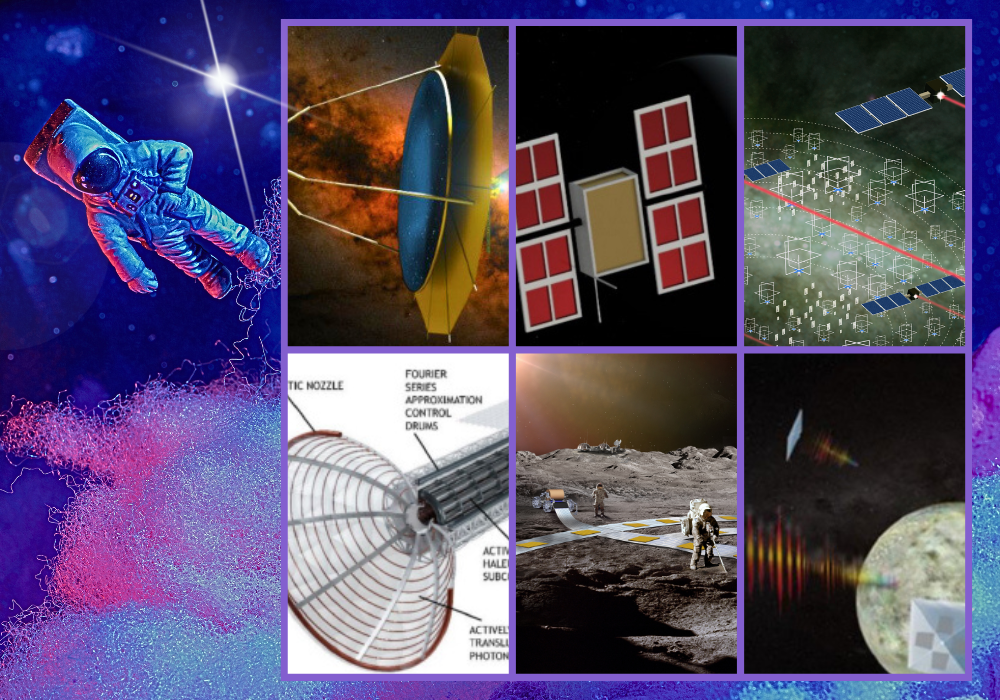
From Levitating Transport System on Moon to Plasma Rocket, NASA Updates on 6 Groundbreaking Space Technology Concepts

From Levitating Transport System on Moon to Plasma Rocket, NASA Updates on 6 Groundbreaking Space Technology Concepts

American space agency, NASA, has a program called "NASA Innovative Advanced Concepts (NIAC)", and this program has taken a significant step by advancing six groundbreaking space technology concepts to a new phase of development. These concepts, which seem like they're straight out of science fiction, have completed their initial phase and have been selected for Phase II, which includes additional funding and development.

The NIAC Phase II conceptual studies will receive up to $600,000 (~ ₹5 Crores) to continue working over the next two years to address key remaining technical and budget hurdles and pave their development path forward.

When Phase II is complete, these studies could advance to the final NIAC phase, earning additional funding and development consideration toward becoming a future aerospace mission.

Here's a brief overview of the six innovative tech concepts:

1. Fluidic Telescope (FLUTE):

The Fluidic Telescope (FLUTE) is a revolutionary concept being developed by NASA in collaboration with the Technion Israel Institute of Technology. It represents a significant leap forward in the design and construction of space observatories.

Artist’s depiction of the Fluidic Telescope (FLUTE) Edward Balaban

The FLUTE concept aims to create a large optical observatory in space using fluidic shaping of ionic liquids. It could potentially help investigate high-priority astrophysics targets, such as Earth-like exoplanets, first-generation stars, and young galaxies.

One of the most intriguing aspects of FLUTE is the concept of self-healing mirrors. These mirrors would be able to maintain their shape and repair themselves from minor damages, which is a significant advantage in the harsh environment of space.

FLUTE is designed to study high-priority astrophysics targets, including Earth-like exoplanets, first-generation stars, and early galaxies. By peering farther into space, FLUTE could help answer one of humanity's most profound questions: "Are we alone in the universe?".

2. Pulsed Plasma Rocket:


From Levitating Transport System on Moon to Plasma Rocket, NASA Updates on 6 Groundbreaking Technology Concepts


The Pulsed Plasma Rocket (PPR) is an advanced propulsion system under development that could significantly reduce travel times for human missions to Mars and beyond. The propulsion system utilizes nuclear fission, where atoms split apart to release energy. This energy is then used to create bursts of plasma for propulsion, pushing the rocket forward in space.

It may generate up to 100,000 N of thrust with a specific impulse (Isp) of 5,000 seconds. This exceptional performance combines high Isp and high thrust, which is crucial for efficient space travel over large distances.

The high efficiency of the PPR allows for manned missions to Mars to be completed within just 2 months. It also enables the transport of much heavier spacecraft equipped with shielding against Galactic Cosmic Rays, reducing crew exposure to negligible levels.

3. The Great Observatory for Long Wavelengths (GO-LoW):

The Great Observatory for Long Wavelengths (GO-LoW) is a visionary project proposed by NASA to explore the low-frequency radio sky, which has been largely inaccessible until now due to the Earth's ionosphere.

GO-LOW aims to measure the magnetic fields of terrestrial exoplanets by detecting their radio emissions at frequencies between 100 kHz and 15 MHz.

From Levitating Transport System on Moon to Plasma Rocket, NASA Updates on 6 Groundbreaking Technology Concepts
Artist concept highlighting the novel approach proposed by the 2024 NIAC Phase II awardee for possible future missions. Credits: Mary Knapp

The observatory will consist of an interferometric array of thousands of identical SmallSats located at an Earth-Sun Lagrange point, such as L5. These autonomous SmallSats satellites will measure magnetic fields emitted from exoplanets and the cosmic dark ages.

GO-LOW is part of a long-term vision to map out the technological development required to make such an observatory feasible in the next 10-20 years.

4. Radioisotope Thermoradiative Cell Power Generator:

This study investigates new in-space power sources that could operate at higher efficiencies than NASA's legacy power generators.
 
From Levitating Transport System on Moon to Plasma Rocket, NASA Updates on 6 Groundbreaking Technology Concepts
Artist’s depiction of Radioisotope Thermoradiative Cell Power Generator Stephen Polly

The Radioisotope Thermoradiative Cell (TRC) Power Generator is an innovative power source being developed for space missions, particularly those targeting the outer planets.

The TRC operates on a novel principle of thermal power conversion, somewhat akin to a solar cell working in reverse. It converts heat from a radioisotope source into infrared light, which is then emitted into the cold expanse of space. This process generates electricity.

This technology could significantly improve the capabilities of small spacecraft, enabling missions that were previously not feasible due to power constraints. It's particularly suited for operations in areas where sunlight is scarce, such as polar lunar craters or the outer reaches of our solar system. The ongoing research aims to refine the TRC technology, focusing on system size, weight, and power (SWaP), and to integrate the effects of potential power and efficiency loss mechanisms developed in Phase.

This power generation concept study is from Stephen Polly at the Rochester Institute of Technology in New York.

5. Lunar Railway System:

A concept being developed at NASA’s Jet Propulsion Laboratory for a railway system to provide payload transport on the Moon.

From Levitating Transport System on Moon to Plasma Rocket, NASA Updates on 6 Groundbreaking Technology Concepts
Artist concept of novel approach proposed by a 2024 NIAC Phase II awardee for possible future missions depicting lunar surface with planet Earth on the horizon. Credit: Ethan Schaler

The FLOAT (Flexible Levitation on a Track system) employs unpowered magnetic robots that levitate over a 3-layer flexible film track: a graphite layer enables robots to passively float over tracks using diamagnetic levitation, a flex-circuit layer generates electromagnetic thrust to controllably propel robots along tracks, and an optional thin-film solar panel layer generates power for the base when in sunlight.

This would be a lunar railway system, providing reliable, autonomous, and efficient payload transport on the Moon. This rail system could support daily operations of a sustainable lunar base as soon as the 2030s. Ethan Schaler leads FLOAT at NASA’s Jet Propulsion Laboratory in Southern California.

FLOAT robots have no moving parts and levitate over the track to minimize lunar dust abrasion / wear, unlike lunar robots with wheels, legs, or tracks.

FLOAT will operate autonomously in the dusty, inhospitable lunar environment with minimal site preparation, and its network of tracks can be rolled-up / reconfigured over time to match evolving lunar base mission requirements.

6. ScienceCraft for Outer Planet Exploration (SCOPE)

Artist’s depiction of ScienceCraft, which integrates the science instrument with the spacecraft by printing a quantum dot spectrometer directly on the solar sail to form a monolithic, lightweight structure. Mahmooda Sultana

The ScienceCraft for Outer Planet Exploration (SCOPE) is a groundbreaking mission concept developed by NASA. It aims to revolutionize the exploration of the outer planets, particularly the ice giants Neptune and Uranus, which are believed to hold secrets about the formation and evolution of our solar system.

SCOPE integrates a science instrument and spacecraft into one monolithic structure, which is a significant departure from traditional spacecraft design.

The mission utilizes a quantum dot-based spectrometer printed directly onto the solar sail material. This allows the spacecraft to not only propel through space but also to conduct scientific measurements.

These visionary studies will receive up to $600,000 each to continue working over the next two years to address technical and budget hurdles and pave their development path forward. When Phase II is complete, these studies could advance to the final NIAC phase, earning additional funding and development consideration toward becoming future aerospace missions.

Chinese Space Rocket Junk Fell in Maharashtra ?

Chinese Space Junk Fell in Maharashtra, ISRO Officials

Last Saturday night, citizen in certain parts of Madhya Pradesh, Maharashtra and Telangana border witnessed lightshow in the sky, believing it to be a Meteor shower while astronomers believed its may be satellite debris from space.

Experts says that it is most likely to be a Chinese rocket body debris. Indian space agency ISRO's officials said that as per alerts from the U.S.-based USSPACECOM, there were four space debris objects expected to re-enter Earth’s atmosphere on Saturday - 1) The CZ-3B R/B (Chinese rocket body from Long March launch vehicle); 2nd is from SpaceX's Starlink 1831 and the remaining two were small objects from the debris of Kosmos-Iridium satellites collision, a collision accident that happened in 2009.


According to a Times of India report, a senior ISRO official explained about this incident, saying - The CZ-3B was originally predicted to have a re-entry time of 4.37pm IST and impact location close to Myanmar. However, in its post event prediction, USSPACECOM put the re-entry time as 7.42pm IST with impact location as Arabian Sea. With the latest orbital information from USSPACECOM, the closest match to the observed re-entry over India has to be from Chinese CZ-3B, which was launched on February 4 last year.

Even a minor error in latitude-longitude analysis could mean a difference of tens of kilometers and “given the time (post 7.40pm IST) of spotting of the object and its landing, it is most likely to be the Long March", ISRO official further said.

When rocket bodies survive atmospheric re-entry, the rocket parts such as nozzles, rings and tanks can impact on Earth.

Such incidents deliberately /or accidently happens because Indian space agency relies on America's USSPACECOM to get alerts on space junks/objects entering India's atmosphere. ISRO therefore has recently exoressed concern over this dependency and showing a determination to be self-reliant. ISRO recently announced that it will establish Space Surveillance and Tracking network with RADARS and Optical Telescopes under the project Network for Space Objects Tracking and Analysis (NETRA).

An another Video from Twitter

Big Step Forward in Researching Interstellar Materials As Smithsonian Institute Creates New Powerful Microwave Spectrometer

The new spectrometer will be a big step forward in the research of interstellar materials between stars.

Digitizer card by Spectrum Instrumentation is a core part of the strongly improved spectrometer

Microwave spectroscopy is a very powerful tool for discovering molecular structures and operates at very low temperatures near absolute zero (1 to 5 Kelvin). The spectrometers generally either operate with high sensitivity over a very narrow bandwidth or a wide frequency with reduced sensitivity. Researchers at the Harvard Smithsonian Center for Astrophysics have used a Spectrum Instrumentation digitizer card to create a next generation molecular spectrometer with both high resolution and high sensitivity that is capable of capturing sample data substantially faster.

 A groundbreaking step forward: The new developed microwave spectrometer at the Harvard Smithsonian Center for Astrophysics 

Brandon Carroll, a Post Doctoral Fellow on the project, explained, "The new design for cooling the sample chamber enables us to have a sampling rate much greater than the usual design, and do so over a wide bandwidth. We therefore needed a means to rapidly capture a large amount of data over a wide bandwidth. Some colleagues at the University of California in Davis recommended a Spectrum Instrumentation digitizer card. We chose an M4i.2230-x8 card as it has a huge amount of on-board memory, a bandwidth up to 1.2 GHz, and the ability to average extremely quickly. We looked at cards from other companies but they were more expensive or did not meet our specifications as well as the Spectrum card did. Plus, it was really easy to integrate with our software to fully automate the data acquisition process unlike the others we considered."

Microwave spectroscopy is used to detect molecules' shape and structure, and this gives unique information about the changes that occur during chemical reactions. "Until we built this spectrometer, it required very complex instruments to use microwave spectroscopy to investigate chemical reactions," Brandon added. "Now we are able to investigate the detailed reaction dynamics of intermediary steps to see how it actually happens. The processes that dominate chemistry and physics change from those of higher temperatures when you are close to absolute zero, i.e., the temperature in many parts of space, hence this research by the Smithsonian Astrophysical Observatory."

The M4i.2230-x8 digitizer card from Spectrum Instrumentation acquires analog signals with 5 Gigasamples per second.

This new spectrometer will provide insights into the chemistry of the interstellar medium, i.e., what is in the space between planets and stars. That material is the feedstock for new solar systems and has a profound effect on how planets are formed - and even the origins of life.

He concluded, "The insights we obtain from this new design will give us a much greater understanding of interstellar chemistry, and we are finding that complex mixture analysis at ultra-cold temperatures is an exciting new direction for our us.”

Two recent papers on the instrument can be found at:

https://arxiv.org/pdf/1902.05852

https://pubs.rsc.org/en/content/getauthorversionpdf/c8cp02055h

About Spectrum Instrumentation

Spectrum Instrumentation, founded in 1989, uses a unique modular concept to design and produce a wide range of more than 200 digitizers and generator products as PC-cards (PCIe and PXIe) and stand-alone Ethernet units (LXI). In 30 years, Spectrum has gained customers all around the world, including many A-brand industry-leaders and practically all prestigious universities. The company is headquartered near Hamburg, Germany, known for its 5-year warranty and outstanding support that comes directly from the design engineers. More information about Spectrum can be found at www.spectrum-instrumentation.com

In A First of Earth's Lifetime, A Space Junk May Collide with the Moon at 9,288 Km/Hour Speed

Representational Image (credits - Pixabay)

An old space junk, which is of Elon Musk promoted company SpaceX's rocket that was launched nearly 7-years ago, will now crash into the moon, predicts astronomers.

Launched in February 2015, SpaceX's Falcon 9 rocket ran out of fuel and now the 4.4-ton (4 metric tons) rocket has been moving around fast in the space, in a chaotic orbit. It was supposed to be the part of a mission to send a climate observation satellite 930,000 miles (1.5 million kilometers) from Earth.

On January 5, 2022, Falcon 9 rocket's debris made a close flyby of the moon.

This all was predicted by Bill Gray, a developer of software that tracks near-Earth objects. In a blog post, he stated, "The rocket's upper stage is now expected to hit the far side of the moon while traveling at a blistering speed of 5,771 mph (9,288 km/h) on March 4, 2022."

"There are still several bits of junk we're tracking that may eventually hit the earth or moon or be ejected into orbit around the sun.", Bill says in his blog post.

Further, the data from observers helped scientists pinpoint its orbit of Falcon 9 rocket, discovering it would hit the Hertzsprung crater on the moon’s far side on March 4 at approximately 12:25 UTC. 

The effects of the collision impact will be minimal, aside from a new, albeit small, crater on the moon.

Jonathan McDowell, an astrophysicist at Harvard University, also confirmed that Falcon 9 space debris will hit the Moon. In a tweet, he said, "yes, an old Falcon 9 second stage left in high orbit in 2015 is going to hit the moon on March 4. It's interesting, but not a big deal."

Though, SpaceX may not be held responsible for this collision as it's apparently unintentional. In the past there are few space probes which have been deliberately destroyed at their objects of study, like the moon or other planets, typically by hard landings or crash landings at the end of their respective missions and/or functionality.

For an instance, several rocket stages utilized during the Apollo space program were deliberately crashed on the Moon to aid seismic research, and four of the ascent stages of Apollo Lunar Modules were deliberately crashed onto the Moon after they had fulfilled their primary mission.  

The moon saw intentional crashing of space probes objects, into its surface, for more than 15 times. 

It is to be noted that sometimes, the components of space probes intentionally crashed in order to prevent the hazards of orbital space junk/debris and planetary contamination.

But, Falcon 9 is a first "space junk", wandering in the space with no control from the earth, will crash into the moon. In other words, this is the first known unintentional impact of space junk with the moon.

Besides the moon, the Mercury too has saw intentional crashing when MESSENGER, a NASA robotic space probe that orbited the planet Mercury between 2011 and 2015, for studying Mercury's chemical composition, geology, and magnetic field, intentionally crashed into Mercury on April 30, 2015, in order to end the mission.

Indian Astronomers Uncover Mystery Behind Decline of Star Formation Rate after its Peak 8-10 Bn Yrs Ago

Giant Metrewave Radio Telescope (GMRT) located at a site about 80 km north of Pune

For long, scientists have been intrigued by the decrease in the rate at which stars were formed in galaxies after it peaked about 8-10 billion years ago. They have now deciphered the mystery behind this decline in star formation activity by measuring the atomic hydrogen of the galaxies.

Galaxies are made up mostly of gas and stars. Gas converts to stars with time. Understanding this conversion requires measurement of the atomic hydrogen gas, the primary fuel for star formation in galaxies in early times. Astronomers have long known that galaxies formed stars at a higher rate when the universe was young than they do today. But the cause of this decline is unknown, mostly because there was no information about the amount of atomic hydrogen gas at that time.

A team of astronomers from the National Centre for Radio Astrophysics (NCRA-TIFR), Pune, and the Raman Research Institute (RRI), Bangalore, an autonomous institute of the Department of Science & Technology (DST), Government of India has used the upgraded Giant Metre wave Radio Telescope (GMRT), operated by NCRA-TIFR, to measure the atomic hydrogen content of galaxies seen as they were 8 billion years ago. 

The research carried out by Aditya Chowdhury, Nissim Kanekar, and Jayaram Chengalur of NCRA-TIFR, and Shiv Sethi, and K. S. Dwarakanath of RRI and published in the journal Nature records the earliest epoch in the universe for which atomic gas content of galaxies has been measured. 

A GMRT antenna at night. Picture by Rakesh Rao


The custom code used to calibrate the GMRT data is publicly available at https://github.com/chowdhuryaditya/calR.

The research was funded by the Department of Atomic Energy, India, and DST, India.

“Given the intense star formation in these early galaxies, their atomic gas would be consumed by star formation in just one or two billion years. And, if the galaxies could not acquire more gas, their star formation activity would decline, and finally cease”, said Aditya Chowdhury, a Ph.D. student at NCRA-TIFR and the lead author of the study. “The observed decline in star formation activity can thus be explained by the exhaustion of the atomic hydrogen,” he added.

The measurement of the atomic hydrogen mass of distant galaxies was done by using the upgraded GMRT to search for a spectral line in atomic hydrogen. K. S. Dwarakanath of RRI, a co-author of the study, mentioned, “We had used the GMRT in 2016, before its upgrade, to carry out a similar study. However, the narrow bandwidth before the GMRT upgrade meant that we could cover only around 850 galaxies in our analysis, and hence were not sensitive enough to detect the signal.”

“The big jump in our sensitivity is due to the upgrade of the GMRT in 2017”, said Jayaram Chengalur, of NCRA-TIFR, a co-author of the paper. “The new wideband receivers and electronics allowed us to use 10 times more galaxies in the stacking analysis, giving sufficient sensitivity to detect the weak average 21 cm signal.”

Detecting the 21 cm signal from the most distant galaxies in the universe was the main science goal of the GMRT when it was designed and built by a team led by Govind Swarup in the 1980s and 1990s. “Govind Swarup was very interested in this work and was following it keenly. Sadly, he passed away shortly before it was published. This work would not have been possible without him and the wonderful team that he put together to first build and then upgrade the GMRT”, said Nissim Kanekar of NCRA- TIFR, a Swarna Jayanti Fellow of DST and co-author of the study.

Technical explanation of GMRT upgradation

Unlike stars, which emit light strongly at optical wavelengths, the atomic hydrogen signal lies in the radio wavelengths, at a wavelength of 21 cm, and can only be detected with radio telescopes. Unfortunately, this 21 cm signal is very weak and difficult to detect from distant individual galaxies even with powerful telescopes like the upgraded GMRT. To overcome this limitation, the team used a technique called “stacking” to combine the 21 cm signals of nearly 8,000 galaxies that had earlier been identified with optical telescopes. This method measures the average gas content of these galaxies.

An image of the stacked 21 cm signal detected with the upgraded GMRT, arising from atomic hydrogen gas in galaxies 22 billion light-years away.


The spectrum of the stacked 21 cm signal detected with the upgraded GMRT, arising from atomic hydrogen gas in galaxies 22 billion light-years away. The width of the signal gives an indication of the average rotation of galaxies 8 billion years ago.


Scientists from India's ARIES Suggests New Formula to Help Estimate the Mass of Black Hole


A new study has suggested a formula that can help probe black holes. Black holes (BH) cannot be observed directly, but their presence can be detected by the huge amount of energy that is liberated through temporary accumulation of matter outside the BH, before it dives into the BH, a process called accretion.

Scientists have found the formula that can assess the spectrum emitted from the accretion discs around black holes. Spectra of accretion discs can help estimate the mass of the black hole.

Accretion flow around BH is composed of ionised plasma, which is a soup of bare electrons and protons. Since electrons are more prone to radiative losses than the protons, it is expected that around a BH, electrons and protons would settle down into two separate temperature distributions. Therefore, the two-temperature equations are generally solved to obtain the emitted spectrum from the electron temperature distribution. This is known as two-temperature modeling of accretion flows. 


Scientists from Aryabhatta Research Institute of Observational Sciences (ARIES), an autonomous institute under the Department of Science and Technology (DST), Govt. of India, investigated the nature of these two-temperature flows.

The research led by Shilpa Sarkar and Indranil Chattopadhyay from ARIES along with Philippe Laurent from IRFU / Service d’ Astrophysique and Laboratoire Astroparticule et Cosmologie, which has been recently accepted for publication in the journal Astronomy & Astrophysics (A&A), found that the number of unknown variables in the two-temperature regime exceeds the number of equations present. Hence, we get multiple solutions for the same set of constants of motion, like total energy or mass-inflow rate.

Looking for a unique solution, scientists have developed a new formula called the Sarkar & Chattopadhyay form of entropy formula that can only be applied near the horizon where gravity overpowers any other interactions like energy exchange terms between ions and electrons. This novel approach helped in selecting a unique solution out of the multiple solutions of accretion disc spectrum emission around a BH. Entropy is the measure of randomness in any system. In two temperature solutions, the formula for measure of entropy does not exist. This new formula allows to measure the entropy of the flow close to the black hole horizon. According to the second law of thermodynamics, nature selects or prefers those processes which maximize entropy. ARIES team showed that there exists one solution for which the entropy is maximum and thereby broke the multiplicity of solutions.

Using this formula, they found that with the increase of the mass supply to the central BH, the accretion disc becomes brighter and more high energy photons are emitted. With the increase of mass of the BH, luminosity increases, and the bandwidth of the emitted spectrum, both in the high energy and low energy range, increases, but the spectral shape does not change. In other words, matter around a massive BH will produce a lot of photons in the low energy and high energy band, but around a smaller BH, it will emit predominantly in the X-rays.

According to the ARIES team, this is the first time any approach of removing degeneracy from two-temperature theory has been proposed. It is necessary to obtain a correct solution, and hence a correct spectrum for any accretion flow around BH as any arbitrary choice of solution would give us a wrong picture of the system. The results could contribute in the understanding of physical processes around extreme objects like BHs.

A Cartoon Diagram of Accretion Disc


the Mach number, and temperature variation with the distance from the BH is plotted. Also, in panel Fig. 2c, the total spectrum and the contribution to the spectrum from various regions of accretion disc are shown.


For more details, contact: Shilpa Sarkar (shilpa@aries.res.in) and Indranil Chattopadhyay

(indra@aries.res.in). ]

Market Reports

Market Report & Surveys
IndianWeb2.com © all rights reserved