‏إظهار الرسائل ذات التسميات Gravitational Waves. إظهار كافة الرسائل

For the 1st Time Scientists Found Experimental Evidence of Graviton-like Particle

For the 1st Time Scientists Found Experimental Evidence of Graviton-like Particle

Gravitons are fascinating hypothetical particles that play a pivotal role in our understanding of gravity. These are the fundamental particles that mediate the force of gravitational interaction in the realm of quantum field theory.

In simpler terms, they carry the gravitational force, much like how photons carry the electromagnetic force. When you toss something upward, and it gracefully descends due to gravity, it's essentially the gravitons at work.

Like photons, gravitons are expected to be massless and electrically uncharged. Gravitons too travel at the speed of light, zipping through the fabric of spacetime. Their existence is rooted in the quest for a unified theory that combines quantum mechanics and gravity.

Gravitons are the focus of the search for the "theory of everything", which would unify Einstein's General Relativity (GR) theory of gravity with quantum theory

Gravitons remain elusive and unobserved and continue to intrigue scientists as we seek to unravel the mysteries of gravity and the cosmos.

In a latest however, scientists have glimpsed into graviton-like particles and these particles of gravity have shown their existence in a semiconductor.

An international research team led by Chinese scientists has, for the first time, presented experimental evidence of a graviton-like particle called chiral graviton modes (CGMs), with the findings published in the scientific journal Nature on Thursday.

By putting a thin layer of semiconductor under extreme conditions and exciting its electrons to move in concert, researchers from eastern China’s Nanjing University, the United States and Germany found the electrons to spin in a way that is only expected to exist in gravitons.

Despite the breakthrough, Loren Pfeiffer at Princeton University, who wrote the paper of this findings, said "This is a needle in a haystack [finding]. And the paper that started this whole thing is from way back in 1993." He wrote that paper with several colleagues including Aron Pinczuk, who passed away in 2022 before they could find hints of the gravitons.

The discovery of chiral graviton modes (CGMs) and their shared characteristics with gravitons, a still-undiscovered particle predicted to play a critical role in gravity, could potentially connect two subfields of physics: high-energy physics, which operates across the largest scales of the universe, and condensed matter physics, which studies materials and the atomic and electronic interactions that give them their unique properties.

Scientists in China, the US and Germany used polarised laser light to measure graviton-like excitation and spin in a quantum material. (Image - SCMP.org)

The ability to study graviton-like particles in the lab could help fill critical gaps between quantum mechanics and Einstein’s theories of relativity, solving a major dilemma in physics and expanding our understanding of the universe.

The term "graviton" was coined in 1934 by Soviet physicists Dmitrii Blokhintsev and F. M. Gal'perin. Paul Dirac later reintroduced the term, envisioning that the energy of the gravitational field should come in discrete quanta—these quanta he playfully dubbed "gravitons."

Just as Newton anticipated photons, Laplace also foresaw "gravitons," albeit with a greater speed than light and no connection to quantum mechanics or special relativity.

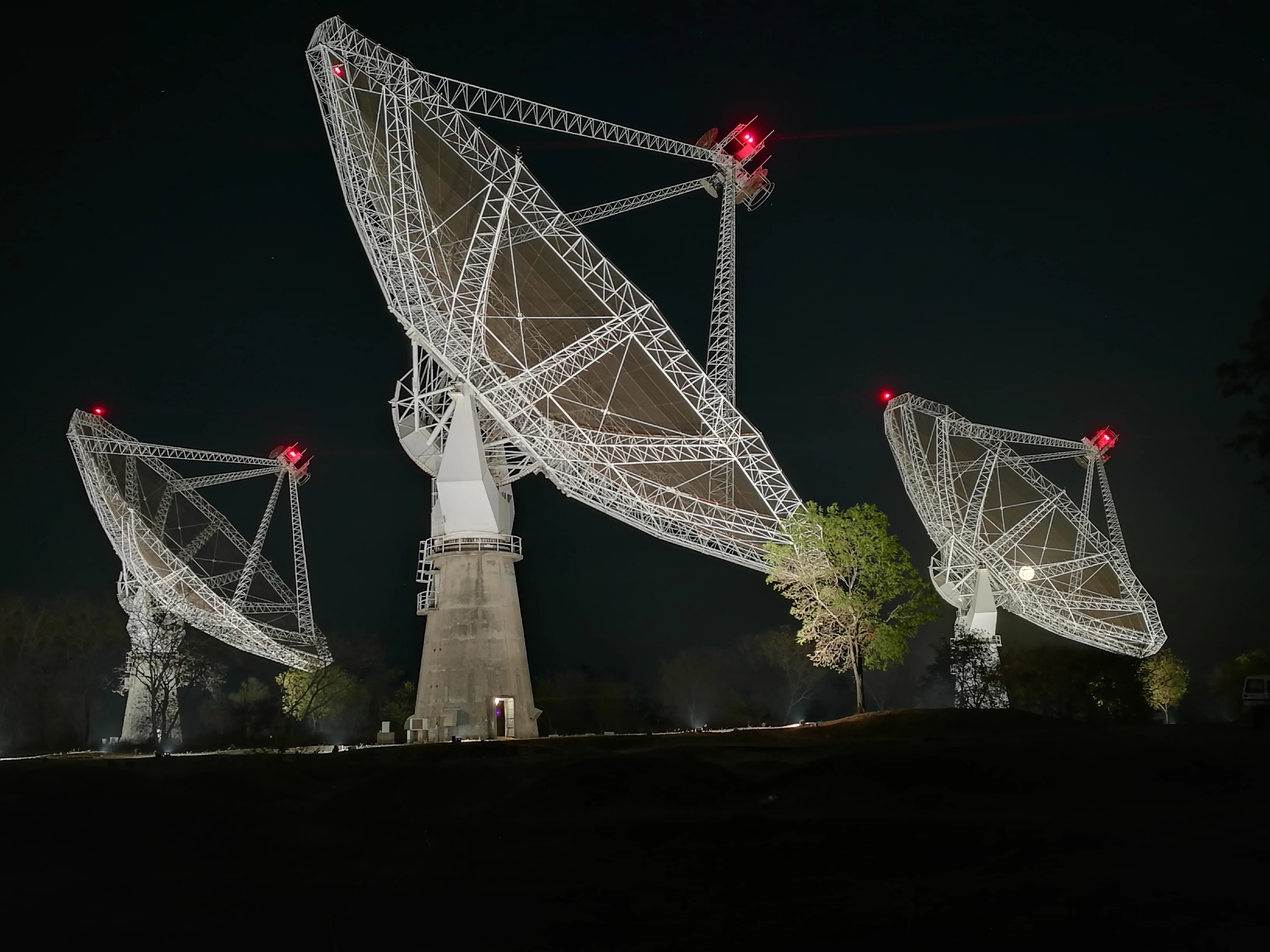
IIT Hyderabad Researchers Help Find Evidence for the Humming of the Universe by Low Frequency Gravitational Waves

  • IITH researchers, as part of the Indian Pulsar Timing Array (InPTA) consortium, find evidence for ultra-low frequency gravitational waves
  • The results could not have been possible without the NSM (National Supercomputing Mission) facility Param Seva installed at IIT Hyderabad
  • Such waves are expected to originate from a large number of dancing monster black hole pairs more than a million times more massive than the Sun.
  • Link to papers: https://doi.org/10.1051/0004-6361/202346844 and https://doi.org/10.1051/0004-6361/202346842
A team of researchers from IIT Hyderabad (IITH) are part of an international team of astronomers from India, Japan, and Europe has published results from monitoring pulsars, nature’s best clocks, using six of the World's most sensitive radio telescopes, including India’s largest telescope uGMRT. These results provide a hint of evidence for the relentless vibrations of the fabric of the universe, caused by ultra-low frequency gravitational waves. Such waves are expected to originate from a large number of dancing monster black hole pairs, crores of times heavier than our Sun. The team’s results are a crucial milestone in opening a new, astrophysically-rich window in the gravitational wave spectrum.

IIT Hyderabad Researchers Help Find Evidence for the Humming of the Universe  by Low Frequency Gravitational Waves
Representative image

Such dancing monster Black Hole pairs, expected to lurk in the centres of colliding galaxies, create ripples in the fabric of our cosmos, and astronomers call them nano-hertz gravitational waves as their wavelengths can be many lakhs of crores of kilometres. The relentless cacophony of gravitational waves from a large number of supermassive black hole pairs creates a persistent humming of our universe. The team, consisting of members of the European Pulsar Timing Array (EPTA) and Indian Pulsar Timing Array (InPTA) consortia, published their results in two papers in the Astronomy and Astrophysics journal, and their results hint at the presence of such gravitational waves in their data set. These results include an analysis of pulsar data collected over 25 years with six of the world’s largest radio telescopes.

The IITH team which took part in this discovery consists of Dr Shantanu Desai, faculty in the Department of Physics and Department of AI, Mr Aman Srivastava, Physics PhD student, Mr Divyansh Kharbanda (2023 BTech graduate in Engineering Physics), Ms Swetha Arumugam (rising BTech senior in EE). Another B Tech student in EE, Ms Pragna Mamdipaka, is also part of InPTA and is playing an active role in ongoing InPTA efforts. IITH has been part of InPTA since 2018, and some of the past InPTA students from IITH are pursuing higher studies in Astrophysics and related industries.

Emphasizing the importance of this result and IITH’s contribution, Prof B S Murty, Director, IITH, said, “Congratulations to the InPTA collaboration and the IITH team involved in this discovery. I am delighted that the state-of-the-art NSM Param Seva computing facility at IITH has helped to create these path-breaking results. This achievement also underscores the power of collaboration in attaining scientific benchmarking results’’.

I am elated that IITH students from both Physics and Electrical Engineering could be part of this historical discovery. These results are due to many years of painstaking efforts from many scientists. I am grateful for the support received from IITH. In particular, the results could not have been possible without the NSM (National Supercomputing Mission) facility Param Seva installed at IIT Hyderabad’’, said Prof Shantanu Desai, IITH.

The InPTA experiment involves researchers from NCRA (Pune), TIFR (Mumbai), IIT (Roorkee), IISER (Bhopal), IIT (Hyderabad), IMSc (Chennai) and RRI (Bengaluru) along with colleagues from Kumamoto University, Japan. More details about InPTA can be found at https://inpta.iitr.ac.in/

This combined IPTA data set is expected to be more sensitive, and scientists are excited about the constraints they can place on the GWB (Gravitational Wave Background) along with understanding various other phenomena that may have taken place when the Universe was in its infancy, just a few seconds old, which can also produce gravitational waves at these astronomically long wavelengths.

IIT Roorkee Researchers Contribute to Unveiling the Humming of Our Universe Observed Through Low-Frequency Gravitational Waves

IIT Roorkee Researchers Contribute to Unveiling the Humming of Our Universe Observed Through Low-Frequency Gravitational Waves
The uGMRT telescope 
Astronomers Discover Evidence of Ultra-Low Frequency Gravitational Waves from Dancing Monster Black Hole Pairs

IIT Roorkee's ongoing support for collaborative research by astronomers from India, Japan, and Europe

An International team of astronomers from India, Japan and Europe has recently published the results from monitoring nature’s best clocks, pulsars using six of the World's most sensitive radio telescopes, including India’s largest telescope, uGMRT. These results provide scintillating evidence for the relentless vibrations of the fabric of our universe caused by ultra-low frequency gravitational waves. Such waves are expected to originate from a large number of dancing monster black hole pairs, crores of times heavier than our Sun. The team’s results are a crucial milestone in opening a new, astrophysically-rich window in the gravitational wave spectrum.

Such dancing monster Black Hole pairs, expected to lurk in the centers of colliding galaxies, create ripples in the fabric of space-time, which the astronomers call nano-hertz gravitational waves. The relentless cacophony of gravitational waves from a large number of supermassive black hole pairs create a persistent humming of our universe. The team, consisting of members of the European Pulsar Timing Array (EPTA) and Indian Pulsar Timing Array (InPTA) consortia, published their results in two seminal papers in the Astronomy and Astrophysics journal, and their results hint at the presence of such gravitational waves in their data set. Prof. P. Arumugam and his senior PhD student, Mr. Jaikhomba Singha, are part of these ground-breaking results.

Image - InPTA Collaboration Meeting held at IIT Roorkee on August 2022
 InPTA Collaboration Meeting held at IIT Roorkee on August 2022

Image - A few InPTA members visiting the PARAM Ganga Facility at IIT Roorkee
A few InPTA members visiting the PARAM Ganga Facility at IIT Roorkee

These results have culminated due to years of efforts of many scientists, including early career researchers and undergraduate students. I am very grateful that IIT Roorkee has been able to constantly contribute in various ways in achieving these results. The NSM facility, PARAM Ganga, installed at IIT Roorkee, among various other facilities, has played a crucial role in this global effort. I hope IIT Roorkee will continue to support the various efforts of this stellar collaboration,” states Prof. Arumugam, Department of Physics, IIT Roorkee.

These light-year-scale ripples can only be detected by synthesizing a galactic-scale gravitational-wave detector using pulsars-the only accessible celestial clocks for humans. Pulsars are a type of rapidly rotating neutron stars that are essentially embers of dead stars, present in our galaxy. Fortunately, a pulsar is a cosmic lighthouse as it emits radio beams that flashes by the Earth regularly, just like a lighthouse near a harbor. Astronomers monitor these objects using the best radio telescopes of the world, including India’s premiere radio telescope, the uGMRT, situated near Pune.

According to Einstein, gravitational waves change the arrival times of these radio flashes and thereby affect the measured ticks of our cosmic clocks. These changes are so tiny that astronomers need sensitive telescopes like the uGMRT and a collection of radio pulsars to separate these changes from other disturbances. The slow variation of this signal has meant that it takes decades to look for these elusive nano-hertz gravitational waves,” explains Prof. Bhal Chandra Joshi of NCRA Pune and Adjunct Faculty, IIT Roorkee, who founded the InPTA collaboration during the last decade.

Scientists of the EPTA in collaboration with the Indo-Japanese colleagues of the InPTA, have reported detailed results of analysing pulsar data collected over 25 years with six of the world’s largest radio telescopes. This includes more than three years of very sensitive data collected using the unique low radio frequency radio telescope, the uGMRT. The analysis of this unique data set has revealed that the measured rate of ticking of these cosmic clocks has characteristic irregularities common across the twenty-five pulsars that have been monitored. This is consistent with the effect produced by gravitational waves at ultra-low frequency (waves that oscillate with periods between one and ten years). Not surprisingly, nano-hertz frequency gravitational waves will unravel some of the best-kept secrets of the Universe. The cosmic population of black hole pairs with masses that are ten-to-hundred crores times more than the mass of our Sun are expected to be formed when their parent galaxies merge and such a population emits gravitational waves at these frequencies. Further, various other phenomena that may have taken place when the Universe was in its infancy, just a few seconds old, also produce these waves at these astronomically long wavelengths. According to Prof. A. Gopakumar, TIFR, Mumbai, and Chair of the InPTA consortium, “The results presented today mark the beginning of a new journey into the Universe to unveil some of these mysteries. More importantly, this is the first time that an Indian telescope’s data is used for hunting gravitational waves”.

To detect these gravitational-wave signals, astronomers in a "Pulsar Timing Array" (PTA) collaboration exploit many ultra-stable pulsar clocks distributed across our Milky Way galaxy to create a “galactic-scale gravitational-wave detector”. Measurements of the exact arrival times of the pulsars, which have been going on for decades, are being compared with each other to study the influence of gravitational waves. As radio signals travel through space and time, the presence of gravitational waves affects their path in a characteristic way: some pulses will arrive a little (less than a millionth of a second) later, some a little earlier. This gigantic galactic-scale GW detector synthesised by incorporating 25 meticulously chosen pulsars in our Milky Way Galaxy makes it possible to access the variations in the pulse arrival times created by gravitational waves with a frequency of oscillation 10 billion times slower than those first observed in 2015 by the two ground-based LIGO detectors in the United States of America.

The current results are based on a coordinated observing campaign using the five largest radio telescopes in Europe, complemented by the observations with the upgraded Giant Metrewave Radio Telescope in India. The analysis of the European and Indian Pulsar Timing Array (EPTA+InPTA) data which is presented today has revealed the presence of a common signal across the pulsars in the array which is broadly in agreement with being due to gravitational waves. The EPTA+InPTA results are complemented by the coordinated publications made by other PTAs across the world, namely the Australian (PPTA), Chinese (CPTA) and North-American (NANOGrav) pulsar timing array collaborations. This same evidence for gravitational waves is seen by NANOGrav and consistent with results reported by the CPTA and PPTA.

Mr. Singha, a senior PhD scholar from IIT Roorkee, says, “This is an extremely exciting time for early career researchers. We are in an era where an international team of researchers across the globe are all collaborating and trying to listen to the humming of our universe. The present results will open a plethora of exhilarating science for us in future."

Importantly, work is already in progress where scientists from the four collaborations – EPTA, InPTA, PPTA and NANOGrav – are combining their data sets under the auspices of the International Pulsar Timing Array (IPTA) to create an array consisting of over 100 pulsars that may allow them to reach this goal in the near future. This combined IPTA data set is expected to be more sensitive, and scientists are excited about the constraints they can place on the GWB along with understanding various other phenomena that may have taken place when the Universe was in its infancy, just a few seconds old, which can also produce gravitational waves at these astronomically long wavelengths.

The InPTA experiment involves researchers from NCRA (Pune), TIFR (Mumbai), IIT (Roorkee), IISER (Bhopal), IIT (Hyderabad), IMSc (Chennai) and RRI (Bengaluru) along with their colleagues from Kumamoto University, Japan.

Prof. K K Pant, the Director of IIT Roorkee, said, “Congratulations to the InPTA team and our esteemed researchers from IIT Roorkee for their remarkable findings and impactful research. I am delighted to learn about the utilization of IIT Roorkee's cutting-edge facilities, such as PARAM Ganga, in this endeavor. This achievement exemplifies the power of international collaborations in attaining greater scientific goals and significantly contributing to our understanding of the universe."

IIT Roorkee is an institute of national importance imparting higher education in engineering, sciences, management, architecture and planning, and humanities and social sciences. Since its establishment in 1847, the Institute has played a vital role in providing the country with technical human resources and know-how.

Meet The Four Indian Scientists Behind Gravitational Waves Discovery

In what can be considered as a landmark discovery earlier this year, 60 scientists from India have contributed in successfully detecting gravitational waves, first hypothesized by the genius Albert Einstein almost a century ago.

Opening a new window to the world of studying the cosmos, the discovery is a fruit of a worldwide collaboration between scientists.

Here are the front runners from India who made this discovery possible:

1) Name: Sanjeev Dhurandhar


dhurandar

Age: 64
Occupation: Emeritus professor, IUCAA, Pune

Pune born scientist Sanjeev Dhurandhar was one of the 1,000 key scientists actively involved in discovery of the gravitational waves. As early as the 80's, when the whole world was obsessing on electromagnetic wave, Sanjeev was sure about this scientific marvel's existence.

While Dhurandhar was adamant about his belief, the scientific community wasn't very welcoming to him initially. During his PhD, when he tried seeking funds for building the world’s biggest 100-metre interferometer to detect gravitational waves, he was politely turned away for not having enough credibility. For the unaware, Interferometers are basically investigative tools used in various fields of science and engineering.

Fast forward today, the Pune born scientist is now considered as the foundation holding up the country's gravitational wave research. He has successfully developed novel algorithms on the way to extract gravitational wave signals from the noise created from sources such as black holes, and how to do the same with several detectors – all of this has been put to use in discovering the gravitational wave.

2) Name: Anand Sengupta


sengupta

Age: 40
Occupation: Faculty, Physics, Indian Institute of Technology - Gandhinagar

When Anand Sengupta was first informed about the first gravitational wave, he didn't believe it to be to be true and thought of it as a mere “injection”. He thought that it was just another case of textbook injection to make sure that the search groups are doing their working properly, all the protocols are in their proper place for due diligence and that frequent checks are being carried out by various programmes.

But, when he finally realised it was true, he was very joyous for his and his team's efforts. He does however feel that though the discovery is a historic one, it is just an isolated one in nature. He believes that more detections are needed and there is also a requirement to locate the sources by using other telescopes.

He and his group meticulously worked on matched filtering algorithm in order to pull out the weak signals.

The group is currently working on an algorithm that will be able to successfully separate background noise from the true gravitational wave event by making use of machine learning.

3) Name: Parameswaran Ajith


ajith

Age: 35
Occupation: Leads astrophysical relativity group, International Centre for Theoretical Sciences – Tata Institute of Fundamental Research, Bangalore

Ajith was vacationing in Kerala when he got informed about a “trigger” in the Laser Interferometer Gravitational Wave Observatory (LIGO) detectors that primarily looked as it was from a binary black hole. The trigger in the LIGO detectors triggered Ajith to cut short his vacation in Kerala and come back to work in Bangalore. It was after three weeks of continuous work that his team was successfully in getting its first results. After this, the team's preliminary results came out in just ten days which were then sent for further revision and review.

In what could be considered a major coincidence, just three months prior to the discovery, Ajith and his group at ICTS-TIFR had released a paper where they had talked about the method to infer the mass and spin of the black holes that determines the shape of the gravitational wave.

4) Name: Archana Pai


pai

Age: 42
Occupation: Faculty, physics, Indian Institute of Science Research and Education, Thiruvananthpuram

A faculty of physics at the Indian Institute of Science Research and Education in Thiruvananthpuram, Pai believes that even more than the event itself, the fact that the discovery was made in the 100th year since Albert Einstein first predicted it, matters more to her.

According to her, even though her group did believe that the detection of the gravitational wave would require more sensitivity and that would possibly happen in the advanced LIGO, she didn't expect the first defection to happen this soon. But, after the initial awe and surprise, they started following what the data was meaning to communicate. Pai and her group of talented scientists tested the gravitational wave from the event and found it to be in consistency with Einstein’s theory of general relativity.

Even India's Prime Minister Narendra Modi was joyous about India's contribution in this discovery and tweeted, "Immensely proud that Indian scientists played an important role in this challenging quest."

Meet The Four Indian Scientists Behind Gravitational Waves Discovery

In what can be considered as a landmark discovery earlier this year, 60 scientists from India have contributed in successfully detecting gravitational waves, first hypothesized by the genius Albert Einstein almost a century ago.

Opening a new window to the world of studying the cosmos, the discovery is a fruit of a worldwide collaboration between scientists.

Here are the front runners from India who made this discovery possible:

1) Name: Sanjeev Dhurandhar


dhurandar

Age: 64
Occupation: Emeritus professor, IUCAA, Pune

Pune born scientist Sanjeev Dhurandhar was one of the 1,000 key scientists actively involved in discovery of the gravitational waves. As early as the 80's, when the whole world was obsessing on electromagnetic wave, Sanjeev was sure about this scientific marvel's existence.

While Dhurandhar was adamant about his belief, the scientific community wasn't very welcoming to him initially. During his PhD, when he tried seeking funds for building the world’s biggest 100-metre interferometer to detect gravitational waves, he was politely turned away for not having enough credibility. For the unaware, Interferometers are basically investigative tools used in various fields of science and engineering.

Fast forward today, the Pune born scientist is now considered as the foundation holding up the country's gravitational wave research. He has successfully developed novel algorithms on the way to extract gravitational wave signals from the noise created from sources such as black holes, and how to do the same with several detectors – all of this has been put to use in discovering the gravitational wave.

2) Name: Anand Sengupta


sengupta

Age: 40
Occupation: Faculty, Physics, Indian Institute of Technology - Gandhinagar

When Anand Sengupta was first informed about the first gravitational wave, he didn't believe it to be to be true and thought of it as a mere “injection”. He thought that it was just another case of textbook injection to make sure that the search groups are doing their working properly, all the protocols are in their proper place for due diligence and that frequent checks are being carried out by various programmes.

But, when he finally realised it was true, he was very joyous for his and his team's efforts. He does however feel that though the discovery is a historic one, it is just an isolated one in nature. He believes that more detections are needed and there is also a requirement to locate the sources by using other telescopes.

He and his group meticulously worked on matched filtering algorithm in order to pull out the weak signals.

The group is currently working on an algorithm that will be able to successfully separate background noise from the true gravitational wave event by making use of machine learning.

3) Name: Parameswaran Ajith


ajith

Age: 35
Occupation: Leads astrophysical relativity group, International Centre for Theoretical Sciences – Tata Institute of Fundamental Research, Bangalore

Ajith was vacationing in Kerala when he got informed about a “trigger” in the Laser Interferometer Gravitational Wave Observatory (LIGO) detectors that primarily looked as it was from a binary black hole. The trigger in the LIGO detectors triggered Ajith to cut short his vacation in Kerala and come back to work in Bangalore. It was after three weeks of continuous work that his team was successfully in getting its first results. After this, the team's preliminary results came out in just ten days which were then sent for further revision and review.

In what could be considered a major coincidence, just three months prior to the discovery, Ajith and his group at ICTS-TIFR had released a paper where they had talked about the method to infer the mass and spin of the black holes that determines the shape of the gravitational wave.

4) Name: Archana Pai


pai

Age: 42
Occupation: Faculty, physics, Indian Institute of Science Research and Education, Thiruvananthpuram

A faculty of physics at the Indian Institute of Science Research and Education in Thiruvananthpuram, Pai believes that even more than the event itself, the fact that the discovery was made in the 100th year since Albert Einstein first predicted it, matters more to her.

According to her, even though her group did believe that the detection of the gravitational wave would require more sensitivity and that would possibly happen in the advanced LIGO, she didn't expect the first defection to happen this soon. But, after the initial awe and surprise, they started following what the data was meaning to communicate. Pai and her group of talented scientists tested the gravitational wave from the event and found it to be in consistency with Einstein’s theory of general relativity.

Even India's Prime Minister Narendra Modi was joyous about India's contribution in this discovery and tweeted, "Immensely proud that Indian scientists played an important role in this challenging quest."

Market Reports

Market Report & Surveys
IndianWeb2.com © all rights reserved