‏إظهار الرسائل ذات التسميات Gaganyaan. إظهار كافة الرسائل

Gaganyaan Takes Flight: ISRO Successfully Qualifies Service Module Propulsion System for Human Space Missions

Gaganyaan Takes Flight: ISRO Successfully Qualifies Service Module Propulsion System for Human Space Missions

ISRO has successfully completed the development and qualification testing of the Service Module Propulsion System (SMPS) for the Gaganyaan human spaceflight mission.

This achievement marks a critical step toward human-rating the Gaganyaan systems and ensures readiness for crew safety and mission reliability.

A 350-second full-duration hot test was conducted on July 11, 2025, at the ISRO Propulsion Complex (IPRC), Mahendragiri. The test validated the integrated performance of SMPS under off-nominal mission abort conditions. Results showed normal performance, aligning with pre-test predictions.

The Service Module (SM) uses a regulated bi-propellant propulsion system. It supports:
  • Orbit circularization
  • On-orbit control
  • De-boost manoeuvres
  • Abort capability during ascent phase
Liquid Apogee Motor (LAM) engines provide the main thrust. Reaction Control System (RCS) thrusters ensure precise attitude control.

A test bed emulating the SMPS fluid circuit was developed, including:
  • Propellant tank feed system
  • Helium pressurization system
  • Flight-qualified thrusters
  • Control components
The System Demonstration Model (SDM) underwent 25 tests under nominal and off-nominal conditions, totaling 14,331 seconds of firing time.

SMPS was designed, developed, and realized by the Liquid Propulsion Systems Centre (LPSC), with tests conducted at IPRC, Mahendragiri.

Agra Man Arrested for Allegedly Leaking Sensitive Info About ISRO's Gaganyaan Mission

Agra Man Arrested for Allegedly Leaking Sensitive Info About ISRO's Gaganyaan Mission

A man from Agra, Uttar Pradesh, was arrested for allegedly leaking sensitive information about ISRO's Gaganyaan mission and other defense projects to Pakistan's ISI. The individual was reportedly manipulated through a honeytrap operation.

The honeytrap incident involving ISRO's Gaganyaan mission has raised significant concerns about national security.

Ravindra Kumar, a chargeman at the Firozabad Ordnance Factory, was arrested by the Uttar Pradesh Anti-Terrorism Squad (ATS) on March 14, 2025. He was accused of leaking sensitive information about India's Gaganyaan mission and other defense projects to Pakistan's ISI.

The accused, Ravindra Kumar, was reportedly honey-trapped by an ISI handler named ‘Neha’ and had been leaking sensitive defence information for an extended period.

Kumar was reportedly manipulated by a Pakistani agent posing as an ISRO officer named "Neha Sharma" on Facebook. Their interactions moved to WhatsApp, where the agent extracted classified information through chats and video calls.

The data shared included details about drone manufacturing, ordnance production, and the Gaganyaan mission. Kumar allegedly received payments from unknown sources multiple times in exchange for this information.

The investigation revealed a larger espionage network operated by ISI, utilizing AI-driven tools and call centers in cities like Lahore and Karachi. This network, known as "Project Lioness," trains female spies for such operations.

The Firozabad Ordnance Factory, which plays a crucial role in manufacturing parachutes for astronaut landings in the Gaganyaan mission, was compromised. Authorities are investigating the extent of the breach and its potential impact on national security.

If convicted under the Official Secrets Act, Kumar could face up to 14 years in prison.

This incident underscores the persistent threat of honeytrapping and the need for stringent cybersecurity measures. Let me know if you'd like to explore more about ISRO's Gaganyaan mission or related topics!

ISRO Achieves Two Significant Milestones for Gaganyaan Mission

ISRO Achieves Two Significant Milestones for Gaganyaan Mission

Indian space agency, ISRO, has achieved two significant milestones for the Gaganyaan mission, which aims to send three astronauts into space for a three-day mission, orbiting Earth at an altitude of 400 kilometers.

Milestone 1: Transport of the First Solid Motor Segment

Transport of the First Solid Motor Segment

On December 13, 2024, ISRO successfully transported the first solid motor segment from the production plant to the launch complex at SDSC-SHAR. This marks a crucial step towards the HLVM3 G1 flight, which is part of India's first human spaceflight mission.

The solid motor segment of the Gaganyaan mission is a crucial component of the Human Rated Launch Vehicle (HLVM3), which will carry astronauts into low Earth Orbit.

The solid motor segment forms part of the first stage of the launch vehicle, providing the initial thrust needed to propel the spacecraft into orbit.

This progress brings India closer to achieving its goal of conducting crewed space missions and establishing itself as a nation capable of human spaceflight.

Milestone 2: Sea Level Hot Test of Its CE20 Cryogenic Engine

Sea Level Hot Test of Its CE20 Cryogenic Engine

ISRO conducted a sea-level hot test of its CE20 cryogenic engine at the ISRO Propulsion Complex in Mahendragiri, Tamil Nadu, on November 29, 2024. The test featured a multi-element igniter, which is necessary for restarting the engine in space.

The CE20 engine has been qualified to operate at a thrust level of 19 tonnes, and it has been upgraded to 20 tonnes for the Gaganyaan mission. It will also be further upgraded to 22 tonnes for future missions.

This test is crucial for the Gaganyaan mission, as it demonstrates the engine's restart capability, which is essential for advanced space missions. This successful test marks a significant milestone for ISRO's propulsion technology and brings India closer to achieving its goal of human spaceflight.

Earlier this week, ISRO and the Indian Navy conducted "Well Deck" recovery trials off the coast of Visakhapatnam. These trials involved practicing the retrieval of the Gaganyaan crew module from the sea, ensuring readiness for both nominal and off-nominal recovery scenarios.

These milestones bring India closer to its goal of conducting crewed space missions and establishing itself as a nation capable of human spaceflight.

Indian Navy and ISRO Conducted Welldeck Recovery Trials for Gaganyaan in Visakhapatnam

Indian Navy and ISRO Conducted Welldeck Recovery Trials for Gaganyaan in Visakhapatnam

The Indian Navy and ISRO recently conducted well deck recovery trials for the Gaganyaan mission on December 6, 2024. These trials took place at the Eastern Naval Command using a well deck ship off the coast of Visakhapatnam.

The well deck recovery process involves flooding the deck of the ship with water, allowing the Crew Module to be towed inside where the crew can exit comfortably. This method ensures quick and safe recovery of astronauts after splashdown.

The trials validated the sequence of operations, including attaching the recovery buoy, towing, entering the well deck, positioning the Crew Module, and draining the well deck.

These steps are crucial for finalizing the Standard Operating Procedures (SOPs) for both nominal and off-nominal recovery conditions.

The Gaganyaan mission aims to demonstrate India's human spaceflight capability by sending a crew of three members to orbit for a three-day mission and safely returning them to Earth.

ISRO and Australian Space Agency ASA Sign Agreement for Gaganyaan Mission

ISRO and Australian Space Agency ASA Sign Agreement for Gaganyaan Mission

On November 20, 2024, the Indian Space Research Organisation (ISRO) and the Australian Space Agency (ASA) signed an Implementing Arrangement (IA) to strengthen cooperation in space activities. This agreement focuses on crew and crew module recovery for ISRO's Gaganyaan missions. 

ISRO's ambitious human spaceflight programme, Gaganyaan, aims to demonstrate human spaceflight capability in Low Earth Orbit with an Indian crew module. The programme includes three un-crewed missions, with the first scheduled for 2024-25.

ISRO & ASA sign Implementing Arrangement for Gaganyaan

The first crewed mission is planned for 2025-27.

The IA enables Australian authorities to support ISRO in search and rescue operations and recovery of the crew module in case of contingencies near Australian waters.

This agreement further solidifies the strategic partnership between India and Australia in space exploration.

It may be recalled that ISRO and the Australian Space Agency (ASA) have had several collaborations over the years, focusing on various aspects of space technology and exploration.

In 2012, ISRO and ASA signed an inter-governmental Memorandum of Understanding (MoU) for cooperation in civil space science, technology, and education. This MoU laid the foundation for future collaborations between the two agencies.

During the Bengaluru Space Expo in 2023, ISRO and ASA facilitated the signing of six Memorandums of Understanding (MoUs) with space technology entrepreneurs from both countries. These MoUs focused on cooperative space flights, product integration, testing, and technology development.

In June this year, NewSpace India Limited (NSIL), a Govt. of India company under the Department of Space and the commercial arm of ISRO and Space Machines Company, an Australian-Indian in-space servicing firm, have signed a landmark Dedicated Launch Service Agreement.

Beside the Govt operated space agencies, private companies and startups from India & Australia have also been collaborating with each other. In September, Australian Space tech company Space Machines Company, and India's Ananth Technologies and Digantaara partnered to conduct cooperative space flights and work together on product integration, testing, and technology development.

Indian space technology startup SatSure also collaborated with Space Machines to develop satellite and AI-based solutions to assist the agricultural, mining, and defense sectors in space[

Another Space technology startups Skyroot Aerospace and Australia's QL Space teamed up to build launch pads in Australia and conduct cooperative mineral exploration flights.

India Announces 4 Astronauts for Gaganyaan

India Announces 4 Astronauts for Gaganyaan

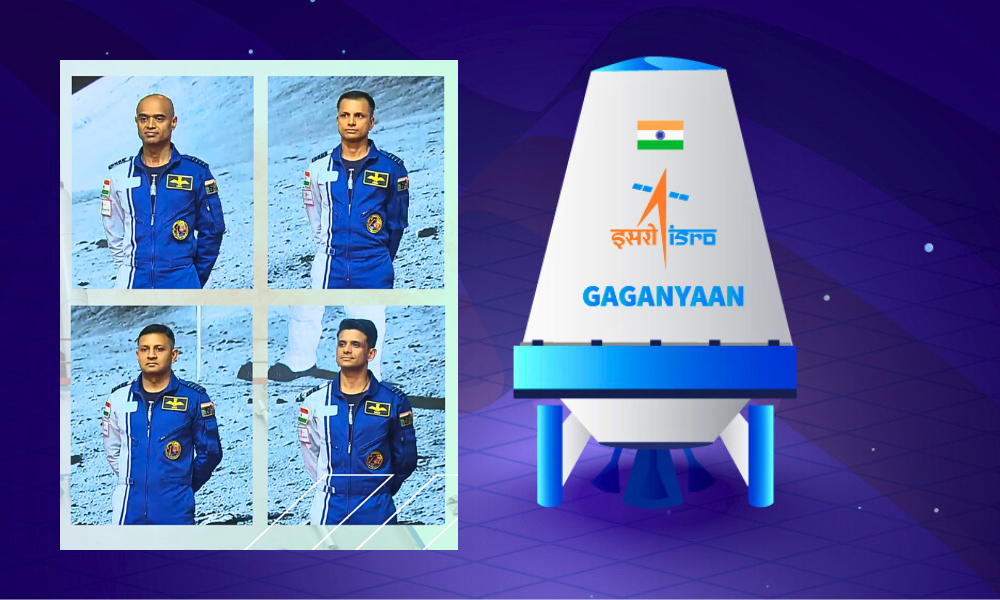
India has unveiled four Air Force pilots who have been shortlisted to travel on the country's maiden space flight — Gaganyaan — scheduled for next year.

During the inaugural ceremony held today at the Vikram Sarabhai Space Centre, Thiruvananthapuram, Hon'ble Prime Minister Narendra Modi unveiled the Indian Astronaut Logo and awarded the 'अंतरिक्ष यात्री पंख' to the four IAF Astronauts.

The four astronauts for the Gaganyaan mission to space are :
  • Group Captain Prashanth Nair
  • Group Captain Ajit Krishnan
  • Group Captain Angad Pratap
  • Wing Commander Shubhanshu Shukla
Indian Air Force (IAF) will be working in 'Mission Mode' along with the Indian Space agency ISRO to achieve the country’s ambitious goal of achieving its own manned Space Flight.

The Gaganyaan mission aims to send three astronauts to an orbit of 400km and bring them back after three days.

Officials said the men were selected from a pool of Air Force pilots and had undergone extensive physical and psychological tests before being shortlisted.

Prime Minister Narendra Modi and Isro chief S Somanath pinned badges with golden wings onto their shirts and Mr Modi described them as "India's pride".

ISRO's Next Mission Gaganyaan's First Trial in October

ISRO's Next Mission Gaganyaan's First Trial in October

Gaganyaan, India's first human space-flight mission ("Gagan" means sky in Hindi, "yaan" is craft), will have its first trial flight by the first or second week of October following the launch of first Solar Mission “Aditya-L1” on 2nd of September.

With Gaganyaan, ISRO plans to launch a crew of three members to an orbit of 400 km for a three-day mission before landing in Indian waters. The mission was planned for 2021, however it was delayed due to the lockdown imposed during the COVID-19 pandemic.

Earlier in a media interaction, S Somnath, chairperson of the Indian Space Research Organisation (ISRO) had told reporters that the mission would be conducted by September-end or October, for demonstration purposes.

"For Ganganyaan, ISRO will do a mission possibly by the end of September or October to demonstrate the crew module and crew escape capability. It will be followed by several test missions until the first manned mission is conducted, possibly by 2025," said the ISRO Chair. 

In the second trial, possibly beginning of next year, a female robot named “Vyommitra” will be onboard the Gaganyaan before the first human mission which may include up to three astronauts.

Four astronauts who have been selected for India’s first Human Space Flight Programme or the Gaganyaan. These selected-4 are test pilots in Indian Air Force, and till March this year, the astronauts have completed 39 weeks of training activities.

Gaganyaan - Astronaut Traikning Facility
Gaganyaan's Astronaut Training Facility
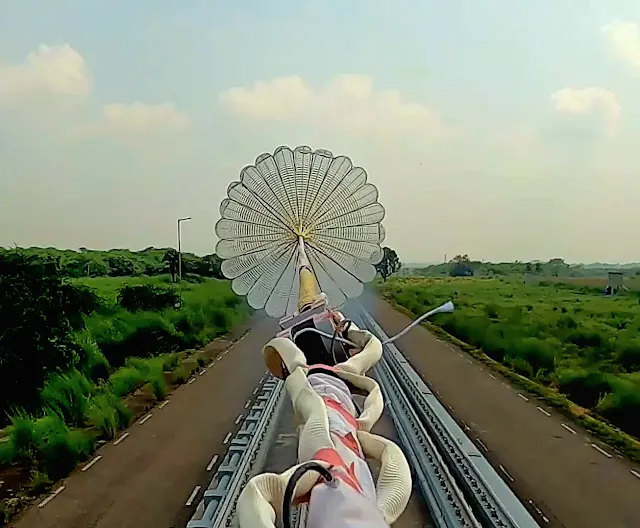
Early of last month, ISRO successfully conducted a series of Drogue Parachute Deployment Tests at the Rail Track Rocket Sled (RTRS) facility of the Terminal Ballistics Research Laboratory, Chandigarh.

Drogue Parachute Deployment Tests
Drogue Parachute Deployment Tests 

Drogue Parachute Deployment Tests
Drogue Parachute Deployment Tests 


The drogue parachutes are mortar-deployed conical ribbon-type parachutes with a diameter of 19 feet. The parachutes is a crucial part of getting the Gaganyaan crew (humans) module safely back to the ground, serving to stabilize the spacecraft and reduce its velocity during re-entry to Earth's atmosphere.

Gaganyaan

Gaganyaan crew module's deceleration system encompasses a total of 10 such parachutes.

In November last year, Vikram Sarabhai Space Centre, where many Gaganyaan activities were conducted, did a major development test "Integrated Main Parachute Airdrop Test, or IMAT" of its crew module deceleration system at the Babina Field Fire Range (BFFR) in the Jhansi district of Uttar Pradesh.

Early of last month, Union Minister of State (Independent Charge) Science & Technology, Dr Jitendra Singh, informed that all subsystems pertaining to Test Vehicle TV-D1 mission have been realized and the Crew module integration is completed, and the test of Gaganyaan, the maiden human space flight mission of India is planned in August/September 2023.

Gaganyaan: 1st Test Vehicle Mission for Validating Crew Escape System Planned in August/September 2023

Gaganyaan: 1st Test Vehicle Mission for Validating Crew Escape System Planned in August/September 2023
Static tests of all Crew Escape System motors have been completed as also Ground testing of Crew Module Propulsion system is completed and Training of crew (Astronauts) is nearing completion: Dr Jitendra Singh

The first Test Vehicle mission, for the validation of crew escape system for Gaganyaan, the maiden human space flight mission of India is planned in August/September 2023.

In a statement laid on the table of the Rajya Sabha, Union Minister of State (Independent Charge) Science & Technology, Dr Jitendra Singh, informed that all subsystems pertaining to Test Vehicle TV-D1 mission have been realized and the Crew module integration is completed.

The Minister also added that Static tests of all Crew Escape System motors have been completed as also Ground testing of Crew Module Propulsion system is completed. Training of crew (Astronauts) is nearing completion.

The objective of the Gaganyaan mission is to demonstrate the capability of conducting human space flight mission to Low Earth orbit (LEO) on-board Indian Launch vehicle. The Orbital module consists of a Crew module and a Service module. Crew module, which is a pressurized module, acts as living quarters for the crew. The orbital module will be positioned in ~ 400 km circular orbit around earth for 1 to 3 days & the Crew module will return back at the designated location in sea.

The other progress made for Gaganyaan programme is as follows:
  • 2nd Crew Module sub-assembly identified for uncrewed mission is completed and delivered by industry.
  • Orbital module preparation facility construction completed. Facility has been commissioned for integration activities of Test vehicle mission. Launch pad augmentation works for Gaganyaan are underway.
  • Recovery training plan by ISRO and Indian Navy & recovery training program commenced at Naval Dockyard, Visakhapatnam.
  • The delivery of human centric products for crew training commenced from various national labs. Testing of human centric products is underway.


ISRO Conducts Test in Jhansi for Safe Landing of Gaganyan Human Spaceflight

ISRO Conducts Test in Jhansi for Safe Landing of Gaganyan Human Spaceflight

People were surprised at Babina, a place near Jhansi, when two red-white parachutes from the sky were coming towards down to the earth with something heavy on it. There was also a light fog in the sky. When people came to know that it was a part of ISRO's Gaganyaan mission, they went and breathed a sigh of relief.

On Friday, Vikram Sarabhai Space Centre, where many Gaganyaan activities are progressing, conducted a major development test “Integrated Main Parachute Airdrop Test, or IMAT “ of its crew module deceleration system at the Babina Field Fire Range (BFFR) in the Jhansi district of Uttar Pradesh. This test marks a significant milestone toward realizing the nation's ambitious Gaganyaan project.

ISRO's crew escape module
The crew escape module

During the test, a 5 ton dummy weight was landed on the ground with the help of these parachutes. That is, it weighs as much as Gagnyan's crew module. IL-76 aircraft of the Indian Air Force ( Indian Air Force) were assisted for this test. The parachute was dropped from two and a half kilometers up. Two small pyro- based mortar pilot parachutes were missed during this test. After seven seconds, both main parachutes opened. This entire test was just 2 to 3 minutes.

For Gaganyaan Crew module, the Parachute system consists of a totally of 10 no. of parachutes. In flight, the parachute sequence starts with deployment of 2 Nos. of Apex cover separation parachutes (protection cover for the Crew Module Parachute compartment) followed by 2 Nos. of Drogue parachute deployment to stabilise & bring down the velocity.

Upon Drogue parachute release, 3 Nos. of Pilot chute will be used to extract 3 Nos. of Main parachute individually, to reduce the speed of the Crew module to safe levels during its landing. Two of the three main chutes are sufficient to land the astronauts on earth, and the third is redundant.

Each parachute's performance must be evaluated by complex testing methods using Rail Track Rocket Sled (RTRS) tests for smaller Parachutes and Aircraft/ Helicopters for the Main parachutes.

The Integrated Main Parachute Airdrop Test simulated the case when one Main parachute failed to open and it is the first in a series of tests planned to simulate different failure conditions of the parachute system before it is deemed qualified to be used in the first human spaceflight mission. In this test, a 5-ton dummy mass, equivalent to the Crew module mass, was taken to an altitude of 2.5 kilometres and dropped using the Indian Air force’s IL-76 aircraft. Two small pyro-based mortar-deployed pilot parachutes, then pulled the Main parachutes. The fully inflated Main parachutes reduced the payload speed to a safe landing speed as the entire sequence lasted about 2-3 minutes and the payload mass landed softly on the ground.

The design and development of the Parachute based Deceleration system for Crew module is a joint venture between Indian Space Research Organisation (ISRO) and the Defence Research and Development Organization (DRDO) and with this test, a significant milestone toward realizing the nation's ambitious Gaganyaan project is achieved with the active coordination between the country’s premier agencies, namely ISRO, DRDO, the Indian air force, and the Indian Army.


Market Reports

Market Report & Surveys
IndianWeb2.com © all rights reserved