Showing posts with label Construction Tech. Show all posts

CSIR-CBRI Hands Over 13 Breakthrough Technologies to Industries and Start-ups

CSIR-CBRI Hands Over 13 Breakthrough Technologies to Industries and Start-ups

On National Technology Day 2026, CSIR-CBRI Roorkee transferred 13 breakthrough indigenous technologies to industries and start-ups, strengthening India’s innovation ecosystem and advancing the vision of Aatmanirbhar Bharat.

CSIR‑CBRI (Central Building Research Institute), Roorkee, is India’s premier research institute dedicated to building science and technology, established in 1947 under CSIR. It develops innovative solutions for construction, housing, disaster mitigation, fire safety, and sustainable infrastructure.  

Event Overview

  • Occasion: National Technology Day, May 11, 2026
  • Organizer: Council of Scientific and Industrial Research (CSIR), New Delhi
  • Focus: Technology transfers by CSIR-Central Building Research Institute (CSIR-CBRI), Roorkee
  • Outcome: 13 indigenous technologies formally handed over to industries and start-ups
Speakers emphasized that these transfers highlight India’s growing research strength and its role in nation-building through technology-led growth and self-reliance.   

Key Technologies Transferred

TechnologyApplication AreaImpact
Fire-resistant transparent intumescent coatingWood & substitutesEnhances fire safety without compromising aesthetics
IPN coating technologyRCC structuresProtects reinforced concrete from corrosion & degradation
Low-carbon footprint brick manufacturingSustainable constructionReduces emissions, supports eco-friendly building
Hybrid solar-assisted heat pump systemEnergy efficiencyCuts energy costs, promotes renewable integration
Prefabricated high-strength steel cord reinforcementWall protectionImproves resilience of infrastructure against stress

These innovations target fire safety, green construction, and energy-efficient infrastructure, aligning with India’s sustainability goals.   

Leadership Insights

  • Prof. R. Pradeep Kumar (Director, CSIR-CBRI): Emphasized the significance of transferring indigenous technologies on National Technology Day.
  • Dr. Ajay Chaurasia (Programme Coordinator, CSIR-CBRI): Highlighted industry-oriented dissemination to accelerate innovation-led development.
  • Dr. N. Kalaiselvi (DG, CSIR & Secretary, DSIR): Stated that science and innovation are key drivers of India’s journey to becoming a developed nation.

Additional Highlights

  • Release of CSIR Smart Village Initiative video showcasing rural development and sustainable technologies.
  • Launch of Annual Report 2025–26 of CSIR-CBRI.
  • Vote of thanks by Dr. S. K. Panigrahi, followed by the National Anthem.

Strategic Significance

  • Nation Building: Strengthens India’s innovation ecosystem and supports Aatmanirbhar Bharat.
  • Sustainability: Promotes eco-friendly construction and energy-efficient solutions.
  • Industry Collaboration: Bridges research outputs with industrial applications.
  • Global Positioning: Positions India as a hub for affordable, indigenous, and socially relevant technologies.

Bessemer Leads $10M Seed in MeltPlan, Construction-Native AI Platform

Bessemer Leads $10M Seed in MeltPlan, Construction-Native AI Platform

MeltPlan, a pre-construction AI platform founded in 2025 announced its $10 Mn Seed funding led by Bessemer Venture Partners, with participation from noa. This brings the total funds raised by the company to $14 Mn. The funds will be used to further develop what it calls the “planning engine” for the $14 Tn construction industry, an AI system designed specifically to optimize decisions before construction begins. The funding will accelerate MeltPlan’s product development across code, cost, schedule, and value decision systems.

While design software optimizes use and aesthetics and construction software optimizes execution and control, MeltPlan is building the missing layer - software that optimizes decisions and tradeoffs upstream, before scope is locked, procurement begins, and change orders become inevitable.

Construction doesn’t fail because teams are not skilled or execute poorly,” said Kanav Hasija, Co-founder and CEO of MeltPlan. “It fails because preconstruction teams are fragmented and commit too early with incomplete information. We’re building an AI system that allows teams to evaluate constraints, run scenarios, and align before plans are frozen.”

Kanav, who previously co-founded a $3 Bn health tech startup Innovaccer to make healthcare in the US more affordable and accessible, is now focusing on making the construction industry more productive. He is joined by Tanmaya Kala, Co-founder and COO, a Stanford educated civil engineer who was project executive at DPR Construction handling large commercial, healthcare, and life science projects.

MeltPlan’s long-term goal is to help teams make construction “boring” by making planning more intense: surfacing constraints and tradeoffs early, aligning stakeholders before plans are frozen, and reducing the need for late-stage redlines, rework, and change orders. “Construction should be boring,” said Hasija. “Planning should be intense. If your construction phase is stressful, something went wrong earlier.”

Built environment workflows are full of irreversible decisions made under uncertainty,” said Pankaj Mitra, Partner at Bessemer Venture Partners. “MeltPlan is approaching preconstruction as a system, not a phase, building a visionary ‘planning engine’ layer that helps teams quantify tradeoffs early and reduce downstream volatility.”

MeltPlan is working with top enterprise contractors like DPR Construction in California and Innovo Group in UAE to help in their planning or preconstruction phase of construction.

An AI system designed for construction, not adapted to It

Unlike general-purpose AI tools adapted for construction, MeltPlan is building a construction-native AI system that is designed to understand building codes, materials, sequencing, procurement, and construction methods. The system has already scored 95% or higher on building inspector exams, and the company is working to expand its expertise across all trades and disciplines in construction planning.

The Planning Engine will have four integrated systems:
  • Code System: Context-aware compliance pathways for architects, engineers, and inspectors
  • Cost System: Risk-oriented takeoffs / quantity survey, bid scoping, and leveling for general contractor and trade contractor preconstruction teams
  • Schedule System: Scenario-based sequencing and what-if planning before scope freeze
  • Value System: Value impact analysis and optimization recommendations for owners and developers. 
Rather than digitizing existing workflows, MeltPlan aims to help teams simulate outcomes before committing to them.

“Preconstruction is treated like a phase,” Kala said. “But it’s actually the operating system of the project. When decisions evolve upstream, execution downstream becomes boring - and that’s a good thing.”

Bharat Nav‑Nirmaan Challenge 2025: NICMAR’s Nationwide Contest for Civil & Architecture Students

Bharat Nav‑Nirmaan Challenge 2025: NICMAR’s Nationwide Contest for Civil & Architecture Students

NICMAR, India’s premier and dedicated institution for Construction, Real Estate, Infrastructure and Project Management education (CRIP), has announced the launch of the Bharat Nav-Nirmaan Challenge, a nationwide initiative aimed at encouraging undergraduate students in solving real-world challenges linked to India’s built environment and nurture breakthrough ideas that can transform the country’s infrastructure landscape.

This one-of-a-kind challenge offers prizes worth Rs 30 lakh and is supported by the All India Council for Technical Education (AICTE). The Bharat Nav-Nirmaan Challenge is open to students in Final and Pre-Final year of civil engineering, architecture, planning and allied disciplines across Indian colleges and universities. Designed as a structured, multi-stage programme, it provides participants with an opportunity to apply their technical learning to practical infrastructure issues while gaining exposure to the academic and industry ecosystem that supports India’s infrastructure development.

Welcoming the Bharat Nav-Nirmaan Challenge as an opportunity for budding students to bring their creative and practical knowledge in one platform, Dr Tapash Kumar Ganguli, Director General (Interim), NICMAR said, “India is entering its most ambitious decade of infrastructure expansion and the demand for skilled problem-solvers with engineering foundations has never been higher. The Bharat Nav-Nirmaan Challenge is our commitment to empower young minds to be part of our nation’s future infrastructure story. India needs innovative thinkers and this platform gives students a meaningful starting point to explore their interests and contribute ideas that align with the country’s development priorities.”

With free registration, student groups comprising of three members (pre-final or final year students), can apply through their colleges. Interdisciplinary approach is encouraged with the requirement of at least two members from civil engineering, architecture or allied disciplines. Participating student groups must submit a brief concept outlining their solution to an infrastructure-related problem.

The Challenge follows five structured stages, College-Level Round, Online Submission Round, City Finale, Regional Finale, and the Grand Finale which will be held in Mumbai. One winning team per college qualifies for the next round, where selected teams enter a national pool to submit detailed proposals. These proposals will form the first layer of evaluation for the jury. This is followed by the City Finales, hosted across key urban centres, where winners will progress to Regional Finales, hosted at NICMAR campuses in Pune, Hyderabad, and Delhi-NCR. One regional winner from each region will participate in the National Grand Finale in Mumbai.

The winners of the Bharat Nav-Nirmaan challenge will receive exciting set of rewards such as infrastructure excellence tour to Dubai, MacBooks, VR headsets, drone trophies and more.

Throughout the contest, participants will gain access to mentorship from NICMAR experts, workshops with engineers, planners, and innovation leaders. Submissions may focus on areas such as construction technology, sustainability, digital construction, mobility, housing, or urban development. Shortlisted teams will be paired with NICMAR faculty and industry mentors to refine their ideas and strengthen feasibility.

EPACK Prefab Raises $20 Mn from GEF Capital Partners

EPACK Prefab Raises $20 Mn from GEF Capital Partners

Funding marks a pioneering backing in this sustainable construction segment in India from a leading global climate focused Fund

EPACK Prefab, one of India’s leading turnkey solution providers for pre-engineered building (PEB), pre-fabricated modular structures and insulation products, today announced raising USD 20 million in its first funding round from GEF Capital Partners, a leading global private equity fund.

The funding supports EPACK Prefab’s commitment to sustainability in the modular construction sector. These technologies entail significantly lower carbon footprint than traditional construction on account of higher design efficiency, minimal wastage and recyclable nature of materials.

This infusion of capital is set to strengthen Company’s manufacturing capabilities at its advanced facilities in Greater Noida, Ghiloth (Rajasthan), and Mambattu (Andhra Pradesh), which collectively have an annual production capacity over of 133,924 metric tonnes. The funds will be used for capex expansion and drive growth initiatives by enhancing production capabilities, accelerating new product development, and expanding presence across the country. Additionally, the funds will be directed toward enhancing research and development initiatives aimed at creating energy-efficient, prefabricated construction technologies.

EPACK Prefab has set a new industry benchmark by constructing India's fastest building in just 150 hours, showcasing the power of prefabricated construction. Having already delivered thousands of projects, EPACK has developed strong brand equity in the industry through its design and engineering capabilities, high-quality manufacturing, timely execution, and project management expertise. The Company also plans to expand its market presence across India and explore opportunities in international markets, further cementing its position as a pioneer in the PEB sector.

Commenting on the first round of funding, Mr. Sanjay Singhania, Managing Director of EPACK Prefab, said, "This funding is a testament to our vision and the capabilities of Prefabrication and PEB technologies. It strengthens our resolve to revolutionize construction practices by delivering innovative, sustainable, and rapid building solutions. This milestone energizes us to set new benchmarks for the industry."

Mr. Nikhel Bothra, Executive Director of EPACK Prefab, added, "We are thrilled to have the support of a global climate fund as we continue to lead the transition towards sustainable construction practices through prefabricated and PEB solutions. This funding empowers us to invest further in cutting-edge technologies and expand our footprint while maintaining a strong focus on sustainability."

Mr. Krishnan Ganesan, Managing Director at GEF Capital Partners said, “Modular construction technologies play a key role in decarbonization of the construction sector with their lower GHG footprint and higher climate resilience. We are excited to partner with EPACK Prefab in their effort to catalyse sustainable practices in the construction industry through their offerings.”

President Inaugurates L&T Skill Training Hub in Her Hometown in Odisha To Upskill Tribal Youth

President Inaugurates L&T Skill Training Hub in Her Hometown in Odisha To Upskill Tribal Youth

The Honourable President of India, Smt Droupadi Murmu, today inaugurated the L&T Skill Training Hub at her hometown Pahadpur, Mayurbhanj in Odisha. The historic event was also graced by Ms Meena Subrahmanyan, President of Prayas Trust - an L&T-funded non-profit organisation, along with senior officials of L&T and the Odisha-based non-profit SLS Trust. The historic event was also graced by Ms Meena Subrahmanyan, President of Prayas Trust - an L&T-funded non-profit organisation, along with senior officials of L&T and the Odisha-based non-profit SLS Trust.

L&T, in collaboration with SLS Trust, has established the Skill Training Hub across a land parcel of five acres. The state-of-the-art facility was completed in a remarkable five-month timeframe and aims at providing underprivileged youth in the region with training in construction skills, thus enabling them to become self-reliant. SLS Trust, led by its President, Ms Itishree Murmu, has been instrumental in creating opportunities for the marginalised sections of society.


Commenting on the launch of project, Ms Meena Subramanyan, President of Prayas Trust said, “This training center will enable candidates to fully focus on learning and developing their skills in an enabling environment with a strong focus on life skills and personality development. We believe that empowering the underprivileged youth through accessible skill training is not just an investment for their future but a promise of a brighter and more inclusive tomorrow.”

The project, which includes operations and maintenance, is a significant opportunity for the tribal youth in the area, connecting them with opportunities beyond their immediate surroundings.

Complementing her comment, Ms Mabel Abraham, Joint General Manager - Corporate Social Initiatives, L&T, said: “Transforming dreams into opportunities, L&T is dedicated to making a lasting impact by equipping underprivileged youth with valuable skills. Our commitment to empower these young individuals is a testament to our vision for a more promising and inclusive society.”

The Skill Training Hub is equipped with contemporary infrastructure, featuring an administrative-cum-institute building, a multipurpose hall, an e-learning hall, a digital training room, separate hostels for both boys and girls (each accommodating 120 individuals), dining facilities, practice yards for various trades, and a dedicated workshop for learning pipe welding.

Additionally, the training center is equipped with state-of-the-art simulators with AR/VR technology to enhance the learning experience.

World's 1st 3D Printed Place of Worship Being Built in Telangana

Apsuja Infratech and Simpliforge Creations collaborate to build this one-of-its-kind architectural innovation positioning India as a global pioneer in 3D printed architecture.

Apsuja Infratech, a Hyderabad-based leading construction company has joined forces with Simpliforge Creations, an innovative 3D printed Construction Company, to achieve a remarkable feat in architectural innovation - the creation of the world's first 3D printed place of worship. The 3D printed temple resonates the pride of Telangana as it set to embark an architectural revolution in the nation.

World's 1st 3D Printed Place of Worship Being Built in Telangana
Situated within Charvitha Meadows, at Burugupally, Siddipet, Telangana the 3D printed temple serves as a testament to the harmonious integration of technology and nature with sustainability.

With this radical achievement, Apsuja Infratech and Simpliforge Creations have not only carved a niche for themselves in the construction industry but have also positioned India as a global pioneer in 3D printed architecture.

The groundbreaking three-part structure marvel, a Hindu temple, sprawling over an impressive 3,800 sq.ft, standing tall at about 30 feet is a unique architectural wonder, a one-of-its-kind innovation being built in Telangana. The three sanctums, or Garbhas within the structure represent a 'Modak' (a fig shaped delicacy) dedicated to Lord Ganesha, a Shivalay, a square abode devoted to Lord Shankar, and a Lotus shaped home for Goddess Parvati. The Structure is 3D printed by Simpliforge with their in-house developed system and indigenously developed material and software. This by far is the first 3D printed structure globally as a place of worship at this massive scale.

World's 1st 3D Printed Place of Worship Being Built in Telangana

World's 1st 3D Printed Place of Worship Being Built in Telangana

This landmark achievement not only showcases the immense potential of 3D printed construction but also demonstrates the architectural freedom and capabilities of the robotic arm system developed by Simpliforge team. “Completely printed on-site, the temple's striking dome-shaped structures including the Modak and the Lotus, presented formidable challenges that required the team to employ bespoke design techniques, meticulous analysis, and innovative construction methods, all the while following the principles of Temple architecture resulting in this awe-inspiring architectural marvel.” Said Mr. Hari Krishna Jeedipalli, MD, Apsuja Infratech.

“With the Shivalay and the Modak construction completed, phase II comprising of the Lotus and the tall spires (Gopurams) are already underway.” added Mr. Hari.

Simpliforge Creations, a leading turnkey solutions provider in 3D printed construction, has hailed this project as a testament to the possibilities within the industry. “This structure demonstrates Simpliforge’s ability to print 51º and 32º in outward and inward cantilever, respectively, especially while printing in-situ catering to the architectural/aesthetic requirements. This construction takes care of the structural requirements, principles of temple design, 3d printing requirements, while dealing with the challenges of in-situ construction. This proof of concept also sets the stage for future applications of Simpliforge's robust systems in inaccessible areas like frontiers, high altitude areas, desserts and snowy regions with applications in challenging terrain, disaster hit areas and defence applications.” Said Mr. Dhruv Gandhi, CEO, Simpliforge Creations. “The enclosed dome shaped structures eliminating the need for flat slab roofs paves the way for extra-terrestrial applications which is Simpliforge’s grander vision.”

The world's first 3D printed place of worship stands as an awe-inspiring testament to the harmonious union of human creativity, technological prowess, and architectural finesse. Having also delivered India’s first 3D printed bridge prototype at Charvitha Meadows previously, the 3D printed temple now adds a Global First to the crown of feats at this project.

Construction Tech Startup projecthero Launches Wage Discovery Feature That Allows Construction Workers to Fight for Pay Transparency

Construction Tech Startup projecthero Launches Wage Discovery Feature That Allows Construction Workers to Fight for Pay Transparency

Construction tech startup projecthero has launched a wage discovery feature in its app for workers. The feature, which allows workers to discover if they are being paid more or less than the average salaries in their fields, will ensure pay transparency and prevent wage exploitation in the construction industry. This is part of projecthero’s initiatives to build a membership driven professional network for the construction industry.

The construction industry is highly fragmented and unstructured, which enables the higher-ups in the industry to exploit workers by providing them with below-average and, often, below-minimum wages. Due to poor technological penetration, workers have to find employment through informal means, which leads to opacity regarding compensation amounts. projecthero’s in-app wage discovery feature enables workers to make sure that they are not being exploited by being paid below-average and below-minimum wages. Such transparency will also enable workers to understand and recognise the value of their work and prevent them from falling prey to fraudulent and corrupt recruitment practices.

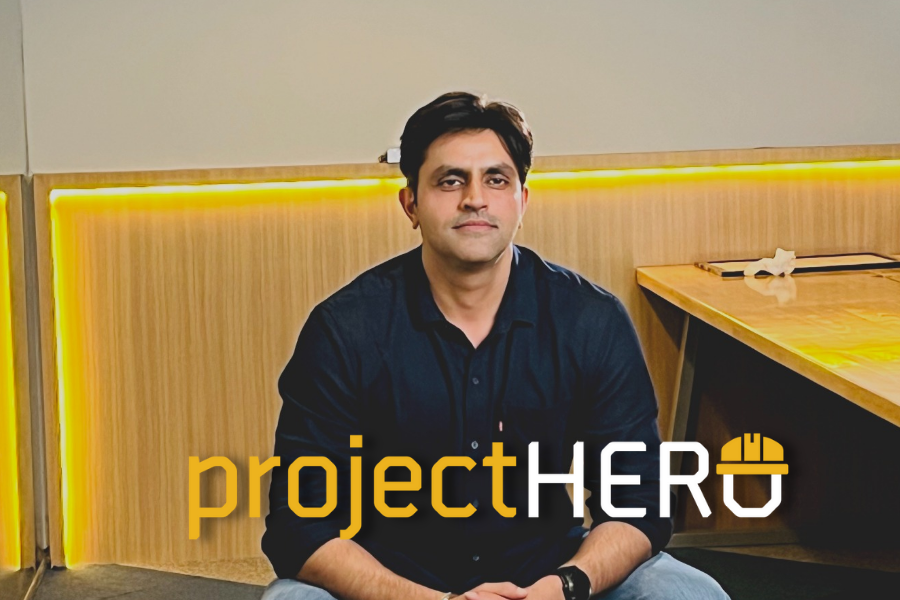
Satya Vyas, CEO & Founder, projecthero
Satya Vyas
Satya Vyas, Founder and CEO of projecthero, said, “Urban organised workforces have various ways of discovering the average salaries in their fields. Gig workers are also aware of their colleagues’ salaries, as they have fixed compensation amounts. With pay transparency, employees can achieve a better standard of living, as they will know if they are being exploited and not being paid optimal salaries. Hence, we thought that developing a feature to prevent wage-based exploitation and wage discrimination in the unorganised construction industry will help blue-collar workers understand their worth and fight for it.”

According to the average salary metrics released by projecthero, 2,308 users have interacted with the average salary discovery feature, and in total, it has been viewed 7.1 K times. This implies an average viewership of 3.2 times per user. Moreover, with regard to workers being paid the minimum salary, in Uttar Pradesh, 79.9% of jobs pay below-minimum wage, and 815 users have been informed of this. In Maharashtra, 68.6% of jobs pay less than minimum wage, and 268 users have been made aware of this, and in Madhya Pradesh, 93.75% of jobs pay less than minimum wage, with 264 users having been informed about this.

The statistics show that Maharashtra has the highest number of users who have checked whether they are being paid more than the minimum wage. Conversely, Madhya Pradesh has the lowest number of users who have checked whether they are being paid the minimum wage, even though it has the highest percentage of jobs paying less than the minimum wage.

Previously, in January 2023, projecthero revealed that 87% of construction workers in India do not receive the government-mandated daily minimum wage. This was found to be true for the major cities of India (Delhi NCR, Mumbai, Bengaluru, Hyderabad, Chennai, and Pune). projecthero’s introduction of the wage discovery feature is in keeping with its goals to build a professional network for the construction industry and make the construction industry more organised, formalised, and ethical.

About projecthero

projecthero is a membership-driven professional network for the construction industry, which provides access to jobs, orders, financial services, etc. to its members. Currently, projecthero has more than 4 lakh construction workers on their platform and has placed over 3000 workers in projects. projecthero was founded by Satya Vyas, Pukhraj Grewal, Raghu Chopra, and Sidhant Panda – all IIT Roorkee graduates.

Since the fundraise of $3.2Mn from Ankur Capital and Omidyar Networks, projecthero’s team has continued to expand and grow, with IIT Roorkee graduate Sidhant Panda (ex-Google) joining the team as Co-founder and CTO.

Market Reports

Market Report & Surveys
IndianWeb2.com © all rights reserved