Showing posts with label 3D printing technology. Show all posts

India's 1st 3D Printed Post Office Opened in Bengaluru


India's first post office constructed using 3D printing technology and robotic arm was inaugurated in Bengaluru on Friday by IT and Communications Minister Ashwini Vaishnaw.

Completely constructed in just 43 days, the 3D printed Post Office building is of 1021 square feet size and costed 2.6 million rupees ($31,249 approx.), which is 40% less than the conventional construction expcenditure.

Inaugurating the brand new post office at the residential Cambridge Layout area of Bengaluru, Union Minister Ashwini Vaishnaw said the building demonstrated “the spirit of development, the spirit of developing our own technology, the spirit of doing something which was considered impossible in the earlier times.”

The 3D printing construction was done by Larsen & Tubro with technical guidance from IIT Madras, which is known for its innovations to have built India's 1st 3D Printed Structure and first 3D printed house in 2018 and 2021 respectively.

“Having a 3D-printed concrete building constructed on site is a great initiative. This is a technology demonstrator. IIT Madras has done fabulous work on this. When this technology will become mainstream, we will see more such initiatives taking this technology forward,” Vaishnaw told reporters.

Prime Minister Narendra Modi also hailed the 3D printed Post Office. In a post on X (formerly Twitter), the Prime Minister said: “Every Indian would be proud to see India’s first 3D printed Post Office at Cambridge Layout, Bengaluru. A testament to our nation’s innovation and progress, it also embodies the spirit of a self-reliant India.”

Earlier, a couple of months back, Apsuja Infratech, a Hyderabad-based leading construction company, along with Simpliforge Creations, a 3D printed Construction startup, achieved a remarkable feat in architectural innovation - the creation of the world's first 3D printed place of worship — A 3D printed temple.

World's 1st 3D Printed Place of Worship Being Built in Telangana

Apsuja Infratech and Simpliforge Creations collaborate to build this one-of-its-kind architectural innovation positioning India as a global pioneer in 3D printed architecture.

Apsuja Infratech, a Hyderabad-based leading construction company has joined forces with Simpliforge Creations, an innovative 3D printed Construction Company, to achieve a remarkable feat in architectural innovation - the creation of the world's first 3D printed place of worship. The 3D printed temple resonates the pride of Telangana as it set to embark an architectural revolution in the nation.

World's 1st 3D Printed Place of Worship Being Built in Telangana
Situated within Charvitha Meadows, at Burugupally, Siddipet, Telangana the 3D printed temple serves as a testament to the harmonious integration of technology and nature with sustainability.

With this radical achievement, Apsuja Infratech and Simpliforge Creations have not only carved a niche for themselves in the construction industry but have also positioned India as a global pioneer in 3D printed architecture.

The groundbreaking three-part structure marvel, a Hindu temple, sprawling over an impressive 3,800 sq.ft, standing tall at about 30 feet is a unique architectural wonder, a one-of-its-kind innovation being built in Telangana. The three sanctums, or Garbhas within the structure represent a 'Modak' (a fig shaped delicacy) dedicated to Lord Ganesha, a Shivalay, a square abode devoted to Lord Shankar, and a Lotus shaped home for Goddess Parvati. The Structure is 3D printed by Simpliforge with their in-house developed system and indigenously developed material and software. This by far is the first 3D printed structure globally as a place of worship at this massive scale.

World's 1st 3D Printed Place of Worship Being Built in Telangana

World's 1st 3D Printed Place of Worship Being Built in Telangana

This landmark achievement not only showcases the immense potential of 3D printed construction but also demonstrates the architectural freedom and capabilities of the robotic arm system developed by Simpliforge team. “Completely printed on-site, the temple's striking dome-shaped structures including the Modak and the Lotus, presented formidable challenges that required the team to employ bespoke design techniques, meticulous analysis, and innovative construction methods, all the while following the principles of Temple architecture resulting in this awe-inspiring architectural marvel.” Said Mr. Hari Krishna Jeedipalli, MD, Apsuja Infratech.

“With the Shivalay and the Modak construction completed, phase II comprising of the Lotus and the tall spires (Gopurams) are already underway.” added Mr. Hari.

Simpliforge Creations, a leading turnkey solutions provider in 3D printed construction, has hailed this project as a testament to the possibilities within the industry. “This structure demonstrates Simpliforge’s ability to print 51º and 32º in outward and inward cantilever, respectively, especially while printing in-situ catering to the architectural/aesthetic requirements. This construction takes care of the structural requirements, principles of temple design, 3d printing requirements, while dealing with the challenges of in-situ construction. This proof of concept also sets the stage for future applications of Simpliforge's robust systems in inaccessible areas like frontiers, high altitude areas, desserts and snowy regions with applications in challenging terrain, disaster hit areas and defence applications.” Said Mr. Dhruv Gandhi, CEO, Simpliforge Creations. “The enclosed dome shaped structures eliminating the need for flat slab roofs paves the way for extra-terrestrial applications which is Simpliforge’s grander vision.”

The world's first 3D printed place of worship stands as an awe-inspiring testament to the harmonious union of human creativity, technological prowess, and architectural finesse. Having also delivered India’s first 3D printed bridge prototype at Charvitha Meadows previously, the 3D printed temple now adds a Global First to the crown of feats at this project.

Samsung Electronics Unveils its New Odyssey, ViewFinity and Smart Monitor Lineups at CES, Igniting the Next Generation of Display Technology

Samsung Electronics Unveils its New Odyssey, ViewFinity and Smart Monitor Lineups at CES, Igniting the Next Generation of Display Technology

The Odyssey Neo G9’s groundbreaking dual UHD 57” curved display paves the way for monitors in 2023 and beyond

Samsung Electronics Co., Ltd. today announced the company will introduce new models in its monitor lineup, expanding its visual display leadership for the users.

New offerings in the Odyssey, ViewFinity and Smart Monitor lineups at CES® 2023 will deliver unmatched image quality and a range of innovative features for people looking to work, play and live through their monitor display.

Samsung is revolutionizing the ultra-wide display category by launching the Odyssey Neo G9, the world’s first single monitor with dual ultra-high definition resolution. This innovation is a testament to Samsung’s industry-leading position in delivering the most immersive and lifelike gaming experience available on the market.

We are introducing the future of gaming monitors with our Odyssey Neo G9, making each game more lifelike with innovative features and picture quality on a new scale,” said Hoon Chung, Executive Vice President of Visual Display Business at Samsung Electronics. “CES is the perfect place to showcase our innovations that can take not only gamers, but also graphic designers or TV fans to the next level, while providing personalized experiences across a range of integrated smart apps.”

Odyssey Neo G9: The World’s First Dual UHD Gaming Monitor

Odyssey Neo G9
The Samsung Odyssey Neo G9 Gaming Monitor (Model Name: G95NC) lets gamers see new levels of detail with an unparalleled field of view. The gaming monitor delivers 7,680×2,160 resolution and a 32:9 aspect ratio in one screen for the first time.

Its 1000R curved 57” screen uses quantum mini LED technology with VESA Display HDR 1000 specification to deliver superi imaging in any game environment, from shadows to bright scenes. The Matte Display reduces light reflection on the screen, minimizing distractions during the most intense gaming sessions.

Odyssey Neo G9
Odyssey Neo G9 57 inch – pers View

It also boasts the world’s first DisplayPort 2.1 support, which transfers data approximately twice as fast as the previously used DisplayPort 1.4. In addition, the new DP2.1 allows lossless industry-standard Display Stream Compression (DSC) to transmit information without distortion.

The Odyssey Neo G9 also supports a refresh rate of 240Hz, so that gamers will not miss a thing during fast-paced gameplay.

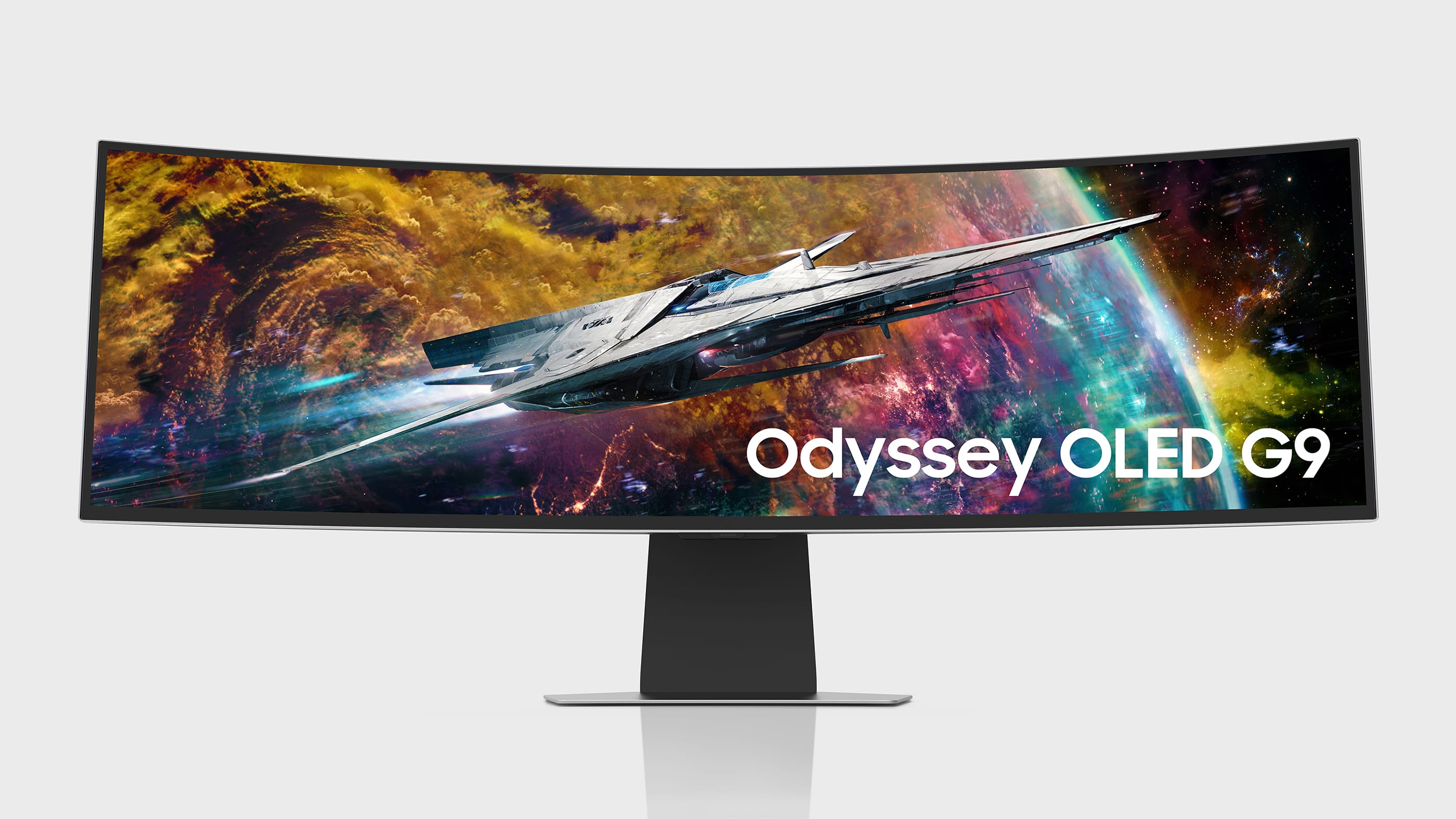
Odyssey OLED G9: Brighter Whites, Deeper Blacks, and Near Infinite Color Contrast, 

Odyssey OLED G9
Odyssey OLED G9 — Front

Odyssey OLED G9
Odyssey OLED G9 G95SC Rear

The Odyssey OLED G9 (Model Number: G95SC) is the latest addition to the Odyssey lineup, featuring a dual quad-HD 49” 1800R curved display, with a 32:9 ratio. Its quantum dot technology OLED lighting is controlled pixel-by-pixel, allowing a near-infinite color contrast ratio.

The OLED screen illuminates each pixel separately and does not rely on a backlight, allowing a 1,000,000:1 dynamic contrast ratio while delivering true RGB and true black without color filters.

For smooth gameplay, the Odyssey OLED G9 also features a 0.1ms response time and 240Hz refresh rate to eliminate lagging and skipping.

The Odyssey OLED G9 also uses apps from partners like Prime Video, Netflix and YouTube through Smart Hub, which allows users to enjoy various over-the-top content using an Internet connection, without the need for a PC.

It is also equipped with Samsung Gaming Hub, an all-in-one game streaming platform that allows gamers to discover and play games in the cloud from partners such as Xbox and NVIDIA GeForce Now, without needing a console or to download games.

ViewFinity S9: Smart Color Calibration Designed for Creative Professionals

ViewFinity S9 S90PC Front Portrait
ViewFinity S9 PC – Front Portrait

The ViewFinity S9 (Model Number: S90PC) is Samsung’s newest addition to its monitor lineup. It features a 5K 27” screen for the first time and is optimized for creative professionals such as graphic designers and photographers. Its 5,120 x 2,880 resolution combined with its wide color gamut of 99% DCI-P3, provides crisp and true-to-form details, and its average Delta E ≦ 2 color accuracy also produces clear and precise color representation, even in complicated or nuanced visual environments.

ViewFinity S9 S90P — Front Landscape with Camera

The monitor’s built-in Color Calibration Engine ensures precise screen color and brightness, allowing users to adjust white balance, Gamma and RGB color balance for perfect accuracy with their smartphones through the Samsung Smart Calibration application. The Matte Display limits light reflection and glare to minimize distractions while working.

Users can connect cameras and other devices to the monitor through USB-C and Thunderbolt 4 connections to easily transfer gigantic files of high-resolution video or other large data sets from storage devices to their PC. The ViewFinity S9 Series comes with a 4K SlimFit camera and supports native video conferencing through apps such as Google Meet that are included in the Samsung Smart Hub.

Smart Monitor M8: Bringing Productivity, Entertainment and Personal Life Together

Smart Monitor M8

The Smart Monitor M8 (Model Number: M80C) features stylish and slim design and now comes in a new 27” size in addition to the existing 32” size, both with 4K resolution. It comes in fou  options that allow this monitor to fit in any room: Daylight Blue, Spring Green, Sunset Pink, or Warm White.

The height-adjustable stand with tilt support gives users the best angle. The screen can now pivot 90 degrees, which helps users view long documents with less scrolling. It also meets VESA mount compatibility standards to help save space and retain a clutter-free environment.

The Smart Monitor M8 can connect, control, and manage hundreds of compatible connected devices through the built-in SmartThings Hub, including lights, cameras, doorbells, locks, thermostats, and more. Samsung plans to expand device choices and usability by supporting Matter functionality and Home Connectivity Alliance standards from this year onwards

Mouse control functionality has been added to many of the Smart Monitor’s over-the-top apps, including SmartThings and the Smart Hub, for a new level of convenient control without a remote.

Users can use the Smart Monitor M8 to get instant access to Prime Video, Netflix, YouTube and other over-the-top services through Smart Hub. They can also easily access Samsung Gaming Hub, the all-in-one game streaming platform.

The new My Contents feature provides users with helpful information at a glance. When the monitor is on standby mode and detects a registered smartphone through low-power Bluetooth, it shows the user’s personalized photos, schedule and more on the screen. The monitor returns to standby mode when the phone moves out of range.

The integrated SlimFit camera in the Smart Monitor M8 has been upgraded with 2K resolution and works with video conferencing apps such as Google Meet.

In addition, the Smart Monitor M8 is also protected by Samsung Knox Vault, which encrypts personal data and keeps stored files and information isolated from the device’s main operating system to safeguard it from attacks.

About Samsung Electronics Co., Ltd.

Samsung inspires the world and shapes the future with transformative ideas and technologies. The company is redefining the worlds of TVs, smartphones, wearable devices, tablets, digital appliances, network systems, and memory, system LSI, foundry and LED solutions. For the latest news, please visit the Samsung Newsroom at news.samsung.com.

Soon A 3D Printing Lab and A Centre for Additive Manufacturing, in Telangana

Soon A 3D Printing Lab and A Centre for Additive Manufacturing, in Telangana

Telangana government is setting up of a lab exclusively for 3D printing, and a National Centre for Additive Manufacturing (NCAM). This was announced by Telangana Industries Minister K.T. Rama Rao while inaugurating the maiden national conference of 3D Printing in Medical Devices & Implants at the Hyderabad International Convention Centre (HICC) here on Friday.

3D printing and Additive Manufacturing are synonyms for the same process. Both terms reference the process of building parts by joining material layer by layer, from a CAD (Computer Aided Design) file, to form a geometric 3D objects with little waste.

While 3D Printing Lab will be set up in the new block of T-Hub, an India's largest incubation facility, the NCAM will be set up wihtin the university campus of Osmania University.

Mr. K.T Rama Rao, said, "T-works that has been using 3D printing for their prototyping efforts. Through all these efforts, Telangana intended to leverage the potential of 3D printing to get a jump start at this hugely promising sector and it is with this intent we established NCAM and conducted this key conference."

Manufacturing using 3D Printing is much faster compared to conventional manufacturing technologies. Many manufacturers use 3D printing or additive manufacturing technologies to produce airplane parts, prosthetic limbs, and even 3D-printed medications.

Advances in medical 3D printing technology have made splendid contributions to fields throughout healthcare. Recent Innovations that applied 3D Printing technologies include creating tissues and organoids, surgical tools, patient-specific surgical models and custom-made prosthetics.

One of the futuristic 3D Tech where India is still in nascent stage is — 3D Bioprinting, an extended application of additive manufacturing, which is now being used globally for tissue engineering and regenerative medicine as it involves the top-down approach of building the complex tissue in a layer by layer fashion. 3D Bioprinting has been used in varied fields from integration of live cells to biosensors and from stem cell fabrication to artificial organ generation.

In India, there are few government and private 3D Printing labs. National Institute of Electronics & Information Technology (NIEIT) has a state of the art 3D printing lab in Aurangabad, Maharashtra.

Last year in April, IIT-Madras incubated startup, Tvasta, built India’s first 3D printed house using concrete as 3d printing material.

IIT Madras Almuni Startup Constructs India's 1st 3D Printed Structure

Bangalore-based Tvasta Manufacturing Solutions (Tvasta), an emerging 3D Printing startup founded by Indian Institute of Technology, Madras (IIT-Madras) alumni, has developed India's first 3D Printing Construction Technology and have successfully built India's first 3D Printed Structure.

Tvasta, along with Civil Engineering Department, IIT Madras has constructed India’s first 3D room module in IIT Madras campus and this prototype structure will serve as a base foundational model for accelerating R&D and testing in the startup's ambitious plan of making affordable sanitation and affordable housing a reality in India.

India’s first 3D room module developed by Tvasta

Additionally, the startup and IIT Madras' Civil Engineering Department have together established a one-of-a-kind 3D printing laboratory - the IIT Madras Printability Lab, in order to formulate technological solutions for construction sector and take its indigenously-developed 3D Printing construction technology to the mass market.

Professor Manu Santhanam, Department of Civil Engineering, IIT Madras, who has been working with the Tvasta team, said, "3D printing of concrete gives a new dimension to construction. This technology can best meet the complex demands of modern architecture with concrete. The use of a combination of binders and optimally proportioned and sized aggregates, along with suitable chemical additives, the concrete mixture is fine tuned to achieve the rheological characteristics that make it possible for extrusion of the material and shape retention after placement."

Founded in 2016, by IIT-Madras alumni Adithya VS, Parivarthan Reddy, Santhosh Kumar and Vidyashankar C, Tvasta is aiming to completely automate construction, including placement of reinforcements and finishing, by re-envisioning the construction process.

Talking about their plans, Mr Adithya VS, Co-founder of Tvasta said, "Tvasta will be building India's first 3D printed house within the next one year. The impact of 3D printing in construction will be primarily focussed towards the 'Housing for All' scheme under the Pradhan Mantri Awas Yojana and Construction of Toilets for the 'Swachh Bharat Abhiyan'. Tvasta is working withmultiple stakeholders in the Construction Industry to make 3D Printing technology suitable and viable for the Indian construction industry."

The founding team of Tvasta see a lot of potential in the high-end Industrial 3D Printing market and also see a lot of potential for pushing the boundaries of the possibilities using 3D Printing technology. The startup also have proprietary 3D printers that are entirely designed and manufactured in-house.

Besides application of 3D Printing in construction industry, the startup is also working on 3D Bio-Printers to design, print and control living cell structures such as plant cells and hydrogels. The startup infact is working on designing, developing and manufacturing 3D Printing tech for various domains including manufacturing and aerospace industry.

IIT Madras is collaborating with several government agencies and industry to disseminate knowledge and establish standards, policies and processes to bring these technologies to the field.

Source - NDTV

Image Credits - Twitter.com/Tvasta_3DP

Indian Hospitals Are Fast Adopting 3D Printed Body Parts For Second Lives

Earlier in the month, we reported how the field of 3D manufacturing in India is gearing up to have a golden period in the times ahead. And now, the country has finally entered the age of 3D printed body parts.

Recently, a team of doctors from Gurgaon's Medanta successfully performed a surgery on the failing spine of a woman and inserted a 3D printed titanium implant giving the 32-year-old teacher a completely new life.

Not only was the surgery successful, the teacher who is also a dancer and singer by passion was able to walk on her feet miraculously just four days after the heavy surgery. According to doctors, if the surgery would have involved traditional surgical techniques, the patient would have taken several months to walk.

Till last month, talking and walking, the two human bodily movements that human beings take for granted, were a herculean task for the patient. After the TB bug slowly consumed the second and third vertebra in her neck, it had slowly started collapsing. In addition to this, her spinal cord had also started getting compressed, resulting in her losing sensation on all her limbs. All this made her day-to-day life a very difficult one to survive.

This is when a team of 10 health specialists from Medanta came to her rescue and decided to deploy for the very first time in India a custom made ultra-modern 3D printed titanium implant to replace the two infected vertebra in her neck in a surgery that spanned over ten hours. A similar surgery has been attempted once last year in Australia and last to last year in China.

According to the team of specialists, the other option that they were considering was to use a piece of bone from the patient's own leg but that particular method would have kept her in the bed for more than 6 months after the surgery. But when they presented the patient with both the options, she courageously decided to go with the 3D one.

"We did the body part reconstruction with a 3D printed vertebra in a damaged spine of a patient who was getting quadriplegic. This was done for the first time in the country and probably for the third time in the world," said lead surgeon Dr V Anand Naik in a statement.

By making use of x-rays and high resolution Cat-scans, a virtual 3D computer model was prepared of the damaged part of the patient's spine. The next step involved designing a suitable replacement on the computer, which was then sent to a 3D printer in Bareilly, India where the titanium implant was specifically made for the patient layer by layer using lasers.

According to details made public by Medanta, the 3-cm-long specially designed medical metal cage was made with 154 grams of high-grade titanium and costed under one lakh rupees. Finally, this cage placed between the head and the torso of the patient relieving pressure on her spinal cord.

Dr Rahul Jain, lead designer of the 3D implant at Medanta said, "Actually it was quite difficult to design this implant because of the complex anatomy of the spine. Titanium implants are totally safe, as these are bio-compatible and it was also made sure that it would not impinge on the spinal cord."

The surgery can definitely be considered as a big step towards using innovation to help patients in India. According to experts, using regular implants can prove to be extremely challenging in some cases as the bones of the patient have to be manipulated in order to ensure that the implant fits perfect. But now, by making use of this 3D technology, the bone implant can be custom-made for the patient

3D Printing and Advanced Manufacturing in India To Rise in 2017

The field of 3D manufacturing in India is gearing up to have a golden period in the times ahead. UAE-based advanced composite aerostructures manufacturing company Strata has recently entered into a Memorandum of Understanding (MoU) with India's Reliance Defence Limited (RDL) to work together on advanced capabilities for aerospace manufacturing.

The agreement signed between the two will not only be looking into exploring opportunities in 3D printing aerospace components and producing carbon fiber composite aerostructures, but will also be aiming to further strengthen the economic and political bilateral ties between the two nations.

Strata and Reliance Defence Limited (RDL), which is a part of part of Anil Ambani’s Reliance Group, will be considering to try their hands at new commercial aerospace opportunities, cater to the currently emerging 3D printing aircraft components market and obsolescence management, and brainstorm about other important areas of growth that can prove to be beneficial from both India's Make in India initiative and UAE's Abu Dhabi Economic Vision 2030.

The Make in India initiative came into action in the year 2014 when the current government assumed office with an aim of transforming the country into a global manufacturing and design hub. It's vision is to raise India's manufacturing sector’s contribution up to 25 per cent of the country's total GDP by the year 2020. On the other hand, the Abu Dhabi Economic Vision 2030 is a long-term economic progress roadmap adopted by the UAE to diversify the country's economy away from oil and gas.

The MoU will help Strata in realising its vision of becoming one of the top global aerospace companies. According to a statement given by Badr Al Olama, CEO of Strata, “As an established player in the advanced manufacturing of aerostructures, we are keen to grow our capabilities globally with Reliance and expand our operational footprint by capitalizing on innovative, cost-effective solutions that can benefit our customers whilst enhancing our financial performance."

In addition to the Reliance partnership, Strata is also in partnerships with Boeing and Airbus, two of the largest aircraft manufacturers in the entire world, both of which are already utilising 3D printing. Boeing made use of 3D printed parts in its Starliner Space Taxis, and Airbus has already unveiled its fully 3D printed unmanned aircraft vehicle called Thor.

According to a statement given by Rajesh K Dhingra, President of Reliance Defence & Aerospace, the agreement between the two companies has the potential of bringing in significant foreign direct investment (FDI) and cutting edge technology in this niche composite aircraft manufacturing segment. Stating how 3D printing will prove to be beneficial than the conventional machining, Dhingra added, "3D printing enables us to produce assembly and machining fixtures in one-quarter the time and at one-half the cost as conventional machining.”

Strata's Al Olama strongly believes that the field of material science and 3D printing technology have the potential of becoming the industrial game changers with its applications to go much beyond aerospace into the space and other manufacturing segments. Offering his reasoning for the belief, he said, "It introduces innovation, redefines processes and, more importantly enhances competitiveness.”

Dassault Aviation, which is a France-based company, has recently signed a joint venture with RDL, which gives Dassault Aviation “an opportunity to have a footprint in India.” According to experts, the joint venture, which is to offset obligations for Dassault’s Rafale twin-jet fighter aircraft, will also help in further strengthening the ties between India and France.

In addition to the aforementioned project, France is also in the midst of discussions with India, as part of the offset obligations of the Rafale, to help India with its next generation Advanced Multirole Combat Aircraft (AMCA).

Dassault CEO Eric Trappier believes that a larger order of almost 200 Rafale jets would be “ideal to transfer high end technology and manufacturing capabilities to India at a ‘competitive level'”. He also added that the company is looking forward to helping India with its various its fighter jet programs.

Rafale, which is capable of operating from both a shore base and an aircraft carrier, is the only jet with dedicated air force and naval versions. According to Trappier, India's current order of 36 Rafale jets is most likely not going to be enough to fully transfer high-end manufacturing or technology to India to continue the upward trajectory of its Make in India initiative.

According to experts, while India might have been a little slower than most to adopt 3D printing technologies, it is better late than never. All of these above mentioned partnerships, initiatives and contracts are going to drive further innovation in 3D printing and additive manufacturing in the country.

10 Top Things in Tech This Week

Busy is the way a majority of the world is living nowadays. If you ended up missing up on your tech updates this week due to the busy life that you're living, here we're to bail you out and give you all the things you must know that happened in the tech sector this week.

1) Microsoft Joined Linux, Exactly 15 Years After Calling it a ‘Cancer’

Yes, this happened. A news that caused a major shock in the tech industry all around the world, tech giant Microsoft ended up joining forces with its once archenemy Linux. The news is particularly shocking because in the year 2001, Microsoft’s previous CEO Steve Ballmer Ballmer called Linux a cancer. He said, “Linux is cancer that attaches itself in an intellectual property sense to everything it touches.” But, now it seems, Microsoft has come a long way from this, under the leadership of its new CEO Satya Nadella.

2) Imperva Introduced an Anti-Mirai Tool That Makes Your IoT Device Hack Proof

Considering the havoc that Mirai, the malware, was causing, an anti-Mirai tool is a necessity that every IoT device owner was looking for since long. For the unaware, Mirai has be responsible for single-handedly causing one of the worst distributed denial of service (DDoS) cyberattacks that the world had experienced in the last few years, and it has now spread and infected internet-connected devices in over 177 countries all around the world.

Seeing this, Imperva decided to come to the rescue of IoT device owners and developed a way through which they could easily come to know if their IoT devices were vulnerable to malware like Mirai. The USP of the tool is, that you don't have to physically buy or install anything to use it — all that you have to do is to visit the scanner website on the IoT device that you want to check. The scanner meticulously analyses the IP address and smart products details used for internet access.

3) Happy Finish Launches AI Technology Prototype Ahead of Crowdfunding

This week saw Happy Finish, the company known for its VR content and global production studio, announcing the launch of its Artificial Intelligence (AI) technology, Shoegazer.

The AI, which is currently in the proof of concept (PoC) stage for the fashion and retail industry, makes use of image recognition and transfer learning technologies to identify brands and models of trainers in real-time, that too with a remarkable 95% accuracy. In order to support the full launch of Shoegazer, the company, which is renowned for its work in virtual and augmented reality and boasts of an impressive portfolio of commercial VR and AR experiences, is also gearing up to embark on a capital fundraising round for a whopping £395,000.

4) Google Teams Up With Indian Govt. To Solve India’s Infamous Toilet Problem

India's toilet problem is famous all around the world. According to data, about 60 percent of the total population in the country still defecate and urinate in the open. Not only is this figure really sad for the country with the second largest population on Earth, but it is also leading to serious sanitation issues in the country.

While the governments over the years have been trying to tackle this problem in their own way, the Modi government has decided to take the help of tech giant Google to solve this problem. India’s Ministry of Urban Development (MoUD) and Google have joined hands to give people in India a toilet serach or toilet locator facility, that will give them the power of searching for toilets within the Google Maps by typing relevant words in English or in their native language, like “toilet,” “lavatory,” “swachhata” and “shulabh.”

5) WhatsApp Rolls Out Video-Calling Feature

Finally, one of the most-used messaging app gave its users a feature they have been vying for a quite a long time-the power of video-calling. Starting now, people will no longer have to have a separate app for instant messaging and a separate app for video calling because Facebook owned WhatsApp will now be able to provide us the best of both worlds. However, However, so far the update has been only rolled out to Windows Phone users.

6) Snapchat’s Snap Inc Files for IPO

Starting its journey in 2012, Snapchat is being termed as one of the fastest growing company that the world has seen in the recent times. And now, Snap Inc, which is Snapchat’s parent company, has filed for an initial public offering (IPO).

According to reports, the company could go public by March next year, and will be valued at $20-$25 billion. This will make it one of the largest technology IPO since the Chinese e-commerce major Alibaba Group Holding Ltd’s went public two years ago valued at a whopping $170.9 billion.

7) Demonetisation Effect: Google India helps Indians find an ATM nearby

In order to help Indians who are now on the streets constantly looking for a functional ATM, a scenario which is almost similar to the ones being witnessed a few months ago during the peak of Pokémon Go popularity, tech giant Google has decided to help the common man in their this search.

Google India’s homepage now has a ‘Find an ATM near you’ link, which when clicked takes one to Google Maps with a list of ATMs marked their surrounding areas.

8) Apple Contemplating to Integrate Augmented Reality into iPhone Camera App

According to a report in the BusinessInsider, Apple’s much famous iPhone's camera app could soon come with Augmented Reality integration, which allow users to point their phone at a real-world object and have it be recognized. Interestingly, the AR mode in the app could also allow app to recognise faces and add filters to it, something very similar to what Snapchat currently does. In 2015, Apple had acquired FaceShift, a company that was working on such a technology.

Tim Cook's passion for virtual reality and augmented reality, and how much potential he sees in the these two emerging computer platforms isn't unknown. In an interview earlier in the year, he had said, "There's virtual reality and there's augmented reality - both of these are incredibly interesting. But my own view is that augmented reality is the larger of the two, probably by far."

9) US Researchers Develop an e-device that can Monitor Heart, Recognise Speech

Researchers from the University of Colorado-Boulder and Northwestern University in the US have successfully developed a tiny, soft and wearable acoustic sensor that has the ability to measure vibrations in the human body. In addition to this, it even allows monitoring of human heart health as well as recognises speech. The device, which weighs less than one-hundredth of an ounce, and resembles a band-aid, can be mounted on almost any surface of the human body.

10) Intel pledges $250 million for autonomous driving tech

Considering that autonomous driving was declared as one of the top 5 Hottest Emerging Technologies of the year 2016 by the World Economic Forum, it comes as no surprise that Intel Capital has pledged to invest $250 million in autonomous driving over the next two years. The announcement was made by company’s CEO, Brian Krzanich, at the recent held Los Angeles Auto Show‘s Automobility event.

This Could Be The Fastest 3D Printer In The World

newpro3d

The engineers at NewPro3D, based in Vancouver, Canada set out to work on their normal projects but ended up making the fastest 3D printer in the world. This new printer is much faster in comparison to an average 3D printer. A 3D model of the Eifel tower can be built in mere 15 minutes as opposed to the 11 hours it normally takes. This shows exactly how fast this printer and what is all the fuss about.

newpro3d_1

This printer was created because the engineers at NewPro3D were fed up the amount of time the 3D printers took to make parts for their projects. This was one step that slowed down their projects immensely and reduced their productivity. In an attempt to overcome this shortcoming they decided to find a solution to overcome this major flaw which would be a great relief. They started spending time on this problem instead and also allocated considerable resources to solving this issue. And sometime later the eureka moment happened when the fastest 3D printer in the world was finally ready!


They have pivoted on the basic working of a 3D printer, and eliminated the layering and peeling process, instead, what they use is a method called continuous printing. This is one place where they saved up a considerable amount of time. The technique they use is something called "ILI", Intelligent Liquid Interface. It took them all of three years to come up with this and make this usable, but the time and effort yielded excellent results.

Next on their agenda is to make changes to the printer so that they can produce much larger parts and equipment. They want to build a turbine that can manufacture 25-foot long turbine blades within a short span of time. With the proper time and resources, that day might not be as far as we think of it to be.

This Could Be The Fastest 3D Printer In The World

newpro3d

The engineers at NewPro3D, based in Vancouver, Canada set out to work on their normal projects but ended up making the fastest 3D printer in the world. This new printer is much faster in comparison to an average 3D printer. A 3D model of the Eifel tower can be built in mere 15 minutes as opposed to the 11 hours it normally takes. This shows exactly how fast this printer and what is all the fuss about.

newpro3d_1

This printer was created because the engineers at NewPro3D were fed up the amount of time the 3D printers took to make parts for their projects. This was one step that slowed down their projects immensely and reduced their productivity. In an attempt to overcome this shortcoming they decided to find a solution to overcome this major flaw which would be a great relief. They started spending time on this problem instead and also allocated considerable resources to solving this issue. And sometime later the eureka moment happened when the fastest 3D printer in the world was finally ready!


They have pivoted on the basic working of a 3D printer, and eliminated the layering and peeling process, instead, what they use is a method called continuous printing. This is one place where they saved up a considerable amount of time. The technique they use is something called "ILI", Intelligent Liquid Interface. It took them all of three years to come up with this and make this usable, but the time and effort yielded excellent results.

Next on their agenda is to make changes to the printer so that they can produce much larger parts and equipment. They want to build a turbine that can manufacture 25-foot long turbine blades within a short span of time. With the proper time and resources, that day might not be as far as we think of it to be.

First Time In India - Surgeon Uses 3D-Printed Surgical Tool To Repair A 16 Year Old’s Broken Hip

Ever imagined 3D printing and medical field coming together? Sure, it does sounds like apples and oranges but believe it or not, 2014 saw the mixing of these two fields for the betterment of humankind. A lot of inspirational stories emerged in the past year in the medical field due to 3D printing and this happened not only in abroad but also in India. More and more medical professionals have now started recognizing the potential that 3D printing holds in making surgeries easy and saving human lives.

One such Indian doctor who recently recognized the potential and got benefited from the mixing of the two fields is Nagpur based Dr. Vaibhav Bagaria. The doctor made use of the 3D printing technology on a 16 year old boy, who was in extremely bad shape due to a very serious motor vehicle accident. The boy suffered a fracture of his acetabulum and a pelvic fracture with disruption of his pelvic ring in the accident. Dr. Vaibhav zeroed down on using 3D printing for the surgery so as to reduce surgery risks and save money and medication for his sixteen year old patient.

[caption id="attachment_97961" align="aligncenter" width="700"]3d_printed_model 3D Printed Model For Surgery[/caption]

A typical surgery on a patient’s acetabulum requires a lot of precision and knowledge as the surgery is considered very challenging and risky. The patient always runs the risks of losing a significant amount of blood in this kind of a surgery.

Dr. Bagaria incorporated 3D printing into the surgery by creating a “3D patient optimized surgical tool” or a 3D post. He started out by taking a CT scan of the fracture and the surrounding area and then 3D printed a 1:1 scale model of the injury. This model of the injury allowed the Nagpur based doctor and his team of doctors get prepared for the real surgery. Dr. Bagaria further used the 3D model to create a seven-hole reconstruction plate that was pre-contoured. The model was also used by the doctor to carry out a surgical stimulation before carrying out the real surgery. The 3D printed model allowed the surgeons to drill the screw trajectories, measure the screw lengths required and confirm the positions of the plate. The 3D model was sterilized and used for intraoperative referencing during the real procedure.

At the end, the surgery was successful and a major chunk of its success goes to the 3D printed model of the injury.  The model allowed the surgeons to reduce the surgery time, cost and the anaesthetics required for the sixteen year old. The doctor and his team of surgeons were successful in achieving a near-perfect fracture reduction and the 3D printed model was then used as an educational tool for the surgical residents.

[caption id="attachment_97964" align="aligncenter" width="653"]Post-operative X-ray Post-operative X-ray[/caption]

First Time In India - Surgeon Uses 3D-Printed Surgical Tool To Repair A 16 Year Old’s Broken Hip

Ever imagined 3D printing and medical field coming together? Sure, it does sounds like apples and oranges but believe it or not, 2014 saw the mixing of these two fields for the betterment of humankind. A lot of inspirational stories emerged in the past year in the medical field due to 3D printing and this happened not only in abroad but also in India. More and more medical professionals have now started recognizing the potential that 3D printing holds in making surgeries easy and saving human lives.

One such Indian doctor who recently recognized the potential and got benefited from the mixing of the two fields is Nagpur based Dr. Vaibhav Bagaria. The doctor made use of the 3D printing technology on a 16 year old boy, who was in extremely bad shape due to a very serious motor vehicle accident. The boy suffered a fracture of his acetabulum and a pelvic fracture with disruption of his pelvic ring in the accident. Dr. Vaibhav zeroed down on using 3D printing for the surgery so as to reduce surgery risks and save money and medication for his sixteen year old patient.

[caption id="attachment_97961" align="aligncenter" width="700"]3d_printed_model 3D Printed Model For Surgery[/caption]

A typical surgery on a patient’s acetabulum requires a lot of precision and knowledge as the surgery is considered very challenging and risky. The patient always runs the risks of losing a significant amount of blood in this kind of a surgery.

Dr. Bagaria incorporated 3D printing into the surgery by creating a “3D patient optimized surgical tool” or a 3D post. He started out by taking a CT scan of the fracture and the surrounding area and then 3D printed a 1:1 scale model of the injury. This model of the injury allowed the Nagpur based doctor and his team of doctors get prepared for the real surgery. Dr. Bagaria further used the 3D model to create a seven-hole reconstruction plate that was pre-contoured. The model was also used by the doctor to carry out a surgical stimulation before carrying out the real surgery. The 3D printed model allowed the surgeons to drill the screw trajectories, measure the screw lengths required and confirm the positions of the plate. The 3D model was sterilized and used for intraoperative referencing during the real procedure.

At the end, the surgery was successful and a major chunk of its success goes to the 3D printed model of the injury.  The model allowed the surgeons to reduce the surgery time, cost and the anaesthetics required for the sixteen year old. The doctor and his team of surgeons were successful in achieving a near-perfect fracture reduction and the 3D printed model was then used as an educational tool for the surgical residents.

[caption id="attachment_97964" align="aligncenter" width="653"]Post-operative X-ray Post-operative X-ray[/caption]

Market Reports

Market Report & Surveys
IndianWeb2.com © all rights reserved