‏إظهار الرسائل ذات التسميات CMERI. إظهار كافة الرسائل

Innovative Electric Tiller Launched by CSIR-CMERI for Small Farmers to Reduce Operational Cost by 80%


The Council of Scientific and Industrial Research (CSIR)-Central Mechanical Engineering Research Institute (CMERI) recently launched an innovative Electric Tiller. The launch event took place in Durgapur and was unveiled by Dr. N. Kalaiselvi, the Director General of CSIR and Secretary of the Department of Scientific and Industrial Research (DSIR)

The Electric Tiller is designed to be a cost-effective and eco-friendly solution, particularly aimed at empowering small farmers. It promises to revolutionize sustainable agriculture in India by potentially reducing operational expenses by up to 85%. This could significantly alleviate the financial burdens of small-scale farmers, who represent over 80% of India’s farming community.

Tillers are essential tools in agriculture that contribute to increased productivity and improved crop yields by efficiently preparing the soil, managing weeds and residues, and enhancing the overall soil structure and fertility.

The Electric Tiller launched by CSIR-CMERI is environmentally friendly, producing zero exhaust emissions and operating quietly, which aligns with India's goal of achieving net-zero emissions. It also offers user-centric features like battery pack swapping and multiple charging options, including AC and Solar DC charging. The tiller can be integrated with various standard agricultural attachments and comes equipped with a 2-inch water pump and a trolley attachment capable of carrying up to 500 kg, enhancing its versatility for different farming activities.

This launch marks a significant step towards modernizing agriculture and supporting the nation's small and marginal farmers with advanced technology.
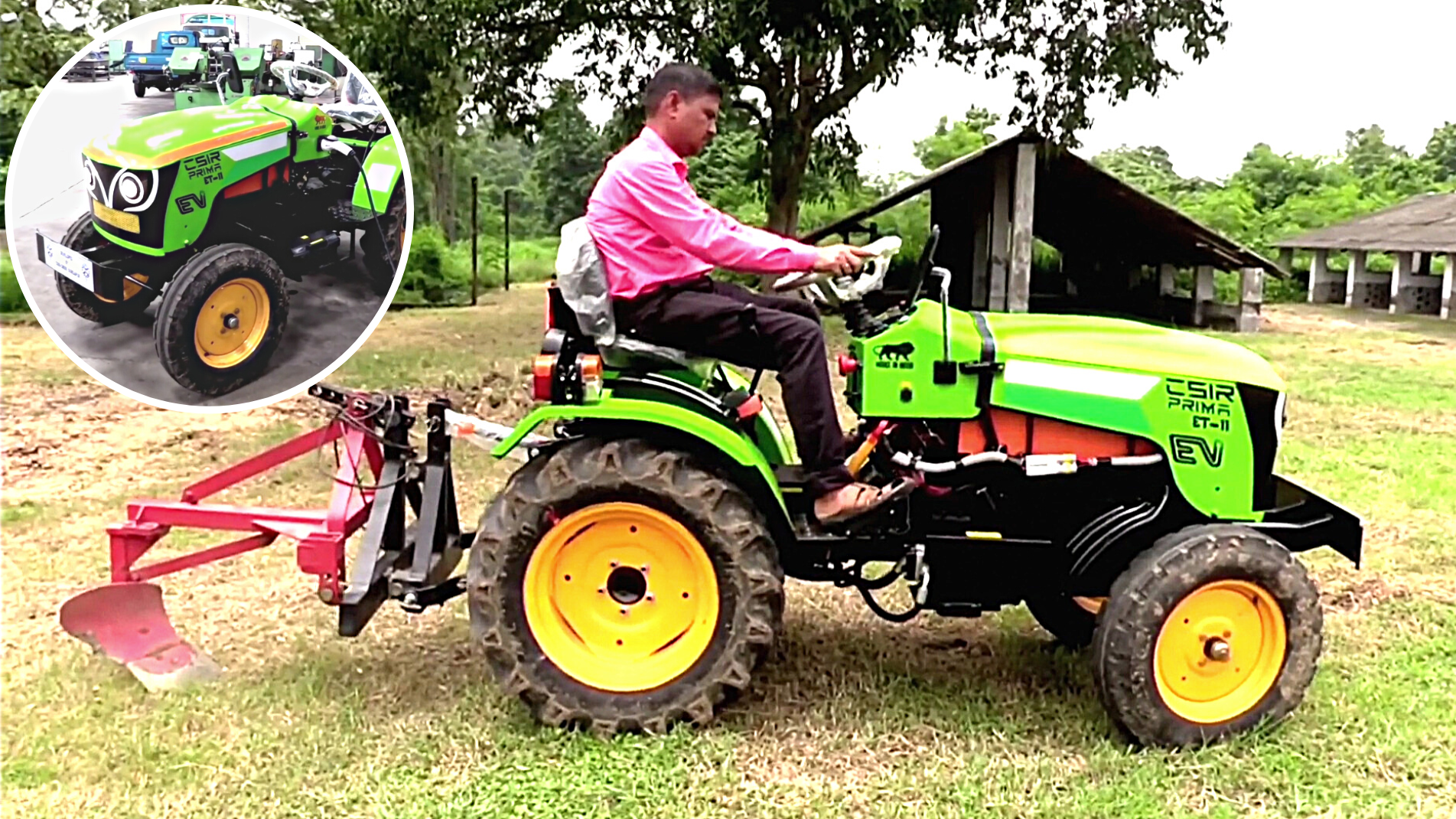
India Launches Its 1st Indigenous e-Tractor Developed By the CMERI

India Launches Its 1st Indigenous e-Tractor Developed By the CMERI

On Monday, Union Minister of State (Independent Charge) Science & Technology, Dr Jitendra Singh, had launched the CSIR Prima ET11, the first indigenous e-Tractor developed by the Central Mechanical Engineering Research Institute (CMERI), Durgapur, a public engineering R&D institution in Durgapur, West Bengal, and a constituent laboratory of the Indian Council of Scientific and Industrial Research (CSIR).

Underlining the role of Agri StartUps in India’s economy and called for the adoption of new and AI driven technologies in Agriculture, Dr Singh said, "an increasing number of new Startups are venturing into the Agriculture sector, focussing on niche technologies including e-Tractor, recycling garbage, drip irrigation, Genome sequenced farming such as Mango and Lotus."

CSIR Prima ET11
CSIR Prima ET11

India Launches Its 1st Indigenous e-Tractor Developed By the CMERI

“This is one sector in which India has rather not taken up the pace that was required,” said Dr Jitendra Singh, adding, “This is a huge unexplored resource, which is only exclusive to India. Those countries which had been promoting IT, have been promoting from their point of view because they have their assets; they don’t have the agri asset that we have. So we don’t have to ape them. If I have plenty of agriculture resource, why not I make use of it… Therefore, this route would be a very important component in India’s future economy in the next 25 years.”

To recall, Indianweb2 recently reported that TI Clean Mobility (TICMPL), the electric vehicle arm of Murugappa Group’s engineering company Tube Investments of India (TII), is launching at least three electric tractors during this fiscal.

Further, Dr Jitendra Singh said, “We have a very enabling atmosphere and an enabling leadership, which is quite patronising,” he said, adding, “PM Modi has not only given us the freedom to perform to our full potential and aptitude, but he has also raised the esteem of science and the scientists.”

The CSIR-CMERI will be celebrating the theme-based campaign “One Week One Lab” from 11-15 September 2023, showcasing the laboratory's cutting-edge research, products and technologies, expertise and facilities to various stakeholders.

CSIR-CMERI Developed Indigenous Mechanized Scavenging System Successfully Demonstrated


CSIR-CMERI developed indigenous Mechanized Scavenging System successfully demonstrated at the premises of the National Physical Laboratory, Delhi on 27.10.2021 in gracious presence of Dr.Shekar C. Mande, DG,CSIR & Secretary DSIR, GOI, Prof.(Dr.) Harish Hirani, Director, CSIR-CMERI, Durgapur, Prof. Venugopal Achanta, Director, NPL, Delhi , Ms Rupa Mishra IAS, JS, Ministry of housing and urban affairs GOI, government officials, Engineers & industrialists.

On the occasion Prof. (Dr.) Harish Hirani, Director CMERI Durgapur explained the details of the indigenously developed technology of mechanised scavenging system. It was developed within the span of eight months. The developed system was benchmarked with the market available system in India, and a number of features have been added which makes it first of its kind in India. Prof. Hirani further explained that in the developed system, the water collected from the drain is recycled to be used for drain/road cleaning. Whereas in the market available systems utilized fresh water, which cannot be sustainable. A camera mounted inspection system is also provided in the vehicle to inspect the current condition of the sewer pipe: Pipe cracks, roots in pipe etc.


Mr. Avinash Kumar Yadav, Sr. Scientist, CSIR-CMERI told that in the market available systems, a rodding mechanism is commonly used to clear the blockage in the sewer pipes, but it may erode the inside surface of the pipe. Whereas CSIR-CMERI Durgapur’s developed system uses a high flow rate system jetting pump which exerts high force to clear the blockage without any damage to the pipe. He also told that the collected sludge may not directly be useful for agricultural purpose. It is recommended to use pyrolysis process to convert sludge to useful products.

Director mentioned that the developed mechanised drain cleaning system is rigorously tested in the National Institute of Technology Durgapur, National Power Training Institute, Durgapur, DVC colony, DSP colony in Durgapur.


Ms Rupa Mishra IAS, JS Ministry of Housing and Urban Affairs, GOI was impressed with the CSIR-CMERI developed mechanised scavenging technology with all the advanced features available in the developed system. She enquired about the roll out business plan for the developed technology. She also commended that reuse of water for drain cleaning in this system is very unique and sustainable approach for mechanised drain cleaning.

Mr. Bhupesh Kumar additional Chief Engineer, Delhi Jal board encouraged the CSIR-CMERI developed technology for its conceptual work and working. He appreciated the reuse of water for drain cleaning as well as post inspection system in this developed technology. However, he was curious to know whether the present developed system can be installed on CNG fuelled powered vehicle in-order to operate in Delhi and NCR region. Mr. Kumar offered the demonstration of the machine in Keshopur area under Delhi Jal board.

CSIR-CMERI has developed a Vehicle Integrated Mechanized Scavenging System after intensive studies of the diverse nature of Indian Sewerage Systems and the manner of its blockages. The System is built in the BS-VI vehicle chassis mainly considering for the Bharat Stage VI pollution norms from Government of India. The technology is modular in design so as to ensure customised deployment strategies as per situational requirements. 

The System also focuses upon Sustainable Usage of water (i.e. sucked slurry from the choked Sewerage Systems is in-situ filtered adequately and redirected for Clearing of blockage using Self-Propelling Nozzle). The high-pressure jetting system (110 lpm @ 130 bar) makes system suitable for any tough choke condition. 

The various electronic feedback system like digital water level indicator for the storage tank, sensors for the filter clog checking, sensors for assess of conditions of various pumps (slurry, jetting & hydraulic) added additional benefits for safety and better utilisation of the system. All the modules like slurry dispensing unit, high pressure jetting unit & Grabbing system engages through the pneumatic pressure for better safety. 

The hydraulic operated grabbing system with hopper system is designed and integrated in the system for collection of the silt. The Jetting hose system is assisted with hydraulic motor system and disinfectant system for minimising the effort as well as improving the health safety of the operators. Many Sewage lines are old, and therefore it is very important to check the health of the sewer pipe periodically. For this purpose, a self-propelled Inspection system is developed and integrated with vehicle to provide inside details of the sewer pipes. The CSIR-CMERI developed machine is designed for up to 5000 people density i.e. best suitable upto 300 mm diameter and upto 100 meter length of sewer system.

Key features of the system:
  • High Pressure Jetting System.
  • Equipped With Safety Operator feedback system
  • Post Cleaning Inspection camera system (self-propelled type)
  • Disinfectant System for jetting hose disinfection.
  • Appropriate filtration and Re-utilization of drain Slurry
  • Indigenous, cost effective & Reliable machine
  • Developed in BS VI chassis (Green and Clean India)
Technical Specification:
  • Chassis: BS-VI, Max power 98 HP & 300 NM torque.
  • Overall length of vehicle: 6.1 meters
  • Slurry Dispensing Unit Power required: 5 HP, 100 lpm
    • Head of the slurry System – 40 feet.
  • Jetting Unit: 30 HP, 100 lpm, 110 bar.
    • Jetting length – 60 meters.
    • Hose Dia - 1 inch
  • D-silting mechanism details –
    • Bucket capacity – 30 ltrs
    • Boom Tilting 180 degrees.
    • Max reach – 3.8 meter (2-meter boom + 1.8-meter stroke)
    • Waste Bucket – 30 ltrs
    • Hydraulic operated.
    • Vertical reach -12 meters.
The developed System would help the Manual Scavengers Skill themselves on the latest technological advancements in Sewerage Maintenance Systems as well as enhance their efficiency, performance and safeguard them against intrusive pathogens. This would remove the Indignity from the Profession of Scavenging and help convert their practice from Skilled to Unskilled.

To Control Riots, CSIR-CMERI Demos Advanced Indigenous Mob Control Vehicle (MCV) Prototypes, Equipped with GPS and Video Transmission

Operational units are height adjustable front shovel, retractable protective front shield, all round irritant spray system, foam spray system and tear smoke munitions system

Other capabilities are cabin pressurization system, retractable multi barrel tear gas launcher with appropriate electronic vision systems, wide angle surveillance, multi-channel video transmission system, GPS tracker and GPS navigator


In a view to elevate modern technical support to paramilitary forces engaged in maintaining law and order situation; train and equip them with advanced options, CSIR has demonstrated its three innovative variants ‘Compact, Medium, Heavy’ category of Mob Control Vehicles (MCVs) to a team of MHA recommended members under leadership of IG (RAF), CRPF. The demonstration was successfully carried out at Parade Ground, CRPF Group Centre, Gurugram recently. This is a first of its kind advanced indigenous design and featured development in the country.

The MCVs have been designed, developed and demonstrated by one of the CSIR’s constituent laboratory ‘Central Mechanical Engineering Research Institute’ (CMERI) based in Durgapur, which had brought indigenous tractor revolution in India.

Tractor based MCV in Operation

The Heavy category of these MCV prototypes has a 7.5-ton payload capacity. While, the Medium category is of 2.5-ton payload capacity, the compact one is a tractor-based vehicle for easy maneuvering. The key requirement and followed specifications have been evolved, formulated with involvement of various designated stakeholders.

The prototypes consist of several independent operational units unified as per vehicle category and operational requirement during mob control. Few example, the operational units are height adjustable front shovel, retractable protective front shield, all round irritant spray system, foam spray system and tear smoke munitions system. The other capabilities are cabin pressurization system, retractable multi barrel tear gas launcher with appropriate electronic vision systems, wide angle surveillance, multi-channel video transmission system, GPS tracker and GPS navigator. The design architecture allows easy and fast customization in downstream products.

Compact Medium Category Vehicle in Operation
 
The production versions of the MCVs can be tailor-made as per the actual requirements and functional priorities of the users so that their effectiveness in mob/riot control scenario can be augmented.Other than IG (RAF) CRPF, DIG RAF, Comdtt RAF, DIG BSF, Director ODC VHF, 2-I/C Assam Riffles, DC CISF, DC ITBP, DC SSB, T Cmdr NSG, SSP JKPS, DCPs from Haryana Police, DIG, Comdtt and DCP from Maharashtra police, Scientists, Technical and Senior Officials from CSIR-CMERI and CSIR HQ also participated in the demonstration.

CSIR-CMERI Develops 1st Ever Waste-Water Treatment Technology which Purifies Waste Water for Irrigation/Farming Purposes


CSIR-Central Mechanical Engineering Research Institute, Durgapur unveiled the first-ever Waste-Water Treatment Technology Model which purifies Waste Water for Irrigation/Farming purposes. Prof. (Dr.) Harish Hirani, Director, CSIR-CMERI inaugurated the ‘Aqua Rejuv’ along with Shri Subhendu Basu, Additional District Magistrate (Zila Parishad), Paschim Bardhaman and Additional Executive Officer, Paschim Bardhaman Zila Parishad today at CSIR-CMERI colony in Durgapur (West Bengal).

During his inaugural speech Prof. Hirani said that he wanted the solution for the society from Carbon Dioxide, frequent chockage of the drainage system and the discharge of sewage water through application of basic sciences. He also referred to different studies where it has been outlined that the COVID virus have the potential to survive up to 34 days in the sewage water. Keeping in mind these societal aspects, he envisioned this technology following the norms of the National Green Tribunal which is the statutory body for handling the expeditious disposal of the cases pertaining to environmental issues in our country.


Aqua Rejuvenation Plant (ARP) is an Integrated Waste Water Rejuvenation Model which has Six-Stage purification profile for comprehensive treatment of Waste Water, based upon diverse purification parameters. The approx. 24,000 litres of Water that can be rejuvenated using ARP will be sufficient for almost 4 acres of Agricultural Land (barring seasonal variations in water requirements). The used filtration media have been specially developed to handle Indian Sewage Water Parameters and based upon Geographical Variations they may be modified. The filter media is also locally source-able, so as to ensure that there would not be any stress in the Supply Chain for scaled-up Manufacturing of ARP. The treated water which is now being used for irrigation can be used even for drinking purpose also when little more time is given for settling. 

The system has dual benefit as while the treated water is being used for irrigation purpose, the filtered sludge generated is also utilized as manure / fertilizer. The bio char prepared from dry leaves falling in autumn season is also used for mixing in soil as it reduces the water requirement for irrigation thus saving precious water. The Institute was earlier also using alternate technologies like sprinkle system and others for reduced water requirement for such purpose. Prof. Hirani urged the different stake holders of the Society, Civic bodies, Governmental authorities, NGOs to come forward and work with the scientific community.

Shri Subhendu Basu appreciated the scientific efforts of the Institute and stated that this technology is a much needed one in the present environment. He said that shortly the Municipal Corporation, Irrigation Department and the District Administration would arrange a seminar with CSIR-CMERI to discuss the issue for its proper implementation at the required places. Shri Basu expressed confidence that CSIR-CMERI has the potential and R&D solutions to the Industrial pollution related issues including waste water management.

World’s Largest Solar Tree developed by India's CSIR-CMERI


India's CSIR-CMERI has developed the World’s Largest Solar Tree, which is installed at CSIR-CMERI Residential Colony, Durgapur. Prof.(Dr.) Harish Hirani, Director, CSIR-CMERI, while elaborating about the technology stated that, “The installed capacity of the Solar Tree is above 11.5 kWp. It has the annual capacity to generate 12,000-14,000 units of Clean and Green Power”.

Founded in 1958, CMERI (Central Mechanical Engineering Research Institute ) is a public engineering research and development institution in Durgapur, West Bengal, India. It is a constituent laboratory of the Indian Council of Scientific and Industrial Research (CSIR).

The Solar Tree has been designed in a manner to ensure maximum exposure of each Solar PV Panel to Sunlight and also creation of the least amount of shadow area beneath. There are a total of 35 Solar PV Panels in each tree with a capacity of 330 wp each. The inclination of the arms holding the Solar PV Panels are flexible and can be adjusted as per requirement, this feature is not available in Roof-Mounted Solar facilities. The energy generation data can be monitored either real-time or on daily basis.


Prof.(Dr.) Harish Hirani explained, “The CSIR-CMERI developed Solar Tree besides being the World’s Largest Solar Tree also has certain customizable features for application at diverse sites. The Solar Trees were designed in a manner to ensure minimum Shadow Area, thus potentially making these Solar Trees available for widespread usage in Agricultural activities such as High Capacity Pumps, e-Tractors and e-Power Tillers.

TheseSolar Trees can be aligned with Agriculture for substituting price-volatile fossil fuels. Each Solar Tree has the potential to save 10-12 tons of CO2 emissions being released into the atmosphere as Greenhouse Gases when compared with fossil fuel fired energy generation.Besides, the surplus generated power can be fed into an Energy Grid.

This Agricultural Model can provide a consistent economic return and help the farmers counter the effects of the uncertain variations in Agriculture related activities, thus, making farming an Economic and Energy Sustainable practice.”

Each Solar Tree will cost Rs 7.5 lakhs and the interested MSMEs can align their Business Model with the Pradhan Mantri Kisan Urja Suraksha evem Utthan Mahabhiyan (PM KUSUM) Scheme for farmers, for developing a Renewable Energy based Energy Grid.

The solar tree has the capability to incorporate IOT based features, i.e. round-the-clock CCTV surveillance in agricultural fields, real-time humidity, wind speed, rainfall prediction and soil analytics sensors. The CSIR-CMERI developed solar powered e-Suvidha Kiosks may also be connected to the Solar Trees for real-time access to the vast majority of agricultural database as well as to the eNAM i.e. National Agricultural MarketPlace for instant and real-time access to an unified online market.This Solar Tree is a Quantum Leap towards making an Energy Reliant and Carbon Negative India.


Market Reports

Market Report & Surveys
IndianWeb2.com © all rights reserved