Showing posts with label Assistive Technology. Show all posts

IIT Madras Unveils NeoStand, A Customizable Electric Standing Wheelchair Made with Indigenous Technology

IIT Madras Unveils NeoStand, A Customizable Electric Standing Wheelchair Made with Indigenous Technology

IIT Madras Develops India’s Most Customizable, Indigenously-Developed Electric Standing Wheelchair

The project was sponsored by Tata Elxsi under its CSR initiative

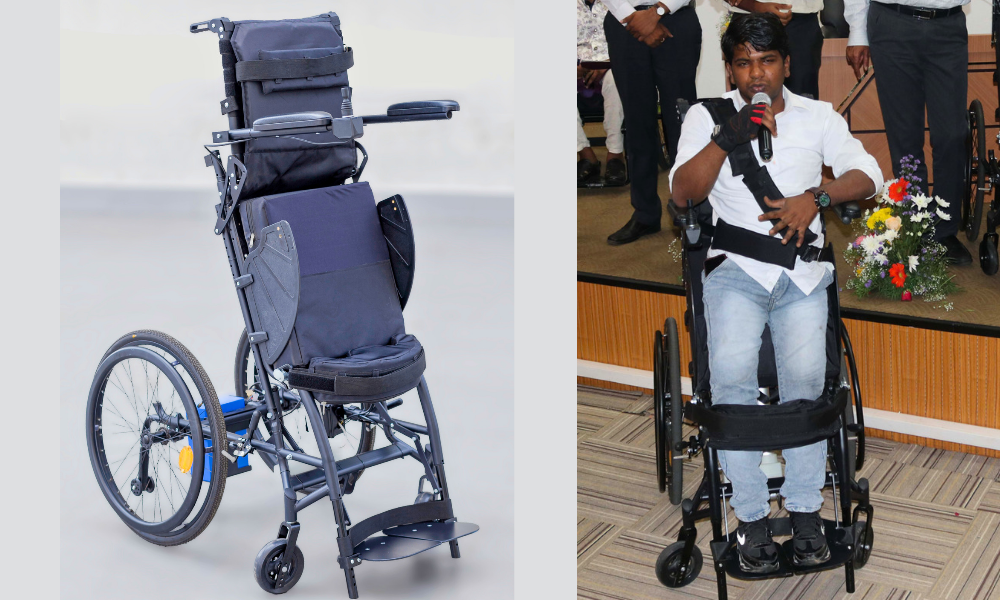
On Wednesday, the Indian Institute of Technology Madras (IIT Madras) launched the NeoStand — an electric standing wheelchair that's customizable and made with indigenous technology. The wheelchair is designed to help users sit for long periods of time and then stand comfortably, reducing the risk of secondary health issues.

This electric wheelchair allows users to stop at intermediate positions using a switch, which can help with therapeutic aspects. For example, a caregiver or therapist can help the user practice standing gradually.

Launched at the IIT Madras campus on 20th March 2024 in the presence of Prof. V. Kamakoti, Director, IIT Madras, NeoStand is India’s most customizable Electric Standing Wheelchair, and has been developed indigenously to enhance the quality of life for wheelchair users.

At the touch of a button, wheelchair users can effortlessly transition from sitting to standing, opening a world of possibilities - be it engaging in eye-level conversations, reaching for a book, or simply enjoying a cup of coffee standing by a counter.

NeoStand
NeoStand 

Key features of the NeoStand:

1. Customizability: NeoStand is designed to be highly customizable, catering to the specific needs of individual users. This adaptability ensures that it can accommodate a wide range of requirements.

2. Motorized Standing Mechanism: With the touch of a button, wheelchair users can seamlessly transition from a sitting position to standing. This functionality opens up new possibilities, such as engaging in eye-level conversations, reaching for objects, or enjoying a cup of coffee while standing at a counter.

3. Compact Design: NeoStand's compactness allows easy maneuverability even in tight spaces, enhancing accessibility for users.

4. Health Benefits: By providing the freedom to sit for prolonged hours and stand comfortably when needed, NeoStand reduces the risk of secondary health complications associated with prolonged sitting.

5. Innovative Approach: The wheelchair offers a seamless transition between sitting and standing, with the option to pause midway. This approach underscores its commitment to improving users’ quality of life and social participation.

 
NeoStand


Mr. Justin Jesudas using NeoStand

Justin Jesudas, who has had quadriplegia for 14 years, says that the ability to stand with the push of a button makes the wheelchair more inclusive and helps quadriplegics stand independently.

The journey of NeoStand from concept to reality was supported by a collaborative ecosystem. The project was sponsored by Tata Elxsi under its corporate social responsibility initiative. The development and design were spearheaded by the TTK Center for Rehabilitation Research and Device Development (R2D2) at IIT Madras and NeoMotion, which took the lead in bringing this product to the marketplace.

The project development was led by Prof. Sujatha Srinivasan, Head, TTK Center for Rehabilitation Research and Device Development (R2D2), IIT Madras, who also led the development of ‘Arise,’ India’s first manual standing wheelchair, and NeoBolt, the country’s first motorized add-on for wheelchairs. This device has been commercialized and is being taken to the market through NeoMotion, an IIT Madras-incubated start-up.

For the majority of wheelchair users across the globe, the ability to stand is far-fetched. Standing is essential for better blood circulation, and digestion, preventing health issues like pressure sores and crucial for daily activities. Currently, users are often dependent on external help and some need to use orthoses. For persons with severe disabilities who have compromised upper body strength, this is a significant challenge, and a manual standing wheelchair is inadequate.

This groundbreaking initiative demonstrates the impact of translational research guided by IIT Madras faculty. NeoStand redefines the wheelchair experience, emphasizing user-centric design and empowering individuals with mobility challenges. As we navigate the complexities of accessibility and societal attitudes, let us recognize that advancements in assistive technology are not only technological imperatives but also moral imperatives.

In A Bundle of Assistive Tech Features, Apple Devices To Speak Your Voice After 10-Minutes of Training

Apple Devices To Speak Your Voice After 10-Minutes of Training

Apple has announced that by the end of the year, users of iPhones and iPads will be able to hear their devices speaking in their own voice as part of a collection of new bundle of software features for cognitive, speech, vision, and mobility accessibility, the tech giant provided a preview of 'Personal Voice' on May 16th. This upcoming feature will display random text prompts to generate 15 minutes audio and capture user's voice.

Furthermore, Apple's 'Live Speech' tool will allow users to save commonly used phrases, which can then be spoken by the device on their behalf during phone calls, FaceTime conversations, and in-person interactions.

In a press release, Apple previewed software features for cognitive, vision, hearing, and mobility accessibility, along with innovative tools for individuals who are nonspeaking or at risk of losing their ability to speak.

For people with cognitive disabilities, Apple's "Assistive Access" uses innovations in design to distill apps and experiences to their essential features in order to lighten cognitive load.

For users at risk of losing their ability to speak — such as those with a recent diagnosis of ALS (amyotrophic lateral sclerosis) or other conditions that can progressively impact speaking ability — Personal Voice is a simple and secure way to create a voice that sounds like them.

Users can create a Personal Voice by reading along with a randomised set of text prompts to record 15 minutes of audio on iPhone or iPad. This speech accessibility feature uses on-device Machine Learning to keep users’ information private and secure, and integrates seamlessly with Live Speech so users can speak with their Personal Voice when connecting with loved ones.

Apple – Personal Voice
Personal Voice allows users at risk of losing their ability to speak to create a voice that sounds like them, and integrates seamlessly with Live Speech so users can speak with their Personal Voice when connecting with loved ones. 

Personal Voice can be created using iPhone, iPad, and Mac with Apple silicon, and will be available in English.

In addition, Apple highlighted a number of other features coming to the Mac as well, including a way for deaf or hard-of-hearing users to pair Made for iPhone hearing devices with a Mac. The company is also adding an easier way to adjust the size of the text in Finder, Messages, Mail, Calendar, and Notes on Mac.

For users who are blind or have low vision, Apple is introducing "Detection Mode in Magnifier", which offers Point and Speak, which identifies text users point toward and reads it out loud to help them interact with physical objects such as household appliances.

Point and Speak in Magnifier makes it easier for users with vision disabilities to interact with physical objects that have several text labels. For example, while using a household appliance — such as a microwave — Point and Speak combines input from the camera, the LiDAR Scanner, and on-device machine learning to announce the text on each button as users move their finger across the keypad. Point and Speak is built into the Magnifier app on iPhone and iPad.

Point and Speak will be available on iPhone and iPad devices with the LiDAR Scanner in English, French, Italian, German, Spanish, Portuguese, Chinese, Cantonese, Korean, Japanese, and Ukrainian.

AssisTech Foundation (ATF) welcomes 10 Assistive Technology Start-ups to ATF Enable Acceleration Program Cohort 5

AssisTech Foundation (ATF) welcomes 10 Assistive Technology Start-ups to ATF Enable Acceleration Program Cohort 5!

Bengaluru based AssisTech Foundation (ATF) has announced the portfolio of India’s first Assistive Technology Start-up Acceleration Program : ATF Enable Acceleration Program Cohort 5.

ATF received an overwhelming response from aspiring disability technology start-ups who applied for the program. It is more enriching that the applications were diverse in nature, covering all areas of disabilities, impact areas, and were in different stages of their start-up journeys. Over the past weeks we have discussed & debated a lot while reviewing so many quality Assistive Technology (AT) solutions.

Congratulating all the passionate technologists for the innovative ideas and aspirations, ATF announced, "We are happy to note that this year’s cohort winners are diverse in terms of covering different disabilities including visual, mobility, speech, cognitive, neural and hearing impairment alongwith one focussing on geriatric care too. They are based not only in the metros but are spread out across Tier 2 and 3 Indian cities and are in various stages of their entrepreneurial evolution."

AssisTech Foundation (ATF) welcomes 10 Assistive Technology Start-ups to ATF Enable Acceleration Program Cohort 5

The list of 10 winners are as follows (in alphabetical order):

Backyard Creators Pvt. Ltd.

Backyard Creators is building a world's first Adhesive Non Surgical hearing device for by birth and severe hearing loss patients without the hearing implant surgeries. They are overcoming all the disadvantages of Implantation surgery by providing a non-surgical adhesive hearing aid.

Dextroware Devices

Dextroware Devices is a startup that is developing a head mouse for people with upper-limb disabled to control smart devices.

H Vision & Innovations LLP

Vision has invented a wallet that allows blind people to identify currency notes and also determine if they are authentic or fraudulent. Vision has also invented the world's most compact currency note checker for the sighted people which is so compact that one can use it as a key chain, attachment on smart phone cover, wallet/ purse etc.

Kidaura Innovations Pvt Ltd

A startup developing a digital game based screening tool for autism and developmental conditions. They are also creating a child therapy delivery platform for providing assistance in home-reinforcement of therapies.

Learn and Empower Pvt Ltd.

Startup that developed a game based teaching and assessment platform that enables the deaf and hard of hearing kids practice and understand what they learn at school 4-6x better while enabling the educators to use it as a teaching aid and assessment tool.

NEMA Artificial Intelligence Pvt Ltd.

NEMA AI is India’s first EEG based special education platform for the children with special needs that helps in assessment and curation of learning content based on their strengths and weaknesses.

Ripple Healthcare Pvt Ltd

A startup developing a product “HIP PRO+” is a smart wearable device that protects elderly from the traumatic and often deadly fall-induced hip injuries. With an acceptable design offered at a fractional cost, it empowers the elderly to lead a dignified lifestyle.

Punarjeeva Technology Solutions

A startup reimagining the rehabilitation of society through gamified physiotherapy by exploiting the technological tentacles and providing opportunities that help them lead an independent and supreme life by stitching knowledge into the tasks. Their portfolio of products include Samatved (Balancing Gamified Exercises for Lower Body), Hasth (Handtracking based system for fine motor skills), Tatvika (VR based solution for physio motor, cognitive and music therapy) and Nibodh (Blended Learning product for problem solving and creative skill development.)

Robo Bionics

Assistive Tech Solution company with a focus on Rehabilitation of Hand related issues like Amputation, Limb Difference, Nerve Damage, Paralysis, Tendon Injury etc. Their Core competency involves providing a Sense of Touch to such solutions to improve the user experience and accelerate rehabilitation and User Independence.

Vifr

Vifr Tech is harnessing the power of VR for training and educating neurodiverse young adults in a fun way. Their product, Halara is a complete virtual reality special education platform to train and teach young adults with autism and other neurodevelopmental conditions.

ATF congratulates all the startups and a warm welcome to the ATF family! We are inspired and impressed by your passion and sincerity. As a next step, we will conduct a workshop to induct the winners into the ATF acceleration program and will start sessions by industry veterans, the best brains from the fields of disability, technology, start-up and business.

AssisTech Foundation (ATF) is working towards growth of the Assistive Technology ecosystem and helping millions of people with disabilities around the world to live their lives with dignity. Collectively, it has empowered its portfolio start-ups to do just that through access to customers, government and investors and other stakeholders. Cumulative efforts of ATF and its portfolio start-ups have impacted over 4.6 lakhs people with disabilities.

The ATF's objective is to create a conducive ecosystem in a structured and programmatic manner and help the start-ups develop a milestone based operating plan and investment strategy which will essentially shape the course of their business.

SBI Foundation, Social Alpha Select Top 4 Start-ups from Assistive Technology Challenge

Representative Image via  Eren Li from Pexels

Winning start-ups, Tinkertech, Cureous Labs, Urvogelbio, and Quarkbitz, to get grant and incubation support for 1 year

A comfortable wearable assistive technology device for the deaf, a device for pressure injuries and bedsores, a biofluid based diagnostics tool to effectively manage central nervous system diseases and other neurodegenerative conditions, and an AI-powered mobile app that empowers the blind, were the four winning solutions at the recently concluded Techtonic: Innovation in Assistive Technology. Jointly conducted by Social Alpha and the SBI Foundation, the challenge invited innovators and entrepreneurs working on products and services that address the difficulties faced by people with disabilities (PwDs) and enable them to lead an empowered life.

The challenge received an overwhelming participation from startups across India. The participants were evaluated based on technological innovation, social impact, and business roadmap among other parameters. The program focused on the following areas: Visual Impairment, Developmental Disorders and Chronic Neurological Conditions, Locomotor Disabilities, and Speech & Hearing Disabilities.

The four winners were chosen from 21 finalists. The winners, Tinkertech, Cureous Labs, Urvogelbio, and Quarkbitz, are eligible for a grant support of INR 15 lakhs, and a year-long Incubation support from Social Alpha. The top 10 finalists, including the winners, are eligible for a Certificate Program in Assistive Technology Solutions by National Institute for Speech and Hearing (NISH).

Speaking on the occasion, Dr. Kshama Kothari, Director of Health and Wellness, Social Alpha, said, “We, at Social Alpha, recognise the need to promote and support R&D in Assistive Technology that can play a pivotal role in reducing social gaps and improve the quality of life of PwDs. I thank SBI Foundation for its enduring commitment to creating an inclusive development paradigm and its support to the Techtonic initiative. Social Alpha will strive to create an enabling ecosystem for AT products and services and catalyse their lab-to-market journey."

Smt. Manjula Kalyanasundaram, Managing Director - SBI Foundation, said, “SBI Foundation remains committed to using technology for development, making it accessible to everyone in our society. According to estimates, 1 in every 12 households in India has a family member with a disability. However, due to low literacy levels, social stigma, and lack of opportunities, PwDs remain the most excluded members of the society. Through our flagship program Centre of Excellence for Persons with Disabilities and partners, we aim to scout and nurture assistive technologies that foster inclusivity, remove barriers for PwDs in everyday life and promote holistic development and growth."

According to estimates, India accounts for 40 to 80 million PwDs - i.e., 1 in 12 households has a family member with a disability. However, due to low literacy levels, social stigma, and lack of opportunities, PwDs remain the most excluded members of society. A large number of children with disabilities stay out of school, disabled adults are unlikely to be employed, families with a disabled member tend to be economically weaker, and the ageing population puts a lot of financial stress at both the household and national level. Techtonic: Innovation in Assistive Technology is aimed at scouting and nurturing assistive technologies that foster inclusivity and remove barriers for PwDs in everyday life.

About the winners of the Techtonic: Innovation in Assistive Technology

Tinkertech has built “TranscribeGlass”, a comfortable wearable assistive technology device for the deaf, hard of hearing, the elderly, and other people who want to improve their comprehension of spoken communication using captions.

Cureous Labs has built a solution for pressure injuries and bedsores in spinal cord injury, quadriplegia, muscular dystrophy and multiple sclerosis patients, who are bedridden and lack mobility.

Urvogelbio is developing and commercializing biofluid-based diagnostics to effectively manage central nervous system diseases for prognosis/diagnosis of Alzheimer's and other neurodegenerative conditions.

Quarkbitz has built “AudibleVision", a multipurpose AI powered mobile app that empowers the blind and people with low vision to access visual information. During the pandemic, it helped users to maintain social distancing.

Govt's BIRAC with Social Alpha and Mphasis are Looking for Startups in Assistive Technology Sector

Biotechnology Industry Research Assistance Council (BIRAC), Government of India, along with Social Alpha and Mphasis, announced the launch of the ‘BIRAC-Social Alpha Quest for Assistive Technologies – supported by Mphasis’ today, a search for startups in the Assistive Technology sector to support innovations focussed on enabling and empowering solutions for persons-with-disabilities.

The Quest will identify and select up to 10 innovations that enhance the learning, working and independent living for persons-with-disabilities. These winning innovations will also be provided up to INR 20 lakhs each to facilitate their market access journey, for implementation of work orders.

Dr. Renu Swarup, Secretary DBT & Chairperson, BIRAC said, “BIRAC is promoting development of innovative biotech solutions to address unmet needs. A number of initiatives rolled out in last few years have positively impacted the Biotech Startup ecosystem which has now grown to 2500+ across the country. This includes products and technologies focused for persons-with-disabilities. BIRAC - Social alpha launch of “Quest for Assistive Technologies” intends to identify, handhold and deploy Assistive Technology solutions for the deserving ones. This partnership could prove instrumental in building a pipeline of innovative and affordable solutions. I hope that this initiative will encourage national & international stakeholders to join hands in delivering assistive technologies at scale.

Addressing the audience at the launch event, Dr. Mohd. Aslam, MD, BIRAC said, “BIRAC promotes entrepreneurs, start-ups and SMEs to undertake strategic translational research to develop innovative products and technologies. Technology driven solutions can steer the change for societal well-being and impact billions of lives. I hope that BIRAC-Social alpha Quest for Assistive Technologies would provide a platform for start-ups to leverage this engagement for creating and deploying innovative assistive technologies across the country.

[caption id="attachment_131539" align="aligncenter" width="1024"] (Left to Right) Manoj Kumar, Meenu Bhambhani and Dr Manish Diwan[/caption]

Speaking at the launch event, Manoj Kumar, CEO and Co-founder, Social Alpha, and Head of Innovation and Entrepreneurship, Tata Trusts said, “There is a huge shortage of quality solutions that cater to and empower persons-with-disabilities at a price point they can afford.  Sometimes we come across innovators who have built the right prototypes, but find them struggling with the end user acceptance, design for manufacturing and market access. Affordability and user experience are the key to large scale adoption of such solutions and our program is designed to validate the product-market fit, help with clinical trials where required and bridge the gaps that exist in the distribution and service channels. We have already incubated four innovative companies in this sector—Bionic Yantra, Blee Technologies, Innaumation, and Tactopus, and through this Quest we are deepening our commitment the sector.”

Meenu Bhambhani, Vice President & Head- Corporate Social Responsibility, Mphasis, addressed the event, and said, “At Mphasis we have a strong focus on improving the lives of persons-with-disability. We have partnered with Social Alpha to support the curation, design and implementation of the Quest. This initiative is aimed at introducing game changing innovations to the market; building this cohesive ecosystem with critical organizations will significantly fast-track the lab-to-market journey for innovators. We believe this can really move the needle for disability inclusion in India and through this partnership we are committed to further the cause” Mphasis, through its CSR initiatives, has been doing pioneering and cutting edge work to promote disability inclusion in the mainstream. This partnership with Social Alpha resonates with our focus on providing solutions that enhance equal participation and dignity for people with disabilities in all spheres of life especially through inclusive solutions.

Upon selection, the winners of the Quest will be enrolled into the Accelerator for Inclusive Solutions — a game-changing 3-month accelerator program where they will be given the chance to work with selected implementation agencies within the Social Alpha, BIRAC and Tata Trusts network, interact directly with potential users of their product, and gain exposure to other funders, buyers and CSR initiatives. As a unique feature, these winning start-ups will also be provided up to 20 lakhs each to kick-start their market access journey, for implementation of work orders, and further support for clinical validation and product engineering. In addition, the start-ups will also have the opportunity to work closely with experts on price discovery, cost optimization, market validation, and marketing and sales.

Multiple estimates suggest that there are anywhere between 4 to 8 crore disabled people in India—i.e. one in twelve households has a family member with a disability. Moreover, due to low literacy levels, social stigma and lack of opportunities, people with disabilities remain the most excluded and unidentified members of Indian society. Large number of children with disabilities stay out of school, disabled adults are likely to be unemployed, and families with a disabled member tend to be economically weaker. While there are several players working to improve the situation, currently, there is no concerted industry effort. To address this gap, Social Alpha also announced that it would be launching a unique Open Innovation Platform which will serve three key purposes: first, identification of key problems and the critical areas where technological interventions are necessary, second, collaboration of innovators and entrepreneurs to develop the technology to serve identified problem, and third, facilitation of  market access for these innovations by aggregating end users and inviting funders, eventually reducing the cost to the end consumer.

“We envisage this platform to include organisations working with persons-with-disabilities, experts and thought leaders, start-ups, channel partners, CSRs arms of companies, family offices and foundations that focus on disabilities, as well as Central and State governments. This platform will bring together the innovation and investment ecosystems; map problems with potential solutions and help capital allocation decision of both philanthropic and commercial capital providers” said Manoj Kumar.

Presently, Social Alpha has partnered with several leading organizations working for inclusivity including Enable India, Artilab, Jaipur Foot, Saksham Trust, Xavier’s Resource Center for the Visually Challenged, National Institute of Speech and Hearing, and AssisTech at IIT-Delhi.

The Quest for Assistive Technologies is open for applicants starting today, June 27, 2019 and will be accepting applications till August 15, 2019. For further information visit - www.socialalpha.org/assisistivetech

Market Reports

Market Report & Surveys
IndianWeb2.com © all rights reserved