


The Western Union Company (NYSE: WU), a global leader in cross-border, cross-currency money movement and payments, today released its 2020 Environmental, Social and Governance (ESG) Report, spotlighting the company’s commitment to its stakeholders through an evolved ESG strategy and actions aligned to its key ESG priorities.
“2020 reinforced the importance of collective action to address global challenges,” said Hikmet Ersek, Western Union’s President and CEO. “Following a year in which borders were sealed and economies struggled, we emerged with an even sharper focus on our role as a connector of people and businesses globally. Our ESG efforts are closely aligned to this view of our business, and our belief that we have a critical role to play in creating solutions and building collaborations worldwide to advance shared ESG priorities.”
2020 ESG Highlights
The report outlines the company’s efforts to connect people and businesses globally, foster an inclusive workplace, move money with integrity, uphold strong governance, safeguard our shared environment, and provide training, education and crisis relief through the Western Union Foundation. Key accomplishments in these areas included:
Cross-border money movement: Enabling nearly 150 million customers in more than 200 countries and territories to send and receive funds in more than 130 currencies, to and from almost anywhere, as the global pandemic raged.
Support for migrants: Continuing to support migrant, refugee and other vulnerable populations through monetary and other support to organizations focused on these groups, raising awareness and funding critical research.
Fraud prevention: Preventing $1.4 billion of fraudulent transactions, with the lowest annual dollar-value payout reported as fraud since Western Union began tracking consumer fraud claims in 2005.
Board diversity: Actively ensuring diversity at Board level - as of 2020, 45% of the company’s 11 Board members were female and/or identified as Latinx, Asian or LGBTQ+.
Human rights: Identifying and prioritizing the company’s human rights impacts, and releasing a Human Rights Statement guided by internationally recognized standards.
Western Union Foundation: Enabling the Western Union Foundation to reach more than 200,000 people through workforce skilling and support for resilience in crises.
Western Union’s ESG Strategy and Goals
In 2020, Western Union completed a refreshed materiality assessment to further shape its ESG strategy and priorities. This process identified 21 ESG topics to be integrated into Western Union’s ESG efforts, prioritizing three topics of greatest importance to its business and stakeholders: furthering economic prosperity around the world; promoting the integrity of global money movement; and advancing diversity, equity, and inclusion (DEI).
The company also set forth the following goals to continue advancing its ESG priorities:
Maintain gender pay equity globally and racial/ethnic pay equity in the U.S.
Increase gender diversity in leadership, achieving at least 40% women in senior management positions by 2025.
Increase racial and ethnic diversity among employees, including reaching at least 25% Latinx and Black employees in the U.S. by 2025.
Conduct more than 300,000 partner engagements, such as compliance program reviews or trainings, with Western Union partners globally to continue building capacity within the financial system to detect and prevent illicit activity, by 2025.
Reach approximately 300 million consumers and clients to promote fraud awareness and education by 2025.
The Western Union 2020 ESG report and executive summary are available for download at https://corporate.westernunion.com/esg/. It is prepared in accordance with Global Reporting Initiative (GRI) standards, and includes responses to select relevant metrics from the Sustainability Accounting Standards Board (SASB) Standards. The report also details Western Union’s actions to advance the United Nations Sustainable Development Goals.
Safe Harbor Compliance Statement for Forward-Looking Statements
This press release contains certain statements that are forward-looking within the meaning of the Private Securities Litigation Reform Act of 1995 that involve risks and uncertainties. These statements are not historical facts or guarantees of future outcomes, but rather are based on current expectations, estimates, assumptions, and projections, and include statements regarding our goals, commitments, programs, and other plans and objectives. Words such as “expects,” “intends,” “targets,” “goals,” “anticipates,” “believes,” “estimates,” “aims,” “plans,” “strives,” and other similar expressions or future or conditional verbs such as “may,” “will,” “should,” “would,” “could,” and “might” are intended to identify such forward-looking statements. Our actual outcomes and results may differ materially from those expressed in, or implied by, our forward-looking statements based on changes in circumstances, assumptions not being realized, or other risks, uncertainties, and factors. Such risks, uncertainties, and factors include, but are not limited to, those discussed in the Risk Factors section throughout our Annual Report on Form 10-K for the year ended December 31, 2020 and subsequent Quarterly Reports on Form 10-Q and Current Reports filed on Form 8-K with the U.S. Securities and Exchange Commission. In addition, we cannot assure you that outcomes or results, including the achievement of any stated goals or targets, will have the forecasted, desired, or expected consequences and effects. Our forward-looking statements are only as of the date they are made, and we undertake no obligation to update any forward-looking statement.
About Western Union
The Western Union Company (NYSE: WU) is a global leader in cross-border, cross-currency money movement and payments. Western Union’s platform provides seamless cross-border flows and its leading global financial network bridges more than 200 countries and territories and over 130 currencies. We connect businesses, financial institutions, governments, and consumers through one of the world’s widest reaching networks, accessing billions of bank accounts, millions of digital wallets, and cards, and over half a million retail locations. Western Union connects the world to bring boundless possibilities within reach. For more information, visit www.westernunion.com.
WU-G

View source version on businesswire.com: https://www.businesswire.com/news/home/20210622005354/en/
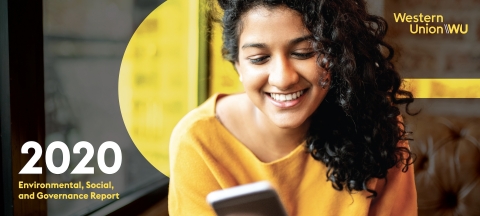 |
| 2020 Environmental, Social & Governance Report (Graphic: Business Wire) |
“2020 reinforced the importance of collective action to address global challenges,” said Hikmet Ersek, Western Union’s President and CEO. “Following a year in which borders were sealed and economies struggled, we emerged with an even sharper focus on our role as a connector of people and businesses globally. Our ESG efforts are closely aligned to this view of our business, and our belief that we have a critical role to play in creating solutions and building collaborations worldwide to advance shared ESG priorities.”
2020 ESG Highlights
The report outlines the company’s efforts to connect people and businesses globally, foster an inclusive workplace, move money with integrity, uphold strong governance, safeguard our shared environment, and provide training, education and crisis relief through the Western Union Foundation. Key accomplishments in these areas included:
Cross-border money movement: Enabling nearly 150 million customers in more than 200 countries and territories to send and receive funds in more than 130 currencies, to and from almost anywhere, as the global pandemic raged.
Support for migrants: Continuing to support migrant, refugee and other vulnerable populations through monetary and other support to organizations focused on these groups, raising awareness and funding critical research.
Fraud prevention: Preventing $1.4 billion of fraudulent transactions, with the lowest annual dollar-value payout reported as fraud since Western Union began tracking consumer fraud claims in 2005.
Board diversity: Actively ensuring diversity at Board level - as of 2020, 45% of the company’s 11 Board members were female and/or identified as Latinx, Asian or LGBTQ+.
Human rights: Identifying and prioritizing the company’s human rights impacts, and releasing a Human Rights Statement guided by internationally recognized standards.
Western Union Foundation: Enabling the Western Union Foundation to reach more than 200,000 people through workforce skilling and support for resilience in crises.
Western Union’s ESG Strategy and Goals
In 2020, Western Union completed a refreshed materiality assessment to further shape its ESG strategy and priorities. This process identified 21 ESG topics to be integrated into Western Union’s ESG efforts, prioritizing three topics of greatest importance to its business and stakeholders: furthering economic prosperity around the world; promoting the integrity of global money movement; and advancing diversity, equity, and inclusion (DEI).
The company also set forth the following goals to continue advancing its ESG priorities:
Maintain gender pay equity globally and racial/ethnic pay equity in the U.S.
Increase gender diversity in leadership, achieving at least 40% women in senior management positions by 2025.
Increase racial and ethnic diversity among employees, including reaching at least 25% Latinx and Black employees in the U.S. by 2025.
Conduct more than 300,000 partner engagements, such as compliance program reviews or trainings, with Western Union partners globally to continue building capacity within the financial system to detect and prevent illicit activity, by 2025.
Reach approximately 300 million consumers and clients to promote fraud awareness and education by 2025.
The Western Union 2020 ESG report and executive summary are available for download at https://corporate.westernunion.com/esg/. It is prepared in accordance with Global Reporting Initiative (GRI) standards, and includes responses to select relevant metrics from the Sustainability Accounting Standards Board (SASB) Standards. The report also details Western Union’s actions to advance the United Nations Sustainable Development Goals.
Safe Harbor Compliance Statement for Forward-Looking Statements
This press release contains certain statements that are forward-looking within the meaning of the Private Securities Litigation Reform Act of 1995 that involve risks and uncertainties. These statements are not historical facts or guarantees of future outcomes, but rather are based on current expectations, estimates, assumptions, and projections, and include statements regarding our goals, commitments, programs, and other plans and objectives. Words such as “expects,” “intends,” “targets,” “goals,” “anticipates,” “believes,” “estimates,” “aims,” “plans,” “strives,” and other similar expressions or future or conditional verbs such as “may,” “will,” “should,” “would,” “could,” and “might” are intended to identify such forward-looking statements. Our actual outcomes and results may differ materially from those expressed in, or implied by, our forward-looking statements based on changes in circumstances, assumptions not being realized, or other risks, uncertainties, and factors. Such risks, uncertainties, and factors include, but are not limited to, those discussed in the Risk Factors section throughout our Annual Report on Form 10-K for the year ended December 31, 2020 and subsequent Quarterly Reports on Form 10-Q and Current Reports filed on Form 8-K with the U.S. Securities and Exchange Commission. In addition, we cannot assure you that outcomes or results, including the achievement of any stated goals or targets, will have the forecasted, desired, or expected consequences and effects. Our forward-looking statements are only as of the date they are made, and we undertake no obligation to update any forward-looking statement.
About Western Union
The Western Union Company (NYSE: WU) is a global leader in cross-border, cross-currency money movement and payments. Western Union’s platform provides seamless cross-border flows and its leading global financial network bridges more than 200 countries and territories and over 130 currencies. We connect businesses, financial institutions, governments, and consumers through one of the world’s widest reaching networks, accessing billions of bank accounts, millions of digital wallets, and cards, and over half a million retail locations. Western Union connects the world to bring boundless possibilities within reach. For more information, visit www.westernunion.com.
WU-G
View source version on businesswire.com: https://www.businesswire.com/news/home/20210622005354/en/
 Predicted growth in international services trade (Graphic: Business Wire)[/caption]
 Predicted growth in services exports by country (Graphic: Business Wire)[/caption]


 IndianWeb2.com is an independent digital media platform for business, entrepreneurship, science, technology, startups, gadgets and climate change news & reviews.
