Showing posts with label Rural India. Show all posts

Policy Push Boosts Rural Wi-Fi Access: PM-WANI Crosses 4 Lakh Hotspots Milestone

Policy Push Boosts Rural Wi-Fi Access: PM-WANI Crosses 4 Lakh Hotspots Milestone

The Government of India’s flagship Prime Minister Wi-Fi Access Network Interface (PM-WANI) Scheme has achieved a major milestone in expanding public internet access across the country. Hon’ble Union Minister of Communications and Development of North Eastern Region, Shri Jyotiraditya M. Scindia, informed the Rajya Sabha that as of February 28, 2026, more than 4,09,403 Public Data Offices (PDOs) — or public Wi-Fi hotspots — are operational under the PM-WANI framework across States and Union Territories.

Alongside these hotspots, 207 Public Data Office Aggregators (PDOAs) and 113 App Providers have registered under the scheme, creating a robust ecosystem for public Wi-Fi services. States such as Delhi, Maharashtra, Karnataka, and Uttar Pradesh have emerged as leaders in hotspot deployment, reflecting strong regional adoption.

Rising Adoption and Data Consumption

The Union Minister highlighted that 2.44 crore internet users have accessed PM-WANI hotspots to date, consuming approximately 58.64 petabytes of data since the scheme’s launch. This surge underscores the growing reliance on public Wi-Fi networks for affordable and accessible broadband services.

Decentralised, Market-Driven Model

The PM-WANI framework is designed around a decentralised and market-driven approach, encouraging local entrepreneurs to set up and operate Wi-Fi hotspots based on techno-commercial viability. The Government’s role remains focused on policy enablement, ensuring affordability and scalability.

Policy Interventions to Boost Growth

  • Cost Reduction: PDOs can now use Fibre-to-the-Home (FTTH) connections and aggregate multiple access points to a single backhaul.
  • Revenue Enhancement: PDOs may offer mobile data offloading services to telecom operators, while PDOAs and App Providers can deliver promotional and branded content with user consent.
  • Improved User Experience: Existing home and business Wi-Fi networks can be integrated into PM-WANI, and roaming among PDOAs has been enabled for seamless connectivity.
Additionally, the Telecom Regulatory Authority of India (TRAI), through a tariff order issued on June 16, 2025, mandated that Internet Service Providers offer retail FTTH broadband plans up to 200 Mbps to PDOs at tariffs not exceeding twice the consumer broadband rate, further improving affordability.

Driving Digital Inclusion

The PM-WANI initiative is seen as a cornerstone in India’s digital inclusion journey, bridging connectivity gaps and empowering citizens with affordable internet access. By fostering entrepreneurship and enabling rural connectivity, the scheme is expected to play a pivotal role in achieving the Government’s vision of a digitally empowered society.

India’s First Phygital Service Hub Launched in MP

India’s First Phygital Service Hub Launched in MP

Union Communications Minister Jyotiraditya Scindia has inaugurated India’s first integrated phygital service centre in Umri village, Guna district, Madhya Pradesh, under the Department of Telecommunications’ Samriddh Gram Phygital Services Pilot Initiative. The centre combines physical and digital access to healthcare, education, agriculture, banking, and government services, marking a major step toward rural digital empowerment.

Key Highlights of the Launch

  • Location: Umri village, Guna district, Madhya Pradesh
  • Date of Launch: March 15, 2026
  • Launched By: Union Communications Minister Jyotiraditya Scindia
  • Initiative: Samriddh Gram Phygital Services Pilot by the Department of Telecommunications
  • Objective: To provide integrated access to essential services (healthcare, education, agriculture, banking, and government schemes) through a hybrid physical-digital model.

What “Phygital” Means Here

  • Physical + Digital Integration: Villagers can walk into the centre for in-person assistance while simultaneously accessing online platforms.
  • Service Coverage:
    • Healthcare: Telemedicine consultations, health awareness programs
    • Education: Digital learning modules, skill development courses
    • Agriculture: Online crop advisory, market price updates
    • Banking: Digital financial services, UPI-based transactions
    • Government Services: Access to schemes, certificates, and grievance redressal

Strategic Importance

  • Digital Empowerment: Bridges the digital divide in rural India by offering both offline and online access.
  • Holistic Development: Encourages rural communities to adopt digital tools while ensuring inclusivity for those less tech-savvy.
  • Pilot Model: If successful, the initiative could be scaled across other districts and states, transforming rural service delivery nationwide.

Comparison: Traditional vs. Phygital Centres

Feature Traditional Rural Centres Phygital Service Centre
Service Access Mostly physical, limited digital Hybrid (physical + digital)
Healthcare Local clinics only Telemedicine + local support
Education Schools, limited resources Digital learning + skill hubs
Agriculture Support Offline advisory Real-time digital updates
Banking Manual transactions Digital payments, UPI, online banking
Government Services Paper-based, slow Online portals + assisted access

Challenges & Risks

  • Digital Literacy Gap: Villagers may need training to fully benefit.
  • Connectivity Issues: Reliable internet access is crucial for success.
  • Scalability: Pilot success in Guna will determine feasibility for nationwide rollout.
This launch positions Guna as a testbed for rural digital transformation, with Scindia emphasizing that the initiative will “bring the world to Umri” by placing opportunities directly in villagers’ hands.

Insurance Awareness Committee (IAC-Life) Applauds Bima Gram API; Acknowledges Its Potential in Strengthening Rural Insurance Coverage

Insurance Awareness Committee (IAC-Life) Applauds Bima Gram API; Acknowledges Its Potential in Strengthening Rural Insurance Coverage

The Insurance Awareness Committee (IAC-Life) is banking on Bima Gram API to change the face of rural insurance penetration. Launched recently by the Insurance Regulatory and Development Authority of India (IRDAI), Bima Gram API is a pioneering digital initiative designed to streamline and authenticate insurance coverage data in rural India.

Developed by the National Informatics Centre (NIC) in collaboration with the Ministry of Panchayati Raj (MoPR), Department of Posts represented by the Centre of Excellence in Postal Technology (CEPT), and the Insurance Information Bureau of India (IIBI), the intervention comprises of a database and an API (Application Programming Interface). The Bima Gram API maps postal PIN codes to Local Government Directory (LGD) codes, creating a unified, verifiable database for rural identification. Through the Bima Gram API, insurers can now simply enter a customer’s postal PIN code to retrieve the corresponding Gram Panchayat (GP) name, ensuring instant digital verification of the policy’s rural location.

To accelerate insurance penetration in India’s rural geographies, the IRDAI has issued Rural and Social (RuSo) mandates to India’s insurers. Under the same, insurers have to cover a minimum percentage of lives, dwellings, shops, and vehicles in identified GPs and the social sector. However, over the years, insurers were finding it challenging to accurately map insurance coverage to rural areas. Most identification documents do not mention the GP name, making it difficult for insurers to accurately measure the level of insurance penetration in rural communities. This has led to cumbersome manual verification processes.

The Bima Gram API provides insurers with real-time certification and verification of rural insurance data from a trusted government source. It ensures that insurance policies emanating from rural geographies can be digitally validated, and accurately mapped with their respective GPs. Apart from reducing manual documentation, it also enhances the accuracy, speed, and efficiency of rural business reporting.

Speaking on the launch, Member, Insurance Awareness Committee (IAC-Life), said,
The launch of Bima Gram API marks a pivotal step in advancing rural insurance inclusion, and deepening and measuring insurance penetration in rural areas. Beyond helping insurers evaluate their rural penetration efforts, the API will enable us to build comprehensive baseline datasets for future policy planning and resource allocation. Bima Gram API is bound to herald a revolution in India’s life insurance history by ensuring that every rural household is served and accounted for in India’s financial safety net.

The initiative has already undergone successful pilot testing with five insurers—including two life, two general, and one health insurance company—who have integrated, tested, and verified the functionality of the API. Full industry integration is expected to be completed soon.

About Insurance Awareness Committee–Life Insurance:

87% of India continues to grapple with a significant life insurance protection gap, which continues to increase, exceeding 90% amongst those aged 18–35. This growing vulnerability is a threat to families’ financial security and aspirations.

Addressing this challenge on a war footing is crucial to maintaining our society’s socio-economic resilience and security. The Insurance Awareness Committee was formed under the aegis of the Life Insurance Council to take action on this issue.

Formed in 2019, 24 Life Insurance firms have come together to contribute under the guidance of six CEOs nominated to lead the agenda. Further comprised of a cross-industry marketing team supported by creative/media agencies, the Insurance Awareness Committee researches, plans, creates, and deploys nationwide campaigns that drive awareness, understanding, and consideration of life insurance products.

Citizens GCC Joins Cognizant’s Flagship Outreach Program to Advance Rural Tech Talent in India

Citizens GCC Joins Cognizant’s Flagship Outreach Program to Advance Rural Tech Talent in India

Cognizant (Nasdaq: CTSH) has announced that Citizens Financial Group’s Global Capability Centre (GCC) has joined its flagship Outreach program to advance skilling and employability for college students in rural communities across Telangana.

The program launched in Hyderabad in 2019 has reached over 4,000 students in Telangana, with 478 hired into technology roles at Cognizant—92% of them women. Nationally, the program has impacted 60,000 students through partnerships with more than 100 institutions, including colleges and nonprofits.

Our Hyderabad GCC is designed as a hub for innovation and collaboration, and partnering with Cognizant’s Outreach program allows us to extend that purpose beyond business into communities,” said Michael Ruttledge, Chief Information Officer and Head of Enterprise Technology & Security, Citizens Financial Group.This marks the beginning of our volunteering journey in India, and we are proud that our GCC associates will volunteer their time and expertise to help students unlock new opportunities and pathways to pursue careers in technology.”

As part of the collaboration, Citizens GCC associates will volunteer weekly to deliver a structured five-step employability training program for students in rural and tribal areas. The sessions will cover generative AI, communication and soft skills, life skills and include readiness for the AMCAT employability test.

Cognizant Outreach is a powerful example of how our people bring purpose to life—using their mentoring skills to uplift communities and create pathways to opportunity,” said Surya Gummadi, President – Americas, Cognizant. “Our collaboration with Citizens’ GCC in Hyderabad strengthens this mission, combining shared values and collective action to equip students—especially young women in underserved areas—with the skills and confidence to thrive in technology careers. Together, we’re bridging the gap between skilling and industry, and scaling impact where it’s needed most.”

Launched in April 2025, the Citizens-Cognizant Global Capability Centre (GCC) in Hyderabad serves as a next-generation innovation hub supporting Citizens’ digital transformation and technology modernization. The GCC is expected to scale up to 1,000 IT and Data and Analytics professionals by March 2026.

Cognizant Outreach is a global, employee-driven volunteer platform focused on driving digital inclusion and supporting community development through initiatives in education, employability, and environmental sustainability.

About Cognizant

Cognizant (Nasdaq: CTSH) engineers modern businesses. We help our clients modernize technology, reimagine processes and transform experiences so they can stay ahead in our fast-changing world. Together, we’re improving everyday life. See how at www.cognizant.com or @cognizant.

About Citizens Financial Group, Inc.

Citizens Financial Group, Inc. is one of the nation’s oldest and largest financial institutions, with $217.5 billion in assets as of December 31, 2024. Headquartered in Providence, Rhode Island, Citizens offers a broad range of retail and commercial banking products and services to individuals, small businesses, middle-market companies, large corporations and institutions. Citizens helps its customers reach their potential by listening to them and by understanding their needs in order to offer tailored advice, ideas and solutions. In Consumer Banking, Citizens provides an integrated experience that includes mobile and online banking, a full-service customer contact center and the convenience of approximately 3,100 ATMs and approximately 1,000 branches in 14 states and the District of Columbia. Consumer Banking products and services include a full range of banking, lending, savings, wealth management and small business offerings. In Commercial Banking, Citizens offers a broad complement of financial products and solutions, including lending and leasing, deposit and treasury management services, foreign exchange, interest rate and commodity risk management solutions, as well as loan syndication, corporate finance, merger and acquisition, and debt and equity capital markets capabilities. More information is available at www.citizensbank.com or visit us on X (formerly Twitter), LinkedIn or Facebook.

Viyona Fintech Wins NPCI TPAP Approval to Expand UPI Payments in Tier II, III & Rural Markets


Hyderabad headquartered Startup Viyona Fintech, One of India’s fastest-growing digital payment platforms, and the developer of GRAAMPAY and the Viyona Pay app has been granted approval by the National Payments Corporation of India (NPCI) to operate as a Third-Party Application Provider (TPAP).

This approval accelerates Viyona’s growth plans to offer Unified Payments Interface (UPI) services in collaboration with partner banks, further expanding access to digital payments across Tier II, Tier III, and underserved rural markets in India.

This approval reflects NPCI’s confidence in our fintech applications to make UPI payments more accessible for farmers, shopkeepers, and households. Through GRAAMPAY and the Farmers Marketplace, we are focused on providing simple and secure financial tools that support both urban and underserved rural communities,” said Ravindranath Yarlagadda, Founder of Viyona Fintech.

Viyona Fintech Wins NPCI TPAP Approval to Expand UPI Payments in Tier II, III & Rural Markets

Viyona’s flagship product GRAAMPAY, is designed to address the unmet digital payment needs in rural India. The platform enables farmers, small merchants, and local communities to carry out digital collections, payouts, and UPI transactions. It also supports rural e-commerce and promotes financial literacy through a network of Village-Level Entrepreneurs (VLEs).

As part of its expansion strategy, Viyona is preparing to launch a Farmers Marketplace within its GRAAMPAY platform. The new feature will connect farmers directly with buyers, aiming to improve price transparency, speed up settlements, and expand access to UPI-based payments.

Viyona Fintech provides a range of UPI-based financial transaction services, including PayIn, PayOut, Virtual Account Numbers, and UPI switching. Its platform is designed to help users manage payment collections, disbursements, and reconciliation processes while ensuring security and operational efficiency.

About Viyona Fintech: Viyona Fintech is a digital payments platform offering innovative UPI-based solutions, including UPI Autopay, UPI Lite, and Credit Card on UPI services. With a strong focus on financial inclusion, accessibility, and regulatory compliance, Viyona empowers individuals, merchants, and communities by delivering transparent, reliable, and easy-to-use digital financial services across India.

Sindri Goes Solar: ACC and Adani Foundation Build a Blueprint for Rural Self-Reliance and Clean Energy Access

  • ACC and the Adani Foundation install solar-powered irrigation and drinking water systems in Chhatatand and nearby villages of Sindri.
  • Solar irrigation systems enable uninterrupted farming on 15+ acres, saving ₹30,000 per farmer per season.
  • Solar water pumps ensure clean drinking water access for 150 families, improving health and reducing daily hardship.
ACC, the cement and building materials company of the diversified Adani Portfolio, along with the Adani Foundation, has implemented solar-powered irrigation and water systems across the Gram Panchayat of Chhatatand and nearby villages in Sindri, Jharkhand.

Sindri Goes Solar: ACC and Adani Foundation Build a Blueprint for Rural Self-Reliance and Clean Energy Access
ACC Sindri - solar drinking water

These clean energy interventions are helping small farmers reduce irrigation costs, boost productivity, and are also ensuring safe drinking water access for more than 150 families in the region.

Until recently, erratic electricity and rising diesel prices made farming unreliable, while daily access to clean water remained a major challenge for many households. To address this, ACC installed 5 HP solar irrigation pumps across 15 acres of farmland in Chhatatand and Samlapur, enabling low-cost, uninterrupted irrigation.

At the same time, six 2 HP solar drinking water systems were installed across five villages, including Simatand, Kushberia and Jamadoba Basti. The systems pump water into overhead tanks, offering families a sustainable and safe source of drinking water close to home.

By integrating renewable energy into rural infrastructure, ACC and the Adani Foundation are advancing long-term self-reliance, improved health outcomes, and climate-friendly livelihoods in Jharkhand’s Sindri region.

Meghalaya’s PRIME Rural Unveils RuralPreneur 2025, Pledges ₹18 Crore to Empower 172+ Entrepreneurs Across 52 Blocks

Meghalaya’s PRIME Rural Unveils RuralPreneur 2025, Pledges ₹18 Crore to Empower 172+ Entrepreneurs Across 52 Blocks

PRIME Rural marked a historic milestone with the inauguration of the first-ever RuralPreneur 2025, officiated by Chief Minister Conrad K. Sangma. This landmark event celebrated and empowered rural entrepreneurs from across Meghalaya. During his address, the Honourable Chief Minister announced the expansion of doorstep incubation support to all 52 blocks of the state under the PRIME Rural program. Financial support of up to ₹18 crore was pledged to provide rural entrepreneurs with Selco-built environmentally friendly facilities, solar energy solutions, and essential machinery to scale operations and enhance productivity in the coming month, reaching to more than 172 beneficiaries. An initial allocation of more than ₹3.4 crore in funds was disbursed to support rural entrepreneurs state-wide.

Held at the Shillong State Central Library, the event brought together over 250 rural entrepreneurs from every district, showcasing the vibrant potential and creativity thriving in Meghalaya’s rural economy. Dignitaries in attendance included Shri Sampath Kumar, IAS, Principal Secretary; Dr. Vijay Kumar D, IAS, Commissioner & Secretary; Smti. Saloni Verma, IAS, Executive Director, Meghalaya Basin Management Agency; Shri. Swapnil Tembe, IAS, Secretary, Meghalaya and Dr. Harish Hande, CEO, SELCO Foundation, where the official catalogue book of PRIME Rural was also launched.

Meghalaya’s PRIME Rural Unveils RuralPreneur 2025, Pledges ₹18 Crore to Empower 172+ Entrepreneurs Across 52 Blocks

Speaking at the inauguration of RuralPreneur, Chief Minister Conrad K. Sangma said, “At the heart of RuralPreneur 2025 lies the belief that transformation begins with a change in mindset. We must encourage our people, especially our youth, to embrace innovation, take risks, and see challenges as opportunities. Entrepreneurship thrives when individuals are willing to step beyond their comfort zones, but it also needs a strong system of support to sustain and guide them.”

In Meghalaya, we recognize that even the smallest details matter when building enterprises. Attention to micro aspects—whether in planning, execution, or delivery—makes the difference between good and great. Yet, no entrepreneur succeeds alone. True progress happens when we work as a team, share ideas, and uplift one another with passion and commitment.

He further elaborated “The Prime Rural initiative is designed to play a crucial role in helping our entrepreneurs move forward with confidence. By nurturing talent, building networks, and developing skills, we are creating an ecosystem where rural entrepreneurs can flourish and compete on larger platforms. RuralPreneur is not just a celebration—it is a movement of growth and resilience. Together, with the right mindset, unwavering dedication, and collective spirit, Meghalaya’s entrepreneurs will pave the way for inclusive development and prosperity.”

Speaking at RuralPreneur inauguration Dr. Vijay Kumar D, IAS, Commissioner and Secretary said “In Meghalaya, we are witnessing a remarkable journey of rural entrepreneurship, powered by a strong and evolving support system. Through initiatives like PRIME Rural, incubation, mentorship, and access to markets, we are creating an ecosystem where ideas from rural areas can grow into impactful enterprises. The energy, creativity, and resilience of our entrepreneurs are inspiring, and with the right guidance and resources, they are scaling new heights. What we see today is just the beginning—Meghalaya is steadily becoming a hub where rural entrepreneurs can thrive, contribute to the economy, and create opportunities for their communities.”

Smti. Saloni Verma, IAS, Executive Director, Meghalaya Basin Management Agency, said, “The launch of RuralPreneur marks a historic step for Meghalaya as we expand PRIME Rural to all 52 blocks.

This initiative ensures doorstep incubation and consistent support for rural innovators, enabling them to access knowledge, markets, and technologies that can transform their livelihoods.”

She added, “RuralPreneur is designed to bridge the gap between rural talent and mainstream markets, fostering economic inclusion and job creation. Our focus is not only to nurture rural enterprises but also to create a sustainable ecosystem where they can thrive.”

Smti. Minha Riyaz Khan, Programme Lead, PRIME Rural, said, “As a lead of the PRIME Rural programme, it gives me immense pride and gratitude. Over the past year, we’ve had the unique privilege of working alongside an incredibly diverse group of entrepreneurs, fessociates and associates across 12 blocks in Meghalaya. PRIME Rural programme has been more than just a professional commitment—it has been a deeply personal and transformative experience. The fellowship enabled us to co-create solutions that are locally relevant and sustainable. What ties it all together is the belief that development is most impactful when it is inclusive, participatory, and rooted in local context.”

RuralPreneur 2025 featured a diverse array of stalls, product displays, and networking sessions, enabling rural innovators to connect with markets, investors, and mentors. Entrepreneurs showcased traditional crafts, agri-products, food innovations, and sustainable solutions, reflecting Meghalaya’s unique cultural and natural wealth.

This event sets the stage for Meghalaya to emerge as a model state for rural entrepreneurship in India, with PRIME Rural’s expansion poised to transform the state’s entrepreneurial landscape in the years to come.

About PRIME Rural

PRIME Rural is Meghalaya’s leading incubation hub, dedicated to fostering innovation and entrepreneurship across the state. Through PRIME Rural, this mission extends into rural communities, providing doorstep incubation to every village and uncovering hidden entrepreneurial talent. The program embarks on an intensive 18-month journey with passionate individuals, offering tailored support, resources, and mentorship to unlock their full potential. The goal is to nurture rural entrepreneurs who are self-sufficient and globally competitive, positioning Meghalaya as a hub of world-class entrepreneurial talent.

HCLFoundation to Accelerate Water and BioDiversity Stewardship in Rural India

HCLFoundation to Accelerate Water and BioDiversity Stewardship in Rural India
HCLFoundation, which drives the corporate social responsibility agenda of global technology company HCLTech in India, announced a 45% increase in the annual outlay to ₹24 crore for its flagship HCLTech Grant initiative that supports innovative rural development projects by Non-Government Organizations (NGOs) in India.

Starting FY26, the HCLTech Grant will be open to applications for promising projects under the new Water category. The Environment category has been replaced with Biodiversity. The Education and Healthcare categories will continue as before.

Each winning NGO in these categories will receive ₹5 crore for four-year projects, while eight runner-up NGOs will get ₹50 lakh for two-year projects. The total grant for the FY26 edition will be ₹24 crore vs ₹16.5 crores in FY25.

The Water category aims to highlight the critical importance of water in sustainable development. HCLFoundation aims to drive impactful community-based solutions to address water scarcity and improve water management in rural areas. The Biodiversity category aims at focused interventions that bring about ecological biodiversity impact that can be seen and measured.

The new initiative will support projects that tackle various aspects of water management, including conservation, efficient usage and sustainable practices. NGOs focusing on water-related issues are encouraged to apply for funding and support.

"Water is a precious resource. Its responsible management is crucial for reducing water stress in India. Through this initiative, we seek to partner with NGOs on innovative projects on water conservation. Also, there is a need to focus on Biodiversity enhancement across the country. Therefore, we have introduced two distinct categories under HCLTech Grant, Water and Biodiversity, while we continue focusing on Education and Healthcare. The increase in total financial outlay further strengthens our commitment towards nation building," said Dr. Nidhi Pundhir, SVP, Global CSR, HCLTech and Director, HCLFoundation. 

To date, the HCLFoundation has awarded ₹152.8 crore (~$18.4 million) through the HCLTech Grant initiative to scale high-impact projects. Through the HCLTech Grant, it has supported 59 projects across 142 districts in 22 States and two Union Territories.

With these new categories, HCLFoundation has announced the 11th Edition of HCLTech Grant, after 10 consecutive successful editions over 10 years. This year's edition includes increased grant funding, more commitment for runners-up NGOs and a higher focus on conservation efforts. The applications portal is already live. Help desks are active, and soon, the HCLTech India Grant team will be conducting symposiums in various regions of the country.

For more details and to apply, visit https://www.hclfoundation.org/hcltech-grant.

HCLTech is deeply committed to water stewardship through various innovative initiatives aimed at promoting sustainable water management and conservation. Platforms like AquaSphere provide a comprehensive solution that helps organizations monitor, measure and optimize water usage using real-time data, enhancing water sustainability practices. HCLTech has been recognized for its efforts in water stewardship, winning the National Water Award 2022 for its water conservation and management initiatives in India.

Through the HCLFoundation, the company has harvested 57.9 billion liters of water and rejuvenated over 200 water structures. Their projects include rainwater harvesting, river rejuvenation and biodiversity enhancement along the Ganga's catchment area. These initiatives align with the United Nations Sustainable Development Goals, particularly SDG 6 (clean water and sanitation) and SDG 15 (life on land). 

About HCLFoundation

HCLFoundation delivers the corporate social responsibility agenda of HCLTech in India. The Foundation contributes to national and international development goals by investing in long-term sustainable programs and special initiatives with thematic focus on education, nurturing grassroots sports, health and sanitation, skill development and livelihood, environment and disaster risk reduction and response management. To ensure equitable development, child protective strategies, inclusion and gender transformative approaches are at the core of all the programs of the Foundation. To date, the HCLFoundation has positively impacted over 6.5 million lives. To learn more visit www.hclfoundation.org

Infosys Foundation Inks MoU With ICT Academy and Pledges Over ₹ 33 Cr to Enhance Employability in Rural Areas

Infosys Foundation Inks MoU With ICT Academy and Pledges Over ₹ 33 Cr to Enhance Employability in Rural Areas

Infosys Foundation, the philanthropic and CSR arm of Infosys, has taken a significant step to enhance the employability of young learners in rural India. They recently signed a Memorandum of Understanding (MoU) with the ICT Academy of Tamil Nadu. Through this collaboration, Infosys Foundation aims to skill 48,000 students across the country.

Key Highlights

1. Centers of Excellence: The initiative will establish "centers of excellence for women and youth empowerment" in over 450 colleges across India. These centers will provide both online and offline training to students.

2. Skill Development: Infosys Foundation will leverage its digital learning platform, Infosys Springboard, to enhance accessibility to learning and skill development for students.

3. Job Placement Aid: In addition to training, the program will also offer job placement assistance to help students transition into the workforce.

This effort reflects Infosys Foundation's commitment to empowering young learners and bridging the employability gap in rural areas.

Earlier in May, the foundation has partnered with Ashoka University, Sonepat, Haryana to enhance scientific research. The two had signed a Memorandum of Understanding (MoU) to support the university's Chemical Biology Lab.

Amazon India and GAME Tieup To Boost Rural Women Entrepreneurship via E-commerce

Amazon India and GAME Tieup To Boost Rural Women Entrepreneurship via E-commerce

Amazon India and GAME will collaborate to empower 25k+ women entrepreneurs across India
  • Partnership will provide women entrepreneurs with essential tools, resources, and training to succeed in the digital ecommerce ecosystem
  • Aiming to foster inclusivity and drive economic growth within rural communities. 
Amazon India signed a Memorandum of Understanding (MoU) with ‘Global Alliance for Mass Entrepreneurship (GAME), to collaborate and promote digital growth of women entrepreneurs in India, especially in Tier-2, Tier-3 cities and beyond. Through this partnership, Amazon India will aim to support approximately 25,000 women entrepreneurs and artisans in their digital entrepreneurial journey. GAME is providing inputs in business capacity building, bridging digital marketing skill gaps and enabling them to aggregate as collected brands. With the objective of creating platform access and enabling financial independence for rural women entrepreneurs and artisans, this initiative will provide the necessary support and resources for them to thrive in the digital landscape.

The MOU between Amazon India and GAME aims to co-develop and facilitate broad-based entrepreneurship to accelerate and sustain the growth of the Micro, Small and Medium Enterprises (MSMEs) in India. Amazon Karigar & Saheli will offer workshops/training, onboarding and AM support for sellers involved in this entrepreneurship without any financial investment.. This aligns with Amazon's commitment to bolster India's economy and create millions of sustainable jobs by 2030, through partnerships within the entrepreneurship ecosystem. Further, women entrepreneurs will be provided with hands-on training and support on digital marketing initiatives, performance marketing, product listing optimization, and advertising techniques, equipping them to adapt to current and future trends in the digital marketplace. Additionally, they will gain access to valuable data-driven insights and metrics get better knowledge on customer behaviour and market trends.

Commenting on the occasion, Mr. Gaurav Bhatnagar Head of Seller Acquisition and Development at Amazon India said, “It is truly inspiring to witness women entrepreneurs nationwide harnessing the power e-commerce to build and grow their business. Through innovative products, they are catering to customer preferences and establishing scalable enterprises that contribute significantly to societal well-being and economy. We are honored to be a catalyst in their entrepreneurial journey through our Saheli program. Our steadfast commitment lies in facilitating worldwide customer access, thereby empowering these women to realize their full potential in the dynamic landscape of Digital India.”

Sharing his views on this occasion, Mr. Ketul Acharya, President, Global Alliance for Mass Entrepreneurship, “We are delighted to have partnered with Amazon for the Saheli program. GAME's Women Economic Empowerment (WEE) program seeks to enable women entrepreneurs by enhancing their livelihood opportunities and connecting them with diverse platforms and economic partners. Through this partnership, WEE at GAME is supporting Amazon in solving large-scale ecosystem challenges to women's economic empowerment with access to training in the digital marketplace as well as research and data about access to new markets."

Amazon launched its special program for women entrepreneurs, ‘Amazon Saheli’ in 2017, which seeks to bring to the fore locally made products from women entrepreneurs and local women owned businesses in India. As part of this initiative, Amazon works with partners and woman entrepreneurs to drive digitization and to provide requisite tools to woman entrepreneurs to enable them to become successful in their digital endeavours. Since its inception, Saheli has digitized over 1.8 million rural, hyperlocal and urban women-led businesses through its partner network, selling selection of products such as apparel, jewellery, groceries, on the ecommerce marketplace. The products are sourced from different (NGOs) across India. More than 80,000+ women artisans are involved in this partnership and benefit from it. The artisans produce and sell these products to support their livelihoods.

Amazon India has provided numerous opportunities for women across its ecosystem, including Seller Partners, Operations Network Partners, Community Beneficiaries, Employees, and Associates, all of whom play crucial roles in positively impacting Amazon's diverse customer base throughout the country. The company has made significant strides in introducing various benefits, programs, and initiatives to empower women both within and outside its organization. These efforts reflect Amazon's dedication to women's empowerment and its unwavering commitment to fostering diversity, equity, and inclusion within its ecosystem culture, thereby enhancing the overall Amazon experience.

In reaffirmation of its commitment to women's empowerment, Amazon India launches the third edition of the #SheIsAmazon campaign on the occasion of the 49th International Women’s Day, under the theme #InspireInclusion. This campaign highlights 49 distinct programs, initiatives, and benefits implemented by various entities within Amazon to empower women both within and beyond the company. These initiatives have played a significant role in advancing women's professional journeys and stand as symbols of Amazon's dedication to their empowerment.

The Amazon.in marketplace is operated by Amazon Seller Services Private Ltd, an affiliate of Amazon.com, Inc. (NASDAQ: AMZN). Amazon.in seeks to build the most customer-centric online destination for customers to find and discover virtually anything they want to buy online by giving them more of what they want – vast selection, competitive prices, fast and reliable delivery, and a trusted and convenient experience; and provide sellers with a world-class e-commerce marketplace.

About Amazon:

Amazon is guided by four principles: customer obsession rather than competitor focus, passion for invention, commitment to operational excellence, and long-term thinking. Customer reviews, 1-Click shopping, personalized recommendations, Prime, Fulfillment by Amazon, AWS, Kindle Direct Publishing, Kindle, Fire tablets, Fire TV, Amazon Echo, and Alexa are some of the products and services pioneered by Amazon.

About Global Alliance for Mass Entrepreneurship (GAME):

GAME intends to unlock the potential of Mass Entrepreneurship (ME) in India. Three prolific entrepreneurs, Ravi Venkatesan, Madan Padaki, and Mekin Maheshwari, started GAME in August 2018 as a backbone organisation that aligns the ecosystem and mobilises action to address systemic challenges to job creation in India. GAME intends to bring together a cross-section of alliances, partners, funders, and other players in the ecosystem who can help inspire an entrepreneurial movement across the country. Its mission is to catalyse an India-wide movement of mass entrepreneurship for the growth of both existing and new enterprises, resulting in 50 million new jobs by 2030, where women own 25% of the businesses. To know more, please visit: https://massentrepreneurship.org/

Tata Power Subsidiary TPRMG Recognized as People-Positive Accelerator of Clean Energy Adoption in Rural India by WEF

Tata Power Subsidiary TPRMG Recognized as People-Positive Accelerator of Clean Energy Adoption in Rural India by WEF


TP Renewable Microgrid (TPRMG), a wholly owned subsidiary of Tata Power- one of India's largest integrated power companies, is has announced that its Renewable Microgrid initiative has been featured in the World Economic Forum’s report on "Using a People-Positive Approach to Accelerate the Scale-up of Clean Power: A C-Suite Guide for Community Engagement." This report was released at the recently concluded 28th United Nations Climate Change Conference (COP28).

The report emphasizes the significance of a people-positive approach as a pivotal factor in accelerating the transition to clean power while delivering broader social, economic, and environmental value while also highlighting the necessity of involving communities in the shift towards sustainable energy to ensure that the transition benefits all stakeholders.

The inclusion of the TP Renewable Microgrid as a case study a in the white paper is a testament to Tata Power's commitment to bringing sustainable development to rural India and its success in leveraging cross-sectoral collaboration. This approach aligns perfectly with the paper's emphasis on partnership with communities, showcasing how industry leaders can work hand in hand with local populations for mutual benefit.

TPRMG has been instrumental in bringing clean electricity to rural India. The initiative has successfully commissioned renewable microgrids in 200 villages in northwest India, impacting around 300,000 lives. Serving a consumer base of about 21,000, these microgrids have saved over 3 million litres of diesel and reduced more than 8,000 tons of carbon dioxide annually.

Dr Praveer Sinha CEO &MD, Tata Power said, "We are privileged to set up Renewable Microgrids for providing clean energy in rural India. We are committed to advancing India's renewable energy initiatives through innovative micro enterprise solutions in rural areas”.

The project's approach is centred around shared value creation, with a strong focus on community engagement. By collaborating with various stakeholders, including social influencers, governments, local communities, and technology innovators, TP Renewable Microgrid has developed solutions that address the specific needs of each community. This collaborative effort has resulted in the seamless installation, operation, and maintenance of projects, while also delivering significant economic, environmental, and social benefits to local communities.

This case study in the World Economic Forum’s white paper is a clear indication of the importance and effectiveness of Tata Power's people-positive approach. It showcases how TP Renewable Microgrid is not only providing clean energy but also creating an ecosystem for socio-economic development in rural India. This initiative aligns with India’s broader goal of transitioning to reliable, sustainable, and community-focused energy solutions, and is an example of how the power sector can provide reliable and clean power to communities that have traditionally relied on fossil-based power.

Through these efforts, Tata Power is not just providing clean energy but also fostering socio-economic development in rural communities.

eSARAS Mobile App Launched to Market Products Made by Women of Self-Help Groups

eSARAS Mobile App Lsunched to Market Products Made by Women of Self-help Groups

Taking another step of strengthening marketing support for products made by women of Self-help Groups (SHGs), Deendayal Antyodaya Yojna- National Rural Livelihoods Mission (DAY-NRLM) launched eSARAS mobile App which will add to eCommerce initiatives for products made by the SHGs.

Currently available for Android phones, eSaras is essentially an online platform to buy Indian handicraft items, handloom items. The e-commerce platform as well as the app have been developed for the enhancement of the livelihood of the rural people. This online platform showcases the products made by self-managed Self Help Groups (SHGs) and federated institutions.

The App was launched by Mr Shailesh Kumar Singh, Secretary, Ministry of Rural Development, Govt of India at New Delhi. Mr Singh also inaugurated eSARAS Fulfillment Centre at the Ministry’s Janakpuri office in New Delhi on this occasion.

eSARAS, an e-commerce mobile app, will be used as a more effective platform for marketing of the products made by women of self-help groups. It is an initiative conceptualized by the DAY-NRLM towards the marketing of the best, authentic handicrafts and hand-looms.

Through this online portal, customers get access to 100% authentic handcrafted products emerging straight from the heart of India.

The eSARAS fulfillment centre will be managed by the Foundation for Development of Rural Value Chains (FDRVC - a Not for Profit Company constituted jointly by Ministry of Rural Development and Tata Trust) and will be used for processing, packaging and shipping of products that customers purchase through the eSARAS Portal and eSARAS mobile App. It will handle the logistics required to bring an online order to a customer's doorstep.

Launching the App, Secretary Mr Shailesh Kumar Singh termed it as an initiative which promotes the spirit of Vocal for Local even further with easier marketing of products prepared by SHG Didis.

He added that the Ministry is targeting that each SHG Household has at least 2-3 sources of livelihoods. One of the multiple sources of livelihoods of the poor is non-farm enterprise. The major intervention in non-farm livelihoods is provision of market linkages for SHG products. Through the eSARAS mobile App, the handmade products made by SHG Didis are now available at everyone’s fingertips in even more customer friendly way.

Empowering Rural Women Entrepreneurs: Enhancing Financial Well-being with FIA Global

Empowering Rural Women Entrepreneurs: Enhancing Financial Well-being with FIA Global
FIA Educating Women on Financial Independence
FIA Global Brings Affordable Digital Financing to Women and Other Unbanked Persons

FIA Global, a woman-led organisation offers a comprehensive range of sachet financial services through its state-of-the-art fintech platform that is powered by artificial intelligence (AI). These services are designed for women and women-owned businesses and other financially excluded populations who live or work in underserved geographies and economically backward areas in India.

FIA Global uses its deep-tech expertise, including investments in AI and developing AI skillsets; investments in a massive rural distribution network, with 50% as women banking agents and its large network of financial service alliances with banks, microfinance institutions (MFIs), insurance companies, mutual fund houses, and the government of India to deploy financial inclusion solutions at scale.

 
Women to fulfill their financial potential with FIA Bank Sakhis

FIA Global Bank Sakhis Transforming Lives

FIA Global works with these financial service partners to customize their products for women, micro and small entrepreneurs, and other unbanked markets. FIA integrates the financial products provided by its financial partners into its platform and helps them reach the rural markets through the existing network of banking agents.

Speaking on the subject, Ms. Seema Prem, the CEO and Co-Founder of FIA Global, comments, “FIA invests time and effort to mobilize and build the capacity of SHGs at scale to support our rapid outreach to close the finance gap. We also partner with public institutions like the National Skills Development Corporation and the edtech company Unnati to provide vocational training to SHG members to enable women to get the necessary skills for starting their businesses. Through this focussed approach FIA, an impact fintech has been serving the low-income households in South Asia.”

FIA Global has a three-pronged approach of expanding the services into the new regions.
  1. Educating and training women to work as banking agent micro-entrepreneurs in new target regions in India and in Bangladesh. Women run about 18 percent of FIA Global's banking outlets. These women are selected, educated and trained by FIA Global trainers. The model accelerates the inclusion of women and minorities in formal finance. The women are an effective channel to get more local community women to use banking services.
  2. Improving financial literacy. Creating financial resilience for lower-income women, women micro-entrepreneurs, entrepreneurs and owners of SMEs requires targeted public education efforts. FIA has been organizing, nurturing and enabling linkages with banks and MFIs by working with the local community partners (NGOs) to create and support Self Help Groups (SHGs). FIA also uses referrals to fill the gap through skill building initiatives.
  3. Connecting women-owned businesses to financing and re-engaging women in the workforce. FIA in association with the community partners, provides training and links the women entrepreneurs who operate in cash economies, who are not noticed by the banks, who are also likely to be targets of unscrupulous money lenders. FIA and its partners also get access for these women to a larger pool of working capital loans, and agricultural and livestock loans at market rates. Once credit history is built, banks extend larger loans.
The digital finance model of FIA Global makes it easy for women-owned or -led businesses to avail themselves of efficient banking services to pay wages and bills digitally and access working capital. The business owners can also avail of the benefits and as much as they can provide their employees, through enrolment in social security schemes, including life and health insurance, and pension plans.

In the post-pandemic world, women suffered job losses and depleted savings, losing financial independence. The absence of bank accounts worsened the situation, limiting savings and social protections. Two-thirds of working women lost jobs in April 2020, with few returning unlike men. Even after two years, women business owners in South Asia face a financing gap that threatens their survival. In India, the gender gap in accessing credit for women-owned MSMEs is estimated at $158 billion due to the pandemic. FIA Global strives to create gender-inclusive financial systems and prevent regression of women's progress in finance and workforce integration.

Tecnimont Supports IIT Bombay Educational Outreach Initiative WiSE to Promote Participation of Girls from Rural India in Science and Engineering Disciplines

Tecnimont Supports IIT Bombay Educational Outreach Initiative WiSE to Promote Participation of Girls from Rural India in Science and Engineering Disciplines

Tecnimont Private Limited (TCMPL), a subsidiary of Milan, Italy-based MAIRE Group, today announced its funding support for Women in Science, Engineering (WiSE) from rural parts of India. This is initiative involving a total of 165 girls is led by Prof. Rajesh Zele from the Indian Institute of Technology Bombay (IIT Bombay) to encourage young girls from rural parts of India to pursue higher education in STEM through a week-long intensive residential program at IIT Bombay.

This activity is part of MAIRE Group's sustainability strategy, specifically in the creation of value for the territories and communities where MAIRE operates through corporate social responsibility projects and initiatives.

Excited with the collaboration, Valentina Grieco, MAIRE Group CSR Senior Specialist said, "Project WiSE is driven with a special focus on the rural areas from India, such as Maharashtra, Bihar, Odisha, to help the adolescent girls build their confidence in subjects like science and mathematics. While the rural adolescent girls face challenging situations in continuing their education, TCMPL strives to make education interesting for the students and parents to ensure enrolment of girls continues in the higher standards."

"TCMPL is committed to helping the communities where they operate," said Prof. Zele, "With their support, we were able to include students from remote areas across the nation. After the week-long program, the girls will continue to uh with one another, and their mentors at IIT Bombay through online sessions. This will help shape their future and career decisions," concluded Prof. Zele.

About Wise Program

For more information about this initiative, you can visit: https://wiseapp.in

About Tecnimont Private Limited

Tecnimont Private Limited (TCMPL) is a subsidiary of MAIRE Group and serves as the Group’s centre of Engineering excellence for India. With more than 2,000 employees, TCMPL is headquartered in Mumbai and has support offices in New Delhi, Middle East, Abu Dhabi and Malaysia. It is a leader in Engineering and Main Contracting for the natural resources transformation industry. With a legacy now spanning six decades, TCMPL has exhaustive experience in executing more than 400 projects globally.

MAIRE S.p.A. leads a technology and engineering group that develops and implements innovative solutions to enable the Energy Transition. We offer Sustainable Technology Solutions and Integrated E&C Solutions in nitrogen fertilizers, hydrogen, circular carbon, fuels, chemicals, and polymers. MAIRE creates value in 45 countries and relies on 6,500 employees, supported by over 20,000 people engaged in its projects worldwide. MAIRE is listed on the Milan Stock Exchange (ticker “MAIRE”). For further information: www.mairetecnimont.com

Boson Whitewater Partners with SGBS Unnati Foundation to Install Water ATMs Across Villages in Karnataka

Boson Whitewater Partners with SGBS Unnati Foundation to install Water ATMs Across Villages in Karnataka

The projects have been funded by ExxonMobil Services & Technology Pvt. Ltd and Broadridge under their CSR initiative and it has been executed by social venture (NGO) SGBS Unnati Foundation and water startup Boson Whitewater

With an aim to povide easy access to safe and clean drinking water, Bengaluru-based Boson Whitewater has partnered with NGO SGBS Unnati Foundation to install water ATMs across villages in Karnataka. The projects have been funded by ExxonMobil and Broadridge under their CSR initiative. Till date, 10 water ATMs have been installed in Malur and Doddaballapur villages on the outskirts of Bengaluru and and over 1500+ families now have access to clean drinking water.

Unnati Foundation is a skilling organization for underprivileged youth across various States. Their program equips youth and guarantees them jobs in corporates in 35 days. They have trained over 28000 youth in the last financial year 2022-23. In addition, they assist villages in setting up Water ATMs to provide safe drinking water to rural communities.

Recently, a few village panchayats in Malur and Doddaballapur villages approached Unnati for help in enabling safe drinking water for their communities. Few of the areas were affected by heavy fluoride water contamination causing health issues in many families. In response, Unnati reached out to Boson Whitewater, a company that has experience in similar projects, particularly in school settings. Boson Whitewater decided to join the effort to contribute and work towards achieving the goal of providing safe water to various rural villages. After assessing the location proposed by Unnati Foundation, Boson Whitewater installs the water ATMs and provides Water ATM cards to the Panchayat. Each family is issued a Water Card with Rs.50 preloaded on it, which can be swiped to dispense 20 litres of water. In order to ensure the sustainability of the program, a nominal charge of Rs.5 per 20-litre per can of water is levied. The financial support for the project has been provided by ExxonMobil and Broadridge.

Commenting on the initiative, Ramesh Swamy, Director, Unnati Foundation, said, “We would like to thank ExxonMobil and Broadridge for their financial support for the projects. This collaboration is a great example of how social ventures and private players can collaborate for the greater good of the community. Through our joint efforts, more people in rural communities can now have easy access to safe and clean drinking water, which is essential for health and well-being. We look forward to working closely with Boson Whitewater to reach many more rural communities across India”

Commenting on this, Vikas Brahmavar, CEO and Co-Founder, Boson Whitewater, said, “At Boson Whitewater, our overarching goal is to use our technology to create easy access to clean water. We look for opportunities like this that allows us to make a huge difference to communities that find it difficult to access clean water. We are excited about our partnership with Unnati Foundation and look forward to implementing more projects together in the future."

Over the next few months, more Water ATMs will be installed across various villages in Karnataka.

About Boson Whitewater

Boson Whitewater, a water utility company, was founded with the aim to change the way industries, IT Parks, malls, and apartment communities recycle their wastewater. Founded in 2011 by Vikas Brahmavar and Gowthaman Desingh, Boson Whitewater converts water from sewage treatment plants into potable high quality water that can be used for household purposes, centralized air conditioning in commercial buildings, and even for drinking.

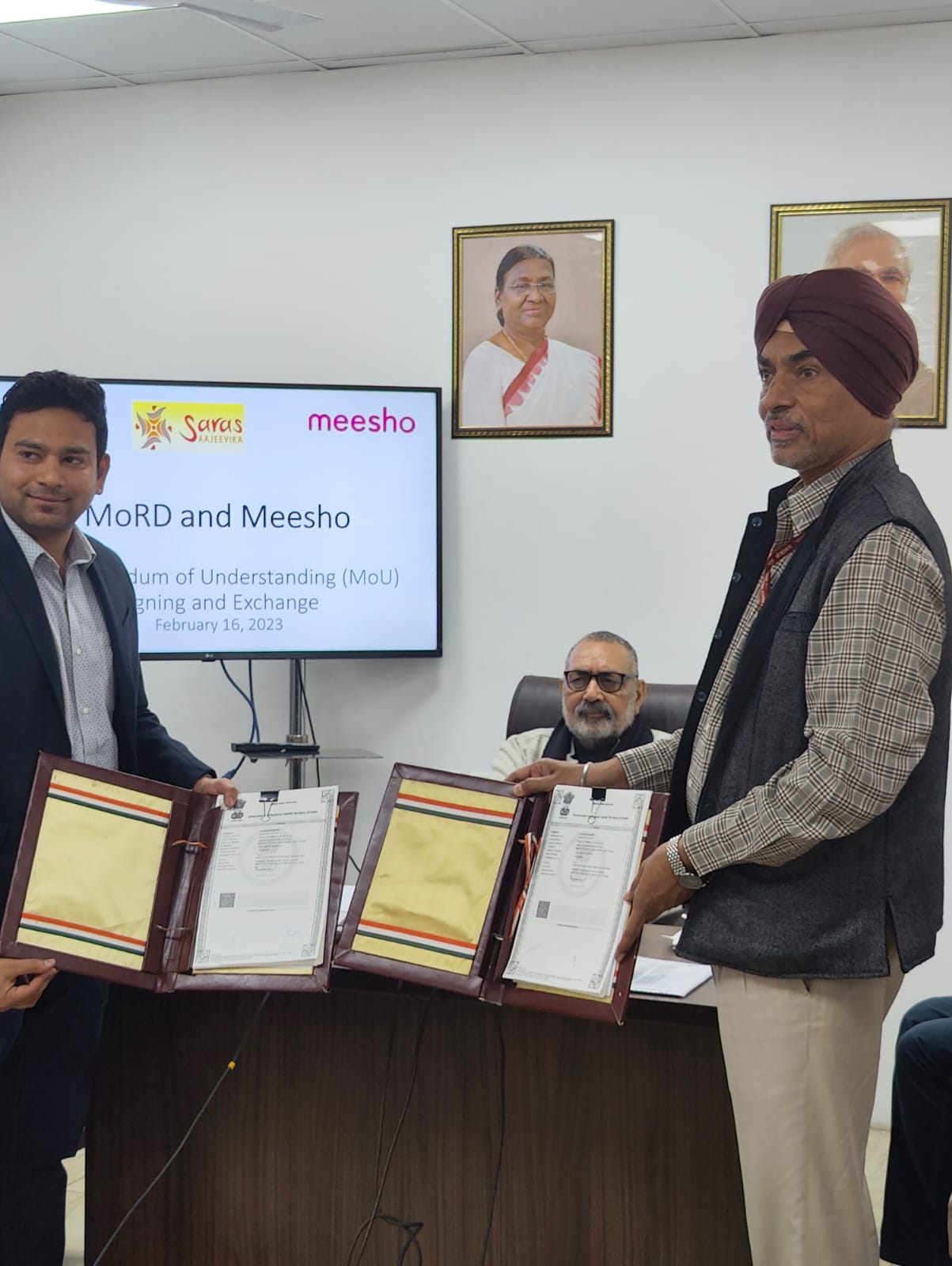
Ministry of Rural Development and Meesho Sign MoU to Onboard Rural Women as Online Sellers

The Ministry of Rural Development and Meesho, India’s only true online marketplace, signed a Memorandum of Understanding (MoU) today to drive digital inclusion of all women registered under State Rural Livelihood Missions (SRLMs) and enable them to sell online.

Sanjeev Barnwal, Co-founder and CTO, Meesho and the Ministry of Rural Development signed a Memorandum of Understanding (MoU) today in Delhi in the presence of Giriraj Singh, the minister for Rural Development and Panchayati Raj to onboard women registered under
Sanjeev Barnwal, Co-founder and CTO, Meesho and the Ministry of Rural Development signed a Memorandum of Understanding (MoU) today in Delhi in the presence of Giriraj Singh, the minister for Rural Development and Panchayati Raj to onboard women registered under the Deendayal Antyodaya Yojana - National Rural Livelihood Mission and enable them to sell on Meesho.

The partnership will give impetus to Meesho’s ongoing efforts to onboard rural women entrepreneurs in various states and enable them to launch and grow their businesses online. Over the last few months, Meesho has tied up with several government-run self-help groups (SHGs), such as Sanjeevini - Karnataka State Rural Livelihood Mission and UMEED - Jammu and Kashmir Rural Livelihoods Mission.

Meesho will now work with the central government to facilitate this digitisation at scale, organising rural women as community institutions, ensuring their financial inclusion and helping them with market access. The Ministry of Rural Development will support Meesho's engagement with state-owned and SRLM-promoted enterprises to bring local artisans, weavers and craft producers into the e-commerce fold.

Giriraj Singh, the Minister for Rural Development and Panchayati Raj said, “Uplifting rural women across India by unlocking livelihood opportunities for them has been our key objective. Our constant endeavour has been to support the growth and development of rural communities and the collaboration with Meesho will be instrumental in driving financial inclusion for them. Through market insights and training on product cataloging and packaging, women from these self-help groups will be able to leverage the power of technology in making their products visible and accessible to a wider customer base, thereby increasing their earning potential.

With more than 40% of the women population into non-farming, it is our collective responsibility to build capabilities and unlock wider opportunities for them through online selling platforms. We are hopeful to empower 10 crore women financially through this partnership, thereby making them an integral part of India’s vision of becoming a $5 trillion economy.”

Meesho’s continued commitment towards creating a level playing field for the smallest of sellers and its industry-first initiatives like zero commission will encourage women from across the country to embrace internet commerce and allow them to access a wider market. Aligned with Meesho’s vision to enable 100 million small businesses to succeed online, the move will allow them to become self-employed entrepreneurs and fulfill their aspirations of achieving financial independence.

Sanjeev Barnwal, Co-founder and CTO, Meesho, said, “We are honoured to partner with the Ministry of Rural Development on our mission to democratise internet commerce for everyone. Women entrepreneurship is key to India's vision of becoming a $5 trillion economy and, over the years, Meesho has empowered lakhs of them to succeed in the online world and achieve financial independence. This partnership will amplify our efforts in that direction, unlocking the power of internet commerce for their social and economic growth. We will provide them with all the tools and guidance they need to grow their business online with Meesho.”

Meesho will provide end-to-end support to SHGs, training them on the various facets of running an online business. From guidance on identifying the right products and creating a seller account to uploading catalogues and packaging, Meesho will organise a host of in-person training workshops in several regional languages. Further, Meesho will impart education and training on features like product and pricing recommendations, besides facilitating logistics tie-ups in the respective states.

About Meesho:

Meesho is India’s only true e-commerce marketplace. With a vision to enable 100 million small businesses, including individual entrepreneurs, to succeed online, Meesho is democratising Internet commerce and bringing a range of products and new customers online. The Meesho marketplace provides small businesses, which includes SMBs, MSMEs and individual entrepreneurs, access to millions of customers, selection from over 30 categories, pan-India logistics, payment services and customer support capabilities to efficiently run their businesses on the Meesho ecosystem.

For more news and updates on Meesho, follow us on Twitter

About National Rural Livelihood Mission:

The Ministry under Deendayal Antyodaya Yojana – National Rural Livelihood Mission (DAY-NRLM) flagship programme has been working to improve the living conditions of rural Indians by enhancing livelihoods through the SHG ecosystem and providing SHG members better income by facilitating better and profitable markets for their produce. As of January 2023, NRLM has its footprints in 7,054 blocks across 737 districts in 34 States/UTs. It has mobilised a total of 8.79 Crore women into 81.61 lakhs SHGs who have been federated into 4.76 lakh Village Organisation and 31,070 Cluster Level Federations.

Besides the Capitalization Support funding of over Rs. 28K crores provided by the programme, Bank loans of Rs. 6.17 lakh crore cumulatively has been also accessed by SHGs. Most of the funds have been used for promoting livelihood activities in the farm and non-farm livelihoods sector. Over 2.30 lakh rural enterprises owned by SHG members have been supported directly under non-farm livelihood activities of DAY-NRLM.

Open Source Digital Infrastructure and New Accelerator Fund for Agri-Startups in Rural Areas

Open Source Digital Infrastructure and New Accelerator Fund for Agri-Startups in Rural Areas

The Union Budget for 2023-24 announced on Wednesday has brought farmers and agriculture at core of government's inclusive growth agenda, the government has thus decided of setting up digital public infrastructure for agriculture and creating an accelerator fund for agri startups in rural areas among other new initiatives for the sector.

The government will set up an Agricultural Accelerated Fund (AAF) to encourage agri-startup units by young entrepreneurs in rural areas.

The fund will aim at bringing innovative and affordable solutions for challenges faced by farmers. It will also bring in modern technologies to transform agricultural practices, and increase productivity and profitability.

Gaurav VK Singhvi, Co-Founder, We Founder Circle, said, "The announcement of the Agri Accelerator Fund by the government will not only encourage entrepreneurs but also strengthen the agri supply chain which has been struggling for way too long. We have been bullish and investing in Agri startups and have 3 companies in our portfolio, I believe this initiative by the government will see a boost across the entire value chain in the agriculture industry and we definitely see a lot of startups emerging and potentially becoming unicorns from the Agri startup community."

In the Budget, the finance minister also announced a digital public infrastructure, which will be built as an open source, will be created for agriculture with an aim of providing inclusive, farmer-centric solutions.

The digital infra will enable farmer-centric solutions such as crop planning and health, improved access to farm inputs, credit and insurance, help for crop estimation, market intelligence and support for growth of agri-tech industry and startups.

The digital infrastructure is dubbed as —Kisan Digital Public Infrastructure Platform,  which will enable inclusive farmer-centric solutions through relevant information services for crop planning and help improve access to farm input, credit, and insurance, help for crop estimation, market intelligence and support for the growth of agritech industry and startups.

With this Digital Infra, farmers do not have to download any application nor have to pay any charge, but a public utility will be created, so that all the information required by the farmers to perform better in the agriculture sector is made available on the digital public infrastructure platform.

For example, farmers will be given access to information on the best alternative seed varieties, suppliers, soil testing, responsible farming practices and nutrient use in agriculture, etc. This information will be available for free, making it easier for farmers to reduce their losses and improve their farming practices.

The government has also started Digital Agriculture Mission to connect farmers with technology and increase their income. Minister of State for Power and Industry, Prahlad Singh Patel called the mission a "miracle". The aim of this initiative is to help the farmers directly without the involvement of middlemen.

Rural Fintech SarvaGram Raises $35 Mn from Elevar Equity, Elevation Capital, Temasek and TVS Capital Funds

Rural Fintech SarvaGram Raises $35 Mn from Elevar Equity, Elevation Capital, Temasek and TVS Capital Funds

Mumbai based SarvaGram Solutions, which focuses on lending to rural households raised $35 million in a Series C round led by Elevar Equity, reported Business Insider.

Other investors participated in this round include Elevation Capital, Temasek and TVS Capital Funds.

SarvaGram is India’s first household centric, data-science led distribution platform that provides a bouquet of financial and productivity-enhancing offerings to meet the growing aspirations of rural India.

The latest fundraise values Sarvagram at $100 million. EY was one of the advisors to Sarvagram for the fundraising.

With this freshly raised funds, SarvaGram plans to expand its distribution network by adding 75 more outlets by the end of FY'24.

The Rural Fintech startup also plans to expand its on-ground franchisees known as ‘SarvaMitra’ to three times the current strength across different states.

Founded in 2018, by Sameer Mishra and Utpal Isser, SarvaGram had earlier raised Series B round at $10 million in February 2021.

SarvaGram provides a range of customised financial and capacity-enhancing products to an increasingly aspirational rural and semi urban India. As per its own estimates, the target market is over 80 million households.

The startup currently operates out of eight hubs, over 50 outlets across four states and has over 250 franchise partners covering over 8,000 villages.

IIMB’s NSRCEL and Yunus Social Business Fund Join Hands to Support Social Businesses from Rural India

NSRCEL- the innovation and entrepreneurship hub of IIM Bangalore, has signed an MoU with Yunus Social Business Fund Bengaluru (YSBFB), the pioneers in social business financing and scaling.


NSRCEL’s Impact Orbit Incubation Vertical recently launched its first-ever Rural Entrepreneurship Incubation program. The program aims to identify, nurture and scale social innovations in rural India. It is the first foray for NSRCEL to understand the challenges to scale for-profit impact businesses from rural India. NSRCEL will support nine early-stage startups in scaling their revenues through specialised businesses and investment-readiness training through this program. The goal of this incubation program is to support at least 25% of the cohort to double their revenue and to directly impact 500-700 livelihoods, and indirectly benefit 2500-3000 lives.

While NSRCEL is leading the incubation program, YSBFB will facilitate modules on investment readiness, working capital management, and exposure to different forms of funding, including an opportunity for two ventures to raise debt from the fund.

“The COVID-19 pandemic and the resulting digitization helped NSRCEL serve entrepreneurs from all over. We also started to see first-time founders moving to rural areas, noticing a local problem or a market opportunity, and innovating for the same. This incubation program is a result of unearthing such ventures with a focus on innovative route-to-market solutions & rural livelihood creation, especially employing local women. We are excited to work with an experienced partner like Yunus Social Business fund Bengaluru (YSBFB), which has worked with such ventures globally in other emerging markets like Kenya, Uganda, Colombia and Brazil. We look forward to having YSBFB team engage with our ventures during our November Bootcamp and ready them for future investments in the impact ecosystem.”- Anand Sri Ganesh, COO, NSRCEL.

“YSBFB has always supported social businesses that intrinsically work with rural populations, creating decentralised livelihood opportunities or enabling access to essential products and services. The Rural Entrepreneurship Program comes at an opportune time to build back a resilient India. YSBFB is thrilled to partner with NSRCEL, which has for the last many years promoted the entrepreneurship movement in India.” -Suresh K Krishna, CEO, YSBFB

Below is the list of selected ventures for incubation-
  1. Sahrudaya Foods: Sahrudaya aims to bring regional rural recipes which are tasty as well as healthy to your doorstep.
  2. Resham Dor: Resham Dor's vision is to revive diminishing craft clusters across India and establish artisans as custodians of their craft.
  3. Kulture Street: Aimed towards building a brand that provides skilled Indian artisans a larger market access (online/offline) and a community of loyal customers that love Indian handmade products, across the globe.
  4. Kalapuri: Kalapuri embraces artisan communities by giving new opportunities, developing artisans into independent entrepreneurs, training and developing artisan communities and providing global market through Kalapuri platform.
  5. IVillage Social Solutions: IVillage aims to address the problem of migration of workforce from rural to urban areas by training rural women to manufacture high quality hand-made products and machine-based stitching processes thus giving them an opportunity to be financially independent.
  6. Indian Yards: Indian Yards up-skills women from the communities in the Nilgiris to become fine macrame artisans and subsequently enables them towards becoming an independent producer group.
  7. ForSarees: ForSarees is a for-profit social enterprise working with rural artisans, with a vison to revive and popularize indigenous weaves.
  8. Bastar se Bazar Tak: Based in Bastar, the organization is working towards improving the livelihoods of tribal farmers through non-timber forest produce.
  9. Ayang: Ayang Trust's Livelihood program provides training and market access to farmers in the north-east to help increase productivity and income.

IIT Hyderabad Denotes Thotis’ Tradition — An Age-Old Tattooing Technique

The Thoti women performed the conventional tattoo making among the Gond women as a part of healing and remedies.

The Thotis are an associated tribal community with the Raj Gonds. The traditional occupation of the Thotis was singing 'Gond Gatha', keeping the history of the Gondwana kingdom alive in the form of oral history. Thotis sustained their livelihood depending on the Gond patrons; The women belonging to the Thoti community are the traditional tattoo makers. 

The Thoti women performed the conventional tattoo making among the Gond women as a part of healing and remedies. The conventional practices of the Thotis are declining gradually; few families are still continuing the generation-old practices along with them and safeguarding their traditions by keeping them alive!


The thotis is one of the endangered tribal communities decreasing in their population. As per the census 2021, the population of thotis are 4811 only. Their living traditions are endangered since only a few community members practice traditional occupations. Documenting and safeguarding their living traditions is an important task and need of the present times.

Department of Design, Indian Institute of Technology Hyderabad, has taken the initiative to research, document and preserve the traditional practices of the Thoti community residing in the Adilabad district of Telangana. Under the guidance and principal investigation of Professor Deepak John Mathew, the research team conducted a field visit to the Thoti Guda at Tosham Village at Gudihatnur Mandal, Adilabad district. The traditional music of Thotis has been recorded using advanced technologies to preserve the intangible cultural heritage of the Thoti community.

“I am delighted to see the work from our Design department. We define IITH as Inventing & Innovating in Technology for Humanity. Preserving Traditions & Cultural Heritage using the Design Concept & encouraging future generations to sustain them fulfils our motto. IITH also has a Rural Development Centre to uplift rural livelihood with the aid of technology. We also have a Department of Heritage Science and Technology, which has similar objectives.”, added Prof B S Murty, Director, IIT Hyderabad.

Speaking about the project, Prof Deepak John Mathew, Head, Department of Design, said, “This documentary beautifully describes the age-old traditions & science behind it. Our objective is to showcase these amazing techniques and help the community to sustain its cultural values. It also a step towards connecting our today’s city generation to rich cultural & social heritage of these communities”.

Electronic release on Thoti’s Tradition: https://youtu.be/-5Ae4u-vfgE

Indian Institute of Technology Hyderabad (IITH) is one of the eight new IITs established by the Government of India in 2008. In a short span of 14 years, the institute has become a top-ranker. It has 280+ full-time faculty, ~3,800 students, nearly 200+ state-of-the-art laboratories, and five research and entrepreneurship centers. The institute has a strong research focus with approx. Rs 535+ crore of sanctioned research funding, with PhD scholars accounting for about 30% of total student strength. IITH has more than 7,500+ research publications with 1,00,000+ Citations, 164 Published Patents, 1,700+ sponsored/consultancy projects with 500+ running projects, and about 100+ startups.

Market Reports

Market Report & Surveys
IndianWeb2.com © all rights reserved