Showing posts with label Micron. Show all posts

Micron Bets Big on India: World’s Largest Semiconductor Clean Room Powers First Dell Delivery

Micron Bets Big on India: World’s Largest Semiconductor Clean Room Powers First Dell Delivery

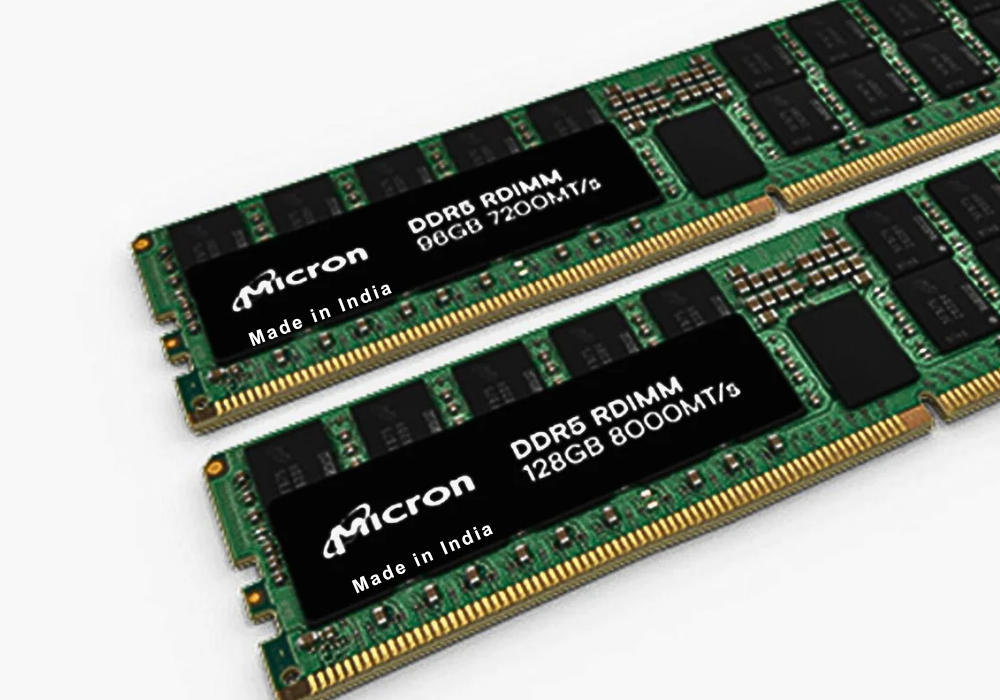
Micron has just marked a major milestone in India’s semiconductor journey. The company inaugurated the world’s largest single raised-floor semiconductor clean room at its new Assembly, Testing, Marking, and Packaging (ATMP) facility in Sanand, Gujarat. This clean room spans 500,000 square feet, making it the biggest of its kind globally. Prime Minister Narendra Modi and Micron CEO Sanjay Mehrotra were present at the launch, underscoring the strategic importance of this project for India’s tech ecosystem.
  • First in India: This is India’s first advanced memory ATMP site, a crucial step in building domestic semiconductor capabilities.
  • Products: The facility will handle DRAM and NAND flash memory, essential for PCs, smartphones, data centers, and SSDs.
  • Scale: Micron invested about $2.7–2.75 billion in the project, with plans to expand further in Phase 2.
  • Output: The plant is expected to produce hundreds of millions of chips annually, converting wafers from Micron’s global network into finished products.
  • First Shipment: The inaugural batch has already rolled out, with Dell as the first customer, signaling immediate commercial integration.
This facility is not just about scale—it’s about positioning India as a serious player in the global semiconductor supply chain. With memory chips being the backbone of modern computing, Micron’s Sanand plant strengthens India’s role in critical technology manufacturing. It also aligns with the government’s push for “Make in India” in high-tech sectors.

Micron’s massive clean room in Gujarat is more than a symbolic win—it could reshape India’s semiconductor ecosystem and global supply chains in several ways:

Impact on India’s Semiconductor Ecosystem

  • Domestic Capability: India now has its first advanced memory ATMP facility, moving beyond software dominance into hardware manufacturing. This strengthens India’s credibility as a chip producer.
  • Startup Boost: Local startups in electronics design, testing, and packaging can plug into Micron’s ecosystem, gaining access to supply chains and talent. This could spur innovation in AI hardware, IoT devices, and consumer electronics.
  • Skill Development: The facility will train thousands of engineers and technicians, creating a skilled workforce that can support future fabs and related industries.
  • Diversification Away from East Asia: With most semiconductor assembly concentrated in Taiwan, South Korea, and China, Micron’s India plant offers a reliable alternative.
  • Resilience: By producing DRAM and NAND flash memory locally, India reduces risks of supply chain disruptions caused by geopolitical tensions in East Asia.
  • Integration with Global Tech Giants: The first shipment to Dell signals immediate integration into global supply chains, showing that India can deliver at scale and quality.
In short, Micron’s Gujarat facility positions India as a new node in the global semiconductor map, reducing reliance on East Asia and opening doors for local startups to scale globally.

Micron to Commence Production at Gujarat Facility by This Month-End

Micron to Commence Production at Gujarat Facility by This Month-End

At the India AI Impact Summit 2026, S Krishnan, Secretary of the Ministry of Electronics and IT (MeitY), officially announced that Micron Technology will begin production at its ATMP (assembly, test, mark, and package) facility in Sanand, Gujarat by the end of February 2026. He emphasized that this will be India’s first commercial-scale semiconductor production facility, and highlighted Micron’s work on high-bandwidth memory (HBM) as part of its expansion strategy.

Earlier, Union Minister Ashwini Vaishnaw confirmed at the World Economic Forum in Davos that Micron’s $2.75 billion Gujarat chip packaging facility will commence operations by February 2026, framing it as a major milestone in India’s semiconductor mission and AI ambitions.

This marks a historic milestone as India’s first commercial-scale semiconductor assembly, test, mark, and package (ATMP) plant.

Key Details

  • Facility: Located in Sanand, Gujarat.
  • Timeline: Production begins by February-end 2026.
  • Scale: $2.75 billion investment, one of the largest in India’s semiconductor sector.
  • Technology Focus:
    • High-Bandwidth Memory (HBM) for AI computing and data-intensive workloads.
    • Advanced packaging solutions to support global semiconductor supply chains.
  • Policy Context: Part of the India Semiconductor Mission, with government approval for 10 semiconductor projects.
  • Strategic Impact: Positions India as a credible player in the global chip ecosystem, reducing reliance on imports and boosting AI infrastructure.

Why It Matters

  • For India: A decisive step in building domestic semiconductor capacity, critical for AI, 5G, and electronics manufacturing.
  • For Micron: Strengthens its global footprint while tapping into India’s growing demand for memory and storage solutions.
  • For AI Ecosystem: HBM production directly supports AI workloads, making India a hub for next-gen computing infrastructure.
The announcement aligns with India’s Semiconductor Mission, under which the government has approved 10 semiconductor projects. Micron’s Gujarat facility is seen as a flagship project that will anchor India’s entry into global semiconductor manufacturing.  

Micron’s Journey: From Investment to Production in Gujarat

Timeline

  • June 2023
    Micron Technology announces plans to build a new semiconductor assembly and test facility in Sanand, Gujarat. The $2.75 billion investment is part of India’s Semiconductor Mission.
  • Late 2023
    Construction begins in phases, with government support and approvals under the India Semiconductor Mission.
  • 2024–2025
    Micron works on facility development, workforce training, and partnerships to prepare for advanced packaging and high-bandwidth memory (HBM) production.
  • January 2026
    At the World Economic Forum in Davos, Union Minister Ashwini Vaishnaw confirms that Micron’s Gujarat facility will commence operations by February-end 2026.
  • February 16, 2026
    At the India AI Impact Summit, MeitY Secretary S Krishnan announces that Micron will begin production at its ATMP facility by the end of February 2026. He highlights Micron’s role in producing HBM for AI workloads.
  • February-End 2026
    Micron officially begins production at India’s first commercial-scale semiconductor ATMP plant, marking a milestone in India’s semiconductor journey.

Micron to Roll Out the First Made-in-India Chips From Gujarat Facility in 2025 for Global Export

Micron to Roll Out the First Made-in-India Chips From Gujarat Facility in 2025 for Global Export

Micron Technology is set to roll out its first batch of semiconductor chips manufactured in India from its Sanand facility in Gujarat by early 2025, the company's India managing director Anand Ramamoorthy, in an interaction with Economic Times. This move is part of a broader strategy to cater to global demand, with a significant portion of the output intended for export markets.

The Sanand unit is focused on exporting chips and is expected to serve multiple sectors, including data centers, smartphones, notebooks, internet-of-things devices, and the automotive industry.

The emphasis is on agility and addressing talent scarcity in niche sectors like cybersecurity as the company prepares for this significant step in semiconductor manufacturing. This development is a part of India's growing semiconductor industry and is expected to contribute to the global supply chain diversification efforts.

The plant will focus on the assembly and test manufacturing for both DRAM and NAND products. The facility is part of Micron's strategy to meet long-term global demand for memory and storage, complementing the company's global assembly and test network.

This development is a testament to India's growing capabilities in the high-tech manufacturing sector and its potential to contribute to the global semiconductor supply chain.

The semiconductor chips to be packaged at Micron's Sanand unit in Gujarat are intended for a wide range of applications and will primarily be used in Data Centers, Smartphones, Notebooks, Internet-of-Things (IoT), Automotive Segments (ADAS).

Idaho based Micron's product range includes DRAM, flash memory, and SSDs, marketed under brands like Ballistix Gaming and Crucial.

In 2023, Micron reported a revenue of US$ 15.54 billion. The company employs around 43,000 people worldwide. Micron has been instrumental in several technological advancements, including the development of atomic layer deposition high-k films for DRAM and pioneering pitch double-patterning for NAND flash memory.

Besides Micron, Indian conglomerates – Tata and Vedanta, are also setting up semiconductor chips manufacturing plants in the country.

Collaborating with a Taiwanese partner, Tata is planning to set up India's first semiconductor fabrication plant in Gujarat's Dholera. The project is estimated to cost Rs 91,000 crore and aims to produce 300 crore chips annually for various sectors.

While, Vedanta has announced a $20 billion investment in technology, electronics, and glass businesses over the next four years, which includes semiconductor manufacturing.

Interestingly, even cricket icon Sachin Tendulkar has invested in a semcon company called RRP Electronics which is investing Rs. 5,000 crore in a semiconductor facility, contributing to the 'Make In India' initiative.

In addition to these, companies like Tata Elxsi, Dixon Technologies, Moschip Technologies, and SPEL Semiconductor Limited are also involved in the semiconductor sector and are considered key semiconductor stocks in India.

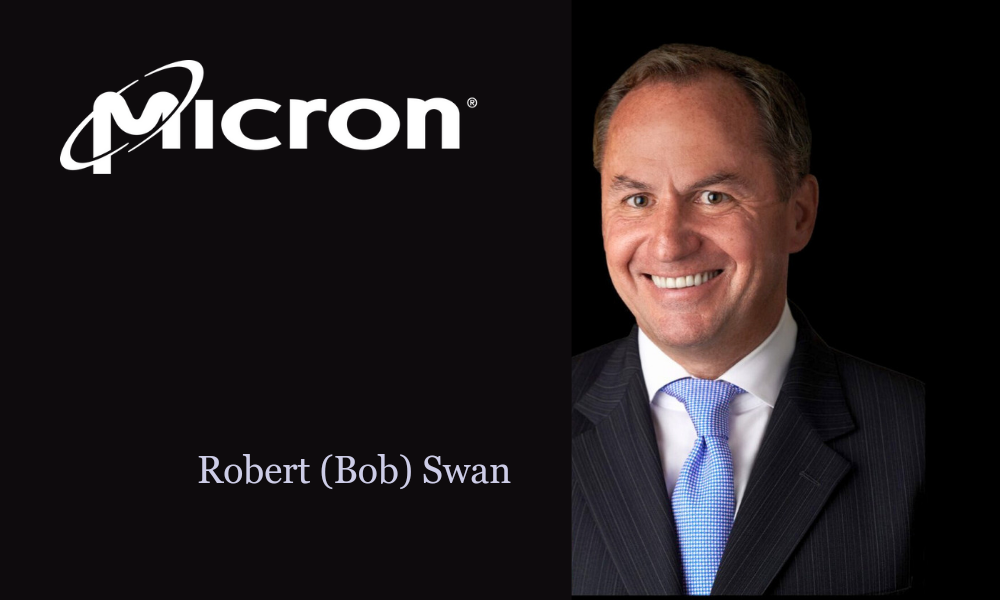
Micron Appoints Robert Swan, Partner at Andreessen Horowitz, To Its Board of Directors

Micron Appoints Robert Swan, Partner at Andreessen Horowitz, To Its Board of Directors

Micron Technology, Inc. (Nasdaq: MU), an industry leader in innovative memory and storage solutions, on Monday, announced the appointment of Robert (Bob) Swan to its board of directors. Swan is currently an operating partner at Andreessen Horowitz (also known as a16z), a venture-capital firm. He will also serve on both the Audit and Finance Committees.

Swan’s extensive background includes his tenure as CFO and later CEO of Intel Corporation, where he oversaw 110,000 employees and $78B in annual sales. Prior to joining Intel, as CFO of eBay, Swan played a significant role in driving the company’s global expansion strategy. Swan also held notable roles as CFO at Electronic Data Systems Corp., TRW Inc., and Webvan Group, Inc., where he additionally served as COO and CEO.

Bob’s track record in driving growth and operational excellence at some of the world’s leading technology companies will be invaluable to Micron as we continue to scale our business and solidify our position at the forefront of the memory and storage industry,” said Micron President and CEO Sanjay Mehrotra. “We are thrilled to welcome Bob to our board and look forward to his contributions to our strategic direction and long-term success.”

In addition to his new position at Micron, Swan is on the boards of several organizations, including the board of directors for Nike, Inc., Flexport and the board of commissioners of GoTo Group. He previously served on the board of directors for eBay, Applied Materials, Intel and Skype.

Bob’s proven ability to navigate complex market dynamics and foster innovation will be pivotal for Micron as we advance our strategic objectives and uphold our commitment to delivering state-of-the-art memory and storage solutions,” said Robert E. Switz, chairman of the board at Micron.We are eager to collaborate with Bob and benefit from his vision, financial acumen and leadership experience.

Swan began his career at General Electric, where he spent 15 years in numerous senior finance roles, including divisional CFO for GE Transportation Systems, GE Healthcare Europe, and GE Lighting. Swan received his B.S. from the University at Buffalo and his M.B.A. from the State University of New York at Binghamton. He received his honorary doctorate from Binghamton in 2022.

About Micron Technology, Inc.

We are an industry leader in innovative memory and storage solutions transforming how the world uses information to enrich life for all. With a relentless focus on our customers, technology leadership, and manufacturing and operational excellence, Micron delivers a rich portfolio of high-performance DRAM, NAND and NOR memory and storage products through our Micron® and Crucial® brands. Every day, the innovations that our people create fuel the data economy, enabling advances in artificial intelligence and 5G applications that unleash opportunities — from the data center to the intelligent edge and across the client and mobile user experience. To learn more about Micron Technology, Inc. (Nasdaq: MU), visit micron.com.

Micron Setting Up New $2.75 Bn Semiconductor Assembly and Test Facility in Gujarat, India

Micron Setting Up New $2.75 Bn Semiconductor Assembly and Test Facility in Gujarat, India
New DRAM and NAND assembly and test facility – the first in India – will expand Micron’s global manufacturing base to meet future demand

Micron Technology, Inc., one of the world’s largest semiconductor companies, has announced plans to build a new assembly and test facility in Gujarat, India, a day after Prime Minister Narendra Modi met Sanjay Mehrotra, the Indian-American President and CEO of Micron, in Washington DC during his state visit to the US.

Micron’s new facility will enable assembly and test manufacturing for both DRAM and NAND products and address demand from domestic and international markets.

While Micron will invest $825 million in setting up the facility, the remaining 1.925 billion will be supported together by Central Government of India and Gujarat state government as fiscal support and in incentives, respectively.

Phased construction of the new assembly and test facility in Gujarat is expected to begin in 2023. Phase 1, which will include 500,000 square feet of planned cleanroom space, will start to become operational in late 2024.

The combined investment by Micron and the two government entities — Central Government of India and Gujarat State Government — over the course obf both phases will be up to $2.75 billion.

Micron will receive 50% fiscal support for the total project cost from the Indian central government and incentives representing 20% of the total project cost from the state of Gujarat, which comes under the government's “Modified Assembly, Testing, Marking and Packaging (ATMP) Scheme" announced in July last year, by Ministry of Electronics & IT (MeitY), Government of India.

Micron’s investment will be up to $825 million over the two phases of the project and will create up to 5,000 new direct Micron jobs and 15,000 community jobs over the next several years.

We are excited about the steps India is taking to develop the local semiconductor ecosystem,” said Micron President and CEO Sanjay Mehrotra. “I am grateful to the Indian government and all of the officials involved that made this investment possible. Our new assembly and test location in India will enable Micron to expand our global manufacturing base and better serve our customers in India and around the world.”

Micron’s investment to set up assembly and test manufacturing in India will fundamentally transform India’s semiconductor landscape and generate tens of thousands of high-tech and construction jobs,” said Union Cabinet Minister for Railways, Communications, Electronics and IT Shri Ashwini Vaishnaw. “This investment will be a crucial building block in the country’s blossoming semiconductor ecosystem.”


Micron Nears $1 Bn India Semiconductor Packaging Plant Investment

Micron Nears $1 Bn India Semiconductor Packaging Plant Investment

US based semiconductor company, Micron Technology, is close to committing at least $1 billion towards setting up a semiconductor packaging factory in India, Bloomberg News report said.

The official announcement regarding this significant investment could be made during the upcoming visit of Prime Minister Narendra Modi to the United States this week. The report further said that the amount of money committed could go as high as $2 billion. The details could change as discussions are in progress, and however there’s no guarantee an agreement will be finalized.

The 44-years-old company, Micron Technology, is a semiconductor company that produces DRAM, SDRAM, flash memory, SSD and CMOS image sensing chips. The $38 billion company offers the industry's broadest portfolio of silicon-to-semiconductor solutions. Micron has 11 manufacturing sites spread across the US, Japan, Malaysia, Singapore, Taiwan and China.

Recently, Micron announced an investment of up to $100 billion over the next 20 Years to construct a new Mega Fab In Clay, New York. With the first Phase of investment of $20 billion planned by the end of this decade.

Earlier this month, Indian media reports also suggested that Modi-led central government has started discussions with US-based Micron Technology to go beyond setting up an Assembly Testing Marking and Packaging (ATMP) facility in India to include a fabrication, or fab, plant.

Micron also said that it was committed to China and would invest 4.3 billion yuan ($603 million) over the next few years in its chip packaging facility in the Chinese city of Xian. This comes despite the fact that China, which is world’s largest semiconductor market, has put a ban on the use of Micron chips in what Beijing called critical infrastructure.

Notably, China has put a ban on using Micron’s products as Chinese authorities announced in late May that Micron failed a cybersecurity review and warned operators of critical infrastructure in the country against buying Micron’s products.

Post this ban, the US is looking at India to strengthen key supply chains outside of China.

In addition, Prime Minister Modi has also pledged $10 billion to woo global chipmakers to India, promising his administration will bear half the cost of setting up all semiconductor sites.

Micron and Tata Communications Accelerate IoT Deployment With Cloud-Based Virtual SIM

Representation Only Image

Solution offers flexible global cellular-enabled connectivity, underpinned by trusted edge-to-cloud onboarding


BOISE, Idaho, and MUMBAI, India, Oct. 27, 2020 (GLOBE NEWSWIRE) -- Micron Technology, Inc., (Nasdaq: MU) and Tata Communications (NSE: TATACOMM) today announced they are joining forces to create a worldwide cellular-enabled connectivity solution that will simplify and accelerate large-scale global deployment of internet of things (IoT) devices. This solution will be powered by a new virtual SIM, the world's first cloud-based embedded subscriber identity module (eSIM), which offers a flexible, scalable alternative to conventional physical SIM cards. The cloud-based eSIM will be enabled by Micron's Authenta™ Key Management Service (KMS) , the industry's first silicon-based security-as-a-service platform for edge devices.

With this technology, the Tata Communications MOVE™ Global IoT Solution will offer a pervasive, end-to-end solution for zero-touch onboarding of connected IoT devices to cloud services across 200 countries and territories — backed by the company's relationships with more than 600 mobile network operators worldwide. The solution will unleash innovation in the expanding IoT services ecosystem, which is predicted to nearly triple in revenue by 2026 to $466 billion (ABI Research, IoT Market Tracker — Worldwide, 2Q 2020 ).The companies are demonstrating this solution, launching in 2021, at the online Micron and Tata Communications IoT Security Conference , kicking off today.

"The business landscape we're experiencing today is uncharted territory, one that is forcing organizations to be agile and adopt zero-touch, digital-first technologies and applications," said Tata Communications Chief Strategy Officer Tri Pham. "IoT solutions can help businesses become more efficient and productive, and can also bring in new opportunities and innovations, enabling them to scale new levels of growth."

Pham added, "Yet cybersecurity, seamless integration, and reliable, robust connectivity and global reach continue to remain key barriers to global enterprise adoption. By joining forces with Micron to reimagine edge connectivity and security, we will create a new paradigm that will rapidly accelerate and simplify IoT deployment."

While industry projections ha d forecasted 50 billion IoT device deployments by 2020, the reality has fallen short with only around 9 billion IoT devices deployed. This disparity stems from vastly underestimated challenges with cellular-enabled connectivity and cybersecurity, which hamper IoT growth. Though cellular connectivity offers significant advantages over Wi-Fi — such as longer range, better outdoor performance, stronger security and existing global infrastructure — ABI Research predicts only 420 million cellular-connected IoT devices in 2021, just a fraction of total IoT deployments (ABI Research, M2M Embedded Cellular Models, 3Q 2020 ). This gap is due to the intricate logistics required for worldwide cellular-enabled services, such as management of physical SIM cards and fixed contracts per operator per country.

Tackling these challenges head-on, Tata Communications will offer a cloud-based eSIM for IoT, underpinned by Micron's flash-based identity platform Authenta KMS. The solution will enable:

Highly scalable IoT security : In lieu of a physical SIM card to verify mobile identity, Authenta KMS provides device identities for the virtual SIM in the cloud, enabling secure, zero-touch device registration and onboarding to IoT services. Seamless global connectivity : The new SIM feeds IoT devices with secure borderless cellular-enabled connectivity anytime and anywhere, eliminating the complex management of physical SIM cards, localized operator contracts and roaming fees. This is especially beneficial for the industrial, infrastructure, automotive, aviation, and transport and logistics sectors that demand far-reaching, global connectivity for portable devices even in remote locations, unfettered by borders and close-range Wi-Fi networks. The solution will also allow enterprises to incorporate 5G into their IoT deployment strategies, taking advantage of 5G's lower latency, higher capacity and faster data speeds. On-demand cellular -enabled subscription : The unique approach to SIM technology enables just-in-time delivery of SIMs so that users don't have to subscribe to a monthly service until the connection is actually needed in the field. This just-in-time delivery reduces customers' capital and operational expenditures, as compared to physical SIM cards that require activation of service contracts well before shipping. Pay-as-you-go flexibility : Tata Communications MOVE™ platform enables pay-as-you-go service, instead of fixed monthly contracts. This is especially beneficial for customers who don't need always-on cellular-enabled connectivity, such as those combining Wi-Fi and mobile networks. Micron and Tata Communications open up innovation for the IoT services ecosystem

In dramatically simplifying flexible global connectivity, the edge-to-cloud solution will also unlock rich possibilities for innovation in the IoT market.

"The IoT ecosystem is at a tipping point. While there is untapped business opportunity, current hardware security methods are too complex and costly, or they limit scalability and flexibility," said Kris Baxter, vice president and general manager of Micron's Embedded Business Unit. "With Tata Communications' cloud-based virtual SIM, Micron's Authenta edge security will bridge this gap, fostering enterprise IoT adoption and open innovation in IoT services."

With physical SIM cards, OEMs must tightly pair device identity to the IoT service during manufacturing to prevent interaction of insecure devices and services, but this results in vendor lock-in. Authenta's simple authentication decouples IoT service security needs from manufacturing flow by allowing late binding of third-party certificates. This flexibility frees end users to securely access diverse, vendor-agnostic services, allowing them to customize and harness IoT devices as platforms for innovation, akin to the robust customization of smartphones with mobile app stores today. Opening up the ecosystem, Micron and Tata Communications will empower the IoT services market to reach its full promise with a broader device footprint.

Micron's Authenta security-as-a-service solution powers flash-based IoT identities

As the threat landscape grows riskier with sophisticated bad actors and hacks on IoT devices from connected fish tanks to baby monitors , cybersecurity is a weak link in IoT adoption. Through its silicon root of trust, Authenta provides a unique level of protection for the lowest layers of IoT software. Starting with the boot process, Authenta uses strong cryptographic identity and security features baked natively into flash memory. To enable device compatibility with this new SIM, OEMs need only to install Authenta flash ; no secure key injection or added secure elements are required.

Leveraging this root of trust, Micron's cloud-based service Authenta KMS authenticates these IoT devices, allowing them to be activated and managed at the edge. This enables platform-hardening and device protection through the entire lifecycle, from manufacturing to installation. The ease of this security-as-a-service solution is particularly beneficial for traditional manufacturers making forays into connected devices for IoT use cases. With Authenta's plug-and-play security, these OEMs, who lack cybersecurity experience, can focus on their core competencies and rely on Micron's decades of embedded expertise to provide hardware security.

Availability

This cloud-based eSIM for IoT devices is slated to begin shipping in the first half of 2021. Those interested in learning more about the eSIM can reach out to MOVE@tatacommunications.com . For additional inquiries on Micron's Authenta technology, contact authenta@micron.com .

About Micron Technology, Inc.

We are an industry leader in innovative memory and storage solutions. Through our global brands — Micron® and Crucial® — our broad portfolio of high-performance memory and storage technologies, including DRAM, NAND, 3D XPoint™ memory and NOR, is transforming how the world uses information to enrich life for all . Backed by more than 40 years of technology leadership, our memory and storage solutions enable disruptive trends, including artificial intelligence, 5G, machine learning and autonomous vehicles, in key market segments like mobile, data center, client, consumer, industrial, graphics, automotive, and networking. Our common stock is traded on the Nasdaq under the MU symbol. To learn more about Micron Technology, Inc., visit micron.com.

© 20 20 Micron Technology, Inc. All rights reserved. Micron, the Micron logo, and Intelligence Accelerated are trademarks of Micron Technology, Inc. All other trademarks are the property of their respective owners.

About Tata Communications

Tata Communications is a digital ecosystem enabler that powers today's fast-growing digital economy. The company enables the digital transformation of enterprises globally, including 300 of the Fortune 500 – unlocking opportunities for businesses by enabling borderless growth, boosting product innovation and customer experience, improving productivity and efficiency, building agility and managing risk. With its solutions orientated approach and proven managed service capabilities and cutting-edge infrastructure, Tata Communications drives the next level of intelligence powered by cloud, mobility, Internet of Things (IoT), collaboration, security, and network services. Tata Communications carries around 30% of the world's internet routes and connects businesses to 60% of the world's cloud giants and 4 out of 5 mobile subscribers. The company's capabilities are underpinned by its global network, the world's largest wholly owned subsea fibre backbone and a Tier-1 IP network with connectivity to more than 200 countries and territories. Tata Communications Limited is listed on the Bombay Stock Exchange and the National Stock Exchange of India.

© 2020 Tata Communications. All rights reserved. TATA COMMUNICATIONS and TATA are trademarks of Tata Sons Private Limited in certain countries. All other trademarks are the property of their respective owners. Tata Communications MOVE is a trademark of Tata Communications in certain countries. All other trademarks are the property of their respective owners.

Market Reports

Market Report & Surveys
IndianWeb2.com © all rights reserved