Showing posts with label Laser internet. Show all posts

Google's Alphabet and Bharti Airtel Bringing New Laser Internet Technology in India

Google's Alphabet and Bharti Airtel Bringing New Laser Internet Technology in India

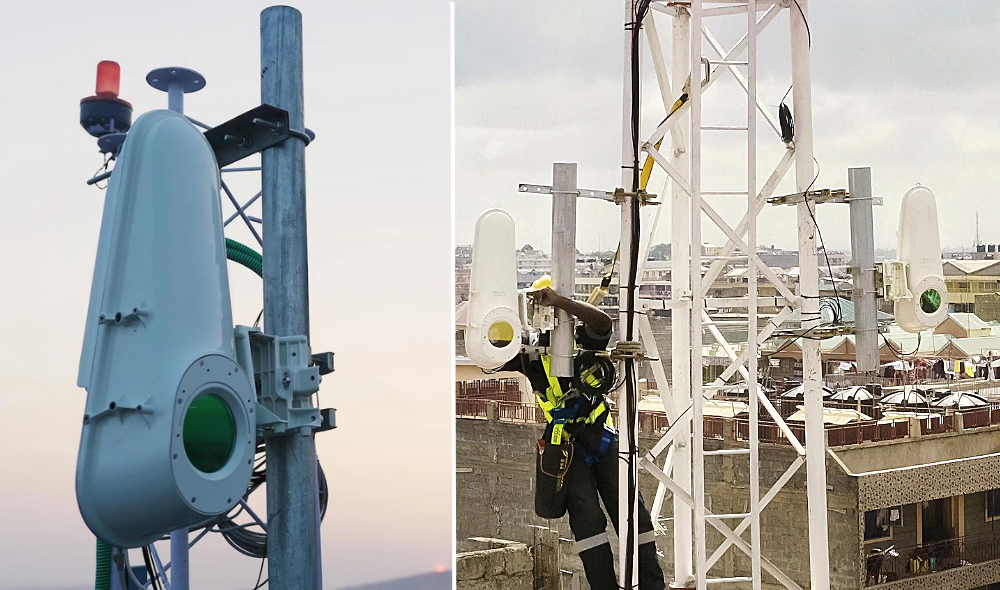
Google's parent Alphabet and Indian telecom and internet provider, Bharti Airtel, are working together to deploy a new laser internet technology in India, reported news agency Reuters.

This is being done under a project known as — Taara, a part of Alphabet's innovation lab called X, also nicknamed the "Moonshot Factory."

Based on open standards to work with existing infrastructure, including radio and fiber, Taara uses light to transmit information at super high speeds through the air as a very narrow, invisible beam.

The Taara team is implementing 20 Gbps connectivity over distances up to 20 km with units that are fast and easy to deploy. The team is working with telcos, internet service providers (ISPs), and governments around the world to significantly accelerate the deployment of the extensive, high-throughput networks necessary to support the future of the web.

The Taara team is currently deploying their light beam internet technology in India, Africa, and other locations around the world.

For Project Taara, the deployment with Bharti Airtel is its largest deployment in India to date, following several pilot projects including rural villages in Andhra Pradesh, downtown Nairobi, and remote areas of Fiji and Tonga

Notably, last year in January Google invested $700 million for a 1.28% stake in Bharti Airtel. Although, Taara's partnership with Bharti Airtel is separate from the Google investment.

In an official blog post, Mahesh Krishnaswamy, General Manager, Project Taara at X said, "Over the coming months Airtel will be deploying Taara’s links across their network in rural and urban areas in an effort to bring fast affordable internet to more people. This rollout follows a number of pilots with Airtel and is the largest deployment of Taara in India to date."

To recall, in a similar lines of laser based communications, Transcelestial, a Singapore-based startup which makes wireless laser communications equipment, had raised $10 million in a funding round led by Airbus Ventures and others, in February this year. 

Facebook Plans to Beam Internet to Backwaters With Lasers

Facebook and its dream of connecting remote areas to Internet is known to one and all. Last year, Facebook unveiled Aquila -- a solar-powered internet drone to beam internet to remote areas. And now, the social networking giant has developed something which might make its dream become a reality faster than ever.

A team of talented engineers at Mark Zuckerberg's Facebook Connectivity Lab have successfully developed a new optical technology that helps laser beams to deliver fast Internet access to remote areas all around the globe. The company was working on this for last half a year.

Lasers are considered as a favourable way to send data over to long distances because of two main reasons. Firstly, they have the potential of holdings in a lot of data/information and propagating a long distance. Not only this, they don't even need a dedicated spectrum of their own like in the in case of cellular networks, meaning they can be easily put to use in setting up ad hoc data links in locations that are totally off the grid. Secondly, since they make use of line-of-sight light transmission, more than one can be deployed in the same area without any disturbance.

Though, in order to attain high data rates, the detectors used for the purpose of catching the light signals will have to be small in size. The problem here is, when a beam of light transmits through space, it ends up becoming wider than the detector itself. While optics can be put to use for focusing the light back down, it's extremely expensive and majorly complex. Hence, Facebook's Connectivity Lab engineers decided to work around the problem and became successful in overcoming it.

Writing in the journal Optica, the engineers explains that instead of making use of optics, the engineers have used fluorescent materials for collecting light from data-carrying laser beams. A series of plastic optical fibers, which are applied with organic dye molecules known to absorb blue light and re-emit it as green light, are shaped into an almost spherical shape. When a laser signal makes contact with the optical fibers, they end up emitting green light within a time period of just two nanoseconds. Ultimately, the light ends up travelling down the length of the optical fibers and gets directed toward a small but fast photo-detector.

As of now, the system can be deployed for receiving signals carrying data at rates of up to 2.1 gigabits per second. But, according to the engineers behind the invention, it has the potential to go much faster than that if the system was built to absorb infrared, rather than blue light.

In order to realise its dream of taking data to the sticks, Facebook has been continuously coming up with several new ideas and projects. In fact, one of its project, the Telecom Infra Project, makes use of open-source cellular networks to attain similar outcomes.

Facebook Plans to Beam Internet to Backwaters With Lasers

Facebook and its dream of connecting remote areas to Internet is known to one and all. Last year, Facebook unveiled Aquila -- a solar-powered internet drone to beam internet to remote areas. And now, the social networking giant has developed something which might make its dream become a reality faster than ever.

A team of talented engineers at Mark Zuckerberg's Facebook Connectivity Lab have successfully developed a new optical technology that helps laser beams to deliver fast Internet access to remote areas all around the globe. The company was working on this for last half a year.

Lasers are considered as a favourable way to send data over to long distances because of two main reasons. Firstly, they have the potential of holdings in a lot of data/information and propagating a long distance. Not only this, they don't even need a dedicated spectrum of their own like in the in case of cellular networks, meaning they can be easily put to use in setting up ad hoc data links in locations that are totally off the grid. Secondly, since they make use of line-of-sight light transmission, more than one can be deployed in the same area without any disturbance.

Though, in order to attain high data rates, the detectors used for the purpose of catching the light signals will have to be small in size. The problem here is, when a beam of light transmits through space, it ends up becoming wider than the detector itself. While optics can be put to use for focusing the light back down, it's extremely expensive and majorly complex. Hence, Facebook's Connectivity Lab engineers decided to work around the problem and became successful in overcoming it.

Writing in the journal Optica, the engineers explains that instead of making use of optics, the engineers have used fluorescent materials for collecting light from data-carrying laser beams. A series of plastic optical fibers, which are applied with organic dye molecules known to absorb blue light and re-emit it as green light, are shaped into an almost spherical shape. When a laser signal makes contact with the optical fibers, they end up emitting green light within a time period of just two nanoseconds. Ultimately, the light ends up travelling down the length of the optical fibers and gets directed toward a small but fast photo-detector.

As of now, the system can be deployed for receiving signals carrying data at rates of up to 2.1 gigabits per second. But, according to the engineers behind the invention, it has the potential to go much faster than that if the system was built to absorb infrared, rather than blue light.

In order to realise its dream of taking data to the sticks, Facebook has been continuously coming up with several new ideas and projects. In fact, one of its project, the Telecom Infra Project, makes use of open-source cellular networks to attain similar outcomes.

Market Reports

Market Report & Surveys
IndianWeb2.com © all rights reserved