Showing posts with label IIT Ropar. Show all posts

MeitY Funded Ink-Manufacturing Technology Transferred to Two Startups

MeitY Funded Ink-Manufacturing Technology Transferred to Two Startups

The indigenous conductive ink manufacturing technology, based on silver nanowires, has been successfully transferred to two startups: Chematico Technologies Private Limited (incubated at IIT Ropar, Punjab) and Vasanthbala Functional Materials Pvt Ltd (incubated at NIT Warangal, Telangana).

This technology, developed under a project funded by the Ministry of Electronics and Information Technology (MeitY), is a significant step towards reducing India's dependency on imported conductive ink.

The indigenous conductive ink manufacturing technology was jointly implemented by Prof. Sarang Gumfekar from IIT Ropar and Prof. Shirish Sonawane from NIT Warangal.

Conductive ink technology has a wide range of applications across industries due to its ability to conduct electricity while being lightweight, flexible, and cost-effective.

The ink has versatile applications, including flexible electronics, wearable devices, solar panels, RFID tags, and more. The global market for such technology is projected to surpass $16.87 billion by 2032, driven by demand in electronics, semiconductors, and renewable energy.

This development not only supports India's self-reliance in advanced materials but also aligns with the broader goals of fostering innovation and boosting the semiconductor ecosystem.

This collaboration highlights the synergy between academic institutions and government initiatives in advancing India's technological self-reliance.
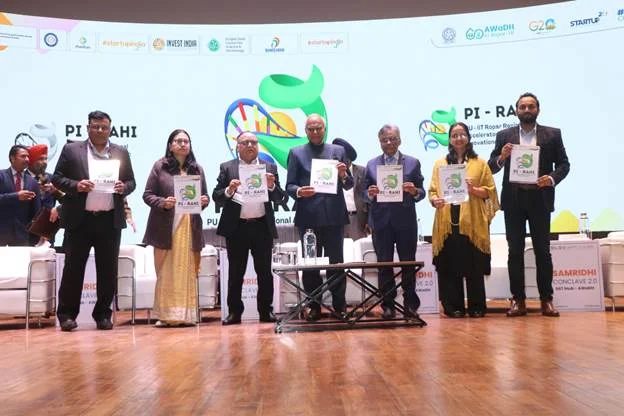
IIT Ropar Launches Deeptech Startup Accelerator Program for Innovation in Agriculture and Water Technology

IIT Ropar Launches Deeptech Startup Accelerator Program for Innovation in Agriculture and Water Technology

SAMRIDHI Conclave, a deeptech startup acceleration drive inaugurated at IIT Ropar

IIT Ropar has announced the launch of SAMRIDHI, a Deeptech Startup Accelerator Program. SAMRIDHI, is a Holistic Initiative for ICPS Startups, focusing on the transformative domains of agriculture and water.

The Governor of Punjab and Administrator of Chandigarh, Mr. Banwarilal Purohit, inaugurated a Deeptech Startup Accelerator Program dedicated to catalyzing innovation in agriculture and water technology called SAMRIDHI (Strategic Acceleration for Market, Research, Innovation & Development: a Holistic Initiative for ICPS Startups) hosted by iHub AwaDH, a Technology and Innovation Hubs set up UNDER National Mission on Interdisciplinary Cyber-Physical Systems (NM-ICPS).

The SAMRIDHI conclave in which five strategic collaborations were formalized, featured five deep-tech innovations. A total of 13 startups shortlisted through rigorous evaluation, presented their ideas while 25 startups showcased their solutions at the exhibition. More than 30 experts spoke on strategic acceleration for market research, innovation, and development.

Dr Akhilesh Gupta, Secretary of the Science and Engineering Research Board; Senior Adviser, DST, GoI, reinforced the efforts taken by the NMICPS to orchestrate the Technology Self-reliant Atmanirbhar Bharat. Mission Director of NM on ICPS Dr Ekta Kapoor, projected the key highlights of the mission leading to CPS technology interventions across sectors such as agriculture infrastructure health, defence, and environment.

Prof. Rajeev Ahuja, Director of IIT Ropar, Prof. Renu Vig, Vice Chancellor of Panjab University, Chandigarh, Dr Pushpendra Pal Singh, Project Director, AwaDH and Mr. Amitabh Nag, CEO of Bhashini Digital India were also present on the ocassion. The event emphasized DST's pivotal role in shaping the future of technology in the region through NMICPS. The Mission has led to the generation of 311 technologies, 549 technology products and created 1613 CPS research bases and contributed to more than 60000 cps skilling.

The conclave organised by IIT Ropar’s Technology and Innovation Hub AwaDH was supported by 46 investment partners, and over 50 jury members evaluated and mentored the startups. Over 110 partners nationwide actively contributed to driving innovation and fostering technological self-reliance. The program is executed with the Department of Science & Technology (DST), Government of India, under the National Mission on Interdisciplinary Cyber-Physical Systems (NM – ICPS), reinforcing DST's commitment to advancing technology and innovation.

IIT Ropar Develops 1st-of-Its-Kind Oxygen Rationing Device - AMLEX


To increase the life of medical oxygen cylinders three fold, the Indian Institute of Technology, Ropar has developed a first-of-its-kind Oxygen Rationing Device – AMLEX that supplies a required volume of oxygen to the patient during inhalation and trips when the patient exhales CO2. This process saves oxygen which otherwise unnecessarily get wasted.

So far, during exhalation, the oxygen in the oxygen cylinder/pipe is pushed out along with the exhaled CO2 by the user. This leads to wastage of a large volume of oxygen in long run. In addition to this, a large volume of oxygen escapes from the openings of the mask to the environment in the resting period (between inhalation and exhalation) due to continuous flow of life saving gas in the mask. As we have seen the demand of medical oxygen has jumped manifold amid the second wave of Covid-19, the device would help in stopping the unwanted wastage of the same.

“The device can operate on both portable power supply (battery) as well as line supply (220V-50Hz)”, said Director, IIT, Ropar, Prof. Rajeev Ahuja.

It has been developed by PhD students of Biomedical Engineering Department of the institution - Mohit Kumar, Ravinder Kumar and Amanpreet Chander under the guidance of Dr. Ashish Sahani, Assistant Professor, Department of Biomedical Engineering.

“Made specifically for oxygen cylinders, AMLEX can be easily connected between oxygen supply line and the mask worn by the patient. It uses a sensor which senses and successfully detects inhalation and exhalation of the user in any environmental condition”, said Dr Sahani. This ready to use device works with any commercially available oxygen therapy masks having multiple openings for air flow.

Appreciating the innovation, Dr GS Wander, Director, Research and Development at Dayanand Medical College, Ludhiana, said that in the present pandemic times we all have learnt the importance of effective and pertinent use of life saving Oxygen. He said though many hospitals are increasing their oxygen production capacity, a device like this can really help in limiting the use of oxygen in small rural and semi urban health centers.

Prof. Rajeev Arora said that the country now needs rapid but safe solutions to combat Covid-19. Since the virus is affecting the lungs and subsequently breathing system of the patient, the institution has not intended to go in for patenting of the device. He said rather the IIT would be happy to transfer this technology free of cost, in the interest of the nation, to those interested to go in for mass production of the device.

IIT Ropar Develops 'AmbiTAG', India's 1st Indigenous IoT Device for Secure Transportation of Vaccines, Blood and Body Organs, Food, Dairy


  • IIT Ropar develops "AmbiTAG"- India's first indigenous temperature data logger for the cold chain management
  • Nation's first-of-its-kind IoT device for secure transportation of vaccines, blood and body organs, perishable products (food and dairy), etc.
  • A step forward for "Atma Nirbhar Bharat."
  • Technology Innovation Hub AWaDH will give away the AmbiTag device at production cost for COVID vaccine transportation.
Indian Institute of Technology, Ropar (IIT Ropar) in Punjab has developed a first-of-its-kind IoT device – AmbiTag that records real-time ambient temperature during the transportation of perishable products, vaccines and even body organs and blood. That recorded temperature further helps to know whether that particular item transported from anywhere in the world is still usable or perished because of temperature variation. This information is particularly critical for vaccines including Covid-19 vaccine, organs and blood transportation.

Shaped as USB device, AmbiTag continuously records the temperature of its immediate surroundings “from -40 to +80 degrees in any time zone for a full 90 days on a single charge. Most of the similar devices available in the international market record data only for duration of 30- 60 days”, said AWaDH Project coordinator, Dr. Suman Kumar. He said it generates an alert when the temperature goes beyond a pre-set limit. The recorded data can be retrieved by connecting the USB with any computer. The device has been developed under Technology Innovation Hub – AWaDH (Agriculture and Water Technology Development Hub) and its Startup ScratchNest. AWaDH is a Govt of India project. Prof. Kumar said that the device is certified with ISO 13485:2016, EN 12830:2018, CE & ROHS.

Besides perishable items including vegetables, meat and dairy products it can also monitor the temperature of animal semen during transit. “So far, such devices are being imported by India in a massive quantity from other countries such as Singapore, Hong Kong, Ireland, and China," said Amit Bhatti, one of the founders and directors of ScratchNest.

AWaDH Project Director, Professor Pushpendra P. Singh informed that IIT Ropar Technology Innovation Hub is gearing for mass-production of AmbiTag. “The device will be made available to all companies involved in COVID vaccine transportation from production facilities to the last mile vaccination centers in the country at the production cost of Rs. 400. This device is our small contribution to the Nation for coming out of the never-seen-before-pandemic and a push towards the Atma Nirbhar Bharat”, said Prof. Singh.

1st Batch of IIT Ropar and The Second Wind Post Graduate Certificate in Artificial Intelligence & Deep Learning (PGCAIDL) completed


Students of the Post Graduate program in ‘Artificial Intelligence and Deep Learning’ (PGCAIDL) offered by IIT Ropar and The Second Wind will receive their certificates via an online convocation ceremony on the 29th of May 2021

At the convocation ceremony the Chief Guest and Director Prof. Rajeev Ahuja, IIT Ropar said, “I congratulate the students on their success. Domain expertise in AI is a skill that will prepare you for the future, as it finds more and more applications across industry verticals. We were proud to partner with The Second Wind to deliver this course to all of you. I also take this opportunity to thank the dedicated faculty at IIT Ropar and The Second Wind for navigating the students through this complex program. We at IIT Ropar are dedicated to offer more such innovative programs as we leverage our efficient operations and advanced technology. Our ultimate goal is to transform education with innovation and technology”.

Commenting at the ceremony, Anish Srikrishna, CEO Times Professional Learning said, “With the rapid emergence of AI, this course will prepare working professionals to meet the dynamic challenges at their workplace and help enhance their career. The Second wind will continue to play a leadership role towards building competencies that meet the requirements of the industry. I heartily congratulate all the students and wish them a very successful career ahead.”

Also present on the occasion were Dr. Rohit Sharma, Program Director – PGCAIDL, Co-ordinator ITJRC, Associate Professor – Department of Electrical Engineering IIT Ropar, Mr. Varun Dhamija, VP & Business Head, Online Programs – Times Professional Learning (TPL) and Mr. Mohan S, Head Technology Programs – TPL

Post Graduate Certificate in Artificial Intelligence & Deep Learning (PGCAIDL) is a 9 months program with live instructor-led sessions by top IIT faculty and industry experts. This artificial intelligence online course is designed for working professionals with weekend classes to impart AI learning.

About IIT Ropar

IIT Ropar is an engineering, science, and technology higher education institute located in Rupnagar, Punjab, India, imparting state-of-the-art technical education in a variety of fields. Its emphasis on promoting cutting-edge research and high quality publications is the key to its recognition in the international research community. It is a well reputed institute, having secured high ranks in ‘Times Higher Education (THE) World University Rankings 2020’, ‘QS India Rankings 2020’, and Union HRD Ministry’s ‘National Institutional Ranking Framework (NIRF)’, among others.

About The Second Wind (TSW)

The Second Wind (TSW) is an initiative by Times Professional Learning for working professionals who are keen to hone their skills to add value to their work for a more rewarding career. TSW’s passion for excellence and a brief that “Executive Education Empowers” works hand-in-hand with the organisation’s aim to impart knowledge to business professionals nationwide.

IIT Ropar Develops Portable Electric Cremation System

Dummy-testing of the Prototype of electric cremation system.

Indian Institute of Technology (IIT), Ropar has developed a prototype of a moveable electric cremation system which claims to be using first of its kind technology that involves smokeless cremation despite using wood. It uses half of the wood otherwise required for the cremation and still is eco-friendly because of the technology that uses combustion air system.

It is based on wick-stove technology in which the wick when lighted glows yellow. This is converted into smokeless blue flame with the help of combustion air system installed over the wicks.

IIT Professor Dr Harpreet Singh, Dean, Industrial Consultancy and Sponsored Research and Industry Interaction (ICSR&II) who has developed the system said that the cremation system or incinerator heats up at 1044 degree Celsius which ensures complete sterilization.

The cart-shaped incinerator has wheels and can be transported anywhere without much efforts. The cart is equipped with combustion air for primary and secondary hot air system. “The disposal of the body is completed within 12 hrs including cooling time as against 48 hours required in the normal wood-based cremation”, Prof. Harpreet added. Use of less wood can also reduce the carbon footprint by half. He said it requires less cooling time in the absence of refractory heat storage. It has stainless steel insulation on both sides of the cart for no heat loss and less wood consumption. It also has a tray beneath for easy removal of ashes.


He said that he has adopted tech-traditional model for cremation as it also uses wood. That has been done keeping in view our beliefs and traditions of cremating on wood pyre.

Keeping in view the present pandemic situation “if this system can be adopted, may provide respectable cremation to the near and dear ones of those who cannot afford the financial burden of arranging wood”, said Harjinder Singh Cheema, MD, Cheema Boilers Ltd. who has made the prototype. He said that since this is portable, it can be taken to any place with the permission of the concerned authorities. This will also help people to avoid space crunch in crematoriums as is the case in present context.

Market Reports

Market Report & Surveys
IndianWeb2.com © all rights reserved