Showing posts with label Health Insurance. Show all posts

Best Health Insurance for Single Individuals in Their 20s and 30s

Best Health Insurance for Single Individuals in Their 20s and 30s

When you are single in your 20s or 30s, health insurance can feel unnecessary. You have no dependents, few liabilities, and you may be healthy. Still, a sudden illness, injury, or planned surgery can lead to hospitalisation costs that strain savings.

A simple health insurance or mediclaim policy helps manage these expenses. This guide explains how to choose the best health insurance for a single adult in India.

Why Single Adults Should Choose an Individual Policy

When you live on your own, you handle expenses alone. A short hospital stay may affect rent, EMIs, or savings. Employer cover can be helpful, but it can change when you switch jobs. Many people keep their employer cover and add individual health insurance, depending on budget, so they have a steadier layer of protection.

What to Compare Before Choosing

For a single buyer, the best health insurance in India is usually the one that matches your city, your budget, and your comfort with the policy rules. Premium is essential, but the fine print can decide how much you pay from your pocket later.

Quick comparison of key features

Feature What it means Why it matters
Sum insured Maximum cover in a policy year, as per terms Helps manage larger hospital bills
Network hospitals Places where cashless may be available Can reduce the need for a full upfront payment
Room rent rules Limits on room category or charges May impact the final payable amount
Waiting periods Time before some conditions are covered Important even for young buyers
Co-payment or sub-limits (if any) Your share or caps on treatments Affects out-of-pocket spending

If two options look similar, the best health insurance is often the one with more precise wording and fewer restrictive limits that can surprise you.

Sum Insured and Deductibles: Keep it Balanced

Choosing the sum insured is not only about picking the highest number. A very low sum insured may feel affordable, but it may not feel adequate if hospital costs in your city are high. A very high sum insured may not fit a starter budget.

A simple approach is to look at typical private hospital costs where you live, your emergency savings, and any employer cover you already have. If you already have a base plan through work, the best health insurance for you may be a top-up or super top-up, but only after you understand the deductible and when the additional cover starts.

Add-ons: Pay Only for What You Understand

Add-ons can increase the premium, so treat them as optional tools, not defaults. Depending on the product, you may see options like consumables cover, higher room eligibility, or a daily cash benefit. For many single buyers, a simple base plan with only the add-ons that match their lifestyle and budget can feel easier to manage.

Terms worth reading before you buy

  • Pre-existing disease definition and related waiting period
  • Room rent conditions and how they influence billing
  • Sub-limits, if any, for specific procedures or treatments
  • Exclusions such as non-medical items and personal comfort expenses
  • Claim steps for cashless and reimbursement, including required documents
  • Renewal rules and how premiums may change with age or product changes
Spending a little time here can make your plan more straightforward to use later.

Bottom line

For single individuals in their 20s and 30s, health insurance can act as a financial buffer while careers and lifestyles evolve. Compare benefits calmly, read the essential terms, and choose a cover you can renew comfortably. With this approach, the best health insurance becomes a simple, informed choice rather than a rushed purchase.

India’s Top Business Tycoons Unite to Fund Healthcare for Supreme Court Lawyers

India’s Top Business Tycoons Unite to Fund Healthcare for Supreme Court Lawyers

India’s top industrialists—including Adani, Ambanis, Birla, and others—have collectively funded a ₹50 crore health insurance scheme for Supreme Court Bar Association (SCBA) members.

The initiative, announced during the Supreme Court’s 75th anniversary celebrations, was spearheaded by Kapil Sibal, who personally reached out to business leaders for contributions.

The scheme, underwritten by United India Insurance, provides ₹2 lakh coverage per family, including parents and in-laws, and covers pre-existing conditions from day one. It also offers cashless treatment across 15,000+ hospitals, ₹50,000 maternity benefits, and coverage for LASIK surgery, congenital conditions, and ambulance charges.

Sibal emphasized that the initiative is a lifeline for young lawyers, ensuring financial security as they enter the profession. The announcement was accompanied by the launch of Pillars of Justice, a book featuring essays on landmark Supreme Court judgments.

This move sets a precedent for corporate-backed welfare initiatives in the legal sector, with CJI BR Gavai urging other Bar Associations to adopt similar models.

The legal community has largely welcomed the ₹50 crore health insurance scheme for Supreme Court lawyers, seeing it as a landmark welfare initiative. Many lawyers, especially young professionals, have expressed relief at having financial security for medical expenses.

Kapil Sibal, who spearheaded the initiative, described it as a lifeline for lawyers entering the profession, ensuring they have a safety net while building their careers. The Chief Justice of India, BR Gavai, praised the move and urged other Bar Associations to adopt similar models to support lawyers across the country.

The scheme’s cashless treatment, maternity benefits, and coverage for pre-existing conditions have been particularly appreciated, with many lawyers calling it a game-changer for the profession.

How Much Health Insurance Do You Need To Cover Your Family?

How Much Health Insurance Do You Need To Cover Your Family?

With the rising number of diseases and inflated healthcare costs, a family health insurance plan emerges as a major financial support. It allows you and your family to access high-quality healthcare services without facing any financial crunch.

But what is the right amount of insurance coverage that a family should get? Read along to know.

What is Family Health Insurance?

Family health insurance is a policy that provides coverage for the medical expenses of all the family members under the same plan. The sum insured by the plan is shared among all the family members covered under the plan.

How Much Family Health Insurance Coverage is Good?

The health insurance coverage requirements for a family vary based on multiple factors such as number of members, their age and health condition, income of the policyholder and many others.

As a general rule of thumb, the amount of your family insurance should be 50% of your annual income.

For example, if you earn ₹30 lakhs in a year, then having a coverage of ₹15 lakhs would be sufficient. Moreover, the baseline is that you must have at least insurance of ₹5 lakh to cover healthcare costs in such a rising inflation.

It is suggested that you make the final decision after considering your family’s healthcare needs and other important factors. Remember, every family has different medical concerns and, thus, requires a customised plan with necessary coverage accordingly.

Factors to Consider Before Choosing Your Family Health Insurance Cover

Medical History

If you or anyone in your family has a history of any disease, such as diabetes or hypertension, you must be careful while choosing family insurance coverage. In case of particular health risks, go for the health insurance plans for the family that provide coverage for it.

Age

While choosing family health insurance coverage, it is important to check the age of individuals covered under it. This is crucial because the coverage requirements are different for different age groups. For example: senior citizens have higher coverage requirements as compared to youngsters due to their deteriorating medical condition.

Sum-Insured Amount

The best mediclaim policy for a family is the one that offers an adequate sum-insured amount to cover the costly medical bills. When selecting sum insured, make sure to consider your income, budget and medical costs in your area.

Premium Price

The amount of the family insurance premium price should be within your budget range. It is not a good idea to choose a high premium that might bring additional financial burden. Thus, make your calculations and buy the right insurance as per your budget.

Summing It Up

Family is the greatest asset for any person and safeguarding their wellbeing is the primary goal. With rising health issues all around the world, having the best mediclaim policy for family is a necessity for every individual.

Choosing the right health insurance plan requires some calculations and research into the best plans available. With that in mind, make sure to buy insurance for your family as early as possible to ensure their good health anf well-being.

Rising Health Insurance Premiums in India Due to Climate Change-Related Health Risks

Rising Health Insurance Premiums in India Due to Climate Change-Related Health Risks

Climate change is increasingly impacting various aspects of life, and one significant area affected is public health. In India, the growing frequency of climate-related events such as heatwaves, floods, and air pollution is leading to a surge in health issues. Consequently, health insurance plans are becoming more expensive as insurers adjust premiums to account for these heightened risks and increased claims. This article explores how climate change is influencing health risks in India, driving up health insurance premiums, and what this means for policyholders.

The Connection Between Climate Change and Health Risks

Climate change is contributing to a rise in health issues, with several key risks becoming more prevalent:

Heat-Related Illnesses: Increasing temperatures and more frequent heat waves are leading to a rise in heat-related conditions like heat exhaustion and dehydration, particularly among vulnerable populations such as the elderly.

Respiratory Problems: Climate change exacerbates air pollution, leading to an increase in respiratory issues like asthma and chronic obstructive pulmonary disease (COPD). Urban areas are particularly affected by rising levels of air pollution.

Vector-Borne Diseases: Changes in temperature and rainfall patterns are expanding the range of disease-carrying insects, leading to a rise in diseases such as malaria and dengue.

Waterborne Diseases: Flooding and changes in water availability are contributing to the spread of diseases like cholera and diarrhoea, especially in rural and underserved areas.

Mental Health Issues: The stress and anxiety caused by climate-related disasters are leading to a rise in mental health conditions such as depression and post-traumatic stress disorder (PTSD).

Impact on Health Insurance Premiums

As climate-related health risks become more prevalent, they are directly affecting the cost of health insurance plans in India. Insurers are adjusting their pricing models to account for these risks, leading to higher premiums. Several factors contribute to this trend:

1. Increased Claims Due to Climate-Related Health Issues

The rise in climate-related health issues has led to an increase in the number of claims filed by policyholders. This surge in claims is driving up costs for insurers, who in turn raise premiums to cover these expenses.

2. Rising Medical Costs

Healthcare providers are facing increased demand for services related to climate change, leading to higher costs for treatments, medications, and services. These rising medical costs are passed on to consumers through higher insurance premiums.

3. Adjustments in Risk Assessment Models

Insurers are revising their risk assessment models to better reflect the heightened risks associated with climate change. Factors such as geographic location, exposure to climate-related events, and the overall health profile of policyholders are now more closely scrutinised. Individuals living in high-risk areas may see higher premiums as insurers account for the increased likelihood of claims.

4. Introduction of New Coverage Options

In response to the specific health risks posed by climate change, some insurers are introducing new coverage options or riders that address these threats. These might include coverage for heat-related illnesses, air pollution-related treatments, or mental health support. While these options provide valuable protection, they also contribute to the overall cost of health insurance plans.

What Policyholders Need to Know

With rising health insurance costs due to climate change, policyholders need to take proactive steps to manage their insurance coverage effectively. Here are some key considerations:

1. Opt for Comprehensive Coverage

Given the broad range of health risks associated with climate change, it is crucial to choose a health insurance plan that offers comprehensive coverage, including hospitalisation, outpatient treatments, and coverage for chronic and acute conditions. Comprehensive coverage ensures protection against a wide spectrum of health issues, reducing the financial burden in case of illness.

2. Prioritise Preventive Care Benefits

Look for best health insurance plans that offer preventive care benefits, such as annual check-ups, screenings, and vaccinations. Preventive care can help detect and manage health issues early, potentially reducing the need for more costly treatments later.

3. Ensure an Adequate Sum Insured

As medical costs rise, it is essential to ensure that your health insurance plan provides an adequate sum insured. This will help cover the higher costs of treatment associated with climate-related health issues and protect you from significant out-of-pocket expenses.

4. Regularly Review and Update Your Policy

Given the evolving nature of climate-related health risks, it is important to regularly review and update your health insurance policy. This may involve increasing your sum insured, adding riders for specific risks, or switching to a plan that offers better coverage.

5. Explore Medical Reimbursement Options

In the face of rising premiums, policyholders may also want to consider medical reimbursement options, which allow for the reimbursement of medical expenses not covered by traditional health insurance. This can provide additional financial relief in the event of high out-of-pocket costs due to climate-related health issues.

Conclusion

Climate change is not only an environmental challenge but also a significant public health issue with far-reaching implications for health insurance plans in India. As insurers adjust premiums to account for increased risks, policyholders must carefully evaluate their insurance needs to ensure adequate coverage. By choosing comprehensive coverage, prioritising preventive care, and regularly reviewing policies, individuals can better protect themselves and their families from the financial impact of climate-related health risks.

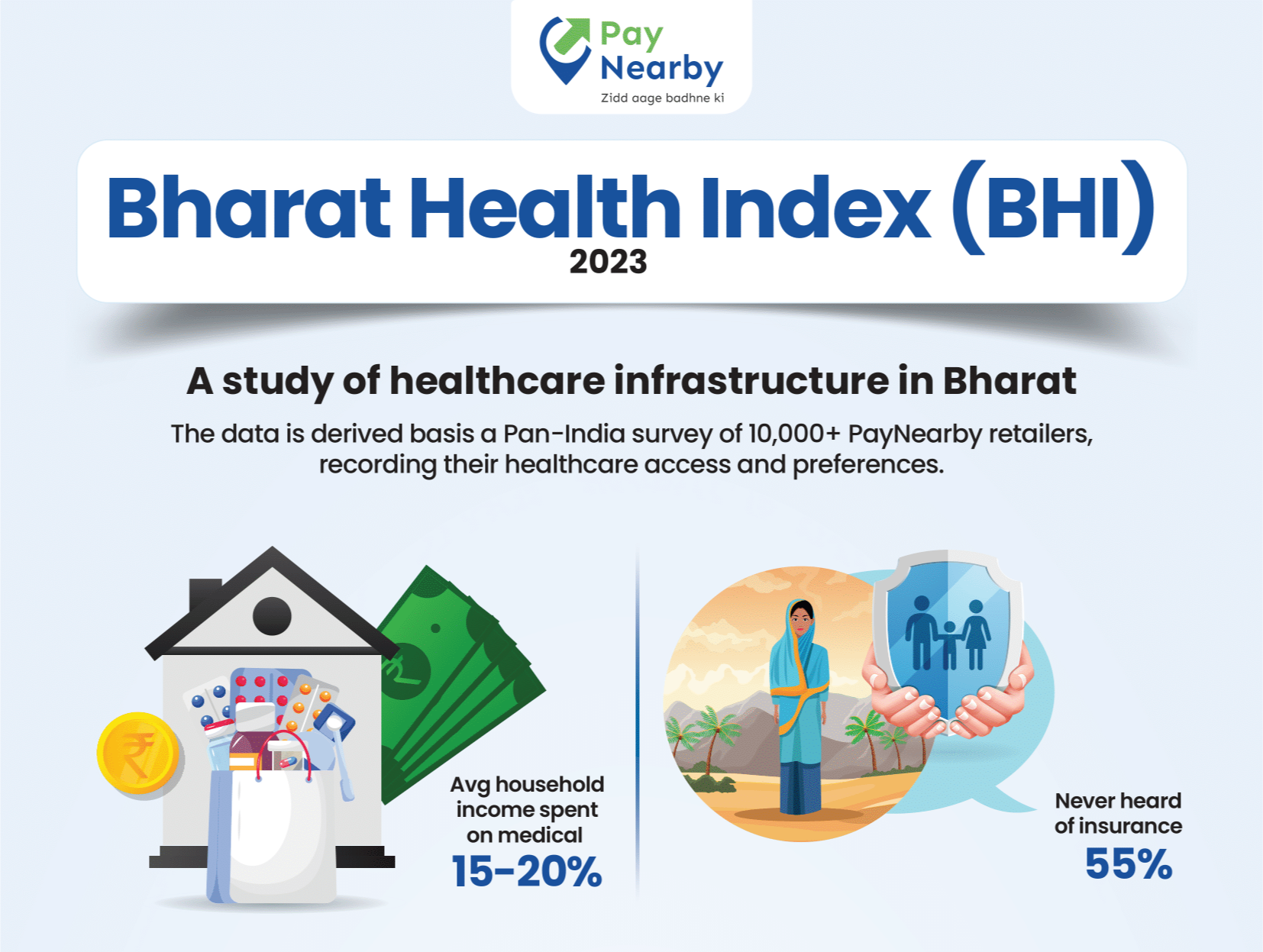
Bharat Health Index 2023: Bharat Spends An Average of 15-20% of Household Income on Medical Expenses; 32% Interested in Telemedicine Consultation

Bharat Health Index (BHI) 2023
On the occasion of India’s 76th Independence Day, PayNearby releases its first edition of ‘Bharat Health Index’ - a study of healthcare awareness in Bharat
  • 15-20% of yearly income spent on medical expenses in Bharat households
  • 55% of those surveyed have never heard of insurance
  • 70% did not have a health insurance cover
  • 23% relied on informal loans or borrowing to take care of hospital expenses
  • 45% travelled more than 10 kms to avail doctor services
  • 35% of respondents expressed interest in online medical purchases
  • 32% have shown interest on telemedicine consultation
Only 25% of the semi-rural and rural population in India have access to modern healthcare within their localities, highlighted a survey titled Bharat Health Index (BHI) 2023, released by PayNearby, India's largest branchless banking and digital network. The accessibility index saw a major dip as one moved from urban to rural India, with only 10% of the rural respondents citing that they had access to healthcare within a 10km radius.

These findings are based on survey responses of 10,000+ retailers across semi-rural and rural India over a month.

Lack of skilled healthcare providers at the last mile pose a significant challenge for accessibility. Only 15% of respondents confirmed having a doctor's clinic or healthcare facility within a 5 km radius. In terms of medical practitioners available, while 25% had access to general physicians in their area, 92% lacked specialised doctors, such as cardiologists, gynaecologists or paediatricians, impacting medical care.

Bharat Health Index (BHI) 2023

For specialised treatment such as cancer, neurological or blood disorders, 90% needed to travel to a different location for treatment. 5% reported loss of a loved one due to unavailability of specialist doctors at the local healthcare facility. The survey also evaluated the accessibility and convenience of medical stores at the last mile. A notable 52% of respondents had a pharmacy within 5 km radius of their residence, making essential medicines relatively accessible. However, 85% of the respondents had to travel more than 10 kms to obtain specialised medicines, indicating potential challenges for those with specific medical needs.

Interestingly, 47% of the respondents possessed a thermometer at home, while only 7% had instruments to check blood pressure and blood sugar, suggesting room for improved self- monitoring and prevention.

The survey also examined the funding mechanism for medical expenses and how affordability could be improved at the last mile. The report indicated that an average household in Bharat spent approximately 15-20% of their yearly income on medical expenses. 23% relied on informal loans or borrowing for hospital expenses, while 6% resorted to selling assets to pay off their medical bills. A significant 53% utilised some form of savings to cover these expenses.

Given the dependence on out-of-pocket expenses for medical costs, the survey emphasized the urgent need for setting up a financial funding mechanism to address the escalating medical expenses at the last mile. The penetration of financial products such as insurance emerged as crucial for enhancing healthcare affordability and accessibility. However, the report highlighted the abysmally low insurance awareness among Bharat’s last mile. A substantial 55% of the respondents had never heard of insurance. Among those aware of insurance, only 32% had opted for insurance at some point, with a mere 28% possessing health insurance for themselves or their families. Among those with insurance, 88% obtained it from government or state sponsored schemes, while less than 10% obtained it from private insurance providers.

For those without insurance, reasons varied. A substantial 38% cited affordability as a major hindrance, while others mentioned uncertainty about where to buy insurance (36%) or its benefits (24%). Respondents identified limited availability of health insurance providers and lack of information (32%) as the primary challenge. This was closely followed by high premiums (28%), complex documentation processes (15%), limited coverage for specific healthcare needs (18%), and language or literacy barriers (7%).

To improve overall accessibility of healthcare services, the survey also evaluated the affinity for online medicine purchase and teleconsultation among this population. 35% expressed interest in online medical purchases, 32% favoured telemedicine consultations, and 32% showed keenness for online awareness programs and diagnostics/lab tests- online appointments. The encouraging response towards digital adoption highlights the need for tech-led innovations and distribution models to broaden healthcare reach across the country.

Commenting on the findings, Mr. Anand Kumar Bajaj, Founder, MD & CEO, PayNearby said, “Over 70% of India resides in rural and semi-rural regions. This survey reinforces the urgent need to scale healthcare services for the masses. More than 80% of doctors, 75% of dispensaries, 60% of hospitals are concentrated in urban India, leaving out marginalised population in SURU to fend for themselves. While infrastructure scaling takes times, leveraging technology for distribution breakthroughs is crucial to cater to a wider audience. Reliable tele-consultation platforms and easy to use online pharmacy modules can greatly contribute. Our recently launched Health Correspondent program, is a step in that direction. Together with our retailers, the mission is to spread medical awareness and create local health hubs, ensuring the reach of critical primary health services through technology."

The survey also highlights the low penetration of insurance among our populace. To address this, more dialogue and action are needed to facilitate better insurance penetration in the country. This Independence Day, PayNearby has introduced Risk se Freedom Pao campaign, to not only build awareness but also eliminate roadblocks that keep people from availing insurance products. It’s critical that people perceive health insurance in the right light for a safer, better future for themselves and their families."

Commenting on the report findings, Jayatri Dasgupta, CMO, PayNearby, said, “As India celebrates its 76th Independence Day, an important yardstick to measure the health of the nation is to understand the state of health infrastructure and awareness among the country’s last mile. Affordable and accessible healthcare is pivotal for country’s progress. PayNearby’s Bharat Health Index (BHI) 2023 initiative addresses gaps in existing healthcare infrastructure and outlines ways to enhance it. The survey highlights the need for more trained medical professionals in rural areas, a better financial support system for medical expenses, accelerated insurance penetration, and the strategic use of technology for distribution breakthroughs.”

About PayNearby:

Incepted in April 2016, PayNearby is a DPIIT-certified company and India’s leading branchless banking and digital payments network. PayNearby operates on a B2B2C model, where it partners with neighbourhood retail stores and enables them with the tools to provide digital and financial services to local communities. PayNearby’s mission is to make financial services available to everyone, everywhere. The company aims to simplify high-end technology so that it can be easily assimilated at the last mile while transforming the lives of its retail partners and customers.

Today, PayNearby, through its tech-led DaaS (Distribution as a Service) network, serves 75% of India and is enabling services like cash withdrawal, remittance, Aadhaar Banking, bill payment and recharges, savings, travel, digital payments, insurance and more. Currently, PayNearby’s 50 lakh-plus micro-entrepreneurs across 20,000+ PIN codes assist 20+ crore customers across the country to the tune of more than ~7500 crores GTV per month.

To know more: www.paynearby.in

Mobility Fintech Moove To Offer An Industry-First Health Insurance Plan to Customers and Their Families in India

Mobility Fintech Moove To Offer An Industry-First Health Insurance Plan to Customers and Their Families in India
Moove aims to empower mobility entrepreneurs financially by providing them a path to asset ownership while ensuring the well-being of their families

Moove, the world's first mobility fintech has today announced a partnership with Reliance General Insurance to provide comprehensive health insurance coverage to its customers and their families in India. This industry-first initiative is part of Moove's vision to empower mobility entrepreneurs globally by democratising access to financial services.

The insurance package offers coverage of INR 2 lacs for customers, their spouse, and up to two children. The launch reinforces Moove’s commitment to support its customers and improve their overall quality of life.

Binod Mishra, Head of Moove India & SA, expressed excitement for this first-of-its- kind customer-centric offering, stating, "In less than a year, Moove has enabled sustainable job creation and a path to asset ownership for its customers.

By providing health insurance coverage to our customers and their families, we are not only ensuring their safety but also giving them peace of mind knowing their loved ones are taken care of. This offering reaffirms Moove's commitment to improving the lives of mobility entrepreneurs and their families in India."

Moove's drive-to-own model enables customers to become vehicle owners in 48 months, with lower rental fees, flexible hours, and no maintenance worries. Customers also benefit from revenue-sharing via advertising campaigns, along with parking holidays based on tenure, and health insurance for themselves and their family. This makes Moove a safe and sustainable alternative for mobility entrepreneurs in their journey to becoming independent.

Moove also offers refundable deposits for peace of mind and provides weekly incentives for those who work hard to meet their targets. The company currently has over 2000 customers driving Moove financed vehicles and is planning to launch an additional 5000 this financial year, with plans to scale further.

Moove is Uber’s largest supply partner in EMEA and launched its India operations by partnering with the global ridesharing leader in 2022.

For more information on Moove and its mission to financially empower mobility entrepreneurs globally, visit www.moove.io

About Moove

Moove

Moove is an African-born, global mobility fintech that is democratising access to financial services for mobility entrepreneurs. It does this by embedding its alternative credit scoring technology onto ride-hailing, logistics, mass transit, and instant delivery platforms, using proprietary performance and revenue analytics to underwrite customers that have previously been excluded from financial services. Moove operates in 13 markets across Africa, the Middle East, Europe, and Asia, and is Uber's largest vehicle supply partner across EMEA. Its customers have completed more than 17 million trips in Moove-financed vehicles.

Market Reports

Market Report & Surveys
IndianWeb2.com © all rights reserved