
Showing posts with label Developer. Show all posts

Autonomy Seen Highest Among US and Indian Software Developers and Lowest Among Germans

Autonomy in Software Development Highest Among US and Indian Developers, Lowest Among Germans

Greater Autonomy to Define the Future of Software Development: Survey

Atlassian Corporation Plc (NASDAQ:TEAM), a leading provider of team collaboration and productivity software and the maker of Jira, Confluence, Bitbucket and Trello products, has released its first-ever global State of the Developer report. The research shows that autonomy trumps all with greater autonomy making developers happier at work, despite more frequent context switching and increased job complexity. Developers who enjoy more autonomy tend to spend more time coding and are able to work on a greater number of products and services.

The report uncovers important trends in how developers' attitudes and preferences about their work have changed over the past year, including the rise of ‘You build it, you run it’ (YBIYRI) as a practice. YBIYRI is an increasingly common software development methodology with almost 60% of teams currently working this way. Teams working in YBIYRI require new and diverse roles, especially when they are transitioning into the practice.

A look at India’s developer ecosystem

The research shows that autonomy levels for developers globally is high, with 50% claiming strong autonomy. Additionally, stronger autonomy correlates with positive feelings about work, and autonomy is at its highest in the US and India (57% and 56% respectively) and lowest in Germany (29%).
 

It was observed that tool sprawl could be the worst in India with 78% of developers saying they are using more than six tools. In the US, this number is 72% while only half of the developers in Germany (50%) use more than six tools.

What should leaders consider when building and managing development teams?

Developer autonomy trumps all – The research shows that greater autonomy makes developers happier at work. Additionally, developers who enjoy more autonomy tend to spend more time coding and are able to work on a greater number of products and services. Autonomy levels are highest for developers who have been in their roles for 6-10 years, within larger companies (250-1000 employees), and in teams running YBIYRI.

Developers are taking more responsibility – The rise of YBIYRI as a practice has seen development teams doing more to support the code they work with. The research shows almost 60% of developers now work this way, with a larger number agreeing that they should be responsible for more of the software product lifecycle than they currently are (over 65%). Developers who are close to a product or service have the potential to improve it further when given a high degree of ownership. Engineering leaders should create more space for development teams to take on YBIYRI responsibilities, ensuring they have the right tools, processes, and rituals to be successful.

Coding or tooling is a matter of preference – Two-thirds of developers (65%) say that writing new code is the most valuable skill in their role, while 74% feel that being able to read code is vital. Yet 58% of developers don’t feel that writing code from scratch will be required as part of their roles in the future, and 51% say they mainly assemble code written by others. Managers and team leaders should let developers lean into those preferences rather than dictating “how things are done around here.”

Fewer tools isn’t always the best outcome – A majority of developers are using more tools to get work done than before (almost 70%), and that’s not necessarily a bad thing. Flexibility in tools is the key. Those with more flexible tools say it simplifies their work, making them happier in their roles, while those adopting a growing number of inflexible tools face the risk of tool sprawl. Almost half of the developers surveyed say they have a stable toolchain (46%). The remainder has increased the number of tools either with flexible tools (38%) or inflexible tools (16%).

Dinesh Ajmera, Site Lead and Head of Engineering, India, Atlassian said, “Our State of the Developer report presents some important findings on the state of play across the global software developer ecosystem, especially in the context of India. Among Indian developers, it was particularly heartening to see that our developer community in comparison to the other countries enjoyed a greater degree of autonomy and thereby stated to be happier at work."

“I believe this report presents an array of findings that will help leaders understand the changing dynamics of the developer ecosystem. At Atlassian, we recognize this and believe that by empowering our teams with the correct set of tools, technologies and processes we will be able to usher in a greater degree of autonomy and build efficiencies for teams," he further added.

There’s no one-size-fits-all approach

Greater autonomy is the future of software development. This means more freedom to decide which tools developers use, what they work on, and how that work gets done.

Atlassian is dedicated to providing the tools that facilitate this alignment and autonomy for teams of all sizes. With the recent launch of Compass, a new Atlassian program to create new products in collaboration with customers, developers are now going beyond coding and are empowered with the autonomy to connect the tools they want to use.

To find out more about the research and download the report, please visit - Autonomy is the future of software development - Work Life by Atlassian

Atlassian unleashes the potential of every team. Our team collaboration and productivity software helps teams organize, discuss, and complete shared work. Teams at more than 225,000 customers, across large and small organizations - including Bank of America, Redfin, NASA, Verizon, and Dropbox - use Atlassian’s project tracking, content creation and sharing, and service management products to work better together and deliver quality results on time. Learn more about our products, including Jira Software, Confluence, Jira Service Management, Trello, Bitbucket, and Jira Align at https://atlassian.com/.

About the research

Atlassian’s first State of the Developer report seeks to uncover the attitudes, preferences, and behaviors of modern software developers. The study offers a range of perspectives on how developers are working, their perception and attitudes on the future skillsets required to succeed, how they’re managing tool sprawl, and what drives job satisfaction. 

This research looks into the trends shaping software development and their impact on development teams in markets across the world. The survey ran for a month between August and September 2021, targeting 2,182 respondents across four countries: Australia (21%), India (36%), Germany (16%), and the United States (27%).
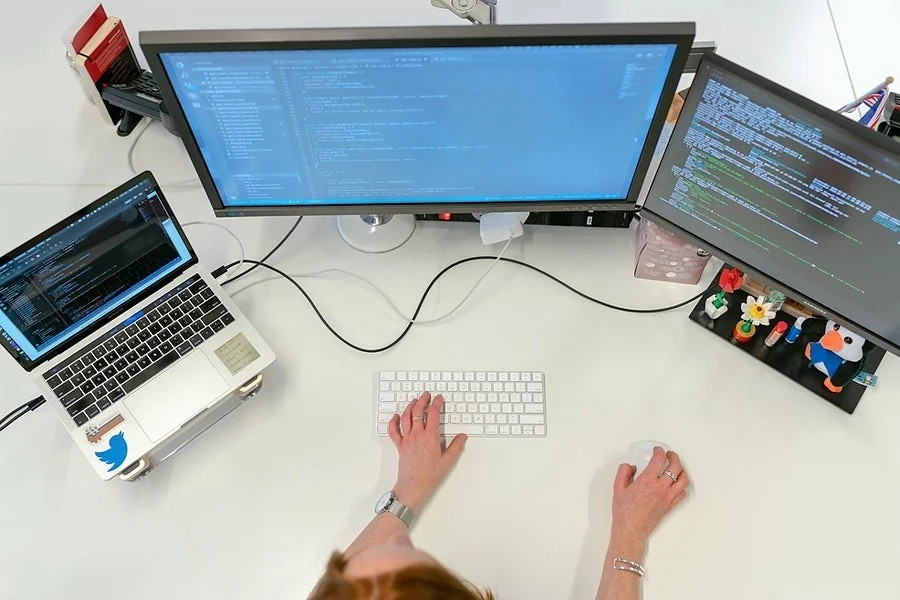

The Difference Between Web Developer and Software Developer

Difference Between Web Developer and Software Developer

Web development and software development are two different fields with a lot in common. Both require you to be proficient in coding, but they differ on what they are building.

Web developers build web-based applications, while software developers build desktop and mobile applications.

Cloud development is a subset of web development focused on developing web-based applications for the cloud. It is an emerging field with a lot of potential for growth as more people adopt cloud computing. It allows for faster deployment and easier scaling of applications, making it an excellent choice for startups or companies with limited resources.

Below, we will discuss the difference between web and software development and various stages from initial to final phases. Are you ready to get enlightened? Keep on reading.

Web and Software Development: What's the difference?

The terms web development and software development sometimes appear to be interchangeable in the minds of non-technical people.

Their perspective is that neither phrase is significant, and even if one of the terms appears to be directly related to the web, it isn't really worth getting worked up over in the first place.

For one thing, software programs run on the web, and many sites depend on web-based software to function. From this perspective, the differences aren't significant.

What is Web Development?

Web Development

Web development is the process of designing, constructing, and managing websites and applications that execute in a browser. A web developer or programmer maintains data. Web development is strongly connected to app design (web design).

The word development refers to the actual building of these items. The basic tools that developers use are CSS, HTML, and JavaScript.

However, developers use additional tools to "manage" or simplify the creation of sites that might otherwise need programming from scratch.

Web Development: Roles and Responsibilities

A web developer employs programming language for developing user-friendly interfaces in the manner of websites, just as a software developer uses programming languages to construct computer programs and online stores.

To create dynamic websites, web developers combine markup languages and programming. These pages might be as simple as text files on the internet or as complicated as e-commerce websites.

Regardless of the final result, if users view it via a web browser, there's a good chance a web developer developed it.

Stages of Web Development Processes

Market Research

This stage, which involves finding and researching, defines what the following stages will look like. At this point, the essential responsibility is to thoroughly understand your potential website's goals, the primary goals you want to achieve, and the target audience you would like to bring to your site.

Planning

The developer provides the information that enables a customer to determine how the whole site will look at this stage of the web development process.

Web Design

All visual elements, such as pictures, photos, and videos, are made. All of the information obtained in the previous stages is important once more. When creating a design, keep the customer and specific audience in mind.

Writing

This stage requires you to write out the core of what you want to convey to your website's target audience and include calls to action. Producing catchy headers, text formatting, rewriting, assembling existing text, and so on are all part of content writing.

Testing and Launch

Testing is the most prevalent part of web development projects. You might want to double-check each form and script for errors and utilize spell-checking software to maximize productivity.

Maintenance

Of course, the last stage is the same as the web development mentioned above. You should double-check that everything is working well and that everyone is happy, and you should always be ready to make improvements in the future.

What is Software Development?

Software Development

Software development is a set of functions or instructions that programmers create computer software. Knowing the software development process opens you to a world of possibilities in the IT business.

The word "software development" refers to the process of creating computer-coded software applications using a particular programming language.

Three Basic Types of Software Development
  1. System Software
  2. Programming Software
  3. Application Software

Stages of Software Development Processes -

1. Research

Before building software, a company must perform extensive market research to determine the product's feasibility. Developers must decide what features and services the program should offer for its intended users, get the most out of it, and find it essential and valuable.

2. Analysis

Comprehensive software analysis is carried out to determine the client's specifications and requirements. This stage is necessary to make tweaks and ensure that the program works correctly in the end.

3. Design

After completing the analysis, the designing stage starts, which involves constructing the project's structure. By establishing a standard and striving to conform to it, this stage helps eliminate potential flaws.

4. Development and Implementation

Professional software developers start the entire software development process. At this stage, the software's needed components and functionality are developed. This stage is critical for testing and evaluating the generated software by all parties. This is to guarantee the expected level of customer satisfaction.

5. Testing

Before releasing the software to consumers, the testing stage inspects it for defects and ensures its functionality. Expert testers check the product's features to ensure it meets the criteria stated in the requirements analysis stage document.

6. Maintenance

After passing the stages without any problems, it will go through a maintenance stage in which it will be checked and maintained regularly to keep up with changes.

Overall Thoughts

What's the difference between web and software development? How do software development companies differ from web development companies? Most people probably don't care.

For most people, software development means creating a windows-based program, while web development means creating web-based apps. Software and web development follow a set of criteria to make applications safer, more precise, and more productive.

But the distinctions are straightforward for individuals looking to enter software development or programming quickly. The world needs software and web developers.

A software developer may be the first exciting and gratifying career path with the right tools and time.

Swiss-based Streamr launches a Data Challenge for the Indian Developer Ecosystem


Streamr, the world's leading decentralised network for real-time data, today announced their plans to expand their developer ecosystem to India with the launch of the Streamr Data Challenge, an open innovation program that leverages the Indian developer ecosystem to build digital-first applications that can integrate with Streamr's Data Union framework. The open innovation program will provide winning projects with up to $5000 in funding along with seed funding opportunities through its investor network and mentoring to build a strong foundation for capital-efficient growth on a case-by-case basis depending on viability.

Through the Data Challenge, Streamr will enable app developers across India to identify solutions that offer data monetisation opportunities to its users, with the aim of decentralising data control away in an emerging global and massive machine data economy. For example, Streamr's Data Union framework could be integrated into an existing fitness app to enable users to sell their workout-routine information.

 Spanning over 4 months, the program includes incentives such as a $200 USD grant to each team that qualifies for the first cohort. The Data challenge will be interspersed by multiple meetups and webinars and will begin with a one-week long mentor session, followed by a two-week-long intensive acceleration period. The ongoing support ranges from access to tech guidance on projects, networking opportunities, PR support, and more.

India is leading the global data consumption market with the increasing mobile data connectivity (3G/4G), falling data tariffs, rising smartphone penetration, and growth in broadband connectivity across India. The exponential data growth in India is projected to continue, with internet traffic expected to increase four-fold from 21 exabytes in 2016 to an estimated 78 exabytes in 2021 as per the report by Omidyar Networks. Streamr understands the huge concern to data privacy and the need to identify feasible concepts solving problems in the big data space and thereby expand their developer base in India. 

"We are very excited to connect with the vibrant developer ecosystem in India! We think that Streamr's Data Union framework can be used as a meaningful tool to solve key problems in data collection, usage, and availability - problems that consumers and businesses face on a daily basis. The goal of the Streamr Data Challenge is to build new tools to democratize the value of our data and to find new ways for users to own and control their data. ," said Henri Pihkala, Founder and CEO of Streamr.

Streamr is a distributed, open-source, software project,  founded in 2017 with the mission of creating a decentralized platform to trade and distribute information while allowing people to regain control over the data they produce. Through its Data Union concept, individuals can crowd sell their information through the Streamr Network along with their fellow Data Union members. Designed for safe data delivery and exchange, the Streamr Network is scalable, low-latency, and secure. 

The 16-week 'Streamr Data Challenge' hackathon is launched in partnership with Lumos Labs, an innovation management firm specializing in running technology open innovation programs in India. The registrations are open from today for developers across India. For more details on the challenge and the registration process, visit - https://www.streamrdatachallenge.com/


About Streamr - 

Streamr is a distributed open-source project, crowdfunded in 2017. The project's goal is to build the decentralized infrastructure for real-time data, replacing centralized message brokers with a global peer-to-peer network. By relying on cryptography instead of trust, the open-source network aims to enable data sharing and monetization in IoT and smart cities, business consortia, individual crowd selling through Data Unions and the decentralized web (Web 3.0).

The Streamr tech stack includes a pub/sub messaging network, a data marketplace to trade and crowd sell real-time data, and a real-time data toolkit.

For more details, visit - https://streamr.network/


About Lumos Labs:

Lumos Labs is a Singapore based innovation management firm that specializes in running technology open innovation programs. Founded in 2018, the company has run several accelerators and open innovation programs for international firms.

For more details, visit - http://lumoslabs.co/

Market Reports

Market Report & Surveys
IndianWeb2.com © all rights reserved