‏إظهار الرسائل ذات التسميات Product Development. إظهار كافة الرسائل

ITLH Shines Bright as a Tech Incubator With 160% Growth; Primed to Set Up a 2-Day Product Design Bootcamp Celebrating National Technology Day

ITLH Shines Bright as a Tech Incubator With 160% Growth; Primed to Set Up a 2-Day Product Design Bootcamp Celebrating National Technology Day
  • One of the leading incubators for tech employability and UI/UX design courses, ITLH is ready to celebrate National Technology Day with a live 2-day product design bootcamp
  • The tier-2 and tier-3 cities have shown massive participation in the ITLH courses showing an increase in numbers by 16%
  • Female participation in the courses has also touched stupendous numbers
Information Technology Learning Hub (ITLH), a fast-growing incubator that helps students gain proficiency in coding skills and knowledge through real-life practical experience, has recorded an immense increase in demand for their UI/UX courses. The company has disclosed that it has seen a 160% growth in the number of students enrolled. The cherry on top of such a stupendous rise is that ITLH has also been a leader in alleviating the gender gap in the tech industry by having 57% female students in comparison to 43% male students. Creating an overarching platform for every candidate from all around the country, ITLH has also seen an increase in enrollment from students from tier 2 and tier 3 cities, who stand dominant at 58% compared to tier 1’s 42%.

Some of the prominent cities that top the ITLH course engagement list are Mumbai, Bangalore, Pune, Hyderabad, Chennai, Navi Mumbai, and Nagpur. Further, ITLH, which prides itself on creating proficient professionals for the tech industry through its experiential learning approach that adheres to industry practices and projects, is gearing up to celebrate National Technology Day. There would be a live 2-day (20th and 21st May 2023) product design bootcamp to celebrate the day and remind us all of the importance of technology and the awareness of practical education in tech-based courses. The boot camp will be online to help participants understand product design principles, techniques, and tools.

Mr. Goncalo Marques, a reputed UI/UX designer, will be the prime mentor during the bootcamp. As a mentor, he will share intricate industry knowledge with all the participants. Mr. Marques has worked in areas such as design, competitive analysis, heuristic evaluations, and user research as a UI/UX and product designer. Despite coming from a music and B2B IT sales background, he has always been passionate about design. Over the last decade, he has taken a greater interest in web and product design. In addition to developing as an artist and a UI/UX designer, he also became a consultant and a researcher through the projects he worked on.

Speaking about the development, Alex George,Chairman & Managing Director of ITLH, said, “It is a moment of elation for us at ITLH that we are growing at such marvelous speed. The enrollments don’t just show the importance of tech-employability in our modern world; rather, they also signify a very overarching engagement, with many of our students being female and many coming from smaller cities. Here’s hoping that the product design bootcamp will see massive participation.”

Founded in 2015, ITLH aims to provide students and professionals with best-in-class practical skills that enhance employability and career development. The platform offers well-curated courses in UI/UX, Machine Learning, Full Stack Web Development, UI Development, and Mean Stack Development. Promoting continuous learning across India, ITLH has also begun to gain traction in countries such as the UAE, Africa, and Canada.
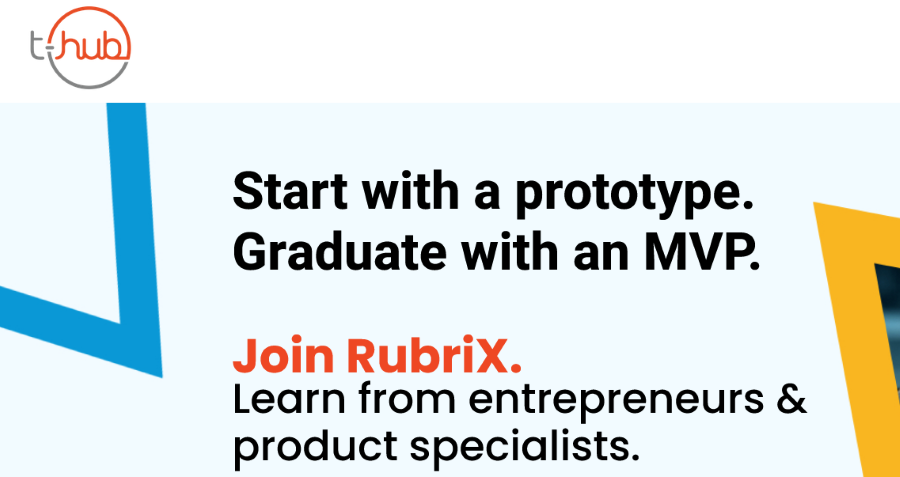
T-Hub Launches RubriX Program for Technology Startups


The program aims to support early-stage tech startups with ready prototypes and help them reach the Minimum Viable Product stage with minimal risks.

This five-month long product development program will bring in cutting-edge solutions for emerging sectors like Fintech, Sustainability, Health-tech, and Mobility among others.

T-Hub, which leads India’s pioneering innovation ecosystem, today announced the call for applications for its first-ever program on product development RubriX. Aiming to support early-stage technology startups with ready prototypes in hardware or software, this program will enable them to reach the Minimum Viable Product (MVP) stage with reduced turnaround time and costs.

This is a five-month-long program that will have 30 startups showcasing innovative solutions from sectors like Fintech, Sustainability, Health-tech, HR Tech, Mobility, IoT, Embedded Systems, Enterprise and Agritech. The application for the RubriX program will close on 12 March 2022, and the program will commence on 22 March. 

Interested and eligible startups can apply for the program here.

MSR, CEO of T-Hub said, “One of the most crucial growth steps of a startup is its transformation from prototype to Minimum Viable Product. We at T-Hub want to ensure that early-stage startups could also make use of the world-class support and capabilities of our robust innovation ecosystem which will enable them in accelerating their products to market with minimal risks. This program will allow T-Hub to help startups develop their solutions in a way that closely fits the requirements of ever-evolving markets and integrate them at an early stage for global-scale growth."

This is a one-of-a-kind program run by seasoned entrepreneurs and product specialists that helps shortlisted startups build scalable products that have higher success rates with customers. The program focuses on the product development fundamentals with a unique 5D framework that involves prototype assessment, market analysis, access to the right tools and frequent tech reviews.

Veera Chappi, Head - Partnership, People and Culture at T Works said, "T-Works is proud to be associated with the RubriX product development program hosted by T-Hub. This program structure and curriculum will enable prototype-ready startups to accelerate to their MVP with minimal risks and costs. While T-works enables ideas to transform into prototypes, we will continue to support innovative ideas heading towards MVP through this association."

T-Hub has also onboarded other ecosystem enablers like Central Institute of Tool Design (CITD), Conquering Imaginations, Expectations and Dreams (CIED), IIT Hyderabad, T-Works, and IIT-Madras Research Park as partners for this program. The partners will support the startups through the right expertise and resources like preferred access to labs to build market-ready products.

The startups will also receive exposure to design thinking, lean startup and agile principles, customized guidance from Technology Entrepreneurs in Residence (EIRs), gamified assessment of milestones and objectives along with access to betas and pilots. Any prototype ready Indian technology startup either in software, hardware, or both with a team of two full-time founders are eligible to be part of this comprehensive product development program.

T-Hub’s program has been successfully scaling startups in partnership with a strong ecosystem of partners. T-Hub till date has impacted 1800+ startups through various programs and initiatives, has 600+ global and national corporate partners, and has provided 2000 mentor connects to help the startup scale.

ABOUT T-HUB

T-Hub (Technology Hub) is an innovation hub and ecosystem enabler. Based out of Hyderabad, India, T-Hub leads India’s pioneering innovation ecosystem. With a mission of enabling and empowering an ecosystem hungry for innovation, T-Hub is creating impact for startups, corporations, and other innovation ecosystem stakeholders. Incorporated in 2015, it has provided over 1800+ national and international startups with access to better technology, talent, mentors, customers, corporates, investors, and government agencies. It has elevated innovation for leading national and global corporations, transforming their business models for the better. Working in collaboration with innovation partners and enablers in Telangana, India and worldwide, T-Hub is building a future-ready innovation ecosystem.

For more information about T-Hub, visit www.t-hub.co.  

WE-Hub Incubated Product Research Startup Startoon Labs Raises First Round Equity Funding

Secunderabad, Telangana-based product research and development startup, Startoon Labs, has raised the first round of equity funding for its operations.

Startoon Labs designs and develops industrial-grade IoT products and smart electronics systems in the embedded systems and robotics fields. The startup was incubated at WE-Hub, a women-exclusive incubator led by Telangana state government, launched this year on Women`s Day.

Founders in 2017, by husband-wife duo - Mythreyi Kondapi and Susurla V.S. Suresh, Startoon Labs is essentially a private research laboratory that is into product Development, Teaching and Engineering consultation along with world class R&D services in the field of Electronics, Embedded systems, Automation and Robotics.

Mythreyi Kondapi is an alumnus of Indian Institute of Management-Ahmedabad and Indian Institute of Technology-Madras, wihle her husband Susurla V S Suresh, is ab alumnus of Indian Institute of Management-Kolkata and Indian Institute of Technology-Madras in November 2017.


The startup will use the freshly raised funds to build Pheezee, a smart physiotherapy tool kit. The device is being designed to monitor and report patients’ rehabilitation and recovery by tracking their mobility and muscle strength.

With Pheezee, one can remotely perform the exercises and let his/her physiotherapist give suggestion over phone about the progress, making the patient's recovery process fast and easy.

Besides, the startup is also developing an open source, Arduino compatible IOT board called SLabs 32 that allows to develop prototypes in the fields of wireless data acquisition, data logging, visualization, remote monitoring/ control of machines with ease.

Startoon Labs is part of the first cohort of 26 women-led startups selected for incubation at WE Hub, a Government of Telangana initiative to promote and foster women’s entrepreneurship from all sectors including IoT, AR, VR, Edutech, Healthtech and FMCG.

“Hardware development is time consuming and capital intensive. Biomedical hardware is much more so, given the stringent compliance, clinical validation and trials required. Finding investors is always challenging,” Ms. Kondapi said, adding that they had found an investor who believed in the product and the team.

Stating that hardware is an integral part of any device or machine, Mr. Suresh said, “When we started off, a lot of software was being built indigenously but hardware was still at a nascent stage. Startoon Labs is building indigenous systems in the field of IoT and healthcare”. Assuring that WE Hub would enable market linkages for the commercial adoption of Startoon Labs’ physiotherapy device Pheezee, CEO of WE Hub Deepthi Ravula said: “The team at Startoon Labs represents inclusive workforce, progressive talent and innovative mindset that we are championing at WE Hub.”

“WE Hub has been working diligently in connecting women-led startups to financing and in catalysing their growth through strategic partnerships,” Principal Secretary Jayesh Ranjan said.


Source - The Hindu

5 Secrets Of Launching A Great Entrepreneurial Product While You Are Still Employed

It's tough in order  to launch a great product. But however by sticking to these five simple rules which are mentioned in the article below will help the reader to prepare himself for a more successful launch day .

The following are the simple rules :

1. Find a partner (just one)


Two heads are however definitely better than one while one is trying to work on an idea. If one is more of a visionary and understands  the direction as to  where one wants  the company to go, it can thus  be helpful in order to find an integrator to partner with. While the visionary is considered as great at seeing the future and also managing the direction of the company, the integrator is thus good at taking an action and also getting stuff done.

If possible, one would  also want to find someone who is thus a friend, or either at least someone one can trust. As one works  on these ideas together, one would thus want to be able to share his vision without having in order  to worry about losing one’s intellectual property along the way.

With a partner, one can thus  do what he  does best. The visionary can also thus come up with ideas, and also an integrator can help bring them in order to fruition. Also, having a partner will save thus save one a great deal of time, and this is also considered as  important if one is trying to launch a product while however holding down another job or also other responsibilities. Although one may consider adding more partners, but thus having more than two can also make it difficult in order to get to a consensus.

2. Connect and hear the truth.


One must always take some time and should talk with everyone one knows, but one should thus not just ask if they like the product idea, as many of the people may however be more inclined in order to be nice than tell one as to  what they really think. Instead, one must also thus  ask about any competitors that however make the products similar to the idea, as well as if they however know any of the challenges that thus exist in that space.

3. Be unique.


If one has however decided that his product would solve an important problem, then one must  make sure that he has a unique angle for it. If one has competitors, this wouldn't thus mean that one should stop. However, instead of copying their product or any service, one must however also make sure that the product also  brings innovation and an improvement to the table. One must ask himself as to how the solution helps them in order to  improve their profits, save costs or both, and also start the conversation there. After all, money is considered as the one thing that however matters most across all businesses.

4. Define your goals.


After one has discussed the idea with others and has also decided in order to move forward, one should thus then:

  • Firstly, write a business plan. It is not required that it should be a huge document; one page can thus be enough.

  • Secondly, one is supposed to write a mission statement. This can thus be a sentence or two about as to why the company exists. When one has challenges later on (and one surely  will!), thus one can however go back to this for inspiration.

  • Thirdly, one is required to Define the phases of the product's lifecycle.

  • Fourthly, one is required to build a minimal product in order  to launch first, then iterate on it. It will thus  be much easier in order  to build once one has a product with some of the customers who are however  giving  the feedback.

  • Fifthly, one is required to use contract or an overseas labor in order to help one to  keep the  costs down.


5. Measure data throughout.


Last but not the least, one is supposed to do a soft launch, and learn what one can from the process. One must  measure all of his activity, see what works, and then  repeat only those activities. Also, one must spend minimal money and also  find innovative ways in order  to get the message out. Some of the examples might however include advertising on Reddit, posting on ProductHunt, posting on Quora, and also using the social channels.

If the customers are interested in trying the product, it's thus decision time. Is one going to raise money or a bootstrap? If one is thus still holding a full-time job at this point, it may thus be time in order to leave or either to cut back on the hours.

However, following these five steps can thus help one in order to launch a great product while one is still holding down a day job. This will also however allow one in order to minimize the risk and also make the most of his time.

The above is a guest article contributed by Simmi Setia, content manager at LegalRaasta -- online platform for GST Software.

[Top Image - Shutterstock]

Mozilla Introduces 'The Open Innovation Toolkit' For Product Development's Best Practices

Mozilla, the company most famous among the masses for its free and open-source web browser Firefox, has always claimed to have innovation as an important part of their DNA. They not only make products that support the open web, but they make them with an approach which is totally participatory and transparent.

Unfortunately, open innovation does come with a paradox. While on one side, the diversity of open community does results in a phenomenal increase in quality solutions, but on the other side, employing practices such as human-centered design across a distributed group can end up being major hard work. But, at the end, it is highly important if one really wants to solve the problems being faced by their users, keep the high quality of experience intact, and finally keep creating innovative products that the users really, really want.

In order to cater to this problem, Mozilla has developed its very own Open Innovation Toolkit, a community-sourced set of some of the best practices, methods and principles, that is capable of helping one successfully incorporate human-centered design into their one product development process. Whether you have just conceived a new idea or have a working prototype that requires testing, the Open Innovation Toolkit will come to your rescue in both the situations and many more.

According to Mozilla, the Open Innovation Toolkit is a collection of easy-to-use, self-serve techniques that have been accumulated together from some of the best practices in the industry. Though they're not specifically new to the industry but when combined they give birth to a magnificent knowledge bank of methods that even Mozilla has found useful every now and then.

With its Open Innovation Toolkit, Mozilla aims to equip everyone in need with a common vocabulary and a set of important and proven tolls that are required to incorporate human-centered design into their product development process.

According to Mozilla, during their journey to come up with Open Innovation Toolkit, they have learned and drawn inspiration from various other similar ideas. One of them was the DIY toolkit by Nesta, which focused towards social innovation. Nesta’s DIY toolkit  has found users in many big, global organisations like Women in Global DemocracyKent city planning council etc.

It seems Mozilla has provided everyone in open source product development, right from developers to advocates, something interesting to play around with, constructively of course.

Market Reports

Market Report & Surveys
IndianWeb2.com © all rights reserved